Answer Engine Optimization (AEO) is the process of creating and structuring your website content so that AI-powered search tools like Google's AI Overviews and ChatGPT can easily find, understand, and feature it as a direct answer to a user's question. In practice, that means putting a 30 to 60 word direct answer at the very beginning of the page and structuring key sections as 40 to 60 word answer blocks followed by 2 to 3 atomic paragraphs of 1 to 3 sentences.
If you run a manufacturing business, you've probably seen a strange pattern. Your product pages still rank. Your spec sheets still exist. Your team still answers the same technical questions about tolerances, materials, lead times, CAD files, and process capability. But fewer buyers seem to arrive through the old path of keyword search, click, and form fill.
That's because engineers, sourcing teams, and plant managers aren't just searching for pages anymore. They're asking AI systems for answers. If your site isn't structured so those systems can extract and trust your content, your expertise gets ignored even when your information is better than everyone else's.
For B2B manufacturers, what is Answer Engine Optimization isn't a trendy marketing question. It's a systems question. Can your site package technical knowledge in a format that AI tools can retrieve, isolate, and present without confusion? If not, your visibility problem isn't just about rankings. It's about answer availability.
Table of Contents
- The Problem with Traditional SEO in the Age of AI
- AEO vs SEO A New Operating System for Search
- How Answer Engines Find and Rank Your Content
- The AEO Toolkit for B2B Manufacturers
- What Tolerance Can CNC Milling Hold for Aluminum Parts
- Your First AEO Project A Step-by-Step Checklist
- Measuring AEO Success and Planning Your Next Move
The Problem with Traditional SEO in the Age of AI
A manufacturer can do everything “right” by old SEO standards and still lose visibility where buyers are making decisions.
We see this with industrial companies that have solid product pages, detailed PDFs, and years of blog content. Their rankings hold steady for terms tied to machining, fabrication, controls, packaging systems, or custom components. Yet the sales team says fewer prospects arrive informed, and fewer inbound leads mention finding them through search.
The buyer journey changed before most websites did
An engineer used to search for a phrase like “stainless steel conveyor washdown compatibility” and review several pages. Now that same engineer may ask an AI tool which material and surface finish are appropriate for a food processing environment, then read the synthesized answer without ever visiting the sites it pulled from.
That shift breaks a lot of assumptions. Traditional SEO is built around persuading a search engine that your page is the best overall document. AEO is built around making sure a machine can lift the exact answer out of your page without getting lost in long introductions, vague copy, or mixed intent sections.
Your website can be technically strong and still fail answer extraction.
For manufacturers, this matters most on pages that contain buyer-critical knowledge:
- Product pages: Dimensions, tolerances, certifications, and material compatibility
- Capability pages: What processes you offer, what volumes you handle, and where your limits are
- Support resources: Installation notes, maintenance guidance, CAD access, and application fit
Stable rankings can hide a real visibility loss
If your team still measures success with page position alone, you'll miss the failure mode. AI systems may summarize the category before a click happens. If your company isn't represented in that answer, you're invisible at the moment of evaluation.
That's why a practical answer engine optimization strategy matters now. It forces you to think beyond keyword targets and ask a harder question. When a buyer asks a machine for a recommendation, definition, comparison, or fit assessment, does your content show up as the answer source?
A lot of manufacturers already have a solid foundation from SEO for manufacturing companies. That foundation still matters. It's just no longer sufficient on its own.
AEO vs SEO A New Operating System for Search
SEO and AEO work together, but they optimize different units.
SEO optimizes the document. AEO optimizes the extractable answer inside the document.
The simplest way to think about the difference
Think of SEO as building a well-organized technical library. You want strong shelves, clear categories, useful references, and enough authority that people trust the whole building.
AEO is different. It's the index card system inside that library. The AI doesn't always want the whole manual. It wants the one passage that answers “What tolerance can this process hold?” or “Is anodized aluminum suitable for outdoor electrical enclosures?”
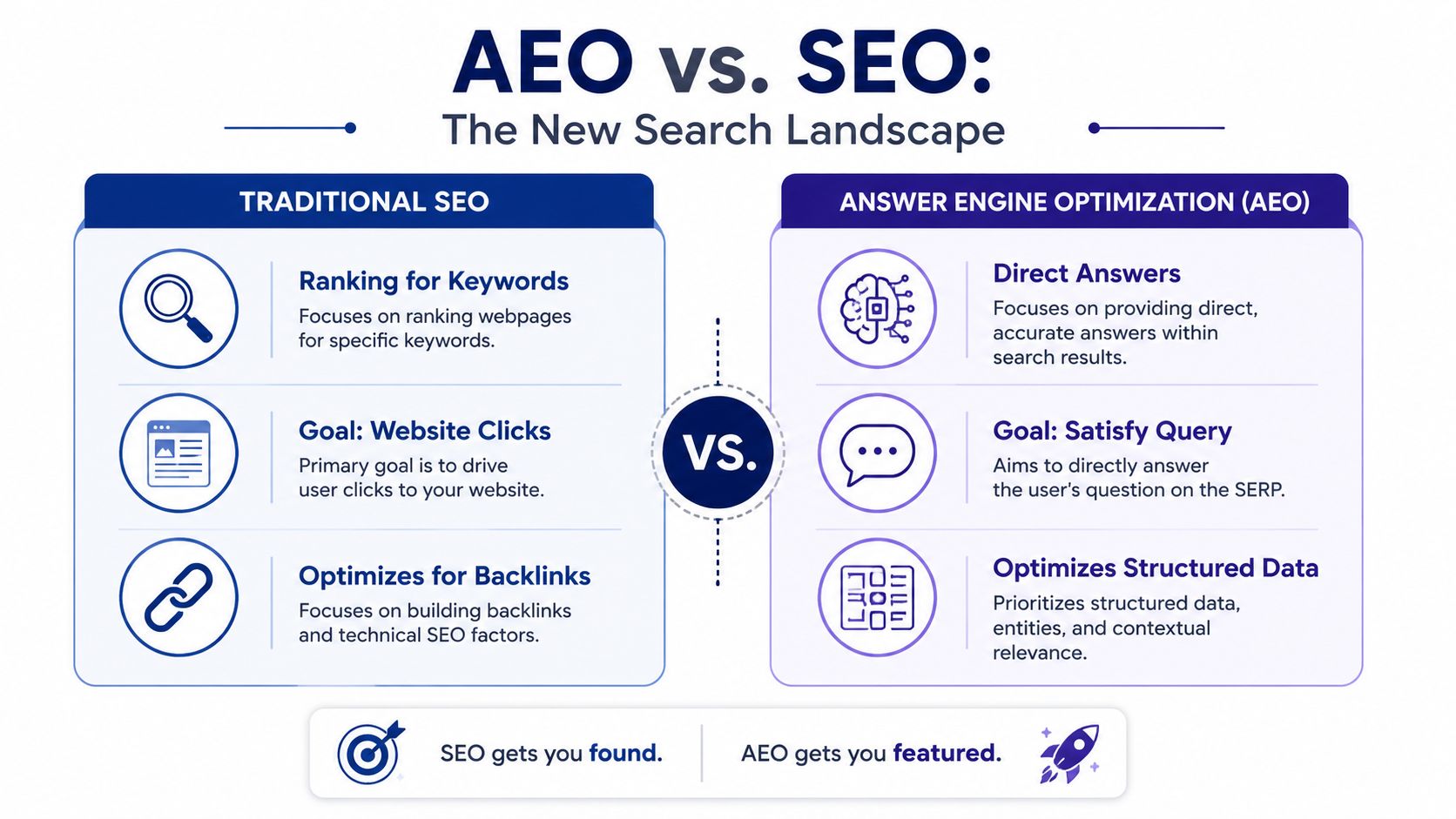
Here's the operational difference:
| Focus | Traditional SEO | AEO |
|---|---|---|
| Primary target | Whole page relevance | Passage extraction |
| Main goal | Earn rankings and clicks | Become the cited answer |
| Content design | Comprehensive topical page | Modular, answer-first sections |
| Winning format | Broad coverage | Precise response blocks |
| Buyer experience | Visit, scan, compare | Ask, receive, verify |
What changes for a manufacturer
Manufacturers usually publish dense pages because they're trying to satisfy technical buyers. That instinct is correct. The format is often wrong.
AEO rewards content that starts fast and separates ideas cleanly. One verified rule is especially important: “To maximize extraction by AI answer engines, content must include a direct, concise answer of exactly 30 to 60 words at the very beginning of the page, as this specific length is the most likely text segment to be pulled for direct responses in Google's AI Overviews and chat assistants” (Vested).
That means your page intro can't wander. If the page is about CNC turning tolerance capability, the opening needs to answer that question directly, not spend two paragraphs talking about your company history or “commitment to quality.”
AEO also changes how you write headings. Generic labels like “Overview” or “Applications” are weaker than explicit question-based headings tied to buyer language.
The video below gives a useful high-level view of the shift.
Practical rule: If a heading sounds like a section title in a brochure, rewrite it as a buyer question.
A manufacturer that adopts AEO isn't abandoning SEO. You're upgrading the operating system so your content can serve both search engines and answer engines.
How Answer Engines Find and Rank Your Content
AI search tools don't consume your site the way a human buyer does. They break it into parts, interpret the user's question, and look for passages that map cleanly to that intent.
AI reads passages, not just pages
That matters because most industrial websites are written in blocks that make sense to internal teams, not to retrieval systems. A product page might bury the best answer halfway down the page, surrounded by sales copy, broad claims, and mixed-use paragraphs.
AI systems prefer content with clear boundaries. They can identify one segment as a definition, another as a specification note, and another as a comparison. That's why formatting isn't cosmetic. It directly affects retrieval.
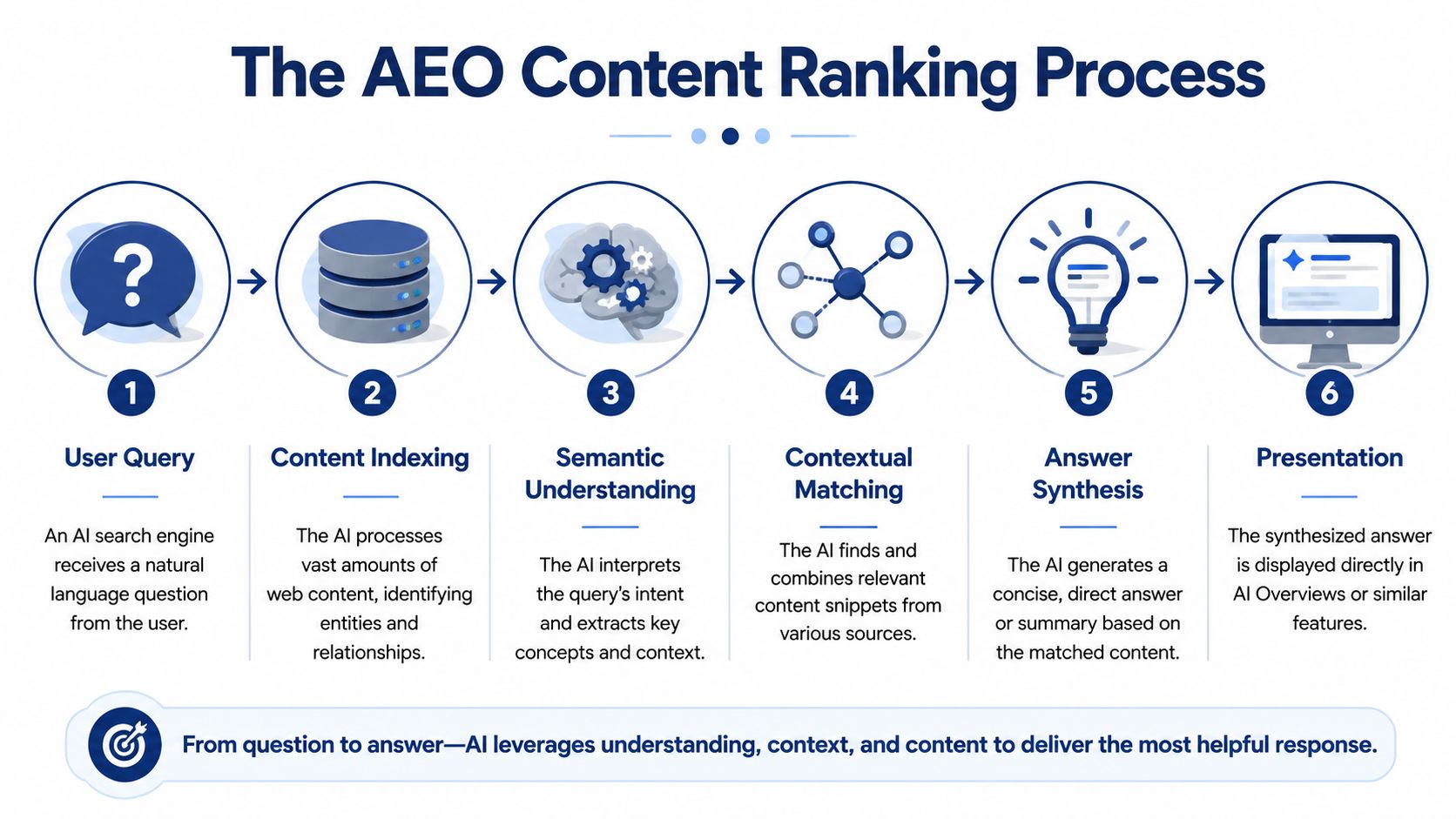
A plain-English model looks like this:
- A buyer asks a natural-language question. Usually more specific than a keyword.
- The engine interprets the intent. It tries to understand the underlying task behind the words.
- It searches for relevant passages. Not just pages.
- It compares those passages for clarity and fit.
- It synthesizes an answer.
- It may cite the source it found most usable.
If your content is hard to separate into coherent chunks, you lose before authority even enters the discussion.
For teams refining semantic structure, this practical guide to latent semantic indexing SEO is a useful companion because it helps you think in related concepts and entities instead of isolated phrases.
Why short answers and deep authority both matter
A lot of advice on AEO creates a false choice. It tells you to write short, scannable answers, then separately tells you to build deep authority. Both are true. Neither works well alone.
The missing piece is hybrid structure. Verified data shows that 82% of AI citations come from content with semantic boundaries and clustered depth, not isolated high-scannability pages (Frase).
So don't publish one thin FAQ page and expect it to outperform a real content system.
Instead, build clusters around the questions your buyers ask:
- Core process question: What machining process fits this material and tolerance?
- Application question: Where does this component fail in high-heat or corrosive environments?
- Selection question: Which enclosure rating fits this installation condition?
- Documentation question: What file format, drawing, or approval package is available?
Short answers win extraction. Deep clusters win trust.
That's the fundamental mechanism behind answer visibility. You need clean passage design inside a broader body of expertise.
The AEO Toolkit for B2B Manufacturers
Manufacturers don't need more vague content advice. You need a formatting SOP your team can apply to product pages, service pages, technical articles, and resource libraries.

The required content structure
This is the core rule set. AEO specifically requires a technical content structure where the core answer is placed immediately after a question-based H2 tag, limited to a 40 to 60 word block, followed by 2 to 3 atomic paragraphs of 1 to 3 sentences that provide context, a format designed for AI crawlers (Surmado).
That isn't a style preference. It's a retrieval design pattern.
A usable section looks like this:
What Tolerance Can CNC Milling Hold for Aluminum Parts
CNC milling can hold tight tolerances for aluminum parts when machine condition, tool selection, fixturing, and part geometry are controlled. For quoting and design review, buyers should evaluate tolerance by feature type, material grade, and production volume rather than assuming one blanket standard.
Then add short context paragraphs:
- One paragraph on variables that change tolerance outcome
- One paragraph on where standard production differs from critical features
- One paragraph on how buyers should submit drawings or GD&T notes
How to format industrial content so AI can use it
Most manufacturers already own the information. The issue is packaging.
Use these building blocks consistently:
- Question-based headings: Write headings the way buyers ask. “Is 316 stainless better than 304 for washdown equipment?” beats “Material Comparison.”
- Atomic paragraphs: Keep each paragraph to one idea. If you combine specs, applications, and caveats in one block, the answer engine has to guess.
- Short lists: Use bullets for steps, supported file types, compatibility notes, or approval requirements.
- Comparison tables: Put materials, ratings, options, or process differences into a compact table instead of prose.
- Explicit nouns: Say “STEP file,” “NEMA enclosure,” “powder coating,” “food-grade polymer,” and “ISO certification” where relevant. Specificity helps machines and buyers.
Here's a simple example for a component manufacturer:
| Buyer question | Bad format | Better AEO format |
|---|---|---|
| Can this part handle chemical washdown? | Long paragraph mixing sales copy and materials | 40 to 60 word answer, then a short table of compatible materials and limits |
| Do you provide CAD files? | Buried line in a resources section | Direct answer under a question heading with file formats listed |
| What industries is this machine built for? | Generic vertical list | Short answer plus atomic paragraphs by application environment |
If your engineers write great answers in email, those answers should be turned into structured website modules.
Manufacturers that want a broader implementation model can borrow from this guide on how to optimize for AI search, then tailor it around industrial buying questions.
A simple SOP your team can follow
Give your marketing and technical teams one repeatable standard:
- Pick a real buyer question. Pull it from sales calls, quoting emails, support tickets, or distributor conversations.
- Write the direct answer first. Keep it inside the approved answer block length.
- Add supporting context. Use short paragraphs, each focused on one variable.
- Attach proof assets. Tables, diagrams, CAD access notes, certifications, process constraints.
- Place the section on the right page. Don't force every answer into a blog post. Many belong on product or capability pages.
AEO finds its utility in B2B manufacturing. You stop producing content for campaigns and start building reusable answer components.
Your First AEO Project A Step-by-Step Checklist
Most companies start by rewriting content. That's the wrong first move.
Start with the audit, not the rewrite
Enterprise AEO begins with a Pre-Optimization Audit, as data shows 73% of brands are misrepresented or absent in AI Overviews for buyer queries before any optimization work begins, making this audit essential for building a baseline ROI (Siteimprove).
If you skip the audit, you won't know three critical things:
- Absence: Are you not appearing at all?
- Replacement: Which competitors or publishers are being cited instead?
- Misrepresentation: Is the AI describing your capabilities inaccurately?
Run the audit manually before you buy software or brief a writer.
Use a spreadsheet and test prompt set across platforms like ChatGPT, Perplexity, and Gemini. Ask the exact questions your buyers ask, especially the high-intent ones tied to quoting, qualification, and vendor selection.
Sample prompt categories for a manufacturer:
- Capability prompts: “Who manufactures custom stainless steel control panels for washdown environments?”
- Selection prompts: “What enclosure material is best for corrosive industrial environments?”
- Comparison prompts: “Laser cutting vs waterjet for thick plate tolerances”
- Supplier prompts: “Best CNC machining companies for tight-tolerance aluminum parts”
Log what appears, who gets cited, what language is used, and whether your company is present.
The audit gives you a baseline. Without it, you can't tell whether optimization changed anything.
Build your first optimization sprint
Once the audit is complete, keep the first project narrow. Don't try to rework the entire site.
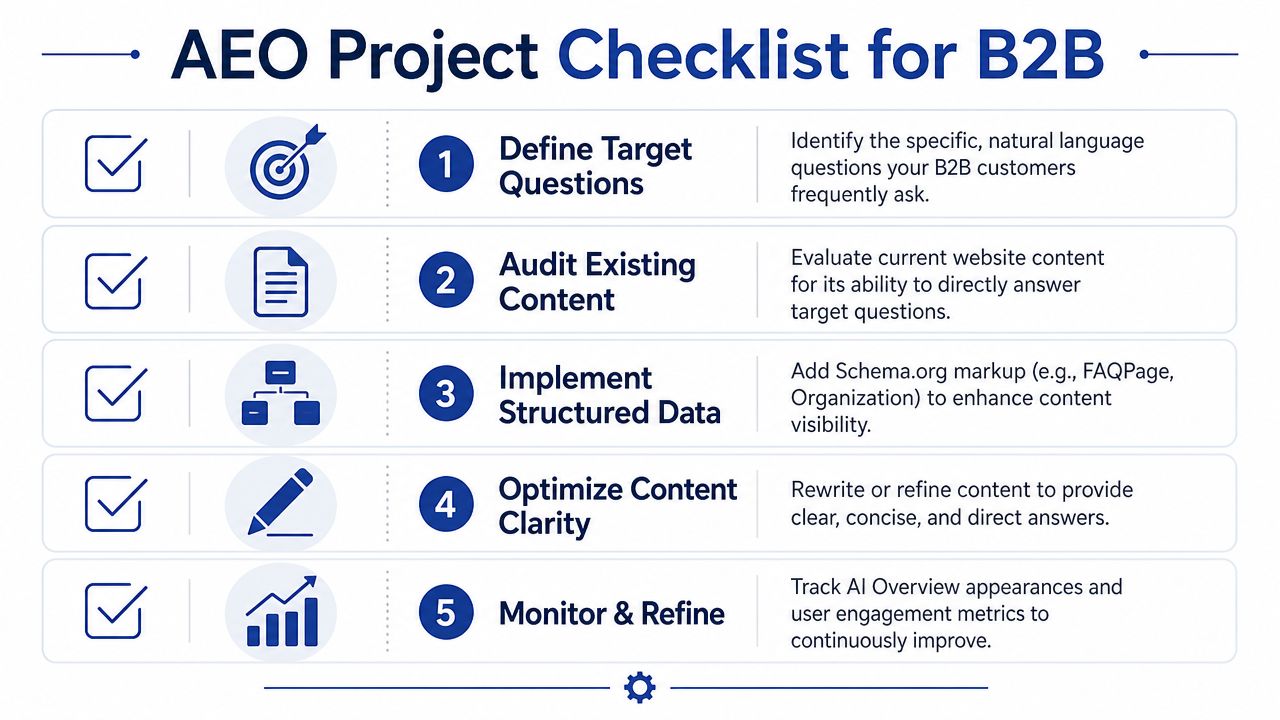
A practical first sprint looks like this:
- Choose three to five high-value pages. Pick product, capability, or application pages tied to revenue.
- Map one primary question per page. Don't overload a page with too many unrelated answer targets.
- Rewrite the opening. Add the direct answer at the top where appropriate.
- Insert question-based H2 sections. Each should target a distinct buyer concern.
- Refactor dense text into atomic paragraphs. One idea per block.
- Add short lists and tables. Especially for specs, file formats, process options, materials, and decision criteria.
- Implement relevant schema markup. Use standard structured data types that fit the page.
- Retest the same prompts. Watch for appearance, citation, and wording changes over time.
Questions to ask yourself before you publish:
- Does the page answer the question immediately, or does it delay the answer?
- Can a buyer skim the page and isolate the answer without effort?
- Would an AI system know which paragraph is the answer and which paragraph is supporting context?
- Does the page include the technical nouns buyers use?
- Have we separated process, material, application, and limitation details clearly?
This is a manageable project for a small team. It's closer to system tuning than content marketing theater.
Measuring AEO Success and Planning Your Next Move
AEO success isn't just “did traffic go up.” That's too blunt.
Use new visibility metrics
Track whether your brand becomes present in the answer layer. The useful measures are:
- AI answer presence: Do you appear in answers for your target prompts?
- Brand citation share: How often are you referenced compared with competitors?
- Message accuracy: Does the answer describe your capabilities correctly?
- Referral quality: When visitors do arrive from AI-driven discovery, do they reach the right pages and take meaningful actions?
This is where disciplined analytics still matters. If you need a practical refresher on event setup and attribution hygiene, Otter A/B's tracking best practices are a solid reference for keeping measurement clean.
Build AEO into your publishing system
AEO works best when it becomes part of your content SOP, not a one-time cleanup project.
One verified formatting rule should stay in your workflow: answer engines prefer atomic paragraph structures consisting of 1 to 3 sentences, combined with short bulleted lists and tables, because this format aligns with how LLMs parse and extract information for synthesized answers (ProFound).
That means every new page should be reviewed for:
- Answer-first intros
- Question-led subheads
- Atomic paragraph length
- Useful tables and lists
- Clear technical language
- Alignment with buyer intent
A manufacturer that does this consistently builds something more valuable than a blog. You build a retrieval-ready knowledge base that supports search, sales, and technical evaluation at the same time.
If you want help diagnosing whether your site is visible in AI search and where your industrial content is breaking down, contact Machine Marketing. We help manufacturers turn scattered marketing assets into a working system with clear priorities, practical SOPs, and measurable next steps.