If you're a manufacturer or machine shop owner, this probably sounds familiar. Your website form fills are coming in, trade show contacts are sitting in a spreadsheet, your sales team is chasing quotes, and the CRM says you have “leads.” But when you look at what becomes real buying conversations, the funnel feels loose, inconsistent, and expensive.
That's where AI lead qualification becomes useful. Not as hype, and not as a replacement for your sales team. It works best as a system for sorting signal from noise, especially when your business has a mix of website inquiries, RFQs, phone calls, distributor referrals, and trade show follow-up that don't fit a clean SaaS-style funnel.
Table of Contents
- Why Your Sales Funnel Is Leaking High-Value Leads
- What Is AI Lead Qualification
- Inside the AI Engine Models and Data Requirements
- An Automated Workflow in GoHighLevel
- Use Cases for Manufacturers and Machine Shops
- How to Measure the ROI of Your AI System
- Implementation Checklist and Common Pitfalls
Why Your Sales Funnel Is Leaking High-Value Leads
Manufacturers rarely have a lead problem in the purest sense. They have a qualification system problem.
A typical industrial funnel collects names from quote forms, contact requests, trade shows, inbound calls, distributors, and older email lists. Then people try to sort all of that with manual notes, rep judgment, and a few basic CRM fields. That setup works until volume rises, follow-up lags, or buyer behavior stops matching the old rules.
Where the leaks usually happen
The first leak is sales time wasted on poor-fit inquiries. A rep spends part of the day answering requests from companies that are too small, outside your capabilities, outside your geography, or just shopping for commodity pricing.
The second leak is good leads getting buried next to weak ones. If your CRM treats a student download, a serious RFQ, and a trade show buyer card as nearly the same thing, your team is sorting with a blunt instrument.
The third leak is manual inconsistency. One rep treats a plant engineer as high potential. Another ignores the same title because the company didn't fill out every field. The process depends too much on who looked at the lead first.
Practical rule: If two people on your team would score the same inquiry differently, your qualification system is not a system yet.
That's why AI lead qualification matters. It gives you a repeatable way to inspect leads the same way a quality system inspects parts. You define what matters, feed the model the right history, and let the system surface which opportunities resemble your best customers.
Questions to ask in your own process
Run this quick diagnosis against your current funnel:
- Are reps doing research that software should do? If your salespeople are manually checking company size, fit, or past engagement before every first call, they're acting like human middleware.
- Does your CRM separate fit from activity? A lead can be active but wrong for your business. It can also be quiet but strategically important.
- Are offline leads entering the same system as web leads? If trade show scans and phone inquiries live outside your CRM, your scoring logic is blind from the start.
- Do you know why a lead became “qualified”? If the answer is “a rep felt it was promising,” that won't scale.
A good manufacturing funnel doesn't just generate interest. It routes the right inquiry to the right next action. That might be a sales call, a quote review, a nurture sequence, or a polite disqualification.
What Is AI Lead Qualification
AI lead qualification is a system that screens, scores, and prioritizes leads based on fit and buying signals. The goal is simple. Your team should spend more time talking to the right prospects and less time sorting through noise.
Think CNC instead of hand tools
The easiest way to understand it is to compare manual scoring to a hand tool, and AI scoring to a CNC process. A person using a simple checklist can still do useful work. But the process depends on judgment, speed, and consistency. A more advanced system uses more inputs, applies the same logic every time, and produces a more reliable output.
That's the shift. Instead of static rules like “give five points for this title” or “mark any form fill as hot,” AI lead qualification learns from the patterns in your closed business.
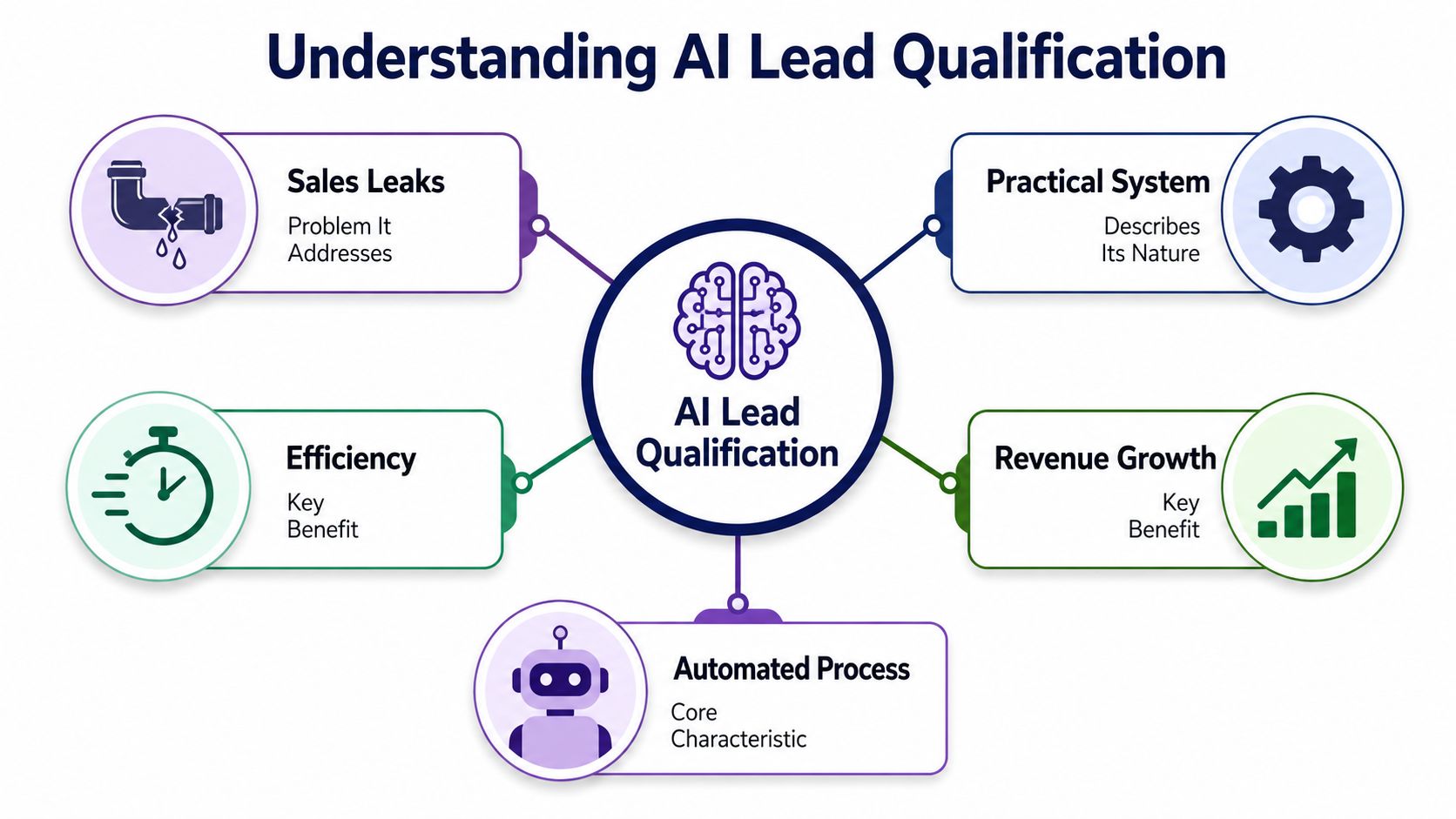
Companies using marketing automation tools with AI components to nurture prospects see up to a 451% increase in qualified leads compared to non-automated approaches, according to Martal's lead generation statistics roundup.
If your current process still depends on manual lead checks, it helps to compare it against a more traditional framework first. This overview of how to qualify sales leads gives you a good baseline before you automate it.
What it actually does in daily operations
In practice, AI lead qualification usually handles a few jobs at once:
| Function | What the system evaluates | Why it matters |
|---|---|---|
| Fit scoring | Industry, company profile, job role, location, capability match | Keeps reps away from poor-fit accounts |
| Behavior scoring | Form fills, page views, content engagement, email activity | Shows current interest level |
| Prioritization | Which lead should be contacted first | Improves response quality |
| Routing | Which rep or workflow should receive the lead | Reduces delay and confusion |
This doesn't mean AI should replace human review. It means AI should handle the repetitive first pass with far more consistency than a busy team can manage manually.
Treat the model like an automated inspection station. It flags likely good parts, likely rejects, and borderline cases that still need a human decision.
That's the right mental model for manufacturers. AI lead qualification is not magic. It is a classification engine inside your sales process.
Inside the AI Engine Models and Data Requirements
Most owners don't need a machine learning lecture. They do need to know what raw material the system needs and what happens when that material is poor.
The raw material the model needs
A useful AI qualification model learns from your historical sales outcomes. According to Relevance AI's lead qualification overview, AI lead qualification systems train on 2–3 years of historical won/lost deal records, analyzing over 10,000 data points per lead such as job title and download activity to build a predictive model that outperforms static frameworks like BANT.
That historical record is the equivalent of training data on your shop floor. If you want a machine to detect a good part, you first have to show it enough examples of good parts and bad parts.
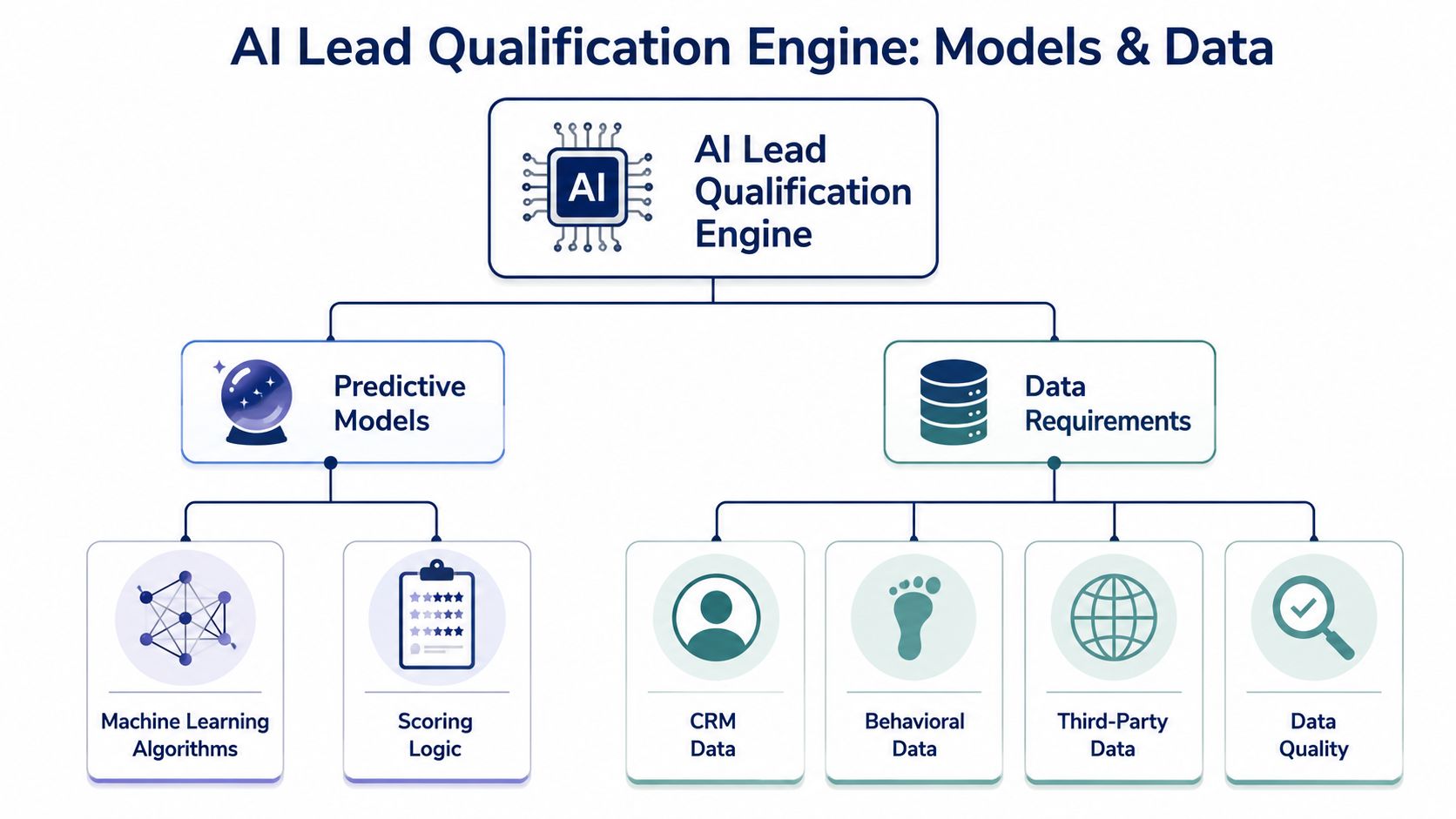
For manufacturers, that usually means the model needs a blend of:
- Firmographic data like industry, company size, market served, and location
- Contact data like job title, role, or buying influence
- Behavioral data like form submissions, quote requests, email engagement, and page visits
- Outcome data showing what became closed-won, closed-lost, stalled, or disqualified
What good scoring logic looks like
Good AI scoring doesn't just ask, “Did this person fill out a form?” It asks a better set of questions.
Did they come from an account type that looks like your best customers? Did their actions resemble buyers who eventually purchased? Did they request the kind of information that usually appears later in serious buying cycles?
A practical model often blends two dimensions:
ICP fit
- Does this company match the type of business you want more of?
- Does the contact appear to influence specification, purchasing, or operations?
Active intent
- Are they asking for a quote, a capability review, or a meeting?
- Are they interacting in ways that historically correlate with won deals?
The black box gets much less mysterious when you remember this. The model is pattern matching against your own history.
Bad data breaks that logic quickly. If your won and lost records are incomplete, titles are inconsistent, and old notes live in spreadsheets or an ERP export, the model will learn the wrong lessons. That's not an AI problem. It's an input problem.
An Automated Workflow in GoHighLevel
Theory matters less than workflow. If you're using GoHighLevel, or considering it as a front-end operating system for marketing and sales automation, AI lead qualification should sit directly inside the intake path.
This visual shows the basic flow before we break it down.
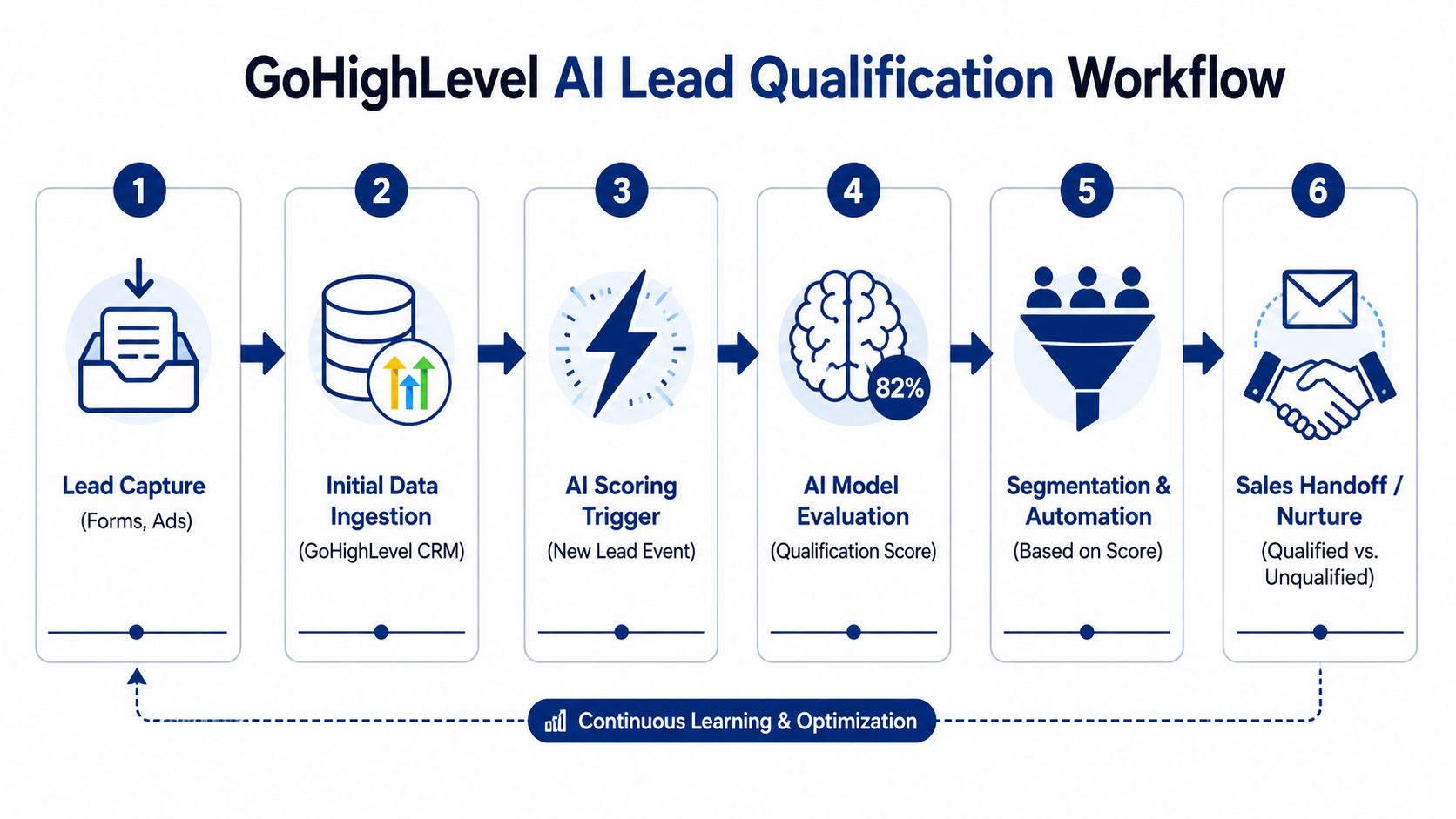
A practical lead flow from form to handoff
A solid workflow in GoHighLevel usually follows this sequence:
Lead capture
A visitor submits a Request a Quote form, a Contact Us form, or a trade show follow-up form. You can also create manual intake pipelines for phone calls and rep-entered leads.
Data ingestion
GoHighLevel stores the contact, source, form responses, tags, and campaign context. Many companies conclude their process at this point. They capture data but don't classify it well.
AI trigger
A workflow fires when a new lead enters a pipeline or receives a tag. That trigger sends the lead data to your scoring logic.
Scoring
The model reviews fit and intent. It checks fields like industry, project type, urgency, part complexity, market segment, and engagement history.
Production-grade AI intake assistants use a five-step workflow of screen, capture, score, route, and hand off, reducing average lead response time from 42 hours to under 5 seconds while handling up to 80-90% of initial lead intakes, according to Digital Applied's implementation guide.
If you're evaluating platforms for this kind of setup, this guide to GoHighLevel for manufacturers helps translate the generic CRM pitch into a manufacturing workflow.
A walkthrough video helps if you want to see how this style of automation feels in practice.
Sample prompt logic and routing rules
Here's the kind of prompt logic that works better than generic lead scoring:
- Classify intent
- “Review this inquiry and determine whether the lead is requesting a quote, general information, vendor qualification, support, or partnership.”
- Score fit
- “Evaluate whether the company appears to match our ideal customer profile based on industry, company type, location, and project relevance.”
- Flag urgency
- “Identify time-sensitive language, active sourcing behavior, or signs that the prospect is in a live buying process.”
- Route next action
- “If the lead shows strong fit and purchase intent, assign sales follow-up. If fit is moderate but timing is early, assign nurture. If poor fit, mark for review or disqualification.”
That structure works because it mirrors how a strong sales coordinator thinks, but applies it consistently at scale.
Use Cases for Manufacturers and Machine Shops
Industrial businesses need a different playbook than software companies. Many serious buyers don't leave a perfect digital trail, and some of your best opportunities start in ways a generic AI model barely sees.
A major challenge is the Intent Signal Visibility Gap. In sectors like machining, 40–60% of purchasing decisions originate from offline channels such as trade shows and phone inquiries, which web-centric AI models can't see on their own, according to Zingly's glossary entry on AI in lead qualification.
Machine shop RFQ filtering
Take a high-mix machine shop. It receives website RFQs, forwarded drawings, repeat customer quote requests, and calls from buyers who just need “a fast price.” Not every RFQ is worth the same level of attention.
The machine shop's AI qualification system should not only ask whether the lead is active. It should ask whether the work is a fit for the shop's operating model.
That means routing based on signals like:
- Capability fit based on materials, tolerances, batch style, or process match
- Commercial fit based on whether the request appears margin-friendly or likely to become a commodity price chase
- Buyer type such as engineer, purchaser, operations lead, or sourcing agent
- Source context including whether the inquiry came from a referral, repeat account, website form, or trade show badge scan
A machine shop doesn't need more quotes. It needs more quotes that fit the machines, the margins, and the schedule.
Offline inputs matter here. If a sales rep met an engineer at a regional show and logged that note manually, that signal should enter the same scoring system as the website RFQ. Otherwise the AI will overvalue the web form and undervalue the buying conversation.
Equipment manufacturer lead triage
A larger equipment manufacturer has a different problem. The company may generate steady traffic, brochure downloads, specification requests, and distributor inquiries, but only a fraction represent enterprise-level buyers.
In that case, AI lead qualification can help separate:
| Lead type | Likely next step |
|---|---|
| Engineer researching options | Technical nurture and spec content |
| Plant manager with a live project | Rep follow-up |
| Distributor or channel inquiry | Partner routing |
| Student, vendor, or irrelevant contact | Disqualify or archive |
The key is feeding the model non-web context. Trade show scans, call summaries, rep notes, and event attendance should become structured inputs, not side conversations buried in email.
That's the difference between a generic B2B setup and one that works for manufacturing.
How to Measure the ROI of Your AI System
A qualification system only earns its place if it changes outcomes you care about. Lead volume alone won't tell you that.
Metrics that matter more than raw lead count
The first thing to watch is qualification accuracy. Organizations implementing AI-driven lead scoring achieve a 40% improvement in accuracy over manual methods, according to Landbase's lead qualification statistics. That matters because qualification accuracy changes who reaches sales in the first place, and the traditional average MQL-to-SQL conversion rate is 13% in the same source.
You don't need a complex dashboard to start. You need a short list of business metrics tied to your funnel.
Track these first:
Sales accepted rate
How many AI-qualified leads does sales agree are worth working?MQL to SQL progression
If more of your scored leads become true sales conversations, the model is doing useful work.Speed to first response
Faster routing is only valuable if qualified leads get contacted quickly.Lead source quality by qualification outcome
Which channels produce leads the system consistently marks as strong fit?Close rate of AI-prioritized leads
This tells you whether the scoring aligns with revenue, not just activity.
A simple ROI review rhythm
Review performance in a monthly operating rhythm. Don't just ask whether the model is active. Ask whether it's helping your team spend time better.
A practical review table looks like this:
| KPI | Before AI | After AI | What to check |
|---|---|---|---|
| Sales response speed | Baseline from current process | Current measured response | Are top leads moving faster? |
| SQL quality | Current accepted lead quality | Current accepted lead quality | Are reps rejecting fewer leads? |
| Pipeline progression | Current stage conversion | Current stage conversion | Are good leads moving further? |
| Sales time use | Manual sorting burden | Reduced manual burden | Are reps spending more time selling? |
Use your own baseline. AI ROI is a delta story. If lead handling becomes cleaner, sales time gets reallocated, and conversion quality improves, that's operational value.
For a broader framework on attribution and reporting, this guide on how to measure marketing ROI is a useful companion.
Don't judge the system by how many leads it touches. Judge it by whether your team talks to better opportunities sooner.
Implementation Checklist and Common Pitfalls
The biggest mistake manufacturers make is starting with automation before they've cleaned the underlying process. That usually creates faster confusion, not better qualification.
The checklist
The most important step is data readiness. The Data Pollution trap is real for industrial companies. AI models trained on fragmented or unclean CRM data can actively degrade lead quality, and success often requires a 3–6 month data consolidation phase before the AI can be effective, according to Monday.com's article on AI-driven lead qualification.
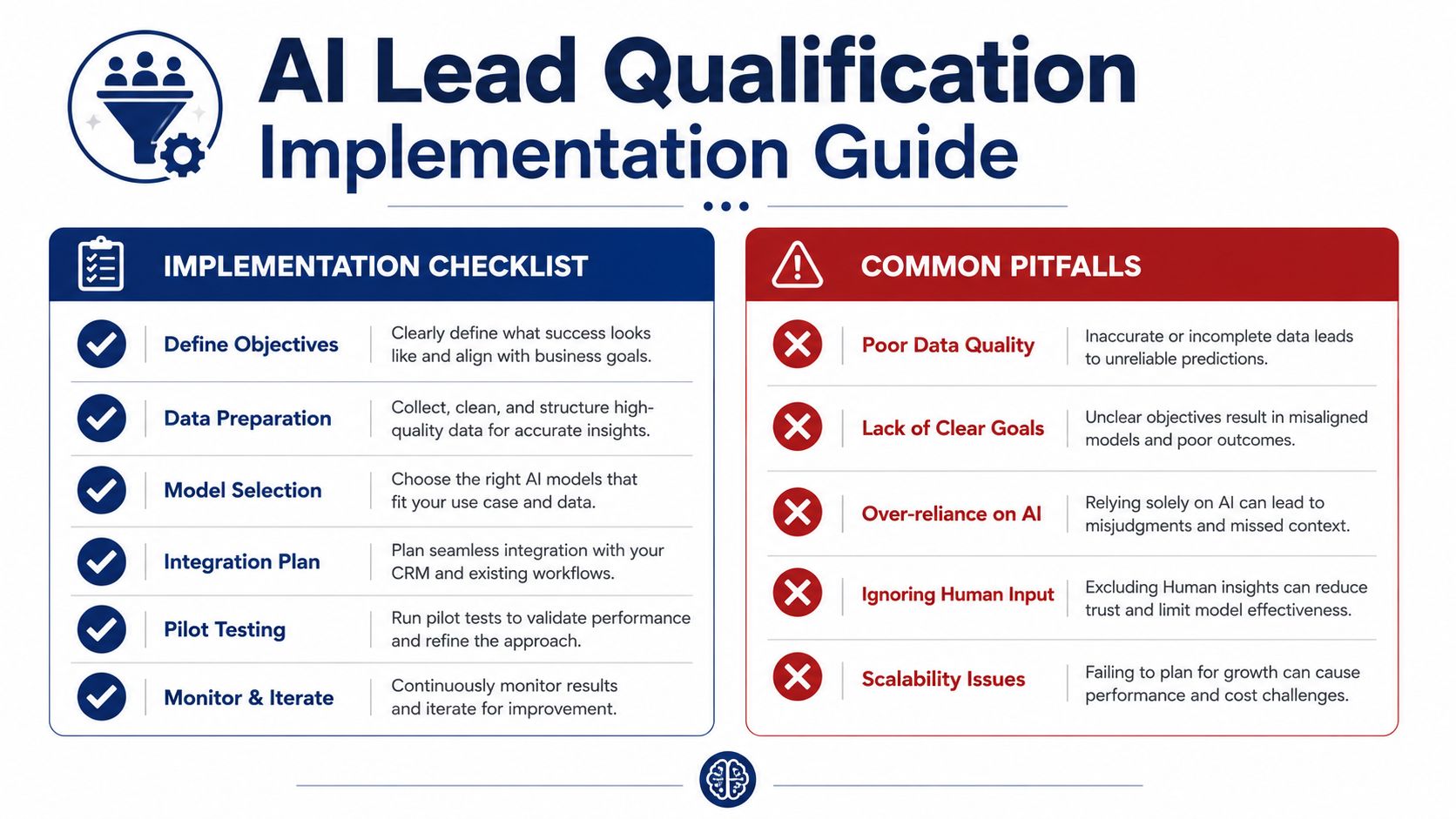
A strong rollout usually follows this order:
Audit your lead sources
List every source that creates an inquiry. Website forms, phone calls, rep notes, trade shows, referrals, and inbox submissions all count.Clean your CRM history
Standardize company names, outcomes, lifecycle stages, and reasons for won or lost deals. If you skip this, the model learns from mess.Define your ICP clearly
Write down what a good-fit customer looks like. Include industry, company type, buying role, geography, and commercial fit.Map offline signals into the system
Create fields and SOPs for trade show scans, phone inquiries, and rep-entered conversations so they can influence scoring.Start with a pilot workflow
Choose one funnel first. RFQs, demo requests, or contact forms are all reasonable starting points.Review decisions weekly
Compare AI scoring decisions against actual outcomes and rep feedback. Tune prompts, routing rules, and thresholds as you learn.
The mistakes that cause bad outcomes
Some failures are technical. Most are operational.
Common pitfalls include:
Over-trusting the model early
Early outputs are directional, not perfect. Keep human review on borderline leads.Using vague stage definitions
If your team can't agree on what counts as qualified, the AI won't fix that ambiguity.Ignoring offline buyer behavior
Manufacturing buyers often move through phone calls, events, and rep relationships. If those inputs stay outside the model, your scoring will skew digital.Automating handoff without accountability
Routing a lead is not the same as working a lead. The sales side still needs ownership and follow-up discipline.
Clean data first. Then automation. In manufacturing, that order is not optional.
When implementation works, the transformation is practical. Your CRM becomes easier to trust, your reps spend less time sorting, and your best opportunities stop getting lost in the pile.
If you want help diagnosing whether AI lead qualification fits your manufacturing sales process, Machine Marketing can help you map the system before you buy more software. We work with manufacturers, machine shops, and industrial teams that already have tools in place but need a clearer strategy, cleaner workflow, and a qualification process that matches how real buyers engage.