You can do everything right on product quality, then lose trust with one bad ad. That's the problem with adverts that are banned. They usually fail because someone pushed a claim too far, skipped proof, or assumed the platform would treat B2B content more leniently than consumer creative.
For industrial marketers, that's a dangerous assumption. Regulators and ad platforms now police health claims, environmental claims, pricing, certifications, origin statements, and even audience targeting with far more rigor than many expect. Google's 2024 enforcement report shows the scale clearly, with 39.2 million advertiser accounts suspended, 5.1 billion ads removed, 9.1 billion ads restricted, and broader action on over 220,000 publisher sites (Google ad safety reporting summarized here). That's not a niche compliance issue, it's a system issue.
If you market for a manufacturer, machine shop, or industrial services firm, the question isn't whether banned ads happen. The question is whether your team has a process that keeps you out of the trigger zones. These are the eight mistakes we see most often, and the ones worth diagnosing first.
Table of Contents
- 1. False Health Claims in Industrial Equipment Marketing
- 2. Unsubstantiated Environmental Claims
- 3. Testimonials and Endorsements Without Proper Disclosure or Verification
- 4. Comparative Advertising with Unsubstantiated or Misleading Claims
- 5. Pricing Deception and False Savings Claims
- 6. Unqualified Product Safety or Performance Certifications
- 7. Misleading “Made In” or Country of Origin Claims
- 8. Implied or Unsubstantiated Professional Credentials and Expertise Claims
- Comparison of 8 Banned Ad Types
- Build Your System for Compliant, High-Trust Marketing
1. False Health Claims in Industrial Equipment Marketing
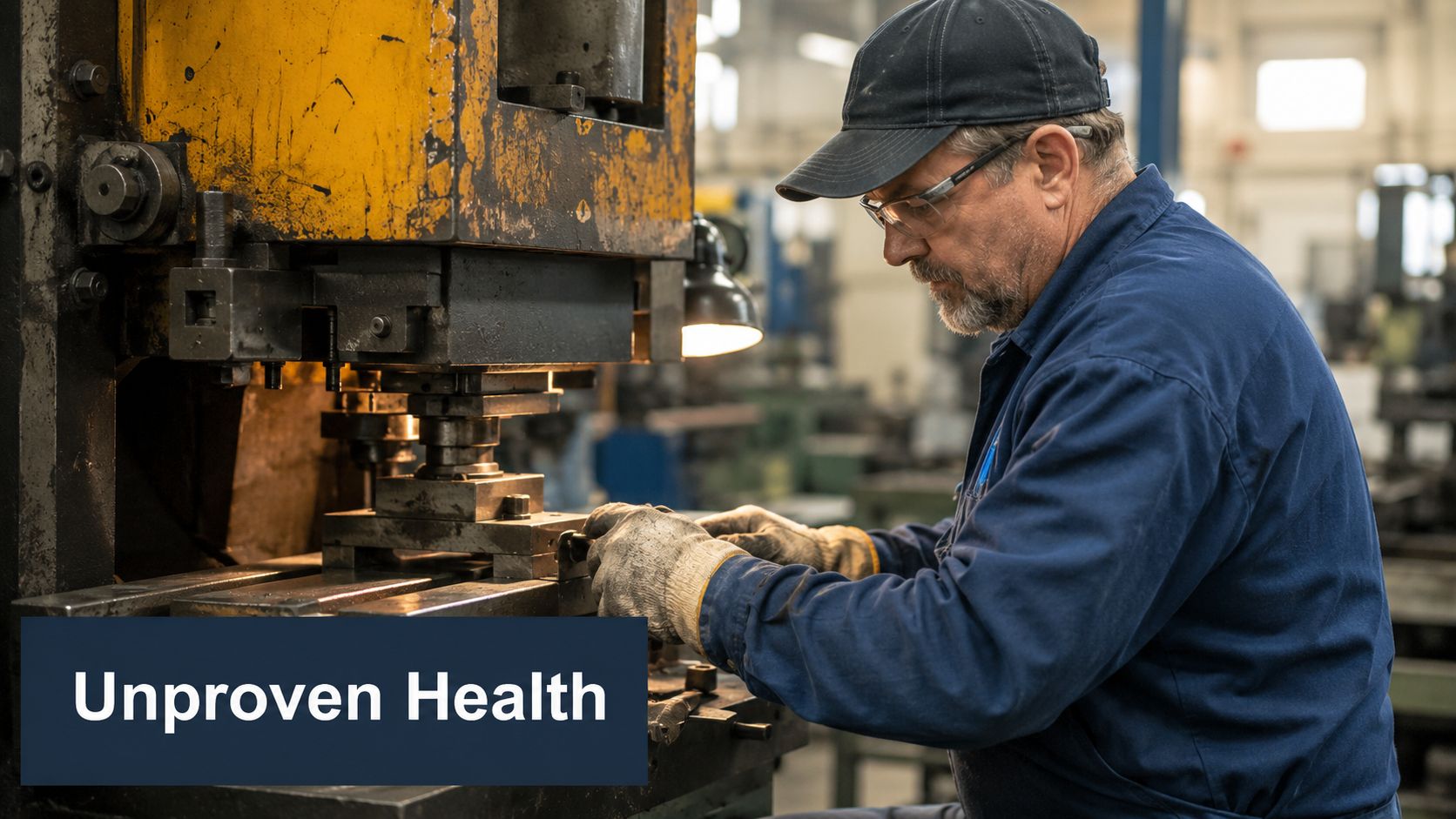
A machine doesn't need to promise medical outcomes to sell. If your ad starts implying that a tool reduces injuries, improves respiratory health, or cuts worker fatigue without evidence, you've moved from product marketing into a claim regulators can challenge.
That's where a lot of industrial teams drift into trouble. A safer machine is not the same as a clinically proven health intervention. If you advertise a conveyor as reducing back pain, or a lubricant as preventing respiratory issues, you need third-party testing or peer-reviewed evidence that supports the exact outcome. Otherwise, you're telling buyers to infer a benefit your product hasn't earned.
What to look for in your copy
The highest-risk phrases are the ones that sound helpful but make a performance promise about human health. They often appear in brochures, landing pages, and sales decks before legal ever sees them.
Practical rule: Separate product function from human outcome. If your machine improves cycle time, say that. If it reduces worker strain, prove it first.
Use measurable engineering metrics instead of health language. Cycle time, throughput, downtime reduction, and maintenance intervals are easier to verify and easier to defend. They also help buyers compare options without turning your ad into a medical claim.
For B2B teams, the process should be simple:
- Document every claim with a test report, lab result, or named source.
- Avoid human-health wording unless you have clinical-grade support.
- Route claims through legal and product engineering before publication.
- Train sales reps not to improvise benefits in outbound messaging.
The diagnosis is blunt. If the claim sounds like it belongs in a workplace safety seminar rather than a product spec sheet, it probably needs proof you don't yet have.
2. Unsubstantiated Environmental Claims
Environmental language gets companies in trouble because it feels harmless. Words like eco-friendly, green, and sustainable are too vague to carry legal weight unless you can show exactly what changed and how you measured it.
That's especially relevant in manufacturing, where every process has trade-offs. A coolant recycling process may reduce waste, but unless you've measured water quality and documented the method, “eco-friendly” is just decoration. The same goes for calling a product a sustainable alternative without lifecycle analysis, or claiming a plant is zero-waste when some waste still leaves the site.
The practical standard is specificity. If you can't say what improved, by how much, versus what baseline, the claim is probably too loose. If you can't back it with certification or data, it belongs in internal strategy, not public copy.
You can tighten this with a few controls:
- Use named standards like ISO 14001 only when certification is current and relevant.
- Quantify the claim with the exact environmental factor, such as emissions, energy use, or water consumption.
- Keep lifecycle evidence on file for any sustainability claim that reaches the market.
- Avoid umbrella language if you only have partial improvements.
The website copy you publish should be able to answer the buyer's next question without hand-waving. If you want a useful framework for structuring claims and evidence, review the way elements of advertising fit together before you launch.
A better way to phrase it
A strong environmental claim sounds narrow, testable, and boring in the best way. “Reduces energy consumption compared with our 2020 baseline” is far safer than “green manufacturing.” Buyers may prefer the shorter phrase, but regulators prefer the measurable one.
If your team sells into procurement-heavy accounts, this matters even more. Your buyer may like the environmental story, but the compliance team will ask for proof. Give them the proof first, and the story becomes much easier to keep live.
3. Testimonials and Endorsements Without Proper Disclosure or Verification
Testimonials fail in two ways. Sometimes the story is fake. More often, the story is real enough, but it hides the context that changes how a buyer should interpret it.
A good B2B case study still needs guardrails. If a customer got a deep discount, if the result was unusual, or if the person quoted is a paid ambassador, your ad copy has to say so. That's especially important for manufacturers and industrial suppliers, because sales teams often recycle customer success stories long after the original conditions have changed.
The risk isn't just regulatory. It's also operational. A testimonial that sounds too polished creates bad expectations, and bad expectations create sales friction later. You want the prospect to trust the proof, not distrust the entire page.
A case study is only useful when the reader can see the conditions behind the result.
Build the proof trail before you publish
Every testimonial or endorsement should have a simple record behind it. If you don't have that record, don't post the quote yet.
- Written permission from the customer or endorser.
- Disclosure of any material connection, such as payment, free product, or discount.
- Verification of use and satisfaction, not just a copied quote.
- Clear context around whether the result is typical or exceptional.
- Current review dates so stale testimonials don't linger in the market.
For teams using influencer-style relationships in B2B, the documentation matters just as much as the content. That's why it helps to study how to engineer trust with influencer marketing in B2B before you let a partner speak for your brand. If you're formalizing outside relationships, brand shield with influencer contracts is the right kind of defensive thinking.
The biggest mistake is treating a testimonial as a creative asset instead of a compliance asset. Once you see it as both, the process gets much safer.
4. Comparative Advertising with Unsubstantiated or Misleading Claims
Comparative ads are powerful because buyers want shortcuts. They want to know whether your CNC is faster, your coolant lasts longer, or your software reduces setup time more effectively than the incumbent. The problem is that a shortcut claim can collapse if the comparison is sloppy.
If you say you're 40% faster than Brand X, you need to define the scenario. Same material, same operator, same volume, same conditions. Without that, the comparison is more marketing theater than evidence. And if you use competitor data in a way that makes your product look better than it is, regulators can treat the entire ad as misleading.
A strong comparison is narrower than expected. Name the competitor, define the test, publish the method, and keep the scope honest. If that feels too cumbersome, it probably means the comparison isn't essential.
The engineering mindset helps here. A fair test is not about winning the argument. It's about controlling variables so the buyer understands what changed.
If you can't explain the test setup in one sentence, the claim probably isn't ready for market.
For industrial marketers, the safest route is often to compare against a baseline you control rather than a rival you can't fully reproduce. That can be your own prior model, your own prior process, or a documented internal benchmark. It's usually cleaner, and it's easier for legal to defend.
If you do use comparative claims, keep the file ready:
- Test methodology
- Dates and operating conditions
- Named competitor product
- Same-use scenario
- Approval from legal and technical owners
The point isn't to avoid every comparison. The point is to avoid lazy ones. A careful comparison builds credibility, while a vague one can get your ad pulled before the buyer ever clicks.
5. Pricing Deception and False Savings Claims
Pricing claims get banned because they manipulate urgency. A fake “original price,” a fake deadline, or hidden fees all create the same problem, the buyer thinks they're seeing a deal when they're really seeing a script.
Industrial marketing is full of this pattern. A machine is listed at an inflated sticker price, then “discounted” to a number that was always the target. Or a quote looks competitive until installation, training, and setup appear later. That's not just bad sales hygiene, it's a trust breaker that can get the ad challenged.
The fix is straightforward, but it requires discipline. The published price needs to match the reality of what the customer will pay, and any savings claim should be anchored to an actual historical offer. If you can't defend the reference price, don't use it.
Questions to ask before you publish a price claim
- Was the regular price real?
- Was it offered long enough to matter?
- Are all mandatory fees visible up front?
- Does the time limit exist?
- Would procurement accept this as a transparent quote?
The whole point of a price ad is to move a buyer forward without making them feel tricked. If you need a tighter framework for how B2B pricing should be positioned, what the market will bear is a better lens than fantasy discounting.
There's also a downstream sales benefit. When the published price and the final quote match, your reps spend less time handling surprise objections. That means fewer stalled deals and fewer awkward conversations about “extras” that should have been disclosed from the start.
If your team sells complex equipment, publish all-in pricing when possible. If that's not possible, make the exclusions visible in the ad itself, not buried in a footer or a contract attachment.
6. Unqualified Product Safety or Performance Certifications
Certification claims look small on a webpage, but they carry huge trust weight. If you show an ISO, ANSI, CE, UL, or CSA mark without valid, current certification, you're not just overstating quality. You're misrepresenting proof.
This mistake often happens because marketing works from old assets. Someone grabs a badge from a previous product line, a lapsed certificate, or a supplier's certification and applies it to the whole company. That's a fast way to create a false safety signal.
The safest approach is to treat certification as a controlled asset, not a design choice. Every badge should have an owner, an expiration date, and a documented scope. If the certification applies only to one product or one process, say that plainly.
Practical rule: Never imply certification unless you can point to the current document, the scope, and the issuer.
Your audit should cover every place a badge can appear:
- Website headers and footers
- Product datasheets
- Trade show banners
- Sales presentations
- Email signatures
- Proposal templates
If a product is awaiting certification, don't fake the signal. Say it's under review by the relevant body, and stop there. Buyers who care about compliance will respect the honesty more than a premature badge.
This is one of those areas where marketing and operations need a shared system. Marketing can't maintain certification claims alone, because the source of truth lives with engineering, quality, or regulatory teams. If those teams don't update the asset library, the error becomes public.
The fix is boring, and that's good. Maintain a renewal calendar, store verification documents centrally, and remove every expired claim the moment it lapses.
7. Misleading “Made In” or Country of Origin Claims
Country-of-origin claims can be a real selling point for manufacturers. Domestic sourcing helps some buyers with compliance, procurement, and preference decisions. But if the claim overstates where the product is made, the message stops being a differentiator and starts becoming a liability.
“Made in the USA” is especially sensitive because the standard is strict. If major components, labor, or assembly happen overseas, the claim can't carry the weight most brands want it to carry. Even wording like “American-made” or “Proudly assembled in America” can mislead if the imported content is substantial.
The practical move is to audit the supply chain before you write the ad. Know where the components come from, where the value is added, and what percentage of the product is domestic. Then choose language that matches the reality.
Better language to use
- Assembled in the USA from domestic and imported components
- Designed and engineered in the USA
- Manufactured with global sourcing
- Domestic final assembly with imported subcomponents
That language is less flashy, but it's safer and more useful for serious buyers. Procurement teams don't need patriotic theater. They need accurate origin statements they can rely on in bids and internal reviews.
The biggest mistake here is assuming the final step defines the origin. It doesn't. If the product is mostly built from imported parts, the marketing should reflect that.
The engineering habit is simple. Treat origin claims like bill of materials claims. If the bill changes, the ad copy has to change too.
8. Implied or Unsubstantiated Professional Credentials and Expertise Claims
A lot of B2B service marketing fails because it borrows authority it doesn't own. Someone says the firm has engineers, certified experts, or industry specialists, then the proof trail turns out to be thin or nonexistent.
That's a serious issue for consultants, automation firms, and service providers selling into manufacturing. Buyers in technical markets are trained to look for credentials. If your copy exaggerates those credentials, you may win the first call and lose the trust check that follows.
The fix is to be precise about who does what. If a person is licensed, name the credential. If they're trained but not certified, say trained. If the company has ISO certification, don't imply every employee is individually certified because the organization is.
A clean credential policy should include:
- License verification for any professional title
- Current certificate records for every claimed certification
- Membership checks for any association-based claim
- Expiration review for staff bios and team pages
- Approval rules for using titles like engineer or consultant
The temptation is to use broad words because they sound impressive. Don't do it. A precise claim may feel smaller, but it earns more trust with a technical buyer than a vague one ever will.
If your team can't prove the credential in writing, it doesn't belong in marketing.
This also applies to expertise claims that aren't formal credentials. Years in business, project history, and measurable results can support authority, but only if they're documented and current. Don't just say you're trusted or experienced, show the basis for that trust.
For industrial buyers, the difference between qualified and implied qualified is the difference between a vendor and a risk.
Comparison of 8 Banned Ad Types
| Ad Type | Implementation Complexity 🔄 | Resource Requirements ⚡ | Expected Outcomes 📊 | Ideal Use Cases 💡 | Key Advantages ⭐ |
|---|---|---|---|---|---|
| False Health Claims in Industrial Equipment Marketing | High 🔄🔄🔄, requires clinical/ergonomic studies | High ⚡⚡⚡, third-party testing, legal review | High regulatory & liability risk; potential worker harm | Avoid unless backed by peer-reviewed or third‑party data | Protects reputation and avoids fines ⭐ |
| Unsubstantiated Environmental Claims (Greenwashing) | Medium‑High 🔄🔄, needs LCA or certification | High ⚡⚡⚡, ISO/third‑party audits, documentation | Misleading claims → regulatory action; substantiation → stronger sales | Use only with certifications or quantified environmental metrics | Builds authentic sustainability credibility ⭐ |
| Testimonials and Endorsements Without Proper Disclosure | Medium 🔄🔄, verification + disclosure processes | Medium ⚡⚡, legal review, consent forms | Undisclosed ties → deception claims; proper disclosure → trusted social proof | Publish only verified testimonials with clear material‑connection disclosures | Powerful persuasion when authentic and transparent ⭐ |
| Comparative Advertising with Unsubstantiated Claims | High 🔄🔄🔄, requires controlled comparative testing | High ⚡⚡⚡, independent tests, documented methodologies | False comparisons → competitor suits/regulatory penalties; accurate → strong differentiation | Use when you have third‑party comparative data and named comparisons | Demonstrates measurable competitive advantage when truthful ⭐ |
| Pricing Deception and False Savings Claims | Medium 🔄🔄, pricing audits and policy controls | Medium ⚡⚡, transparent pricing systems, audit trails | Misleading savings → consumer disputes and enforcement; transparent pricing → trust | Offer genuine, documented discounts and disclose all material fees | Increases buyer trust and reduces negotiation friction ⭐ |
| Unqualified Product Safety or Performance Certifications | High 🔄🔄🔄, certification/testing workflows required | High ⚡⚡⚡, lab testing, certification fees, compliance work | False claims → safety hazards, liability, criminal risk; valid certs → premium trust | Only claim certifications with current, verifiable certificates and scope | Serves as a strong trust and safety signal; reduces liability ⭐ |
| Misleading "Made in" or Country of Origin Claims | Medium 🔄🔄, supply‑chain audit and traceability | Medium ⚡⚡, supplier verification, documentation | False origin claims → legal challenges, procurement disqualification | Use precise origin language; audit component costs and assembly locations | Supports domestic‑sourcing sales and compliance when accurate ⭐ |
| Implied or Unsubstantiated Professional Credentials | Low‑Medium 🔄🔄, credential verification and policy | Low‑Medium ⚡⚡, document collection, staff audits | Misrepresentation → loss of trust, licensing penalties; accurate claims → credibility | List only current, verifiable individual and company credentials | Commands higher trust and justifies premium pricing ⭐ |
Build Your System for Compliant, High-Trust Marketing
Avoiding banned ads isn't about memorizing every rule. It's about building a claim system that works the same way your production system does, with checks, documentation, and clear ownership. The companies that stay out of trouble usually don't rely on creativity alone. They verify before they publish.
The pattern across all eight mistakes is consistent. A claim goes too far, the evidence is thin, or the wording implies something broader than the product, process, or person can support. That's why the best diagnostic question is simple. Can you prove this claim quickly, in writing, to someone outside marketing?
Use the examples above as a practical audit. Start with testimonials, certification badges, and environmental language this week, because those are the areas most likely to look harmless while carrying real compliance risk. Then move to pricing and comparative claims, where the pressure to sound sharper often creates the biggest gap between promise and proof.
The broader lesson shows up in platform enforcement too. Google's 2024 actions, with 39.2 million advertiser accounts suspended and 5.1 billion ads removed (report summary), show that ad bans are now part of normal platform governance, not a rare penalty for obvious abuse. If your system depends on luck or last-minute review, you're already behind.
A better model is to treat marketing approvals like quality control. Build an SOP for claims review, define who signs off on what, and keep a shared folder of evidence for every public statement. If a claim touches health, sustainability, pricing, certification, origin, or credentials, require proof before launch, not after the takedown notice.
There's also a commercial upside. Strong compliance processes protect speed because teams spend less time cleaning up rejected ads and more time launching campaigns that stick. They also protect reputation, which matters more in B2B than many admit, because one poorly handled claim can echo across procurement, sales, and technical review.
If you want your marketing to create growth without creating avoidable risk, make compliance part of the system, not a last-minute checkpoint. For a deeper diagnosis of your claims, assets, and launch workflow, contact us and let's map where your marketing is most likely to get flagged.
Machine Marketing helps manufacturers and industrial businesses build marketing systems that are accurate, scalable, and easier to trust. If you want help tightening your claims, improving ad compliance, and turning your website and campaigns into a stronger lead engine, visit Machine Marketing and start the conversation.