A plant manager asks why a strong technical post generated attention but no sales conversations. The marketing lead can see likes, reposts, and clicks, but the CRM shows no clear connection to pipeline. That gap is common when paid social is treated as a visibility purchase instead of a measurable system.
Twitter Promoted Tweets, now delivered through X, can help industrial companies test positioning, capture active intent, and move qualified visitors into a CRM. They're not a magic lead engine, and they won't replace search, sales outreach, or a strong website. Used with disciplined targeting, creative testing, timing, and attribution, they can become a useful part of a B2B demand system.
Table of Contents
- Introduction Why Twitter Promoted Tweets Still Matter for Manufacturers
- What Twitter Promoted Tweets Are and How They Fit Into X
- How the Auction and Cost Per Engagement System Works
- Targeting and Placement Options That Drive B2B Results
- Budgeting Bidding and Creative That Earns Engagement
- Step by Step Campaign Setup Checklist for Busy Teams
- Measuring Troubleshooting and Scaling Promoted Tweets With Your CRM
Introduction Why Twitter Promoted Tweets Still Matter for Manufacturers
Industrial buyers discuss maintenance problems, production constraints, automation projects, materials, equipment reliability, and supplier questions in public conversations. These discussions leave intent signals. For manufacturers, the opportunity is to capture those signals with a paid system that connects message, timing, audience, and pipeline measurement.
Twitter Promoted Tweets, now delivered through X, can function as a precision testing and intent-capture layer. A message about reducing unplanned downtime can be matched with relevant keywords, audience criteria, placements, and a defined follow-up path. The goal is not broad exposure alone. It is to learn which technical message earns attention from people already discussing a related problem, then identify whether that attention becomes qualified activity.
Start with three diagnostic questions:
- What problem are buyers discussing? Record the language prospects use before they contact sales.
- What message should we test? Convert technical expertise into a short, understandable point of view.
- What happens after the click or engagement? Send visitors to a focused page, preserve the campaign source, and route activity into the CRM.
Treat the campaign like an engineered process. Define the input, control the audience and message, observe the output, then adjust the system. Auction quality affects delivery, keyword targeting affects relevance, and burst timing can determine whether a message appears during an active conversation. CRM integration provides the downstream check. A high impression count alone does not prove business value.
Promoted tweets can support awareness, retargetable traffic, event promotion, technical education, and message testing. They are less suitable when the requirement is a guaranteed volume of highly specific decision-makers or when the sales process cannot connect engagement with opportunity. The practical standard is evidence: audience fit, message relevance, useful visits, and qualified pipeline activity.
What Twitter Promoted Tweets Are and How They Fit Into X
A Promoted Tweet places a sponsored message inside the same feed where procurement teams follow industry updates, read technical discussions, and search for relevant topics. It keeps the format of a regular post while carrying a promoted label, giving manufacturers a way to capture existing intent instead of broadcasting to an unrelated audience. Delivery can occur in the Timeline or Search.
The format works like a sponsored booth at a trade show. The booth belongs inside the event, but its location, message, and staff determine whether the right visitors stop. A message tied to an active industry conversation has a stronger starting point than a banner placed outside the venue. For industrial B2B, that makes Promoted Tweets useful for testing which technical idea earns attention before sales invests in broader outreach.
Twitter introduced Promoted Tweets publicly in April 2010 as an advertising feature that inserted sponsored posts into selected search results. The initial rollout included launch partners such as Best Buy, Bravo, Red Bull, Sony Pictures, Starbucks, and Virgin America. The format was designed to resemble ordinary tweets while remaining labeled as promoted. Twitter's launch announcement described testing whether promoted content resonated with users, with underperforming ads removed.
The early system was narrow, with reporting describing one promoted tweet per search results page and an initial focus on Twitter.com. X now offers an auction-based advertising system with broader targeting and placement controls. That progression matters because manufacturers can combine keyword relevance, short campaign bursts, and message variations, then connect engagement with CRM records for a clearer pipeline check.
For a manufacturer, the operating difference is clear:
- Organic post: You publish and wait for distribution.
- Promoted tweet: You pay to place a selected post before a defined audience.
- Engineered campaign: You connect the post, audience, placement, objective, landing page, and CRM tracking.
The third model turns the format into a precision intent-capture and message-testing system. This guide to amplify X engagement can clarify platform mechanics. Use it to configure the basics, then write the first campaign objective in one sentence before opening the campaign builder.
How the Auction and Cost Per Engagement System Works
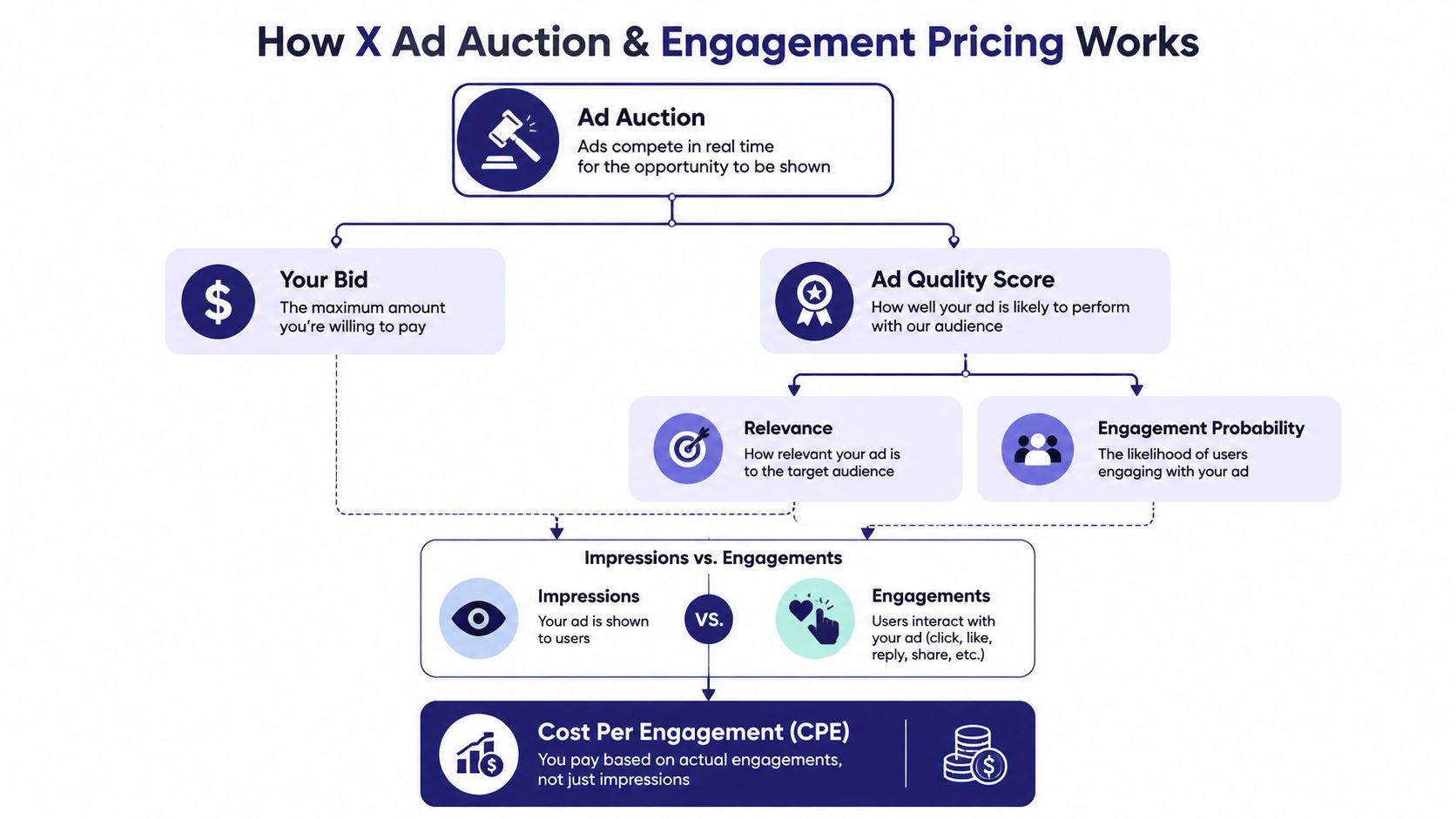
X doesn't determine delivery from the bid alone. Its auction considers both what the advertiser is willing to pay and the quality of the ad, including its expected ability to generate engagement. That creates an important operating principle: a better message can compete more efficiently than a weak message with a similar bid. X's auction documentation explains that ad quality and engagement affect the effective price.
An engagement objective uses a cost-per-engagement model. X states that impressions without an engagement aren't billed, while engagements include clicks, Retweets, replies, likes, poll votes, and hashtag clicks in its engagement objective playbook.
That doesn't mean every engagement has equal commercial value. A click to a technical guide may indicate research. A like may indicate recognition. A reply may create a sales conversation, but it may also be unrelated. Your campaign objective should match the signal you want the system to prioritize.
A practical auction diagnosis
Use the following sequence when delivery or efficiency disappoints:
- Check relevance first. Does the ad directly answer the problem represented by the audience or keyword?
- Check the engagement signal. Are people clicking, replying, or only generating low-value interactions?
- Check the landing page. Does the page continue the exact promise made in the tweet?
- Adjust the bid only after reviewing the above. A higher bid can buy more opportunities, but it won't repair weak positioning.
A manufacturer selling an inspection service might test two messages. One says, “Improve your quality process.” The other says, “Find recurring dimensional defects before they become customer returns.” The second message gives a technical audience a clearer reason to engage because it names a recognizable operating problem.
Practical rule: When delivery is weak, improve the bid only after you've checked message fit, audience fit, and the landing-page handoff.
The first review should focus on patterns rather than isolated results. Look at which audience layers produce meaningful actions, which creative earns qualified clicks, and whether engagement quality matches your sales objective. You can also view Xholic AI's best ad tweets for examples of how concise advertising messages create a clear response path.
Targeting and Placement Options That Drive B2B Results
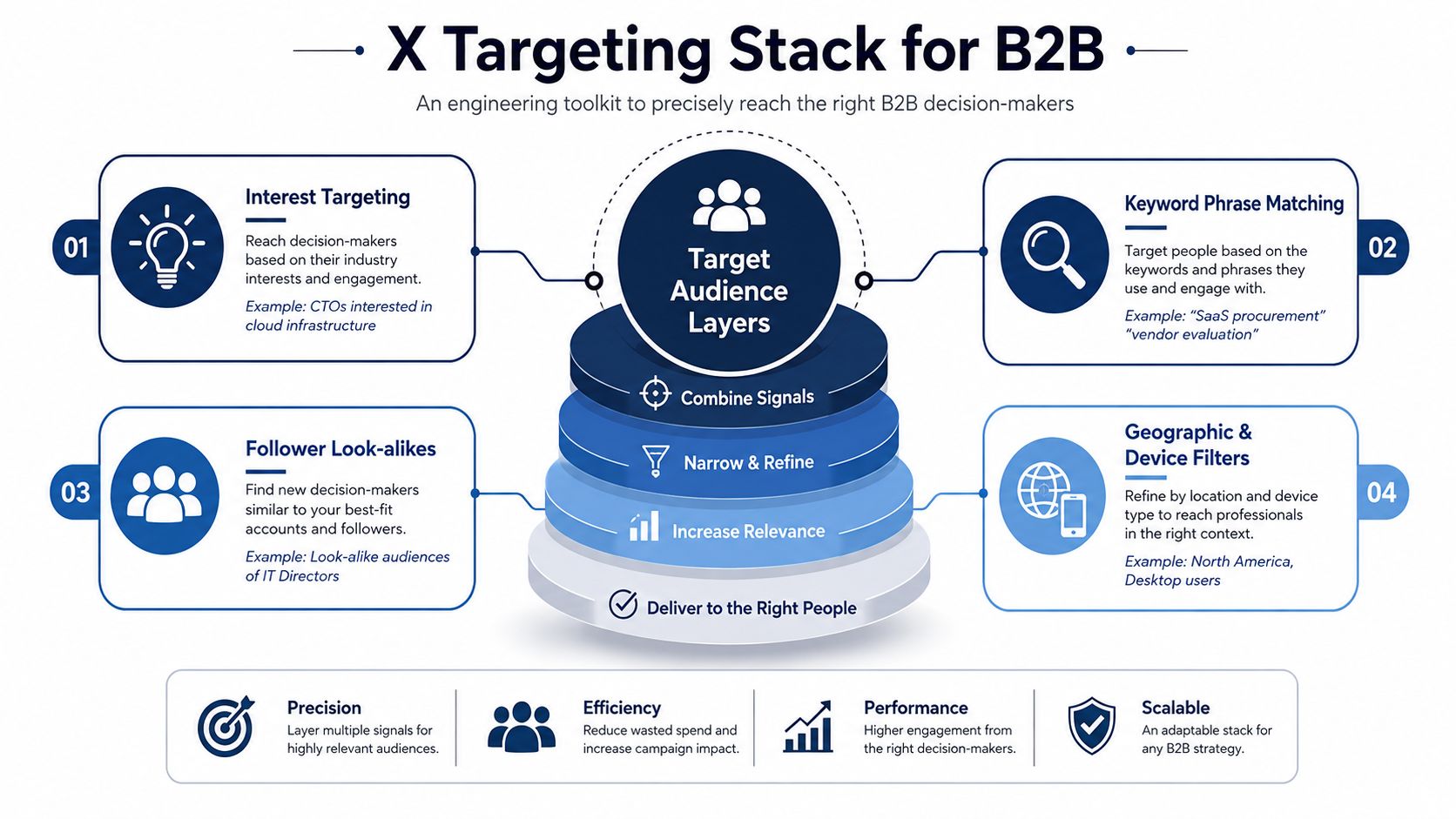
For a manufacturer, targeting should work like a control system. Each setting filters for a different signal, then the combined audience determines whether a promoted tweet reaches researchers, operators, engineers, or irrelevant browsers.
Interest categories provide the broadest input. A machine builder can start with manufacturing, automation, industrial technology, or maintenance interests to locate a relevant population. Interest targeting alone is generally too wide for a high-value industrial offer, but it can help identify language and topics for later testing.
Keyword targeting adds intent because delivery can respond to recent user activity. X supports phrase keywords and unordered keywords, based on keywords in recent Tweets. The X Ads API campaign management documentation lists line-item controls such as phrase_keywords and unordered_keywords.
Choose each match type for a defined job:
- Phrase keywords: Use wording tied to a specific problem or buying context, such as “predictive maintenance” or “CNC inspection.”
- Unordered keywords: Use related terms when their order can change without changing the topic.
- Conversation targeting: Join an active industry discussion when timing can affect response.
- Event targeting: Reach people around trade shows, conferences, product launches, or technical sessions.
Build the audience around a job
Audience layers should answer a practical question:
- Follower lookalikes: Can you reach users who resemble followers of relevant manufacturers, suppliers, publications, or competitors?
- Geographic filters: Does delivery stay within countries, states, regions, metro areas, or zip codes covered by plants, customers, and sales teams?
- Device and Wi-Fi filters: Does mobile discovery differ from office or plant connectivity?
- Language and gender: Does the offer or market require either filter?
- Tweet engager targeting: Can you reconnect with people who interacted with earlier content?
- Location targeting: Can you focus on plant corridors and service territories instead of buying irrelevant geography?
Placement determines the context of the interaction. Timeline placement supports discovery as users read their regular feed. Search placement fits active topic exploration. X's targeting documentation distinguishes supported targeting for Twitter Search and Twitter Timeline, so teams can test these contexts separately rather than treating them as identical inventory.
A practical manufacturing sequence might pair maintenance keywords with Timeline delivery for education, then use Search placement for an inspection or retrofit offer. Match the message to the signal. Someone discussing downtime should see a downtime solution, not a generic company introduction.
Before building the audience, record the assumptions and test them against this target audience identification framework. Check whether the audience's language, geography, and operating problem align with the offer. That record also gives sales and CRM teams a clear basis for comparing promoted-tweet engagement with later pipeline activity.
Budgeting Bidding and Creative That Earns Engagement
A plant manager sees an unexpected downtime post while reviewing industry updates. If the message names the equipment problem and offers a useful next step, the interaction can become an intent signal. Budget, bid, creative, and CRM capture should therefore work as one system, not as separate campaign settings.
Start with the commercial constraint. Set the maximum amount you can spend for a qualified action, then define what the campaign is buying: research, traffic, conversations, or form submissions. An engagement campaign should not be judged only by closed revenue if it was never built to capture a conversion signal. Judge whether engagement creates useful retargeting or sales activity.
X's auction model considers both bid and ad quality. Its engagement objective charges for engagements rather than non-interacting impressions, as described in X's bidding and auctions guidance. Creative becomes a cost lever. A clear industrial problem, relevant audience, and direct next step can improve auction quality and engagement without depending entirely on a higher bid.
Write for a technical buyer in a moving feed
A technical buyer should understand the post quickly:
- Open with the operating problem. “Unplanned downtime is difficult to explain after the line stops” is clearer than “We provide solutions.”
- Use one proof point. Name the process, equipment category, material, certification, or application you support.
- Give one action. Ask readers to review a guide, compare an approach, or request an assessment.
- Make the visual earn its space. Show a machine, process, diagram, or inspection detail that remains clear on a mobile screen.
- Test the message, not just the color. Compare a cost problem with a quality problem, or a risk message with a throughput message.
Creative fatigue requires active monitoring. Broad repetition can lose value in a crowded timeline, while complaint coverage about promoted content shows why exposure pressure deserves attention. TechCrunch's coverage of user complaints about promoted content supports treating frequency as a user-experience concern, not as proof of a specific engagement curve.
Use short bursts for time-sensitive campaigns, such as a webinar, product demonstration, plant open house, or trade-show meeting campaign. Rotate the message angle before the audience stops noticing. For a small industrial audience, relevant variants may matter more than accumulating broad reach.
Before launch, check the nine elements of advertising against the offer, audience, promise, proof, and action. Then connect each variant to a CRM field or campaign code, so engagement can be compared with qualified conversations and later pipeline activity.
Step by Step Campaign Setup Checklist for Busy Teams
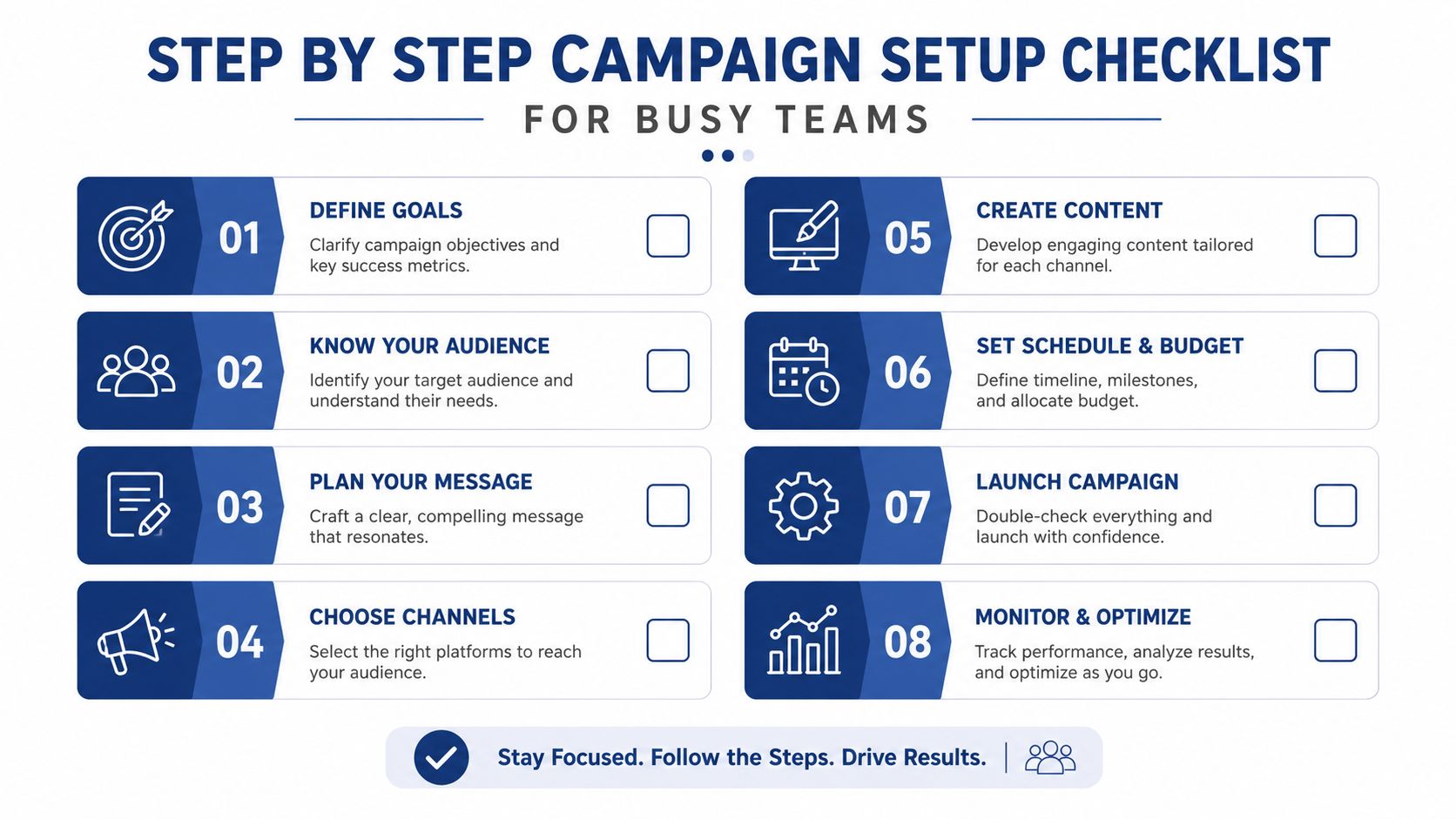
A campaign becomes easier to manage when you build it in a fixed order. The sequence below prevents a common failure, launching an attractive post before deciding what success means or how the CRM will record it.
-
Select the campaign objective. Choose engagement when you want to test a message or build interaction. Choose a traffic or conversion-oriented objective when the business outcome happens on your website. Write the success event in one sentence before opening the campaign builder.
-
Define the audience. Start with the business problem, then translate it into interests, keywords, follower lookalikes, geography, devices, or engager audiences. Keep separate audience groups when you need to compare intent levels.
-
Create the keyword set. Divide terms into problem language, solution language, and event or competitor language. Remove terms that attract students, job seekers, or unrelated consumer conversations if they don't fit the offer.
-
Choose placement. Use Timeline when the message needs discovery inside an ongoing feed. Test Search when the audience is actively exploring a topic. Record the placement so you can compare quality, not only volume.
-
Write the creative variants. Prepare different hooks for the same offer. One might focus on downtime, another on inspection risk, and another on production throughput. Keep the landing page and call to action consistent while you isolate the message variable.
-
Set the bid and budget controls. Start with a controlled amount that allows you to observe engagement quality without exposing the full quarterly budget. Define the point at which you'll pause, revise, or expand.
-
Install tracking before launch. Use campaign-specific URLs, form source fields, and CRM campaign names. Confirm that a test visit and form submission create the expected record and source data.
-
Review and launch. Check spelling, destination links, mobile rendering, audience exclusions, approval status, and sales ownership. Launch a controlled test flight, then document the settings in an SOP so the next campaign doesn't depend on memory.
The handoff matters as much as the launch. Give sales a short note explaining the audience, offer, expected lead context, and follow-up timing. If a prospect arrives after reading about a specific maintenance problem, the first response should acknowledge that problem rather than send a generic company introduction.
Measuring Troubleshooting and Scaling Promoted Tweets With Your CRM
Native X reporting gives you delivery and engagement signals, but your CRM tells you whether those signals became business activity. Track impressions, engagements, clicks, replies, landing-page visits, form completions, qualified opportunities, and revenue as separate stages. Don't collapse them into one “performance” number.
Independent benchmark-style content cited in the brief reports promoted X posts averaging 1% to 3% CTR, compared with 0.5% to 1.5% for organic posts, and older brand-lift research reported 22% message association growth after exposure and 53% higher purchase intent among engagers. Review the source discussion of Twitter advertising benchmarks carefully, and treat these figures as directional context rather than a promise for your manufacturing market.
Diagnose the failure before changing the budget
- Low engagement: Rework the opening line, sharpen the problem, or narrow the audience.
- High cost per engagement: Improve relevance before raising the bid.
- Strong clicks but weak form completion: Compare the landing-page promise with the ad and reduce friction.
- Good engagement but no pipeline: Check source capture, sales follow-up, and CRM campaign mapping.
- Performance declines after launch: Rotate the creative and review exposure pressure.
- Delivery stalls: Check whether the audience, geography, keyword set, or placement is too narrow.
A GoHighLevel or comparable CRM workflow can record campaign source, route a form submission, create a follow-up task, and place engaged visitors into an appropriate nurture path. The CRM campaign integration guide explains how to connect campaign activity to the broader lead-management system.
Scale only after you can identify the winning combination of audience, message, placement, and downstream action. Pause weak variants, preserve the original settings, and create a new test rather than changing every variable at once. That approach gives you a usable learning record instead of a confusing before-and-after comparison.
Machine Marketing helps manufacturers connect promoted tweet strategy with audience diagnosis, technical messaging, CRM workflows, and measurable pipeline reporting. Visit Machine Marketing to request a practical diagnosis of your paid social and lead-generation system, then identify the next campaign improvement worth implementing.