A closing thank-you note can do more than end a conversation politely. In the right situation, it confirms what you heard, clarifies momentum, and gives the recipient a useful reason to respond. Boomerang's analysis of more than 350,000 email threads found a 62% average response rate for emails ending with thankful language, compared with 46% for emails without a grateful sign-off, a 36% relative lift (Boomerang's email sign-off analysis). That doesn't mean appreciation fixes a weak offer, but it does show that the final line can influence engagement.
For manufacturers, machine shops, and B2B sales teams, the practical question is simple: what should the closing ask the relationship to do next? We'll cover seven approaches organized by sales intent and relationship stage, then adapt each for email, handwritten notes, SMS, and LinkedIn. You'll also get timing guidance, a personalization checklist, and a CRM follow-up sequence that keeps the note connected to the sales process. If you use physical mail, these ideas can complement thank-you mailers for customers.
Before sending, ask yourself:
- What did they care about? Identify the problem, outcome, or concern they emphasized.
- What happens next? Confirm the meeting, decision, review, or deliverable.
- What value can we deliver now? Offer a useful resource, observation, introduction, or clear next action.
Choose the close from the prospect's stage, stated problem, and confirmed commitment. Don't paste the same polished sentence into every template.
Table of Contents
- 1. The Direct Commitment Close
- 2. The Specific Value Close
- 3. The Strategic Partnership Close
- 4. The Problem-Solving Close
- 5. The Referral-Ready Close
- 6. The Timeline-Specific Close
- 7. The Permission-to-Share Close
- 7-Point Comparison: Closing Thank-You Notes
- Build the Follow-Up System Behind Every Note
1. The Direct Commitment Close
“Looking forward to working together” is strongest when the relationship already has forward motion. It connects appreciation with a specific commitment, which makes the note feel like part of a business process rather than a courteous afterthought.
Use it after an initial consultation, proposal presentation, strategy call, or technical review where both sides understand what happens next. A machine shop owner who has approved a follow-up workshop should receive a more direct close than a prospect who has only downloaded a guide.
Practical rule: Use a commitment close only when a next step is confirmed. Otherwise, you may sound as if you've assumed a decision the buyer hasn't made.
Adapt the wording to the conversation:
- After a proposal: “Looking forward to working together to solve the lead-generation challenges we discussed.”
- After a scheduled review: “Looking forward to connecting next Tuesday to review the CRM implementation plan.”
- After a manufacturing meeting: “Let's turn these insights into measurable results for your team.”
The channel should change the length, not the meaning. In email, include the relevant project and scheduled action. In a handwritten note, keep the sentence personal and brief. In SMS, write, “Thanks for today. Looking forward to reviewing the proposal with you Tuesday.” On LinkedIn, avoid sounding like a formal letter. A short message such as, “Appreciated the conversation about your quoting process. Looking forward to continuing it next week,” is enough.
Your CRM should record the commitment type, agreed date, owner, and next action. Tag contacts who receive this close so you can compare response and conversion behavior by stage. If you need supporting language for the full message, adapt one of these sales follow-up email templates.
2. The Specific Value Close
“Excited to help you achieve [concrete outcome]” works when the prospect has clearly named a business result. The close should reflect their language, not your generic service description.
Suppose a sales manager says, “Our reps log activity, but nobody trusts the CRM.” A weak ending would be, “Looking forward to helping with your marketing.” A stronger version is, “Looking forward to helping your team turn the CRM into a usable sales system.” The second sentence proves that you listened and understood the operational issue.
Start with the problem recorded in your meeting notes, then connect it to the outcome you can influence:
- Lead flow: “Excited to help you build a more predictable pipeline for your machine shop.”
- CRM adoption: “Looking forward to helping your team use the CRM consistently, not just log activity.”
- Nurture strategy: “I'm excited to help you identify where qualified prospects are dropping out of the nurture sequence.”
Avoid promising an outcome you can't control. A marketing consultant can improve the system, messaging, and follow-up process. They can't guarantee that every prospect will buy. A specific close should create confidence without becoming a disguised guarantee.
For email, repeat the exact business issue in one sentence and attach the agreed next step. A handwritten note can say, “I appreciated hearing how important predictable project flow is for your team. I'm excited to help you work toward that.” SMS should use plain language and one outcome. LinkedIn is best for a lighter version, especially after a networking conversation.
Record the problem, desired outcome, decision-maker, and promised action in the CRM. That information gives the next salesperson or account manager context and helps you judge whether the close matches the opportunity.
3. The Strategic Partnership Close
Some prospects aren't ready to buy. They may need internal approval, a budget discussion, or more confidence in the problem itself. “Grateful for the opportunity to be a resource” keeps the relationship active without forcing a decision.
This close is appropriate after exploratory calls, networking events, introductions, and early discovery. It positions you as someone who can contribute useful thinking before a formal engagement begins. That matters in manufacturing, where several stakeholders may need to understand the operational and commercial case before a project moves forward.
Use a tangible promise so “resource” doesn't become empty positioning:
- “Grateful for the opportunity to be a resource as you evaluate your options. I'll send the benchmark report we discussed.”
- “Thanks for the introduction. I'm always happy to compare notes on manufacturing marketing when it's useful.”
- “I appreciate the conversation and would be glad to support your team as you develop the strategy.”
The trade-off is clear. This language feels safe and relationship-focused, but it can become vague if you don't attach a real action. Send the promised report, make the introduction, or share the relevant observation. Then create a CRM task for the follow-up you've committed to, rather than leaving the relationship in a general nurture list.
Email gives you room to explain what you'll contribute. A handwritten note should focus on appreciation and one useful promise. SMS works when the resource is simple, such as a link or introduction. On LinkedIn, keep the tone conversational: “Thanks for the introduction. I'll send over the manufacturing lead-generation checklist we discussed.”
Use this approach early in the buying process. As the prospect confirms a project, decision date, or deliverable, shift to a more direct close.
4. The Problem-Solving Close
“Ready to dig deeper into [specific challenge]” turns a thank-you note into an invitation to diagnose. It fits engineers, manufacturers, and operations leaders who respond better to a clear problem-solving process than to broad claims about growth.
The word specific matters. “I'm ready to dig deeper into your marketing” is too broad. “I'm ready to dig deeper into your lead-scoring process and identify where qualified inquiries are being lost” gives the recipient something concrete to evaluate.
A practical example is a discovery call with a manufacturer whose website attracts traffic but produces few inquiries. The close could read, “Thank you for walking me through your current process. I'm ready to dig deeper into how website inquiries move into your CRM, and I'll outline the first points I'd inspect.”
Use a low-friction diagnostic offer:
- Audit: “I can review your current lead-capture and follow-up system and return with three observations.”
- Workshop: “Let's map the handoff from marketing to sales and identify where ownership becomes unclear.”
- Short review: “I'd like to spend a focused session examining your email nurture sequence.”
Don't imply technical depth you haven't earned. If you haven't reviewed the system, say you're ready to examine it. Follow up promptly with the proposed format, participants, preparation, and deliverable. A clear discovery call framework can help you keep that next conversation focused.
In email, explain the diagnostic action. In a handwritten note, use one thoughtful sentence. SMS can confirm the agreed audit time. LinkedIn is useful after an industry conversation, but keep the invitation light. Record the challenge and proposed diagnostic in the CRM so future follow-up doesn't restart the conversation from zero.

5. The Referral-Ready Close
“Please keep me in mind, and feel free to refer” is a relationship close, not a default sales line. It works when trust exists, when someone has introduced you, or when the prospect has made it clear that the timing isn't right but your work is relevant to their network.
Specificity prevents awkwardness. “Let me know if you know anyone who needs marketing” creates work for the recipient. “If you meet a machine shop owner struggling with inconsistent B2B lead flow, feel free to share my contact information” tells them exactly who you help.
Try one of these formulations:
- “Please keep me in mind as you plan your marketing strategy. If another manufacturer in your network is working through inconsistent lead flow, I'd be grateful for an introduction.”
- “I work with manufacturers that need a clearer system for turning marketing activity into qualified conversations. Feel free to share my contact directly.”
- “Thanks again for the introduction. I spoke with your colleague last week, and I appreciate you connecting us.”
A referral request can feel transactional if you ask too early. Reserve it for an established relationship or a conversation where the other person has already expressed confidence in your work. Don't make the request conditional on a reward unless your referral policy is clear and appropriate for the relationship.
For email, include a simple booking path or permission to forward your contact details. Handwritten notes should focus primarily on gratitude, with referral language as a soft final sentence. SMS is appropriate after a successful introduction, not as an unsolicited referral pitch. LinkedIn can make sharing easy, but don't turn a personal thank-you into a public promotion.
Track the referral source in your CRM and acknowledge every introduction. The person who made the connection should know that you followed through, even when the conversation doesn't become an opportunity.
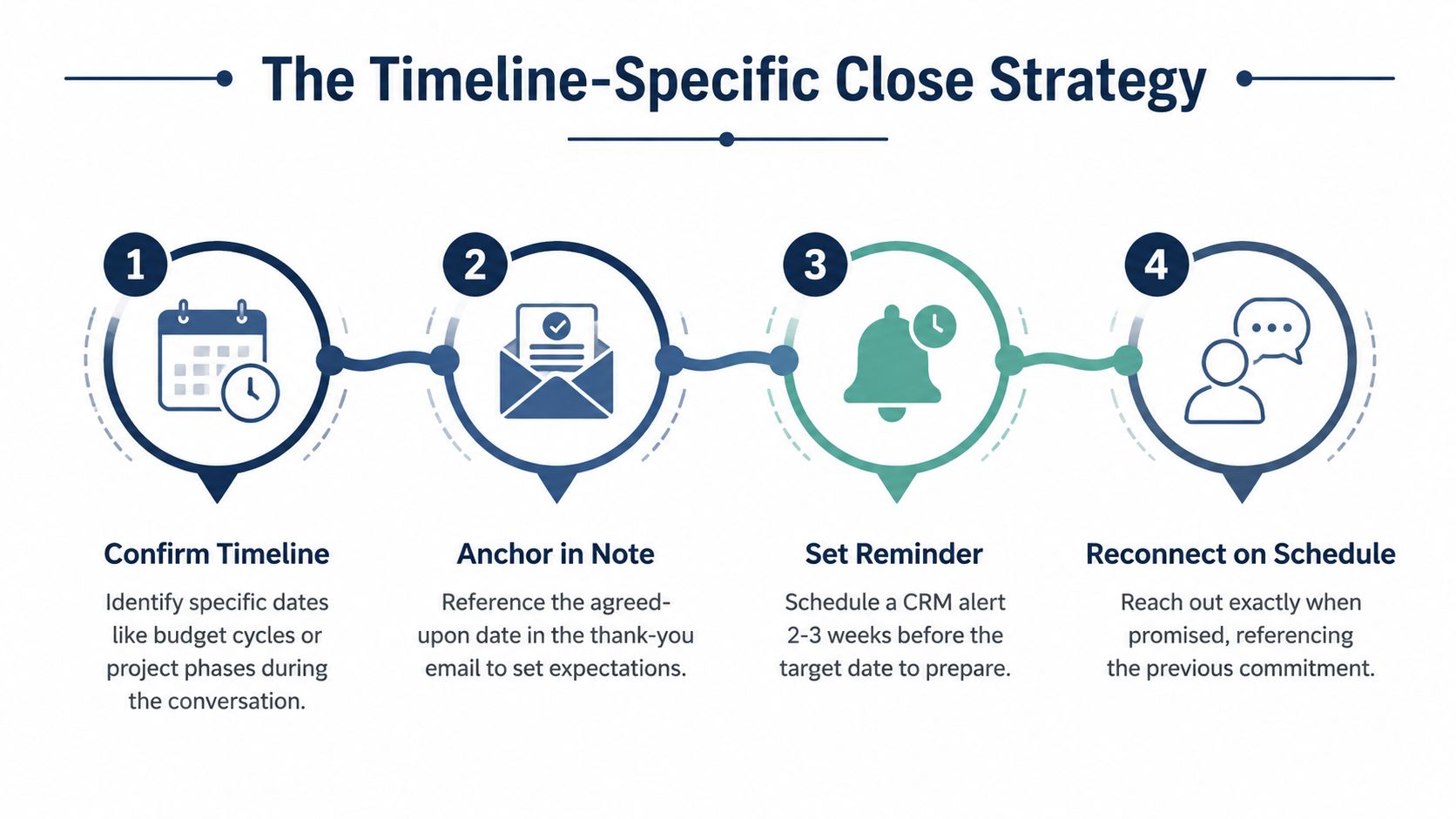
6. The Timeline-Specific Close
“Looking forward to reconnecting on [date or timeframe]” removes one of the most common failures in B2B follow-up: vague future intent. This close respects the prospect's actual buying conditions while giving both sides a clear point of accountability.
Use it when the prospect has identified a budget cycle, hiring plan, project phase, trade show, or internal review. Don't guess at readiness. Confirm the timing in the conversation, then repeat it accurately in the note.
Examples include:
- “As discussed, I'll reach out in early September when your budget committee reconvenes.”
- “Once your new sales representative joins the team, let's review the CRM and marketing handoff.”
- “I'm looking forward to reconnecting after the IMTS show to compare notes on what you learned.”
- “I'll follow up in March, when your current project is complete and you can revisit the lead-generation strategy.”
The sentence should contain the trigger, the timeframe, and your action. If the prospect says they'll contact you, don't convert that into your own assumption. Confirm who will follow up and when.
Create the CRM task immediately. Set an earlier reminder to prepare useful context, such as the original proposal, meeting notes, or a relevant resource. When the date arrives, open with the commitment you made: “As promised, I'm reaching out now that the budget review is underway.” If circumstances change, update the prospect before the scheduled date rather than disappearing.
Email can include the full context. A handwritten note may use the date as a personal reference. SMS should be short and explicit. LinkedIn works well after an event, where “let's reconnect after the show” feels natural, but record the commitment outside the platform so it doesn't depend on memory.
7. The Permission-to-Share Close
“Happy to send over that resource” connects appreciation with immediate value. It gives the recipient a concrete reason to expect your next message and helps you avoid a thank-you note filled with unsupported promises.
Name the deliverable. “I'll send some resources” sounds automated. “I'll send the CRM adoption roadmap we discussed” tells the prospect that the material was selected for their situation.
Useful examples include:
- “I'll send over our manufacturing lead-generation checklist tomorrow. It's designed for teams that need a more consistent path from inquiry to sales conversation.”
- “I'm happy to send the CRM adoption roadmap we discussed so your team can review the rollout sequence internally.”
- “I'll share the email automation template we mentioned. You can adapt it for your nurture sequence.”
- “I'd like to send the benchmark report we discussed so you can compare your current process with the questions we identified.”
Don't offer a resource you don't have ready. If the material requires explanation, say what the recipient should look for and invite a focused follow-up. A thank-you note can say, “Check your inbox tomorrow for the checklist. Once you've reviewed it, let me know which section fits your current process.”
Send the promised resource promptly, then track delivery and engagement in your email system where appropriate. Map resources to prospect types, industries, and problems so your team can use the approach consistently. You can also review how to send a proper email for the supporting message structure.
7-Point Comparison: Closing Thank-You Notes
| Closing Type | Implementation Complexity 🔄 | Resource Requirements ⚡ | Expected Outcomes ⭐📊 | Ideal Use Cases 💡 | Key Advantages |
|---|---|---|---|---|---|
| The Direct Commitment Close: "Looking Forward to Working Together" | Low, simple forward-looking sentence 🔄 | Low, no extra deliverables ⚡ | ⭐⭐, clarifies next steps; increases momentum 📊 | After proposals, consultations, or scheduled next steps 💡 | Signals momentum and delivery-focus; reduces ambiguity |
| The Specific Value Close: "Excited to Help You Achieve [Concrete Outcome]" | Medium, requires tailoring to a named outcome 🔄 | Low–Medium, uses conversation notes; minimal prep ⚡ | ⭐⭐⭐, higher reply rates; feels highly relevant 📊 | When a clear pain or measurable goal was identified 💡 | Demonstrates listening; differentiates you with specific value |
| The Strategic Partnership Close: "Grateful for the Opportunity to Be a Resource" | Low, relational tone, low friction 🔄 | Low, requires ongoing availability and follow-through ⚡ | ⭐⭐, builds trust over time; warms prospects 📊 | Early-stage or exploratory conversations; networking 💡 | Positions you as a long-term partner; low-pressure engagement |
| The Problem-Solving Close: "Ready to Dig Deeper Into [Specific Challenge]" | High, proposes diagnostic work or deep discovery 🔄 | Medium–High, expert time for audits/analysis ⚡ | ⭐⭐⭐, attracts quality, consultative prospects; advances to discovery 📊 | When you want to move to a diagnostic/consultative engagement 💡 | Signals rigor and expertise; filters for serious buyers |
| The Referral-Ready Close: "Please Keep Me in Mind (and Feel Free to Refer)" | Low, straightforward referral ask 🔄 | Low, tracking referrals in CRM; acknowledge sources ⚡ | ⭐⭐, expands network; can generate high-trust leads 📊 | After networking, events, or when rapport exists 💡 | Leverages peer recommendations; faster trust & higher close rates |
| The Timeline-Specific Close: "Looking Forward to Reconnecting on [Date/Timeframe]" | Medium, needs an agreed timeline and confirmation 🔄 | Low–Medium, CRM reminders and scheduling ⚡ | ⭐⭐⭐, improves follow-up consistency and reply rates 📊 | When prospect has a known budget/project/hiring timeline 💡 | Removes ambiguity; aligns with prospect's process; automatable |
| The Permission-to-Share Close: "Happy to Send Over That Resource (Specific Deliverable)" | Medium, must prepare or select a useful deliverable 🔄 | Medium, create/curate assets and send within 24 hrs ⚡ | ⭐⭐⭐, higher open rates; drives engagement and forwarding 📊 | Any stage where a tangible resource was discussed or helpful 💡 | Provides immediate value; creates a concrete reason to follow up |
Build the Follow-Up System Behind Every Note
The best closing thank-you note depends on the sales intent, not on which sign-off sounds most polished.
- Use commitment language when the next step is confirmed.
- Use value language when the prospect has named a clear outcome.
- Use partnership language during exploration or internal evaluation.
- Use problem-solving language when a diagnostic conversation is the logical next action.
- Use referral language after trust has been established.
- Use timeline language when both sides have agreed on a future trigger.
- Use resource-sharing language when you can deliver something specific and useful.
Channel changes the format, but it shouldn't erase the substance. Preserve the specific reference in every version, shorten the body for SMS and LinkedIn, and keep handwritten notes personal rather than automated. A physical note should sound like it came from a person who remembers the conversation. An email can carry more context, while a mobile message should usually make one point and confirm one action.
Timing also affects credibility. A thank-you note sent promptly keeps the interaction fresh. Guidance from Old Soul Etiquette recommends sending a note within a week of the event, with a goal of no longer than two weeks, while also noting that late is better than never (timing guidance for thank-you notes). If you're late, acknowledge it briefly and return to the person's contribution or the agreed next step.
For formal business correspondence, formatting matters as well as wording. Purdue OWL advises placing the closing one line after the last body paragraph, aligning it with the date, capitalizing only the first word, and leaving four lines for a signature. It also explains that a colon in the salutation calls for a comma after the closing, while other salutations don't require punctuation there (Purdue OWL business-letter guidance).
Build a simple operating sequence:
- Send the thank-you promptly.
- Deliver every promised resource.
- Record the sales stage, problem, commitment, and channel in the CRM.
- Create the follow-up task for the agreed date.
- Review the result and improve the template.
Don't treat gratitude as a substitute for a clear offer, good timing, or disciplined follow-up. A fundraising field experiment found baseline response of 1.6% versus 1.8% when a solicitation used “thank you in advance,” and handwritten thank-you postcards didn't materially change donor contributions (the fundraising experiment). Appreciation can support engagement, but it can't repair unclear value or weak follow-up mechanics.
Audit your existing templates this week. Mark each one by prospect stage, stated problem, next commitment, channel, and CRM action, then replace generic closers with the approach that matches the situation. If your marketing system lacks a consistent diagnosis-to-follow-up process, review the workflow tools you already use, including top workflow automation platforms, and identify where ownership or timing breaks down.
Machine Marketing helps manufacturers, machine shops, and industrial businesses connect marketing strategy, lead generation, CRM, automation, and follow-up into a system your team can use. Visit Machine Marketing to request a strategy diagnosis and turn your closing thank-you notes into reliable next steps instead of isolated messages.