Your manufacturing team has probably already created its most valuable repurposing candidate. It may be a technical whitepaper, webinar, application note, or customer story that took weeks to produce, then settled into a resource library with little follow-up. The problem usually isn't a lack of expertise or writing ability. It's the absence of a distribution and governance system that turns one credible source into useful touchpoints for search, email, sales, and social channels.
Table of Contents
- The Asset Sitting on Your Hard Drive Right Now
- What Content Repurposing Actually Means
- Why Industrial B2B Teams Cannot Afford to Skip It
- Matching Source Assets to Derivative Formats
- A Repeatable Workflow for Repurposing Existing Content
- Preventing Accuracy Drift and Message Dilution
- Measuring Repurposing ROI Across the Sales Cycle
- Your Next Step and a 30-Day Repurposing Checklist
The Asset Sitting on Your Hard Drive Right Now
A manufacturing marketing manager opens a 40-page technical whitepaper on tolerance capabilities. The engineering team spent eight weeks reviewing it, the designer formatted it, and sales approved the final PDF. The download tracker shows three downloads last quarter. On LinkedIn, the same spec sheet earned 12 likes and zero comments.
That asset represents a substantial investment performing far below its ceiling. It contains technical explanations, terminology, process details, proof points, and answers to questions buyers may ask during supplier evaluation. Yet the company has treated it as a single PDF with a single landing page.
The gap isn't necessarily a writing problem. The team has produced substantive, engineer-credible content. What's missing is the distribution architecture needed to deploy that knowledge across the places where industrial buyers research, compare, validate, and involve other stakeholders.
The real cost of one-and-done publishing
A whitepaper may help a buyer who already knows the company, finds the landing page, trusts the title, and feels comfortable completing the form. It won't automatically reach the engineer searching for a specific tolerance question, the salesperson preparing for a plant visit, or the operations leader who prefers a short email summary.
We treat the original asset as a source system, not a finished campaign. Its sections can answer search questions, its diagrams can support sales conversations, and its approved technical language can give social posts more substance than a generic promotional message.
Practical rule: If a source asset contains validated expertise, don't judge it only by the performance of its original format.
The frustration is familiar because many industrial companies have a deep content library but a thin publishing rhythm. Content repurposing addresses that structural mismatch by adapting existing material for specific channels and buying stages. It doesn't excuse weak source content, and it doesn't turn every PDF into a qualified opportunity. It gives strong content more chances to do useful work.
What Content Repurposing Actually Means
Content repurposing is the deliberate process of transforming one verified source asset into multiple derivatives, with each derivative adapted for a particular channel, audience, and buying-stage objective. The definition matters because repurposing is often confused with copying.
The process has three connected parts.
Start with reuse that has a job
A precision stamping whitepaper might become an engineer-focused article answering a tolerance question, a field sales one-pager for supplier meetings, an executive email summary, and a webinar Q&A. Each derivative should have a reason to exist. A search article should answer a search need, while a sales handout should help a representative explain capability and next steps.
Atomize the source
Atomization means breaking a substantial asset into reusable components, such as:
- Validated facts: Technical details that remain accurate outside the original document.
- Frameworks: Decision criteria, process explanations, or evaluation steps.
- Approved language: Descriptions of capabilities that have passed technical and brand review.
- How-to steps: Practical guidance that can stand alone in an article, email, or presentation.
- Questions and answers: Buyer objections or engineering concerns that can shape a webinar or nurture sequence.
Those components are then rebuilt into platform-native content. A LinkedIn carousel needs a visual progression and concise points. A search page needs a clear question, supporting context, and useful depth. A sales one-pager needs scannable proof and a clear conversation path.
For a broader introduction to scaling reach without burnout, it helps to compare repurposing with simple redistribution. Posting the same PDF link repeatedly isn't adaptation. Copying a paragraph into every channel isn't atomization.
Preserve one approved source
Every derivative should trace back to a source of truth. If an engineer changes a specification, the content manager needs to know which articles, emails, social posts, and sales documents depend on it. That traceability separates a content system from a collection of disconnected rewrites.
Repurposing doesn't mean spinning text, rewriting without purpose, or cross-posting identical material. Engineers and technical buyers notice lazy duplication quickly. Useful adaptation preserves the original meaning while changing the format, depth, context, and call to action.
Why Industrial B2B Teams Cannot Afford to Skip It
Industrial marketing teams face a difficult production equation. Buyers expect useful information across search, email, social platforms, sales conversations, and field activity, but the available subject-matter experts are often limited. Every new asset requires research, interviews, review, design, and approval.
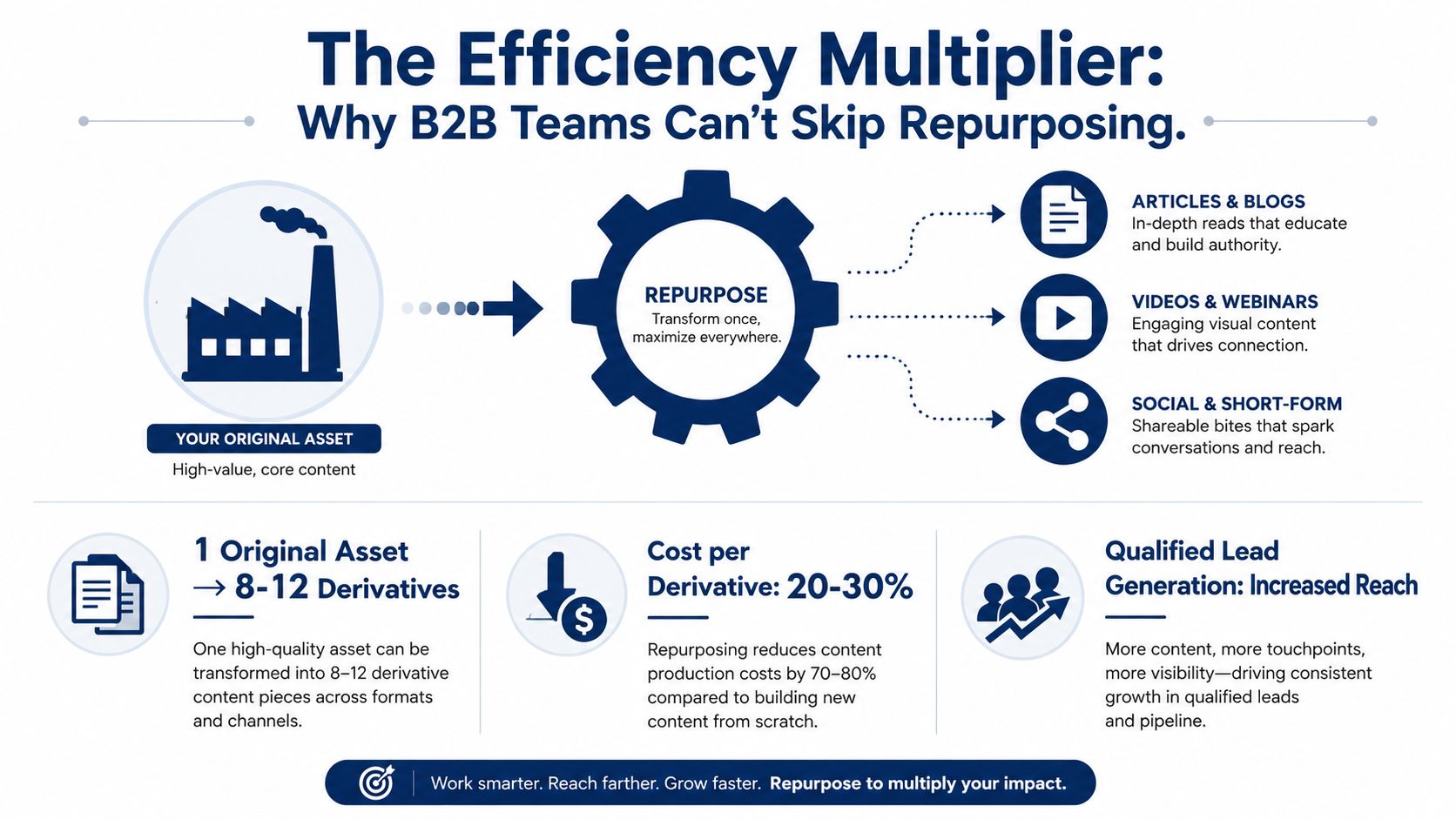
Industry reporting cited in content repurposing statistics says repurposing can increase results by 75% without a proportional increase in investment. A separate compiled analysis reports that 94% of marketers repurpose content regularly, while only 29% have a systematic repurposing process. Those figures point to a practical distinction: adoption is widespread, but operating discipline is not.
The same analysis estimates that one blog post can become 8 to 12 pieces, that multi-format distribution can expand reach by 12x, and that repurposing can cut per-piece cost by 80% compared with creating every asset from scratch. These figures come from industry reporting, so we use them as directional benchmarks rather than promises for an individual manufacturer. Actual output depends on source quality, technical review, format selection, and distribution strength.
Why the industrial context changes the calculation
Manufacturing purchases often involve long evaluation periods, specialist audiences, engineer-led scrutiny, and trade-show or sales-led first contact. A single whitepaper sitting idle on a landing page can't support all of those interactions.
A structured repurposing system lets one source support:
- SEO discovery: Articles, glossary entries, and comparison pages that answer specific research questions.
- Email nurture: Summaries and follow-up sequences that keep a technical topic active.
- Sales enablement: One-pagers, talk tracks, and leave-behinds that support conversations.
- Field marketing: Presentation slides and event follow-ups that extend trade-show activity.
- Social distribution: Short, useful posts that point toward deeper evidence.
Our content marketing best practices include the strategic discipline that makes this work. Repurposing isn't a justification for publishing more noise. It's a way to maintain a credible presence without asking your team to double headcount or agency spend.
Matching Source Assets to Derivative Formats
Format choice should follow the source asset's depth and the job the derivative needs to perform. A long-form source can support more independent ideas than a short technical note, but more output isn't automatically better. Each derivative still needs technical accuracy, audience fit, and a measurable purpose.
| Source Asset | SEO Derivatives | Email & Nurture | Sales Enablement | Social & Reach |
|---|---|---|---|---|
| Long-form whitepaper | Supporting articles, glossary entries, comparison pages | Executive summary, nurture sequence, sales handoff brief | One-pager, talk track, leave-behind | LinkedIn carousels, quote graphics |
| Technical application note | Focused how-to article, terminology page | Technical summary, follow-up email | Application brief, objection guide | Process graphic, short explainer |
| Webinar recording | Q&A article, transcript-led resource page | Replay email, topic sequence | Call preparation notes, FAQ sheet | Chaptered clips, expert excerpts |
| Product spec sheet | Capability page, comparison page | Product update email | Capability one-pager, qualification checklist | Specification-led post, diagram |
| Customer case study | Problem-solution article, industry page | Proof-focused nurture email | Case study leave-behind, account brief | Quote graphic, short story post |
A 20-page whitepaper may contain enough distinct material to support 8 to 12 derivative assets, a benchmark cited in content repurposing ROI statistics. A 400-word technical note usually has less conceptual range, so it may produce only a small set of focused derivatives. That isn't a failure. Forcing a short source into a large content package usually creates repetition or unsupported claims.
Match the format to the buying stage
At the top of the funnel, supporting articles, glossary entries, short videos, and social explainers can help buyers understand a problem. In the middle, application notes, comparison pages, email sequences, and webinar follow-ups can support evaluation. Near a sales conversation, buyers often need concise capability documents, technical FAQs, and proof that a supplier understands the application.
Some pairings look efficient but underperform. Chopping a webinar into random clips often produces fragments without context. A better approach is to chapter the recording, identify a complete question or explanation, add a clear title, and connect the clip to a relevant next step.
A derivative should feel native to its destination, not like a source asset cut into smaller pieces.
A Repeatable Workflow for Repurposing Existing Content
We use a five-stage workflow with B2B manufacturing clients. The names can change inside your team, but the control points shouldn't.
1. Audit the asset library
Inventory existing assets and tag each one for performance, freshness, accuracy, and sales usage. Look for material that still answers an active customer question, supports a current product, or contains reusable expertise. Don't select an asset only because it took a long time to produce.
The content manager owns the inventory. The SME reviewer flags technical risk, and the distribution lead identifies where the material could support current campaigns.
2. Select the pillar
Choose one flagship asset per quarter and tie it to a product launch, campaign, market priority, or sales objective. Score candidates for residual value, audience relevance, conversion potential, and longevity.
A pillar without a business connection can generate output without helping the pipeline. A strong candidate has both substantive content and a clear reason to distribute it now.
3. Extract the atoms
Pull out standalone facts, frameworks, statistics, customer-approved quotes, process explanations, objections, and how-to steps. Then test each atom outside the original context. If a sentence becomes misleading when separated from the surrounding paragraphs, it isn't ready for reuse.
A content manager can lead extraction, but an SME must review claims involving specifications, certifications, materials, safety, or performance.
4. Map channels and ownership
Assign each atom to a format, audience, funnel stage, owner, and review path. The team decides whether an idea belongs in an SEO article, email, sales brief, LinkedIn carousel, or video script.
Use a content calendar planning framework to schedule derivatives without flooding one channel while neglecting another. For teams evaluating automation, an AI repurposing workflow can help with extraction and drafting, but human review remains necessary for technical content.
5. Distribute, measure, and iterate
Schedule output across owned, earned, and paid channels. Capture engagement and conversion signals in the source record, then re-atomize when the campaign or product context changes. The distribution lead should own publication and reporting, while the content manager maintains the asset map.
For a mid-length whitepaper, plan the work realistically. Atomization may require 6 to 8 hours, depending on the source's structure, review requirements, and number of channels. Automation can reduce drafting effort, but it can't replace approval.
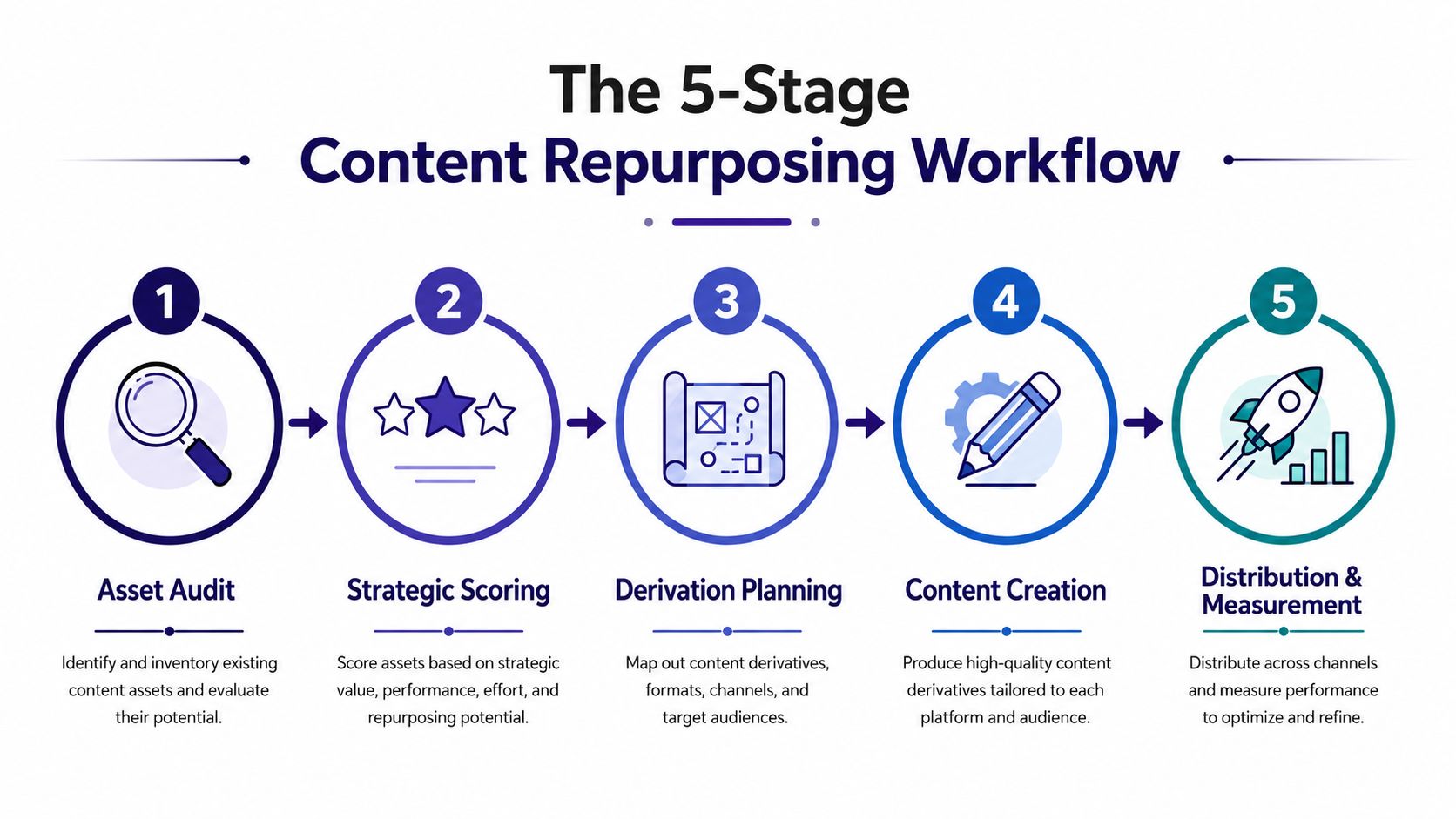
A simple visual reminder helps teams keep the stages connected rather than treating each derivative as a separate project.
Preventing Accuracy Drift and Message Dilution
Manufacturers have valid reasons to be cautious. Technical specifications age, regulatory references shift, part numbers become obsolete, and a performance claim can change meaning when someone paraphrases it for a short post. A source asset can be accurate while several derivatives become wrong.
The solution is governance, not avoidance.
Build a controlled source of truth
Maintain a versioned source document with one canonical URL. Record the technical owner, approval date, review status, affected products, and known expiration conditions. Every derivative should reference that source internally, even when the public asset doesn't display the relationship.
Create a claim library containing approved language for specifications, certifications, capabilities, and performance statements. Writers and AI tools can draw from the library instead of improvising technical phrasing.
Define review and retirement rules
Require SME review for any derivative that touches specifications, certifications, safety, materials, compliance, or performance claims. A general brand review isn't enough for those topics.
Use a release-cutover rule. When the source changes, pause or retire dependent derivatives until the team reviews them. Then run a quarterly sample check across published articles, social posts, email templates, and sales documents.
Governance standard: One approved source, one claim library, one owner for release decisions.
Without these controls, manufacturers can end up with contradictory LinkedIn posts, outdated leave-behinds in the field, and SEO pages ranking for claims the product no longer supports. The risk isn't limited to reputation. Salespeople may repeat the wrong language, and buyers may lose confidence when different company assets describe the same capability in different ways.
Measuring Repurposing ROI Across the Sales Cycle
Repurposing succeeds when it helps qualified buyers move forward, not when the team produces a large volume of derivatives. Impressions and downloads can provide context, but they rarely tell you whether an engineer trusted the company enough to request a conversation.
Map metrics to the format and the buying stage.
| Derivative Format | Funnel Stage | Primary Metric | Secondary Metric |
|---|---|---|---|
| LinkedIn post or short clip | Top of funnel | Relevant reach and engaged visits | Branded search activity |
| SEO article or glossary page | Top of funnel | Qualified organic sessions | Return visits and assisted conversions |
| Email summary or nurture sequence | Middle of funnel | MQL-to-SQL progression | Replies and meaningful engagement |
| Webinar Q&A or application article | Middle of funnel | Asset-assisted demo requests | Account engagement |
| Sales one-pager or talk track | Bottom of funnel | Opportunities influenced | Stage progression |
| Case study or technical proof asset | Bottom of funnel | Opportunity conversion | Win rate among touched accounts |
A long-cycle industrial business should also watch whether a repurposed asset appears in account activity before a meeting, during technical evaluation, or near proposal review. That doesn't create perfect attribution, but it gives sales and marketing a shared view of influence.
Use a 90-day measurement cadence with one source-of-truth dashboard. Review channel engagement, qualified conversions, influenced opportunities, and sales feedback together. Ignore isolated vanity signals, such as likes without relevant visits or downloads from unqualified contacts.
For a practical framework, use how to measure marketing ROI to connect activity to commercial outcomes. The dashboard should answer three questions: which source assets create useful derivatives, which formats support each sales stage, and which pieces deserve another distribution cycle.
Your Next Step and a 30-Day Repurposing Checklist
You don't need new headcount to test the system. You need a controlled pilot, a clear source asset, named owners, and a measurement plan.
Week 1, audit
Review the top ten existing assets by traffic and sales usage. Tag each for freshness, technical accuracy, audience relevance, and possible funnel role. Ask sales which documents they use and which buyer questions remain unanswered.
Week 2, score and prioritize
Score the candidates for reuse potential, current business relevance, technical review burden, and conversion opportunity. Choose two flagship pieces, then define the audience and sales-stage objective for each.
Week 3, atomize and adapt
Turn each flagship into four derivative formats mapped to different stages. For example, one could become an SEO article, an email summary, a sales one-pager, and a LinkedIn carousel. Keep a claim library and route technical statements to the SME reviewer before publication.
Week 4, launch and measure
Publish, distribute, and instrument each derivative. Record traffic quality, engagement, replies, sales usage, influenced opportunities, and stage movement in one dashboard. Schedule a review so the team can identify which formats deserve another cycle.
The central principle is simple: repurposing is a distribution architecture, not a creative shortcut. One approved source should support multiple buying stages, governance should prevent accuracy drift, and measurement should focus on qualified pipeline rather than output volume.
Request a repurposing diagnosis from Machine Marketing to benchmark your current asset library, identify the safest high-value source materials, and prioritize the derivatives most likely to support your sales cycle. Visit Machine Marketing to start a practical conversation about turning existing technical expertise into a governed content system.