You've probably seen this pattern: marketing reports that the MQL target was hit, while sales says the leads aren't worth pursuing. Meanwhile, the quoting team is waiting for better opportunities, high-intent accounts receive inconsistent follow-up, and the pipeline stalls without a clear explanation. The problem usually isn't effort. It's the system connecting targeting, qualification, routing, sales action, and revenue reporting.
For manufacturers and machine shops, how to align sales and marketing requires more than improving handoff speed. Long industrial buying cycles involve engineers, operations leaders, owners, procurement, and finance. If both teams aren't targeting the same accounts, recognizing the same buying signals, and updating the same CRM record, a fast handoff can just move a bad process faster.
Table of Contents
- Why Sales and Marketing Misalignment Costs Manufacturers Growth
- Define Shared Goals and the Lead Lifecycle That Both Teams Trust
- Build Lead Scoring and Routing That Makes Handoff Automatic
- Create Your SLA and Playbook With Response Times and Scripts
- Measure What Matters and Run the Cadence That Keeps Teams Aligned
- Your Next Step to Turn Alignment Into Consistent Pipeline
Why Sales and Marketing Misalignment Costs Manufacturers Growth
A manufacturing funnel can look productive until sales opens the records. The campaign produced form submissions, content downloads, and MQLs, yet the list includes students, job seekers, suppliers, existing customers seeking support, and contacts with no role in a purchase. Reps build separate prospect lists while marketing continues optimizing for lead volume.
That pattern is an operating system failure, not a personality conflict. Marketing tracks top-of-funnel activity, sales tracks opportunities and revenue, and neither team owns the definitions between those outcomes. One account may appear under several spellings. Several contacts from the same buying committee may sit in disconnected records. Routing then treats an account-level opportunity as unrelated individual leads.
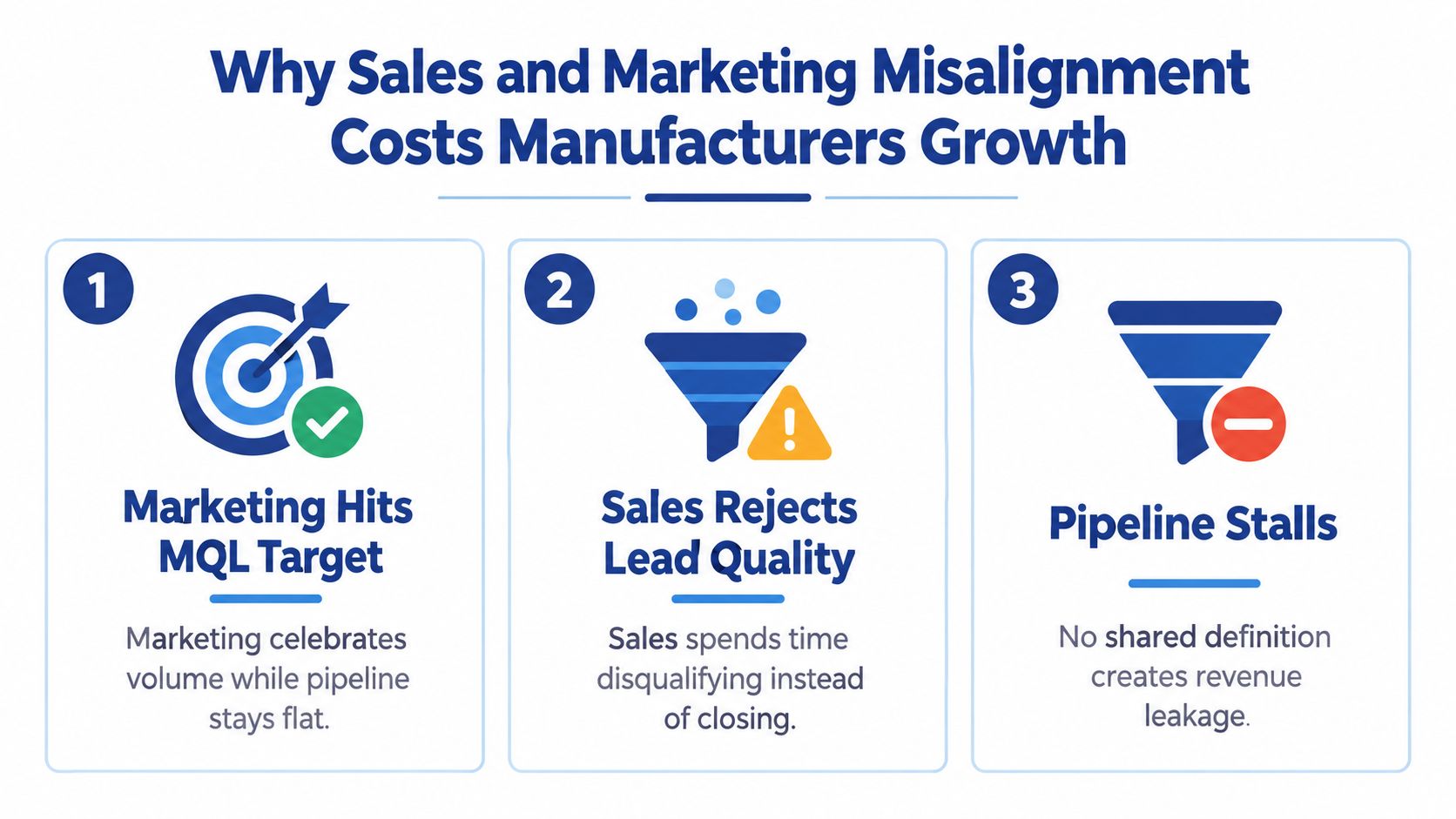
A major Forrester survey in Q2 2024 found that 65% of sales and marketing professionals believed there was a lack of alignment between the two functions, as summarized by SoPro's sales and marketing alignment statistics. For an industrial company, disconnected definitions can produce duplicated outreach, wasted campaign spend, missed stakeholders, and unclear ownership. The longer the buying cycle, the more opportunities exist for those gaps to distort account coverage.
Diagnose the leak before assigning blame
Trace one opportunity backward through the system before changing response-time targets. Ask:
- Targeting: Did sales and marketing agree that this company fits the ideal customer profile?
- Buying committee: Do both teams recognize the people who influence, approve, evaluate, and use the solution?
- Qualification: Which observable facts made this contact an MQL?
- Routing: Did the CRM assign the record to the correct territory, product specialist, or account owner?
- Follow-up: Can you see what happened after the account became eligible for sales action?
- Feedback: If sales rejected the lead, did the rep record a reason marketing can apply?
If the answers depend on memory, inbox searches, or spreadsheets, the funnel has a governance problem. Review why manufacturers struggle with marketing when demand generation is active but the commercial process around it remains disconnected.
Define the transformation in operational terms
Alignment means both teams target the same accounts and buying committees while retaining distinct responsibilities. Marketing needs a clear view of the accounts and roles sales can pursue. Sales needs the intent and content context marketing provides, then must return structured feedback instead of labeling every weak lead “bad.”
The same-account view should come before stricter handoff rules. Standardize account naming, buying-committee roles, qualification evidence, CRM ownership, and rejection reasons first. Once those foundations match, service-level agreements and response times can improve execution rather than accelerate conflicting workflows.
Analysts cited in the alignment benchmark summary report that aligned B2B organizations grow revenue 19% faster and are 15% more profitable than misaligned peers. Those figures do not guarantee an outcome for your company. They reinforce a practical point: alignment is a measurable operating lever, not a meeting-calendar objective.
Define Shared Goals and the Lead Lifecycle That Both Teams Trust
A manufacturer can shorten lead response time and still miss the account. Marketing may target engineers at companies sales does not cover, while sales pursues plants and buying groups absent from campaign planning. Alignment starts with a shared commercial outcome and the same-account view, then defines how each team contributes to it.
Set one target for revenue or qualified pipeline. Connect it to account coverage, buying-committee coverage, qualification stages, and next actions. A lead quota for marketing beside a revenue quota for sales creates local optimization. A shared target exposes the trade-offs, such as investing in broad reach versus concentrating on named industrial accounts with longer buying cycles.
Create a one-page lifecycle glossary in the CRM documentation. Keep it visible to both teams. Every stage needs entrance criteria, exit criteria, required fields, owner, and next action.
Use observable criteria for every stage
A practical manufacturing lifecycle can look like this:
- Subscriber: A contact opts into communication or engages with a resource. The contact is known, but the account or project has no confirmed commercial relevance.
- MQL: The contact and account meet agreed fit and interest criteria. Fit may include industry, application, geography, or company type. Interest may include repeated engagement with technical or commercial content. Define what constitutes a marketing qualified lead in terms the CRM can apply.
- SAL: Sales formally reviews the MQL and accepts it for active review, or returns it with a documented reason.
- SQL: Sales confirms enough buying intent, business relevance, and next-step evidence to justify active qualification.
- Opportunity: The account enters an active commercial evaluation with a defined problem, stakeholders, and a credible path toward a purchase decision.
- Customer: The deal closes won and contributes to the shared revenue outcome.
A formal SLA-style handoff can place a Sales Accepted Lead, or SAL, between MQL and SQL, allowing sales to confirm shared acceptance criteria before direct follow-up, as explained in Act-On's MQL guidance.
The SAL stage separates marketing qualification from sales acceptance. It gives both teams a record of the criteria, the acceptance decision, and the rejection reason. That prevents marketing from treating delivery as success while sales treats every poor-fit record as a generic bad lead.
Build a shared glossary your team can enforce
For each stage, document:
- Definition: What the label means in plain English.
- Required evidence: Fields or behaviors that must exist.
- Owner: The person responsible for the next action.
- Exit condition: What moves the record forward.
- Return path: What happens when the account is not ready or does not fit.
For industrial buying committees, qualify the account as well as the contact. A design engineer downloading a technical document may signal interest, but the record is more useful when it also identifies the company, application, role, likely project, and known stakeholders. Standardize account names, ownership, role labels, and rejection reasons before tightening handoff rules.
Have the marketing leader, sales leader, and CRM governance owner approve the glossary. A definition that one team can change alone will not remain trusted.
Use the following video as a practical discussion prompt with your team:
Build Lead Scoring and Routing That Makes Handoff Automatic
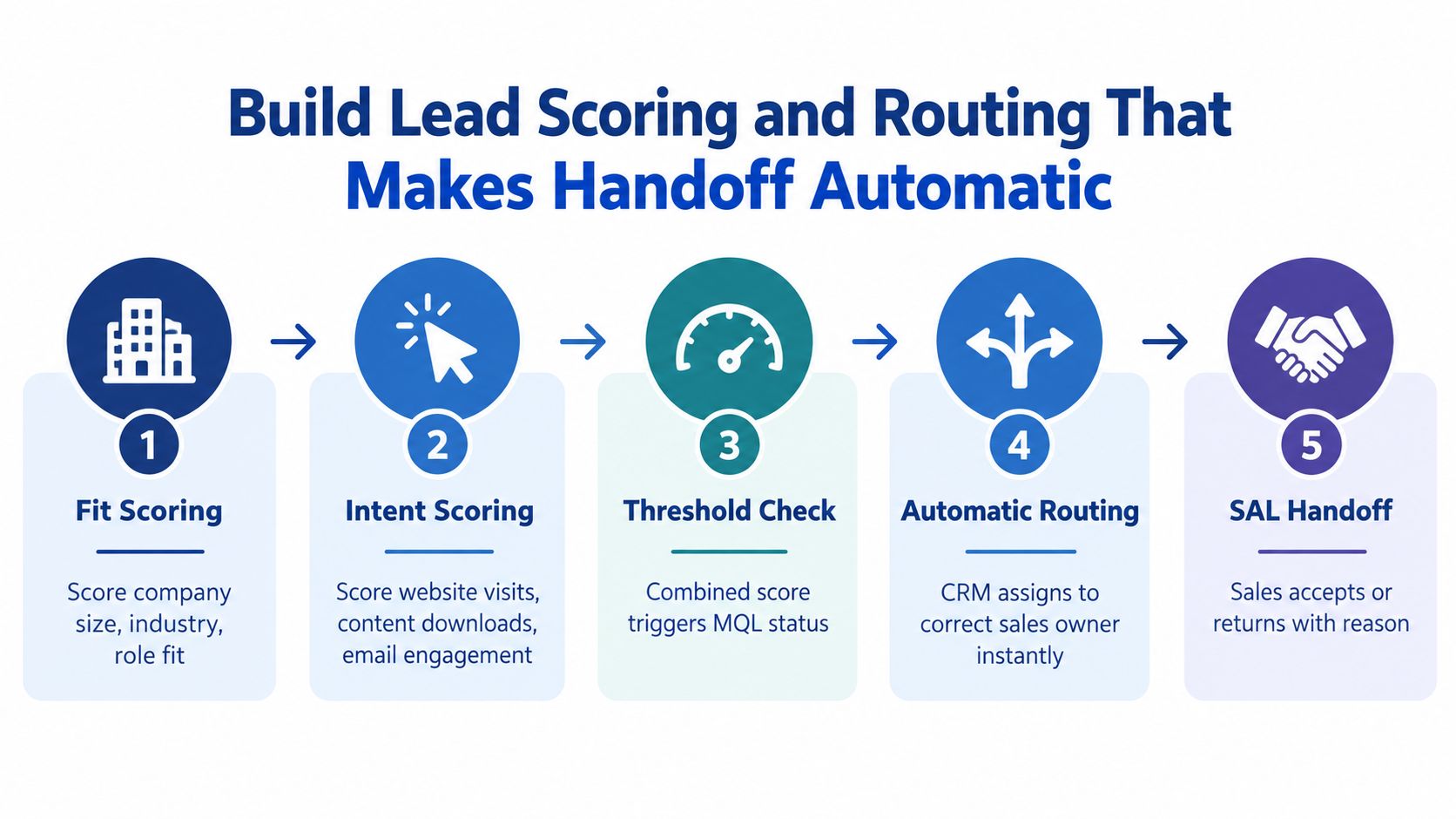
A lifecycle definition only works when your CRM can apply it consistently. The scoring model doesn't need to be complicated. It needs to distinguish fit, intent, and account context, then trigger a clear owner and action.
Start with two scores rather than one opaque number. A fit score answers, “Is this the kind of company we can serve well?” An intent score answers, “Is there evidence that this account or buying group is active now?”
Score fit and intent separately
Fit fields may include:
- Company profile: Industry, geography, operational model, and account type.
- Application relevance: The process, material, equipment, or service need.
- Role relevance: Engineer, operations leader, procurement contact, owner, or another defined buying role.
- Account priority: Whether the company is already a strategic target or assigned account.
Intent fields may include:
- Technical engagement: Visits to application pages, specifications, or engineering resources.
- Commercial engagement: Pricing, quote, consultation, or capability requests.
- Buying-group activity: Multiple known contacts from one account engaging around a related topic.
- Sales context: Existing opportunity, open project, previous conversation, or recorded timing.
Set the MQL threshold only after reviewing real records. The threshold should represent the point where marketing has enough evidence to request sales attention, not the point where a contact has merely interacted with a form.
If your team needs a deeper implementation reference, use this practical guide to build a lead scoring system before configuring weights in your CRM.
Route the account, not only the form fill
Routing should reflect how your sales team operates. Assign by territory if geography controls coverage, by product line if technical specialization matters, or by account ownership if named-account selling is already in place.
Before sending an alert, make the CRM check:
- Whether the contact belongs to an existing account.
- Whether that account already has an owner.
- Whether an opportunity is open.
- Whether another contact from the same company is active.
- Whether the record has enough data for useful outreach.
- Whether the account is excluded, duplicated, or already in a nurture path.
Same-account targeting becomes practical. Marketing and sales should see the same buying committee, engagement history, account priority, and missing roles. A single contact handoff can't provide that context.
In a 2026 survey of 500+ SMBs, aligned teams were 3.5 times more likely to report strong cross-functional data sharing, 59% versus 16%, while 23% of sales teams still cited poor handoff as a barrier, according to Unbounce's alignment research. The same source cites a benchmark in which 53% of companies had broken handoffs, with sales following up with fewer than 35% of marketing-engaged prospects. These figures point to a data-sharing and account-routing problem, not merely a response-time problem.
Keep the automation explainable
Every score and route should answer three questions: What caused this status? Who owns it? What happens next? If reps can't understand why a record was routed to them, they'll work around the automation.
Start with a small field set, review rejected leads weekly, and change one rule at a time. Over-engineering creates false precision. A simple model that sales trusts will outperform a complex model that nobody can explain.
For manufacturers evaluating the broader connection between CRM, automation, and qualification, AI lead qualification for manufacturing can provide a useful framework for deciding where automation belongs and where human review is still necessary.
Create Your SLA and Playbook With Response Times and Scripts
Your SLA should function like an operating agreement, not a document that gets approved and forgotten. It connects the lifecycle definitions to daily behavior by specifying the trigger, owner, response target, required action, feedback reason, and recycle path.
A manufacturing SLA should include:
- MQL definition: The fit, intent, account, and data requirements.
- Acceptance threshold: The score or qualification evidence required for sales review.
- Ownership rule: The person or team responsible for the account.
- Response target: The maximum time allowed before review or outreach.
- Acceptance action: The CRM status sales must select.
- Rejection reason: A controlled list such as poor fit, duplicate, wrong role, no project, or incomplete data.
- Recycle rule: The conditions that return the account to nurture or future review.
- Escalation path: What happens when an assigned owner misses the agreed action.
Some frameworks specify targets such as under 2 hours for high-scoring MQLs and under 24 hours for standard MQLs, as described in OliverList's SAL and MQL glossary. Choose targets your team can measure and enforce. A target that sounds impressive but can't survive travel, quoting work, or territory complexity will produce exceptions and mistrust.
Sample SLA Response and Ownership Matrix
| Lead Tier | Response Time Target | Owner | Required Action |
|---|---|---|---|
| High-intent target account | Same business day | Named account owner | Review account context, identify buying-group gaps, and begin the agreed outreach |
| High-scoring MQL | Under 2 hours | Assigned sales representative | Accept or return with a documented reason, then complete the first relevant touch |
| Standard MQL | Under 24 hours | Territory or product owner | Review fit and intent, accept, reject, or recycle using the approved status |
| Recycled account | Defined nurture review point | Marketing owner | Apply the reason code, update the nurture path, and set the next review trigger |
Benchmark data cited in an alignment framework reports that companies with a defined SLA responded within 15 minutes about 54.9% of the time, compared with 29.5% for companies without one. That is a 25.4 percentage-point difference, suggesting the agreement changes operational behavior, as reported in the Digital Applied SLA framework.
Give reps a playbook they'll actually use
The SLA says what must happen. The playbook shows how.
A first-touch script should reference the account's likely application or business issue, not just the form submission. For example: “You looked at our information about [application]. Are you evaluating a current production problem, planning a new capability, or gathering technical options?”
An email can use the same logic:
Subject: Question about your [application] project
You recently reviewed our material on [topic]. I'm reaching out because manufacturers usually look at this when they're addressing [specific operational issue]. Is that relevant to a current project, or are you researching for later?
Document the allowed cadence, the fields reps must update, the disqualification reasons, and the recycle timing. Then audit missed actions and rejected leads as process exceptions, not personal failures.
Measure What Matters and Run the Cadence That Keeps Teams Aligned
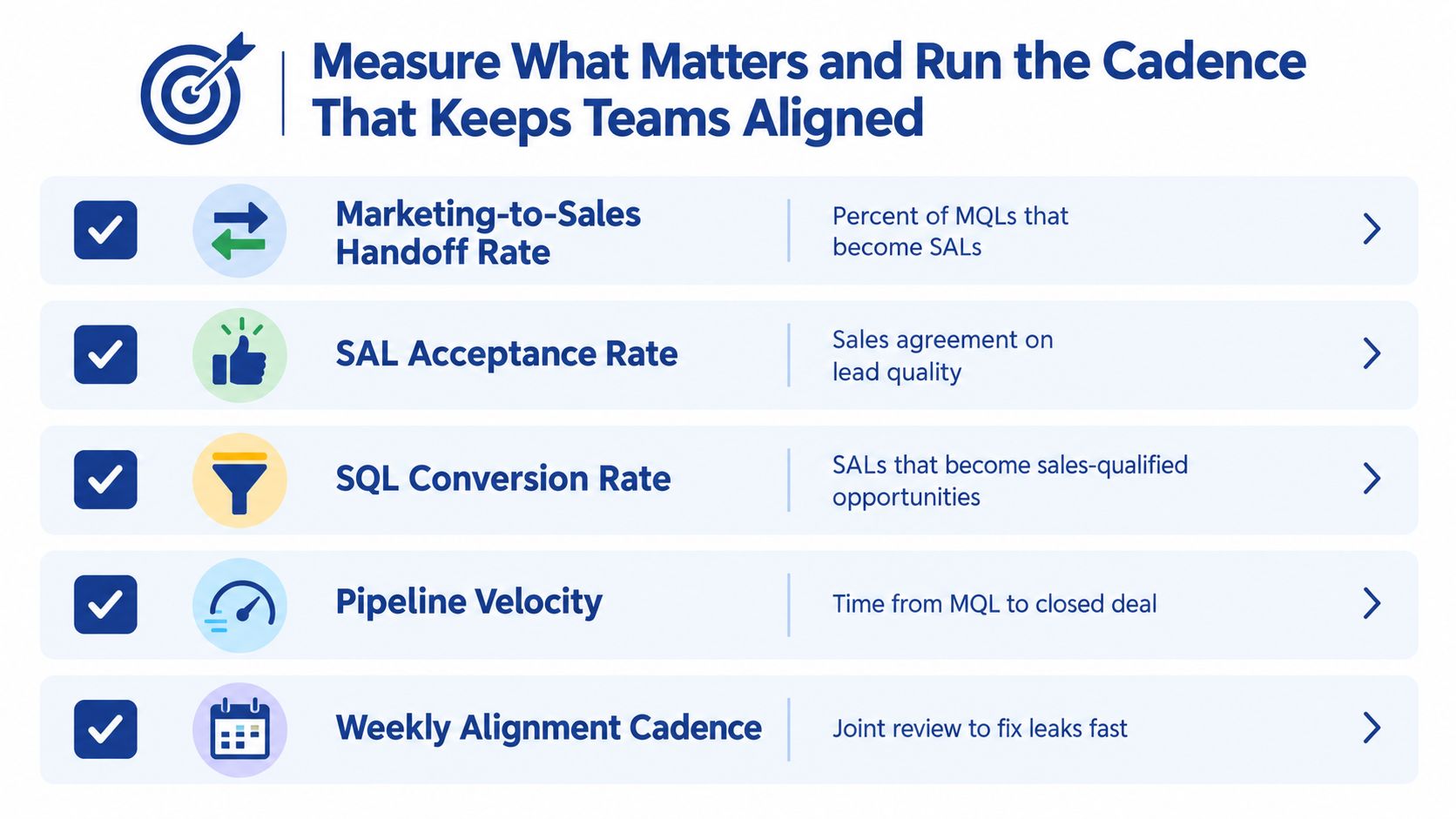
A shared dashboard should reveal whether both teams are working the same system. Local metrics still have a place, but they can't define success on their own. Marketing activity and sales activity must connect to account progression, pipeline, and revenue.
Track these shared measures:
- Marketing-to-sales handoff rate: The share of MQLs that receive a documented sales review.
- SAL acceptance rate: The share of reviewed MQLs sales accepts under the agreed criteria.
- Time to first touch: The elapsed time between eligibility and the first meaningful sales action.
- SQL and opportunity conversion: The movement from accepted lead to genuine sales qualification and active opportunity.
- Pipeline sourced and influenced: The opportunities connected to marketing activity, using one agreed attribution method.
- Content support by stage: The assets sales uses to address technical, commercial, and buying-group needs.
- Buying-group coverage: Whether the required stakeholder roles are identified and engaged on priority accounts.
Use 35% or higher handoff coverage for high-intent prospects as a health check, not as a guarantee of revenue. The benchmark framing is that organizations shouldn't call alignment complete until handoff, audience overlap, and content support are tracked as shared measures, as outlined in the 2025 sales and marketing alignment benchmarks.
Run meetings that produce decisions
A weekly alignment huddle should focus on active accounts, unaccepted alerts, stalled opportunities, missing buying roles, and SLA exceptions. The sales leader, marketing owner, and CRM or revenue operations owner should leave with named actions.
The monthly funnel review should examine stage conversion, response behavior, rejection reasons, pipeline contribution, and content gaps. Segment the discussion by product line, territory, account tier, or use case so a healthy area doesn't hide a broken one.
A quarterly SLA audit should test whether definitions, fields, routing, and targets still match how your business sells. Update the operating document when the company changes markets, products, territories, or sales capacity.
Look for the perception gap
One team may believe alignment exists because meetings happen and dashboards are shared. The other may experience missing ownership, incomplete account data, and inconsistent follow-up. Independent benchmark research surveyed 251 B2B sales and marketing leaders, with a reported margin of error of plus or minus 6.1% at a 95% confidence level, and emphasized shared revenue goals, explicit handoffs, and accountability mechanisms as practical alignment foundations, according to the DemandScience alignment benchmark report.
Ask each team to independently describe an MQL, SAL, target account, and accepted opportunity. Differences in those answers are diagnostic evidence. Fix the definition or workflow before asking people to work harder.
Your Next Step to Turn Alignment Into Consistent Pipeline
Alignment becomes durable when it has five connected parts: one revenue goal, one lifecycle, one account view, automated routing, and a governed SLA with shared reporting. You don't need to rebuild every system at once. You need to find the first break in the chain and repair it with a rule both teams can see.
Use this 30-day implementation checklist:
Days 1 through 7
- Interview sales and marketing separately.
- Compare their definitions of MQL, SAL, SQL, opportunity, and target account.
- Trace a sample of recent MQLs from source through sales action.
- List every missing field, duplicate account, routing error, and rejection reason.
Days 8 through 14
- Agree on one revenue outcome and the pipeline stages connected to it.
- Define the ideal customer profile and the buying roles that matter.
- Publish the lifecycle glossary with entrance, exit, ownership, and recycle criteria.
- Choose the SAL checkpoint and require a documented acceptance decision.
Days 15 through 23
- Configure fit and intent fields in the CRM.
- Match contacts to existing accounts before routing.
- Create ownership rules by territory, product line, or named account.
- Write the SLA matrix and the first-touch scripts.
Days 24 through 30
- Launch the shared dashboard.
- Review rejected and unaccepted records with both team leaders.
- Run the first weekly account huddle.
- Set the monthly funnel review and quarterly SLA audit.
- Change only the rules supported by observed process evidence.
The most useful question to ask yourself is simple: Can a sales rep and a marketer look at the same account today and agree on who is involved, why the account matters, what signal is active, and what should happen next? If they can't, improving campaign volume won't solve the pipeline problem.
Start with the diagnosis, document the system, automate the repeatable work, and inspect the results together. That's how alignment moves from a collaboration goal to a dependable commercial process.
Machine Marketing helps manufacturers and industrial businesses diagnose disconnected funnels, define shared lead and account processes, and build practical CRM and follow-up systems. Visit Machine Marketing to discuss a marketing audit or diagnostic review for your sales and marketing alignment.