
A plant manager says your system is too expensive. A buyer says now isn't the right time. Your answer in the next thirty seconds can decide whether the conversation moves forward or stalls. The problem is that these statements rarely tell you enough to act on. “Too expensive” might mean unclear ROI, an unapproved capital cycle, or concern about implementation risk. “Not now” might mean limited team capacity, missing internal support, or a polite attempt to end the discussion.
The strongest objection handling techniques start with diagnosis. We acknowledge the concern, ask a precise question, and identify whether the barrier is value, risk, authority, timing, budget, or technical fit. Then we choose a response that matches the cause instead of delivering a rehearsed rebuttal.
This approach is especially important in industrial sales, where equipment reliability, changeover downtime, compatibility, lead times, and committee approval can carry more weight than the initial price. Research based on approximately 35,000 sales calls helped establish this consultative approach, with high-performing salespeople exploring the buyer's problem and business impact rather than immediately countering objections (background on Rackham's objection-handling research).
The examples below give you exact words to use, clear trade-offs, and a practical way to record what happens next. If you want more perspective on building a solution-engineer mindset, explore this solution engineer growth podcast.
Table of Contents
- 1. The Question-Back Method
- 2. The Isolation Method
- 3. The Feel-Felt-Found Method
- 4. The Reframing Method
- 5. The Third-Party Validation Method
- 6. The Direct Denial Method
- 7. The Objection Reversal Method
- 8. The Problem-Solving Partnership Method
- 8 Objection-Handling Techniques Compared
- Match One Objection to One Technique This Week
1. The Question-Back Method
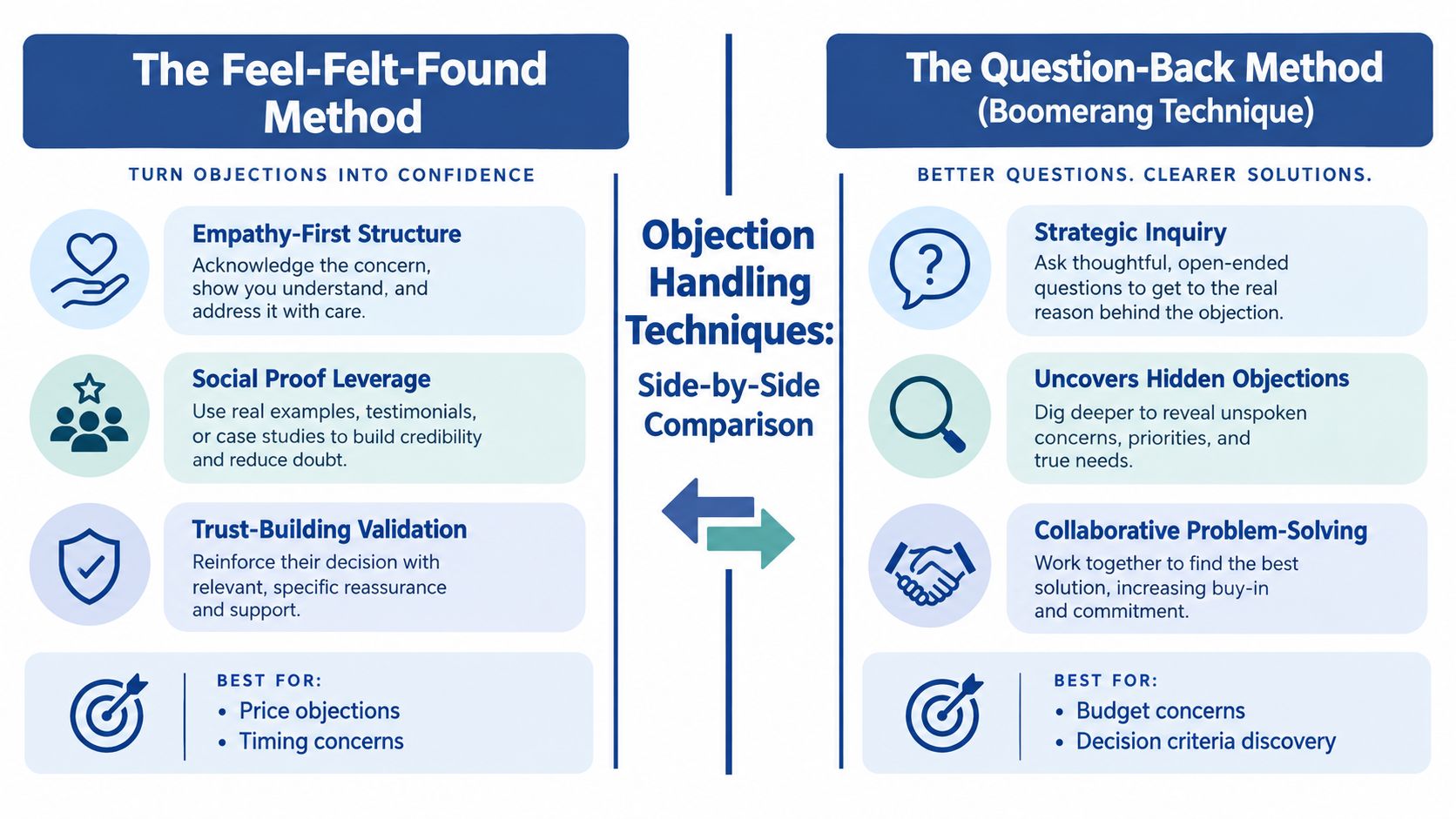
The question-back method turns an objection into a discovery prompt. Instead of defending your offer, you ask the buyer to explain what the concern means in their operating environment. That shift often reveals the issue beneath the wording.
Practical rule: Don't answer “too expensive” until you know whether the buyer means price, payback, budget authority, or perceived risk.
Suppose a prospect says, “Your solution is too expensive.” You can say:
“I hear you. Help me understand what would make the investment feel justified. Is the concern the total price, or do you need a clearer payback timeline?”
If they say, “We're not ready to implement,” ask:
“What does ready look like for your team? Is it bandwidth, budget approval, production planning, or something else?”
These questions work because they require thought. A yes-or-no question can produce another brush-off. An open question encourages the prospect to describe the constraint in their own language, which gives you better information for the next step.
Where this method fits
Use it early in discovery, especially when the objection is vague. It also fits industrial buying journeys where an engineer, plant manager, procurement lead, and owner may each use different language for the same concern. A technical buyer may say “compatibility,” while the owner is really asking whether the investment will pay back without disrupting production.
The trade-off is that questioning can feel slow when you already know the likely answer. Resist the urge to rush. Gong Labs analyzed 67,149 sales call recordings and found that average representatives responded to objections with an immediate monologue lasting 21.45 seconds. More successful representatives were more likely to clarify instead of assuming they understood the concern (Gong Labs' analysis of objection responses).
After the call, record the exact wording, the suspected root cause, the question you asked, and the next action in your CRM. Review those records by sales stage. If “price” repeatedly turns into “unclear payback,” your team needs a better ROI asset, not a faster discount.
For stronger discovery before objections surface, use this guide to what a discovery call is.
2. The Isolation Method
Industrial buyers often present several concerns at once. They may mention price, implementation time, reliability, integration, and internal approval in the same conversation. If you answer all of them with a long presentation, you may create more confusion and still miss the actual blocker.
The isolation method narrows the conversation. List the concerns, test them one at a time, and confirm which one controls the decision.
A useful response sounds like this:
“I hear three concerns: cost, implementation time, and the feature gap. If we can show a credible payback case, would cost still stop the project?”
If the buyer says no, continue:
“If we can agree on a phased deployment plan, would the timeline still prevent a next step?”
If that answer is also no, say:
“So the feature gap is the main decision point. Is that fair? Let's focus on what the system covers, what it doesn't cover, and whether that creates a genuine mismatch.”
This method prevents a common sales mistake, solving the easiest objection instead of the most important one. A plant manager who says a new system may not be reliable could be worried about the equipment itself, local support, maintenance response, or the personal risk of sponsoring a change.
Isolate before you prescribe
Use conditional language, but don't turn the conversation into a mechanical interrogation. Ask one question, listen, and watch which concern carries the most emotion or detail.
- Separate reliability from support: “Is the concern the system's track record, the availability of local support, or both?”
- Separate price from approval: “If the financial case is accepted, would the purchasing process still delay the project?”
- Separate timing from capacity: “If we reduced the implementation burden on your team, would the timing objection remain?”
The LAARC structure, Listen, Acknowledge, Assess, Respond, Confirm, provides a useful operating sequence because the assessment step stops you from answering surface wording before you understand the root cause (B2B objection categories and the LAARC framework).
This approach doesn't fit every brush-off. If someone says “send information” and clearly wants to end the conversation, don't force a full diagnosis. Use a short relevance test instead:
“I can send something useful. Which matters more right now, equipment reliability, changeover time, or investment justification?”
If they engage, continue. If they don't, respect the signal and log it accurately.
3. The Feel-Felt-Found Method
A plant team says, “We can't risk disruption during changeover.” At that point, Feel-Felt-Found can work well because it lowers friction without arguing with the concern. You show that you understand the risk, you point to a comparable case, and you explain what the buyer can reasonably expect next.
The method fails when reps use it like a script. “I understand how you feel, others felt the same, and they found it was fine” sounds evasive, especially in industrial sales where buyers are judging equipment reliability, support coverage, and the career risk of backing a change. If you use this technique, the example has to match the buyer's world.
Try language like this:
“I understand why a changeover plan would concern you. Other manufacturers have raised the same issue when a new system affected production scheduling. They found that a phased rollout gave them more control because each stage had a defined owner, test, and acceptance point.”
Then stop for a moment.
That pause matters because it gives the buyer room to correct you. Some buyers are worried about downtime. Others are really worried about whether the equipment will perform consistently after installation, whether operators will absorb training fast enough, or whether a budget committee will reject a project with unclear ROI. A simple follow-up keeps the conversation useful:
“Is the main concern the production interruption itself, or the proof you'd need to take this to the team?”
That small change keeps Feel-Felt-Found from blending into the isolation method. Here, the point is not to diagnose every branch of the objection. The point is to validate, present relevant proof, and then direct the next step.
The proof you use should be chosen with care. For reliability objections, use maintenance plans, service terms, test procedures, or references that reflect a similar operating environment. For changeover downtime, use rollout stages, ownership maps, training schedules, and acceptance criteria. For ROI questions, use total cost of ownership models and the assumptions behind payback. For committee objections, use a short decision document that lays out the problem, options, risks, and recommendation.
If you do not have a close match, say so plainly.
“We don't have a directly comparable reference yet. We can still define the acceptance criteria and test the fit before you commit.”
That may slow momentum, but it protects trust. It also gives your team something useful to record. Log the objection type in the CRM, note which proof asset you used, and track whether the next follow-up moved the deal forward. Over time, you can test which follow-up sequence works better for reliability concerns, downtime concerns, committee reviews, and unclear ROI.
4. The Reframing Method
A buyer says implementation will pull people off the line, the committee will ask for numbers you do not have yet, or the current setup has worked for years. Reframing helps when the objection is real, but the buyer is looking at only one slice of the decision.
Use it to widen the frame. Keep the facts the same. Change the decision from a flat yes or no into a question of conditions, risk, and fit.
Say a production manager tells you:
“Implementation will pull our team away from production.”
A useful response sounds like this:
“It will take team time. The decision is whether we can contain that impact well enough to justify the result. Let's break the work into phases, define where production could be affected, and agree on what has to be true before each phase starts.”
That wording fits industrial sales because downtime is rarely the argument on its own. The buyer usually wants control, visibility, and a way to defend the decision internally. Reframing gives them that without pretending disruption disappears.
The same approach works with a familiar objection:
“We've always done it this way.”
You can answer:
“That tells me the current process is stable and people know how to run it. The question is whether it still supports the output, quality, and handoffs you need next, or whether a targeted change would remove a recurring constraint.”
Notice the trade-off. Reframing is useful when the buyer is focused too narrowly. It is a poor fit when the objection is a hard factual gap, like a missing integration requirement or no acceptable service coverage. In those cases, you need proof or a corrective plan, not a better angle.
The emotional layer still matters. “We need to wait” can mean nobody wants to own the risk. “The system is new to us” can mean support reliability is unclear. “The ROI is not clear” can mean the budget committee will not accept soft assumptions.
Use direct language tied to the objection:
For changeover downtime: “We should decide whether the timing, sequence, and acceptance criteria make this manageable.”
For unclear ROI: “We should look at which assumptions the committee will accept and which ones need stronger support.”
For internal approval: “We should identify what your reviewers need to see before this can move.”
Test reframes in the field. I would run them past an engineer, plant manager, or operations lead who will call out anything that sounds slick. Then log the objection category in the CRM, note the reframe you used, and track what happened next. Over time, you can test which follow-up sequence gets better traction for reliability concerns, downtime risk, committee review, and unclear ROI.
5. The Third-Party Validation Method
A plant manager says, “I'm not risking a line stoppage on a supplier promise.” That is the moment for third-party validation.
This method works when the objection is credibility. The buyer does not need a better pitch. They need proof that stands outside your own claim and fits their operating conditions. In industrial sales, that usually means one of five things. A customer reference, an independent report, an industry standard, a test result, or a documented implementation example. The match matters more than the format.
Use it narrowly. If the concern is equipment reliability, bring evidence from a comparable operating environment, or a test record that shows how the equipment was evaluated. If the concern is changeover downtime, a reference call alone is usually too weak. You need a rollout sequence, acceptance criteria, and the conditions that must be true before anyone touches production. If the issue is unclear ROI or a budget committee that will challenge assumptions, give them a short business case they can carry internally, with costs, assumptions, risks, and expected operational impact.
Here is language that keeps the conversation grounded:
“You should not accept our claim at face value. Let's line up your requirements with the documented interface, service terms, and rollout conditions. If there is a gap, we will find it before anyone approves the project.”
Notice what this does. It lowers pressure and raises scrutiny. That is often the right trade-off with technical buyers.
Customer stories help, but only if they are accurate and permissioned. Do not pad them with neat outcomes you cannot support. If your team needs a cleaner way to document them, this guide to creating B2B case studies is useful. In the CRM, log the objection type, the evidence you sent, whether the buyer trusted it, and what follow-up sequence came next. Over time, you can test whether reliability concerns move faster after a reference call, whether downtime objections respond better to implementation documents, and whether committee objections need a different sequence entirely.
A simple question often opens the right path:
“Would it help to review a similar implementation, speak with someone who managed one, or examine the service and acceptance terms first?”
That gives the buyer options. It also tells you which proof they consider credible.
6. The Direct Denial Method
A maintenance lead says, “We tried this before. It caused downtime.” A procurement manager says, “Your option costs more.” Those moments call for direct denial only when the buyer is wrong on the facts and you can prove it. Use it to correct a specific claim, not to win an argument.
Start by lowering friction and narrowing the point:
“I can see why that would be the concern. On this project, the implementation conditions are different. Let's check the rollout steps, acceptance conditions, and what would need to happen to avoid production interruption.”
Then bring evidence that matches the objection. For equipment reliability, that may be a test record or service history. For changeover downtime, use the phased implementation plan and the conditions attached to it. For unclear ROI, use a total-cost-of-ownership view, but keep the comparison tight. For budget committees, show what is included in scope so the team is not comparing unlike options.
Deny the fact, not the experience
A buyer's past experience may be valid even when their conclusion about your proposal is off. Handle those separately.
If a plant manager says, “New systems always disrupt operations,” respond to the generalization, not the frustration:
“Your last rollout may well have caused disruption. The question is whether the same conditions exist here. Let's compare that implementation with this phased plan and the controls around changeover.”
If a buyer says, “Your price is higher,” do not deny the visible number. Deny the incomplete comparison:
“The listed prices may differ. Before we call it more expensive, let's compare scope, training, support, integration work, and operating cost.”
This method does not fit every objection. If you lack proof, if the buyer is describing trust problems, or if the issue is political approval inside a budget committee, use a different technique. Direct denial is strongest with technical buyers who want a clear correction and a document they can pass on internally.
Gong's call analysis, cited earlier, supports a simple behavior change here: ask a clarifying question before you explain, instead of delivering a long monologue. In practice, that means confirming what the buyer is comparing, what source they are using, and whether the objection is really about reliability, downtime, cost, or approval risk.
Log the result in the CRM after the call. Save the evidence used, note whether the buyer accepted the correction, and record what happened next. Then test your follow-up sequences. You may find that downtime objections respond to rollout documents, while ROI objections need a tighter financial comparison before the committee will engage.

7. The Objection Reversal Method
The objection reversal method examines the cost of leaving the current problem unresolved. It doesn't pressure the buyer to act. It asks whether the short-term discomfort of change is smaller or larger than the operational risk of staying with the current process.
A budget committee says, “We can't afford this right now.” You can respond:
“I understand that budget is a constraint. Let me ask it differently. If the current lead-generation or production problem continues, what does that create for your targets, capacity, or supplier risk? Which consequence would the committee care about most?”
A buyer says, “We're not sure this will work for us.” Try:
“That's fair. If the fit is confirmed through a technical review and a defined acceptance test, what operational improvement would make the project worth pursuing?”
This approach makes the buyer compare alternatives. Every decision has an alternative, including doing nothing, delaying, repairing the current process, or continuing to absorb manual work.
Keep the reversal grounded
The method becomes manipulative when you invent consequences or exaggerate urgency. Use the buyer's own priorities and documented operating context. If the buyer hasn't described a meaningful cost of inaction, ask before you state one.
- For changeover downtime: “What does the current changeover process limit during a busy production period?”
- For reliability: “What happens when an equipment issue remains unresolved longer than planned?”
- For unclear ROI: “What evidence would let the committee compare the investment with the cost of maintaining the current process?”
A useful sales conversation can expose a real trade-off without forcing a conclusion. The buyer may decide that waiting is sensible. That is still valuable information, because you can record the trigger that would change the decision.
Modern sales-call analyses challenge the idea that every objection is negative. One analysis of more than 224,000 calls reported win rates increased by nearly 30% when prospects raised objections, while another analysis reported objections in about 58% of discovery calls and roughly 75 to 80% of later demos or proposal reviews (sales-call objection statistics and context). These figures don't prove that every objection improves a deal. They do support treating concerns as engagement data when the buyer is willing to discuss them.
8. The Problem-Solving Partnership Method
The partnership method treats the buyer as the expert on their operation. You bring technical and commercial knowledge, but you don't pretend to understand the plant, machine shop, workflow, or approval process before examining it.
A prospect says, “Our workflow is unique. A standard CRM won't work here.”
Say:
“You may be right that a standard setup won't fit your process. Walk me through how work moves from inquiry to quote, production, delivery, and follow-up. We'll identify what can map directly, what needs configuration, and whether there's a genuine mismatch.”
That response creates a joint investigation. It also gives you permission to say the solution isn't suitable if the evidence points that way.
A buyer who has experienced an implementation failure may say, “We've been burned before.” Don't jump to a feature explanation. Ask:
“I appreciate you telling me. What specifically went wrong, and what would need to be different this time for you to feel confident?”
Then document the answer as acceptance criteria. If the previous project failed because ownership was unclear, assign ownership. If training was inadequate, define training responsibilities. If integration was assumed rather than tested, schedule a technical validation.
Collaborate with a defined outcome
Partnership doesn't mean endless discovery. Set a clear working session and finish with decisions.
- Map the current process: Capture systems, handoffs, delays, exceptions, and owners.
- Define success: Agree on the operational result, evidence required, and acceptance conditions.
- Test the fit: Identify what can be configured, what needs specialist work, and what won't be addressed.
- Document the next step: Assign each action to a person with a date and a decision attached.
This approach works best when you've built enough credibility for the buyer to share operational detail. If trust is low, start with relevant third-party validation or a limited technical review. If the evidence shows a poor fit, say so. “We're not the right supplier for this requirement” can protect the relationship and improve the quality of your pipeline.
Sales and marketing must use the same language for these concerns. This guide to aligning sales and marketing can help teams connect objection data with content, enablement, and follow-up. For teams improving outbound consistency, B2B prospecting automation for sales may also be relevant, but automation shouldn't replace diagnosis.
8 Objection-Handling Techniques Compared
| Method | 🔄 Implementation complexity | ⚡ Resource requirements & speed | 📊 Expected outcomes (⭐ effectiveness) | 💡 Ideal use cases | ⭐ Key advantages |
|---|---|---|---|---|---|
| The Question-Back Method (Boomerang Technique) | 🔄 Medium, requires practiced open-ended questioning and comfort with silence | ⚡ Low resources · Slower (longer discovery) | 📊 ⭐⭐⭐⭐ Uncovers root causes; improves diagnostic accuracy | 💡 Budget/timing objections, unclear ROI, discovery calls | ⭐ Reveals true objection, builds buy-in, reduces defensiveness |
| The Isolation Method (Condition-Based) | 🔄 Medium–High, systematic probing to separate issues | ⚡ Moderate resources · Moderate–slow (multiple clarifying steps) | 📊 ⭐⭐⭐⭐ Focuses effort on deal‑critical issues; qualifies prospects | 💡 Multi‑stakeholder deals, complex decision processes, stalled opportunities | ⭐ Prevents wasted effort, uncovers stakeholders, targets closing levers |
| The Feel‑Felt‑Found Method | 🔄 Low, formulaic three‑part structure (empathy → proof → outcome) | ⚡ Low resources · Fast to deploy in conversation | 📊 ⭐⭐⭐ Builds rapport; effective on price/timing and anxiety | 💡 Price objections, implementation fears, competitive comparisons | ⭐ Validates concerns, leverages peer outcomes, smooth transition to resolution |
| The Reframing Method | 🔄 High, needs creativity, emotional insight, and careful framing | ⚡ Low–Moderate resources · Moderate speed | 📊 ⭐⭐⭐ Shifts perspective; surfaces overlooked benefits | 💡 Change resistance, risk/uncertainty, perceived trade‑offs | ⭐ Non‑confrontational, reveals new value, reduces fear of change |
| Third‑Party Validation Method (Social Proof) | 🔄 Moderate, requires curated case studies and data assets | ⚡ Moderate–High resources to build assets · Fast when assets ready | 📊 ⭐⭐⭐⭐ High credibility; lowers perceived risk and adoption anxiety | 💡 ROI questions, implementation concerns, first‑time buyers, risk‑averse buyers | ⭐ Highly credible with analytical audiences; systematizable evidence |
| The Direct Denial Method | 🔄 Medium, must have ironclad evidence and tactful delivery | ⚡ Moderate resources (data, comparisons) · Fast resolution | 📊 ⭐⭐⭐ Quick, decisive rebuttal for factual or outdated claims | 💡 Technical misconceptions, competitive comparisons, factual errors | ⭐ Demonstrates expertise quickly; prevents prolonged false premises |
| The Objection Reversal Method (Negative Reverse) | 🔄 Medium, careful hypothetical framing required | ⚡ Low resources · Moderate speed (pauses for prospect reflection) | 📊 ⭐⭐⭐ Creates urgency by highlighting cost of inaction | 💡 Budget stalls, "we'll think about it", low‑urgency prospects | ⭐ Prompts prospect self‑realization, builds urgency without pressure |
| Problem‑Solving Partnership Method (Collaborative) | 🔄 High, collaborative discovery, co‑design, and longer dialogue | ⚡ High resources · Slow (time‑intensive, requires coordination) | 📊 ⭐⭐⭐⭐ Strong alignment; higher fit, retention, and reduced churn | 💡 Complex/custom implementations, relationship‑focused buyers, strategic deals | ⭐ Builds deep trust, surfaces true requirements, prevents misalignment |
Match One Objection to One Technique This Week
Objection handling improves when your team treats it as a system rather than a collection of clever replies. Start with the objection you hear most often. Write down the prospect's exact words, not your summary. “Too expensive” and “I can't defend this price to the committee” require different responses, even if both appear in the CRM as a price objection.
Then choose one technique that matches the likely cause:
- Use the Question-Back Method when the concern is vague or could have several meanings.
- Use the Isolation Method when the buyer raises multiple barriers.
- Use Feel-Felt-Found when you have a comparable customer resolution.
- Use Reframing when the concern is valid but the buyer hasn't considered the wider operational context.
- Use Third-Party Validation when trust or proof is the main gap.
- Use Direct Denial only when you have accurate evidence that corrects a specific assumption.
- Use Objection Reversal when the cost of inaction is relevant and can be discussed without pressure.
- Use the Problem-Solving Partnership when technical fit, workflow, or implementation risk needs joint investigation.
Write the opening sentence before the next call. For a reliability objection, it might be:
“I understand why reliability matters. What evidence would you need to feel comfortable that the system can perform in your environment?”
For a committee objection, try:
“Of course. What questions will the committee ask first, and which of those questions haven't we answered yet?”
For an unclear ROI objection, ask:
“Which outcome would make this investment defensible internally, and what baseline should we use to evaluate it?”
Log four fields after the conversation: the exact objection, the root cause, the evidence or technique used, and the agreed next action. Add the sales stage and stakeholder role if your CRM supports them. This lets you compare patterns across discovery, demos, proposals, and procurement rather than relying on individual memory.
Run the same variation in follow-up sequences, but change one element at a time. You might test a technical proof asset against a business-case summary, or a question-led follow-up against a direct recap. Don't claim a winning variation from one response. Look for repeated patterns across comparable opportunities, then update the relevant email, proposal section, FAQ, or sales playbook.
Self-service content matters because many B2B buyers want to evaluate without speaking with a representative. Gartner reports that 61% of B2B buyers prefer a rep-free buying experience, 73% avoid suppliers that send irrelevant outreach, and 69% see inconsistencies between a company's website and its salespeople (Gartner's B2B buyer survey). Your website, CRM, proposals, and sales conversations should answer the same objections in language that engineers, procurement teams, and owners can share internally.
Risk also deserves its own evidence plan. Research reports that 77% of buyers describe recent purchases as highly complex, while unclear pricing is a leading frustration. Separate 2025 buyer research identified a lack of pricing transparency as the top reported friction for 39% of respondents (B2B buyer complexity and pricing-friction research). Those findings support a practical conclusion: discounting won't solve every price objection. If the buyer fears execution failure, a lower price doesn't prove technical fit, supplier reliability, or implementation control.
Choose one objection this week, script one diagnostic question, and review the result with your team. Keep the technique that creates clearer decisions, not merely longer conversations. Remove the response that produces a polished explanation but no agreed next step.
Machine Marketing helps manufacturers, machine shops, and industrial business owners connect messaging, content, CRM, and sales processes so common objections are answered consistently. Visit Machine Marketing to discuss an objection-handling system built around your buyers, evidence, and next steps.
