If your business growth has stalled, the root cause is often a disconnect between what your business offers and how you're reaching customers. The purpose of modern advertising agency services is to diagnose and fix that disconnect, building a predictable system for generating leads and driving revenue.
In this guide, we'll break down exactly what services a modern agency provides, how to diagnose which ones you actually need, and what to look for in a partner who can build the growth engine your business deserves.
What Are Advertising Agency Services in 2026?
Are you thinking of an agency as just another line item on your expense sheet? A true agency partner functions as the architect for your company’s growth engine. When you hire one, you're not just buying ads; you’re bringing on a team to diagnose marketing issues, design a robust system, and execute a plan that consistently attracts and converts your ideal customers.
It’s the difference between random acts of marketing and running a predictable machine.
For results-driven business owners in sectors like B2B and manufacturing, this partnership is the first step toward getting clarity and seeing real, measurable progress. It all starts with a deep dive into your business to figure out what’s working, what isn’t, and where the opportunities are hiding.
From Jargon to Tangible Solutions
The advertising world loves jargon. Our job is to cut through the noise and translate confusing terms into tangible business outcomes. Instead of just "running ads," a true partner builds the entire operational framework needed to support your growth.
This system includes:
- Strategic Planning: We start by creating a detailed roadmap that ties every marketing activity directly to your revenue goals. A good plan ensures every dollar you spend has a clear purpose.
- Digital Marketing Execution: This is the hands-on work of getting your message in front of the right audience through the right channels, whether it’s SEO, paid advertising, content creation, or a mix of all three.
- CRM & Automation: We implement systems like a Customer Relationship Management (CRM) platform to manage your leads, automate follow-ups, and give you a crystal-clear view of your sales pipeline.

This integrated approach is more critical than ever. The US advertising agency industry hit $62.4 billion in 2023, with digital services alone shooting up by 12.3% to $25.3 billion. That massive shift proves that having specialized, system-focused support isn't just nice to have—it's essential for getting a strong return on your investment.
Building Your Growth Engine
So, what does this "growth engine" actually look like? Think of it as a machine where every part has a specific job. The goal of advertising agency services is to build and fine-tune this machine for you so it runs smoothly and produces consistent results.
A true agency partner doesn’t just sell you services; they build a system. They diagnose the points of failure in your customer acquisition process and engineer solutions that produce consistent, measurable results.
For instance, if your website traffic is low, the fix isn't just "more ads." The diagnosis might point to a combination of technical SEO to make your site more visible on Google and a content strategy that actually answers your customers' biggest questions.
If you’re getting leads but they never seem to close, the solution might involve building automated email and SMS follow-up sequences inside your CRM. This nurtures those relationships and keeps you top-of-mind until they're ready to make a decision. This is how marketing stops being a cost center and becomes a predictable source of revenue.
Mapping Agency Services to Your Business Goals
It's one thing to talk about services, but it's another to see exactly how they solve your specific problems. This table breaks down common business challenges and connects them to the agency services designed to fix them.
| Your Business Goal | Key Advertising Agency Service | What It Solves For You |
|---|---|---|
| Increase Brand Visibility & Awareness | Content Marketing & SEO | Puts your brand in front of customers actively searching for solutions on Google and other platforms. Builds authority and trust over time. |
| Generate High-Quality Leads | Paid Advertising (PPC) & Lead Magnets | Drives targeted traffic from platforms like Google and LinkedIn directly to your offers, capturing contact information from interested buyers. |
| Improve Sales Conversion Rates | CRM Implementation & Marketing Automation | Nurtures leads with automated follow-ups, ensuring no opportunity falls through the cracks and your sales team talks to warmed-up prospects. |
| Reactivate Old Leads or Customers | Email & SMS Marketing Campaigns | Re-engages your existing database with targeted offers and valuable content, turning past interest into new revenue without the cost of new acquisition. |
| Establish Industry Authority | Thought Leadership & PR | Positions your company leaders as the go-to experts in your field through articles, interviews, and strategic content placements. |
By aligning the right service with the right goal, an agency can create a focused strategy that delivers a measurable impact where your business needs it most. It's about applying the right tool for the job.
Diagnosing Your Needs with Core Agency Services
Not all advertising agency services are created equal, and you certainly don’t need every single one. The key is to diagnose your most pressing business problem and match the right service to solve it.
Think of it like an engineering diagnosis. We help you pinpoint the exact solutions that will deliver the most immediate and tangible impact. We don’t just sell a list of services; we identify the core friction point and build a specific system to resolve it. This is especially vital for B2B and manufacturing businesses, where every marketing dollar must be accountable and drive measurable results.
Problem: Low Website Traffic and Poor Online Visibility
Is your website a ghost town? If potential customers can't find you on Google, you're invisible right where it matters most. This is a classic challenge stemming from a site that isn't built to communicate effectively with search engines or your audience.
The solution is a two-part system: technical search engine optimization (SEO) and strategic content creation.
Think of technical SEO as tuning your car's engine. We get under the hood to fix structural issues, improve site speed, and make sure everything is configured for peak performance. This makes it easy for search engines like Google to find, understand, and rank your pages.
Once the engine is tuned, content is the fuel. We develop and publish articles, case studies, and guides that directly answer the questions your ideal customers are asking. This doesn't just attract them to your site—it establishes your authority and builds crucial trust.
- Diagnosis: Your website isn’t being found by qualified prospects during their research phase.
- Solution: A technical SEO overhaul paired with a consistent, valuable content strategy.
- Transformation: Your website becomes a magnet for organic traffic, steadily bringing in prospects who are actively looking for the solutions you provide.
Problem: Inconsistent or Low-Quality Leads
Are you getting leads, but they're a random mix of spam, unqualified inquiries, and prospects who quickly go cold? This is a clear symptom of a disconnected marketing and sales process. You’re missing a system to capture, filter, and nurture leads effectively.
The answer is a professionally configured Customer Relationship Management (CRM) system with automated lead nurturing. A CRM acts as the central nervous system for your entire sales process. We build a system that automatically captures every lead from your website, social media, and ads, then sorts them based on their potential.
A CRM isn't just a database; it's a machine for turning interest into revenue. By automating follow-ups, you ensure no lead is ever forgotten and that your sales team only spends time on conversations with genuinely interested prospects.
For example, when a prospect downloads a guide from your site, the CRM can automatically send a series of follow-up emails and even SMS messages over several weeks. This process educates them, builds a relationship, and keeps your brand top-of-mind, warming them up for a sales conversation without any manual effort from your team.
The demand for this kind of data-driven marketing is accelerating. Globally, the advertising agency service market is projected to grow from $1,148 million in 2024 to $1,937 million by 2032, a CAGR of 7.8%. This growth is fueled by the need for measurable ROI, making data-centric services like SEO and lead nurturing essential. You can read the full research about these market findings for more details.
Problem: Stagnant Customer Database and No Repeat Business
What about all those contacts already in your database—past customers, old leads, and lost proposals? For many businesses, this is a goldmine of untapped revenue just sitting dormant. The problem isn't the contacts; it's the silence.
The solution here is strategic email and SMS marketing campaigns. This isn't about spamming your list. It’s about segmenting your audience and re-engaging them with relevant, valuable information that sparks a new conversation.
We build campaigns designed to achieve specific goals:
- Reactivation: We target old leads who never converted with a new offer or a compelling case study that hits home.
- Upselling/Cross-selling: We inform past customers about new products, services, or maintenance plans that complement their original purchase.
- Building Loyalty: We share valuable industry insights and company news to keep your brand in front of your entire database, building long-term loyalty and trust.
This process turns your static contact list into an active asset. It’s one of the most cost-effective ways to generate new business because you're marketing to an audience that already knows who you are.
The Machine Marketing Method: Your 90-Day Growth Plan
How do you know if an agency can deliver? You shouldn't have to guess. We believe in complete transparency, so we're pulling back the curtain to show you what a structured, effective engagement process actually looks like. It’s a system we’ve built to create trust and deliver results right out of the gate.
The whole process starts not with a sales pitch, but with a diagnosis. Our comprehensive 40-Question Marketing Review is the foundation of our partnership. This isn’t busywork; it’s a deep dive into your business to align your vision and revenue goals with a concrete, actionable strategy. We ask the tough questions you should be asking to get a crystal-clear picture of where you are and where you want to go.
The Initial Diagnostic Phase
Think of this first stage like a doctor's visit. A good doctor doesn’t just write a prescription; they run a thorough examination to understand the root cause of the problem. That’s exactly what our marketing review does. We dig into your target audience, current marketing efforts, sales process, and technology stack.
This clarity is non-negotiable. Without it, any marketing is just guesswork. The insights from this review let us map out a clear path forward, ensuring every tactic we recommend is tied directly to a specific business objective. It’s how we turn ambiguity into a well-defined plan.
This timeline shows exactly how we move from diagnosis to execution, with clear milestones and measurable progress along the way.
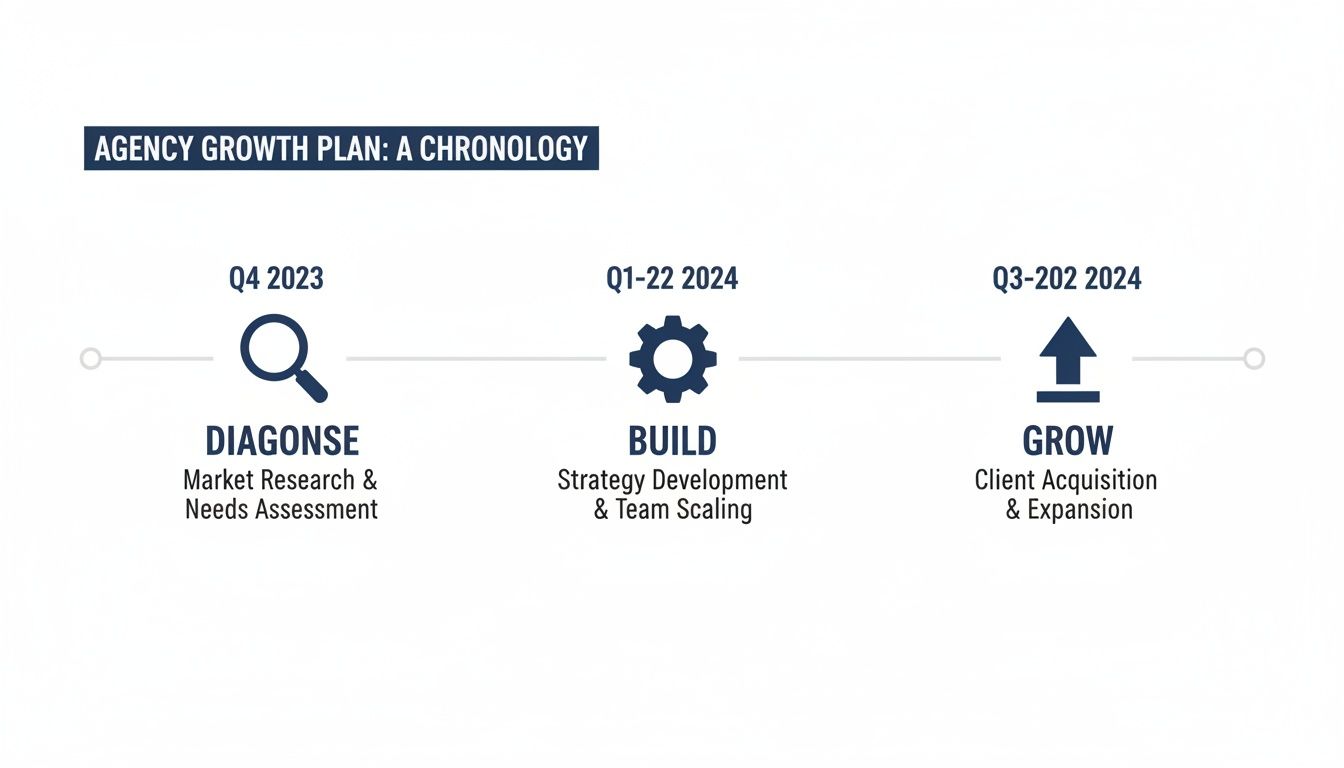
The bottom line is that a successful partnership starts with a structured plan. We move from understanding your business (Diagnose) to creating the necessary systems (Build) and then executing campaigns (Grow).
Your 90-Day Plan: Proof of Concept
The output of our diagnostic is your 90-Day Plan. This isn't a vague, high-level strategy document. It’s a detailed, week-by-week roadmap of what we will build, launch, and measure over the first three months. The plan is designed to achieve two critical goals: deliver early wins and prove the concept.
We focus on high-impact activities that generate momentum quickly. A typical plan might look like this:
- Weeks 1-4 (Build): Setting up or optimizing your CRM, configuring lead capture forms, and building foundational email automation. This is the essential infrastructure work.
- Weeks 5-8 (Launch): Kicking off a targeted lead generation campaign, like a paid ad push on LinkedIn or a focused SEO content effort around a key service.
- Weeks 9-12 (Optimize): Analyzing the initial data, refining ad creative or keywords, and reporting on leading indicators like new leads, website traffic, and engagement rates.
The 90-Day Plan is our commitment to you. It makes our work tangible and holds us accountable for delivering measurable progress in a short timeframe. It’s the ultimate test of a good agency partnership.
This approach demystifies the process of working with us. You will always know what we're working on, why we're doing it, and what results to expect. It replaces uncertainty with a clear, predictable system for growth. For owners looking to take their company to the next level, understanding how to scale a small business begins with exactly this kind of foundational planning.
This is what you should expect from any high-performing agency providing modern advertising agency services.
How to Choose the Right Agency Partner
Picking a partner to handle your advertising is a critical business decision. Get it right, and you gain a powerful growth engine. Get it wrong, and you can burn through cash with nothing to show for it.
The trick is to look past the slick sales presentations and think like an engineer. You're not just buying a service; you're vetting a team to diagnose problems, build solutions, and deliver measurable results. To do this right, you need a solid decision framework for choosing the right marketing agency to cut through the noise and compare your options systematically.
Question to Ask Yourself: What problem am I trying to solve?
Before you even start talking to agencies, get clear on this. Are you trying to:
- Generate more leads?
- Increase your brand's visibility?
- Improve your sales conversion rate?
- All of the above?
Knowing your primary goal helps you evaluate agencies based on their ability to solve your specific problem, not just on their list of services.
Look for Industry-Specific Expertise
Does the agency truly get your world? This is non-negotiable for B2B and manufacturing companies. Our sales cycles are longer, the customer journey is more complex, and the technical details matter. A generalist agency that just did a campaign for a local coffee shop won't understand your buyers.
Don't be afraid to put them on the spot. Ask about their direct experience with companies just like yours.
- Bad Answer: "Oh yeah, we've worked with B2B clients."
- Good Answer: "We helped a CNC machine shop boost their qualified leads by 40%. We did it by creating content that addressed the specific machining tolerances their customers were searching for. We know you have to talk to an engineer and a procurement manager in two completely different ways."
An agency that already speaks your language can hit the ground running. They won't waste your first three months (and your budget) just learning the basics of your industry.
Scrutinize Case Studies for Real Results
Every agency has a portfolio. But you need to look past the pretty designs and fluffy "vanity metrics." A 200% jump in social media engagement is worthless if it didn't generate a single lead or sale. You're running a business, and the only metric that truly matters is growth.
When they show you a case study, dig in with these questions:
- What was the exact problem you were hired to solve? A great case study starts with a clear diagnosis, not just a vague goal.
- What specific system did you build to solve it? You want to see the "how," not just a list of services they threw at the problem.
- What were the tangible business outcomes? Don't let them off the hook. Ask for the numbers that count: Marketing Qualified Leads (MQLs), Customer Acquisition Cost (CAC), and the total pipeline value generated.
Don't be swayed by pretty pictures. A true growth partner can connect every action they took directly to a measurable improvement in their client's bottom line. Their results should tell a story of transformation, not just activity.
Agency Evaluation Checklist
Before you sign any contracts, use this checklist during your interviews. It helps you compare apples to apples and make a decision based on facts, not just feelings.
| Evaluation Category | Key Question to Ask | What to Look For in the Answer |
|---|---|---|
| Industry Expertise | "Tell me about your experience with manufacturing/B2B companies like ours. What specific results have you achieved?" | They should provide specific examples, name-drop relevant client types, and use industry-specific terminology. Vague answers are a red flag. |
| Results & KPIs | "Can you walk me through a case study, from the initial problem to the final business results, including metrics like MQLs or CAC?" | A focus on business outcomes (leads, sales, pipeline value) over vanity metrics (likes, impressions). They should be able to connect their work directly to revenue. |
| Process & Systems | "What does your onboarding process look like? How do you manage projects and what can we expect for communication?" | A clear, documented process (e.g., 90-Day Plan), use of project management tools, and a set schedule for meetings and reporting. They should inspire confidence and stability. |
| Team & Culture | "Who, specifically, would be working on our account? Can we meet them?" | You want to know if you'll be working with the A-team you met in the sales pitch or a junior team. Look for alignment in communication style and work ethic. |
| Strategy vs. Tactics | "If we hired you today, what would be your first steps to diagnose our current marketing and sales performance?" | The best partners start with diagnosis and strategy first, before jumping to tactics like "run more ads." They should ask more questions about your business than you ask about theirs. |
Using a structured approach like this ensures you find a partner who is not only capable but is the right fit to help you build a predictable growth engine for your business.
Measuring Success With KPIs That Actually Matter
When it comes to advertising, results are everything. But it’s far too easy to get distracted by "vanity metrics"—flashy numbers like likes and shares that look great on a report but do little to actually grow your business.
Real success isn't about social media applause; it's about driving tangible growth. To get there, you must focus on the right kinds of numbers. Think of it like a game: you have the final score, and you have the individual plays that win the game.
Lagging Indicators: This is the final score. Metrics like total revenue or quarterly profit are the ultimate goals, but they’re slow to move and only tell you what happened, not why.
Leading Indicators: These are the game-winning plays. They're the real-time metrics that predict future success. A smart agency obsesses over these because they are the levers we can pull to directly influence the final score you care about.
From Vanity Metrics To Value Metrics
We build your marketing system to track the leading indicators that signal true business momentum. These are the numbers we live and breathe because they show us exactly what’s working, what isn't, and where we can optimize to improve your outcomes.
The most important question to ask any agency isn't "How many clicks did we get?" It's "How did those clicks contribute to our sales pipeline?" A true partner focuses on the entire journey, from the first click to the final sale.
For any business, there are a few core leading indicators that immediately tell the story:
- Qualified Leads: We don’t just count form submissions. We focus on contacts who match your ideal customer profile and show genuine buying intent.
- Conversion Rate: This is the percentage of website visitors who take a meaningful action, like requesting a quote or downloading a spec sheet.
- Customer Acquisition Cost (CAC): This is the total cost to land a new customer. Our job is to systematically push this number down over time, making your growth more profitable.
Tracking is only the first step. The real work comes from applying strategic conversion rate optimization best practices to make every dollar you invest work harder.
KPIs For B2B and Manufacturing
For manufacturers and B2B companies with long, complex sales cycles, the KPIs have to be even more dialed in. A single "lead" doesn't do justice to a buying journey that can span months and involve an entire committee.
That’s why we use a more granular approach, tracking metrics that show progress through your entire sales funnel:
Marketing Qualified Lead (MQL) to Sales Qualified Lead (SQL) Rate: This number is a direct measure of lead quality. It tells us what percentage of the leads we generate are good enough for your sales team to actively pursue. A high rate means we’re attracting the right decision-makers.
Pipeline Value Generated from Marketing: This is where the rubber meets the road. It’s a dollar-figure metric that shows the total value of potential deals that came directly from our marketing efforts. It draws a straight line from marketing spend to potential revenue.
Sales Cycle Length: How long does it take to convert a prospect into a customer? By tracking this, we can pinpoint bottlenecks and use tools like automated email nurturing to shorten the cycle and get you to revenue faster.
We track every one of these metrics in a system like GoHighLevel, giving you a live dashboard to see exactly how campaigns are performing. This level of transparency means you always know how your investment is paying off, turning your marketing from a cost center into a predictable engine for growth.
If you're ready for a deeper dive, you can learn more about the fundamentals of marketing analytics in our guide.
Straight Answers to Your Agency Questions
When you're considering bringing on an agency, you don't have time for vague promises. You need direct answers to make a smart decision for your business.
We get it. Here are the most common questions we hear from business owners just like you, along with our no-nonsense replies.
How Much Do Advertising Agency Services Cost?
This is always the first question, and for good reason. The honest answer: it depends entirely on the scope of work and the specific problems we’re solving. Agency pricing isn't a one-size-fits-all product off a shelf.
You'll typically see a few common pricing models in the industry:
- Monthly Retainers: The most common structure, usually ranging from $2,000 to $10,000+ per month. This covers ongoing work like SEO, content creation, and managing ad campaigns. This is best for a continuous growth system.
- Project-Based Fees: This is for a single, well-defined project. Think of a complete website overhaul or a CRM setup, which might run anywhere from $5,000 to $25,000.
- Performance-Based Models: In some specialized cases, an agency's fees can be tied directly to the results generated, like a certain number of qualified leads. This model isn't right for everyone, as it requires very clear tracking and agreement on what defines a "result."
We believe in total transparency. After our initial diagnostic call, you’ll receive a clear proposal outlining a detailed 90-Day Plan and the exact investment needed. No surprise charges, ever.
What Is the Difference Between an Ad Agency and a Marketing Agency?
The terms are often used interchangeably, but there's a world of difference. Traditionally, an "ad agency" focused purely on creating ads and buying media space to run them. A modern marketing agency, like Machine Marketing, builds the entire growth system for your business.
Think of it this way: an old-school ad agency sells you a fishing pole and wishes you luck. We’re the partners who survey the lake, find where the fish are biting, build you a better boat, and teach you how to fill it. We engineer a sustainable lead generation machine—from strategy and CRM setup to executing campaigns that actually move the needle.
How Long Does It Take to See Results From an Agency?
Building a predictable growth engine takes time, but you shouldn't have to wait forever to see progress. While some tactics like paid ads can drive traffic almost instantly, we design our partnerships for both short-term wins and long-term momentum.
You can expect to see leading indicators of success—like more website traffic, higher keyword rankings, and a noticeable flow of new leads—within our initial 90-day plan.
Game-changing results, like predictable revenue growth and a consistently lower cost to acquire a customer, typically build over 6 to 12 months. The system we build gains momentum and gets smarter as we collect more data, becoming more efficient and effective over time.
Do I Need an Agency if I Have an In-House Marketer?
Absolutely. In fact, this is one of our favorite scenarios. We love partnering with businesses that have talented marketing teams already in place.
An agency brings specialized expertise, access to enterprise-level tools, and a critical outside perspective that perfectly complements your internal team. We can handle the highly technical heavy lifting—like a full SEO overhaul or a complex CRM automation—which frees up your marketer to focus on what they do best, like creating great content and engaging with customers. It’s a powerful partnership that drives growth faster than either team could on their own.
Ready to stop guessing and start building a predictable system for growth? At Machine Marketing, we help business owners like you diagnose your marketing challenges and implement a clear plan for success.
Book your no-obligation discovery call with Karl today to see how our engineering mindset can build your growth engine.