If you run a B2B company, you may already know the pattern. Referrals carry one quarter. Trade shows help another. Then the pipeline goes thin, your sales team starts chasing cold lists, and marketing gets blamed for inconsistency.
Most of the time, that is not a lead problem. It is a systems problem.
B2B digital marketing works when you stop treating it like a pile of tactics and start treating it like a machine. Inputs, routing, handoffs, measurement, and feedback loops all matter. That is especially true now that the global B2B eCommerce market was valued at $32.11 trillion in 2025 and is projected to reach $36.16 trillion by 2026 according to SellersCommerce. Buyers are already moving online. If your process still depends on manual follow-up, disconnected tools, and vague messaging, competitors with tighter systems will win the easier deals first.
We see this often with manufacturers, technical service firms, and niche SMBs. Good businesses with solid delivery struggle because their marketing has no central logic. Their website says one thing, their sales emails say another, and nobody can tell which channel produces revenue.
A better approach is to build a repeatable operating system for demand generation. If you want a strong companion framework, this lead generation blueprint to build a predictable B2B pipeline lays out the logic behind consistent pipeline creation. For a related view on attracting and converting the right prospects, our team also recommends reviewing this guide on https://machine-marketing.com/inbound-marketing-lead-generation/.
Stop Guessing and Start Building Your Lead Generation System
Random acts of marketing create random results.
A company publishes a blog post when someone has time. Sales sends follow-up emails when inboxes are quiet. Ads run for a month, then stop when nobody is sure what happened. That is not a strategy. It is motion without control.
What a real system looks like
In b2b digital marketing, a functioning lead generation system has five parts:
- A defined audience. You know which companies you want, which roles matter, and what buying problem triggers urgency.
- A message map. Your website, emails, ads, and sales calls speak to the same commercial pain points.
- Channel roles. SEO attracts, email nurtures, paid media accelerates, CRM automation routes follow-up.
- Operational handoffs. Leads do not sit in inboxes. They move into a sequence, a pipeline, or a task queue.
- Measurement. You track what creates qualified conversations, not just traffic spikes.
If one of those parts breaks, the whole machine underperforms.
Practical rule: If your team cannot explain how a lead moves from first click to booked meeting in under two minutes, the system is too loose.
Common failure points we diagnose first
Many B2B firms do not need more tactics. They need fewer gaps.
- Unclear targeting: Everyone is a prospect, so messaging becomes generic.
- Weak offer structure: The website asks for a call before trust is built.
- Poor lead routing: Form fills sit in email inboxes instead of entering a CRM workflow.
- No nurture layer: Prospects who are not ready now disappear.
- Vanity reporting: Teams celebrate impressions while pipeline quality drops.
The fix is not more activity. The fix is tighter design.
What B2B Digital Marketing Is and Why It Needs an Engineer
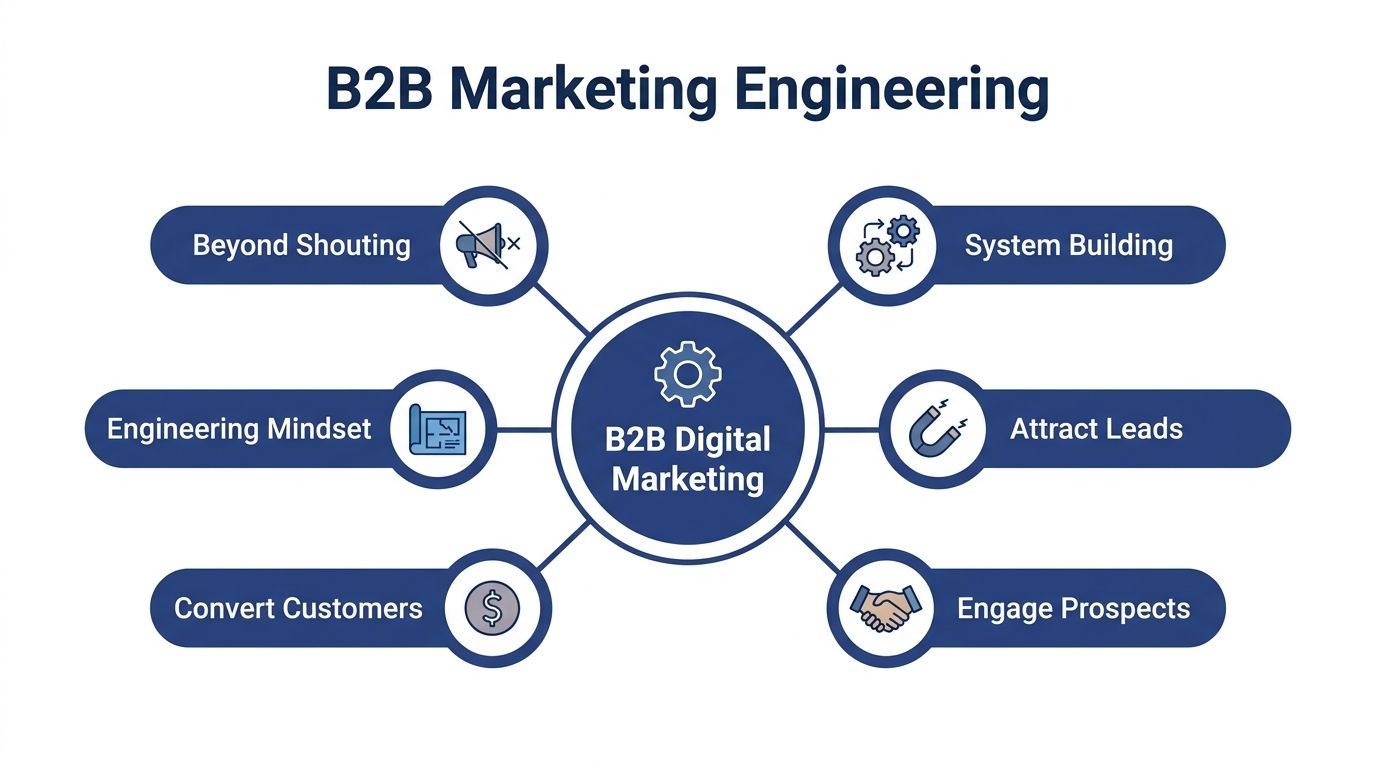
B2B digital marketing is the coordinated use of online channels to attract, qualify, nurture, and convert business buyers. That sounds simple until you deal with the complex buying environment.
B2B sales usually involve more than one stakeholder. Technical reviewers care about fit. Operations cares about implementation risk. Finance cares about cost control. Leadership cares about confidence and timing. Your marketing has to support all of them without creating confusion.
Why B2B is different from B2C
In B2C, a buyer might see a product, compare a few options, and purchase quickly. In B2B, the path is slower and less linear. A prospect may read your site, ignore you for months, return through search, open one email, talk to a sales rep, then pull in two other stakeholders before any decision happens.
That is why an engineering mindset matters. You are not trying to make one ad go viral. You are designing a system that keeps working across long sales cycles and multiple touchpoints.
The tension in modern B2B is clear. 82% of buyers want a B2C-like digital experience, yet over 50% actively seek niche specialists, according to Mario Peshev. Buyers want smooth, fast, intuitive journeys, but they also want vendors who understand their exact use case. Generic messaging loses on both fronts.
Your ICP is not a slogan
A strong Ideal Customer Profile (ICP) is the design spec for your marketing machine.
An ICP should answer questions like:
- Which industries do you serve best?
- What company size fits your delivery model?
- What problems create urgency?
- Which buying roles usually influence the decision?
- What disqualifies an opportunity early?
Without that, content drifts and paid media gets expensive.
Personas matter when they are operational
Buyer personas often fail because teams make them too soft. Keep them practical.
Use personas to document:
| Persona element | What to capture |
|---|---|
| Role | Job title or function involved in the decision |
| Primary concern | What risk or result this person cares about most |
| Common objection | What typically slows approval |
| Evidence needed | Specs, examples, workflow detail, budget logic |
| Preferred next step | Demo, audit, quote, call, site visit |
This is not branding theater. It is routing logic for your content and follow-up.
Questions to ask before you launch anything
Before spending on campaigns, ask:
- Are we targeting the buyers we can close profitably?
- Does our website explain outcomes in industry language?
- Do we have content for both technical and commercial stakeholders?
- Is there a clear path from inquiry to follow-up?
- Can sales see the lead history before making contact?
If the answer is no on several of those, your marketing does not need more traffic yet. It needs better design.
The Core Channels of Your B2B Marketing Engine
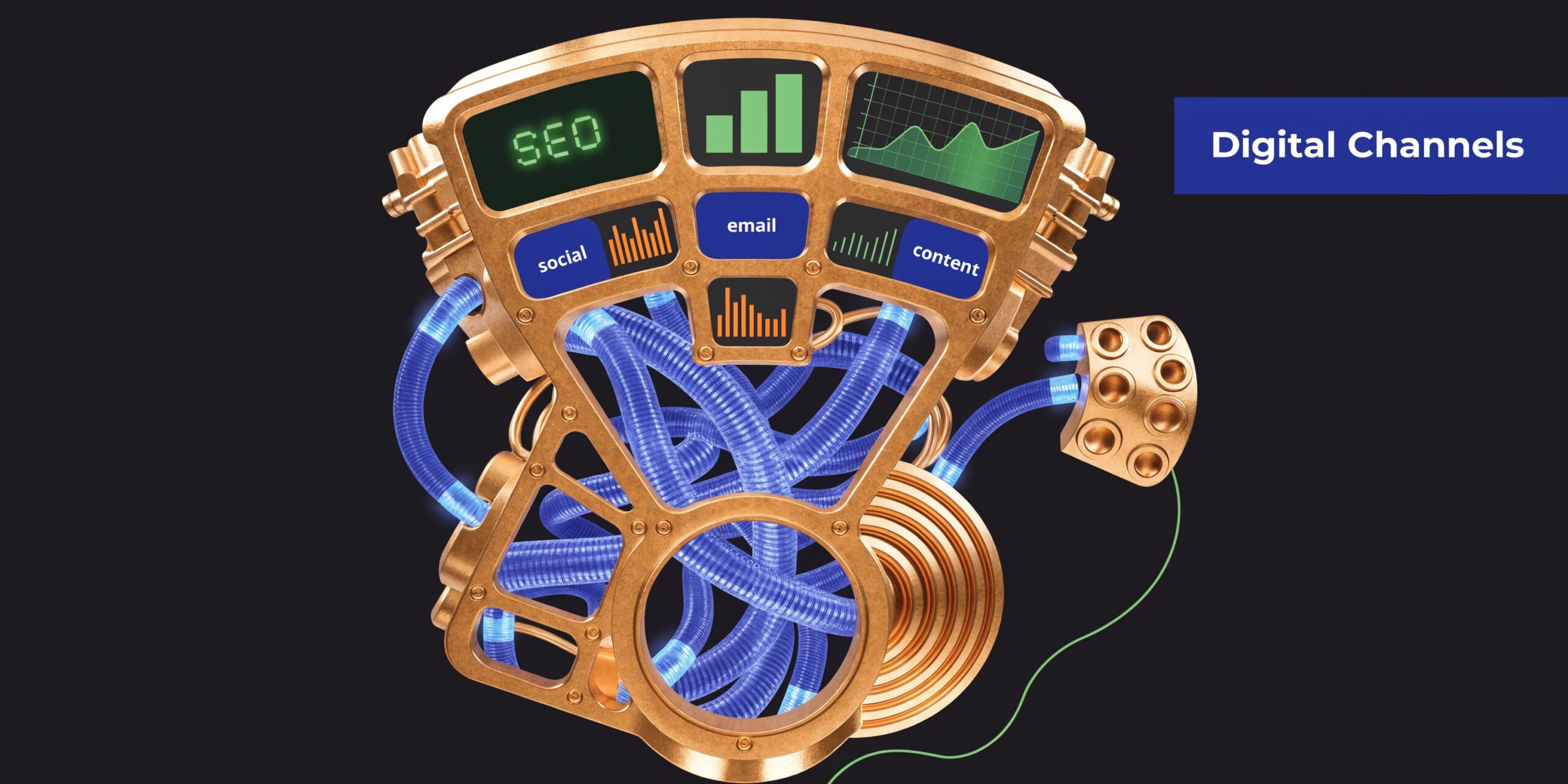
Most channel problems are really integration problems. SEO, email, paid media, content, and social all have value. They fail when teams run them as separate activities with separate goals.
Attraction channels bring the right buyers in
Search and content do the heavy lifting at the top of the funnel.
For B2B companies, especially manufacturers and technical service firms, this means publishing material that answers real buying questions. Not broad motivational content. Not vague trend summaries. Buyers respond to useful specificity.
Good attraction content often includes:
- Problem pages: Explain issues your buyers are trying to fix.
- Service pages: Clarify scope, fit, process, and outcomes.
- Comparison pages: Help buyers understand options and trade-offs.
- Technical explainers: Address specs, implementation, compliance, or maintenance questions.
- Case-led proof pages: Show the work, the context, and the process.
A common mistake is producing content that sounds polished but says nothing. If a plant manager, operations lead, or technical buyer cannot learn something actionable from the page, it will not help much.
Engagement channels keep opportunities alive
Email remains the strongest direct-response channel in many B2B environments. 77% of B2B buyers prefer email for outreach, and 50% of U.S. B2B marketers rate it as the most impactful channel in their multichannel strategy, according to DBS Website.
That matters because many B2B deals do not close on first contact. Prospects go quiet. Committees change. Priorities shift. Email gives you a controlled way to stay present without forcing a sales call too early.
What effective email nurture looks like
A useful nurture sequence does not just “check in.” It moves the prospect forward.
Try a structure like this:
Response email
Confirm the inquiry, restate the problem discussed, and set expectations.Proof email
Send a short example, use case, or process explanation tied to their industry.Objection email
Address a common concern such as implementation burden, switching risk, or timing.Decision email
Offer a defined next step. Demo, audit, review call, or scoped estimate.Reactivation email
Reopen the conversation later with a relevant trigger or operational insight.
SMS can support this process for appointment reminders or simple confirmations, but it should be used carefully in B2B. For many firms, email carries the heavier relationship-building role.
Tip: If your nurture emails could be sent to any industry and still make sense, they are too generic.
Amplification channels create speed
Paid media helps when you need targeted visibility faster than organic channels can provide. LinkedIn often fits B2B because of job-title and firmographic targeting. Paid search can work well when buyers already know the problem they need solved.
Use paid media for narrow objectives:
- Promote one strong offer.
- Test one audience segment.
- Validate one message angle.
- Retarget visitors who already engaged.
What usually fails is broad targeting paired with broad messaging. A generic ad to a broad audience creates expensive traffic and weak intent.
Social should support trust, not replace strategy
Social media in B2B is often overrated when used as a standalone lead source. It becomes useful when it reinforces expertise and keeps your brand visible during long buying cycles.
For example:
- Sales reps can share short technical insights tied to common buyer questions.
- Leadership can comment on operational issues in the market.
- Project photos, process clips, or behind-the-scenes content can increase trust.
- Customer proof can be repurposed into lightweight posts that validate your positioning.
Think of social as credibility distribution. Not the whole engine.
Channel selection by business situation
| Situation | Priority channels |
|---|---|
| New market entry | Paid media, targeted landing pages, outbound email support |
| Long sales cycle | Email nurture, remarketing, educational content |
| Technical product sale | SEO, spec-driven pages, case-led content, sales enablement email |
| Local B2B service | Local SEO, Google Business Profile, email reactivation, review requests |
The key is role clarity. Search captures intent. Content builds trust. Email nurtures. Paid media accelerates. Social validates. CRM automation ties them together.
Measuring What Matters B2B Marketing KPIs
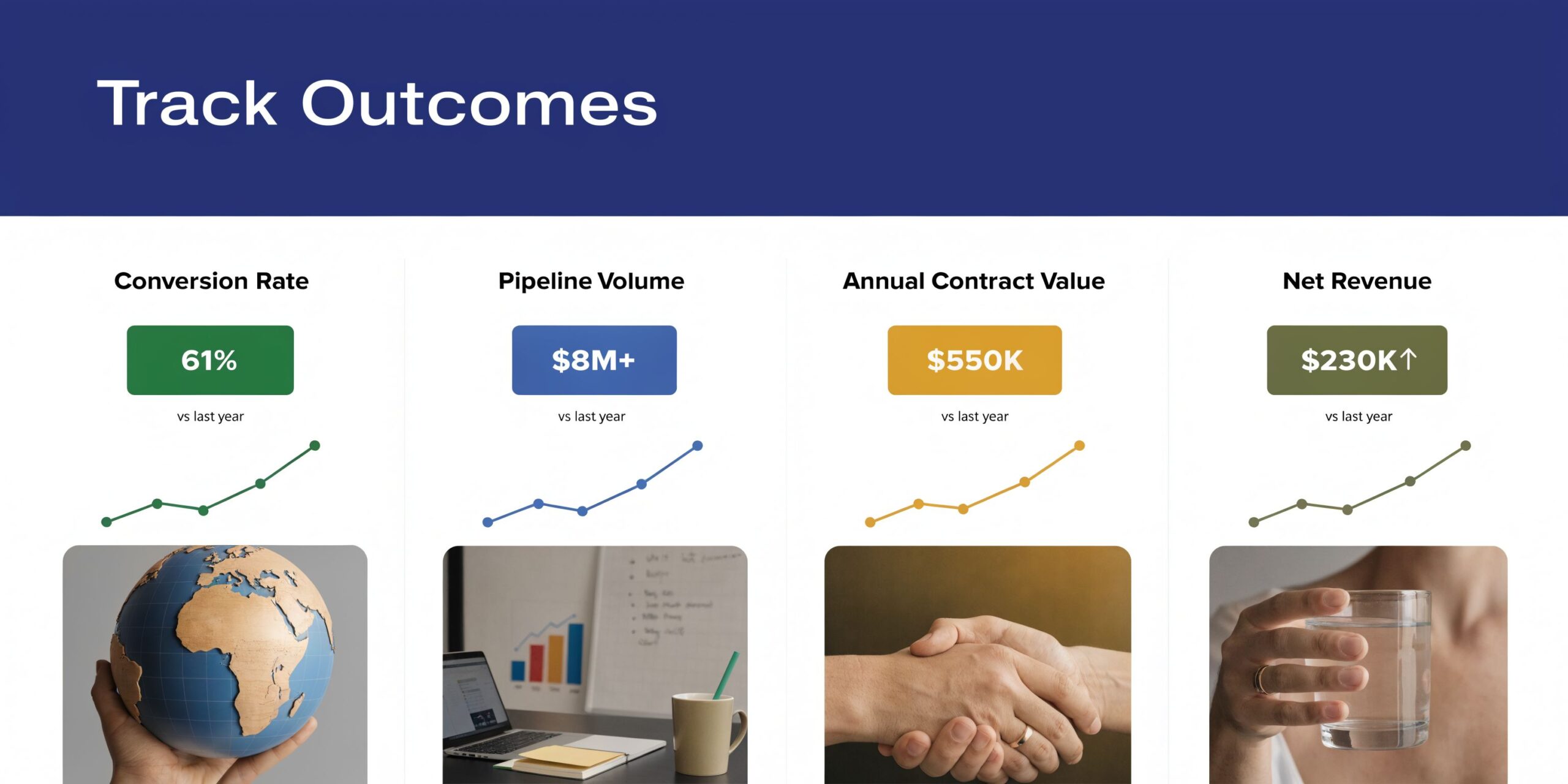
A lot of B2B reporting is decorative. Dashboards look busy, but nobody can answer the only question that matters. Are we buying pipeline efficiently?
Stop leading with vanity metrics
Traffic, impressions, likes, and follower growth are not useless. They are just incomplete. They tell you activity happened. They do not tell you whether the system is healthy.
Business owners should care more about:
- Customer Acquisition Cost
- Customer Lifetime Value
- Marketing Qualified Leads
- Sales Qualified Leads
- Pipeline velocity
- Lead source quality
If your team cannot tie campaigns to these, you do not have a measurement system. You have channel reporting.
The KPI dashboard that helps decisions
The average Customer Acquisition Cost for a B2B SaaS company is $702, and a healthy business typically aims for a CLV-to-CAC ratio of at least 3:1. The same source notes that integrating intent data and CRM automation can reduce CAC by 20-30%. Those benchmarks come from Intentsify.
Even if you are not a SaaS company, the lesson still applies. CAC is a pressure gauge. If it rises while close rates fall, something is off in targeting, qualification, offer structure, or follow-up timing.
A practical KPI dashboard should answer:
| KPI | What it diagnoses |
|---|---|
| CAC | Whether acquisition spend is efficient |
| CLV | Whether the customer relationship justifies the spend |
| MQL to SQL movement | Whether marketing is sending viable opportunities |
| Pipeline velocity | How quickly opportunities move through stages |
| Demo or quote to close rate | Whether sales conversations convert |
The strongest teams review these together, not in isolation.
What to do when a metric goes bad
A metric only matters if it triggers action.
- If CAC climbs, check audience targeting, lead quality, and handoff delays.
- If MQLs rise but SQLs stall, tighten qualification criteria or fix messaging.
- If pipeline velocity slows, review bottlenecks in follow-up and proposal flow.
- If CLV is weak, look beyond acquisition and improve onboarding, retention, or account expansion.
For a practical view on modern answer-engine and search measurement, this guide on how to measure AEO results and the B2B tracking stack is useful. We also recommend building your reporting discipline around https://machine-marketing.com/what-is-marketing-analytics/ so your team can separate signal from noise.
A short explainer can help your team align on the basics before building the dashboard:
Key takeaway: The purpose of reporting is not to prove marketing stayed busy. It is to show where the machine loses money or gains efficiency.
Your Tech Stack The Central Nervous System
Disconnected tools create silent failure.
A lead fills out a form on the website. The notification goes to one inbox. Sales does not see it until the next day. No nurture sequence starts. No task is created. No source is tracked properly. A week later, everyone says lead quality is poor.
That is not a lead quality issue. That is a routing issue.

What the stack needs to do
Your core stack should connect four functions:
Capture
Website forms, landing pages, chat, call tracking, and manual imports.Organize
A CRM that stores contact records, company details, activity history, and pipeline stage.Automate
Email sequences, SMS reminders, internal tasks, lead scoring, and status updates.Report
Source attribution, conversion rates, campaign performance, and stage movement.
If those functions sit in separate tools with weak handoffs, your system gets brittle fast.
A simple workflow that works
For many B2B firms, a CRM-centered workflow can be straightforward:
- A buyer submits a quote request or consultation form on the website.
- The form pushes the contact into the CRM with source tagging.
- The contact enters a customized email sequence based on service line or industry.
- If the prospect clicks key pages, replies, or books time, the system flags intent.
- A sales rep gets a task with context before making contact.
- If the opportunity goes quiet, the CRM moves it into a reactivation track instead of letting it disappear.
Here, platforms like GoHighLevel become useful. They combine CRM, automation, forms, pipelines, email, and SMS in one environment. Machine Marketing also implements GoHighLevel-centered systems for companies that need CRM setup, workflow customization, and integrated follow-up. The point is not the brand name. The point is centralization.
What to look for in a CRM setup
Use this checklist when reviewing your stack:
- Single record view: Can sales see inquiry source, page views, and prior messages in one place?
- Pipeline discipline: Are deal stages defined clearly enough to support reporting?
- Automation logic: Do high-intent actions trigger internal follow-up immediately?
- Segmented nurture: Can different audiences receive different messaging paths?
- Maintenance reality: Can your team manage this without constant manual patching?
For a broader framework on tool selection and integration, review https://machine-marketing.com/marketing-technology-stack/.
A central nervous system does one job well. It routes signals quickly so the rest of the body can act. Your marketing stack should do the same.
Proven B2B Tactics for Manufacturers and Niche SMBs
Generic advice breaks down fast in specialized industries. A machine shop, industrial service firm, waste operator, cybersecurity provider for SMBs, and local maintenance company do not need the same content or follow-up logic.
That gap creates opportunity. Niche B2B targeting in underserved sectors like manufacturing and specialized services yields 10-15% higher conversion rates than generic campaigns, according to Bain. The same point matters even more in practice. Buyers in niche sectors can tell immediately whether you understand their environment.
For manufacturers
A manufacturer usually does not win with polished generalities. It wins with relevance.
One practical playbook looks like this:
Build technical authority pages
Create pages around machine reliability, tolerances, downtime reduction, maintenance intervals, integration requirements, or production fit. Buyers often need clarity before they need persuasion.Use ABM for named accounts
If you already know the companies you want, build account-specific outreach around their vertical, equipment context, or operational constraints. A generic contact-us path is often too weak for strategic accounts.Create sales content for engineers and non-engineers
Technical evaluators need detail. Financial buyers need confidence. Operations leaders need implementation clarity. One asset rarely serves all three.Reactivate old quotes and dormant contacts
Many industrial firms have years of stale opportunity data. Segment it, clean it, and run re-engagement sequences tied to current service capacity or product updates.
Tip: Manufacturers often hide their best value in sales calls. Pull that detail forward into the website and nurture flow.
For service-based niche SMBs
A local or regional B2B service business often has a different problem. The business is known, but the digital layer is weak.
A common scenario looks like this. The company gets referrals and repeat business, but its website is dated, Google Business Profile is neglected, and past customers never hear from it unless a rep remembers to reach out.
A better operating model includes:
- A cleaned-up service page structure with clear offers
- An optimized Google Business Profile with accurate categories, services, and imagery
- Short email and SMS follow-up for estimates, reminders, and reactivation
- Review requests built into post-service workflows
- Local content tied to actual buying questions, not generic blog filler
What works better than broad brand content
In both manufacturers and niche SMBs, practical specificity beats broad thought leadership most of the time.
Use content like:
- process walkthroughs
- implementation FAQs
- service area pages
- common failure diagnostics
- buying checklists
- comparison pages
- customer onboarding expectations
These formats reduce sales friction because they answer real pre-sale questions.
Your First 90-Day B2B Digital Marketing Roadmap
You do not need to build the entire machine in one sprint. You need to install the basics in the right order.
Days 1 to 30
Start with diagnosis.
Audit your current website, lead sources, CRM setup, and follow-up process. Define your ICP and document the problems your best buyers are trying to solve. Review your current pages and ask whether they match those problems in plain language.
Then tighten the foundation:
- Set up or clean your CRM
- standardize form capture
- define pipeline stages
- fix core website conversion paths
- update your Google Business Profile if local visibility matters
- create one reporting view for lead source and stage movement
This first phase is about removing obvious friction.
Days 31 to 60
Launch the first working assets.
Build one strong content pillar around a core buying problem. Pair it with one relevant landing page or service page update. Create a short nurture sequence for new inquiries and another for dormant leads worth reactivating.
At the same time, test one focused demand channel. That might be paid search for a clear commercial term, LinkedIn targeting for a narrow audience, or direct outreach supported by email automation.
The rule here is restraint. Do not open five channels at once and create attribution confusion.
Days 61 to 90
Shift into optimization.
Review which messages generated conversations. Look at pipeline movement, not just clicks. Identify where leads stall. Rewrite weak pages, improve qualification criteria, and adjust follow-up timing.
Use the third month to answer these questions:
- Which audience segment engaged most seriously?
- Which page or offer helped buyers take the next step?
- Where did speed break down between inquiry and response?
- Which objections showed up repeatedly?
- What should be removed because it created noise instead of momentum?
By day 90, you want a functioning system. Not a finished one. A system that captures demand, routes it properly, nurtures interest, and gives you enough data to improve the next quarter.
Start Your Diagnosis Today
Strong b2b digital marketing is rarely about one brilliant campaign. It comes from building a system that can survive real buying behavior. Long cycles. Multiple stakeholders. Delayed decisions. Uneven intent. Internal handoff problems. All of that is manageable when the machine is designed properly.
The businesses that improve fastest usually do one thing well. They stop asking, “What tactic should we try next?” and start asking, “Where does our current system break?”
That change matters.
A manufacturer may already have demand in the market but lose it through weak follow-up. A service business may have a good reputation but poor digital visibility. Another company may generate leads but have no reliable way to qualify and route them. Different symptoms. Same underlying issue. No integrated system.
The smartest next move is not to copy a list of tactics. It is to diagnose the bottleneck, fix the routing, and build from there.
If you want a clear diagnosis of your current marketing system, talk with Machine Marketing. We help B2B companies, especially manufacturers and niche service operators, identify where lead flow breaks, set up practical CRM and GoHighLevel workflows, and build a focused 90-day roadmap for growth.