If your manufacturing company is struggling to generate consistent, high-quality leads, you’re not alone. We see this all the time—and the root cause is often a missing system, not a lack of effort. Old-school tactics like trade shows and cold calls are no longer enough to keep the pipeline full.
The problem isn't a shortage of potential customers; it's the absence of a modern marketing engine built for how industrial buyers actually make decisions today.
In this guide, we'll show you how to diagnose the gaps in your marketing and share practical, step-by-step instructions to build a system that delivers predictable results.
Your Blueprint for Modern Manufacturing Marketing
Does your sales pipeline feel more like a rollercoaster than a reliable revenue stream? If you're stuck in a "feast-or-famine" cycle, the issue isn't a lack of leads—it's that your marketing isn't engineered for today's buyer.
The game has changed. An overwhelming 73% of B2B buyers do most of their research online before they ever pick up the phone to talk to a salesperson. If you're not there to answer their questions during that research phase, you're not even in the running.
This guide is your blueprint for building a dependable engine to attract and convert qualified industrial buyers.
Engineer a System for Growth
A modern marketing strategy isn't a random collection of activities. It’s an integrated, well-oiled machine where every part works together to achieve a specific outcome. When you get this right, marketing stops being a cost center and becomes your most powerful growth driver.
We engineer this machine using three core stages: Diagnose, Engineer, and Grow.
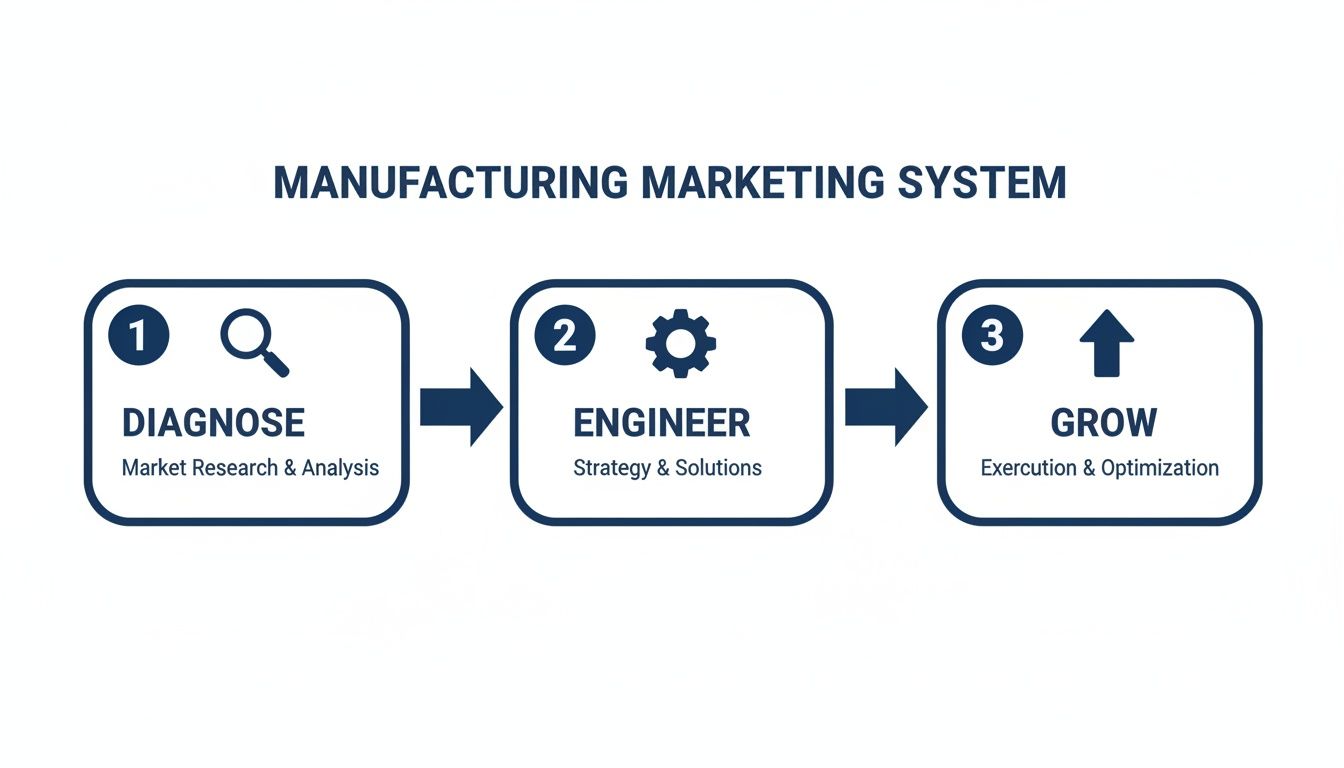
Sustainable growth isn't about one-off campaigns or lucky breaks. It's the direct result of a deliberate, repeatable process. To build this system, we need to ensure all the essential components are working in unison.
The Core Components of a Manufacturing Marketing System
| Marketing Pillar | Primary Function | Key Outcome |
|---|---|---|
| Market Research & ICP | Deeply understand your ideal customer's pains and needs. | Laser-focused targeting on high-value accounts. |
| Positioning & Messaging | Define what makes you the only logical choice for your ICP. | A clear, compelling value proposition that cuts through the noise. |
| Website & SEO | Turn your website into a 24/7 resource for industrial buyers. | A steady stream of inbound, qualified organic traffic. |
| CRM & Automation | Systematize lead management and communication. | No lead falls through the cracks; consistent follow-up. |
| Lead Generation Campaigns | Actively attract buyers with valuable content and offers. | A predictable pipeline of sales-ready opportunities. |
| Sales Enablement | Arm your sales team with tools and content to close deals faster. | Shorter sales cycles and higher close rates. |
| Measurement & Iteration | Track what works and double down on successful tactics. | Continuous improvement and optimized ROI. |
Each of these pillars is crucial. A great website won't matter if your messaging is wrong, and a perfect lead generation campaign will fail without a solid CRM to manage the incoming interest.
Throughout this guide, we'll show you how to:
- Diagnose your Ideal Customer Profile (ICP) so every marketing dollar is spent talking to the right people.
- Build your website into an educational hub that works as your best salesperson.
- Engineer a lead generation engine using content that solves your customers' real-world problems.
- Automate your follow-up and nurturing process so your sales team can focus on closing deals.
By following this blueprint, you can stop guessing and start building a predictable pipeline. For a deeper dive into creating your foundational strategy, see our guide on how to build a marketing plan.
Diagnosis: Who Are Your Real Buyers?
Before an engineer builds anything, they first diagnose the core problem. The most common failure point we see in B2B marketing for manufacturers is a fundamental misunderstanding of the modern buyer. They aren't waiting for your sales rep to call; they're online, doing their own deep research.
Your first step isn’t to launch a campaign—it’s to diagnose exactly who you’re trying to reach. This means ditching guesswork and building a data-backed Ideal Customer Profile (ICP). An ICP isn't just a persona; it's a clear definition of the company that gets the most value from your product or service.
Getting this right eliminates wasted effort. Instead of casting a wide, expensive net, you’re creating a precise target for every marketing dollar.
From Vague Ideas to a Data-Backed ICP
To build a useful ICP, think like an engineer. Analyze what's already working and reverse-engineer the solution. Don't invent your perfect customer; find them in your own data.
Start by pulling a list of your top 20% most profitable accounts. Now, ask yourself: what do these powerhouse customers have in common?
- Firmographics: What is their specific industry? What’s their company size (revenue and employees)? Where are they located?
- Operational Details: What equipment are they using? Which internal processes does your product improve? What regulations or standards must they meet?
- Business Relationship: Why did they choose you over the competition? What was their onboarding like? Are they repeat buyers?
Answering these questions forces you to stop thinking "who could we sell to?" and start focusing on "who should we be selling to for maximum profit and long-term success?" This is a game-changing shift in perspective.
Mapping the Entire Buying Committee
In manufacturing, you're almost never selling to just one person. Decisions are made by a committee of individuals, each with their own priorities and pain points. Your job is to understand and speak to every single one of them.
Use a tool like LinkedIn Sales Navigator to map out the key roles within your ideal customer accounts. You'll quickly see a pattern emerge, typically involving these players:
- The Engineer: This person lives for technical specs, performance data, and reliability. They need to know your product will solve their technical problem without creating new ones.
- The Procurement Manager: Their world revolves around price, lead times, and total cost of ownership. They must justify the expense and ensure you won't disrupt their supply chain.
- The Executive (CEO/COO): They think about strategic impact: ROI, operational efficiency, and competitive advantage. They need the big-picture story of how you make their business better.
To make this actionable, you need to turn these roles into detailed buyer personas. Learning how to create buyer personas that drive B2B growth translates your ICP data into messaging that resonates with each committee member. When you speak to everyone's unique needs, you build trust and shorten the sales cycle.
Solution: Build Your Website as a 24/7 Sales Tool
Stop thinking of your website as a digital brochure. It’s your hardest-working salesperson—one that never sleeps and is ready to educate and qualify prospects around the clock.
For any manufacturer, a high-performance website is the hub of your marketing system. This is where engineers find technical specs at 2 AM and where procurement managers verify your credibility before they ever pick up the phone.
The goal is to engineer a self-service resource that answers your buyers' questions before they even ask them. This positions you as the expert and filters out tire-kickers, freeing your sales team to focus on high-value conversations.
From Digital Brochure to Lead Generation Machine
Turning your site from a static catalog into a dynamic sales tool starts with a mindset shift. Every page and line of text must serve one purpose: helping your Ideal Customer Profile solve their problem.
Here’s where to focus your energy first:
- Clear, Problem-Oriented Messaging: Your homepage shouldn't be a list of what you make. It needs to immediately state the problem you solve and who you solve it for.
- Intuitive Navigation for Technical Buyers: Engineers are busy and don't have time to hunt for information. Make finding technical data sheets, CAD files, and material specs completely effortless.
- Prominent Calls-to-Action (CTAs): Guide every visitor to the next logical step. Whether it’s “Request a Quote,” “Download the Spec Sheet,” or “Talk to an Engineer,” your CTAs must be clear and compelling.
This isn't just a "nice-to-have." The industrial buying process has shifted toward digital, self-service channels. A Forrester analysis found that over half of large B2B purchases ($1 million or more) are expected to happen through digital channels like vendor websites. If your site can’t support that, you’re leaving money on the table. You can read the full Forrester predictions for B2B marketing and sales here.
Technical SEO for Industrial Buyers
Search Engine Optimization (SEO) is how you ensure your site shows up on Google. For manufacturers, this requires a technical strategy that aligns with how your specific buyers search for solutions.
This means optimizing your site for the exact terms your customers use every day. Think of your website's content as a digital subject matter expert, ready to answer the highly specific questions your engineering and procurement buyers are typing into search engines.
Here are the SEO pillars you need to build on:
- Product & Part Number Optimization: Create dedicated, detailed pages for every product. Optimize them for specific part numbers, model numbers, and technical names to capture high-intent traffic.
- Problem-Based Content: Develop resources that tackle common engineering challenges. Create articles and guides with titles like, "How to Reduce Cycle Time in CNC Machining" or "Choosing the Right Polymer for High-Temperature Applications." You're selling the solution, not just the product.
- Trust Signals and Credibility: Your buyers need to trust you. Plaster your site with case studies, certifications (ISO, AS9100), client testimonials, and partner logos to reduce their perceived risk.
- Site Performance: Industrial buyers are impatient. Your website must be fast, secure, and mobile-friendly. A slow-loading site is a deal-killer.
Putting these pieces together creates a powerful asset that consistently generates qualified leads. Getting visitors is only half the battle; check out our guide on how to improve website conversion rates to ensure they take action once they arrive.
Solution: Engineer a Predictable Lead Generation Engine

With a high-performance website in place, it's time to build the engine that brings in the leads. This is about systematically creating assets so valuable that your Ideal Customer Profile (ICP) will gladly provide their contact information to get them.
For manufacturers, the most potent lead generation strategy is content that solves tangible problems. Your buyers—engineers, procurement managers, and operations leads—live on data and ROI. Your content has to speak their language.
Content That Solves Engineering Problems
The core principle is simple: educate, don't sell. Your prospects are doing their homework long before they want to talk to a salesperson. Your job is to be the most helpful resource they find.
The modern industrial buying journey is powered by content. Studies show that 40% to 75% of B2B buyers read at least three to five pieces of content before reaching out, and 56% or more have already made a purchase decision before speaking to a supplier. This fact alone shows how critical it is for your marketing to educate prospects on its own. You can discover more insights about B2B buyer content consumption to see how self-directed this process has become.
To meet this demand, create assets that deliver immediate, practical value.
- Detailed Technical White Papers: Go deep on a specific challenge or technology relevant to your ICP.
- Downloadable CAD Files & 3D Models: Let engineers drop your components right into their designs. This makes you an indispensable part of their workflow.
- Application Notes & Case Studies: Show, don't just tell. Detail exactly how your products solved a specific problem for a company like theirs.
- Product Demo Videos: Provide clear, no-fluff visual explanations of how your equipment works.
These resources do more than generate leads; they position you as a credible expert and fuel your entire marketing system.
The Power of Gated Content
How do you turn viewers into actual leads? With gated content. By placing your most valuable assets—like white papers or CAD files—behind a simple form, you create a fair value exchange. You give them expert knowledge; they give you their contact information.
This simple act is a massive qualifier. It instantly separates casual browsers from serious buyers who are actively hunting for solutions. Gating content isn't about putting up walls; it's about identifying intent. Someone willing to fill out a form for a technical guide is signaling genuine interest.
Aligning Content with the Buyer's Journey
Not all leads are at the same stage. A smart marketing strategy for manufacturers needs content tailored to each phase of the industrial buying cycle.
Here's a practical breakdown of how to map your content to their journey.
Lead Generation Content for the Industrial Buyer's Journey
This table outlines the content that resonates as buyers move from identifying a problem to selecting a supplier.
| Buyer Stage | Buyer's Goal | Effective Content Types | Call to Action (CTA) |
|---|---|---|---|
| Awareness | "I have a problem, but I don't know the solution yet." | Educational blog posts, industry trend reports, explainer videos. | "Learn More About [Topic]" |
| Consideration | "I'm researching potential solutions and comparing vendors." | Technical white papers, detailed case studies, product demo videos, webinars. | "Download the White Paper" |
| Decision | "I'm ready to choose a supplier and need final validation." | Implementation guides, ROI calculators, spec sheets, customer testimonials. | "Request a Quote" or "Talk to an Engineer" |
By building a library of content for each stage, you create a repeatable lead generation engine that nurtures prospects from initial search to final purchase.
System: Automate Lead Nurturing with a CRM

Getting a prospect to download a resource is a win, but it’s only half the battle. In manufacturing, where sales cycles are long, what happens after that download is what separates a stalled pipeline from a signed contract. This is where a Customer Relationship Management (CRM) system becomes essential.
Think of your CRM as the central nervous system for your entire sales and marketing operation. It’s the single source of truth, tracking every interaction a prospect has with your company. Without that intelligence, you're flying blind, and valuable leads are guaranteed to fall through the cracks.
The goal is to build a smart system that ensures timely, relevant follow-up happens automatically, freeing your sales team to focus on building relationships and closing deals.
Building a Simple Nurturing Workflow
Let's diagnose a common failure point. A prospect downloads a technical white paper, but then nothing happens. This is exactly what automation is designed to fix. You can engineer a simple system to nurture that lead without anyone lifting a finger.
Here’s a step-by-step example of a basic lead nurturing automation:
- The Trigger: A prospect fills out a form to download your white paper on "Reducing Cycle Time in CNC Machining."
- Immediate Follow-Up (Email 1): Instantly, the CRM sends an email delivering the white paper.
- Value Add (Email 2 – 3 Days Later): The system automatically sends a follow-up email linking to a case study showing how a similar company cut cycle times by 15% with your tooling.
- Deeper Dive (Email 3 – 7 Days Later): A week later, another automated email invites them to watch a short product demo video related to the white paper.
- Human Handoff (The Final Step): If the prospect engages with any of these follow-ups (clicks the case study, watches the video), the CRM automatically notifies a sales rep, flagging them as a warm, educated lead ready for a conversation.
This systematic approach transforms a single download into an ongoing educational conversation, building trust and demonstrating expertise over time.
From Cold Calls to Warm Conversations
The real power of a CRM is the intelligence it gives your sales team. Before picking up the phone, a salesperson can see a complete history of that prospect's journey: which white paper they downloaded, what pages they viewed, and which case study caught their eye.
This context is a game-changer. The conversation shifts from a generic, cold interruption to a highly relevant, helpful discussion. Instead of asking, "Are you familiar with our company?" the sales rep can open with, "I saw you were interested in our guide on CNC machining. We helped a client in your industry solve a similar challenge—do you have a few minutes to discuss it?"
This approach respects the buyer's time and positions your sales team as knowledgeable consultants. To learn more, explore our guide on using a CRM for lead generation.
Transformation: Measure Performance and Prove ROI

You can't improve what you don't measure. Without clear data, marketing feels like an expense with no connection to the bottom line. The goal is to transform marketing from a cost center into a predictable, revenue-driving machine. This means cutting through vanity metrics like "likes" and focusing on the numbers that actually matter to a business owner.
Key Performance Indicators for Manufacturers
To diagnose your marketing's health, track the entire journey from website visitor to new customer. Chasing the wrong metrics burns time and budget. Instead, focus on these critical KPIs.
- Marketing Qualified Leads (MQLs): A prospect who shows genuine interest by taking a meaningful action, like downloading a technical white paper or signing up for a demo.
- Sales Qualified Leads (SQLs): An MQL that your sales team has vetted and confirmed is a solid fit, ready for a direct conversation.
- Customer Acquisition Cost (CAC): The total sales and marketing spend for a period divided by the number of new customers won. It answers the vital question: "How much does it cost to land a new account?"
- Marketing-Influenced Revenue: The ultimate proof. This metric connects marketing activities directly to closed deals, showing how much revenue your content, ads, and emails helped generate.
The ideal is a closed-loop system where you can clearly trace the path from a blog post to a white paper download (MQL), a sales conversation (SQL), and finally, a new account. This is how you prove ROI, plain and simple.
Building Your B2B Marketing Dashboard
You don’t need expensive, complicated software to start. You can build a powerful dashboard using free tools to connect your website activity to real business outcomes.
A simple, effective setup uses two key tools:
- Google Analytics 4 (GA4): Your data engine. Set up conversion goals to track every important action on your site, from "Request a Quote" submissions to "Download CAD File" clicks.
- Google Looker Studio: Your command center. It pulls data from GA4 and your CRM, turning it into clean charts and graphs. You can see at a glance which channels and content are driving the most MQLs.
Organic search is often a primary driver of high-quality leads for manufacturers, so it's critical to measure its performance. To go deeper, you can learn how to understand how to measure SEO success.
By checking this dashboard regularly, you can answer the questions that drive growth:
- Which content is generating qualified leads?
- Which marketing channels are driving the most valuable traffic?
- Where should we double down on our investment next quarter?
This cycle of measuring, analyzing, and adjusting is what transforms your marketing from a series of tactics into a predictable system for growth.
Your B2B Manufacturing Marketing Questions Answered
When we talk about building a marketing system, the same questions always come up. As engineers and problem-solvers, you want straight answers about the budget, the team, and how to prove it’s all worth the investment. Let's get right to it.
How Much Should a Manufacturer Budget for Marketing?
This is always the first question, and the honest answer is: it depends entirely on your goals. Benchmarks like 5% to 12% of total revenue are often not a helpful starting point. A better approach is to work backward from your goals.
Instead of asking what to spend, ask: "How many qualified leads do we need each month to hit our sales targets?" Once you have that number, you can build a budget that directly supports that outcome. A goal-driven budget ensures every dollar is an investment in a specific result, not just an expense.
We recommend starting with a focused, proof-of-concept budget for the first 90-180 days. This lets you test what works for your specific audience, then confidently scale up the tactics that are proven to deliver results.
What Should Our Marketing Team Look Like?
You don't need to hire a ten-person department. Many successful manufacturers run a lean operation, keeping strategy in-house and outsourcing specific tactical work to partners.
The most critical role is your Marketing Manager or Director. This person owns the system, manages the budget, and is responsible for connecting marketing activities to sales numbers.
From there, the structure depends on your core strategy:
- If you’re all-in on content: You need a technical writer. This can be an in-house expert or a partnership with a specialized agency.
- If SEO is your main driver: An SEO specialist is non-negotiable. This is a technical role almost always outsourced to an agency with a track record in B2B markets.
- For any modern strategy: A CRM/Automation specialist is essential to keep your lead nurturing engine running smoothly.
The winning formula is often to hire for strategy and outsource for execution. This keeps your core team focused on the big picture while giving you access to top-tier talent.
How Do We Prove Marketing Is Actually Working?
This is how you get buy-in from leadership. Proving ROI is about closing the loop between a marketing action and a sales result. Your CRM and analytics dashboard are your two best friends here.
Focus on tracking a few core numbers that tell a clear story:
- Leads Generated by Source: Know exactly which channels (organic search, paid ads, email) are delivering your best MQLs.
- Lead-to-Customer Conversion Rate: What percentage of marketing leads end up signing a PO? This is the ultimate measure of lead quality.
- Marketing-Influenced Revenue: Use your CRM to tag every deal that touched a piece of marketing content. This draws a direct line from a blog post to dollars in the bank.
When you can walk into a meeting with a simple report showing these connections, the conversation shifts from "What did marketing do?" to "Look at the revenue marketing generated."
At Machine Marketing, we specialize in diagnosing these challenges and engineering marketing systems that deliver predictable results for manufacturers. If you're ready to stop guessing and start building a reliable engine for growth, book a discovery call with us today.