If your social media feels like a lot of work for zero leads, you’re not alone. We see this all the time—the root cause is often a broken system, not a lack of effort. For B2B companies, the goal isn't just to post content; it's to build a predictable system that attracts, nurtures, and converts your ideal clients.
In this guide, we'll diagnose why your current B2B social strategy might be failing and give you a step-by-step framework to build one that generates a measurable pipeline. It’s the difference between chasing likes and creating a direct path from a social post straight into your CRM.
Diagnosis: Why Is Your B2B Social Strategy Broken?

If your social media efforts feel like shouting into a void, you're not imagining it. We diagnose this problem constantly, especially in technical B2B industries. The issue is almost never a lack of effort—it’s a broken approach rooted in a few common, fixable mistakes.
The real problem is the gap between activity and results. You might be posting daily, but if that work doesn't translate into qualified conversations or leads in your pipeline, the system is failing. That isn't just frustrating; it's a monumental waste of time and resources.
The Symptoms of a Flawed System
How can you tell if your strategy is off track? A flawed system usually shows up in a few distinct ways. Ask yourself if you recognize any of these red flags:
- Chasing Vanity Metrics: Your team gets excited about a post with 100 likes, but a quick check shows none are from potential customers. The focus is on surface-level numbers, not actual business impact.
- Generic, Self-Serving Content: Your feed is a wall of company announcements, product features, and holiday greetings. It talks at people instead of speaking directly to your ideal client's biggest challenges.
- No Clear Path to a Lead: A potential customer sees your post and is impressed… but has no idea what to do next. There's no call to action, no resource to download, and no clear path to engage your sales team.
- Inconsistent or Random Posting: You post ten times one week, then go silent for the next three. This rhythm fails to build the trust, authority, or momentum needed for a strong B2B social strategy.
If this feels familiar, exploring proven frameworks can shine a light on where things are going wrong. A great starting point is to see what effective strategies look like, such as these 10 B2B Social Media Marketing Strategies That Don't Suck, which can offer a much-needed fresh perspective.
Our advice: Shift your mindset from 'being on social media' to 'building a lead generation system with social media.' One generates noise; the other generates revenue.
How to Run a Quick Diagnosis
Before you can build a better system, you have to diagnose the current one. This isn't a long, complicated process. It's about asking the right questions to pinpoint the exact points of failure.
Use this quick diagnostic table to connect the problems you're seeing with their likely cause.
| Diagnosing Your B2B Social Strategy Gaps |
| :— | :— | :— |
| Symptom | Common Cause | First Step to a Solution |
| Low engagement from target accounts. | Your content is too broad or self-promotional; it doesn't solve a specific problem for your ideal client. | Map out your Ideal Customer Profile's top 3 pain points. |
| No leads from social media. | There is no clear "next step" in your content. You aren't giving people a reason or a way to raise their hand. | Create a simple call-to-action (CTA) for your next 5 posts (e.g., "DM for the guide," "Link in bio for the checklist"). |
| Engagement comes from students, competitors, or irrelevant profiles. | Your content topics are too generic and don't speak the language of decision-makers in your niche. | Focus on niche, technical topics that only a potential buyer would care about. |
| Inconsistent posting schedule. | Lack of a content plan and a repeatable workflow for creation and approval. | Draft a simple 2-week editorial calendar with post topics and formats. |
This table helps turn vague frustrations into actionable problems. To dig deeper, a more focused review is needed. You can learn more about this process in our guide on what a full marketing audit involves.
Questions to ask yourself:
Take 30 minutes and look at your last month of social activity.
- Who engaged? Go through the profiles of people who liked, commented, or shared. Are they students and competitors, or are they actual purchasing managers and engineers from your target companies?
- What was the topic? Did your most popular post solve a real problem for your audience, or was it a generic company update?
- How many leads did we get? Can you trace even one qualified lead back to a specific social media post from the last 30 days? Be honest.
Answering these questions gives you the data you need to make real changes. It shifts the conversation from "social media isn't working" to "our content isn't resonating with purchasing managers." That's a problem we can solve.
Solution: Build Your Foundation with Audience and Channel Research

A winning B2B social strategy isn't built on guesswork. It starts with knowing exactly who you're talking to and where they spend their time online. This isn't about broad demographics; it's about getting surgical with your audience understanding.
You need to build a detailed Ideal Customer Profile (ICP). This isn't just a persona that says "engineers." It's a profile of the specific plant manager or operations director who buys from you. What are their titles? Their daily headaches? What technical problems keep them up at night?
From Vague Idea to Precise ICP
Building an effective ICP means digging for real answers, not making assumptions. This process is a diagnostic tool that will inform every piece of content you create. Start by interviewing your sales and customer service teams—they're on the front lines hearing the real-world frustrations of your customers.
Here are the questions you should be asking to sharpen your ICP:
- What are their exact job titles? Think "Operations Director" or "Quality Control Manager," not just "manager."
- What are their primary KPIs? What metrics define success in their role?
- What are their biggest professional pain points? Are they struggling with efficiency bottlenecks, compliance headaches, or supply chain risks? Get specific.
- What technical language do they use? Do they talk about "cycle times," "tolerance stacking," or "preventive maintenance"? You must speak their language.
- Where do they go for information? Are they active in industry-specific forums, certain LinkedIn groups, or trade publications?
Getting clear answers here provides a rock-solid picture of the person you need to reach. If you want to go deeper, you can identify your target audience in our detailed guide. This clarity is the bedrock of a B2B social strategy that actually works.
Choosing Your Channels with Purpose
Once you know who you're talking to, figuring out where to talk to them becomes much easier. The biggest mistake we see is spreading resources thin trying to be everywhere. For most B2B companies, your channel strategy must be focused and deliberate.
Posting the same generic message across LinkedIn, X, and Instagram is a recipe for wasted effort. Each platform has its own context.
Your ICP dictates your channel strategy. Go where your ideal customers are already having professional conversations.
LinkedIn: The B2B Powerhouse
For nearly every B2B company, LinkedIn is non-negotiable. The platform is built for professional context, making it the most fertile ground for connecting with decision-makers. In fact, over 80% of B2B social media leads come directly from LinkedIn. This isn't a platform you can afford to ignore.
Here’s why it's so effective:
- Targeting Precision: You can zero in on users by job title, company size, industry, and seniority.
- Professional Mindset: People are on LinkedIn for business. They are more receptive to content that helps them solve work-related problems.
- Building Authority: It’s the perfect stage for sharing technical deep-dives and case studies that position you and your leaders as true experts.
Is any other platform worth it?
While LinkedIn is your core, other channels can play powerful supporting roles, depending on your ICP's habits.
- X (formerly Twitter): A great real-time ear to the ground for monitoring industry news and engaging with journalists.
- YouTube: If your product has any complexity, YouTube is your best friend. It’s the ideal home for technical demos and visual case studies.
- Niche Forums & Communities (e.g., Reddit): This is where engineers ask candid questions. Participating genuinely (not just dropping links) can build immense trust.
Our advice: Master one platform first—which will almost certainly be LinkedIn—before you expand. This concentrated approach ensures you invest your time and budget where they will generate the highest return.
Solution: Develop Your Content Pillars and Cadence
Posting randomly won't get you B2B leads. A system will. Once you know who you’re talking to and where, you need a plan for what you're going to say. This is where content pillars and a publishing cadence stop you from making noise and start building a real B2B social strategy.
Content pillars are the 3-5 core themes your brand owns. They should live at the intersection of your customer's biggest headaches and your company's most valuable solutions. These aren't just product categories; they are the strategic topics that prove your authority.
From Core Themes to Engaging Content
Let’s get practical. If you manufacture custom CNC machine parts, your pillars aren’t "CNC Machining." They’re about the specific problems you solve for your engineering and purchasing clients.
Your pillars might look like this:
- Pillar 1: Material Science & Selection: Content that helps engineers pick the right materials for durability, cost, and performance.
- Pillar 2: Design for Manufacturability (DFM): Actionable tips on designing parts that are faster and cheaper to produce.
- Pillar 3: Supply Chain Reliability: Content highlighting the risks of offshore production versus the stability of a domestic partner.
With these pillars as your foundation, you can brainstorm dozens of content ideas. This is how you keep your feed from getting stale.
For example, the "Design for Manufacturability" pillar alone can fuel multiple posts:
- A quick video showing a common DFM mistake.
- A LinkedIn carousel on "3 Ways to Reduce Part Complexity."
- A client success story showing how a small design tweak saved them 15% on production costs.
- A simple "myth vs. fact" graphic about material tolerances.
A system like this ensures every post has a purpose. It’s the difference between being a random broadcaster and becoming a go-to resource.
Creating a Sustainable Publishing Cadence
Here’s the truth: consistency is more important than frequency. A sustainable cadence is one your team can actually stick to without burnout. Posting three high-value updates a week is infinitely better than posting twice a day with generic filler.
Start with a simple, repeatable plan. For most B2B companies, a 3-post-per-week schedule on LinkedIn is a solid place to start.
A content calendar isn’t a rigid box. It’s a repeatable workflow that frees up your brainpower for higher-value tasks. You can and should break from the plan for timely industry news.
Here’s a sample weekly LinkedIn cadence for our CNC manufacturer.
Sample Weekly LinkedIn Cadence
| Day | Post Type & Pillar | Format Example | Goal |
|---|---|---|---|
| Tuesday | Educational Post (Pillar 2: DFM) | A 5-slide carousel on "How to Optimize Wall Thickness for CNC Parts." | Establish expertise and deliver immediate value. |
| Thursday | Trust-Building Post (Pillar 3: Supply Chain) | A text-and-image post with a photo from the shop floor, telling a short story about a recent rush job. | Humanize the brand and build trust. Show, don't just tell. |
| Friday | Lead-Generation Post (Pillar 1: Material Science) | Announce a new downloadable asset: "The Engineer's Guide to High-Performance Plastics." Link to a landing page to capture info. | Capture qualified leads with a high-value resource. |
This rhythm strikes a balance between education, trust-building, and lead generation. It gives your audience a predictable flow and your team a manageable workflow. With your pillars set and a cadence in hand, you have the blueprint for what to post, when to post, and—most importantly—why it matters to your bottom line.
Solution: Integrate Social Leads into Your Sales Pipeline
A lead from social media is just a spark. Without a system to catch it, that spark fizzles out into a missed opportunity. This is where you build the bridge that turns a casual click on a LinkedIn post into a qualified contact in your sales pipeline.
The whole point is to eliminate manual data entry and ensure every interested person gets an immediate, relevant response. This transforms a cold name into a warm contact who already sees you as a valuable resource. It starts by making it simple for them to raise their hand.
Building Your Lead Capture Mechanisms
You need a clear path for a prospect to trade their contact information for something genuinely useful. Gated content—like a detailed whitepaper or technical guide—is the perfect currency for this exchange. We find two methods work best for capturing these leads.
- Native Social Lead Forms: Platforms like LinkedIn have built-in lead forms that are incredibly effective. They pre-fill a user’s information, making it a nearly frictionless, two-click process for them to download your guide.
- Dedicated Landing Pages: When your offer is more complex or you need total control over the brand message, a dedicated landing page is your best bet. This page has one job: get the download. No site navigation, no other buttons—just a powerful headline, a quick summary of the value, and the form.
The assets you gate can't be an afterthought. They must be a deliberate output of your content strategy, built from your core pillars.
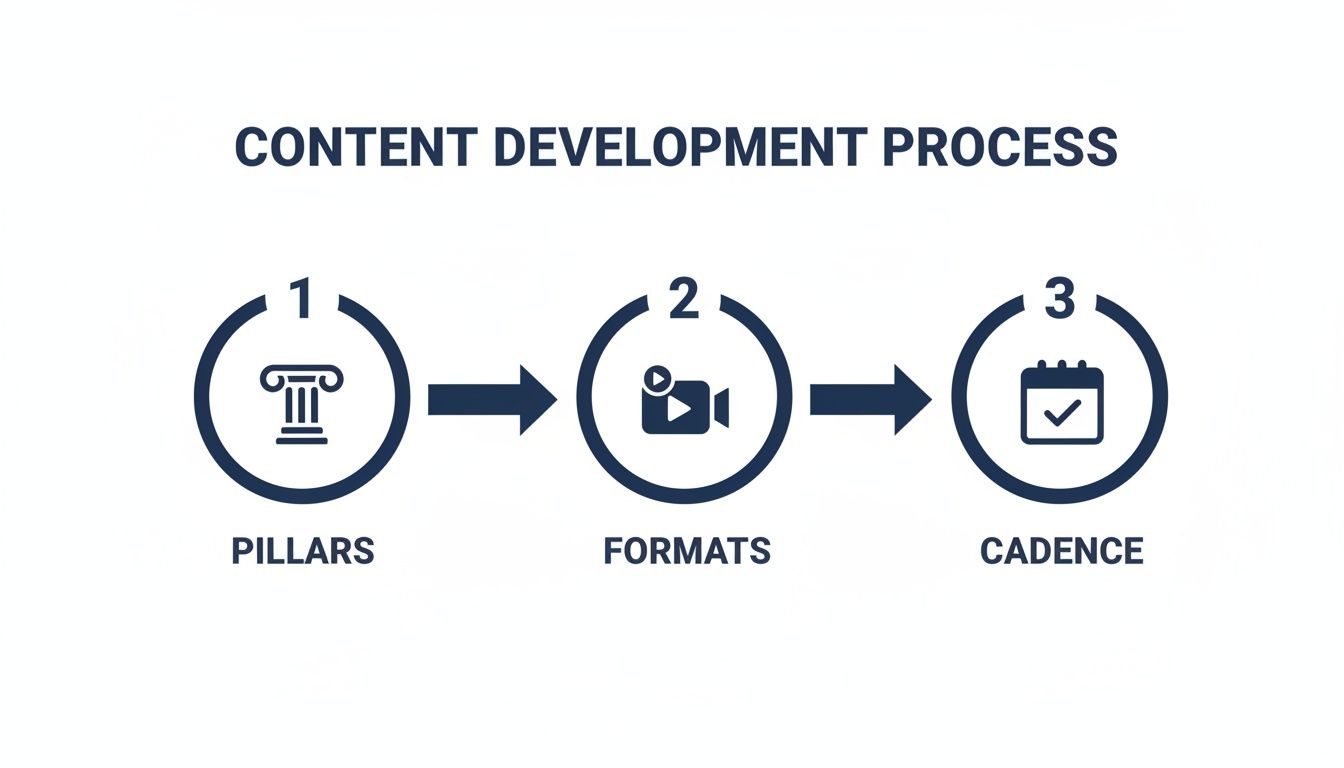
As you can see, great lead-capture assets aren't random; they’re the logical output of a well-oiled content machine.
Automating the Hand-Off to Your CRM
Once someone fills out that form, the clock starts ticking. A lead that sits in a spreadsheet for three days is a dead lead. This is where automation becomes your most valuable player, and a system like GoHighLevel is built for exactly this kind of work.
You need to connect your lead form—whether it's on LinkedIn or your landing page—directly to your CRM. This triggers an automated workflow the second someone hits "submit."
Our advice: Automation doesn’t replace the human touch; it enables it. By automating data entry and initial follow-up, you free up your sales team to have meaningful conversations with prospects who are already engaged.
Here’s a simple, powerful workflow we've built in GoHighLevel for a "Download Our Whitepaper" campaign:
- Trigger: A prospect submits the lead form.
- Tag: The system instantly tags the new contact (e.g., "Lead-Whitepaper-CNC_Materials"). This is crucial for segmenting your list later.
- Deliver: An automated email goes out immediately, delivering the promised whitepaper with a helpful message.
- Notify: Your assigned salesperson gets an instant internal notification (email or text) with the lead's details and tag. The rep knows exactly who they are and what they care about.
- Nurture: The contact is added to a short, 3-email follow-up sequence over the next week. These emails offer more value on the same topic, building trust before a sales call is ever made.
This automated system ensures no lead falls through the cracks. It transforms a single click into the start of a real relationship, feeding warm, informed contacts directly to your sales team. To get a deeper look at how this technology fits into the bigger picture, you can learn more about using a CRM for lead generation in our dedicated guide.
Transformation: Measuring What Matters and Optimizing for Growth
Let's be direct: likes and followers don't pay the bills. These vanity metrics won’t tell you if your social media efforts are actually adding to your bottom line. True success for a B2B social strategy is measured in qualified leads, contributions to the sales pipeline, and a clear return on investment.
This isn't about chasing algorithms. It’s about building a data-driven feedback loop to make smarter business decisions, double down on what works, and consistently improve your ROI. This is the transformation from marketing activity to business growth.
Differentiating Channel Metrics from Business Metrics
First, you must understand the difference between two types of metrics. Both are valuable, but they tell completely different parts of the story.
- Channel Metrics show you how your content is performing on the platform itself. Think of them as leading indicators that your content is resonating with your audience.
- Business Metrics show you how your social media activity impacts your company's actual goals. These are the lagging indicators that prove the strategy is working.
Digging into the right social media engagement metrics is the only way to get a true pulse on your channel performance.
| Metric Type | Key Question It Answers | Examples |
|---|---|---|
| Channel Metrics | "Is our content resonating with our target audience on this platform?" | Engagement Rate (likes + comments + shares / followers), Click-Through Rate (CTR), Video View Duration, Follower Growth (from target industries) |
| Business Metrics | "Is our social media activity helping us grow the business?" | Cost Per Lead (CPL), Lead Conversion Rate, Cost Per SQL (Sales Qualified Lead), Pipeline Contribution, Customer Acquisition Cost (CAC) |
Focusing only on channel metrics is like a pilot staring at the airspeed indicator without checking the compass. It's important information, but it doesn't tell you if you're headed in the right direction.
Building Your B2B Social Strategy Dashboard
You don't need a massive analytics suite to get started. A simple dashboard built with data from your social platforms and CRM is often more than enough. Tools like GoHighLevel are perfect for this, since they bring your marketing and sales data into one place.
Your dashboard should give you an at-a-glance view of the entire funnel, from the initial social post to a closed deal.
Here’s how that might look in practice with GoHighLevel:
- Connect your sources: Integrate your LinkedIn Ads account and website landing pages.
- Track the user journey: When someone clicks a LinkedIn ad for your whitepaper and fills out the form, GoHighLevel can automatically tag them as "Lead-LinkedIn-Whitepaper."
- Visualize the funnel: Build a dashboard that tracks key numbers month-over-month: LinkedIn Ad Spend > Leads Generated > Cost Per Lead > Leads Converted to SQL > Cost Per SQL.
This simple setup directly connects what you spend on social ads to its impact on sales. It shifts the conversation from, "How many clicks did we get?" to, "How much pipeline did we generate from that $1,000 ad spend?"
The real power of measurement isn't in the report itself, but in the conversations it enables. A good dashboard forces you to ask better questions and make smarter strategic bets.
Creating a Rhythm for Review and Optimization
Data is useless if you never act on it. The final piece of the puzzle is establishing a regular review cycle to diagnose performance and decide where to put your efforts next.
We’ve found a two-tiered review process works best:
- Monthly Performance Review: A tactical meeting focused on channel metrics. What posts drove the highest engagement? What content formats are getting the most clicks? Use these insights to refine next month's content calendar.
- Quarterly Business Impact Review: A strategic meeting that includes sales and leadership. How much pipeline did social contribute this quarter? What was our customer acquisition cost? This is where you make bigger decisions about budgets and overall strategy.
This rhythm ensures you’re always learning and iterating. It transforms your social media from a content-publishing machine into a data-driven growth engine.
Common Questions About B2B Social Strategy
Even with a clear plan, you probably still have some questions. Here are our transparent, direct answers to the most common ones we hear from business owners.
How much should we budget for a B2B social strategy?
There’s no magic number, but a smart approach splits your budget into two buckets: content/management and paid advertising.
For most small to mid-sized businesses, a realistic budget for quality content creation and daily management falls between $2,000 and $7,000 per month. This could fund an in-house hire or an agency partner, depending on the scope.
For paid ads, particularly on a platform like LinkedIn, we advise starting with a proof-of-concept budget. You must commit at least $1,000 to $3,000 per month to get enough data to see what’s working and find your true cost per lead.
Our advice: The initial number isn't the point. Your commitment to tracking ROI is. If you can prove that every $1 in ad spend brings in $5 of sales pipeline, increasing the budget becomes one of the easiest decisions you’ll make.
Start small, prove the model, and then scale your investment based on real performance, not guesswork.
How long does it take to see real results?
In B2B social media, patience is a strategic advantage. B2B sales cycles are long and built on trust, so you won't see a flood of closed deals overnight. You're building momentum that compounds over time.
That said, you should expect to see "leading indicators" within the first 90 days. These are early signs that the system is working:
- An uptick in profile views from people at your target companies.
- Higher engagement rates from relevant professionals.
- A steady stream of new followers who fit your ICP.
- Your first handful of leads from a downloadable guide.
However, be realistic. For a significant, measurable impact on your sales pipeline and closed deals, give it 6 to 12 months. That’s a transparent timeframe for building authority from the ground up, one valuable post at a time.
Should our CEO and sales team be active on LinkedIn?
Yes, absolutely. A modern B2B strategy isn’t just about the company page—it’s about empowering your people. People buy from people they know, like, and trust.
A post from your CEO sharing a real insight on an industry trend feels infinitely more authentic than a branded graphic. The same goes for a sales rep who shares a story about solving a customer problem. It positions them as a helpful expert, not just another vendor.
How to apply this: Launch a simple employee advocacy program. The goal isn't to force it, but to make it easy. Give your team key content pillars and pre-approved posts they can customize. Their individual networks are often more powerful than the company's entire follower list.
Can we just use AI to create all our social content?
This strategy isn't right for everyone. AI is a fantastic assistant, but it's a terrible strategist. Relying on it to run your entire content show is a shortcut to soulless, generic posts that your audience will scroll right past.
Here’s the right way to think about it:
- Use AI for efficiency. It’s brilliant for brainstorming, creating rough first drafts, or summarizing a long webinar into shorter social posts. It can dramatically speed things up.
- Rely on humans for authority. Your best content comes from your company’s unique experience, customer stories, and point of view. AI can't invent a case study or share a lesson your team learned on the shop floor yesterday.
The best approach is a hybrid one. Use AI for 80% of the grunt work, but always have a human expert handle the final 20%—the critical editing, fact-checking, and injection of your genuine brand personality. This gives you both scale and authenticity.
A winning B2B social strategy is a system, not a series of random posts. When you focus on the right audience, create genuinely valuable content, and measure what actually matters, your social channels become a predictable engine for growth.
If you’re ready to stop guessing and start building a marketing system that delivers, we can help. Machine Marketing specializes in diagnosing growth gaps and implementing practical, data-driven strategies for B2B companies.
Try this step next: Book a discovery call with us today and we'll help you build a roadmap for your success.