If you're spending too much time on repetitive tasks or watching good leads fall through the cracks, the problem isn't your team—it's your system. The core idea behind marketing automation is to give your team their time back, grow revenue predictably, and deliver personalized experiences that actually scale.
Think of it as an engineering fix for your marketing operations. In this guide, we'll diagnose the common pain points that signal a need for automation and show you exactly how to build a system that fuels growth instead of draining resources.
Is Your Business Ready for Automation?
We see this exact bottleneck all the time with growing businesses. You have a fantastic product or service, but the sheer manual effort of following up with every lead, sending every email, and tracking every interaction is becoming impossible. The root problem is almost always a lack of systems built to handle volume. This is where you have to diagnose what's really going on.

Ask yourself: are any of these common pain points hitting too close to home?
- Inconsistent Lead Follow-Up: Leads come in, but your team is swamped and can't get to every one right away. By the time they do, the lead has gone cold.
- Generic Messaging: You’re blasting the same email to your entire list because segmenting contacts by hand would take all day. This is a missed opportunity for connection.
- Wasted Time on Repetitive Tasks: Your day is a blur of copy-pasting data, scheduling social media posts one by one, and manually updating your CRM.
- A Disconnect Between Sales and Marketing: Marketing generates leads, but the sales team is flying blind with no real insight into a prospect's history or interests.
If that sounds familiar, you aren’t just losing time—you're leaving money on the table. Every missed follow-up is a potential sale that just vanished. For a deeper dive into this, check out our guide on marketing automation for small business for more specific examples.
The Shift From Manual Effort to Automated Systems
This isn’t about replacing your team. It's about building a predictable, efficient, and scalable engine for growth. Marketing automation transforms that reactive, manual grind into a proactive, strategic system that works for you 24/7.
Let’s compare the old way with the new way to see the transformation.
| Manual Task | The Problem It Creates | How Automation Solves It |
|---|---|---|
| Sending one-off emails | Inconsistent, time-consuming, and hard to track engagement. | Triggers email sequences based on user behavior (e.g., website visit, form submission). |
| Manually adding leads to CRM | Prone to human error, delays follow-up, and creates data silos. | Instantly captures and syncs leads from all sources into one unified system. |
| Guessing which leads are "hot" | Sales wastes time on unqualified prospects while good ones are ignored. | Automatically scores leads based on their actions, telling sales exactly who to call next. |
| Updating spreadsheets for reports | Tedious, drains hours of productive time, and reports are often outdated. | Generates real-time dashboards and reports on campaign performance and ROI. |
See the pattern? The manual approach keeps you stuck in a reactive loop. An automated system puts you in control, letting you build processes that run on their own.
The real transformation happens when you stop asking, "Who will do this task?" and start asking, "What system will handle this process?" This is the engineering mindset that builds a foundation for scalable growth.
By diagnosing where these manual tasks cause friction, you build a clear business case for a more systematic approach. The goal is to free your people from low-value work so they can focus on what actually moves the needle: strategy, building customer relationships, and closing deals.
Benefit #1: Reclaim Your Time and Boost Productivity
The first and most powerful benefit of marketing automation is handing your team back its most precious resource: time. Look at your team’s daily schedule. You’ll find hours bleeding out on repetitive work—sending welcome emails, slicing up contact lists, or queuing up social media posts.
These tasks have to get done, but they don’t demand deep, strategic thinking. Marketing automation acts as a force multiplier for your team, taking over these workflows. It runs 24/7 and never forgets to follow up, freeing up your people to focus on strategy, building real customer relationships, and solving tough problems.
From Repetitive Tasks to Automated Systems
Let’s break down how this works with a classic example: welcoming a new subscriber. Done manually, the process is reactive and almost always delayed. With automation, you engineer a system that just runs.
Manual Welcome Process (The Problem):
- Someone signs up for your newsletter on Tuesday.
- The notification gets buried in a crowded inbox.
- On Thursday, someone on your team finally adds them to the email list and fires off a generic "welcome" message.
- By then, the subscriber has already forgotten why they signed up. Your chance to make a great first impression is gone.
Automated Welcome Sequence (The Solution):
- A new subscriber signs up, any time of day or night.
- Your automation platform instantly tags them and adds them to a "New Subscribers" segment.
- Immediately, it sends the first email in a pre-built welcome series, introducing your brand.
- Three days later, the system automatically sends a second email with a useful case study or valuable tip.
- A week later, a third email asks if they have any questions, opening the door for a real conversation.
This simple workflow guarantees every new contact gets a consistent, timely, and professional experience without anyone on your team lifting a finger. This is the engineering mindset in action: build the process right once, and the system executes it perfectly, every time.
Enhancing Sales Productivity and Lead Quality
The upside isn't just for marketers; it directly fuels your sales team's effectiveness. Sales reps spend far too much time on admin work or chasing cold leads. Marketing automation flips that dynamic by creating a smooth, intelligent handoff from marketing to sales.
Instead of just tossing a name and email over, automation delivers a warm, qualified lead packaged with their complete history. Your sales team sees exactly which pages they visited, what emails they opened, and which guides they downloaded. That context is pure gold.
The conversation changes from a cold call to a helpful, informed discussion. A salesperson can lead with, "I saw you downloaded our guide on X, and wanted to see if you had any questions about putting it into practice," instead of, "Are you interested in our services?"
This targeted approach doesn't just increase conversion rates—it boosts morale. Your sales team gets to do what they do best: build relationships and close deals with people who are already interested.
The data tells the same story. Automated nurturing can increase qualified leads by a staggering 451%. Around 80% of marketers say they generate more leads with automation, while also cutting marketing overhead by 12% and increasing sales productivity by 14.5%. You can discover more marketing automation statistics and see the impact for yourself.
Benefit #2: Connect Marketing Efforts to Revenue Growth
While saving time is a huge win, every business investment must answer one critical question: what’s the return? Marketing automation provides a clear answer by drawing a straight line from your marketing activities to your bottom line.
It's the tool that finally flips marketing from a cost center into a predictable, measurable revenue driver. For an engineering mindset, this is where you shift from optimizing for efficiency to optimizing for profit. The goal is to build a system that squeezes every drop of value from each customer relationship.
Turning Systems into Sales
So, how does a software platform actually put more money in the bank? It creates automated pathways for strategic upselling, cross-selling, and boosting customer retention.
Think about it. A loyal customer is your most valuable asset. Automation helps you spot—and act on—opportunities to increase their lifetime value.
- Automated Upsell Offers: A customer buys a foundational piece of equipment. Three months later, your system can automatically trigger a campaign showcasing an advanced add-on that pairs perfectly with their initial purchase.
- Intelligent Cross-Selling: A client in manufacturing downloads a guide on improving production line efficiency. Your platform recognizes this interest and sends them a targeted case study about another service you offer, like preventative maintenance software.
- Proactive Retention Workflows: The system can track customer engagement. If a high-value client hasn't clicked or bought anything in six months, it can automatically send a personalized re-engagement email, stopping churn before it starts.
These aren't random email blasts. They are precise, timely, and relevant communications triggered by real customer data.
Measuring What Matters Most
To truly get the benefits of marketing automation, you must connect these actions to tangible financial metrics. The diagnosis is simple: you need to track the right Key Performance Indicators (KPIs).
The transformation is complete when you can confidently say, "We invested X dollars into this automated workflow, and it generated Y dollars in return." This clarity lets you make smart, data-backed decisions about where to put your marketing budget.
Two of the most important metrics for measuring revenue impact are:
- Customer Lifetime Value (CLV): The total profit you expect to make from a single customer. Automation boosts CLV by systematically creating opportunities for repeat purchases and upselling.
- Lead-to-Customer Conversion Rate: How effectively you turn prospects into paying customers. By delivering better-qualified leads, automation directly increases the percentage of leads who make a purchase.
The infographic below shows how automation powers the lead generation process, which is the very first step toward revenue.
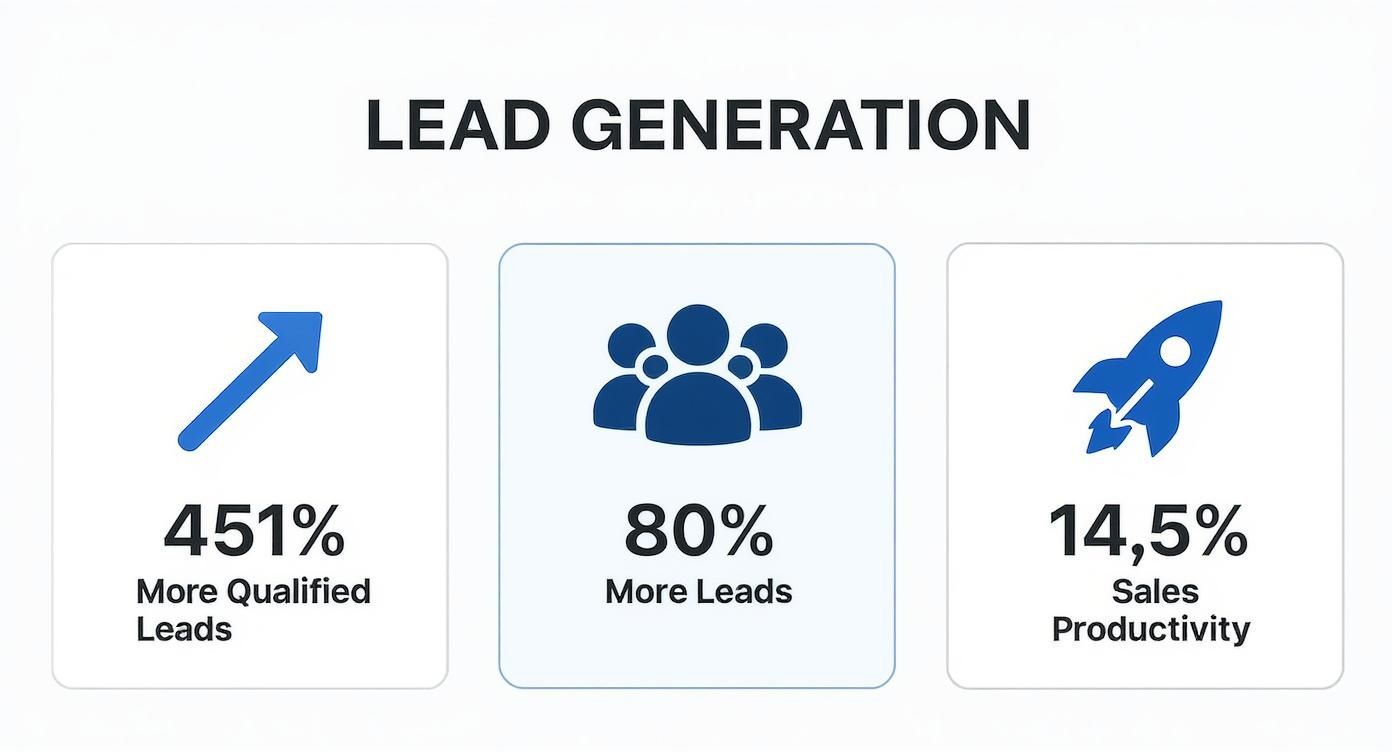
This data shows that automation doesn’t just bring in more leads—it dramatically improves their quality, giving your sales team a much stronger pipeline.
The Clear ROI of Automation
The numbers don't lie. On average, companies earn $5.44 for every $1 spent on automation, which is a 544% ROI over three years. The payback is often fast, too, with 76% of businesses seeing a return within the first year.
To see a real-world application of this, you can learn more about how automation can triple your engineering firm’s ROI in our detailed guide. This isn't just theory; it’s a proven financial outcome businesses are achieving now.
Benefit #3: Deliver Personalized Experiences at Scale

Let's be direct: your customers expect you to understand them. They expect you to talk to them like an individual, not just a number on a list.
The days of blasting the same generic message to everyone are over. That approach isn't just ineffective; it can actively push good prospects away.
This is where marketing automation truly shines. It gives you the power to create highly personal, one-to-one experiences for your entire audience without chaining your team to their keyboards. You can finally make every customer feel seen and understood, which is the bedrock of building loyalty.
How Does It Actually Work?
So, what’s the "engineering" behind making personalization work at scale? It’s all about turning customer data into smart, timely conversations. You're essentially building a system that listens to what your customers do and responds intelligently.
It boils down to three core mechanics:
- Audience Segmentation: Ditch one giant email list for several smaller, highly focused ones. You group contacts based on shared traits, like "New Leads," "Repeat Customers," or "Contacts Interested in Service X." Automation handles this for you.
- Behavioral Triggers: This is where the magic happens. A trigger is a specific action a user takes that kicks off an automated sequence. For example, if someone views your pricing page three times in a week, that action can trigger a personalized follow-up from a sales rep.
- Dynamic Content: This is the secret to showing different content to different people within the same email or on the same webpage. A B2B company could show a case study that’s perfectly matched to the visitor’s industry.
Putting It Into Practice: Real-World Examples
Let's look at how this solves real-world business problems.
B2C E-commerce: The Abandoned Cart
- The Problem: A shopper adds items to their cart but gets distracted and leaves. Following up manually is impossible.
- The Automated Fix: A behavioral trigger spots the abandoned cart. The system then kicks off a simple, automated sequence.
- 60 minutes later: A quick email or text pops up: "Did you forget something?"
- 24 hours later: A second email arrives, highlighting a key benefit or showing customer reviews.
- 48 hours later: A final nudge offers a small incentive (like 10% off) to close the deal.
- The Transformation: You start recovering sales that were destined to be lost forever, turning hesitation into a completed purchase.
B2B Manufacturing: Nurturing a Niche Lead
- The Problem: You get leads from all sorts of industries. Sending them the same generic brochure doesn't address their specific challenges.
- The Automated Fix:
- A lead from an automotive company downloads your whitepaper on "Improving Production Line Efficiency."
- The system sees this and automatically adds them to your "Automotive Prospects" segment.
- A week later, an automated workflow sends them a follow-up email with a case study detailing exactly how you helped another automotive client solve that very problem.
- The Transformation: The lead gets content that speaks their language, positioning you as an expert in their field and warming them up for a sales call.
The core idea is simple: use data to prove you're listening. When a customer's actions shape the marketing they receive, the entire interaction shifts from a generic broadcast to a meaningful conversation. This is how you build trust and accelerate the sales cycle.
A Practical Roadmap to Implementation
Understanding the benefits of marketing automation is one thing. The real question we hear from business owners is, "This sounds great, but where do I actually begin?" Putting these ideas into practice can feel overwhelming, which is why we approach every implementation with a clear, engineering-minded roadmap.
This isn’t about flipping a switch and hoping for the best. It’s about building a solid foundation, piece by piece, to create a system that delivers results. Let’s break down the essential phases of getting your automation engine running.
Phase 1: Define Your Goals and Clean Your Data
Before you look at software, you need to answer one question: what problem are you trying to solve? Are you trying to improve lead follow-up speed, nurture long-term prospects, or win back past customers? Pick one or two primary goals to focus on first.
Next, you have to face your contact data. Your automation system is only as good as the information you feed it. If your contact list is a mess of outdated emails and duplicate entries, your results will be disappointing.
Transparency Check: This is the unglamorous but non-negotiable first step. Taking the time to clean and segment your contact data before you start will save you from massive headaches down the road. It’s the only way to ensure your messages reach the right people.
Phase 2: Choose the Right Platform
With your goals defined, now you can pick your tool. The market is flooded with options. Don't get distracted by endless features you'll never use.
Focus on a platform that solves your immediate problems and can grow with you. For many of the service businesses we work with, a unified platform like GoHighLevel is a strong choice because it rolls the CRM, email, SMS, and sales pipelines into one system.
Questions to Ask When Choosing a Platform:
- Does it integrate with the other tools I already use?
- Is the user interface straightforward enough for my team to learn?
- Can it handle the specific workflows I identified in Phase 1?
- Does the pricing model make sense for my business size and future growth?
Phase 3: Your First 90 Days Checklist
Once your platform is in place, avoid the temptation to automate everything at once. This common pitfall leads to overly complex, broken workflows. Instead, focus on building a few high-impact automations that deliver immediate value.
Here’s a practical checklist for your first 90 days. Start with the first one, get it running smoothly, then move to the next.
- Build a "Welcome" Series for New Contacts: This is your automation MVP. Create a simple 3-5 email sequence that automatically goes out to anyone who fills out a form on your site. This ensures every new lead gets an immediate, consistent first impression.
- Set Up a Lead Nurturing Sequence: This workflow targets prospects who aren't ready to buy yet. It automatically sends them valuable content—like case studies or guides—over several weeks, building trust and keeping your brand top-of-mind.
- Create an Internal Lead Notification: As soon as a "hot" lead is identified, the system should automatically notify the right salesperson and create a task in the CRM for them to follow up. This closes the gap between marketing and sales.
These initial workflows are the building blocks of a powerful system. By tackling them one by one, you create tangible momentum. For a closer look at how these systems are built for B2B environments, our guide on business-to-business marketing automation provides a deeper diagnosis.
A Few Common Questions Answered
When business owners explore automation, a few key questions always come up. Getting clear on these points is the first step toward building a system that actually works.
Is Marketing Automation Just for Big Companies?
Not anymore. While massive corporations were the first to adopt it, today’s platforms are built to be accessible and affordable for small and medium-sized businesses.
Honestly, the core benefits—saving time, improving lead quality, and personalizing communication—often have an even bigger impact on smaller teams. When you’re lean, automating repetitive work frees you up to think about strategy and growth. That’s a massive competitive edge.
What’s the Difference Between Email Marketing and Marketing Automation?
Think of it like this: your standard email marketing tool, like Mailchimp or Constant Contact, is a power drill. It’s fantastic for one specific job, like sending a monthly newsletter.
A true marketing automation platform is the entire toolkit. It does that one job, but it also connects everything else.
A real automation system can:
- Send personalized emails automatically when someone visits a specific page on your site.
- Segment your audience into targeted lists based on their behavior.
- Score leads so your sales team knows exactly who to call next.
- Send text messages, create internal tasks, and track a customer's entire journey from first click to final sale.
It’s the system that connects all the dots between your marketing and sales efforts.
How Long Until I See Results?
This is a great question, and the transparent answer is: it depends on your goals.
You'll see some benefits almost immediately, like the time you save by automating your welcome email sequence. For bigger results, industry data shows that 76% of companies see a positive ROI within the first year. More complex goals, like a major jump in your lead conversion rate, might take 3-6 months as you build, test, and refine your automated workflows.
The key is to start with a few high-impact automations to get the ball rolling and build momentum.
Ready to stop patching holes and start building a true engine for growth? The team at Machine Marketing specializes in implementing practical, results-driven automation for manufacturers and service businesses. We’ll help you build the right system, starting with a clear 90-day plan. Book a discovery call with Karl today.