If you're a manufacturer or B2B business owner, you've probably already done the hard part. You've built trust, published useful content, and earned attention from buyers who don't make impulsive decisions. The next step is turning that authority into partnership revenue without bolting on a messy system that your team won't maintain.
That's where most affiliate programs fail. The problem usually isn't the idea. It's platform fit. A network that works for lifestyle creators can be a poor match for industrial software, replacement parts, technical training, or high-consideration services. If your audience researches before they buy, you need a platform that supports long sales cycles, clear attribution, and content-led discovery.
Affiliate marketing is large enough to matter. The global affiliate marketing industry was valued at $18.5 billion in 2025 and is projected to reach $31.7 billion by 2031, with U.S. spending at $8.2 billion, according to Hostinger's affiliate marketing statistics roundup. For B2B companies, that matters because this channel has moved well beyond coupon sites and into content, software partnerships, and niche publishers.
If you're still sorting out link structure and tracking basics, start with SponsorRadar's affiliate linking guide. Then use this list to choose a system that fits how your buyers buy.
Table of Contents
- 1. impact.com
- 2. CJ formerly Commission Junction
- 3. PartnerStack
- 4. ShareASale an Awin company
- 5. Rakuten Advertising Affiliate Network
- 6. Awin
- 7. Partnerize
- 8. FlexOffers
- 9. Amazon Associates US
- 10. Refersion
- Top 10 Affiliate Networks Comparison
- Your Next Step Building a Partnership System
1. impact.com
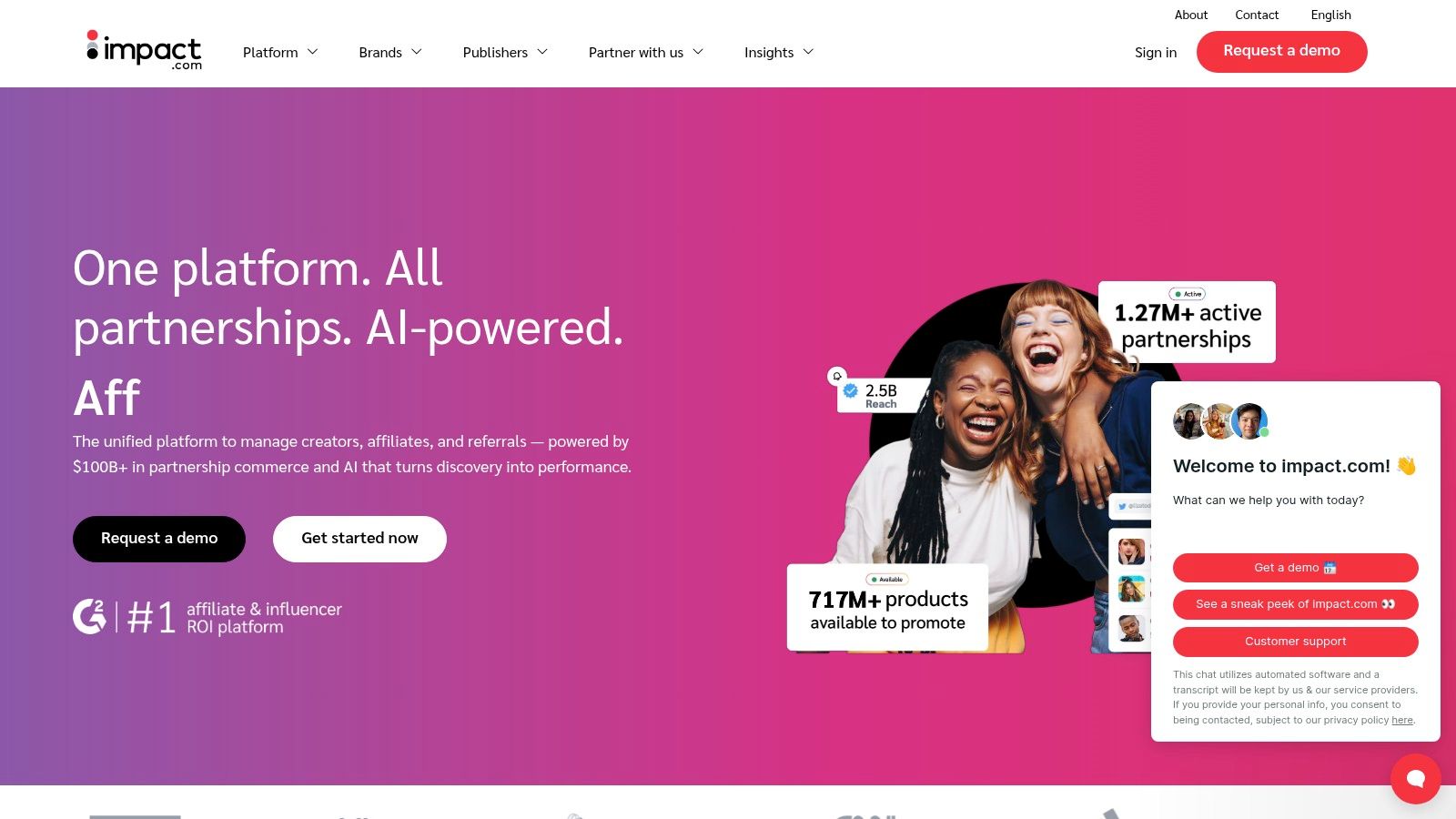
A common B2B problem looks like this. Your company wants one partner program, but the actual partner mix includes technical publishers, implementation consultants, channel partners, and referral relationships that all need different terms. impact.com handles that complexity better than the simpler affiliate networks on this list.
For industrial software, technical services, and higher-consideration offers, that control is the main reason to shortlist it. You can structure payouts around the specific buying motion instead of forcing every partner into the same commission model. A niche industry publication may need a content-focused payout. A consultant who influences closed deals may need a different arrangement. A dealer or integration partner may need contract terms that look closer to channel management than classic affiliate marketing.
Why it works for industrial partnerships
impact.com fits teams that treat partnerships as an operating system, not a side channel. Recruiting, contracting, tracking, and reporting live in one place, which reduces the spreadsheet sprawl that usually shows up once legal, finance, sales, and marketing all get involved.
That is especially useful in B2B.
Industrial buyers rarely convert on first click, and many programs need to measure more than a last-click sale. If your product has a longer sales cycle, a quote request, a demo, or an assisted conversion path, impact.com is better suited to that reality than a lightweight network built mainly for retail volume.
What stands out in practice:
- Partner type flexibility: Works well if your program includes publishers, affiliates, consultants, tech partners, or referral partners with different compensation models.
- Contract and payout control: Useful for industrial businesses that need custom terms by region, product line, or partner role.
- Systems integration: APIs and reporting are a good fit when affiliate data needs to flow into CRM, finance, or BI workflows.
The trade-off is setup overhead. Smaller teams can buy more platform than they can operate. If nobody owns partner recruitment, approval logic, commission rules, and reporting hygiene, the feature depth becomes friction.
Practical rule: Choose impact.com if your partnership program needs structure, exceptions, and internal coordination. Skip it if you only need a basic affiliate link system for a few publishers.
impact.com is a strong fit when your affiliate channel supports a broader authority-building strategy, especially if your team is already investing in content marketing best practices.
2. CJ formerly Commission Junction
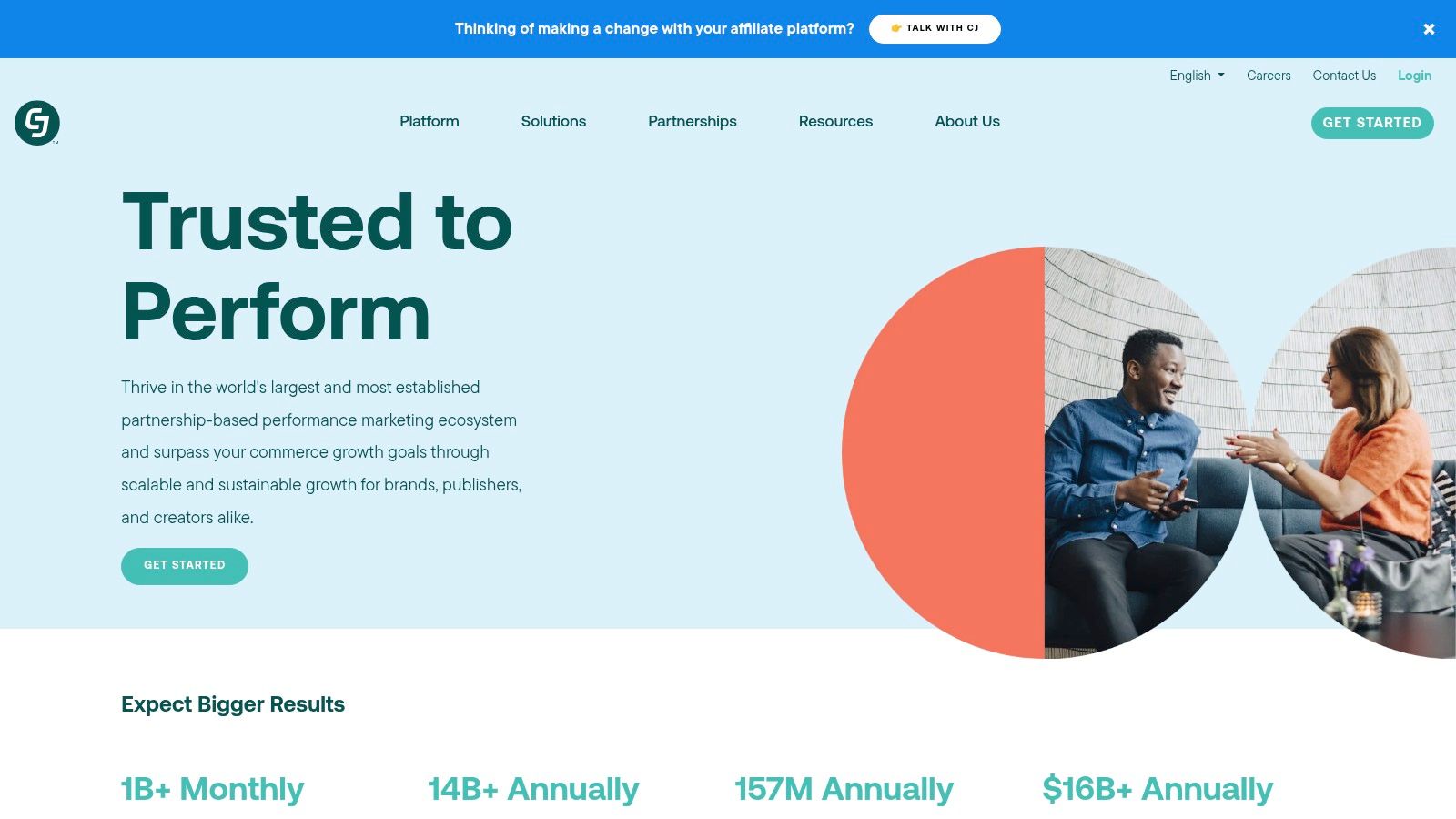
CJ is one of the safest answers when you want breadth. If your industrial audience buys across business software, office equipment, training, shipping tools, or general business services, CJ gives you a large marketplace with mature tooling and a long operating history.
This platform works well for publishers and B2B brands that think in categories, not single offers. A machine shop blog, for example, might need software partners in one content cluster, tax or finance tools in another, and office or procurement solutions elsewhere. CJ supports that kind of mixed portfolio.
Where CJ fits best
CJ is not the easiest platform for beginners, but that's partly because it has depth. Real-time reporting, product feeds, and merchant-specific applications give experienced teams more control over what they promote and how they analyze it.
The main downside is process friction. Approvals happen at the merchant level, so your team still needs to vet each program, read terms carefully, and avoid assuming that network access equals strategic fit.
Questions to ask before you commit to CJ:
- Does this merchant match your buyer? A recognizable brand isn't enough if it solves a problem your audience doesn't have.
- Can you support deep-linking and content mapping? CJ is better when you already know what content assets will drive clicks.
- Will your team use the reporting? Mature dashboards only help if someone reviews them and acts on the data.
The best affiliate marketing sites don't remove the need for diagnosis. They make better diagnosis possible.
If your company already has disciplined reporting and a content engine, CJ is a practical option. If you're looking for a simpler first step, another network on this list may get you live faster.
3. PartnerStack
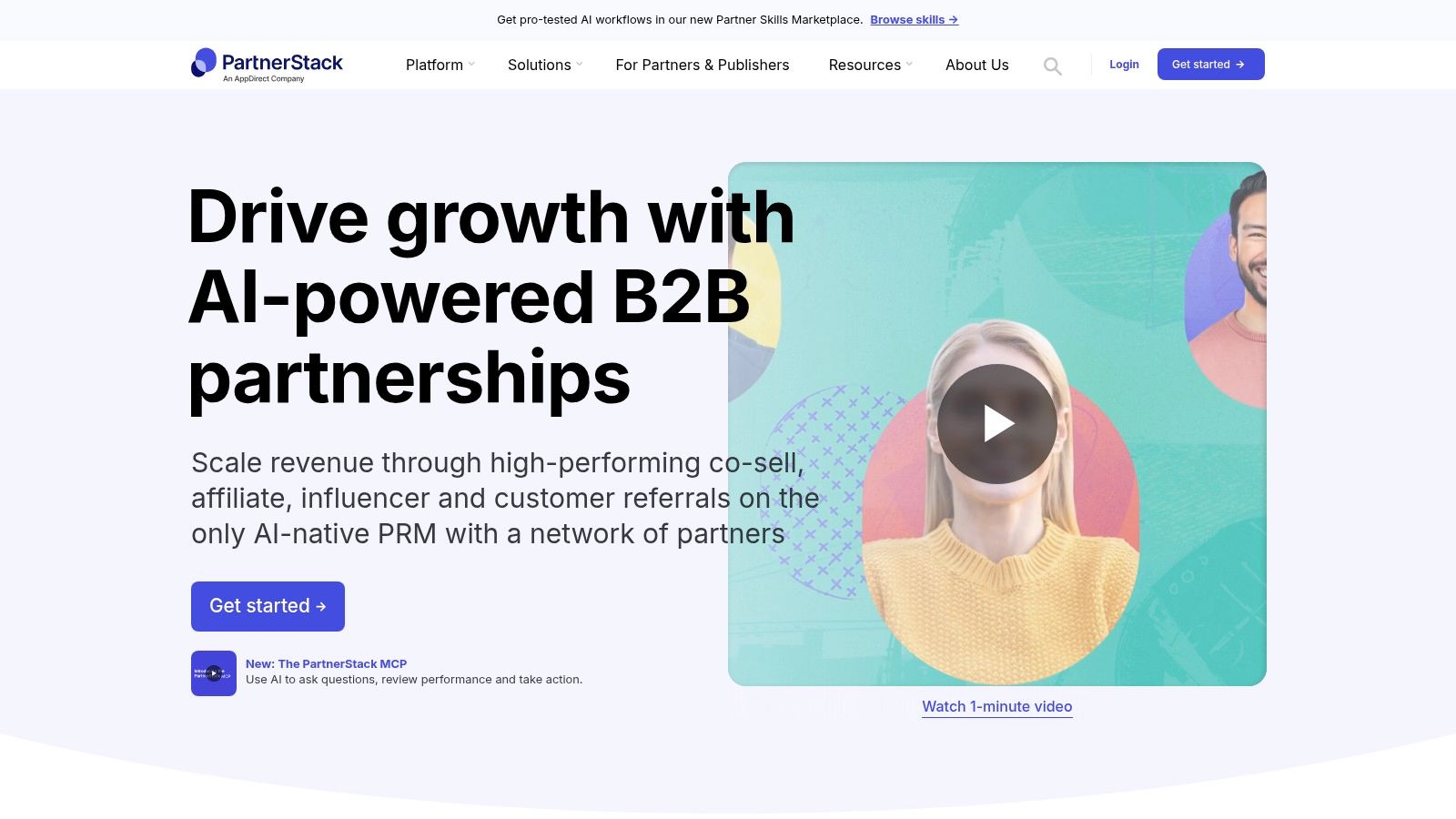
PartnerStack is the most clearly B2B-oriented option in this roundup. If your audience buys software, subscribes to platforms, or evaluates tools over time instead of in a single session, this is one of the most logical places to start.
Industrial companies often underestimate how many software buying decisions surround physical operations. ERP add-ons, quoting tools, CRM systems, maintenance software, training platforms, and workflow automation all create partnership opportunities. PartnerStack is built closer to that buying motion than broad retail-heavy networks.
Best for software-led industrial offers
PartnerStack is strongest when your revenue model includes trials, demos, subscriptions, or recurring relationships. That lines up with one of the biggest shifts in affiliate strategy. As discussed in this YouTube breakdown on affiliate trends, top performers are increasingly prioritizing high customer lifetime value, sticky software, and recurring commission structures instead of chasing high search volume alone.
That thinking is especially useful for industrial B2B. A one-time payout can look attractive, but a durable software product with strong retention often creates better long-term economics for both merchant and publisher.
A few practical observations:
- Good fit: SaaS reviewers, consultants, implementation partners, and niche B2B educators.
- Less ideal: Content teams that mostly recommend commodity products or one-time purchases.
- Big advantage: The platform understands software partnerships as a system, not an add-on.
If your content helps operations leaders choose systems, not just products, PartnerStack deserves a hard look.
4. ShareASale an Awin company
ShareASale stays popular because it solves a common real-world need. You want one account, lots of merchants, and easy link generation without enterprise complexity. For many B2B publishers and smaller industrial firms, that's enough.
It isn't glamorous. That's part of the appeal. When you need to test offers across business services, niche tools, or practical SMB products, ShareASale usually lets you move quickly.
What to watch before you join
ShareASale has a broad catalog, but quality varies a lot by merchant. Some programs are well-managed and active. Others look fine at first glance and then stall because the merchant hasn't updated creative, terms, or communication in a while.
That's why this network works best when your team treats it like a testing environment. It pairs well with companies already investing in marketing automation strategies, because you can use content and email workflows to validate which offers attract the right buyers before you scale promotion.
Use ShareASale when you need:
- Fast program discovery: Good for finding offers adjacent to your core niche.
- Simple deep linking: Useful for resource pages, blog posts, and tool roundups.
- Merchant variety: Helpful when your audience spans procurement, operations, and administration.
The trade-off is curation. You still need to inspect each program like an engineer inspects a machine before startup. Network access doesn't guarantee partner quality.
5. Rakuten Advertising Affiliate Network
A common B2B problem looks like this. The marketing team wants partner growth, but legal, procurement, and brand stakeholders need approval paths, documented terms, and fewer surprises once affiliates start promoting the offer. Rakuten Advertising fits that operating model better than networks built mainly for fast volume.
That matters for industrial companies selling technical products, software, or specialized services. If your buyers care about spec accuracy, compliance language, or channel conflict, a looser affiliate setup creates avoidable risk. Rakuten tends to appeal to teams that want tighter program controls and stronger alignment with established brands.
Rakuten Advertising makes the most sense when your affiliate strategy needs discipline more than experimentation. The value is not just access to advertisers. The value is a cleaner operating environment for companies that already run on process.
Where Rakuten fits best
Use Rakuten when your team needs:
- Clear program rules: Helpful for businesses that need disclosures, approved messaging, and consistent partner behavior.
- Stronger brand alignment: Useful when protecting reputation matters more than adding a large number of affiliates quickly.
- Experienced publisher relationships: Better suited to companies that want partners who can handle structured campaigns and established reporting expectations.
The trade-off is speed.
Some B2B and industrial firms will find Rakuten slower to work with than broader, more open networks. That is usually the price of tighter screening, more formal program standards, and a network culture built around established advertisers. If your goal is to test many small offers fast, this will feel restrictive. If your goal is to recruit dependable partners for higher-stakes products, that same restriction can save time later.
I would treat Rakuten as a fit for companies asking a specific question: do we need more affiliates, or do we need fewer affiliates who can represent a complex offer correctly? For technical categories, that distinction matters. A bad partner fit does more damage in B2B than in impulse-driven consumer markets because the sales cycle is longer, the claims are easier to get wrong, and the wrong lead can waste sales engineering time.
6. Awin
Awin makes sense for B2B and industrial companies that sell across regions and need a partner network that can support that complexity. If your distributors, resellers, referral partners, or content affiliates sit in different countries, the network reach matters. So do the operational controls behind it.
Awin is a good fit for teams that have moved past basic affiliate testing but are not ready to buy a heavier partnership platform. I usually place it in the middle tier. Broader and more internationally useful than entry-level options, but still practical for a lean marketing team that needs to recruit partners and keep the program under control.
That distinction matters in technical markets.
A B2B software company expanding into Europe, or an industrial supplier selling to regional buyers in multiple countries, often needs more than a simple marketplace of affiliates. The team needs partner discovery, cleaner onboarding, and enough structure to prevent inaccurate messaging around product specs, implementation claims, or service terms. Awin handles that better than networks built mainly for high-volume consumer offers.
It also pairs naturally with ShareASale because the two sit under the same parent company. For a business owner, the practical benefit is optionality. You can start with a simpler program setup, then widen your recruiting approach as your offer, margins, and partner mix become clearer.
The trade-off is complexity. Awin is not the best choice if you are still proving whether affiliates can drive qualified demand for a narrow industrial niche. In that case, a more focused network or a direct partner program can be easier to manage. Awin works better once you already know the offer converts and now need wider reach without losing process discipline.
7. Partnerize

Partnerize is built for serious partnership operations. If you're managing multiple brands, multiple business units, or a large portfolio of publisher relationships, this platform starts to make sense quickly. If you're a small manufacturer trying to launch your first affiliate offer, it may be too much system too early.
That isn't a criticism. It's a fit issue.
When enterprise depth matters
Partnerize is strongest where analytics, optimization, and partner management need to scale across teams. Agencies and larger advertisers often benefit because they can standardize reporting and recruitment inside one environment.
For industrial businesses, here's the practical dividing line:
- Choose Partnerize if you already have partner operations that need governance, reporting consistency, and room to expand.
- Skip it for now if your team still needs to prove that affiliate content can generate qualified demand in your niche.
The best affiliate marketing sites are not always the biggest or most powerful platforms. Sometimes the best system is the one your team can operate well for the next year. Partnerize is powerful. It just expects operational maturity in return.
8. FlexOffers
FlexOffers is the breadth play. If you're filling content gaps, testing adjacent categories, or trying to monetize a wide library of niche industrial articles, this network can help you move faster than a smaller, more curated platform.
That speed is useful when your content library touches many buying contexts. Maybe one article covers facility signage, another covers accounting software for job shops, and another covers shipping supplies. FlexOffers gives you range.
Good for breadth, not always for depth
FlexOffers is practical when you need inventory and optional account support more than deep strategic partnership tooling. That's why it works for publishers testing what resonates before committing to direct relationships or more specialized networks.
A good operating approach looks like this:
- Use FlexOffers to test categories: Identify which offers align with actual reader intent.
- Promote proven offers deeper elsewhere: Once something works, look for a stronger direct or specialized relationship.
- Keep quality standards high: Some programs are solid. Some aren't. Review terms and merchant reputation carefully.
This platform is useful for exploration. It is less useful as the final home for a highly strategic B2B partnership program.
9. Amazon Associates US
A plant manager reads your article on shop-floor organization, clicks through to buy bins, barcode labels, and a handheld label printer, and wants to place the order in five minutes. That buying situation is where Amazon Associates earns its place in a B2B or industrial content stack.
Amazon is rarely the highest-margin option. It is often the lowest-friction option for commodity purchases and low-consideration accessories. That distinction matters. If your audience needs MRO supplies, safety gear, measuring tools, maintenance books, or replacement consumables, Amazon often has the SKU and a checkout process buyers already trust.
Best use inside an industrial content strategy
Amazon Associates works best as a utility layer for articles with clear purchase intent. It fits content built around "what to buy," "best tools for," "replacement parts," or "supplies needed for" searches. It is less effective for complex industrial equipment, technical software, or services that require specification guidance, demos, or sales involvement.
For B2B teams, the trade-off is simple. You get broad product coverage and easier conversion on everyday items. You give up some commission upside, control, and relationship depth compared with specialized partner programs.
Use Amazon selectively:
- Good fit: commodity tools, books, office and warehouse supplies, PPE, labels, small accessories
- Weak fit: high-ticket equipment, technical SaaS, engineered products, and custom industrial services
- Best operating model: pair Amazon links with stronger direct programs for products that need education and sales support
Execution matters here. Amazon traffic usually converts best on pages that remove friction, clarify use case, and help buyers choose the right item fast. If you're sending industrial readers to basic product roundups, improving the page first often matters more than swapping affiliate networks. Start with these website conversion rate improvements for B2B pages.
The weaknesses are real. Commission rates can be modest. Compliance rules are strict. Terms can change without much warning. For industrial publishers, that means Amazon should support your monetization system, not define it. Use it where buyer intent is immediate and product complexity is low. Use specialist programs everywhere trust, technical validation, or sales assistance drive the conversion.
10. Refersion
Refersion is a good option when you want direct brand relationships without depending entirely on a giant network. That matters for niche B2B and industrial brands selling through e-commerce systems, especially when they want merchant control and simpler tracking.
Some industrial-adjacent companies don't belong in huge affiliate marketplaces. They need a merchant-run program, clean attribution, and clear payout handling. Refersion supports that model well.
Where direct merchant relationships help
Refersion makes sense when your best partnership opportunities are specific brands, not broad marketplace discovery. It also helps when promo-code tracking matters alongside referral links, which is useful for segmented campaigns or partner-exclusive offers.
For B2B teams, this can be a practical bridge between e-commerce and lead generation. If you're improving landing pages and trying to convert niche traffic more efficiently, that affiliate traffic needs to arrive on pages built to close. That's where website conversion rate improvements become part of the same system.
What to expect:
- More merchant variability: Program quality depends heavily on the individual brand.
- More control: Good for brands that want fewer layers between themselves and partners.
- Less breadth than major networks: Better for targeted relationships than mass exploration.
If your partnership model depends on a handful of well-matched brands, Refersion is often more practical than a larger but less focused network.
Top 10 Affiliate Networks Comparison
| Platform | ✨ Key features | 👥 Best for | ★ Quality | 💰 Pricing / value | 🏆 Standout |
|---|---|---|---|---|---|
| impact.com | 90k+ partner marketplace, in-platform contracts, fraud controls | 👥 Enterprise B2B, large manufacturers | ★★★★★ | 💰💰💰💰 (sales-assisted) | 🏆 Enterprise partnership ops & scale |
| CJ (Commission Junction) | Broad advertiser pool, APIs & product feeds, publisher onboarding | 👥 Data-driven publishers, B2B-friendly categories | ★★★★☆ | 💰💰 | 🏆 Deep US brand roster |
| PartnerStack | B2B SaaS marketplace, recurring & multi-touch commissions, enablement | 👥 SaaS vendors & software-focused partners | ★★★★ | 💰💰💰 | 🏆 Purpose-built for B2B SaaS partnerships |
| ShareASale (Awin) | Centralized program discovery, "Get Links" tools, affiliate docs | 👥 SMB-midmarket publishers & niche merchants | ★★★★ | 💰💰 | 🏆 Easy link gen; broad mid-market catalog |
| Rakuten Advertising | Premium advertisers, Affiliate Intelligence, strong compliance | 👥 Brands valuing policy/compliance & brand safety | ★★★★ | 💰💰💰 | 🏆 Brand-safe network & clear legal guidance |
| Awin | Opportunity Marketplace, create-a-link, partner invites | 👥 Mid-market/global brands and international programs | ★★★★ | 💰💰 | 🏆 Global reach + publisher invitation workflows |
| Partnerize | Enterprise analytics, partner discovery, program optimization | 👥 Agencies & enterprise advertisers | ★★★★☆ | 💰💰💰💰 (sales-led) | 🏆 Enterprise-grade analytics & scale |
| FlexOffers | Large offer inventory, publisher marketplace, APIs | 👥 Publishers needing fast breadth & category testing | ★★★ | 💰💰 | 🏆 Rapid access to many programs |
| Amazon Associates (US) | Near-universal catalog, simple link tools, high conversion | 👥 Content for MRO, tools, consumables for manufacturers | ★★★★ | 💰 (lower commission) | 🏆 Universal SKU coverage & conversion |
| Refersion | Merchant-run programs, Shopify/Woo/Magento integrations | 👥 Brands wanting direct merchant control & e‑commerce | ★★★★ | 💰💰 | 🏆 Clean tracking & merchant-controlled programs |
Your Next Step Building a Partnership System
A manufacturer publishes a detailed guide on reducing downtime, adds a few affiliate links to software and replacement parts, and expects the channel to grow on its own. Months later, traffic exists, but revenue is inconsistent and no one can explain which partner offers fit the buying process. The missing piece is usually not network access. It is system design.
For B2B and industrial companies, affiliate marketing works best when it is treated like an extension of demand generation. Start with diagnosis. What does your audience already purchase as part of normal operations? What do they research before they request a quote, book a demo, or approve a vendor? Which of those problems connect to an offer with a credible merchant, a clear buying path, and tracking your team can trust?
The strongest programs for technical products and industrial services usually share a few traits. They match search intent, fit naturally inside useful content, and connect to email or CRM follow-up. SEO still leads affiliate traffic, and email remains one of the highest-return channels, as noted in OptinMonster's affiliate marketing statistics roundup. For industrial buyers, that pattern is familiar. They search for a solution, compare options internally, then return later through email, retargeting, or a sales follow-up.
Validation is the part generic affiliate roundups usually miss.
Signing up for a network is easy. Verifying that a program can support a niche B2B audience takes more work. The key test is commercial fit: demand in the market, a merchant that will convert professional buyers, and an offer that belongs inside your content without feeling forced. As noted in this YouTube discussion on affiliate niche validation, the gap often sits between finding a topic people care about and finding a program with real revenue potential.
Social channels can support the system, but they rarely carry the full load for industrial or technical offers. AffiliateStatistics.marketing's roundup shows broad affiliate usage across social platforms and strong revenue concentration on Instagram and TikTok. That can help for awareness, simple product discovery, and remarketing. It is less reliable for long sales cycles, spec-driven purchases, or offers that require internal approval.
Start with one or two platforms from this list and build around buyer behavior. A B2B SaaS company may get better results from PartnerStack or impact.com because onboarding, attribution, and partner workflows match recurring-revenue offers. A manufacturer publishing practical maintenance content may see better performance from Amazon Associates or selected merchant programs through Awin or CJ when the products are easier to evaluate and buy online. A team with legal review, channel conflict, or distributor considerations should favor platforms with tighter governance and clearer controls.
The goal is a partnership system your team can run every month. Content that answers buying questions. Offers that fit the job. Tracking that connects clicks to revenue. Follow-up that keeps qualified buyers moving.
If you want help diagnosing which affiliate platform fits your audience, offer mix, and growth system, talk with Machine Marketing. We help manufacturers, machine shops, and industrial business owners connect content, SEO, CRM, automation, and partnership strategy into one practical system that your team can effectively operate.