If your marketing feels like you’re just firing shots in the dark, the problem probably isn't your tactics—it’s a brand strategy that’s disconnected from your operations. We see this all the time with B2B companies and manufacturers. The good news? It’s a solvable problem.
In this guide, we'll diagnose the common gaps in brand strategy and give you a proven system for building a brand that drives measurable growth. Effective brand strategy management ensures every marketing dollar, every sales call, and every customer interaction builds a single, trustworthy reputation. It’s what elevates you from being just another vendor to an indispensable partner.
Why Your Brand Is More Than Just a Logo
So, what is the difference between branding and brand strategy? Business owners often mix them up, but the distinction is critical.
Branding is what you can see and touch—your logo, color scheme, website design, and sales slicks. Brand strategy, on the other hand, is the thinking behind all of it. It’s the foundational blueprint that answers the most important questions about your business:
- Who are you? Your core mission, vision, and values.
- Who do you serve? A razor-sharp picture of your ideal customer.
- How are you different? Your unique spot in the market that no competitor can touch.
- What is your promise? The core value you deliver, every single time.
Without a solid strategy, your branding is just expensive decoration. Your website might look slick and your logo might be sharp, but the message will feel hollow or inconsistent. This is why so many marketing efforts fail to generate high-quality leads or build real customer loyalty—they lack a strategic core.
A brand strategy isn't a document that collects dust. It's an operational system that guides every decision you make, from product development straight through to customer service.
The Engine for Sustainable Growth
For B2B companies, particularly in technical fields like manufacturing, a strong brand strategy creates a massive competitive advantage. How? It translates complex technical features into clear, customer-focused benefits. It’s what builds trust during a long sales cycle and justifies a premium price point.
This shift from random tactical marketing to strategic brand management is gaining momentum. The global Brand Strategy Services market is projected to grow at a CAGR of 6.1% through 2033. Businesses are finally realizing that brand isn't a "soft" asset; it's a critical driver of performance.
Turning Strategy into Action
Great brand strategy management ensures your brand promise is delivered at every customer touchpoint. It gives your team the framework they need to create aligned content, run targeted campaigns, and speak to customers with one unified voice.
Knowing how to improve brand awareness in an AI-driven world is more critical than ever, and a clear strategy is what makes it possible. It gives you the focus needed to cut through the noise and connect with the right audience. This transforms your brand from a static identity into a dynamic engine for growth, ensuring every action you take builds long-term value.
Diagnosing Your Brand's Current State
Before you can build a stronger brand, you have to diagnose where you stand right now. Skipping this discovery phase is like a doctor prescribing medication without an exam—you’re just guessing, and guesses are expensive.
This diagnostic process moves you from assumptions to data-driven clarity. It's about mapping your current position so you can chart the most direct route to your goals.
Start with an Internal Interrogation
The first place to look for answers isn't the market—it's inside your own building. Your team holds powerful, often unstated, beliefs about your brand. The goal is to get it all out in the open.
We kick off every brand engagement with a version of our 40-Question Marketing Review. It’s not about finding "right" answers, but about spotting misalignments.
Gather your leadership, sales, and marketing teams and ask these questions:
- Who is our absolute ideal customer (and just as importantly, who isn't)?
- What is the single biggest problem we solve for them?
- If our top three competitors vanished, why would customers still choose us?
- What are the five words we want customers to use when describing us?
When your head of sales describes your value proposition one way and your marketing lead describes it another, you’ve just diagnosed a major disconnect. That's a core problem a good brand strategy is built to fix.
Analyze the Competitive Landscape
Your brand doesn't exist in a vacuum. A clear-eyed view of your competitors helps you identify the "white space" in the market—the unique position only you can own. This isn't about copying what others are doing. It's about finding a way to be different where it matters most to your customers.
Go deeper than a quick glance at their websites. You need to analyze their:
- Messaging: What specific promises are they making? What pain points do they focus on?
- Content: What topics do they "own"? Are there expertise gaps you can fill?
- Customer Reviews: What do their customers love and hate about them? Their weaknesses are your opportunities.
For example, a B2B manufacturer might notice all their competitors talk about are technical specs. The white space? Focusing on post-sale support, operator training, and total cost of ownership—benefits that solve the real-world operational headaches their customers actually face.
The goal of a competitor analysis is not to be better, but to be different. It’s about uncovering the unoccupied territory in your customers' minds and planting your flag there.
This process clarifies the path from your strategy to your branding and, ultimately, to how your customers perceive you.
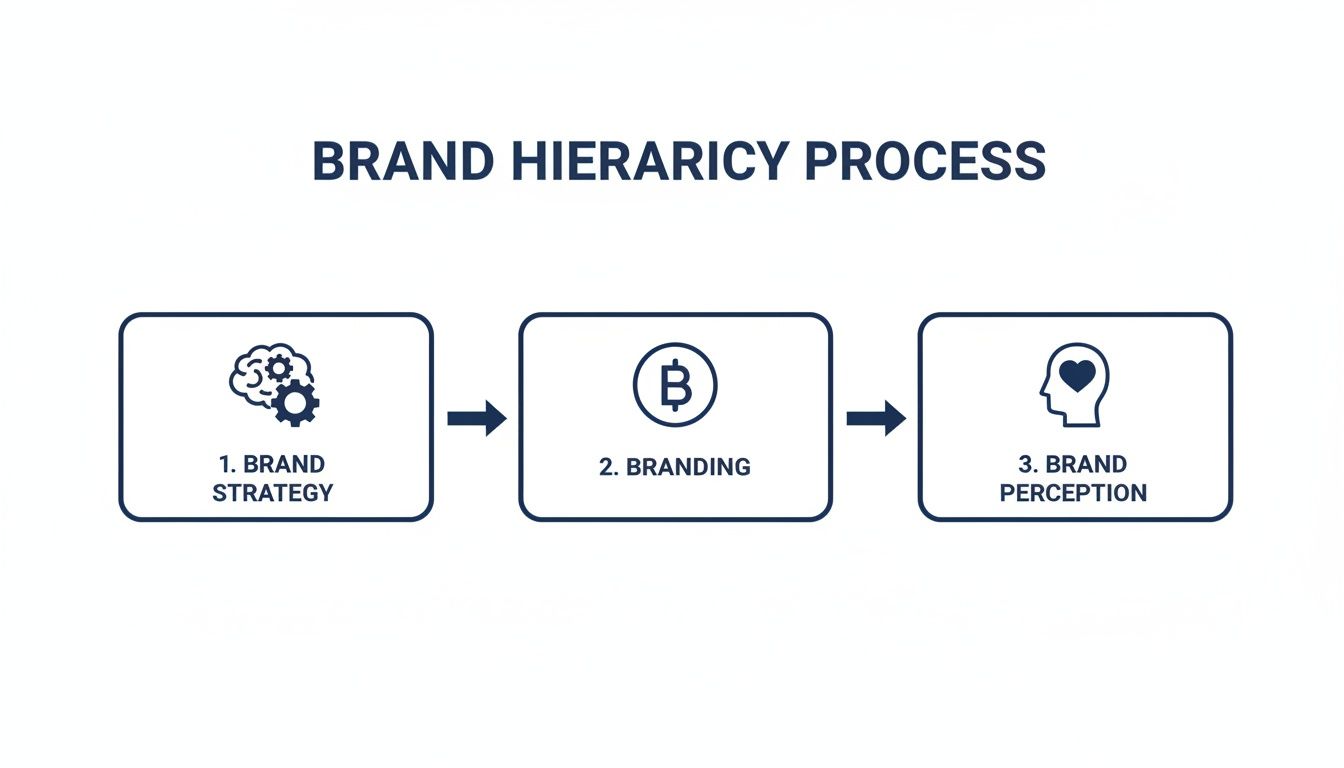
It all flows from the strategic thinking (the brain), which informs the tangible assets like your logo (the branding), and finally shapes the emotional connection and reputation you build with customers (the heart).
Audit Your Brand Assets and Customer Feedback
Finally, conduct a thorough audit of your current brand touchpoints. Gather every piece of material that represents your company: your website, sales slicks, email signatures, trade show banners, and social media profiles.
Lay it all out. Do these pieces look and feel like they come from the same company? Do they communicate a consistent message? Often, what you'll find is a patchwork of different logos, outdated taglines, and conflicting value propositions.
This internal review must be paired with direct customer feedback. Talk to your best customers—the ones you wish you could clone. Ask them point-blank:
- "Why did you originally choose to work with us over everyone else?"
- "In your own words, what do we do better than anyone?"
- "Was there anything about our process that almost made you not choose us?"
Their answers are the unvarnished truth about your brand's real-world perception. When you combine this external feedback with your internal audit, you get a complete diagnostic picture. For a deeper look at this process, check out our guide on how to conduct a comprehensive marketing audit. This initial diagnosis is the bedrock of your entire brand strategy.
Crafting Your Brand Positioning and Message

You’ve done the research. You have the raw data. Now it’s time to build the blueprint that will guide your brand for years. This is the heart of effective brand strategy management—translating what you’ve learned into a powerful market position and a message that cuts through the noise.
This isn't an abstract exercise. It's about making deliberate choices that define how customers, competitors, and your own people see your business. Get this wrong, and your marketing will always feel disjointed, leaving your sales team without the sharp, unified story they need to close deals.
From Data to Direction
First, distill your research into foundational brand statements. Think of these not as fluffy taglines, but as internal compass points that keep everyone marching in the same direction.
Mission Statement: This is your "why." It has to be more than making money. A B2B manufacturer could shift from "We build widgets" to "We empower manufacturers to achieve zero-downtime production through reliable components."
Vision Statement: This is your "where." It paints a picture of the future you’re working to create. It should be ambitious enough to inspire your team but plausible enough to attract partners.
Core Values: These are the non-negotiable principles guiding your company’s behavior. Stick to three to five powerful words or short phrases (like "Unyielding Reliability," "Proactive Partnership," or "Practical Innovation") to make them memorable and actionable.
These elements become the strategic filter for every decision you make. If a new marketing campaign doesn’t align with your mission, vision, and values, you don't do it. It's that simple.
Defining Your Unique Value Proposition
Your unique value proposition (UVP) is the most critical part of your messaging. It must answer one question for your ideal customer with absolute clarity: "Why should I buy from you and not your competition?"
This is where many B2B companies stumble. They list features instead of benefits. To craft a message that resonates, you first have to identify a target audience and speak directly to their specific pain points.
A strong UVP lives at the intersection of three key things:
- What your customer truly needs.
- What you do exceptionally well.
- What your competitors do poorly.
That sweet spot is your unique and defensible position in the market.
Your UVP isn't a list of everything you do. It's a sharp, pointed statement about the one thing you do better than anyone else for the specific customer you serve. It's your knockout punch.
For a deeper dive into turning features into compelling benefits, our guide on creating a powerful marketing messaging framework offers practical steps and templates.
Real-World Example: A Machine Manufacturer
Let's make this real. We worked with a mid-sized machine manufacturer whose marketing was falling flat. Their website was a wall of technical jargon like "proprietary servo-motor integration."
The problem? Their customers weren't engineers—they were overwhelmed plant managers. Their biggest pain wasn't a lack of servo-motors; it was costly production downtime and the headache of training new operators.
We helped them translate technical specs into customer-focused benefits. Here's the messaging framework we developed to connect their features to what managers actually care about.
Brand Messaging Framework Example
| Core Feature | Technical Description | Customer Pain Point | Benefit-Driven Message |
|---|---|---|---|
| One-Touch Setup | Pre-calibrated servo-motor with automated tooling alignment | "New operators take weeks to train, causing errors and downtime." | "Get new operators running production in under an hour." |
| Remote Diagnostics | Integrated IoT sensor with cloud-based monitoring dashboard | "When a machine goes down, we lose thousands per hour waiting for a tech." | "Diagnose and fix 80% of issues remotely in minutes, not days." |
This simple shift in messaging was transformative.
By changing the conversation from what the machine is to what the machine does for the manager, their brand perception changed. They went from being just another equipment supplier to a partner in operational efficiency. The result? This clear messaging led to a 35% increase in qualified sales inquiries within six months because it finally connected with the people signing the checks.
Building Your Brand Identity and Asset System

With your positioning defined, it’s time to give your brand a face and a voice. This is where your strategy becomes tangible. A solid brand strategy management system ensures this is a deliberate process to build recognition and trust.
Think of it as creating a complete toolkit for your team. Every asset, from your logo to your email signature, must feel like it came from the same source and is telling the same story. This consistency is what separates brands people remember from those they forget.
Developing Your Brand Style Guide
The cornerstone of a cohesive brand identity is a comprehensive brand style guide. This document isn't just for designers; it’s the rulebook for your sales team, marketers, and anyone creating customer-facing materials. It removes guesswork and empowers your team to execute your brand flawlessly.
A practical style guide should clearly define:
- Logo Usage: Clear rules for your logos, including minimum sizes, exclusion zones (the "breathing room" around it), and examples of incorrect usage (like stretching it or changing colors).
- Color Palette: Your primary and secondary colors with their exact codes (HEX, RGB, CMYK) for digital and print. This guarantees your brand’s blue is the same on your website as it is on a trade show banner.
- Typography: The specific fonts for headlines, body text, and accents. This makes your content instantly recognizable and easier to read.
- Imagery Style: Guidelines on photography and illustrations. Should photos feature people or products? Should the mood be bright and optimistic or more technical and precise?
- Voice and Tone: A clear description of your brand's personality. Are you an authoritative expert or a helpful guide? Include "say this, not that" examples to make it practical.
A style guide is your system for consistency. It translates your brand strategy into practical instructions, ensuring every touchpoint—from a social media post to a sales proposal—reinforces the same core identity.
Building a Centralized Asset System
The style guide is your rulebook, but your team still needs the tools. The next step is to build a centralized, easy-to-access library for all your brand assets. This is a game-changer for efficiency and ends the constant "Can you send me the logo?" emails.
This needs to be more than just a folder on a shared drive. A modern asset system, often managed within a platform like GoHighLevel, should be well-organized and intuitive.
Essential components of your asset library:
- Logos: All approved logo files (.PNG, .SVG, .EPS) in every color variation (full color, black, white).
- Templates: Pre-built templates for common materials—sales presentations, proposals, email newsletters, and social media graphics.
- Photography: A curated library of approved company photos, headshots, and stock imagery that aligns with your brand style.
- Copy Snippets: Approved boilerplate text for company descriptions, executive bios, and product overviews.
This system ensures that when a salesperson needs a proposal, they aren’t grabbing an old logo from their desktop. They're using an approved template with the correct fonts, colors, and messaging, reinforcing your brand with every interaction.
This structured approach is tied to results. Hyper-personalization has become a critical part of effective brand strategy management, helping brands see 10-15% higher revenue growth. For B2B manufacturers, this means ditching generic brochures for tailored experiences—something only possible with a flexible asset system. You can dig deeper into these marketing trends and how they impact growth by checking out this guide at Wedia Group.
Implementing Brand Governance and Measurement
A great brand strategy is just an idea until you put it to work. This is where you build the systems that protect your brand’s integrity and prove its value. Without governance, your message gets muddled. Without measurement, you’re just guessing.
Think of it this way: You’ve designed the blueprint (strategy) and built the machine (identity). Now you need the control panel and the quality assurance process to turn your brand into a dynamic asset that actively drives performance.
Establishing Brand Governance Workflows
What is brand governance? It's your playbook—a system of rules, processes, and tools that ensures every piece of content and every campaign stays true to your core strategy. It's how you maintain consistency when multiple people across multiple departments are creating materials for your company.
The point isn't to kill creativity; it's to give your team clear guardrails. When everyone knows the rules, they can move faster and with more confidence.
Here are the essential workflows to put in place:
- Centralized Asset Management: This is non-negotiable. A single, organized hub for all brand assets is a must. A platform like GoHighLevel can house approved logos, templates, and key messaging, killing off rogue versions and saving everyone time.
- A Clear Review and Approval Process: Define who signs off on what. A social media post might only need a marketing manager's glance. A major sales brochure will likely need input from sales leadership and product experts. Document the workflow to eliminate confusion.
- Regular Brand Training: Don’t just email the style guide and hope for the best. Hold short, recurring training sessions for new hires and refreshers for existing teams—especially sales and marketing. This is your chance to reinforce the brand’s voice, mission, and visual standards.
Governance isn’t about being the "brand police." It's about empowering your team with the clarity they need to make the right decisions on their own, ensuring the brand's integrity scales as your company grows.
Measuring What Matters Most
To manage your brand, you have to measure it. But it's easy to get lost tracking vanity metrics like social media likes. The key is to track KPIs that connect brand health directly to business outcomes.
Your measurement dashboard should be a diagnostic tool. It needs to help you answer the big questions: Is our brand getting stronger? Is it attracting the right customers? Is it making our sales process more efficient? To get a solid grip on this, it's worth exploring the fundamentals of what marketing analytics really are and how they apply here.
Start by tracking these essential brand health indicators:
- Branded Search Volume: This is a gold-standard metric. When more people search for your company name directly on Google, it’s an undeniable sign that brand awareness is growing.
- Website Traffic from Branded Search: Dig into your analytics and see how much traffic comes from people who specifically looked you up. This audience is highly qualified and much more likely to convert.
- Share of Voice (SOV): How often is your brand mentioned online compared to your top competitors? Use monitoring tools to track brand mentions across social media, forums, and news sites to see how much of the market conversation you own.
- Lead Quality: A stronger brand attracts better leads. Work with your sales team to score incoming leads. A clear sign your brand strategy is working is an increase in the percentage of Marketing Qualified Leads (MQLs) that become Sales Qualified Leads (SQLs).
By monitoring these metrics, you create a feedback loop. You can see which campaigns are moving the needle on brand recognition and which are falling flat. This allows you to iterate and refine your strategy based on real data, transforming brand management into a core business function that drives measurable growth.
Frequently Asked Questions About Brand Strategy
Even with a solid playbook, good questions always surface. Let's tackle a few of the most common ones we hear from business owners digging into brand strategy management.
How Long Does It Take to Develop a New Brand Strategy?
There's no magic number, but for most small to mid-sized businesses, you should plan for a 6 to 12-week process. That timeline isn't random; it's built around distinct, critical phases.
- Weeks 1-4: Discovery & Research. This is diagnosis. We conduct internal interviews, deep competitor analysis, and gather real customer feedback. Rushing this stage is the single biggest mistake we see.
- Weeks 5-8: Positioning & Messaging. This is where we turn research into your core brand pillars: mission, vision, values, and your unique value proposition. This is where the hard strategic choices happen.
- Weeks 9-12: Initial Asset & Governance Setup. With the strategy set, we build the foundations. This means creating the initial brand style guide and putting the systems in place to deploy and manage everything consistently.
At our agency, we model our initial 90-day plans around this structure to build momentum and show real progress quickly.
What Is the Difference Between Brand Strategy and Marketing Strategy?
This is a crucial distinction. The simplest way to think about it is an architect's blueprint versus the construction crew's schedule.
Brand strategy is your "who" and "why." It’s your company’s fundamental identity—your mission, values, market position, and the core promise you make to every customer. It’s the foundation that shouldn’t change often.
Marketing strategy is your "how" and "where." This is the action plan to get your brand's message out and hit specific business targets. It covers the channels you use (like SEO, email, or social media), the campaigns you run, and the day-to-day tactics you deploy.
A powerful brand strategy doesn't replace your marketing plan; it makes it ten times more effective. It ensures every ad, blog post, and sales call feels connected and reinforces the same message.
How Can I Measure the ROI of Brand Strategy Management?
Measuring the return on your brand isn't as simple as tracking a PPC campaign, but it's absolutely possible—and necessary. You just need to know what to look for.
Here are the metrics that matter for connecting brand health to business outcomes:
- Branded Search Volume: Are more people searching for your company name on Google? This is a direct signal of growing brand awareness.
- Lead Quality: A stronger brand attracts better-fit customers. Work with your sales team and track the percentage of leads that are truly qualified. If that number climbs, your message is hitting the mark.
- Sales Cycle Length: When your brand is clear and trusted, it builds confidence faster. Prospects need less convincing, which often shortens the time it takes to close a deal.
- Customer Lifetime Value (CLV): A brand that connects with its audience creates loyalty. Loyal customers mean repeat business, which directly drives up your CLV.
By using your CRM to tag leads from different brand-building activities, you can follow them through the entire sales journey. This lets you draw a straight line from your investment in brand management to your bottom line, turning your brand from a fuzzy concept into a measurable revenue-driver.
Ready to stop guessing and start building a brand that drives measurable results? The first step is a clear diagnosis. At Machine Marketing, we help business owners build marketing systems that deliver consistent growth.
Book a discovery call with us today to see how a strategic approach can transform your business.