If your business feels like it’s hit a wall, you’re not alone. We see this all the time—and the root cause is often hidden in plain sight. The problem isn't the quality of your work; it’s a mismatch between your strategy and where your business actually is in its lifecycle.
In this article, we’ll show you how to diagnose which of the four core business growth stages you're in. Then we'll give you practical, step-by-step solutions you can use today to build a system that works.
Why Understanding Business Growth Stages Is Critical
Trying to scale your business without knowing its current stage is like using the same map for every city. The strategy that helps a startup land its first clients will absolutely hamstring a mature company trying to defend its market share. You end up burning cash on the wrong tactics and missing opportunities.
As an agency with an engineering mindset, we see this constantly. Business owners come to us frustrated, asking, “Why did my marketing stop working?” The answer is almost always that the business quietly leveled up to a new growth stage, but its strategies and systems got left behind.
Pinpointing where you are on this journey is the most important diagnostic you can run. It immediately clarifies what you need to do next.
- Focus Your Resources: Are you wasting money on tactics that don’t matter? Knowing your stage helps you put your budget and team where they’ll have the biggest impact.
- Anticipate Challenges: You’ll see the next obstacle coming. Whether it's a cash flow crunch in the early days or complacency at maturity, you can prepare instead of just reacting.
- Set Realistic Goals: You can define KPIs that make sense for where you are now. This prevents the frustration that comes from chasing the wrong numbers.
- Build the Right Systems: You can implement the marketing, sales, and operational processes you need not just for today, but to set you up for the next phase of growth.
A Quick Look at the 4 Stages
To give you a high-level overview, we've broken down the business lifecycle into four distinct stages. Each one has a different primary goal, its own set of common headaches, and requires a unique marketing focus.
The 4 Business Growth Stages At a Glance
| Stage | Primary Goal | Common Challenge | Key Marketing Focus |
|---|---|---|---|
| Startup | Prove the business model and survive. | Lack of brand awareness and inconsistent lead flow. | Building a brand foundation and generating initial leads. |
| Growth | Acquire customers and scale revenue rapidly. | Systems breaking and inefficient processes. | Creating repeatable, scalable marketing and sales systems. |
| Maturity | Optimize for profitability and defend market share. | Market saturation and slowing growth. | Customer retention, upselling, and optimizing for efficiency. |
| Renewal/Decline | Reinvent the business or manage its decline. | Complacency and resistance to change. | Exploring new markets, innovating offers, or strategic exit. |
This table is just a starting point. Now, let's dig into the diagnosis and solution for each stage.
The Foundational Framework for Growth
At its core, the business lifecycle follows a predictable path. To move through each phase successfully, you have to adapt by using actionable small business growth strategies that fit the moment.
This visual maps out the progression, from the scrappy, high-energy launch of a startup to the established stability of a mature company.
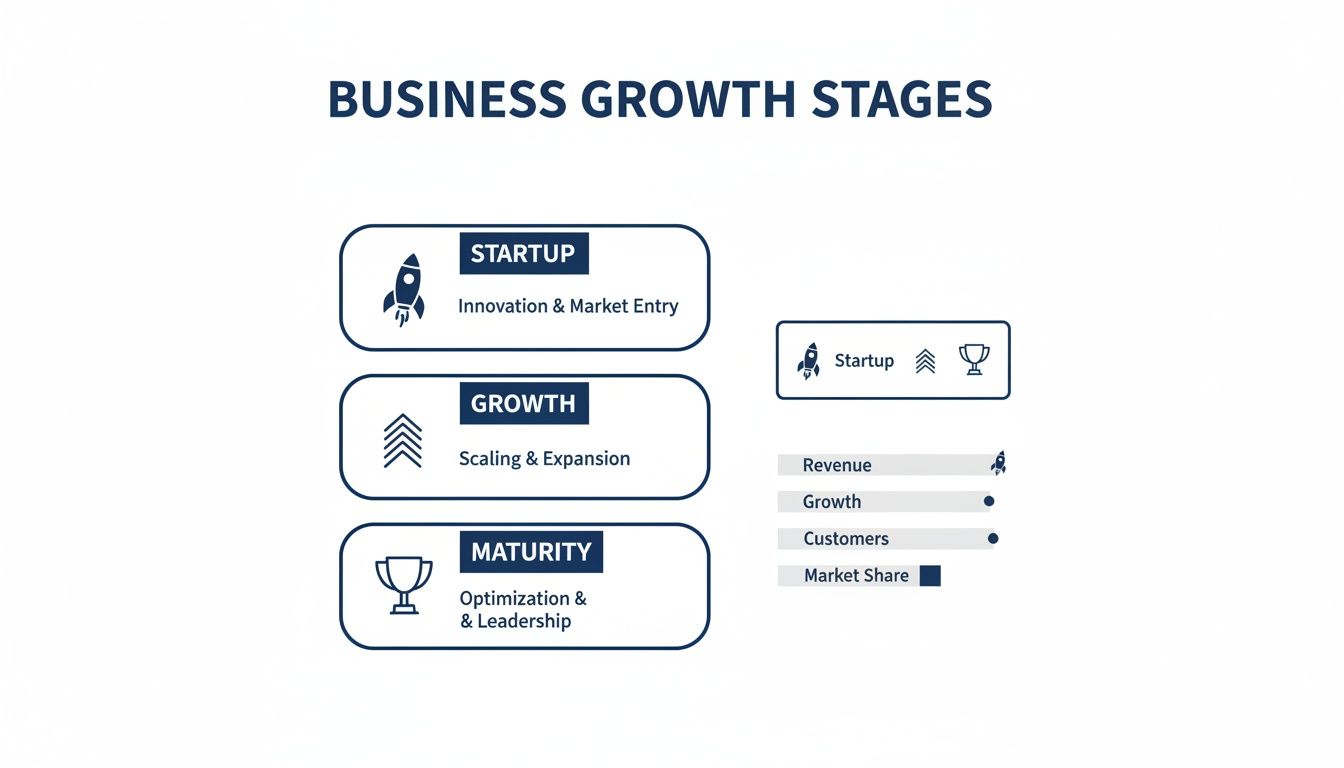
The big takeaway here is that your primary focus has to shift. It moves from survival and validation at the start, to building scalable systems during the growth phase, and finally to optimization and defense when you hit maturity.
The tools and approaches that got you to this point often become the very things holding you back. Success depends on finding solutions that fit the stage you're in now, not the one you just left.
A Roadmap for Action
Consider this guide your blueprint. We’re going to break down each of the business growth stages from a practical, engineering perspective to help you pinpoint exactly where you stand. From there, we’ll give you a clear, solution-focused framework with marketing and operational plays built for manufacturers and B2B companies.
You’ll get specific GoHighLevel workflows, website and SEO priorities, and proven lead generation tactics for each stage. No more generic advice.
By the end, you’ll have a clear picture of what to prioritize, what to ignore, and how to build the right systems for your current needs. To get a head start, you can grab our free marketing roadmap template to start lining up your strategy with your growth stage today.
Let's start by diagnosing your business.
Stage 1: The Startup Survival Stage
Welcome to the trenches. The Startup Stage is defined by one mission: prove your idea works before the money runs out. Every move is about chasing product-market fit—that magical point where you’ve built something real customers desperately want and are happy to pay for. It’s a blur of high energy, non-stop experiments, and a bank account that always feels too empty.
For a manufacturer, this isn't about tinkering with a prototype; it's about getting the first B2B orders that prove your widget solves a real-world problem. For a B2B service firm, it’s signing the initial contracts that show your expertise moves the needle for another business. The entire game is jumping from a concept to a business that generates revenue.
Diagnosing the Startup Challenge
If you're in this stage, you probably feel pulled in a hundred directions. The root problem is simple: you have no proven systems. You’re building the product, team, sales process, and market presence all from scratch.
Here are the classic hurdles you should be looking for:
- Crippling Cash Flow: Is money going out faster than it’s coming in? Is your runway always getting shorter?
- An Unproven Model: Do you have a theory about what the market needs, but no cold, hard data or customer feedback to back it up?
- The Invisibility Problem: Does it feel like you're shouting into a void? You have a tiny brand and an even tinier budget.
- Founder-Led Everything: Are you and your small crew wearing every single hat? This is unsustainable and puts the business at risk if one person becomes a bottleneck.
This is the chaos where most new businesses die. Only about 10% of startups make it past their first year, and 20% fail within two years, usually because they run out of cash or discover nobody wanted their product. Getting your initial strategy right isn't a "nice to have"—it's survival. You can find out more about navigating this phase by exploring insights on business growth.
A Solution-Focused Plan for Survival and Validation
To break out of the startup churn, you have to trade frantic activity for focused action. Your goal isn't to do everything; it's to build a lean, efficient machine for validating your business model.
First, ask yourself this question:
Can you explain what you do, who it's for, and why they should care in less than 30 seconds? If the answer is no, stop everything and fix that first. Your message is the bedrock of every sales call and marketing campaign.
Once your message is razor-sharp, your focus shifts to landing a few critical wins that prove you're onto something. Here’s a lean marketing strategy to make it happen:
- Capture Every Lead: At this stage, every interested person is gold. You can’t afford to let a single business card or form submission slip through the cracks. A basic CRM like GoHighLevel isn't a luxury; it's a day-one necessity.
- Focus on Direct Outreach: Forget expensive, broad-stroke advertising. Your best bet is targeted outreach to a hand-picked list of ideal clients. Think LinkedIn messages, targeted emails, or picking up the phone.
- Build Your Foundational SEO: You don't need a huge budget, but you must get the fundamentals right. Claim and optimize your Google Business Profile, dial in your website for main service and location keywords, and create pages that answer your customer's biggest questions.
The Transformation From Idea to Viable Business
Working this plan is what turns a promising idea into an actual business. Success is no longer theoretical; it’s measured in your first paying customers and the data that proves you're on the right path.
Example in Action:
We worked with a new B2B machine shop that was stuck. They had top-notch capabilities but their phone wasn't ringing. We put a simple, focused system in place:
- CRM Setup: We used GoHighLevel to create one central place to track every contact and inquiry. No more lost leads.
- Direct Outreach: We helped them identify 50 ideal manufacturing companies in their area and wrote a simple email sequence to showcase their specific skills.
- Foundational SEO: We optimized their website for "CNC machining [City Name]" and built out service pages that clearly showed their work.
Within 90 days, they landed three new clients directly from that effort. It wasn't a firehose of leads, but it was something far more valuable: proof. They validated their model, brought in critical revenue, and gained the confidence to push toward the next of the business growth stages. That’s the transformation—you stop hoping the phone will ring and start building the machine that makes it ring.
Stage 2: The Growth and Scaling Stage
This is the moment you've been grinding for. Sales are taking off, your customer list is getting longer, and the market is validating what you’ve built. But this isn't time for a victory lap—it's a new kind of battle. The scrappy, all-hands-on-deck approach that got you here will start to break under the pressure.
The challenge isn’t survival anymore. Now you have to figure out how to scale a business without the wheels falling off. The big question has shifted from, "Can we make it?" to "Can we handle this?"

The Classic Pains of Rapid Growth
Momentum is powerful, but it's also messy. As demand spikes, the informal processes that got you off the ground begin to crack. Think of your business as an engine—you're redlining it, and the weak points are showing.
Here are the questions to ask to diagnose this stage:
- Are systems breaking? Is the spreadsheet you use for order tracking a bottleneck? Is the shared customer service inbox a black hole?
- Is quality control slipping? When the team rushes to fulfill orders, is quality the first thing to suffer?
- Is the team and culture strained? Are you hiring constantly, but new people are creating chaos instead of helping?
- Has the founder become the bottleneck? If you try to approve every decision, you become the single biggest obstacle to growth.
These aren't signs of failure. They're the predictable symptoms of success, and they signal it’s time to professionalize the operation.
A Clear Plan for Building Scalable Systems
The answer isn't to hit the brakes. It’s to build the infrastructure that lets you accelerate with control. It’s about shifting from a personality-driven business to a system-driven one.
This is where you invest in the operational backbone of your company. Businesses in this stage often see 30-50% annual revenue increases. For B2B manufacturers, that can mean growing the team by 20-50% and bringing in tools like GoHighLevel to automate campaigns that re-engage 15-25% of past customers.
Here’s where to focus your energy:
- Systematize Everything: Document your core processes. Turn tribal knowledge into Standard Operating Procedures (SOPs). This is the perfect time to implement a CRM like GoHighLevel to automate marketing, sales follow-ups, and customer communications.
- Turn Your Website into a Machine: Your website is no longer a digital business card. It needs to become a lead-generation engine. That means serious SEO, clear calls-to-action, and a flawless user experience.
- Build Your Feedback Loop: Your growing customer base is an intelligence goldmine. Implement surveys, regular check-in calls, and automated review requests to gather feedback that will shape your next product or service improvement.
In the Growth Stage, you stop being the one who does all the work and become the one who designs the system that does the work. This is the fundamental mindset shift required to scale.
From Scrappy Startup to Scalable Organization
Nailing this stage means evolving from a chaotic startup into a professional organization. The change is profound: your business now has a repeatable, profitable system for getting and keeping customers. Revenue is no longer a rollercoaster; it becomes predictable.
Our guide on how to scale a small business gets into the weeds on how to execute this process step-by-step.
Example in Action:
A client of ours, a specialized parts manufacturer, was growing fast, but their team was swamped. Leads were getting lost in email chains, and production timelines were slipping. Their success was creating chaos.
- System Diagnosis: We quickly saw their quoting process and lead follow-up were entirely manual and depended on one person's memory.
- GoHighLevel Solution: We built an automated workflow. When a new RFQ came through their website, it was instantly assigned to a sales rep, a follow-up sequence kicked off, and the lead was tagged in the CRM for tracking.
- Website and SEO: We rebuilt their main product pages with better technical specs and customer case studies, then optimized them to rank for the exact terms engineers were using to find them.
The result? They could handle 40% more inbound leads without adding sales headcount. Their quote-to-close rate jumped by 25% because no lead was ever forgotten. This simple system gave them the confidence to go after bigger contracts, knowing they could handle the work.
Stage 3: The Maturity & Optimization Stage
You’ve made it. After all the hustle, your business has reached the top of the mountain. You're an established player with a solid market share and predictable revenue. The fight is no longer about survival; it's about defending your position and finding smart ways to keep growing.
Frankly, the biggest threat you face now isn't a competitor—it's complacency.
Diagnosing the Risks of Maturity
At this point, you're no longer the disruptor; you're the market leader. That success, however, puts a target on your back. New, hungrier competitors are nipping at your heels, and your innovative products might now be the industry standard. The danger isn't a sudden collapse, but a slow slide into stagnation.
If you think you're in the maturity stage, ask your team these questions:
- Has our revenue growth slowed to single digits?
- Are we starting to lose market share to smaller, more agile competitors?
- Is our team more focused on protecting what we have than on creating new opportunities?
- Are we making decisions based on "how we've always done things" instead of what the data is telling us?
Answering "yes" to any of these is a bright, flashing sign. It means optimization and innovation need to become your new obsessions. Ignoring these signals is the first step toward decline.
The Solution: Optimization and Innovation
The game has changed. Your mindset needs to shift from growth-at-all-costs to profitable efficiency and intelligent expansion. You have to defend your core business while planting the seeds for your next growth spurt.
Mature companies often see annual growth dip to 5-10%. This forces a shift toward operations and customer experience, with many businesses spending 45% of their time on optimization. For B2B firms, this is critical—without continuous innovation, they risk losing 10-15% of their market share every year. You can read more about business growth benchmarks to see how your numbers compare.
Here’s a clear plan for thriving in the maturity stage:
- Deepen Customer Relationships: Your CRM is now a goldmine. Dig into purchasing history to find cross-sell and upsell opportunities. Predict which customers are at risk of leaving and step in with proactive support.
- Optimize Your Digital Presence: You're a known brand, so you should dominate local search. A perfectly optimized Google Business Profile can boost local visibility by as much as 50%. Your SEO strategy should pivot to defending top rankings for your most valuable keywords.
- Automate for Loyalty: Use a tool like GoHighLevel to build sophisticated email and SMS automation that keeps loyalty high. Think campaigns for new product announcements, customer anniversaries, or sharing exclusive content for long-term clients.
In the Maturity Stage, your existing customer base is your single most valuable asset. The goal is to maximize Lifetime Value (LTV) and turn happy customers into your most effective sales force.
Exploring New Avenues for Growth
While defending your current position is non-negotiable, you have to keep an eye on the horizon to avoid stagnation. This is where you put your stability and resources to work, making strategic moves that can spark your next growth cycle.
Consider these strategic options:
- Diversification: Can you launch a new product line for a different segment? A B2B manufacturer could develop a complementary component or offer a maintenance service. About 40% of mature companies pivot through diversification to sidestep decline.
- Market Development: Can you take your proven products into new geographic areas or industries? Your successful model can often be replicated.
- Strategic Acquisitions: Is there a smaller, innovative competitor you could acquire? This can be a fast track to new technology, talent, or market access.
Transformation: From Growth Engine to Market Powerhouse
Successfully navigating this stage transforms your business from a growth-focused engine into a resilient, market-leading powerhouse. You'll emerge with hyper-efficient systems, a loyal customer base, and a strategy for both defending your territory and exploring new frontiers.
Example in Action:
An established industrial equipment supplier came to us with flat-lined revenue. They were a recognized leader but were losing smaller deals to more aggressive online competitors.
- Diagnosis: Their marketing was entirely passive. They were coasting on an old reputation and had zero systems for proactive customer engagement.
- CRM-Powered Solution: We rolled out a GoHighLevel workflow that segmented their massive customer list. From there, we launched automated campaigns to announce product updates, offer exclusive bundles to their top 20% of clients, and re-engage dormant accounts.
- Transformation: Within six months, they locked in 15% more repeat business. Even better, they uncovered a brand-new service opportunity—preventative maintenance contracts—that created an entirely new, recurring revenue stream. They stopped passively defending their market and started actively growing within it.
Stage 4: The Renewal or Decline Stage
You’ve reached the top. After navigating the startup, growth, and maturity phases, your business is a well-oiled machine. But what happens when that machine starts to slow down?
This is the crossroads every established business eventually faces: The Renewal or Decline Stage. It’s a moment of truth where you have to make a choice. Will you reinvent the company and kickstart a new growth cycle, or will you manage a slow fade into the background? This isn't about small tweaks; it’s about a fundamental strategic shift.
Complacency is your biggest enemy here. The market has moved on, new competitors are at your heels, and the strategies that got you here won't keep you here. Ignoring the writing on the wall is a one-way ticket to decline.

Diagnosing the Onset of Decline
The signs of a downturn are often subtle at first, but they become painfully obvious if you let them fester. Spotting them early is one of the toughest challenges in navigating the business growth stages, but it's essential.
Get your leadership team together and ask these hard questions:
- Are our sales flat or—even worse—trending down year-over-year?
- Are our profit margins getting squeezed because we’re forced to compete on price?
- Are we consistently losing deals to smaller, more nimble competitors?
- Has our once-innovative product become just another commodity?
If you're answering "yes" to these, it’s a clear signal that the status quo isn’t working anymore. It's time for a change.
The Action Plan for Strategic Renewal
The goal isn't just to stop the bleeding; it’s to spark a full-blown rebirth. This means taking an honest look at your company and the market to carve out a new path for growth. It’s about being proactive, not reactive. You can learn more about how this connects to your offerings in our guide to product life cycle marketing.
A renewal strategy forces you out of your comfort zone and usually involves one of three paths:
- Reinvent Your Core Offering: Can you fundamentally upgrade your product? For a manufacturer, this might mean integrating Industry 4.0 tech like IoT sensors into equipment to sell predictive maintenance as a service.
- Enter New Markets: Can you apply your proven expertise to a new industry? Your core skills might solve a problem for a customer you've never even thought of.
- Pivot Your Business Model: This is the most radical option. It means changing how you make money. A manufacturer that has always sold equipment could pivot to a "machine-as-a-service" subscription model, building recurring revenue.
A business in decline is often one that has fallen out of touch with its customers. The first step toward renewal is to go back to the source and use intensive market research to find emerging needs you are uniquely positioned to serve.
From Potential Decline to Strategic Rebirth
The transformation here is profound. You shift from managing a slow decline to actively building your company's next chapter. It takes courage, investment, and a willingness to let go of what once made you successful.
Example in Action:
We worked with a legacy printing company that was watching its business evaporate as clients moved to digital. Their core service was becoming obsolete. Instead of giving up, they committed to a strategic renewal.
- Diagnosis: Market analysis revealed their clients still needed high-quality marketing materials, but what they really struggled with was design and distribution.
- The Pivot: They invested in a small design team and built a digital storefront using GoHighLevel. They stopped being just a printer and became a full-service marketing partner, offering design services, direct mail campaigns, and simple digital ads.
- Transformation: Within 18 months, 40% of their total revenue came from these new services. They successfully ignited a new growth cycle by changing their identity to meet the market where it was heading, not where it had been.
Common Questions About Business Growth Stages
Knowing the theory of business growth is one thing. Figuring out how it applies to your company—and what to do about it—is where the real work begins.
Here are the most common questions we hear from business owners, with the straightforward answers we give our clients.
How Do I Know Which Business Growth Stage My Company Is In?
You can't just look at revenue. Diagnosing your stage requires an honest look at your primary focus, cash flow, and how your team operates.
Ask yourself these critical questions:
- What is my main focus right now? Is it just about finding those first few customers (Startup)? Are you drowning in new demand (Growth)? Or are you defending market share (Maturity)?
- What does our cash flow look like? Is it consistently in the red, growing fast, or stable but sluggish?
- How is our team structured? Is it a small crew where everyone does a bit of everything? Or are you hiring for specialized roles and building out departments?
A startup is desperately searching for a repeatable business model. A growth-stage company has found it and is scrambling to keep up. A mature company is focused on optimizing that proven model for profit.
The real diagnosis comes from looking at these signals together. A huge revenue spike might feel like Growth, but if you have no real systems and the founder is still doing everything, you’ve got one foot stuck firmly in the Startup stage.
Can My Business Be in Multiple Stages at Once?
Absolutely. This is a common situation, especially for diversified businesses. It's possible to have a core product that’s a profitable, well-oiled machine (Maturity) while you're launching a new product line that's essentially its own internal startup.
The trick is to manage each part of the business accordingly. You wouldn't give a proven cash cow the same budget, KPIs, or team structure as a high-risk venture. You have to segment your strategy. Treat each business unit like its own company, with a plan tailored to its specific growth stage.
What Is the Single Most Important Tool for Managing Business Growth?
If we had to pick only one, it would be a robust, well-implemented CRM (Customer Relationship Management) system. A platform like GoHighLevel becomes the central nervous system for your business, but its role changes dramatically depending on your stage.
- Startup Stage: It’s your safety net. It ensures no lead falls through the cracks when every contact is precious.
- Growth Stage: It’s your scaling engine. It automates marketing and sales so you can handle a flood of new business without hiring an army.
- Maturity Stage: It’s your intelligence hub. It gives you the data to understand customer behavior, improve retention, and find new revenue streams.
A CRM is the foundation that connects your marketing, sales, and service. It makes data-driven decisions possible across the entire lifecycle of your business.
How Long Does Each Business Growth Stage Last?
There's no magic number. How long you spend in each stage depends on your industry, market conditions, and strategy. A tech startup might blast from Startup to Growth in 12–18 months. A B2B manufacturer, on the other hand, could spend years in the startup phase perfecting its product and supply chain.
The goal isn’t to race through the stages. The goal is to master each one. Building a solid foundation where you are now is the fastest, most sustainable way to get to what's next.
Ready to diagnose your business stage and build a marketing system that delivers results? Machine Marketing specializes in helping businesses get unstuck. We blend strategic diagnosis with hands-on execution to build marketing and sales systems that drive sustainable growth.
Book a discovery call with us today to get a clear, actionable plan for your business.