If you're an industrial business owner, this situation is familiar. You've published a few blogs, posted on LinkedIn when someone had time, maybe turned one customer win into a case study, and still the pipeline feels unchanged. The problem usually isn't effort. The problem is that the content exists, but the system around it doesn't.
Content marketing for industrial companies works when it answers buyer questions, reaches the right people, and connects to a measurable sales process. Without that plumbing, even solid content turns into isolated activity. What you need is a repeatable operating system that starts with audience research, runs through production and distribution, and ends inside your CRM where sales can use it.
Table of Contents
- Why Your Content Isn't Generating Leads (A Diagnosis)
- The Foundation Your Audience and Messaging
- Your Industrial Content Creation Engine
- Industrial SEO and Content Distribution
- Connecting Content to Your Sales Pipeline
- Your First 90-Day Content Sprint Plan
Why Your Content Isn't Generating Leads (A Diagnosis)
Most industrial companies don't have a content problem. They have a coordination problem.
The pattern is usually the same. Marketing publishes when there's time. Sales asks for materials only when a deal is active. Subject matter experts review content late, so production slows down. Nobody agrees on which questions the content should answer, who it's for, or what action a prospect should take next.
That's why content can feel expensive even when the channel itself is efficient. Industry reporting notes that content marketing costs 62% less than traditional B2B marketing while generating about 3x the lead volume, but only 47% of B2B marketers say they have a documented content strategy, which helps explain why execution often breaks down in practice (Equinet on content marketing for manufacturers).
One-off content creates predictable failure
When content is treated like a string of isolated projects, four things happen:
- Topics get chosen randomly. Teams write what sounds interesting instead of what buyers ask before requesting a quote.
- Formats don't match the sales cycle. A buyer looking for technical proof gets a general awareness post. A buyer early in research gets a hard sales pitch.
- Distribution is weak. The asset goes live, gets one social post, then disappears.
- Measurement never closes the loop. Page views exist in one tool. leads live in another. Sales outcomes sit in the CRM with no content attribution.
Practical rule: If sales can't tell you which asset helped move a live opportunity forward, you don't have a content engine. You have publishing activity.
Start with diagnosis, not more production
Before you create anything else, audit the system. Look at the handoffs between audience research, content creation, publishing, CRM capture, follow-up, and reporting. That's usually where the leak is.
A structured review often surfaces the actual bottleneck faster than another brainstorm session. If you need a starting point, a marketing audit for industrial companies is the right lens because it forces you to inspect the entire path from first touch to qualified lead.
The shift is simple, but important. Stop asking, “What content should we make next?” Ask, “What part of our lead-generation system is failing, and what content would fix that failure?”
The Foundation Your Audience and Messaging
A lot of industrial content underperforms because it's written from the company's point of view, not the buyer's. The website talks about capabilities, certifications, and equipment lists. The buyer is trying to reduce risk, solve an operational problem, or justify a vendor decision internally.
That disconnect shows up in the data. One industry roundup reports that 85% of manufacturers use content marketing, yet 66% say creating content that converts is their biggest challenge (manufacturing marketing stats from Lead Forensics). In industrial sales, that usually means the content exists, but it doesn't line up with the questions people ask during a long research process.
Stop guessing who the buyer is
Forget broad personas like “Operations Manager” or “Engineer.” Those labels are too vague to guide useful content.
Use internal evidence instead. Pull insight from:
- Sales calls: Review call notes, proposals, and lost-deal reasons.
- Service and support teams: They hear the blunt questions customers ask after the sale and often reveal what should have been addressed before it.
- CRM records: Look for common deal triggers, common objections, and repeat buying patterns.
- Customer interviews: Ask recent buyers what they were comparing, what caused doubt, and what information helped them move forward.
Ask questions that reveal decision mechanics:
- What problem made the buyer start looking?
- What risk were they trying to avoid?
- Who influenced the decision besides the final signer?
- What technical details mattered most?
- What delayed the sale?
- What proof finally reduced uncertainty?
Industrial teams get sharper than generic B2B marketing. You're not just identifying a demographic profile. You're identifying the operational trigger, the internal approval barrier, and the proof needed to move the deal.
Build a messaging matrix your team can use
Once you have those inputs, turn them into a working messaging matrix. Keep it simple and operational.
| Buyer Role | Main Concern | Question They Ask | Message Angle | Best Next Asset |
|---|---|---|---|---|
| Engineer | Technical fit | Will this work in our environment? | Precision, specifications, application detail | Technical article or video |
| Operations leader | Downtime and throughput | Will this improve process reliability? | Efficiency, implementation, support | Case study or process guide |
| Procurement | Vendor risk | Can this supplier deliver consistently? | Reliability, responsiveness, documentation | Capability page or proof asset |
| Executive approver | Business case | Is this a sound decision? | Risk reduction, commercial clarity | Summary sheet or ROI-focused content |
This matrix keeps your team from defaulting to generic messaging. It also prevents a common waste pattern. Marketing writes one piece for “everyone,” and sales uses it for no one.
Buyers rarely need more branding. They need clearer answers, matched to their role and stage in the decision.
When your audience and messaging are tight, content production gets easier. Topics become obvious. Calls to action make sense. Sales starts trusting the material because it sounds like the authentic conversation they're already having.
Your Industrial Content Creation Engine
Industrial buyers don't respond well to content that feels promotional first and useful second. They respond to proof, clarity, and technical usefulness. That's why the strongest content mix is usually built around education and evidence, not slogans.
Benchmark data supports that direction. In manufacturing content research, 74% of manufacturing marketers said video produced the best results. For distribution, LinkedIn stood out, used organically by 93% of manufacturers and ranked effective by 79% (Act-On manufacturing content benchmarks).
The four formats that do the heavy lifting
Most industrial companies don't need more formats. They need a tighter role for each format they already create.
Technical blog posts answer narrow questions with high buying intent. These are useful when buyers are comparing methods, materials, tolerances, lead times, compliance issues, or implementation options. A good industrial blog should reduce confusion, not chase traffic for its own sake.
White papers work when the topic needs more depth than a standard article can carry. Use them for process education, application trade-offs, regulatory context, or detailed problem framing. They're most useful when multiple stakeholders need something they can circulate internally.
Case studies exist to lower perceived risk. A strong one shows the customer's initial problem, the constraints involved, the solution applied, and the actual outcome in practical terms. If your sales team isn't using your case studies in active deals, they're probably too vague.
Video explainers help when the product, process, or application is easier to understand visually. For industrial companies, that often means walkthroughs, plant-floor context, process clips, short engineering explanations, or sales-support videos that answer the same question reps explain repeatedly.
If you're refining your production standards, this guide on content marketing best practices for B2B teams is a helpful reference for tightening process and consistency.
Industrial Content Format Comparison
| Content Type | Primary Goal | Target Audience | Typical Effort |
|---|---|---|---|
| Technical blog post | Capture search demand and answer buyer questions | Engineers, operations, technical evaluators | Moderate |
| White paper | Educate deeply and support internal sharing | Mixed buying committees, senior stakeholders | High |
| Case study | Provide proof and reduce vendor risk | Decision-stage buyers, sales conversations | Moderate to high |
| Video explainer | Clarify complex processes and build trust quickly | Engineers, buyers, internal champions | Moderate |
What usually fails
The wrong content isn't always bad content. It's often just out of place.
- Awareness content fails when it stays too broad and never connects to a real industrial use case.
- Decision-stage content fails when it reads like marketing copy and avoids specifics.
- Thought leadership fails when nobody can tell what practical action the reader should take next.
- Video fails when it looks polished but doesn't answer a question buyers are asking.
A better production rule is this:
Create content only when you can name the buyer, the buying-stage question, and the next action you want that person to take.
That keeps the engine disciplined. It also keeps your subject matter experts from burning time on assets that look good in a quarterly review but do nothing in the field.
Industrial SEO and Content Distribution
A common industrial SEO failure looks like this. The company publishes a decent article, it gets a little traffic, sales never uses it, and nothing in the CRM changes. The issue is rarely the article by itself. The issue is the missing system around it.
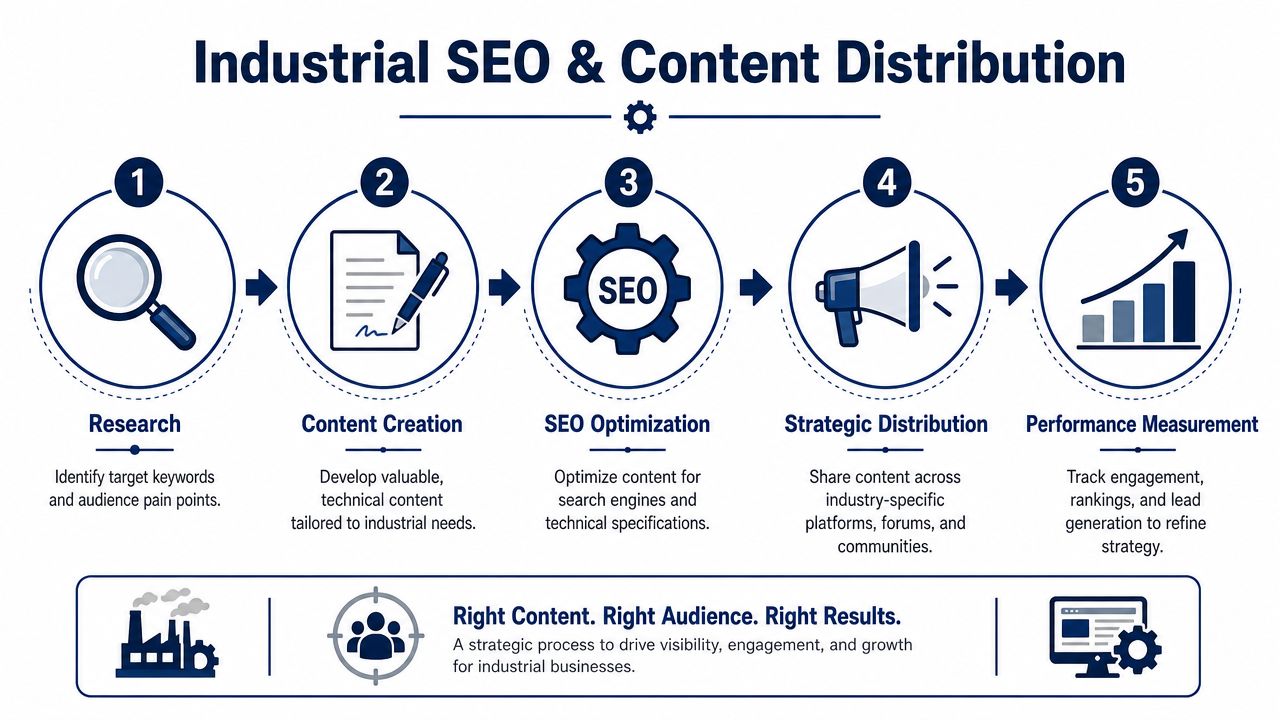
Industrial SEO should mirror how buying decisions happen in manufacturing. Engineers and technical buyers search for tolerances, failure causes, material compatibility, retrofit options, standards, lead times, and application fit. They do not search the way a consumer shops. They search to reduce risk before they talk to a supplier.
Build search visibility around real buying questions
Start with one revenue line, not your whole catalog. If a manufacturer tries to optimize every service, every part family, and every vertical at once, the program turns into a publishing calendar with no commercial focus.
Pick one topic area tied to pipeline value. Then map it the way a buyer evaluates the problem.
A practical structure looks like this:
- Choose a commercial topic with margin and sales relevance. Examples include a machining capability, an automation retrofit service, or a high-value component line.
- Pull real questions from sales calls, quote requests, and service tickets. Use the exact wording buyers use, including awkward technical phrasing.
- Create one core page for the solution category. That page should explain fit, constraints, process, and common applications.
- Publish supporting pages for the evaluation path. Cover comparisons, specifications, implementation issues, mistakes, and use-case questions.
- Link pages based on buyer progression. A page about a problem should lead to a page about solution fit, then to proof, then to contact or quote intent.
This structure does two jobs at once. It helps search engines understand topical relationships, and it gives buyers a clear path from early research to vendor evaluation. That second part matters more than many teams realize. Traffic without progression usually means the content answered a question but did not move the account.
For manufacturers that need a tighter search process tied to lead generation, SEO for manufacturing companies lays out the operational model in more detail.
Distribution is part of the system, not a follow-up task
Publishing a page is the midpoint, not the finish line. If distribution is ad hoc, your best assets die in the blog archive and sales keeps asking for new collateral instead of using what already exists.
Use channels you control first. Put the asset in the places buyers and sales reps already visit.
A working distribution sequence usually includes:
- Service and product page placement. Add contextual links from bottom-of-funnel pages, not just the blog.
- Email sends by segment. Send different content to plant managers, engineers, procurement contacts, and open opportunities.
- Sales-triggered sharing. Give reps a reason to send the asset during live deals, such as answering an objection or clarifying implementation.
- LinkedIn distribution. Use the company page, subject matter experts, and sales reps selectively. A technical post from an engineer often gets better engagement than a polished brand post.
There are trade-offs here. Broad distribution gets more reach, but less relevance. Tight segmentation gets fewer clicks, but better sales conversations. Industrial marketers usually benefit more from relevance because the buying committee is small and the deal value is high.
Email needs one operational check before you judge performance. If opens and clicks are weak, the issue may be deliverability rather than content quality. Use a tool that shows how to check if emails are going to spam before you rewrite the campaign. I have seen companies discard good content because their domain setup was the actual problem.
The goal is not to produce isolated assets. The goal is to build distribution paths that keep each asset working across search, email, sales follow-up, and buyer education. That is the plumbing. When that plumbing is connected properly, SEO stops being a traffic project and starts feeding a measurable lead system.
Connecting Content to Your Sales Pipeline
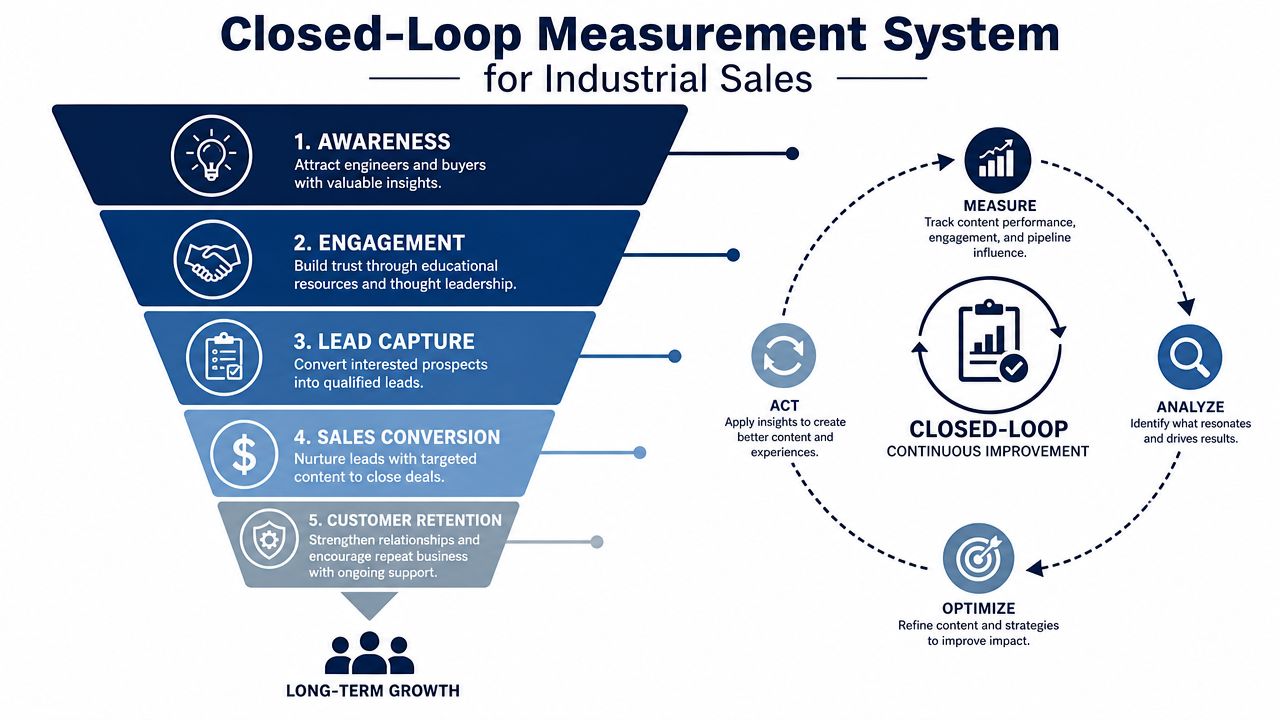
Most industrial content programs typically falter at this stage. Teams can create content, publish it, and even generate inquiries, but they still can't answer the one question leadership cares about. Is this influencing revenue?
That gap is common in industrial marketing because sales cycles are long, several stakeholders are involved, and many conversations happen offline. Guidance for industrial companies often acknowledges the challenge, but the core issue is operational. Manufacturers struggle to prove ROI across long sales cycles, and the missing link is connecting content engagement to lead nurturing and CRM data so you can see whether content is influencing a deal (Market Veep on industrial content ROI measurement).
What to track inside the CRM
You do not need a giant reporting stack to start. You need clean contact records, consistent attribution fields, and stage-based tracking.
At minimum, your CRM or marketing automation setup should capture:
- First known content touch: The first asset associated with the lead.
- Conversion asset: The page, form, or download that triggered lead capture.
- Key engagement history: Important pages viewed, downloads completed, email clicks, or repeat visits.
- Lifecycle stage: Subscriber, lead, marketing-qualified lead, sales-qualified lead, opportunity, customer.
- Opportunity linkage: Which contacts belong to which deal and what content they interacted with.
Whether you use HubSpot, GoHighLevel, or another CRM, the principle is the same. Every asset needs a job, and every contact action needs a place to live.
How the handoff should work
The cleanest setup is a closed-loop workflow:
- A prospect finds an asset through search, email, LinkedIn, or a sales send.
- The asset captures intent with a form fill, demo request, quote request, or return visit pattern.
- Automation tags the contact by topic, content type, and likely interest area.
- Lead scoring or routing rules trigger follow-up based on meaningful behavior, not just any click.
- Sales sees the engagement history before outreach, so the first conversation starts with context.
- Closed-won and closed-lost reasons go back into planning so future content reflects real deal friction.
Don't report on content in isolation. Report on how content assisted movement from inquiry to opportunity.
That's the difference between a content library and a demand system.
There's also a useful lesson from adjacent B2B sectors. Software marketers often build stricter attribution and nurture systems because they're forced to prove channel influence earlier. Even though the business model is different, these demand generation playbooks for SaaS are useful to study because they show how disciplined follow-up, segmentation, and reporting can support long consideration cycles.
The industrial version should be simpler, not looser. Fewer channels. Better tagging. Stronger sales handoff. Tighter reporting.
Your First 90-Day Content Sprint Plan
A typical industrial team hits the same wall by month two. A few blog posts are live, sales has not used them, form fills are thin, and nobody can say which topic should come next. The problem is rarely effort. The problem is sequence.
A 90-day sprint gives the work enough structure to produce signal, not just output. It forces the team to set the audience, message, workflow, distribution path, and CRM handoff before content starts piling up. That matters because industrial content only becomes a lead source when the operational plumbing is in place.
Here's the sprint plan.
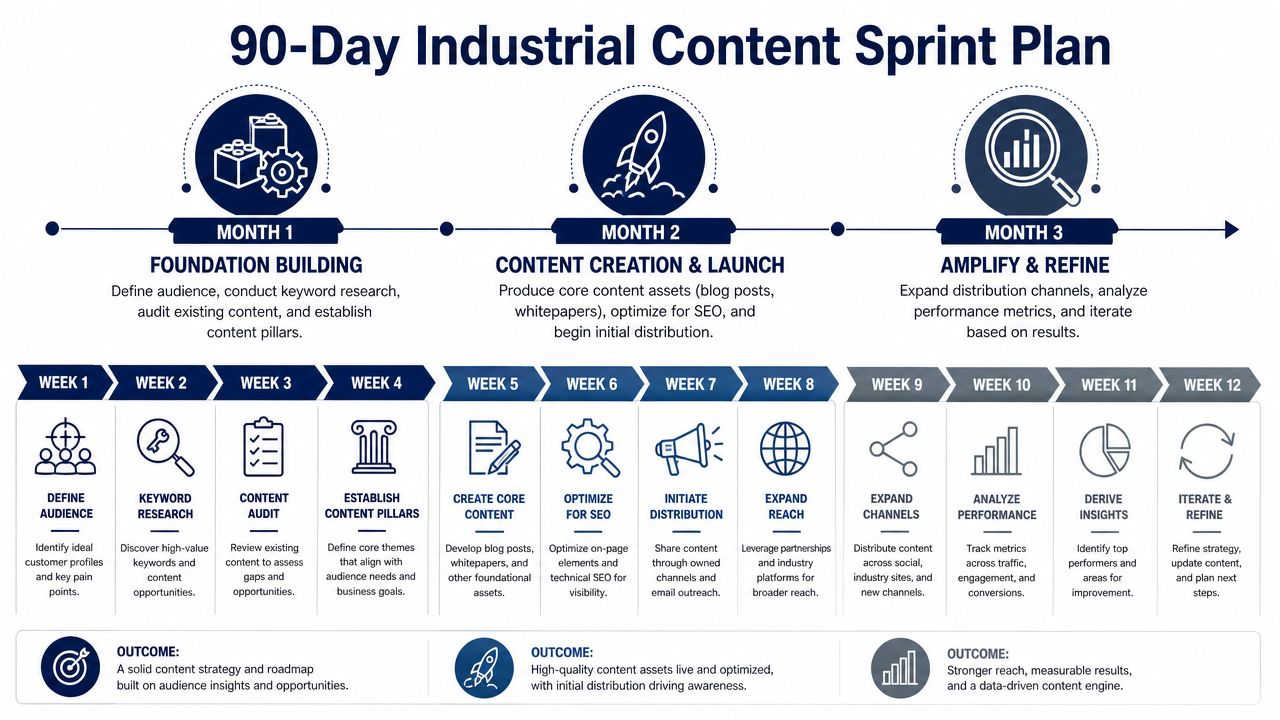
Days 1 through 30 build the foundation
The first month is for diagnosis and setup. If you skip this stage, month two fills with content that has no clear buyer, no routing logic, and no way to measure whether it influenced pipeline.
Week 1
Interview sales, service, and leadership. Review CRM notes, quote requests, and recent won or lost opportunities. Pull out repeated buyer questions, objections, spec requirements, and decision triggers. The content plan begins with these insights, not in a keyword tool.
Week 2
Audit existing assets across blogs, product pages, videos, PDFs, slide decks, and case studies. Tag each asset by audience, buying stage, and business topic. Keep the taxonomy simple enough that your team will keep using it. If the tagging model is too detailed, it will die after one quarter.
Week 3
Build the messaging matrix and define the first content pillars. Choose a narrow set of commercial themes tied to revenue, margin, strategic product lines, or recurring sales friction. Set up the tracking basics in your CRM and forms so contact records capture source, topic interest, and conversion path from the start.
Week 4
Create templates and workflow. Standardize the outline for blog posts, case studies, email sends, and subject matter expert reviews. Assign one owner for draft creation, one for technical review, and one final approver. If review ownership is fuzzy, production slows down and deadlines become optional.
Field note: A simple workflow your team follows beats a complex process that depends on perfect coordination.
A short walkthrough can also help your team align on execution expectations. This video is a useful companion to the sprint approach:
Days 31 through 60 publish the core assets
Month two is for building the first working version of the engine.
Start with one pillar asset tied to a commercially important topic. That could be a deep service page, a technical guide, or a long-form article built around a buying question your sales team hears every week. Then build supporting assets that point back to it, reuse the same message, and create multiple entry points for the same problem.
A practical month-two output could include:
- One pillar page or flagship article tied to a high-intent topic
- Two supporting blog posts answering narrower questions
- One proof asset such as a case study or application summary
- One short video that explains the process or answers a recurring technical question
- One email send promoting the asset to a relevant list
- One LinkedIn distribution plan for company and team sharing
Keep review cycles tight. Industrial companies lose momentum when every asset turns into a group project. One subject matter expert, one editor, one final approver is often enough to keep quality high without dragging production into a three-week loop.
This is also the point where integration matters. Every asset should have a defined CTA, a form or conversion path, and a destination inside your CRM or GHL setup. If content consumption never creates a usable contact record, publishing more will not fix the problem.
Days 61 through 90 measure and tighten the system
Month three is where the machine starts to improve.
Review how prospects found the content, what they engaged with, which CTAs they clicked, and whether those actions turned into real conversations. Then compare lead volume against lead quality. High traffic with weak fit usually points to a topic problem, a CTA problem, or both.
Use questions like these to guide the review:
- Which topic generated the most relevant inquiries?
- Which asset got used by sales during active deals?
- Where did prospects drop out after landing on the site?
- Which calls to action attracted curiosity but not qualified intent?
- What did recent opportunities reveal that your content still doesn't answer?
Then make operational changes:
- Tighten weak pages: Rewrite headlines, introductions, and calls to action.
- Improve routing: Make sure the right form submissions reach the right owner fast.
- Repurpose winners: Turn the strongest article into a video, email sequence, or sales enablement piece.
- Retire weak topics: If a topic attracts the wrong audience, stop publishing around it.
At the end of 90 days, the goal is not a bigger content library. The goal is a working system your team can repeat. You know who the content is for, which messages are pulling their weight, how assets move through production, where distribution happens, and how engagement shows up in the pipeline.
That is what industrial content should do. It should turn recurring buyer questions into trackable assets, route intent into the CRM, and give sales a better starting point for the next conversation.
If your team has tools in place but the system still feels disconnected, Machine Marketing can help you diagnose the gaps, build the operating plan, and connect content, SEO, CRM, and sales follow-up into one measurable growth system.