If you're staring at three dashboards that all tell a different story, you're not crazy. Marketing says paid search is winning, sales says trade shows are generating the actual deals, and the CFO just wants to know why revenue doesn't match either report. That gap is exactly where cross channel attribution matters, because in manufacturing the buyer journey is usually stitched together across email, search, distributor calls, a rep visit, and offline quoting, not captured cleanly in one platform.
The hard truth is that last-click reporting flatters the channel that happens to close, not the channels that created the opportunity. StackAdapt analyzed roughly 5 million influenced conversion paths and found that 52.5% of conversion journeys spanned multiple channels, while 25% followed repeatable cross-channel sequences such as a CTV ad followed by a display ad StackAdapt's cross-channel attribution analysis. If your reports only reward the final click, you're making budget decisions with half the story missing.
Table of Contents
- Why Your Best Channel Might Be the Wrong Story
- What Cross Channel Attribution Actually Means
- Comparing Attribution Models Side by Side
- Why Measurement Is Harder for Manufacturers
- Your Implementation Roadmap From Zero to Trusted
- Validating Attribution With Incrementality Testing
- Two Short Stories of What Changed
- KPIs, Questions to Ask, and Your Next Step
Why Your Best Channel Might Be the Wrong Story
A plant manager downloads a spec sheet, then your rep follows up, then the prospect sees a retargeting ad, then a procurement manager asks for a quote. In your dashboard, paid search gets the credit because that's where the buyer finally clicked. In practice, the sale only happened because several touches built confidence before anyone filled out the form.
That's why team arguments about channel performance are usually measurement arguments in disguise. The marketing manager isn't necessarily wrong, and the sales director isn't necessarily wrong either. They're looking at different slices of the same journey, and the slice that shows up last gets overpraised.
If you want the broader marketing framework first, the multi-channel marketing overview is a useful companion, but don't confuse channel coordination with measurement. The machine that runs the business still needs a way to assign credit across paid, owned, and offline touchpoints, which is where attribution starts to matter.
Practical rule: when sales and marketing disagree on which channel “works,” assume the problem is data structure before you assume the channel underperformed.
A good starting reference for the terminology is the Keywordme attribution guide, but the bigger point is simpler. If your data suggests one channel is the hero every month, yet your buyers keep moving through several platforms before they convert, the dashboard is probably lying by omission. That is the diagnostic problem we need to fix before we touch budgets.
What Cross Channel Attribution Actually Means
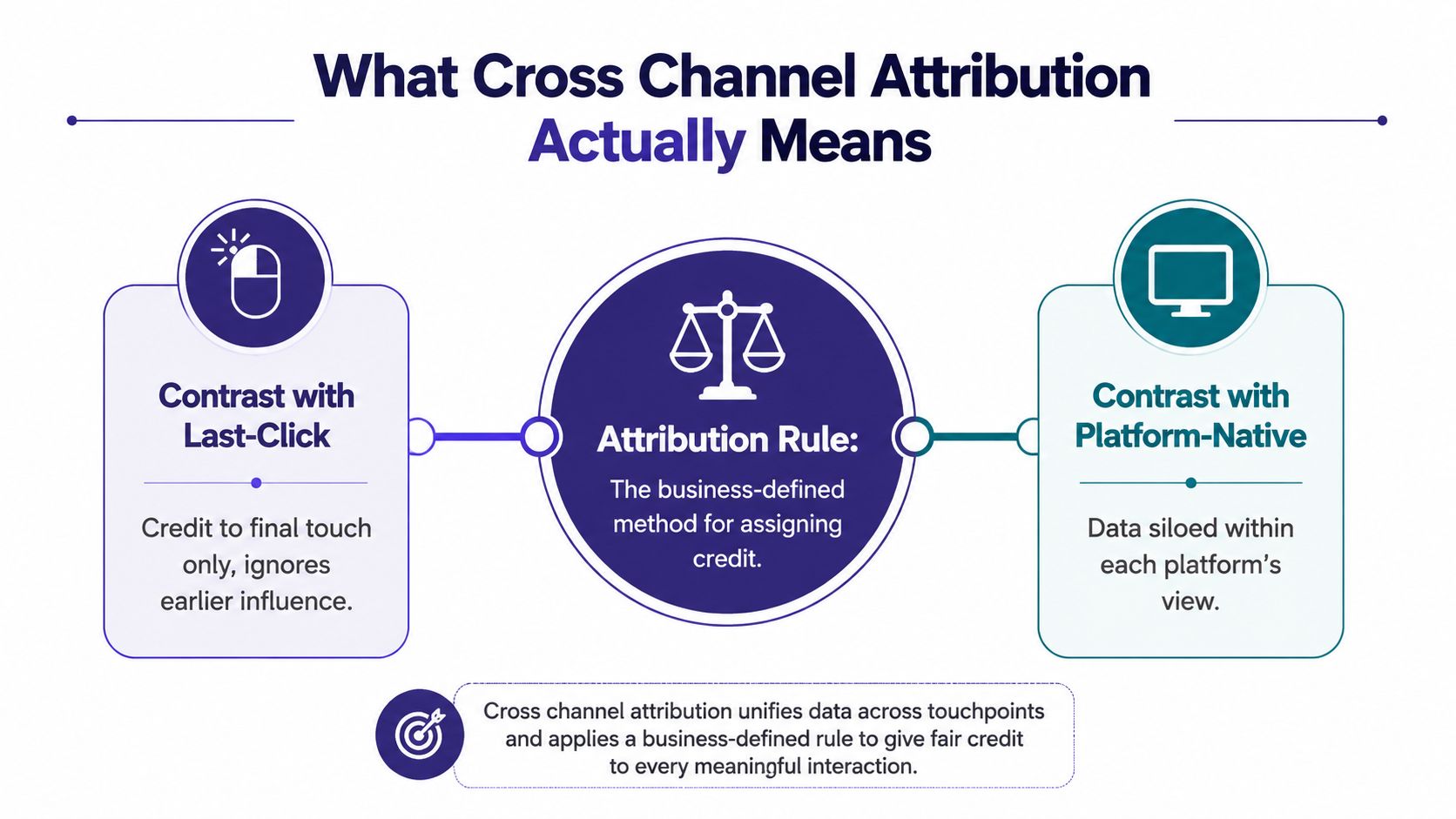
Cross channel attribution is the rule your business uses to split conversion credit across the touchpoints that influenced a deal. It's not a theory and it's not a platform feature. It's a measurement decision about how much weight each interaction should get when someone moves from first touch to closed revenue.
That matters because last-click gives all the credit to the final interaction, while platform-native reporting usually stays trapped inside one channel's own view. Amazon's guide puts it plainly, cross-channel attribution assigns conversion credit across multiple touchpoints so marketers can see how channels work together across the full customer journey, including combinations of social, email, paid ads, and website visits rather than only the final interaction Amazon Advertising's guide to cross-channel attribution. If you're only looking at the last touch, you're not measuring influence, you're measuring the last place the buyer happened to land.
A manufacturing example makes this concrete. A prospect scans a badge at a trade show, downloads a spec sheet later that week, gets three retargeting ads, opens two sales emails, and finally requests a quote. A last-click model credits the quote request. A first-click model overstates the trade show scan. A more balanced model splits the work across the path, which is much closer to how the sale happened.
Working definition to share internally: cross channel attribution is the method of assigning conversion credit across paid, owned, and offline touchpoints so teams can see how the journey actually produced revenue.
For a deeper analytics context, the marketing analytics overview helps frame attribution as part of a larger measurement system. The point is not to make attribution perfect. The point is to make it honest enough that you stop cutting channels that were helping the sale move forward.
Comparing Attribution Models Side by Side
The wrong model creates fake certainty. The right model gives you a usable decision rule, even if it's imperfect. For manufacturers, I'd rather see a simple model that matches the journey than a fancy one built on bad data.
The table below is the practical version, not the academic one.
| Model | How It Credits Touchpoints | Weak Spot in Manufacturing | Best Fit Stage |
|---|---|---|---|
| Last-click | 100% to the final interaction | Hides the value of nurture, trade shows, distributor influence, and early research | Sanity check only |
| First-click | 100% to the first interaction | Overstates awareness and ignores the touches that helped convert the lead | Very early campaign analysis |
| Linear | Equal credit to every touchpoint | Can flatten the difference between a casual visit and a decisive sales email | Good starting point when journey data is visible |
| Time-decay | More credit to recent touches | Can over-credit retargeting and end-of-funnel activity | Useful when your sales cycle is long |
| Position-based, U-shaped | More credit to the first and last touches, with middle touches sharing the rest | Still simplifies complex buying committees, but it's practical | Strong starting point for many manufacturers |
| Position-based, W-shaped | Gives extra weight to first touch, lead creation, and close | Works better when you can identify the lead-creation moment clearly | Useful when CRM hygiene is decent |
| Data-driven | Uses observed patterns to assign credit | Breaks fast if your CRM, UTM, or offline data is messy | Only after data is clean |
| Shapley | Estimates each channel's marginal contribution across combinations | More advanced than most teams need at first, but it's a fairer multi-touch method | Mature teams with strong data discipline |
If you want a useful external reference while you compare options, the HelpWithMetrics explanation of measuring the full customer journey is worth a look. My recommendation is direct. Start with linear or position-based if your visibility is decent. Move to Shapley or data-driven models only after the CRM and revenue data are trustworthy. Keep last-click as a comparison line, never as the source of truth.
Why Measurement Is Harder for Manufacturers
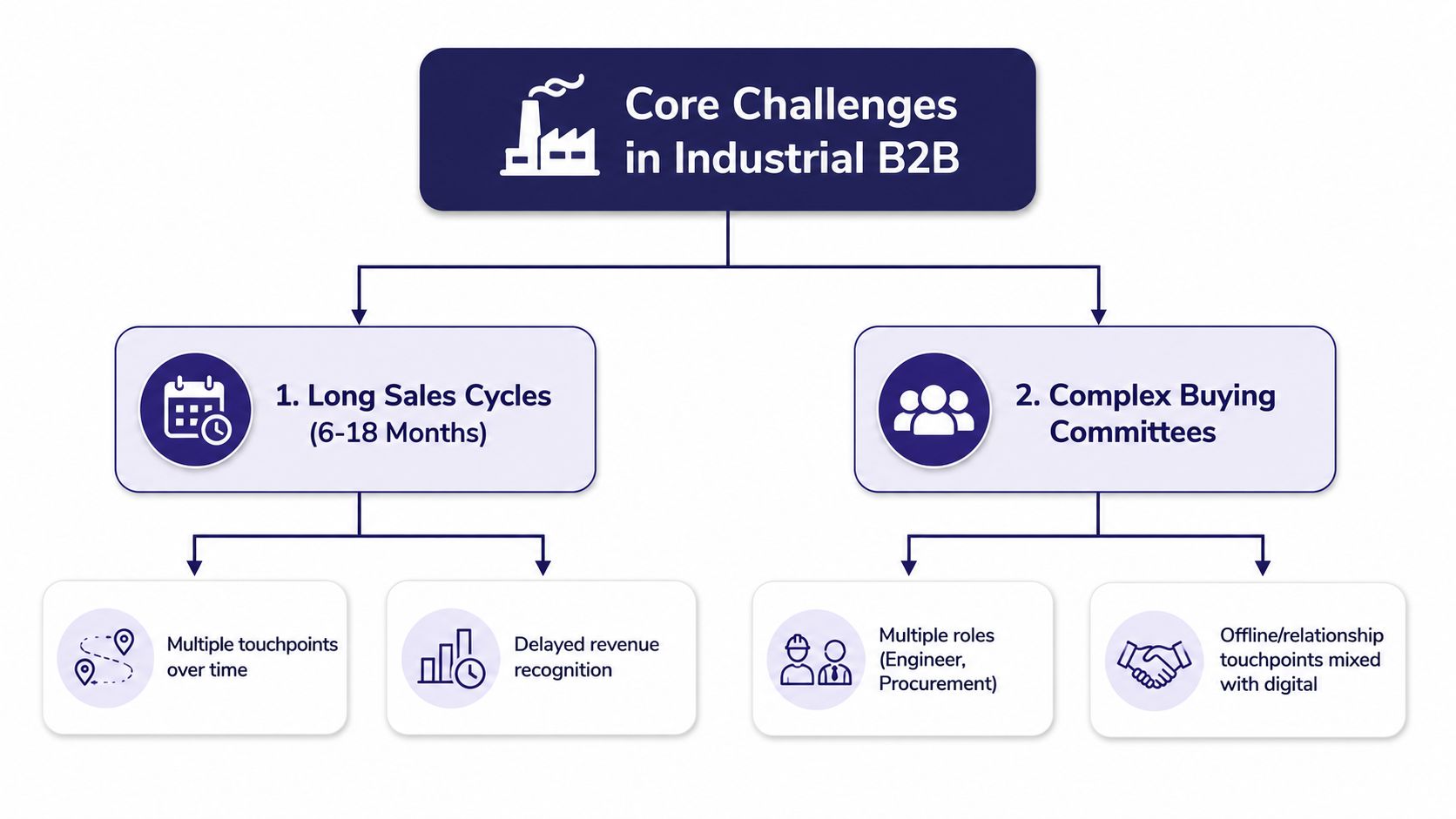
Manufacturing journeys don't behave like ecommerce funnels. Buyers don't discover a machine, click once, and convert the same day. They compare vendors, loop in engineering, ask procurement for numbers, talk to a rep, and maybe attend a trade show before they ever submit an RFQ.
That's why attribution gets messy fast. Independent 2026 reporting citing Nielsen data shows that 85% of marketers feel confident in ROI measurement, but only 32% measure ROI across both traditional and digital media, a 53-point confidence-to-coverage gap DemandLocal's cross-channel attribution statistics summary. Confidence is not coverage, and in industrial B2B that gap gets wider because so much of the journey happens outside the clickstream.
The offline path is part of the sale
Reps, distributors, trade shows, and phone calls still move deals. A buyer may never click an ad again after speaking to a distributor, but that doesn't mean the ad didn't matter. It means your tracking stopped where the sale continued.
That's where many teams fool themselves. They cut an upper-funnel channel because it looks weak in last-click, then wonder why the pipeline dries up two quarters later. The channel didn't fail, the attribution lens did.
Your data is split across too many systems
In a typical manufacturer, the CRM knows one part of the story, the ERP knows another, quoting tools hold the pricing trail, and ad platforms only see what happened online. If those systems aren't connected, you're not measuring a journey, you're stitching together fragments after the fact.
Watch for this: when sales says “those leads were junk,” the real problem may be that the lead source was never linked back to the eventual quote, follow-up, and closed deal.
The practical diagnosis is blunt. If your customer data lives in separate systems and your offline touchpoints are invisible, attribution quality will be weak no matter how polished the dashboard looks. That's why data plumbing matters more than model choice at this stage.
Your Implementation Roadmap From Zero to Trusted
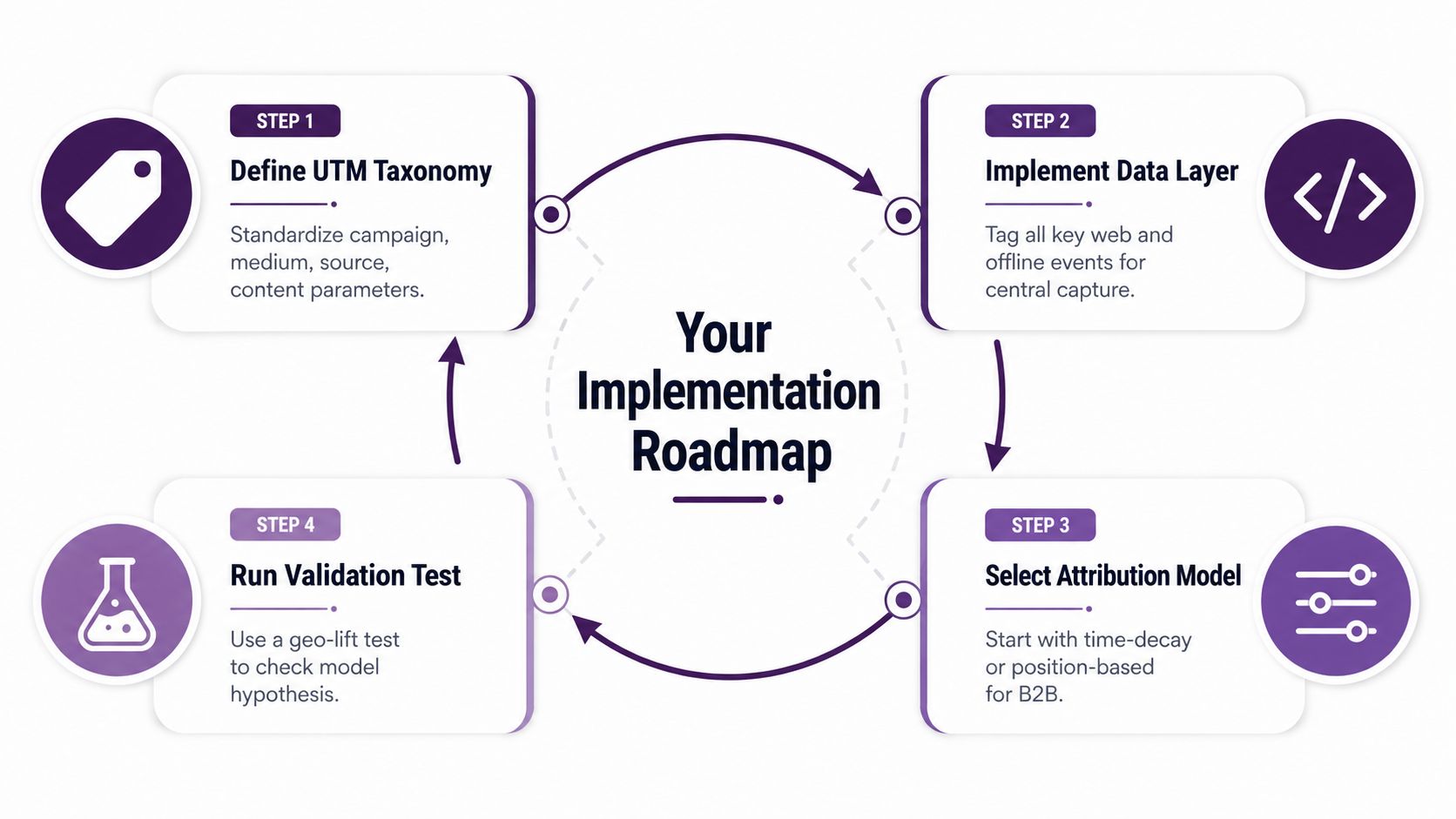
Start with hygiene, not software. If your UTM naming is inconsistent, no model will save you. If your CRM and email data don't match campaign records, you'll spend more time debating reports than improving performance.
The simplest practical step is to connect your advertising platforms, GA4, a CRM such as HubSpot or Salesforce, and your email system into a single environment, then enforce UTM tagging across every campaign so touchpoints can be traced back to specific initiatives ClicData's cross-channel marketing attribution guide. That doesn't mean every team needs a giant warehouse on day one. It does mean someone has to own the data layer and the naming standard.
Phase 1, standardize the inputs
Create a UTM SOP and stop letting every marketer invent their own naming system. Use one source, one medium, one campaign convention, and one rule for events and offline imports. If your email links, paid ads, and event scans don't all point back to the same campaign structure, the model will misread the journey.
Phase 2, wire the core systems
Pull GA4, ad platforms, CRM records, and email data into the same measurement layer. For smaller teams, that can be a lightweight stack with clear exports and one shared dashboard. For larger teams, a warehouse-backed setup is cleaner and easier to audit.
Phase 3, align marketing and revenue
Closed-won revenue has to flow back into the attribution system. Lead counts alone are misleading, especially in B2B manufacturing where one lead may stall while another becomes a large order months later. If you can't tie a closed deal back to a campaign, you don't have attribution, you have reporting.
Phase 4, choose the model and test it
Use a simple rule-based model first, then compare it against your baseline. Only move to data-driven models when the inputs are stable and the output stops changing wildly from week to week.
- Clean the UTMs across every live campaign.
- Link CRM and ad data so revenue can flow back.
- Pick one primary model for decisions.
- Run a shadow period before changing budgets.
Ask yourself one question before you spend another dollar on software. Who owns the data, and who is allowed to change the naming standard? If the answer is “everyone,” the system will drift.
Validating Attribution With Incrementality Testing
Attribution tells you what looked responsible. Incrementality tells you what caused lift. If you skip that distinction, you'll keep rewarding channels that were present but not decisive.
The cleanest framework for a mid-sized manufacturer is straightforward. Test channels that receive more than 15% of budget by turning them off in matched geo markets for 14 to 30 days and comparing observed lift against the model's predicted contribution Improvado's cross-channel marketing analytics guide. That's not perfect science, but it's a far better test than trusting a dashboard because it looks detailed.
Shapley attribution is a useful technical ceiling because it calculates each channel's marginal contribution across all possible channel combinations. That's why it's often fairer than simple first-click or last-click logic. It still isn't causation, though, and it still needs validation against real lift.
The operating rule I recommend is simple. Use attribution for day-to-day optimization. Use incrementality tests for quarterly calibration. Then reweight budget based on the test result, not the prettiest report.
A model you never test is just a dashboard.
That's the difference between measurement and theater. If a channel looks efficient in attribution but fails a geo holdout, trust the holdout. If a channel looks expensive in last-click but proves incremental in test markets, protect it.
Two Short Stories of What Changed
A precision machining supplier with three plants thought paid search was carrying sales. After cleaning up attribution and fixing CRM links, they found that a niche industry publication plus a long email nurture sequence were driving most of the qualified RFQs. They shifted budget toward the publication and nurture, and the conversation inside the company changed from “What's broken?” to “Why didn't we see this sooner?”
An industrial equipment maker kept pouring money into trade shows because leadership liked them. Once badge scans, offline follow-up, and downstream pipeline were tied back to the digital touches that warmed up attendees, the team saw which shows produced real revenue and which mostly produced scans. They cut the weak events and kept the ones that moved deals.
The lesson in both cases is the same. The first report was not the truth, it was the easiest version of the truth. Once the data was connected, the budget followed the buyer, not the ego of the channel owner.
KPIs, Questions to Ask, and Your Next Step
If you want to know whether attribution is helping, track the numbers leadership cares about. Sourced pipeline value, assisted pipeline value, cost per qualified opportunity, sales cycle length by source mix, and marketing-attributed revenue versus total revenue tell you whether the system is changing decisions, not just producing reports.
Cross-channel attribution must respect the actual shape of the journey. Cross-channel attribution requires accounting for non-linear paths, not a fixed funnel sequence, because users may repeat, skip, or overlap steps, and the model should distribute value across multiple interactions instead of assuming one moment caused the conversion Usercentrics on cross-channel attribution. If your reporting still assumes one neat funnel, it's too simple for the market you're selling into.
Use this guide to measuring marketing ROI to connect attribution back to outcomes your team already watches. Then ask these questions before you launch anything new:
- Where does the data live? If you can't name the systems, you can't fix the gaps.
- Who owns UTM standards? If nobody owns them, the model will decay.
- Can you trace a closed deal back to a campaign? If not, the system isn't ready.
- What decision changes if attribution improves? If no decision changes, the work is just reporting overhead.
Don't wait for perfect data. Start with the systems that feed revenue, clean up the naming, and build a model you can defend in a room with sales, finance, and operations.
If cross channel attribution is the bottleneck between your current spend and the pipeline you need, Machine Marketing can help you diagnose the leaks, clean up the data, and build a measurement system your team will trust. Visit Machine Marketing to start a strategy conversation and get a practical plan for your manufacturing business.