If your sales engineer is waiting on an RFQ while marketing keeps sending the contact generic emails, you don't have a lead-generation problem. You have a coordination problem. Customer journey orchestration connects marketing activity, website behavior, CRM records, sales action, and buying-group context so the next move reflects what the account is doing.
For manufacturers, that distinction matters. Industrial buyers rarely move through a clean, individual funnel. Engineers research specifications, maintenance teams validate operating requirements, procurement negotiates, and plant leadership approves risk and budget. We'll show you how to design a governed system that coordinates those roles across a long sales cycle, without pretending that another AI feature will repair broken data or unclear ownership.
Table of Contents
- Why Industrial Sales Break Down Between Marketing and Sales
- What Customer Journey Orchestration Really Means
- The Four Core Components of an Orchestrated System
- Orchestrated Journeys Versus Traditional Campaign Sends
- A Five-Step Framework to Implement Journey Orchestration
- A Worked Example for a Machine Shop Buying Cycle
- Why AI Alone Will Not Fix a Broken Journey
- Your First 30 Days and a Final Checklist
Why Industrial Sales Break Down Between Marketing and Sales
A precision components manufacturer receives an RFQ that could develop into a substantial contract. An applications engineer downloads a tolerance specification, returns to the website, and visits the configurator. Marketing automation recognizes a known contact and starts a generic nurture sequence. The regional sales engineer receives no useful alert, task, or account context. The opportunity remains untouched.
The problem sits in the operating design, not in employee effort. Marketing tracks email engagement, the CRM contains partial contact records, sales stores technical notes elsewhere, and the product catalog is disconnected from the workflow that should turn buying activity into commercial action.
The symptoms are operational, not cosmetic
Manufacturing teams see the breakdown in repeated, measurable friction:
- Weak lead scoring: Marketing assigns scores without sales input, so a specification download can outrank an RFQ or a return visit to a product page.
- Manual re-keying: Sales engineers copy information from forms, emails, and spec sheets into the CRM. Delays and inconsistent records follow.
- Missing buying-group visibility: One contact's activity is visible, while the account's combined research across engineering, maintenance, procurement, and operations remains hidden.
- Unreliable forecasts: Sales leaders estimate deal health from anecdotes because the system does not show current engagement, stalled stages, or completed handoffs.
A conventional CRM for lead generation can capture contacts. Capture alone does not coordinate what happens next. Teams evaluating workflow automation for B2B sales teams should set ownership, triggers, suppression rules, and escalation paths before adding more form-to-email functionality.
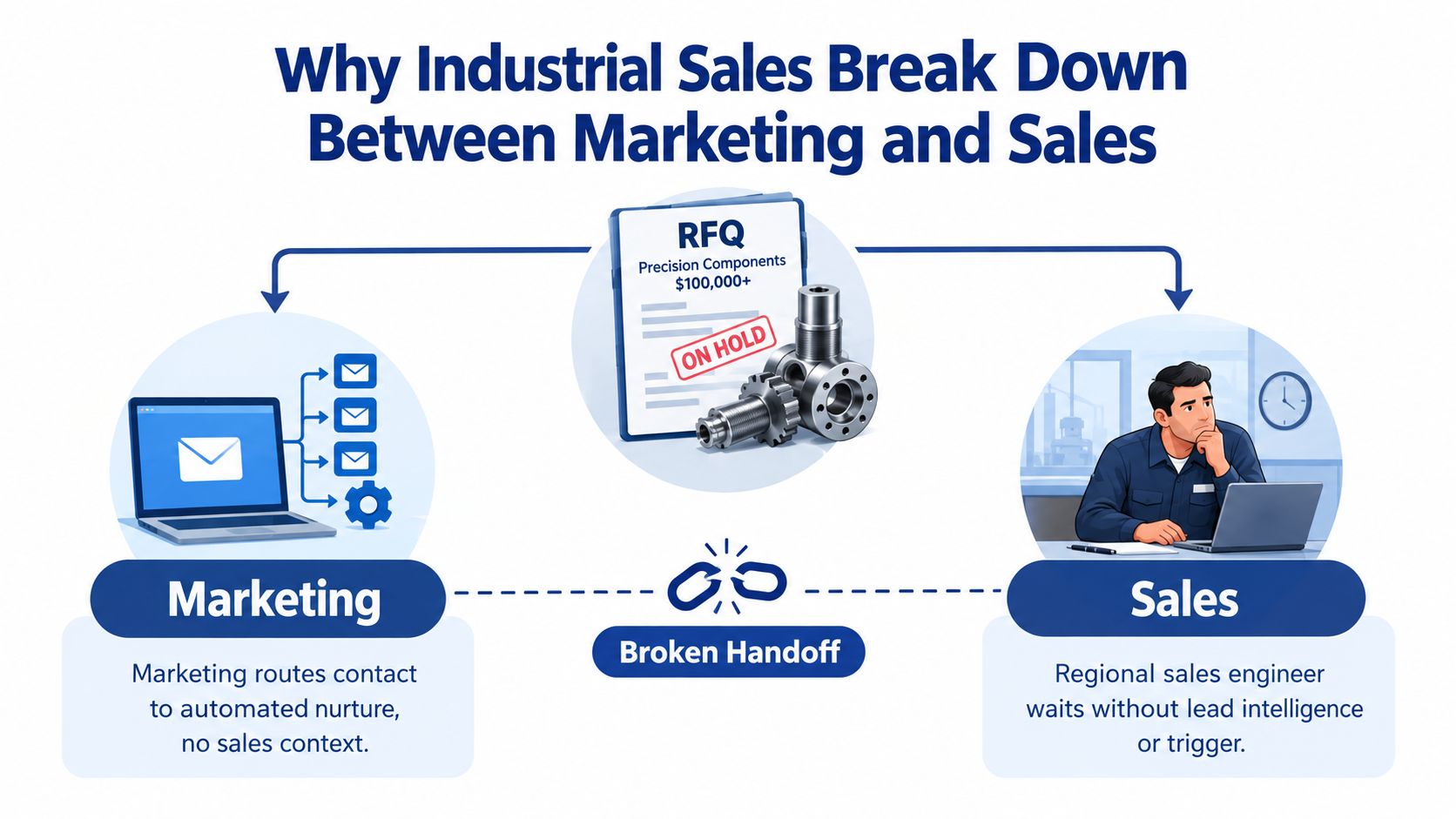
Customer journey orchestration is the connective tissue
Orchestration connects a behavioral signal to a specific decision. A repeat visit to a tolerance page can create a sales-engineer task, suppress generic nurture, and notify the account owner. A quote request can move the account into a proposal journey, send procurement commercial content, and deliver technical documentation to engineering.
The operating model matters more than campaign volume. Marketing, sales, service, and channel partners need one governed account record, agreed handoff rules, and clear responsibility for the next action. Without those controls, real-time data and AI merely accelerate inconsistent follow-up.
Market estimates also show growing interest in customer journey orchestration. Mordor Intelligence reports differing estimates and projections for the market, but the direction is clear: adoption extends beyond narrow B2C messaging into coordinated revenue operations. Mordor Intelligence outlines both market estimates and projections. For industrial companies, the practical test is simple: can the system coordinate a buying group across a long sales cycle, or does it only send another email to one contact?
What Customer Journey Orchestration Really Means
Customer journey orchestration is the system that decides what should happen next, for whom, through which channel, and under what conditions. It uses live behavior and business context to coordinate interactions across email, web, CRM, sales tasks, service activity, and partner channels.
Use a factory control system as the analogy. Sensors collect information from the production line. A programmable controller evaluates the signal. Workstations perform the next operation. The production schedule determines how the parts move, what gets paused, and what requires inspection. A finished component emerges because the system coordinates the sequence, not because one workstation sends a better message.
In a revenue system:
- Sensors are data signals: page visits, form submissions, quote requests, portal activity, meetings, service cases, and account changes.
- Controllers are rules or models: conditions that evaluate role, account stage, intent, consent, ownership, and recent activity.
- Workstations are channels: email, web content, sales tasks, phone outreach, retargeting, distributor notifications, and service prompts.
- The production schedule is journey logic: the order of actions, exit criteria, suppression rules, and handoffs.
A real orchestration layer ingests telemetry such as web clickstreams, mobile interactions, and other events, then uses rules or machine learning to trigger the next action. The technical value is stateful logic, meaning the system remembers where the account and each person are in the journey instead of treating every interaction as an isolated event. This technical overview describes event-driven journey control and real-time decisioning.
What orchestration is not
It isn't a single email campaign. It isn't a lead score. It isn't a CRM workflow that assigns a task after a form submission. Those tools may be components, but orchestration connects them around a shared journey state.
It also isn't journey mapping. A map documents the intended path and exposes friction. Orchestration turns that map into live execution, with decision rules, channel actions, human handoffs, and measurable commercial outcomes. The objective is not to deliver a personalized message. It's to improve the quality and timing of the next business action across the account.
The Four Core Components of an Orchestrated System
A manufacturer doesn't need a giant platform diagram to begin. You need four connected components, and each one must support the others.
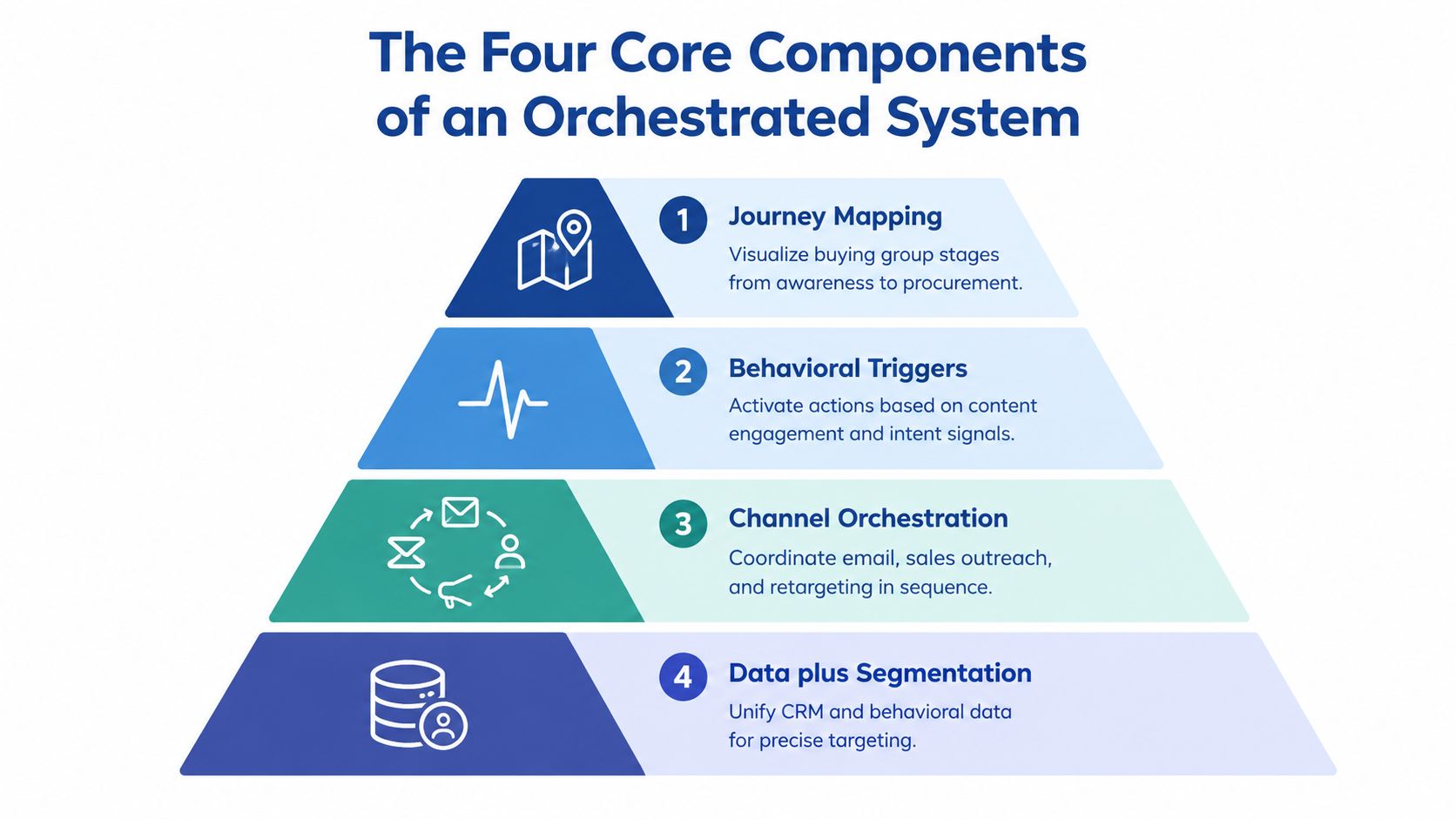
Journey mapping gives the system a destination
Map the industrial buying process around stages, roles, decisions, and exit criteria, not generic funnel labels. A useful map might include technical discovery, specification, validation, commercial review, procurement, and implementation.
For each stage, document:
- The buying-group roles involved
- The evidence required to advance
- The content or sales action that supports the decision
- The condition that exits the stage
- The person accountable for the handoff
A process engineer may need tolerance data while procurement needs lead times, terms, and quote documentation. One account can have both contacts active at different stages, so the map must represent the account journey and the individual role journey together.
Behavioral triggers reveal intent
A trigger should represent a meaningful change in buying state. Examples include:
- A repeat visit to a tolerance specification PDF
- Abandonment of a product configurator
- A distributor portal login after a dormant period
- A quote request or technical inquiry
- A return visit from a known contact after a sales meeting
B2B intent often appears as an operational action, not a dramatic content conversion. An engineer comparing tolerances may be closer to a technical conversation than someone who downloaded a broad industry guide. The rule should reflect that difference.
Channel orchestration controls the sequence
Email, sales tasks, web personalization, retargeting, distributor alerts, and rep notifications should work as a sequence. If a sales engineer has already scheduled a technical call, the system should suppress generic educational emails and deliver preparation material instead.
The right channel depends on the action required. Marketing may nurture early research, sales may handle specification questions, and a distributor may own local follow-up. Orchestration decides which team acts and when, rather than asking every channel to send something.
Data and segmentation make action possible
At minimum, the data model needs a reliable contact, account, role, stage, owner, activity, and consent structure. Manufacturing teams should also consider account hierarchies, parent and subsidiary relationships, distributor associations, product interest, territory, and opportunity status.
Layer segmentation instead of relying on one list. Start with the ideal customer profile, then add account status, buying-group role, journey stage, product fit, and recent behavior. Your marketing technology stack should support these relationships or make them visible through clean integrations. If it can't, no amount of personalization will compensate for missing context.
Orchestrated Journeys Versus Traditional Campaign Sends
A traditional campaign asks, “Who should receive this email?” An orchestrated journey asks, “What has this account done, what does the person need next, and which team should act?”
That difference becomes obvious when a machine shop has three contacts researching the same equipment. An engineer may need technical comparisons. A maintenance lead may need proof of serviceability. Procurement may need commercial terms. A calendar-based send treats them as a list. An orchestrated system treats them as connected participants in one buying process.
| Dimension | Traditional Campaign Sends | Orchestrated Journey |
|---|---|---|
| Timing | Calendar-driven, with fixed send dates | Signal-driven, based on current account and contact behavior |
| Personalization | List, industry, or basic segment level | Account, role, stage, product interest, and recent intent |
| Response handling | Manual review after the campaign runs | Automated routing, task creation, suppression, and escalation |
| Measurement | Opens, clicks, and form fills | Stage progression, time in stage, handoff quality, and pipeline movement |
| Buying-group context | Each contact is treated separately | Related contacts and account activity inform the next action |
| Sales involvement | Sales often receives a list after launch | Sales owns defined actions with agreed service expectations |
Traditional campaigns still have a place. They're useful for broad education, product announcements, and controlled testing. The problem starts when a batch send becomes the operating system for a complex sale.
Practical rule: If a campaign has no exit criterion, no owner for the next action, and no suppression rule after a buying event, it isn't orchestrating a journey.
A well-written cold email can start a conversation, and this cold email guide is useful for improving outbound fundamentals. But outbound quality doesn't solve a broken handoff. Once an account responds, the system must know whether to route the response to sales, continue education, involve a distributor, or pause outreach.
The financial difference appears in wasted effort and missed timing. Traditional sends create duplicate touches, stale follow-up, and weak visibility. Orchestrated journeys coordinate the work that moves an account from one commercial decision to the next.
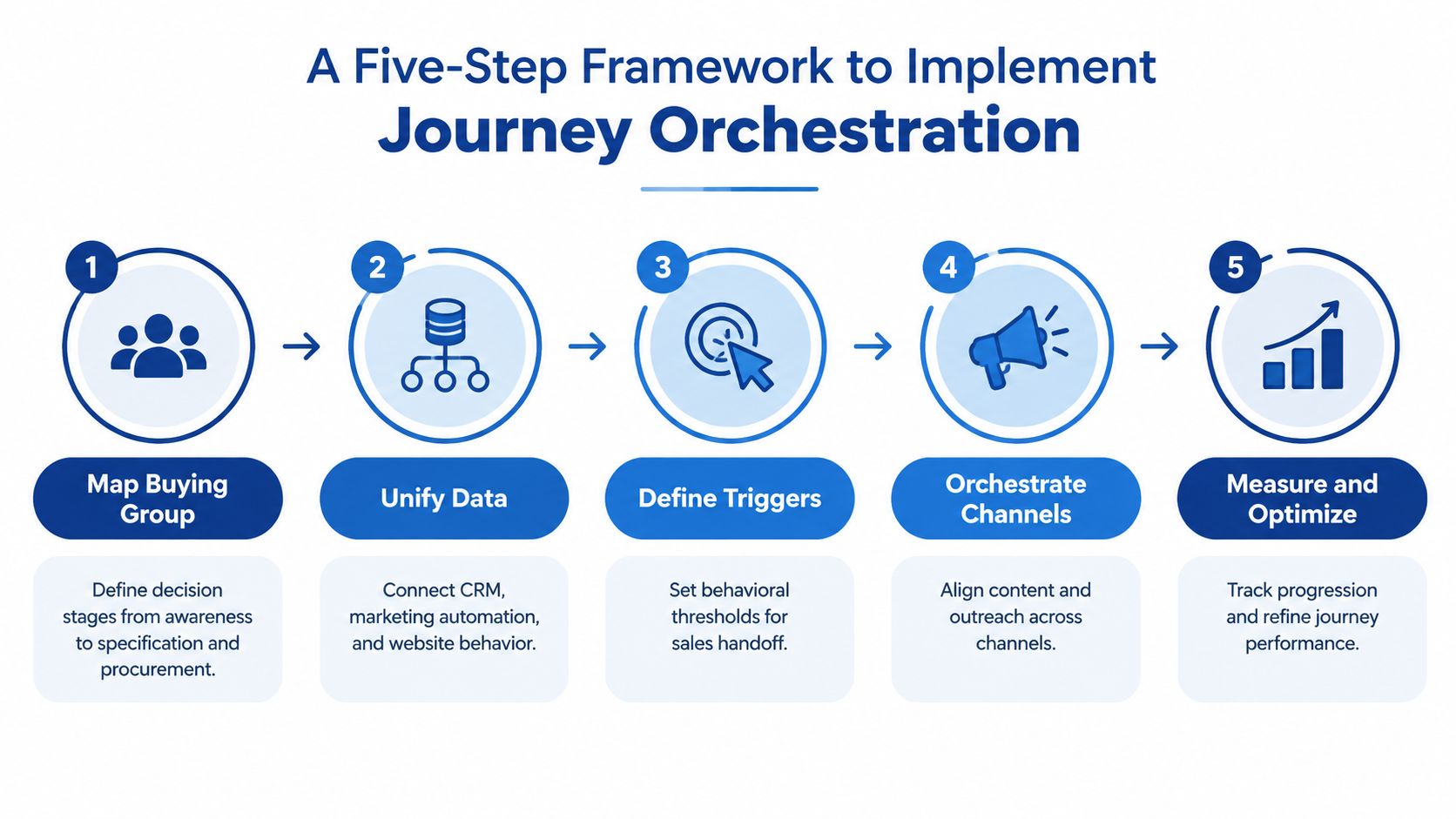
A Five-Step Framework to Implement Journey Orchestration
You don't need to replace every system before improving coordination. Start with one high-value industrial journey and build the operating discipline around it.
1. Map the buying group and decision stages
Document who participates from awareness through specification, approval, and procurement. Record what each role needs, what evidence advances the account, and what blocks progress.
Action: Put the current journey on one page and mark every handoff.
Diagnostic question: Can sales and marketing agree on what must be true before an account changes stage?
2. Unify the data sources
Connect CRM records, marketing automation, ERP context, and website behavior where the data supports a decision. You don't need every field. You need a trusted view of the account, the contact's role, recent activity, owner, and current stage.
Resolve duplicate contacts and define which system owns each field. If an ERP contains customer status but the CRM contains opportunity status, make the relationship explicit instead of asking staff to reconcile it manually.
Action: Create a field ownership sheet and remove fields nobody uses.
Diagnostic question: Can a sales engineer see the relevant marketing and website activity without asking marketing to investigate?
3. Define triggers that represent intent
Use behavioral thresholds tied to commercial action. A single broad download may warrant education. Repeated technical-page visits, a configuration attempt, or a quote request may warrant human involvement.
Keep the first trigger set small. Every trigger should specify the event, condition, action, owner, and suppression rule.
Action: Write five trigger rules in plain language before building them in software.
Diagnostic question: Does each trigger change what your team does, or does it only create another notification?
4. Orchestrate channels and ownership
Assign the next action to the right channel and person. Email can deliver technical content, a sales task can prompt a consultative call, and a distributor alert can initiate local follow-up. Add service-level agreements so the handoff has a response expectation.
Your marketing automation strategy should define what happens when the owner responds, misses the task, or learns that the opportunity isn't ready.
Action: Build one sequence with explicit owners, deadlines, and escalation rules.
Diagnostic question: What happens when the assigned rep doesn't act?
5. Measure progression, not activity
Track movement through stages, time in stage, handoff completion, stalled accounts, and pipeline influenced by the journey. Keep engagement metrics as diagnostics, not as the definition of success.
Measure the account's progress, not the platform's activity feed.
Action: Create a weekly report that shows stage movement and unresolved handoffs.
Diagnostic question: Can you identify where accounts stall and who owns the fix?
A Worked Example for a Machine Shop Buying Cycle
Consider a machine shop evaluating equipment over a roughly 12-week buying cycle. The journey begins with research, but the buying group emerges gradually. Orchestration earns its value by adapting as each role shows intent.
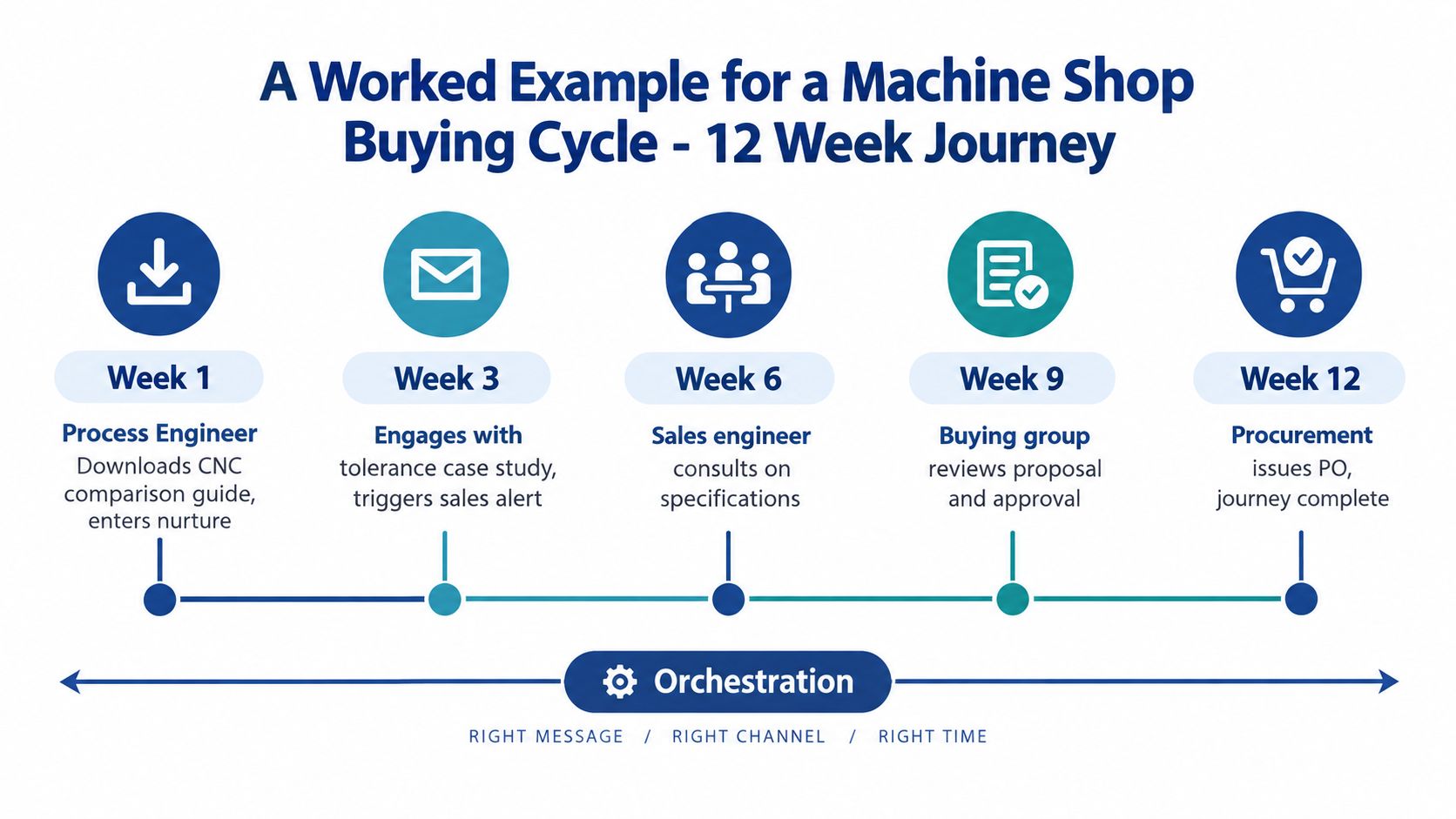
The journey in operation
| Stage | Trigger | Next-best action | Channel and owner | CRM signal |
|---|---|---|---|---|
| Week 1 | Process engineer downloads a CNC comparison guide | Deliver related technical content and identify role and account | Email, owned by marketing | Guide download, role, account match |
| Week 3 | Contact engages with a tolerance case study | Alert the sales engineer and suppress broad nurture | Sales task and email, owned by sales engineering | Technical intent event |
| Week 6 | Sales consultation confirms specification questions | Provide application support and involve the right technical resource | Meeting and follow-up, owned by applications engineering | Meeting outcome, product interest, stage |
| Week 9 | Buying group reviews proposal and seeks approval | Give procurement commercial documentation and plant leadership decision support | Direct outreach and proposal workflow, owned by account team | Proposal stage, buying-group roles, approval status |
| Week 12 | Procurement issues a purchase order | End prospecting messages and start customer onboarding | CRM and service handoff, owned by customer team | Closed-won status, product, owner |
The important detail is that no single person represents the entire journey. The process engineer creates technical context. The maintenance lead validates practical fit. Procurement manages the commercial process. The plant manager authorizes the business decision.
Under a campaign-send model, each person might receive the same product email while the sales engineer waits for a manual update. Under orchestration, every signal changes the next action, and every handoff writes context back to the account record.
What proves the system worked
Don't claim success because the email received engagement. Review whether the account advanced through the mapped stages, whether the sales task was completed, how long the account remained in each stage, and whether the buying group became visible in the CRM.
The repeatable pattern is simple:
- Map the role and stage.
- Capture the signal.
- Trigger the right action.
- Assign a human owner where judgment is needed.
- Record the outcome and adjust the journey.
That pattern gives the shop a system it can reuse for other equipment categories without turning every campaign into a custom manual exercise.
Why AI Alone Will Not Fix a Broken Journey
AI can choose a message, summarize activity, or recommend a next action. It can't decide whether your lifecycle stages make sense, whether sales trusts the lead definition, or who owns an account when a distributor and direct rep both claim responsibility.
The maturity gap is clear. A recent CX survey reported that 98% of organizations have deployed AI in the customer journey, yet only 15% combine agentic AI with cross-departmental orchestration, and only 5% can quantify AI's business impact. Business Insider reports these findings and the related governance concerns.
For manufacturers, the prerequisites are practical:
- Unified first-party data: CRM, website, marketing, sales, and service records must use a usable identity and account structure.
- Agreed journey stages and service levels: Marketing and sales need shared definitions for qualification, handoff, response, progression, and exit.
- A governance owner: One person or team must be accountable for journey performance, data quality, suppression rules, and escalation.
Governance is a working routine
Run a weekly journey-health review. Name an owner for each stage. Review stalled accounts, failed triggers, duplicate touches, missed handoffs, and false-positive alerts. Define when an AI system may act automatically and when it must route the decision to a human.
AI is a force multiplier. If the underlying process is inconsistent, it multiplies inconsistency. Start with rules your team understands, prove that the data and handoffs work, then add AI where prediction or content variation solves a defined problem.
Your First 30 Days and a Final Checklist
You can begin without buying a new platform. Use the systems you already have to diagnose the gaps and coordinate one meaningful journey.
Days 1 to 30
Audit CRM data quality, map the top three buyer journeys on paper, and name an owner for every stage. Identify missing account, role, stage, and activity fields.
Days 31 to 60
Wire practical triggers into the CRM and email platform. Define marketing-to-sales service levels, escalation rules, suppression criteria, and a weekly journey review.
Days 61 to 90
Launch two orchestrated journeys end to end. Instrument stage conversion, time in stage, handoff completion, and influenced pipeline. Document the governance rules for AI, including the actions it may take independently and the actions that require human approval.
Use this checklist before purchasing another tool:
- Assign stage ownership: Name one accountable person for every journey stage.
- Define exit criteria: Stop or redesign campaigns that have no clear next-stage condition.
- Validate record quality: Confirm that every active CRM record carries account, role, and stage data.
- Test suppression: Make sure converted, disqualified, or actively engaged accounts don't receive irrelevant messages.
- Review handoffs weekly: Look for stalled tasks, duplicate outreach, and missing sales feedback.
- Start with two journeys: Choose journeys where better coordination can directly support pipeline movement.
Schedule a one-hour working session with sales this week. Bring one stalled opportunity, map every signal and handoff, and agree on the next action, owner, and CRM field that should record the outcome.
Machine Marketing helps manufacturers connect CRM, marketing automation, content, and sales workflows into a practical B2B growth system. Visit Machine Marketing to discuss a working diagnosis of your buyer journeys and the next orchestration improvements to make.