If your clients keep reordering, replying when they need something, and generally seem satisfied, it’s easy to assume engagement is fine. For a lot of B2B manufacturers, that assumption is where risk starts.
Stable isn’t the same as secure. A relationship can look healthy on the surface while running on habit, inertia, or lack of alternatives. Once a competitor shows up with faster responses, clearer communication, or a smoother buying process, that “good” relationship can move fast in the wrong direction.
To define client engagement properly, you have to stop treating it like a soft concept. It’s not goodwill. It’s not occasional follow-up. It’s a system of signals, touchpoints, and workflows that make it easy for clients to trust you, buy from you, and stay with you.
The Hidden Risk in Your “Good” Client Relationships
A common scenario looks like this. A manufacturer has long-term accounts, decent repeat business, and a sales team that knows the buyers by name. The company assumes loyalty is strong because nobody is complaining.
Then small failures start stacking up.
A quote takes too long. A support question gets bounced between departments. A buyer has to repeat the same details to operations and then again to customer service. Nobody notices reduced email replies because revenue hasn’t dropped yet. By the time the account looks “at risk” in the monthly numbers, the relationship has already cooled.
That’s the hidden problem with reactive service. It solves today’s issue but tells you nothing about the health of the relationship.
According to customer engagement statistics summarized by Salesgenie, only 29% of B2B customers are fully engaged, which means most are somewhere between neutral and vulnerable. Neutral is dangerous because it often feels like safety.
Transactional relationships hide failure until it’s expensive
In manufacturing, this is similar to running equipment without a proper monitoring system. If you only respond when something breaks, you’ll always be late. The same applies to client relationships.
A transactional relationship usually has these traits:
- Communication happens only around orders: You hear from clients when they need pricing, delivery updates, or problem resolution.
- No one owns the full journey: Sales, service, and operations each handle their piece, but nobody manages continuity.
- Feedback is informal and inconsistent: The team relies on gut feel instead of structured signals.
- Silence gets misread as satisfaction: Clients stop engaging, and the business mistakes that for stability.
Practical rule: If your team only hears from a client when there’s a request, a complaint, or a renewal decision, you don’t have an engagement system. You have a ticketing pattern.
What changes when you treat engagement like a system
A real engagement model is proactive. It creates planned touchpoints before friction appears. It tracks whether clients are interacting, responding, adopting, and progressing. It also gives your team a repeatable way to intervene early.
That shift matters because “if it ain’t broke, don’t fix it” is poor operating logic for retention. In B2B, accounts rarely announce they’re drifting. They just become slower to reply, harder to renew, and easier to poach.
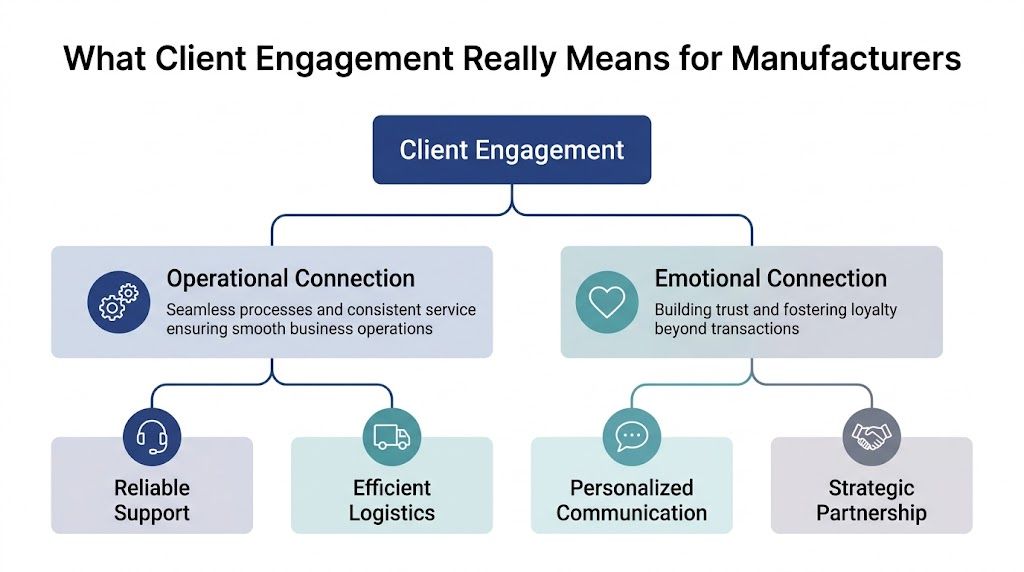
What Client Engagement Really Means for Manufacturers
For manufacturers, client engagement is the combined operational and emotional connection a buyer has with your business across the full relationship. That includes quoting, onboarding, delivery updates, support, account management, reorder cycles, education, and follow-up after the sale.
It’s not just whether clients like you. It’s whether doing business with you feels reliable, useful, and worth repeating.
Think like a maintenance engineer
A well-maintained production line performs because people monitor it, calibrate it, and correct drift early. Client relationships work the same way.
Reactive engagement says, “We’ll respond when they ask.”
Engineered engagement says, “We know the touchpoints that keep the relationship healthy, and we run them on purpose.”
That definition has two connected parts:
| Component | What it means in practice | What weak execution looks like |
|---|---|---|
| Operational connection | Clear handoffs, fast answers, consistent updates, and a smooth buying process | Delays, repeated questions, siloed teams |
| Emotional connection | Trust, confidence, relevance, and the feeling that you understand the client’s goals | Generic messaging, impersonal follow-up, low perceived value |
The four pillars that matter most
Proactive communication
Manufacturers lose momentum when communication is left to memory. Buyers want updates before they have to ask. That includes order milestones, implementation steps, expected timelines, and post-sale check-ins.
This doesn’t require endless meetings. Often it means automated status messages, scheduled account reviews, and reminders inside GoHighLevel so no account goes quiet by accident.
Continuous value delivery
The sale isn’t the end of engagement. Strong suppliers keep helping the client succeed after the invoice is paid.
That can mean application tips, maintenance reminders, reorder prompts, training content, or short educational emails tied to the equipment or service they already bought. If you need a wider planning lens, this guide to marketing strategy for manufacturers is useful because it connects messaging, channels, and follow-up into one system.
Seamless experience
A lot of engagement problems aren’t emotional at all. They’re operational friction disguised as customer apathy.
Clients disengage when your handoffs are messy, your CRM is incomplete, or your departments communicate like separate companies. A “good relationship” can still erode if it’s tiring to get simple things done.
Feedback loops
If you don’t collect feedback in a structured way, you’re guessing. Good engagement systems ask, capture, tag, and route feedback so the business can act on it.
The strongest client relationships usually feel easy from the buyer’s side because somebody worked hard behind the scenes to remove friction.
Buyer expectations have shifted
Referral-driven growth still matters, but it’s not enough on its own. According to InvestmentNews reporting on changing client engagement strategies, expanding into initiatives such as Google Business Profile optimization and GHL automation can increase client pools by 25% to 40% for local service and manufacturing businesses by reaching Gen X and Millennial buyers more directly. That matters because newer buyers often expect digital responsiveness, clearer content, and less dependence on old-school relationship maintenance.
Why Client Engagement Is Your Hidden Growth Engine
A manufacturer can hit its lead target for the quarter and still miss the revenue number. The usual cause is not top-of-funnel volume. It is post-sale drift inside existing accounts. A buyer stops replying. A reorder gets delayed. A champion leaves and no one notices. Revenue weakens long before an account is marked at risk.
That is why client engagement deserves the same discipline as production planning or quality control. It is a revenue system.
Growth usually comes from account performance, not just new demand
In B2B manufacturing, growth is often won after the first PO. Margin improves when accounts reorder on schedule, expand into adjacent product lines, and need fewer rescue interventions from sales or service. Client engagement supports those outcomes by keeping the right contacts informed, prompting follow-up at the right intervals, and exposing account changes before they become churn.
Bain & Company has long noted in its research on customer economics that improving retention can produce a disproportionate profit impact because repeat customers tend to buy more over time and cost less to serve than newly acquired ones. That logic applies directly to manufacturers with long sales cycles and high acquisition costs.
The practical point is simple. If your team wants stronger ROI, it needs a system for protecting and growing current revenue, not just filling the pipeline. That is the same discipline behind measuring marketing ROI across the full revenue cycle.
In manufacturing, engagement failure looks operational
A lot of engagement advice is written for software or retail. Manufacturers have a different problem set.
One account might involve engineering, procurement, plant operations, and finance. Each contact cares about different things. Engineering wants technical confidence. Procurement wants response speed and clean quoting. Operations wants reliability. Finance wants predictability. If your follow-up treats the account like one generic inbox, the relationship gets weaker even while the product performs well.
That is why engagement works like plant infrastructure. If the system is well designed, output stays stable. If handoffs are sloppy, small failures show up everywhere.
The economics improve when engagement is systematized
Strong engagement changes the cost structure of growth.
It reduces preventable churn. It lowers the time reps spend chasing basic updates. It gives account managers context before renewal or expansion conversations. It also creates cleaner CRM data, which makes forecasting less dependent on gut feel.
In GoHighLevel, that can look very concrete. Use pipelines to track post-sale stages, custom fields to log buying roles and product interests, automated email or SMS sequences for reorder reminders, and task triggers when an account goes quiet past a set threshold. None of that is glamorous. All of it affects revenue.
What poor engagement usually costs
Poor engagement rarely shows up as one dramatic failure. It appears as small leaks that compound into missed orders, lower retention, and more expensive account management.
| Hidden leak | What it does |
|---|---|
| Slow follow-up | Trains buyers to expect delays and push urgent requests elsewhere |
| Inconsistent post-sale contact | Leaves the account active but unmonitored until a problem surfaces |
| No visibility into account health | Hides stalled reorders, contact turnover, and expansion signals |
| Generic messaging | Lowers response because engineering, procurement, and operations get the same message |
| Manual, memory-based account management | Creates coverage gaps whenever a rep is overloaded or out of office |
Good client engagement is not a soft skill layer on top of sales. For manufacturers, it is the control system that keeps revenue stable, service coordinated, and growth easier to repeat.
How to Measure What Matters in Client Engagement
You can’t improve engagement by instinct alone. You need a dashboard.
For manufacturers, the useful model is a dual-metric framework. One side tracks what clients do. The other tracks how they experience working with you. The first is operational. The second is experiential. Together they tell you whether an account is healthy, drifting, or in need of intervention.
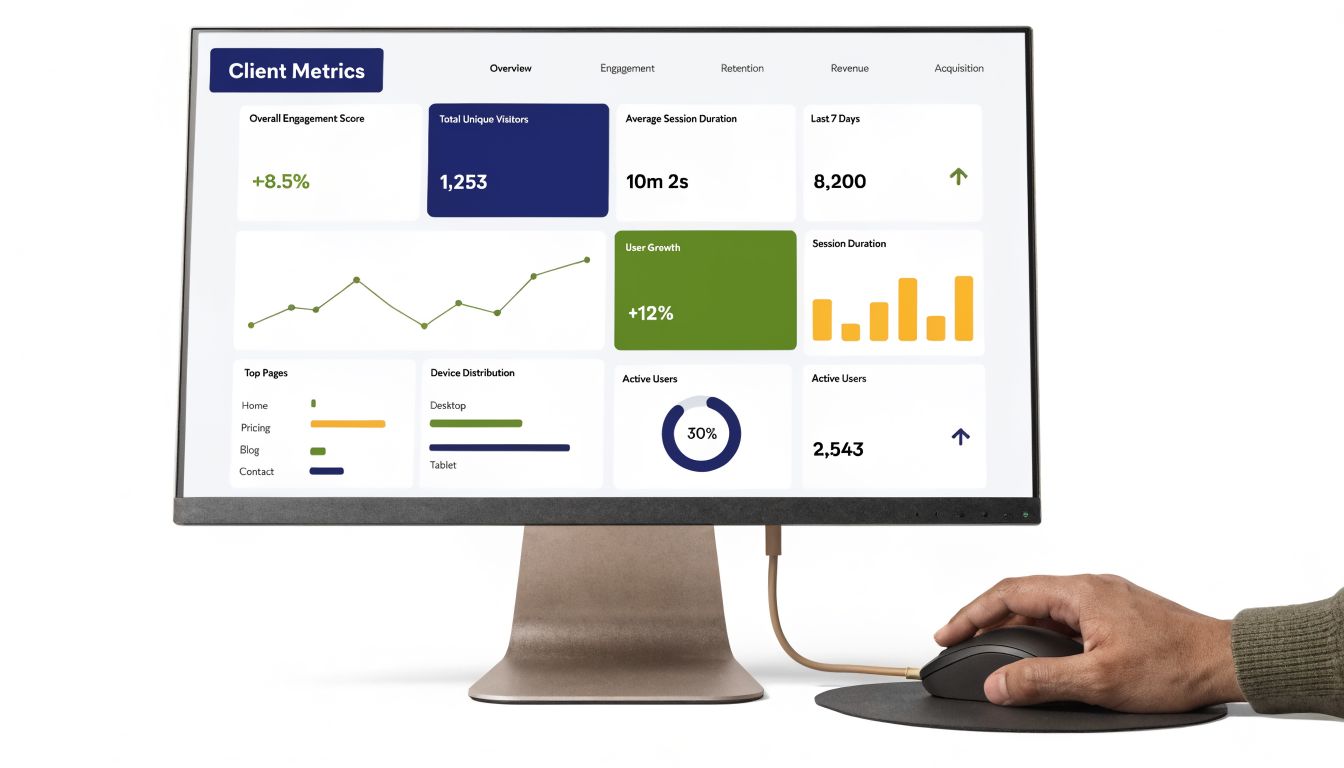
According to Seven Figure Agency’s guide to client engagement metrics, manufacturers improve engagement measurement by connecting operational metrics such as purchase frequency and feature adoption with experience metrics such as NPS and CSAT. The same source notes that engaged customers are 2-3x more likely to click through marketing offers, and that engagement frequency can be factored directly into CLTV.
Operational metrics show relationship behavior
These are the signals most CRM systems can capture if the setup is disciplined.
Watch for patterns like:
- Purchase frequency: Are orders recurring on a stable cadence, slowing down, or stopping?
- Feature or product adoption: Are clients using what they bought as expected?
- Email engagement: Opens matter less than clicks and replies, but all are useful when reviewed in context.
- Website revisits: Repeat visits to support pages, documentation, or product pages can indicate interest or friction.
- Support case volume and resolution patterns: Rising tickets can mean either active use or rising pain. Context matters.
- Response times from your team: Slow replies often create disengagement before anyone admits it.
If you want to tighten the financial side of this work, this guide on how to measure marketing ROI helps connect these metrics to commercial outcomes rather than vanity reporting.
Experience metrics show relationship quality
Operational data tells you what happened. Experience data tells you how the client felt about it.
Track these consistently:
- NPS: Useful for loyalty and referral intent.
- CSAT: Better for specific interactions such as onboarding, service calls, or delivery support.
- Customer Effort Signals: Even if you don’t run a formal CES program, note where clients have to repeat steps or chase answers.
- Qualitative feedback: Comments in surveys, emails, and call notes often reveal the underlying issue faster than a score does.
A short walkthrough helps make the dashboard idea more concrete.
Build a simple engagement score
You don’t need a perfect model on day one. Start with weighted indicators that reflect your business reality.
A practical approach inside GoHighLevel looks like this:
Choose a small set of signals
Pick a mix of operational and experience metrics. For example, recent replies, quote requests, support activity, survey feedback, and website revisits.Assign relative weight
High-intent behaviors should matter more than passive ones. A direct reply usually means more than an email open.Score accounts weekly or monthly
Don’t wait for quarterly reviews. Engagement drift often starts subtly.Tag accounts by tier
Use labels like healthy, watching, at-risk, and dormant.Trigger the right action
Healthy accounts might get educational content. At-risk accounts should trigger a personal outreach task.
What to avoid
A lot of teams collect data but still learn nothing because the measurement system is poorly designed.
Common mistakes include:
- Tracking too many low-value metrics: Busy dashboards often hide the important signals.
- No ownership: If nobody reviews the score, the score doesn’t matter.
- Treating all accounts the same: A strategic account and a low-value account shouldn’t have the same intervention model.
- Ignoring qualitative notes: Sales and service teams often hear the truth before the dashboard does.
Client Engagement in Action Concrete Examples
Definitions are useful. Workflows are better. Here’s what client engagement looks like when it moves from theory into daily operations.
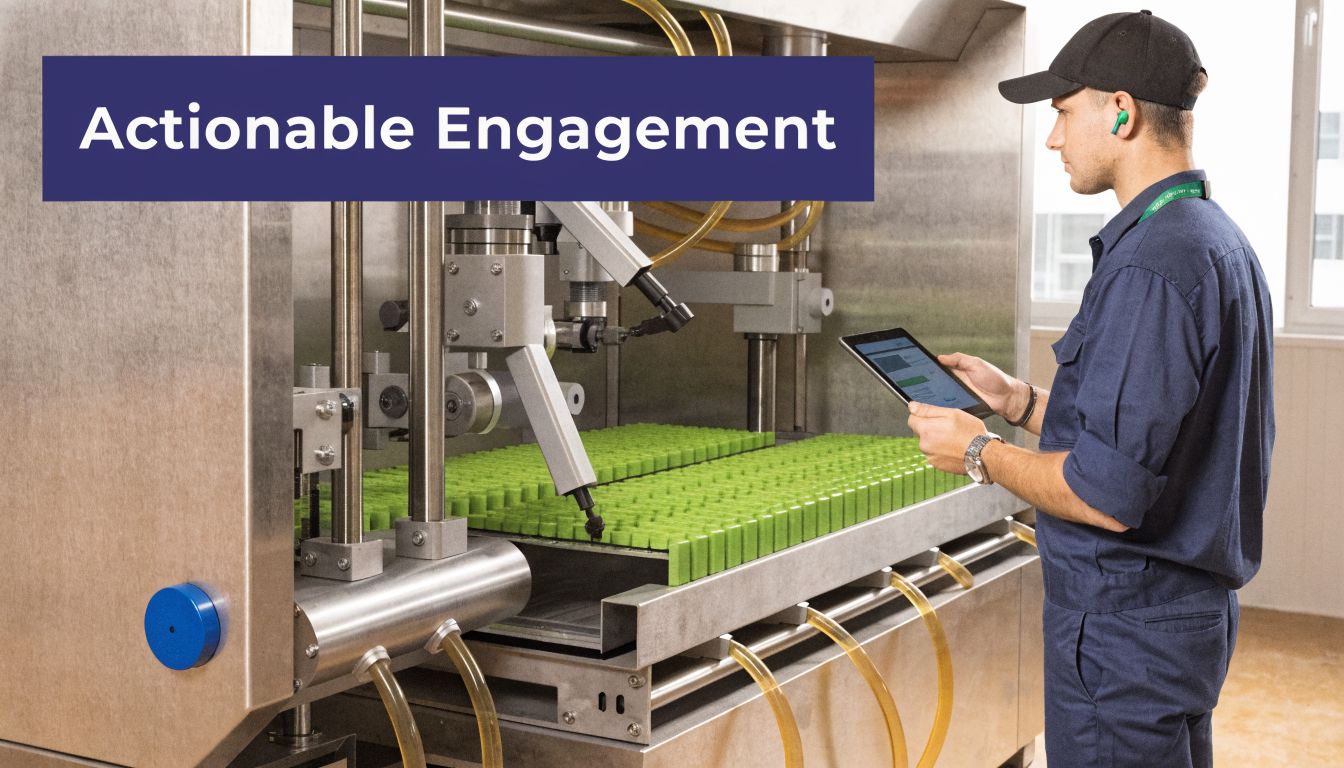
Example one from a machine manufacturer
A machine manufacturer installs equipment and then goes quiet unless the client opens a support request. That’s common, and it leaves money on the table.
A stronger setup uses GoHighLevel to trigger a post-install sequence. After the install is marked complete, the client receives a timed series of maintenance tips by email and SMS, plus a reminder to check a consumables list and a prompt to book a review call if performance questions come up.
This works because it does three things at once:
- Reduces avoidable confusion: Clients get guidance before a minor issue becomes a support ticket.
- Creates a relevant upsell path: Replacement parts and consumables are introduced naturally.
- Signals competence: The supplier looks organized, not reactive.
None of that feels pushy if the timing matches the actual usage cycle.
Example two from a B2B service firm
A consulting or service business can apply the same logic even without physical products. Suppose the firm tracks client activity inside a portal, watches whether key emails are opened, and notes when meeting cadence drops.
When an account’s activity declines, GoHighLevel can create an internal task for the account manager and trigger a light-touch check-in. The outreach isn’t “Just following up.” It’s specific. It references the slowdown, asks whether priorities changed, and offers a next step.
That kind of outreach often uncovers one of three things:
| Signal | Likely meaning | Better response |
|---|---|---|
| Fewer logins | Usage is dropping or value isn’t clear | Offer training or a reset call |
| Slower replies | Attention has shifted | Ask about current priorities |
| Reduced meeting attendance | Stakeholders changed or urgency dropped | Re-map contacts and goals |
When engagement data is useful, your team stops guessing which accounts need attention.
Why these small systems matter financially
Retention is where the economics become obvious. A 5% improvement in customer retention can boost profits by 25% to 95%, according to the Bain & Company statistic cited by Emarsys in its customer engagement statistics roundup.
That’s why this work shouldn’t stop at automation. You also need a feedback method. If your team wants a practical framework for how to measure customer satisfaction, that guide is a solid companion resource because it helps turn subjective impressions into something you can track and improve.
Actionable Strategies to Engineer Better Engagement
Most engagement problems start before automation. They start with poor diagnosis.
If your CRM is messy, your journey stages are vague, and your follow-up depends on whoever remembers to send the email, no workflow builder will save you. For B2B manufacturers in particular, one underserved need is aligning tools like GoHighLevel with a complex buyer journey. Digital Leadership’s discussion of underserved customer needs highlights the value of combining a diagnostic review with ROI-focused email and SMS re-engagement to address journey gaps where clients get stuck.
Start with a diagnostic review
Before building automation, audit the relationship path.
Ask questions like:
- Where do clients get handed off between teams?
- What information has to be repeated?
- When do we go silent after the sale?
- Which accounts haven’t heard from us unless they initiated contact?
- What content or support would help clients use the product or service better?
A structured review matters. Many firms benefit from a detailed question set that forces clarity around messaging, pipeline stages, onboarding, service ownership, and reactivation opportunities.
Build three workflows first
You don’t need twenty automations. You need a few that solve real friction.
New client welcome workflow
The moment a deal closes, launch a sequence that sets expectations. Include who owns the account, what happens next, expected timelines, and the best channel for support.
This lowers anxiety and reduces avoidable inbound questions.
Quarterly feedback and health check
Create a recurring workflow that asks a short set of questions, routes low scores to a human, and tags responses by theme. Keep it concise. Long surveys get ignored.
Use GoHighLevel to assign follow-up tasks when replies indicate confusion, delays, or missed expectations.
Reactivation sequence for quiet accounts
This is one of the highest-value workflows for manufacturers and established service firms. Build a segment of past customers or inactive accounts, then send a staggered series:
Message one
Reconnect with context. Reference the prior purchase, project, or service relationship.Message two
Share something useful, such as a maintenance reminder, product update, buying checklist, or industry-specific tip.Message three
Ask a direct question that surfaces need. For example, whether they’re planning expansion, replacement, or support review.Internal task
If the contact clicks, replies, or visits a key page, assign personal outreach to a salesperson or account manager.
Use content as part of the engagement system
A lot of businesses separate “content marketing” from “client engagement.” That’s a mistake. Useful content is one of the easiest ways to stay relevant without nagging people.
For example, post-sale content can include onboarding checklists, maintenance guidance, reorder reminders, product comparison notes, and FAQ videos. If you want a practical way to think about this, turn every piece of content into a growth opportunity is worth reading because it pushes content beyond awareness and into actual business use.
You can also extend that thinking with a more detailed look at how to improve customer engagement so your automations, messaging, and follow-up habits reinforce each other instead of operating as separate tactics.
Field note: The best engagement systems feel personal to the client even when automation does much of the coordination behind the scenes.
What works and what doesn’t
What tends to work
- Specific timing: Messages tied to real milestones outperform generic newsletters.
- Clear ownership: Someone should own each stage, even if multiple teams contribute.
- Short feedback loops: Ask simple questions and act on the answers quickly.
- CRM discipline: Good automations depend on clean fields, tags, and pipeline stages.
What usually fails
- One-size-fits-all campaigns: Different client types need different follow-up logic.
- Automation without strategy: Sending more messages doesn’t equal better engagement.
- No human intervention path: Some signals require a person, not another sequence.
- Overbuilt systems: If your team can’t maintain it, it won’t last.
Your First Step Toward Systematized Engagement
Client engagement becomes useful when you stop defining it as a relationship feeling and start treating it as a business system. For manufacturers, that means mapping the journey, identifying friction, tracking account health, and using tools like GoHighLevel to support the right touchpoints at the right time.
You don’t need to rebuild everything this quarter. Start smaller. Pick one point in the client journey where silence, confusion, or inconsistent follow-up keeps showing up. Then design one better workflow around it.
That could be onboarding. It could be post-install support. It could be reactivating accounts that haven’t heard from you in months.
What matters is the shift in mindset. Good service is helpful. Engineered engagement is repeatable, measurable, and far more valuable over time.
If you want help diagnosing where your current client journey is leaking revenue, Machine Marketing can help you map the gaps, clean up the workflow, and build a practical engagement system around your real sales process.