A local digital marketing system is what separates struggling local businesses from those with predictable growth. If you feel like you’re just throwing random marketing tactics at the wall, you’re not alone. The problem for most local businesses isn’t a lack of effort—it’s the absence of a cohesive local digital marketing system that consistently turns online searches into paying customers.
This isn’t about running a Facebook ad one day and sending an email blast the next. It’s about building a predictable engine for growth. In this guide, we’ll diagnose the common gaps in a local marketing system and give you the step-by-step blueprint to fix them.
Building a Local Digital Marketing System (Not Random Tactics)
Why do so many marketing efforts feel like a waste of time and money? We see this constantly with busy business owners who are experts in their trade but can’t get marketing to produce predictable results.
The root cause is a disconnect between getting attention online and capturing that value. Your marketing needs to function like a well-oiled machine, where every gear turns the next one seamlessly. You need a system.
To diagnose if you have a system or just a collection of tactics, ask yourself: Can I predict where my leads will come from next month? Do I know what happens to every lead that contacts my business? If the answer is no, you have an opportunity to build a more reliable growth engine.
The Shift From Random Tactics to a Marketing System
This table shows the transformation that happens when a local business stops chasing shiny objects and commits to building an actual system.
| Problem (Tactics Only) | Solution (System-Based Approach) |
|---|---|
| Unpredictable lead flow—feast or famine. | Consistent, measurable stream of qualified leads. |
| Wasted ad spend on untracked campaigns. | Optimized ad budget with clear ROI on every dollar. |
| Inability to tell what’s working or why. | Data-driven decisions based on a complete customer journey. |
| Manual, time-consuming follow-up with leads. | Automated nurturing sequences that convert prospects. |
| Leads fall through the cracks; sales opportunities are lost. | Centralized lead management in a CRM; zero missed opportunities. |
| Brand message is inconsistent across platforms. | Cohesive brand experience from first click to final sale. |
Moving from the “Problem” column to the “Solution” column isn’t magic. It’s the result of building a deliberate, interconnected marketing process.
Why a Local Digital Marketing System Starts With Local Search
Imagine you run a local machine shop, and a potential client in your city searches for ‘CNC machining near me’. That single query is a golden opportunity.
Statistics show that a staggering 46% of all Google searches carry local intent. That means nearly half of all users are actively hunting for solutions right in their backyard. Even better, 88% of mobile users who perform a local search end up visiting a store or business within just 24 hours.
This isn’t just trivia; it’s a clear signal that a structured approach to local marketing is non-negotiable if you want to grow.
Visualizing the Customer Journey
The path from a local search to a new customer isn’t complicated. It’s a clear, repeatable process that you can build a system around.
This flowchart breaks it down.
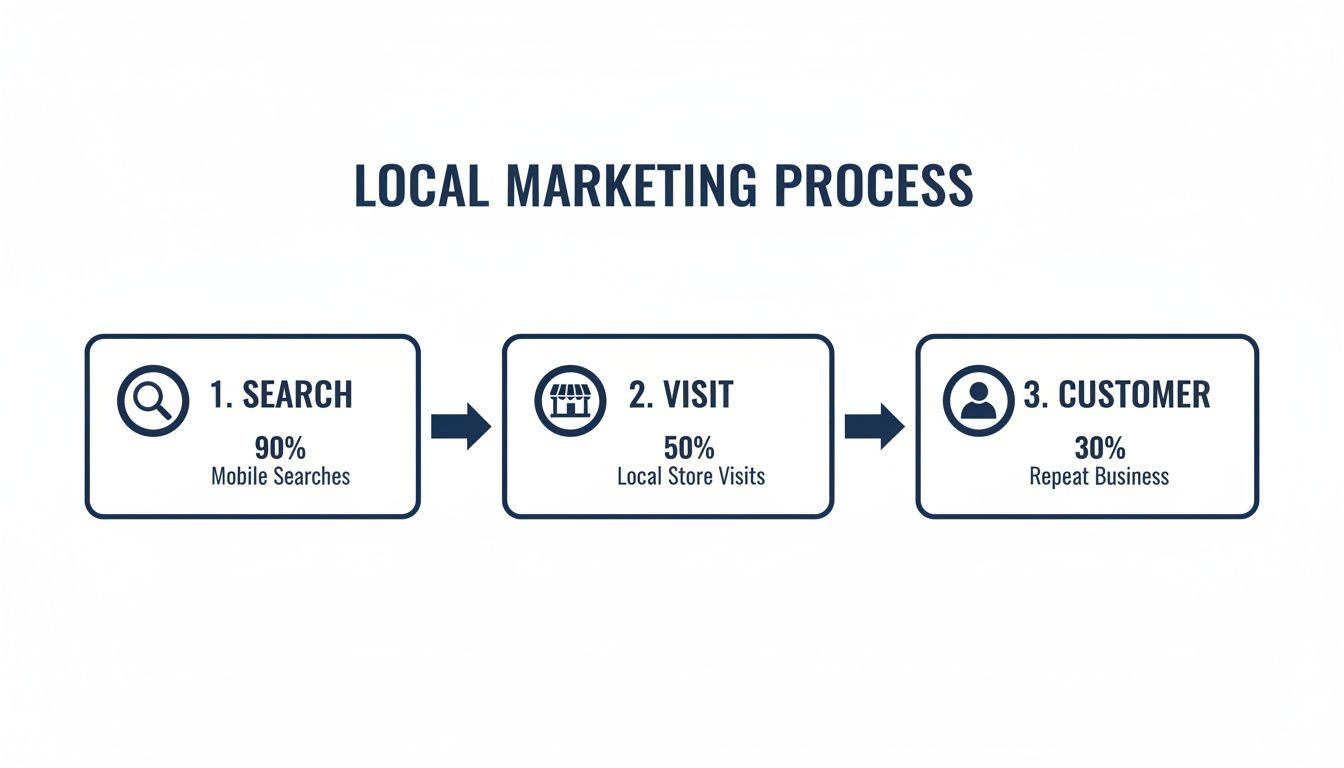
This flow highlights the absolute need for a system that grabs attention during the “Search” phase and smoothly guides prospects all the way through to becoming a loyal “Customer.”
The foundational mindset shift is moving from random acts of marketing to building a strategic, scalable asset for your business. This system doesn’t just find customers; it creates a predictable pipeline for growth.
By connecting your online presence (like your Google Business Profile) with your sales process in a CRM, you create this reliable engine. This guide is the blueprint. Before diving in, you can get a head start by reviewing our guide on how to build a marketing plan.
Local Digital Marketing System Foundation: Local SEO & Google Business Profile
When a potential customer searches “plumber near me,” the battle for their business is won or lost in seconds. The bedrock of any local digital marketing system isn’t a complex ad campaign—it’s mastering your digital storefront: your Google Business Profile (GBP).
When optimized correctly, your Google Business Profile becomes a core pillar of your local digital marketing system, directly feeding high-intent traffic into your growth pipeline.
Think of your GBP as your number one sales tool. Many businesses treat it as a set-it-and-forget-it task, leaving a massive opportunity on the table. This is the non-negotiable first step because it directly answers the questions your local customers are asking Google right now.
Transform Your GBP from a Listing to a Lead Machine
The difference between a top-ranking GBP and an invisible one comes down to two things: activity and detail. Google rewards profiles that are actively managed and give users a rich, helpful experience.
Start with a quick diagnosis of your own profile. Ask yourself:
- Is every single field filled out? We mean everything—service areas, detailed attributes (like “wheelchair accessible”), and dead-on accurate hours. Gaps signal an incomplete profile.
- Is your business description actually helpful? Don’t just say what you are. Describe what you do using the terms your customers search for. Instead of “We are a landscaping company,” try: “We offer professional landscape design, lawn maintenance, and irrigation services for homeowners in Springfield.”
- When was the last time you uploaded a photo? A steady stream of high-quality photos—of your team, your work, your location—shows Google your business is active and gives customers a real look inside.
The goal is to make your Google Business Profile the most authoritative and complete source of information about your business anywhere online. If you nail this, Google will reward you with visibility in that coveted “Local Pack.”
The effort pays off directly. A fully optimized GBP gets 7x more visits than an incomplete one. That’s a huge jump in potential foot traffic and phone calls before you spend a single dollar on ads.
Go Beyond the Basics with Active Management
Once your profile is 100% complete, the real work begins. This is how you pull away from the competition.
Your weekly management checklist should include:
- Google Posts: Use these to announce offers, show off new products, or share recent projects. Aim for a new post every week to maintain freshness.
- Q&A Section: Proactively populate this section by asking and answering your own FAQs to control the narrative. Monitor it daily to answer new customer questions quickly.
- Photo and Video Uploads: Aim to add new media weekly. If you’re a service business, this could be before-and-after shots. For a restaurant, it’s photos of new menu items. Consistency is key.
Align Your Website with Local Search Signals
Your GBP is only half of the local SEO coin. Your website has to back it up by sending the same signals to Google.
The most critical piece is NAP consistency. Your Name, Address, and Phone number must be identical across your website, your GBP, and any other online directories. A tiny variation, like “St.” versus “Street,” can confuse search engines and water down your authority.
Next, build out location-specific service pages on your website. If you’re a roofer serving three towns, you need a dedicated page for each one (e.g., “Roof Repair in Springfield”). These pages must have unique content relevant to that area, proving to Google that you’re a local authority. We dig deep into this in our complete guide to local SEO best practices.
How a Local Digital Marketing System Uses a Central CRM Hub
Getting a lead is just the start. The real money is made in how you capture, nurture, and follow up. If you’re serious about growth, relying on a spreadsheet or your inbox is a massive failure point in your system. Leads get lost, follow-ups are forgotten, and revenue vanishes.
Without a centralized platform, a local digital marketing system cannot function reliably, because automation, attribution, and follow-up all depend on a unified data environment.
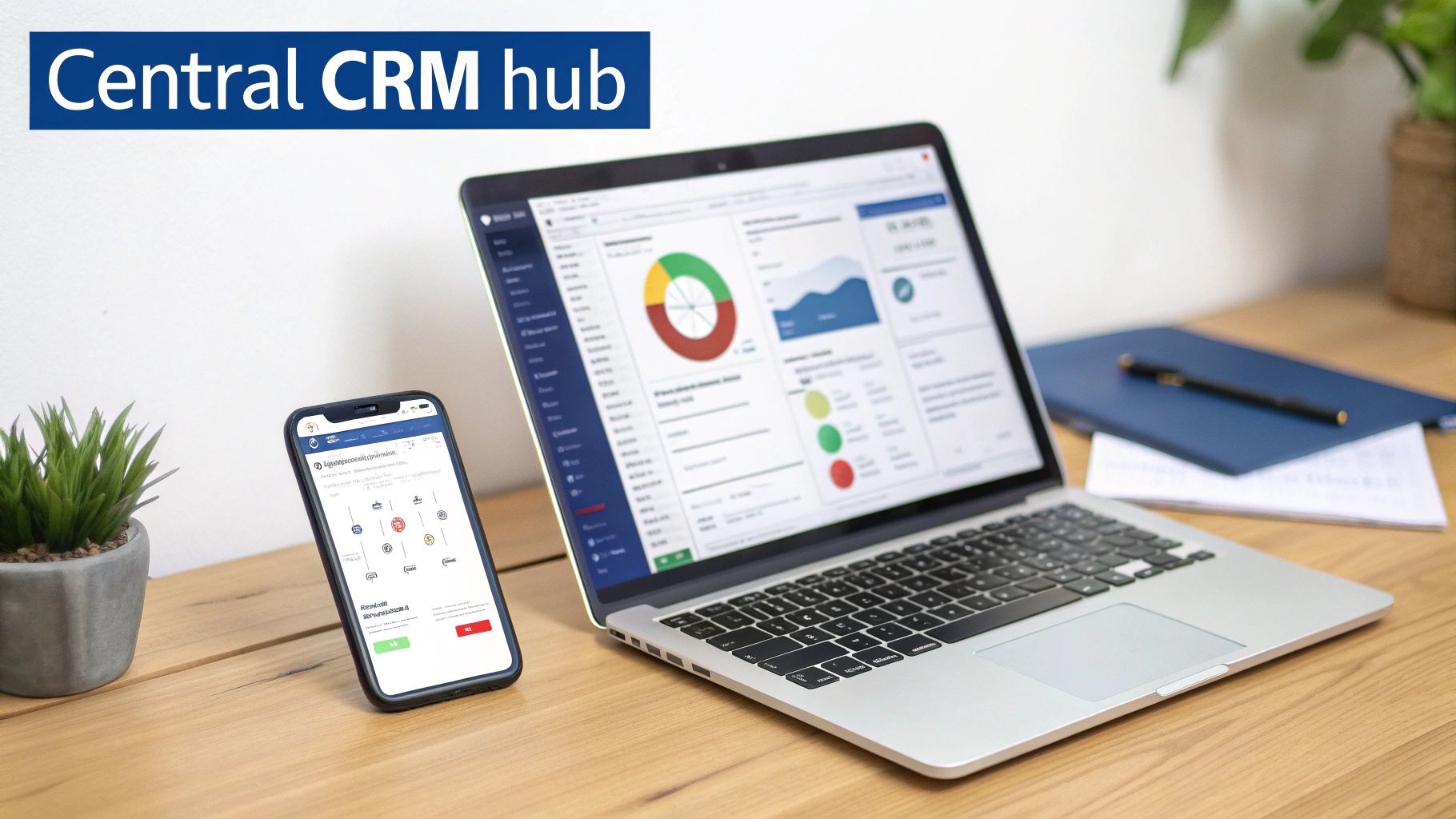
The problem is simple: your marketing and sales efforts lack a central “brain.” A Customer Relationship Management (CRM) system fills this role. It’s the command center that connects every lead source—from website forms to GBP messages—into one manageable pipeline.
From Lead Chaos to Organized Control
What problem are we truly solving here? We’re fixing the broken, manual process that dogs most local businesses. A potential customer fills out your “contact us” form, and an email lands in your inbox. Someone else messages you on Facebook. Another calls from your GBP listing.
Without a central system, you’re constantly jumping between platforms. It’s a recipe for inefficiency.
A centralized CRM, like GoHighLevel which we use for our clients, fixes this by becoming your single source of truth. Every inquiry is automatically captured and organized, instantly stopping leads from falling through the cracks. For a deeper dive into the setup, check out our guide on how to implement a CRM system.
Building Your First Automation Workflow
This is where you get your time back. Once leads flow into one place, you can build simple automations that do the heavy lifting for you 24/7. Let’s walk through a real-world example for a new lead from your website.
The goal is to deliver an immediate, professional response and ensure the lead is tracked for follow-up. You’re turning a manual process into an instant, repeatable system.
A Simple “New Web Lead” Workflow:
- Trigger: A visitor submits the contact form on your website.
- Immediate Action 1 (SMS): The system instantly sends a personalized text: “Hi [Contact Name], thanks for reaching out to [Your Business Name]. We’ve received your request and will be in touch within the next business hour. Talk soon!”
- Immediate Action 2 (Internal Notification): Simultaneously, the system notifies you or your sales lead with all the lead’s details.
- Wait Step: The workflow pauses for 24 hours.
- Follow-up Action (Email): If the lead’s status in the CRM hasn’t been updated (e.g., to “Contacted”), the system automatically sends a follow-up email with a helpful resource or a link to your scheduler.
This simple five-step sequence ensures every web lead gets an immediate response and is never forgotten.
The real value of a CRM isn’t just storing contacts; it’s automating the critical first touchpoints. Speed is everything—businesses that respond within the first hour are nearly seven times more likely to have meaningful conversations with decision-makers.
Connecting All Your Lead Sources
The true “hub” concept comes to life when you connect all your lead sources into the CRM. This is how you get a complete view of your marketing performance.
You need to integrate:
- Website Forms: Every “contact us,” “quote request,” and newsletter signup form.
- Google Business Profile: Hook up the messaging feature so chats automatically create new contacts.
- Social Media: Integrate your Facebook and Instagram DMs to capture every inquiry.
- Phone System: Use a tracking number that routes calls through your CRM, logging every interaction.
By funneling every potential customer interaction into one system, you stop being reactive and start running a proactive, organized sales process. This is the operational backbone of any successful local digital marketing strategy.
Tap Into Your Hidden Goldmine: Reactivating Your Customer Database
In the dash for new leads, it’s easy to forget about the single biggest growth opportunity you already have: your existing customer list. That’s a goldmine of people who have already said “yes” to you once. They already trust you and are far more likely to buy again than a complete stranger.
The problem is that most businesses let this asset collect dust while spending a fortune trying to attract a colder audience. The fix is to build a repeatable system using email and SMS to pull these people back into your world.
This isn’t just a hunch. The global digital marketing market is projected to hit $667 billion in 2024, and the channels leading the charge are email marketing and mobile messaging. You can explore more data on digital marketing effectiveness and see for yourself how these channels drive real results.
Simple, Actionable Reactivation Plays
You don’t need a complex marketing funnel to get started. The goal is to deliver a timely, relevant message that starts a conversation.
Here are three simple campaigns you can launch this week:
- The “We Miss You” Offer: Pull a list of customers who haven’t been back in over six months. Send a friendly email or text with a simple, compelling offer to welcome them back.
- The Seasonal Tune-Up: Perfect for any service business (HVAC, plumbing, landscaping). A month before the season changes, send a targeted reminder that it’s time for their tune-up or inspection. You’re providing value, not just selling.
- The “Insider” Update: Launching a new service? Send an “exclusive first look” campaign just for past customers before you announce it to the public.
Pro Tip: Your CRM is your best friend here. A platform like GoHighLevel lets you tag customers based on their last service date, pull a list of “inactive” clients in seconds, and send a personalized SMS campaign in minutes.
Segment Your List for Maximum Impact
Blasting the same generic message to your entire list is a surefire way to get ignored. To get a response, you have to segment. This just means breaking your list into smaller groups to send more relevant messages.
Here are a few easy ways to slice up your list:
- By Last Purchase Date: Group people who bought in the last 6 months, 6-12 months, or over a year ago.
- By Service or Product: A customer who got a full HVAC system replacement needs a different message than someone who had a minor repair.
- By Location: If you serve multiple towns, send hyper-local offers or announcements.
Writing Copy That Actually Gets a Response
Whether it’s an email or a text, your message needs to be direct, personal, and have a clear call to action.
Follow these simple rules:
- Keep It Short: Get straight to the point, especially with SMS.
- Make It Personal: Use their first name. If you can, reference their last service. (“Hi John, hope you’re enjoying the new water heater we installed last fall!”)
- Give Them Value: What’s in it for them? A discount? A helpful reminder?
- Tell Them What to Do Next: Make the next step painfully obvious. “Reply YES to book,” or “Click here to claim your 15% off.”
When you systematically reach out to past customers, you generate immediate cash flow and turn a forgotten spreadsheet into one of your most powerful marketing engines.
Pouring Fuel on the Fire with Local Ads and Social Content
With your foundational systems humming, it’s time to stop just capturing existing demand and start creating it. This is where you pour fuel on the fire with paid local ads and a smart social content strategy.
The goal isn’t to spray your budget across the internet. It’s about being ruthlessly efficient, putting your message directly in front of potential customers inside a specific, profitable radius. You’re not trying to reach everyone; you’re trying to reach the right people in your service area.
Nail Your Targeting with Geo-Fenced Ads
The single biggest mistake we see local businesses make with paid ads is casting too wide a net. Why pay to show an ad for your plumbing service to someone 50 miles away?
The fix is geo-targeting. Platforms like Google Ads and Facebook Ads let you draw a virtual fence around your business. You can show your ads only to people within a 5, 10, or 20-mile radius, ensuring your budget is spent exclusively on people who can actually hire you.
The power of local ads is reaching people at the precise moment they have a problem you can solve. Combine tight location targeting with intent-driven keywords, and you become the obvious choice.
A quick tip: send ad traffic to a dedicated landing page with one clear job, like a “Request a Quote” button. This feeds every lead directly into your CRM, closing the loop so you can track exactly which ads are bringing in paying customers.
Social Content That Builds Real Trust
Let’s be clear: social media for a local business isn’t about chasing viral trends. It’s about building trust and staying top-of-mind within your community. Your customers want to see the real people behind the business.
Your content plan should be simple and sustainable. Focus on showing up consistently with authentic content that helps people.
- Show the Work: Post a photo of your team starting the day or a short video of a tricky part of a job. This humanizes your brand instantly.
- Give Away Your Knowledge: A roofer can share a 30-second video on how to spot the early signs of a leak. This positions you as the local expert.
- Share the Love: Did you get a great review? Screenshot it and post it. Sharing photos of a finished project at a local landmark provides powerful social proof.
Consistency beats complexity every time. Aim for a few high-quality, real posts a week.
Choosing Your Local Advertising Channel
So, where should you put your first ad dollars? It boils down to whether you want to capture existing demand or create new awareness.
This table should simplify the choice.
| Channel | Best For… | Key Metric |
|---|---|---|
| Google Local Ads | Capturing high-intent searches when someone has an immediate need (e.g., “AC repair near me”). | Cost Per Lead (CPL) |
| Facebook/Instagram Ads | Building brand awareness and reaching specific demographics within your service area (e.g., homeowners aged 35-65). | Reach & Engagement |
| Nextdoor Ads | Hyper-local targeting to build trust and generate word-of-mouth referrals in specific neighborhoods. | Local Impressions |
Our advice? Start with one channel, master it, and then expand. For most service-based businesses, Google Ads offers the most direct path to a positive ROI because you’re tapping into active, urgent demand.
Scaling a Local Digital Marketing System With Reviews and Data
Traffic and leads are great, but in local business, trust is the real currency. Your online reputation, built on customer reviews, is the ultimate social proof that turns a curious searcher into a paying customer.
Building that trust isn’t about luck. It’s about engineering another machine inside your marketing system.
Most businesses get reviews passively. You do a great job and hope the customer remembers to leave feedback. We’re going to flip that script from passive hope to active, automated encouragement, using your CRM as a reputation engine.
Automating Your Review Generation
The secret to a constant flow of positive reviews is simple: ask at the perfect moment—right after you’ve delivered fantastic service.
Here’s a simple, automated workflow you can build right inside your CRM:
- The Trigger: You mark a job as “Completed” in your system.
- The Wait Step: Set a short delay—24 hours is perfect.
- The Action: The system automatically sends a personalized SMS or email: “Hi [Customer Name], we loved working with you! Would you mind taking 30 seconds to share your experience on Google? It helps our local business immensely. [Link to Google Review Page]”
This automation removes the friction and forgetfulness from the equation, ensuring every happy customer gets a gentle nudge.
A business with just nine recent reviews is seen as 52% more trustworthy than one with none. Automating your requests is the fastest way to build that credibility without adding another daily task.
Always, Always Respond to Every Review
Getting reviews is only half the battle. Responding to them solidifies your reputation by showing you’re engaged and value feedback.
Make it a rule: respond to every single review, good or bad, within 24 hours.
- For the good ones: Thank the customer by name. Mention a specific detail from their feedback.
- For the bad ones: Acknowledge their frustration calmly. Immediately take the conversation offline by providing a direct contact number or email to solve the problem. This shows public accountability.
Measuring What Actually Drives Growth
How do you know if this system is actually working? It’s time to stop chasing vanity metrics and start monitoring the Key Performance Indicators (KPIs) that directly impact your bottom line.
Your dashboard just needs to answer one question: “Is our marketing bringing in profitable customers?”
Your Local Marketing KPI Dashboard
Focus on these four numbers for total clarity.
| KPI | What It Tells You | Where to Find It |
|---|---|---|
| GBP Views & Actions | Are people finding you in local searches? Are they calling, visiting your website, or asking for directions? | Google Business Profile Insights |
| Website Traffic (Organic) | Is your local SEO strategy driving qualified visitors to your digital storefront? | Google Analytics |
| New Leads Generated | How many real sales opportunities (forms, calls, messages) did your marketing create this month? | Your CRM |
| Lead-to-Customer Rate | What percentage of those leads are turning into paying customers? This is your ultimate ROI metric. | Your CRM |
By focusing on these core metrics, you move beyond guesswork. You can clearly see how your digital marketing is performing and make smarter decisions to fuel your growth.
Your Top Questions About Local Digital Marketing, Answered
Once you commit to building a system, you’ll have questions. Here are the straight-up answers to the ones we get asked the most.
How Much Should a Small Business Really Budget for Marketing?
There’s no single magic number, but a common rule of thumb is 5-10% of your total revenue. The real answer depends on your business’s stage and goals. A new business might need to invest more to gain traction, while an established one can be more targeted.
A better question to ask is, “What outcome do I need, and what is the required investment to achieve it?” Price out the essential components—SEO, a CRM, a smart ads budget—and treat it as a non-negotiable operational cost, just like your rent.
How Long Does It Actually Take for Local SEO to Work?
Local SEO is a long game. While you might see quick wins from optimizing your Google Business Profile in a few weeks, expect it to take at least 3-6 months to see significant, predictable results in local search rankings.
This timeline depends on market competition and how consistently you execute the plan. Consistency is key—weekly GBP posts, a steady stream of reviews, and building local citations over time. These efforts compound.
Think of it like investing. The daily changes are small, but consistent contributions build unstoppable momentum. The sooner you start, the faster you’ll see the payoff.
Do I Really Need a CRM for Just a Handful of Customers?
Yes. Without a doubt. Saying you don’t need a CRM with only a few leads is like a builder saying they don’t need a toolbox for a small project.
Starting with a CRM when your lead volume is low is the perfect time. It allows you to build the right habits and iron out your systems before things get chaotic. A simple CRM will ensure no lead ever falls through the cracks, automate your follow-up, and build a priceless database of customers you can market to again.
Ready to stop wrestling with disconnected tactics and build a marketing machine that moves the needle? The team at Machine Marketing specializes in diagnosing broken marketing processes and replacing them with systems that deliver predictable, scalable growth. We can build the entire foundation for you, from local SEO to a fully integrated CRM that captures and converts every lead.
Book a discovery call with us and let’s map out your custom growth plan.