If your lead pipeline feels more like a slow drip than a steady flow, the problem isn't a lack of effort—it's almost always a hidden flaw in your marketing system. Effective digital marketing for manufacturers isn't about throwing random tactics at the wall to see what sticks; it's about building a predictable, measurable engine for growth.
We see this all the time—and the root cause is often hidden in plain sight. In this guide, we’ll show you how to diagnose the gaps in your current marketing system and share practical, step-by-step solutions you can take today to start seeing results.
Diagnosing Your Current Marketing System
Is an inconsistent flow of leads the real problem? Or is it just a symptom? Like any engineering challenge, the right solution starts with a thorough diagnosis to find the weak points in your current approach. When you're running a manufacturing business, your focus is on production, quality, and logistics. Marketing can easily feel like a secondary concern.
But in today's market, your digital presence is the primary driver of new opportunities.
Your competitors are already making the shift. In fact, recent research shows that manufacturers are increasing their digital marketing budgets by more than 10 percent, focusing on SEO and paid ads. This isn't just a trend; it's a fundamental change in how B2B buyers find, research, and vet suppliers. To see the full picture, you can discover the latest manufacturing marketing stats on MBTMag.com.
The point of this diagnosis is to stop guessing and start making data-driven decisions. Before we can build a solution that works, we need honest answers to some tough questions.
To make this simple, we've created a quick diagnostic checklist. Spend 15 minutes going through these questions. This isn't about finding fault; it's about spotting opportunities for transformation.
Marketing System Diagnostic Checklist
Use this table to quickly identify where the leaks are in your current marketing and sales process. Be honest—the more accurate your assessment, the more effective your solution will be.
| Area to Diagnose | Key Question to Ask Yourself | What to Look For (Red Flags) |
|---|---|---|
| Website Performance | Is our website a 24/7 salesperson or just a digital brochure? | Outdated design, slow load times, no clear calls-to-action, not mobile-friendly. |
| Lead Capture | How are leads from our site tracked and passed to sales? Are they falling through the cracks? | No contact forms, no CRM integration, manual lead entry into spreadsheets, slow follow-up. |
| SEO Visibility | When a prospect searches for our specific capabilities (e.g., "AS9100 certified 5-axis machining"), can they find us on Google? | Not appearing on the first page for core service keywords; competitors dominate search results. |
| CRM & Data | Do we have a central system (a CRM) to manage all our customer and prospect interactions? | No CRM in place, customer data scattered across inboxes and spreadsheets, no visibility into the sales pipeline. |
| Messaging & Audience | Does our messaging solve our ideal customer's problems, or does it just talk about us? | Website copy is all "we do this" and "founded in 1985" instead of "you face this challenge, we solve it like this." |
This quick audit gives you the "before" picture. It establishes a baseline so you can measure progress and prove the ROI for every marketing dollar you spend.
The Engineering Mindset for Marketing: Treat your marketing like any other critical system in your facility. It has inputs (budget, time), processes (campaigns, content), and outputs (leads, revenue). A proper diagnosis finds the bottlenecks and inefficiencies in that system.
Without this diagnosis, any digital marketing effort becomes a series of disconnected activities with no clear path to growth. With it, you have a clear blueprint for building a reliable lead generation machine.
Building Your Foundation with Automation and a CRM
Let’s be direct. If your lead management system is a chaotic mix of spreadsheets, email inboxes, and sticky notes, you’re not marketing—you’re guessing. We see it all the time with manufacturers. Great products and great people, but no central system to track who's interested and what happens next.
This is where a Customer Relationship Management (CRM) system and automation come in. Think of it as the central nervous system for your entire marketing and sales operation. It’s not just a fancy database; it’s the operational backbone that turns random activities into a predictable process.
Instead of chaos, picture a well-organized shop floor. Every tool is in its place, every process is documented, and you have total visibility from raw material to finished product. A CRM does the same for your leads, tracking every interaction from the first website visit to the final sale.

Why This Is Non-Negotiable for Growth
Why is implementing a CRM and automation so critical? It’s about building a predictable revenue engine. Once your systems are connected, you unlock powerful capabilities that directly impact your bottom line.
Here’s the transformation you can expect:
- No More Lost Leads: Every form submission, phone call, and email gets captured and assigned automatically. Nothing slips through the cracks.
- An Empowered Sales Team: Your reps can stop wasting hours on manual data entry and focus on what they do best—building relationships and closing deals. They’ll have a complete history of every conversation at their fingertips.
- Data-Driven Decisions: You will know exactly which marketing channels are bringing in the most valuable leads, so you can confidently double down on what’s working.
We’ll be transparent: setting this up correctly takes a real investment of time upfront. But the long-term payoff in efficiency and higher conversion rates is massive. It’s what separates a marketing department that feels like a cost center from one that operates as a genuine growth machine.
Getting Started with Simple Automation Workflows
"Automation" can sound intimidating, but you can start with a few simple, high-impact workflows that run on autopilot. These systems work for you 24/7, nurturing leads so your team doesn't have to. The key is to map your customer’s journey and automate the repetitive communication steps.
For instance, when a new lead comes in from your website, you can trigger an automated sequence:
- Instant Confirmation: An email goes out immediately, thanking them for their inquiry and offering a relevant resource, like a product catalog or a compelling case study.
- Sales Notification: Simultaneously, your sales team gets an instant alert with the lead's details, enabling follow-up in minutes, not hours or days.
- Nurture Sequence: Over the next few weeks, the system automatically sends a series of pre-written emails that showcase your capabilities, answer common questions, and build trust.
Key Takeaway: Automation isn't about replacing your people. It's about handling the robotic, repetitive tasks so your team can focus on high-value, personal conversations at exactly the right moment.
This systematic approach ensures every lead gets a consistent, professional experience. As you build this foundation, you can become more sophisticated by following established marketing automation best practices.
Of course, choosing the right platform is a critical first step. Many options aren't built for the specific needs of industrial companies. To help you cut through the noise, we've put together a guide on how to choose a CRM that actually works for manufacturing companies. Getting this piece right from the start will save you a world of headaches down the road.
Optimizing Your Website for Technical B2B Buyers
Think of your website as your hardest-working salesperson. It’s on the clock 24/7, working to attract and engage the engineers, procurement managers, and operations directors who make or break your sales pipeline. Too many manufacturing websites are little more than static digital brochures—a massive missed opportunity.
Let’s put ourselves in your buyer’s shoes. An engineer lands on your site hunting for a specific material tolerance for a project with a tight deadline. A procurement manager is there to quickly verify your certifications before adding you to a vendor list. If they can’t find this info in a few clicks, they're gone. Your website's core job is to answer their technical questions and build trust, fast.

This means your site needs more than just a modern design. It demands a strategic architecture built from the ground up for technical B2B buyers. The entire experience should make it incredibly easy for them to find specs, download a CAD file, or request a quote.
Building a High-Performance Manufacturing Website
A great manufacturing site strikes a careful balance between deep technical substance and a seamless user experience. And don’t forget mobile. Around 42% of B2B buyers now use their phones during the research phase. A site that’s clunky on mobile isn't just an annoyance; it’s a deal-breaker.
Here are the core elements you have to get right:
- Intuitive Navigation: Structure your site menu logically—around your services, capabilities, or the industries you serve. An engineer shouldn't have to click more than twice to find your CNC machining specs or your AS9100 certification.
- Clear Calls-to-Action (CTAs): Don't make visitors hunt for the next step. Every page should guide them toward an action. Use direct, unambiguous language like "Request a Quote," "Download Spec Sheet," or "Talk to an Engineer."
- Showcase Technical Specifications: Stop burying the details. Your product and service pages must prominently feature specs, tolerances, materials, and other critical data your technical audience needs to make a decision.
- Build Trust with Social Proof: Get your certifications, case studies, and testimonials front and center. These elements are powerful third-party validation, reassuring potential buyers you can deliver on your promises.
Unlocking Growth with SEO for Manufacturers
Once your website is tuned for your buyers, you have to ensure they can find it on Google. This is where Search Engine Optimization (SEO) comes in. A solid digital marketing plan for any manufacturer hinges on an SEO strategy targeting the specific, technical phrases your ideal customers are typing into the search bar.
Your buyers aren't just searching for "machining services." They're looking for solutions to specific problems.
The SEO Mindset Shift: Stop thinking about what you want to sell and start thinking about what your customer needs to know. Your keyword strategy should be built around answering their highly specific technical and logistical questions.
This is all about focusing on long-tail keywords. These are longer, more specific search phrases that signal a much higher intent to buy. Instead of targeting the broad term "CNC machining," you should go after a phrase like "AS9100 certified 5-axis CNC machining for aerospace." The person searching that phrase knows exactly what they need and is likely much further down the buying funnel.
An Actionable On-Page SEO Checklist
To start pulling in this high-intent traffic, you need to optimize your website's pages—a process called on-page SEO. It’s how you tell search engines what your content is about. When you’re targeting technical B2B buyers, a focused approach using specialized SEO strategies for manufacturers can make all the difference.
Here’s a quick checklist to get you started:
- Optimize Page Titles and Meta Descriptions: Ensure every important page has a unique title and description. It should include your target keyword and clearly state the page's value to the searcher.
- Use Descriptive Headers: Break up your content with clear H2 and H3 subheadings. This doesn't just help with SEO; it makes your pages far easier for busy professionals to scan.
- Create a Resource Library: Build out a section of your site with genuinely helpful, in-depth content. Think technical white papers, material comparison guides, or detailed project case studies. This establishes your authority and attracts valuable backlinks.
Nailing the fundamentals of your website and SEO is a critical first step in building a predictable lead generation machine. For a much deeper dive into this topic, check out our comprehensive guide on SEO for manufacturing companies.
Generating Leads with Content and Paid Advertising
Once your website is optimized and your CRM is in place, it's time to open the floodgates. A perfect website is a passive asset. To truly drive growth, you need to actively pursue leads using a one-two punch: the long-term authority of content marketing combined with the immediate impact of paid advertising.
The days of relying solely on trade shows and cold calls are over. Modern B2B buyers—especially in technical fields—do their homework online long before they pick up a phone. Research shows that 74% of B2B buyers conduct more than half of their research online before making a purchase. To see how these trends are reshaping the industry, you can explore the 2025 manufacturing outlook from BluestonePIM.
This shift means your digital marketing for manufacturers has to be proactive, educational, and laser-focused.
Create Content That Actually Solves Problems
Let's be transparent: your buyers—engineers, procurement managers, and operations directors—aren't looking for fluffy blog posts. They're looking for answers to specific, complex problems. Your entire content strategy should be built around providing those answers and proving you're the expert. This isn't about selling; it's about being helpful.
Here are the types of content that deliver real results for manufacturers:
- Detailed Case Studies: Don't just say you solved a problem. Show your work. Break down the client's initial challenge, the specific solution you engineered, and the bottom-line business impact (e.g., "reduced cycle time by 15%," "cut material waste by 8%").
- Technical White Papers: Go deep on a specific process, material, or technology. A white paper comparing the performance of different alloys for a high-stress application will attract the exact high-intent engineers you want to reach.
- Equipment Demos & Process Videos: Show, don't just tell. A quick video demonstrating the precision of your 5-axis CNC machine or walking through your quality control process builds incredible trust and credibility.
- Material Comparison Guides: Create practical, downloadable tools that help your prospects make smarter decisions. A simple PDF comparing the pros and cons of different polymers for injection molding can become a lead-generation machine.
Once you create this high-value content, share it on platforms like LinkedIn and in industry-specific groups. This positions your team as the subject matter experts they are.
Run Paid Ads That Reach Decision-Makers
While content builds your reputation over the long haul, paid advertising gets you in front of people right now. For manufacturers, however, generic Google Ads campaigns can be like throwing money into a furnace. The key is hyper-targeting. You must ensure every ad dollar is spent reaching the right people at the right companies.
Our Paid Ads Philosophy: Don't spray and pray. Use powerful targeting tools to surgically place your message in front of the exact job titles and industries that matter to your business.
This is where a platform like LinkedIn Ads becomes your best friend. Unlike broader platforms, LinkedIn lets you target your campaigns with surgical precision.
Setting Up a Hyper-Targeted LinkedIn Campaign
Let’s say you sell specialized hydraulic systems for the aerospace industry. Instead of running a generic ad, you can build a campaign that is only shown to:
- Job Titles: Design Engineer, Procurement Manager, Head of Operations
- Industry: Aviation & Aerospace
- Company Size: 100-500 employees
- Location: Specific manufacturing hubs in North America
That level of targeting is a game-changer. You stop wasting money on irrelevant clicks and start speaking directly to decision-makers, driving highly qualified traffic to your site or a specific content download.
Pairing this paid strategy with your organic content creates a powerful flywheel. You build long-term authority while generating immediate opportunities. For a deeper dive, check out our complete guide on lead generation for manufacturers.
Content vs. Paid Ads: Which to Use When
Deciding where to put your marketing budget can be tricky. Content marketing is a marathon that builds lasting brand equity, while paid ads are a sprint that delivers immediate results. Neither is "better"—they just serve different purposes. This table breaks down when to lean into each channel.
| Marketing Goal | Best Channel (Content/Paid) | Example Tactic | Expected Time to Results |
|---|---|---|---|
| Build Long-Term Brand Authority | Content | Publishing a detailed technical white paper | 6-12 months |
| Generate Immediate Leads for Sales | Paid | A hyper-targeted LinkedIn ad campaign | 1-4 weeks |
| Educate Prospects in the Research Phase | Content | Creating a video series on your process | 3-6 months |
| Drive Traffic to a New Product Launch | Paid | Google Ads targeting product-specific keywords | Days to weeks |
| Improve SEO and Organic Rankings | Content | A consistent blog with case studies | 9-18 months |
| Promote a Limited-Time Offer or Event | Paid | Retargeting ads to website visitors | Immediate |
Ultimately, the most powerful approach combines both. Use paid ads to amplify your best content and get it in front of a targeted audience quickly, then let that content nurture them into becoming long-term customers.
Your First 90 Days: A Practical Action Plan
All the diagnosis and strategy in the world are just theory without execution. Real results come from disciplined action. This is where we shift from planning to doing.
To make this manageable, let's break your first quarter down into three focused, 30-day sprints. The goal isn't to do everything at once. It's to build momentum with small, consistent wins that create a real marketing system you can measure, analyze, and build on.
Month 1: The Foundation (Days 1-30)
Your first 30 days are all about laying the groundwork. Rushing this part is like building a factory on a shaky foundation—it will only cause problems later. We need to establish a baseline, implement the core systems, and get brutally honest about who you're talking to.
Here are your primary objectives:
- Run the System Audit: Use the diagnostic checklist from the first section to get a frank assessment of where you stand today. Document everything. This is the "before" photo you'll use to prove ROI.
- Set Up Your CRM: Get your CRM up and running. Pull all contacts out of spreadsheets and scattered inboxes to create a single source of truth. At a minimum, set up a simple pipeline to track leads from "New Inquiry" to "Quote Sent" to "Deal Won."
- Define Your Ideal Customer Profile (ICP): Get your sales and leadership teams in a room. Who are your absolute best, most profitable customers? What industries are they in? What keeps them up at night? This clarity will shape every piece of content you create and every ad you run.
Month 2: Optimization and Content Creation (Days 31-60)
With the foundation solid, month two is about optimizing your most important digital asset—your website—and creating the content that will attract your ideal buyers. This is where you start building the marketing tools that will work for you 24/7.
Here’s where to focus:
- Implement Key On-Page SEO: Using insights from your new ICP, start keyword research for the technical, long-tail phrases your buyers are using. Optimize the page titles, meta descriptions, and headers on your most critical service and product pages.
- Create Two Cornerstone Content Pieces: Don't try to pump out a dozen blog posts. Focus your energy on producing two high-value, in-depth pieces of content that directly solve one of your ICP's biggest problems. Think detailed case studies or a technical white paper.
This infographic shows how these stages—Foundation, Content, and eventually, Ads—all fit together to generate qualified leads.
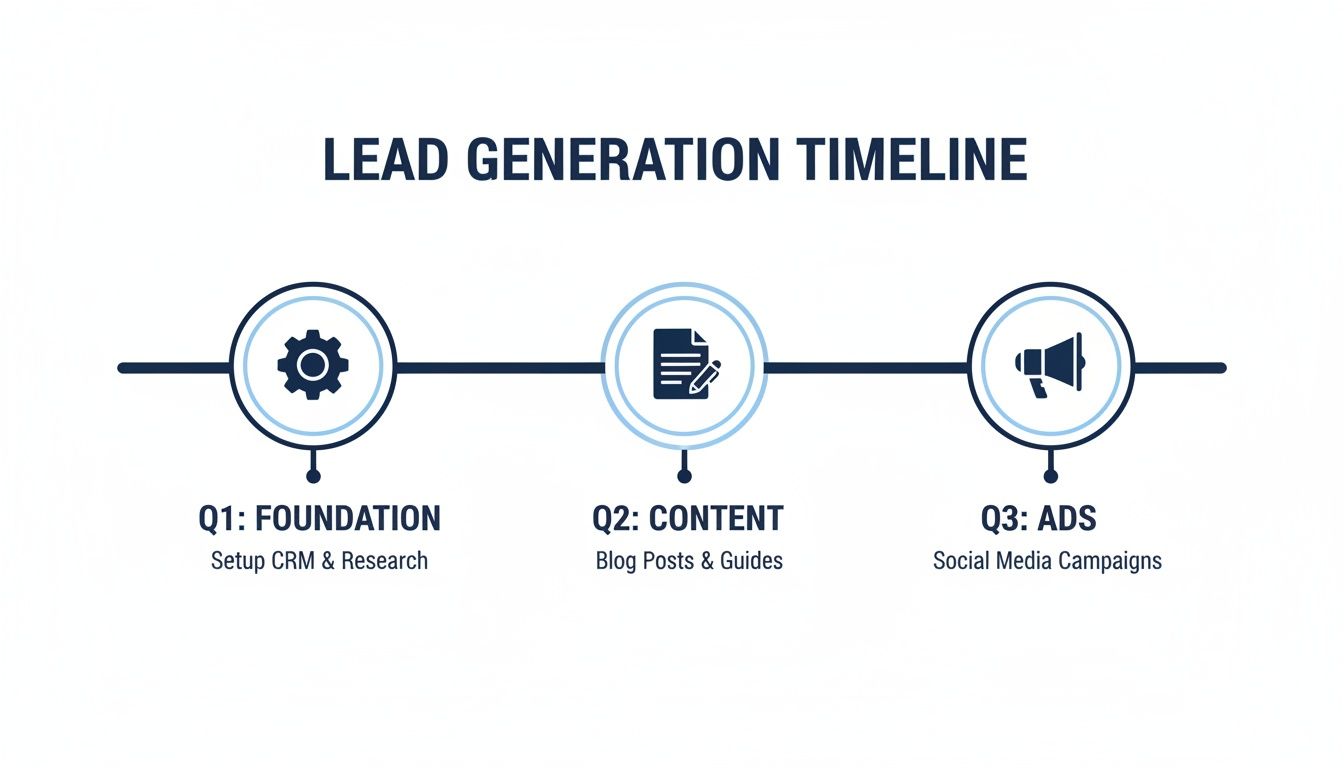
As you can see, each step builds on the last. It’s a system: build the core, create the assets, and then actively promote them.
Month 3: Gaining Momentum (Days 61-90)
You now have an optimized website and some genuinely valuable content. It's time to start driving traffic. This month is about launching, analyzing, and reactivating your dormant contact list. You're about to see the first real data flow into your new system.
Your priorities for these final 30 days:
- Launch a Targeted Ad Campaign: Take one of your cornerstone content pieces and use it as the offer for a hyper-targeted LinkedIn ad campaign. The goal is to drive traffic to a dedicated landing page where prospects can download the asset in exchange for their contact info.
- Deploy an Email Reactivation Campaign: Your existing contact list is a goldmine. Send a simple, direct email campaign to past customers and old leads, sharing your new content. This can re-engage dormant contacts and see who might be back in the market.
What to Measure: Don't get lost in vanity metrics. At this stage, track the Key Performance Indicators (KPIs) that prove the system is working. Focus on Marketing Qualified Leads (MQLs), Cost Per Lead (CPL), and the Website Conversion Rate on your new landing page. These are the numbers that tell you if your investment is turning into real sales opportunities.
Common Questions from Manufacturers
We've walked through the playbook for building a predictable marketing machine, but we know from experience that a few key questions always come up. Here are direct answers to help you navigate digital marketing in the manufacturing world.
How Much Should a Manufacturer Budget for Digital Marketing?
There’s no magic number, but a common rule of thumb for B2B companies is 5-10% of annual revenue. That said, if you're just getting started, a project-based approach is a smarter way to begin.
Look at your diagnosis and put your initial budget into the one or two areas that will make the biggest impact. That might be a website overhaul to capture leads or a foundational SEO campaign to start showing up for your core capabilities.
The Real Answer: Start with a budget you can track. The goal is to obsessively measure your return on investment. Once you see a specific channel delivering—like paid ads generating qualified leads for a predictable cost—you can confidently pour more fuel on that fire.
How Can Content Marketing Work for Our Technical Products?
This is where manufacturers have a massive, often overlooked, advantage. Highly technical products are a perfect match for content marketing because your buyers aren't looking for fluff; they are actively hunting for detailed, expert information to solve complex problems.
Your content needs to be a resource, not a sales pitch. Focus on creating high-value technical assets that build trust and authority.
Here’s what that looks like in practice:
- Detailed case studies that walk through how your product solved a specific engineering challenge.
- White papers comparing material performance under different stress conditions.
- Video demonstrations showing your equipment in action, highlighting its precision and efficiency.
Content like this doesn't position you as just another vendor. It makes you an invaluable partner and problem-solver, attracting the exact technical buyers you want to talk to.
Why Do We Need SEO if We Get Business from Referrals?
Referrals are great, but they're unpredictable and hard to scale. Search Engine Optimization (SEO) gives you a consistent, measurable, and scalable stream of inbound leads that works alongside your existing channels.
Think about it: even when someone gets a referral, what's their next move? They Google you. A professional, optimized online presence instantly validates that referral and builds confidence before you’ve even had a conversation.
Beyond that, with 74% of B2B buyers doing most of their research online, SEO is no longer a "nice-to-have." It’s how you get found during that critical research phase. You start capturing high-intent prospects who are actively looking for the solutions you provide—opportunities you would have never known existed. SEO transforms your website from a digital brochure into a 24/7 lead generation machine.
Ready to stop guessing and start building a marketing system that delivers predictable results? At Machine Marketing, we specialize in implementing the exact strategies outlined in this guide for manufacturers and industrial companies. We'll help you diagnose your system, sharpen your messaging, and deploy campaigns that generate qualified leads.
Contact us for a diagnosis and get a clear, actionable roadmap for sustainable growth.