If you're a manufacturer or B2B operator, you've probably lived some version of this already. You bought a CRM. You added an email platform. Someone set up analytics. You may even have a chatbot, a social scheduler, and a paid ads account sitting there.
Yet the sales team still asks the same question. Where are the qualified leads, and which part of marketing is producing them?
That frustration usually isn't a tool problem. It's a system problem. The global digital advertising and marketing market is projected to reach $786.2 billion by 2026 (Insivia), which means your competitors are investing whether your internal setup is clean or not. If your stack isn't connected, your budget gets spread across disconnected activities instead of producing a repeatable pipeline.
Digital marketing technologies work when they behave like an engineered process. Data enters once, actions trigger automatically, sales sees context, and management can trace spend to outcomes. That's the standard. Anything less is expensive noise.
Your Marketing Feels Stuck and Tech Is the Suspect
Most stuck marketing systems look busy from the outside.
The website is live. Campaigns go out. Trade show leads get uploaded eventually. Sales follows up when time allows. Reports exist, but nobody trusts them enough to make a budget decision from them.
The real problem isn't too little software
In manufacturing, people rarely buy production equipment without thinking about throughput, handoffs, maintenance, and output quality. Marketing often gets treated differently. Teams buy platforms one at a time, usually in response to a pain point, and end up with a pile of partial fixes.
That creates familiar symptoms:
- Lead tracking breaks down: A form fill comes in, but nobody can tell whether it turned into an RFQ or disappeared.
- Follow-up depends on memory: Reps intend to reply, but urgent work on the floor or in the office wins.
- Reporting stays shallow: You can see clicks and visits, but not which campaigns helped sales conversations start.
- Old contacts go cold: Past buyers, inactive distributors, and former quote requests sit untouched.
The issue isn't that digital marketing technologies don't work. It's that they aren't arranged to support a single operating process.
Practical rule: If a lead can enter your business without creating a record, a task, and a follow-up path, you do not have a system yet.
What a working system looks like
A useful setup does a few things consistently.
It captures intent. It routes people into the right workflow. It stores context in one place. It gives sales a reason to act at the right time. It also gives leadership enough visibility to decide what to improve next.
For B2B firms, especially manufacturers, this matters more than flashy campaign tactics. Your buying cycle is usually longer, your buyers ask technical questions, and your leads need qualification before anyone should celebrate. A disconnected stack makes those realities harder. An integrated one turns them into an advantage.
Thinking Like an Engineer About Your Tech Stack
A better way to think about digital marketing technologies is to stop calling them "tools" and start treating them like a production line.
A manufacturer wouldn't install a CNC machine, inspection station, and packaging line without defining what each one contributes. Marketing deserves the same discipline. Each platform should have a job, a handoff, and a measurable output.

Your digital workshop needs stations
A practical stack has stations, not random subscriptions.
Your website is where visitors inspect your capability. Your CRM is where commercial memory lives. Automation handles repetitive follow-up. Analytics tells you where the process is leaking. Paid media and SEO bring people into the system. Social channels support trust and visibility.
If you're trying to sketch this out, our guide to marketing tech stacks is a useful companion to map the components before you buy anything else.
Start with the business problem, not the product demo
Most bad software decisions happen because the vendor controls the conversation. The demo shows dashboards, AI features, and slick templates. None of that matters if the system doesn't solve your actual bottleneck.
For a manufacturer, the bottleneck is usually one of these:
- Inconsistent inbound demand
- Slow or uneven follow-up
- Poor visibility between marketing and sales
- No structured way to reactivate past contacts
- A website that attracts traffic but not serious buyers
Once the bottleneck is clear, the stack design becomes easier.
A CRM without a defined sales process becomes a database graveyard. An automation platform without trigger points becomes another login. A content platform without search intent becomes a brochure archive.
Treat every platform like equipment on a line. Ask what goes in, what comes out, who owns it, and how failure gets detected.
What works and what doesn't
What works is boring in the best sense. Clear forms. Clean fields. Standardized stages. Short automated sequences. Reports that answer a business question.
What doesn't work is overbuilding early. Teams often try to launch every channel, every workflow, and every integration at once. That creates complexity before discipline exists.
The strongest setups usually begin with a narrow path. One audience. One offer. One conversion action. One follow-up flow. Then they expand only after the first loop is reliable.
The Core Categories of Digital Marketing Technologies
Most B2B firms don't need more categories. They need a cleaner understanding of what each category is supposed to do.
The easiest way to organize digital marketing technologies is by operational role. Not by trend, not by acronym, and not by what the vendor says on the homepage.
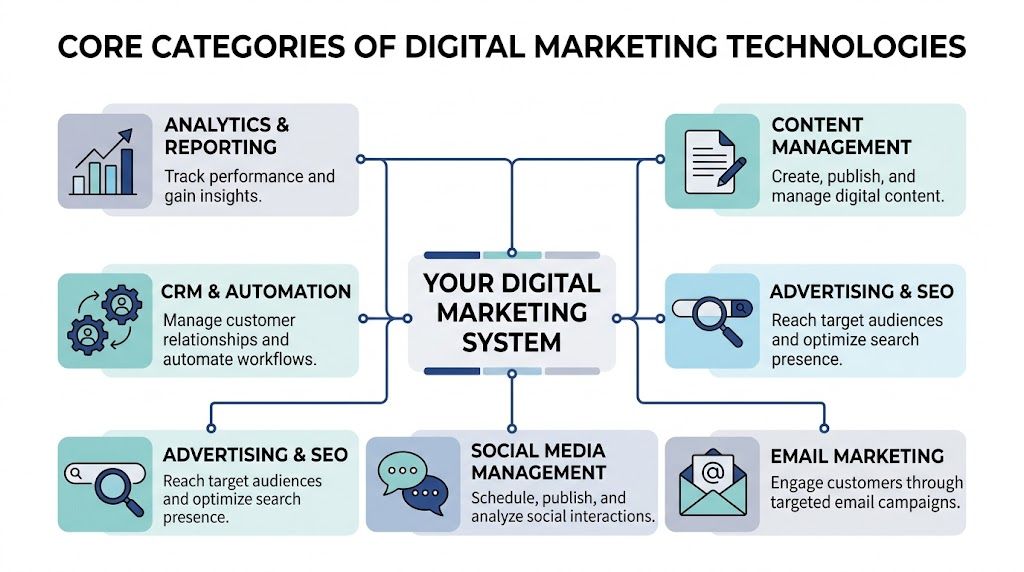
Quick reference for manufacturers
| Category | Primary Job | Example for a Manufacturer |
|---|---|---|
| CRM | Store contact, company, and deal history | Track RFQs, distributors, spec requests, and past buyers |
| Marketing and sales automation | Trigger follow-up without manual chasing | Send a thank-you email and reminder after a whitepaper download |
| Analytics and reporting | Show what drives qualified activity | Compare quote-form submissions by traffic source |
| SEO and content platforms | Attract buyers researching solutions | Publish pages for machine capabilities, tolerances, and applications |
| Paid media tech | Reach a defined audience quickly | Run campaigns to buyers searching for a specific industrial service |
| Social media management | Maintain brand visibility and credibility | Schedule LinkedIn posts featuring applications, process insight, and project updates |
| Email marketing | Nurture and reactivate lists | Re-engage dormant customers with product updates or service reminders |
If you're comparing software across categories, it can help to explore various digital marketing tools in one place before narrowing the field.
CRM is the operational center
A CRM isn't just a contact list. It's the place where your company remembers what happened.
For manufacturers, that includes quote requests, website inquiries, sales calls, application notes, purchasing timelines, and post-sale follow-up. If a rep leaves, the relationship history should stay. If marketing sends leads, sales should see source and engagement context. If management asks what happened to a batch of inquiries from a campaign, the answer should be traceable.
What works here is simple structure. Standardized lifecycle stages. Required fields that matter. Notes written for the next person, not for internal theater.
What fails is turning the CRM into a junk drawer.
Automation removes the follow-up gap
Marketing automation is where many B2B firms finally recover wasted demand. Leads don't usually disappear because nobody cared. They disappear because manual follow-up is inconsistent.
According to Expertia, marketing automation platforms can increase email open rates by 25-35% and reduce customer churn by 20% compared to manual campaigns (Expertia). In plain language, that means a trade show contact or inbound form fill can receive timely, relevant follow-up even when your team is busy.
A practical automation setup might do this:
- New inquiry received: Create the contact, assign an owner, and send a confirmation.
- Technical resource downloaded: Send related material over the next few days.
- Inactive customer identified: Trigger a reactivation email or SMS.
- High engagement detected: Notify sales to call while intent is still fresh.
The key trade-off is restraint. Good automation feels timely and useful. Bad automation feels like software talking to itself.
Analytics should diagnose, not decorate
Most dashboards are too broad to help.
For B2B operators, analytics should answer operational questions:
- Which channels produce serious inquiries
- Where visitors abandon quote or contact forms
- Which pages support sales conversations
- How fast leads move from inquiry to rep contact
The standard reporting error is celebrating traffic while ignoring conversion quality. More visits aren't automatically progress. Better fit, faster response, and clearer attribution matter more.
SEO and content platforms support technical buying
Industrial buyers often research before they contact anyone. They compare vendors, capabilities, materials, tolerances, turnaround, and applications.
That makes SEO and content platforms useful when they answer actual buyer questions. A strong content system doesn't publish generic thought leadership just to stay active. It builds pages and articles around the language your buyers use.
Useful examples include capability pages, FAQ pages, specification explainers, process comparisons, and problem-solution content tied to common applications.
Paid media and social have different jobs
Paid media tech is useful when you need speed, focus, or reach into a precise segment. It works well for targeting high-intent searches, retargeting site visitors, and supporting launches or campaigns around a narrow offer.
Social media management plays a different role. For many manufacturers, it won't be the primary lead engine. It can still support trust, employer brand, distributor confidence, and top-of-funnel visibility, especially on LinkedIn.
Don't ask one channel to do every job. Paid media creates controlled demand. Content earns discovery. CRM and automation turn attention into pipeline.
How to Evaluate and Choose the Right Tools
Buying software is easy. Buying software that your team will use, integrate, and maintain is harder.
The most expensive mistake isn't picking a weak product. It's picking a powerful one that doesn't fit your operating reality.
The first screen is operational fit
Start with the questions that expose friction early.
- Who will own it daily: A marketing coordinator, sales manager, external partner, or nobody?
- What existing system must it connect to: Website forms, CRM, analytics, calendar, ad platforms?
- What process is it replacing or improving: Lead capture, quote follow-up, reactivation, reporting?
- How much discipline does it require: Complex setup, content production, list hygiene, scoring rules?
If the answers are vague, the software decision is premature.
A lot of B2B teams buy for future sophistication and ignore current capability. That's backwards. You need a stack your team can run consistently before you need one with every advanced feature.
AI capability is now a real buying criterion
AI isn't a side feature anymore. Marketing Dive reports that 73% of marketers are already using AI tools and 64% of businesses believe AI enables more personalized experiences (Marketing Dive).
That doesn't mean you should chase every AI label on a pricing page. It means you should ask vendors specific questions:
- Can the tool summarize lead activity for sales
- Can it suggest follow-up content based on behavior
- Can it help segment contacts by likely intent
- Can it reduce repetitive work without creating junk output
If you want a broad view of current options, this roundup of best AI tools for digital marketing is useful for seeing how different products approach content, automation, and analysis.
All-in-one versus best-of-breed
Teams usually get stuck at this point.
An all-in-one platform gives you fewer moving parts. CRM, email, SMS, landing pages, forms, and workflows live in one system. That usually means faster setup, simpler reporting, and less integration overhead.
A best-of-breed stack gives you more specialization. You may get deeper SEO features, stronger analytics, or more advanced ad management. You also inherit more integration work and more points of failure.
When all-in-one usually makes sense
- You need speed
- Your team is small
- Your current stack is fragmented
- You want one operational center
- You care more about consistency than edge-case sophistication
When best-of-breed usually makes sense
- You already have disciplined owners for each function
- Your reporting requirements are more advanced
- You need specialist features for a mature program
- Your volume and complexity justify extra overhead
For a side-by-side view of common platform options, our review of top marketing automation platforms can help you compare the trade-offs in plain terms.
Buy for adoption first, expansion second. A simpler system used well will outperform a sophisticated stack used halfway.
Questions to ask before you sign
Use this as a live checklist in vendor calls.
- What does setup involve in the first month
- What integrations are native, and what requires workarounds
- How are contacts, companies, and deals structured
- How does the system handle lead scoring or sales alerts
- What reports can leadership see without exporting data
- How does AI improve execution, not just copywriting
- What breaks if one part of the system goes unused
- Who on your team will maintain this after implementation
A good vendor will answer directly. A weak one will pivot back to features.
From Silos to System A Real Integration Example
Disconnected tools create invisible delays. The website captures a lead. Email marketing knows something happened. Sales hears about it later, or not at all.
An integrated setup fixes that by making each action trigger the next one.

A whitepaper download with real handoffs
Take a common B2B scenario. A prospect visits your site and downloads a technical whitepaper.
Here is what should happen.
First, the website form creates or updates the contact in the CRM. The record should include source, campaign, company name, and the asset downloaded. If you need a deeper look at how these systems support each other, this overview of CRM and digital marketing is a helpful reference.
Second, the automation layer sends an immediate thank-you email with the requested asset. Not a generic newsletter. The exact resource they asked for, plus one closely related next step.
Third, the system starts tracking engagement. Did they open? Did they click? Did they return to the product page? Did they view the quote form?
Fourth, the lead score or engagement status changes based on that behavior. At this stage, you don't need complexity for its own sake. You need enough signal to separate casual curiosity from active buying research.
Fifth, once the threshold is met, sales gets notified with context. Not just "new lead." The rep should see what the person downloaded, which pages they visited, and what company they represent.
Where the system earns its keep
The value isn't in any single email or alert. It's in removing the dead space between actions.
Without integration, the prospect downloads a document and hears nothing useful back. Or sales calls with no context. Or marketing keeps nurturing someone who is ready for a technical conversation.
With integration, each team sees the same sequence unfold.
- Marketing knows source and engagement
- Sales knows timing and context
- Leadership can review the flow later
- The prospect gets communication that matches behavior
A lead isn't cold just because the first form fill looks passive. Many B2B buyers reveal intent across several small actions before they speak to sales.
One hub is often enough to start
A central platform can help. Systems such as GoHighLevel can act as a shared operating layer for CRM, forms, landing pages, automation, messaging, and pipeline management. Machine Marketing uses GoHighLevel implementations as one practical option for businesses that need those functions connected in a single workflow.
That approach isn't mandatory for every company. But the principle is. Your stack needs a central nervous system. If every platform stores a different version of the truth, your team will keep working from guesses.
Your 90-Day Implementation Roadmap
Teams often don't require a giant transformation project. They need a sequence they can finish.
A good 90-day rollout builds control first, then proof, then improvement. That order matters. If you automate chaos, you just get faster chaos.

Days 1 to 30 with foundation and diagnosis
This phase is about cleaning the floor before you install more equipment.
Start by auditing what you already have. Website forms, CRM records, analytics, existing lists, and current follow-up habits. Most companies discover duplicate contacts, missing fields, weak attribution, and no consistent response path.
Focus on a short list:
- Clean the CRM: Remove obvious duplicates, define core fields, and standardize lifecycle stages.
- Fix lead capture: Make sure every key form sends data to one central record.
- Verify analytics: Confirm that inquiry actions are tracked correctly.
- Map the human process: Who responds, when, and with what information.
This is also the right time to decide what counts as success in practical terms. Not vanity metrics. Real outcomes like qualified conversations, quote requests, or reactivated accounts.
Days 31 to 60 with activation and first proof
Now you build one reliable path.
Pick a narrow workflow with visible business value. New inbound leads are usually the best candidate. A second option is reactivating dormant contacts if your database has real history in it.
Your first automation doesn't need to be elaborate. It should be dependable.
A strong starter workflow often includes:
- Immediate acknowledgment so the prospect knows the request went through.
- A short nurture sequence tied to the topic they asked about.
- A task or alert for sales when engagement passes your internal threshold.
- A simple dashboard so you can see volume and response quality.
Give the workflow time to run. Watch where it breaks. Sales feedback matters here. If reps say the alerts are noisy or the context is weak, fix that before adding channels.
Later in the build, video can help your team align on execution and rollout expectations.
Days 61 to 90 with optimization and controlled expansion
Only after the first loop is running should you start tuning.
More advanced digital marketing technologies begin to justify themselves. During optimization, prescriptive analytics tools can recommend the next action based on user behavior. William & Mary notes that a system might prescribe a specific SMS follow-up to leads who abandon a quote request form, and that kind of action has shown lead qualification improvements of 30-40% in benchmark tests (William & Mary).
That doesn't mean you need to turn everything into an algorithmic experiment. It means you can begin reacting to real behavior instead of broad assumptions.
Use this phase to test and tighten:
- Messaging: Which follow-up language gets better engagement from serious prospects?
- Timing: Are leads contacted quickly enough while interest is fresh?
- Routing: Do the right reps get the right inquiries?
- Content path: Does each next message match the buyer's likely question?
The first 90 days should produce clarity, not perfection. If you can capture, follow up, and measure one path reliably, the rest of the system gets easier to expand.
From Tech Chaos to a Predictable Growth Machine
The point of adopting digital marketing technologies isn't to become a software company. It's to build a commercial system that works without relying on memory, luck, or heroic effort from one person on your team.
That matters in manufacturing because generic advice usually misses the specific operating constraints. Long buying cycles, technical evaluation, uneven follow-up, distributor relationships, and old customer lists all require more than a few disconnected apps.
Research on B2B firms in sectors like manufacturing notes that managers often resist digitalization because ROI is unclear and practical implementation guidance is missing (Taylor & Francis). That's a reasonable concern. Most businesses don't need more hype. They need a roadmap they can test, measure, and improve.
The engineering mindset solves that. Diagnose the bottleneck. Build the smallest useful system. Measure the handoffs. Improve the weak points. Repeat.
If you apply that discipline, marketing stops being a collection of activities and starts behaving like infrastructure. Leads get tracked. Follow-up becomes consistent. Sales gets context. Leadership gets visibility. The business gets a process it can scale.
Frequently Asked Questions About Marketing Tech
Do we really need all these tools as a small manufacturer
No. You shouldn't try to deploy everything at once.
Start with the bottleneck that's costing you the most. If leads arrive but nobody follows up consistently, begin with CRM plus basic automation. If people visit your site but don't convert, improve forms, pages, and tracking before adding more channels.
A smaller stack run well beats a larger stack nobody maintains.
Can we use one platform for almost everything
Often, yes.
For many small and midsize B2B companies, one integrated platform can cover the basics well enough to create order. CRM, email, SMS, forms, scheduling, and pipeline tracking in one place usually reduces friction and reporting gaps.
The trade-off is specialization. If your search program, paid media operation, or analytics needs become more advanced later, you may add dedicated tools around the core system.
What's the biggest mistake companies make with digital marketing technologies
They buy software before they define the process.
If your sales handoff is unclear, a CRM won't repair it by itself. If nobody knows when to follow up, automation won't invent good timing. If your website offer is weak, more traffic won't solve the underlying issue.
Map the workflow first. Then choose the software that supports it.
How much AI do we actually need
Enough to remove repetitive work and improve relevance. Not enough to flood your system with low-quality output.
Useful AI in B2B marketing often means summarizing activity, helping segment contacts, suggesting next actions, or assisting with reporting and outreach drafts. It doesn't mean surrendering strategy or technical messaging to a generic prompt.
What should we look for in the first month
Look for control, not scale.
You want accurate lead capture, one clean source of truth, one dependable follow-up path, and visibility into what happens after an inquiry comes in. Once that exists, scaling becomes a process decision instead of a guessing game.
Is SEO still worth it for manufacturers
Yes, when it answers technical buyer intent.
SEO isn't about publishing filler articles every week. It's about creating useful pages around capabilities, applications, specifications, and buying questions. If your buyers search before they call, you need a discoverable and credible site.
Should sales or marketing own the system
Both, but in different ways.
Marketing usually owns traffic, content, forms, and automation. Sales usually owns direct contact, qualification, and deal progression. The system fails when either side treats the other as downstream.
The handoff is the primary asset.
If your current setup feels fragmented, that's usually fixable with better diagnosis and a simpler operating model. Machine Marketing helps manufacturers and other B2B teams map workflows, implement CRM and automation, and build a practical growth system around the way the business sells.