Tired of content that doesn’t convert? Let’s fix that.
You’ve seen the advice: create great content. The problem is that most examples of great content marketing get pulled from consumer brands with viral budgets, lifestyle products, and audiences that buy on impulse. That’s not your world if you sell technical services, industrial products, or long-consideration B2B offers.
We see the same failure pattern over and over. A company publishes blog posts because “SEO matters,” posts videos because “video is big,” or sends emails because “nurture is important.” The assets exist, but there’s no system tying them to buyer intent, lead capture, sales follow-up, or revenue.
That’s why content often underperforms. The issue usually isn’t effort. It’s architecture.
If you’re looking for 10 actionable B2B content marketing examples, use that as extra inspiration. In this article, we’re taking a different angle. We’re not building a gallery of pretty campaigns. We’re reverse-engineering what makes content work, where each example is useful, and how to adapt the logic for B2B and manufacturing teams that need qualified leads, not vanity engagement.
Some of the examples below are platforms and libraries rather than single campaigns. That’s intentional. If you’re a decision-maker, you don’t just need one famous campaign to admire. You need repeatable references, proven patterns, and practical ways to plug content into your actual marketing system.
1. Machine Marketing The Integrated Content and SEO System
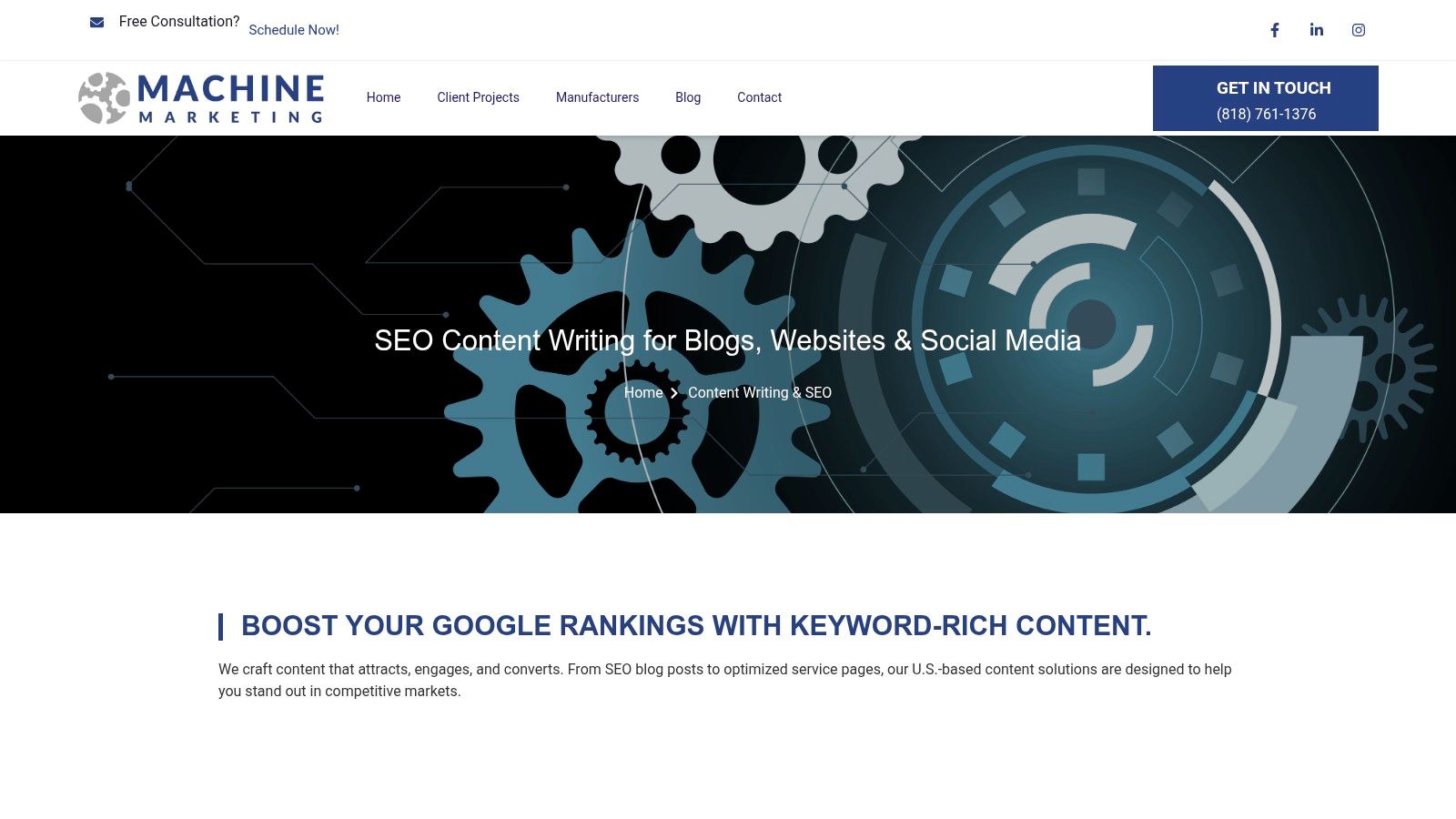
Most content programs fail before the first article gets written. The failure starts in diagnosis. Teams skip audience clarity, publish vague thought leadership, and hope traffic will turn into pipeline on its own.
That’s why our benchmark example starts with a system, not a campaign. Machine Marketing’s content writing and SEO service is built for companies that need content tied to buyer intent, search visibility, and lead handling from day one.
Why this works in B2B
For technical companies, generic content creates generic leads. An integrated system fixes that by connecting four things most companies keep separate: research, content production, on-site SEO, and CRM follow-up.
The work starts with structured onboarding and a 40-question Marketing Review. That matters because B2B content usually breaks when messaging is too broad, product language is too internal, or sales and marketing aren’t aligned on who the ideal buyer is. Once that diagnosis is done, content gets built around actual search intent and decision-stage questions.
That means the output isn’t just “more blogs.” It can include service pages, case studies, product descriptions, and educational articles that support search visibility and sales conversations at the same time.
Practical rule: If your content lives in the CMS but not in your CRM workflow, you don’t have a content system. You have a publishing habit.
What the integrated approach changes
This model is especially useful for manufacturers and industrial operators because the sale rarely happens on the first visit. Buyers research, compare, ask internal questions, and often return multiple times. Content has to do more than attract traffic. It has to support trust and next steps.
A strong setup usually includes:
- Audience-specific messaging: Content speaks to engineers, procurement contacts, operations leaders, or sales reps differently.
- Intent-led SEO: Pages are mapped to the searches buyers make when they’re evaluating problems, suppliers, and solutions.
- Lead capture inside the journey: Calls to action connect to forms, CRM pipelines, and follow-up sequences rather than ending at a generic contact page.
- A workable rollout plan: A 90-day roadmap reduces the risk of launching too much too early and gives the team room to validate what’s working.
The trade-off is that this isn’t a fast-content model. It needs access to your site, analytics, and CRM. It also needs timely client input. If approvals stall, technical access gets delayed, or subject matter experts stay unavailable, velocity drops.
That said, this structure is what makes the work useful. B2B content shouldn’t be optimized for speed alone. It should be optimized for accuracy, relevance, and conversion path fit.
Where this beats inspiration-only examples
A lot of examples of great content marketing show what a brand published, but not how the asset plugged into lead management. That’s a major gap in the market. There’s also a documented gap in transparent ROI and attribution frameworks in content marketing examples, especially for B2B operators evaluating budget allocation, as noted in this review of content marketing example gaps from KlientBoost.
That’s where a system-first model wins. It doesn’t rely on one breakout post. It builds a repeatable machine.
If you want a deeper view of how technical pages and educational assets should support search and conversion together, this guide on conversion-centric technical content SEO is the right companion piece.
2. Content Marketing Institute The Award Winner’s Gallery
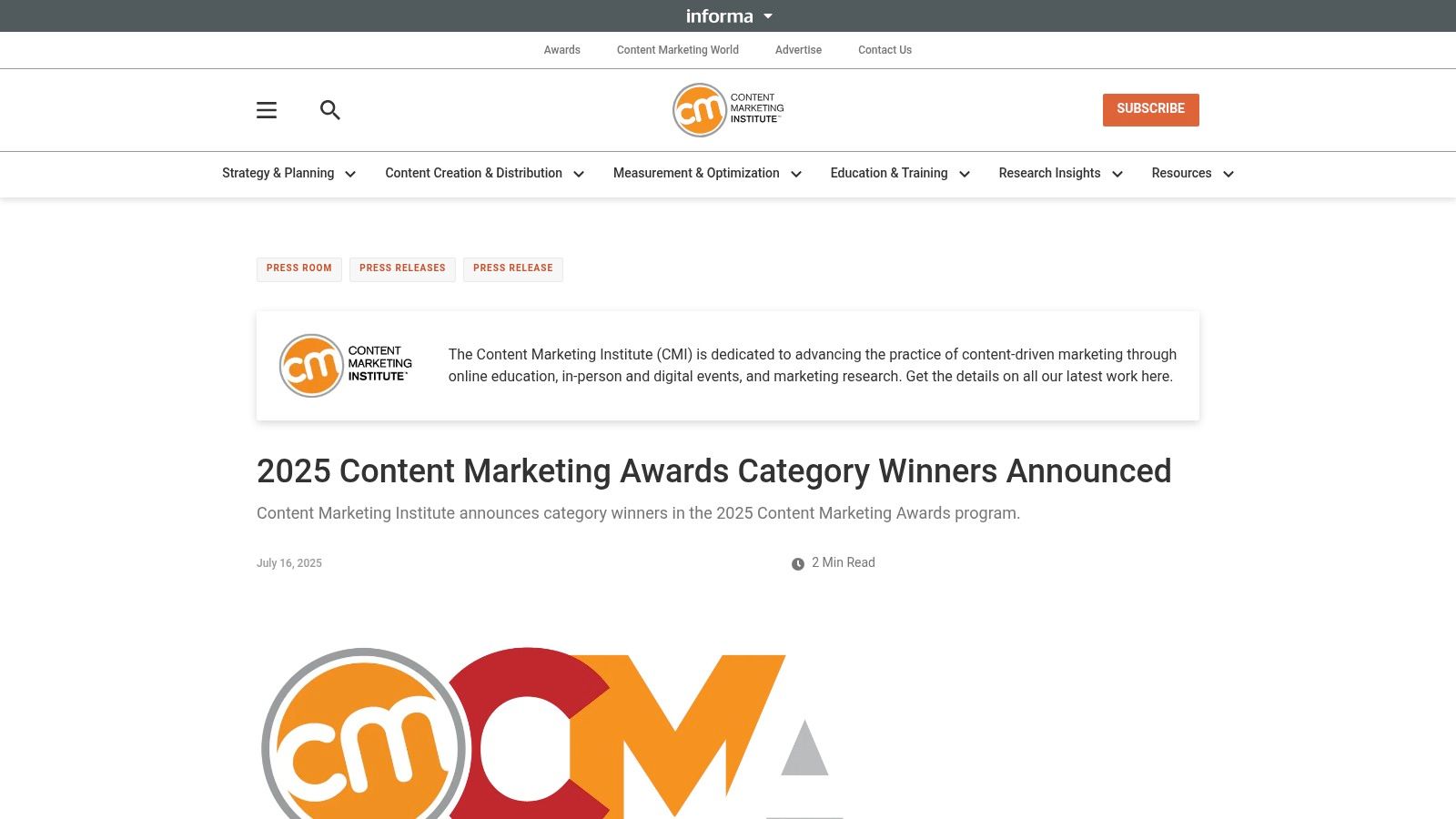
If your team needs a fast way to calibrate quality, Content Marketing Institute’s awards winners gallery is one of the better places to start. It filters out a lot of weak examples because the work is juried instead of casually curated.
That matters when you’re trying to benchmark standards. Not every “successful campaign” online is useful. Some are just loud.
What it’s good for
CMI is useful when your problem isn’t content creation. It’s content judgment.
You can use the gallery to assess:
- Format selection: Which brands are winning with video, editorial, design, or demand generation.
- Program maturity: What more established teams produce across channels, not just as one-off assets.
- Internal briefing: How to show leadership concrete examples of polished execution without building a deck from scratch.
This is a strong reference point if your team keeps asking, “What does good look like?”
Where it falls short
The shortcoming is depth. Award summaries usually show the polished result, not the full operating system underneath it. You’ll often see the concept, category, and broad approach, but not enough detail to replicate the execution directly.
That’s a common problem with award content. It’s good at showing excellence. It’s weaker at showing process.
Use award winners to set quality thresholds, not to copy tactics blindly. The prettier the example, the more carefully you should inspect whether it fits your budget, sales cycle, and team capacity.
For B2B and manufacturing teams, this matters even more. Enterprise creative standards can be inspiring, but if your buyers care more about proof, clarity, and technical authority than cinematic polish, then production quality alone won’t carry the result.
Still, CMI earns a place here because good examples of great content marketing should sharpen your standards. This gallery does that well.
3. Think with Google The Measurement First Case Study
Some content examples are strongest on creative. Think with Google case studies are strongest on measurement logic.
That distinction matters. If your team already produces decent content but can’t explain what role each asset plays in awareness, consideration, or conversion, you don’t have a content problem. You have a measurement problem.
Why operators should pay attention
Google’s case studies are useful because they show sequencing, channel pairing, and KPI thinking. Even when the examples live heavily inside Google and YouTube environments, the underlying lesson transfers well: content performs better when distribution and measurement are designed together.
For B2B teams, that usually means asking better questions before launch:
- Which asset introduces the problem clearly
- Which asset supports evaluation
- Which retargeting step moves someone toward a form fill or conversation
- Which metrics indicate attention versus buying intent
That’s where many content plans break. They treat all engagement signals as equal. They aren’t.
A practical B2B translation
This type of thinking lines up well with the Bloomreach campaign executed by Column Five Media. In that campaign, the team used geofencing, historical data analysis, and job title segmentation across digital, connected TV, programmatic, and podcast channels. The result was 13 million impressions, a $10 average CPM, 429,000 completed audio listens at $0.03 per listen, and 10% of the target account list moving from unaware to aware.
That example matters because it shows what measurement-first content looks like in practice. The value wasn’t just in making content. The value came from precise audience targeting, active optimization, and tracking movement through the funnel.
For manufacturers and other B2B operators, the takeaway is simple. Don’t ask content to “perform” in the abstract. Define the stage, define the audience, and define the action that signals progress.
4. HubSpot The Practical Inspiration Roundup
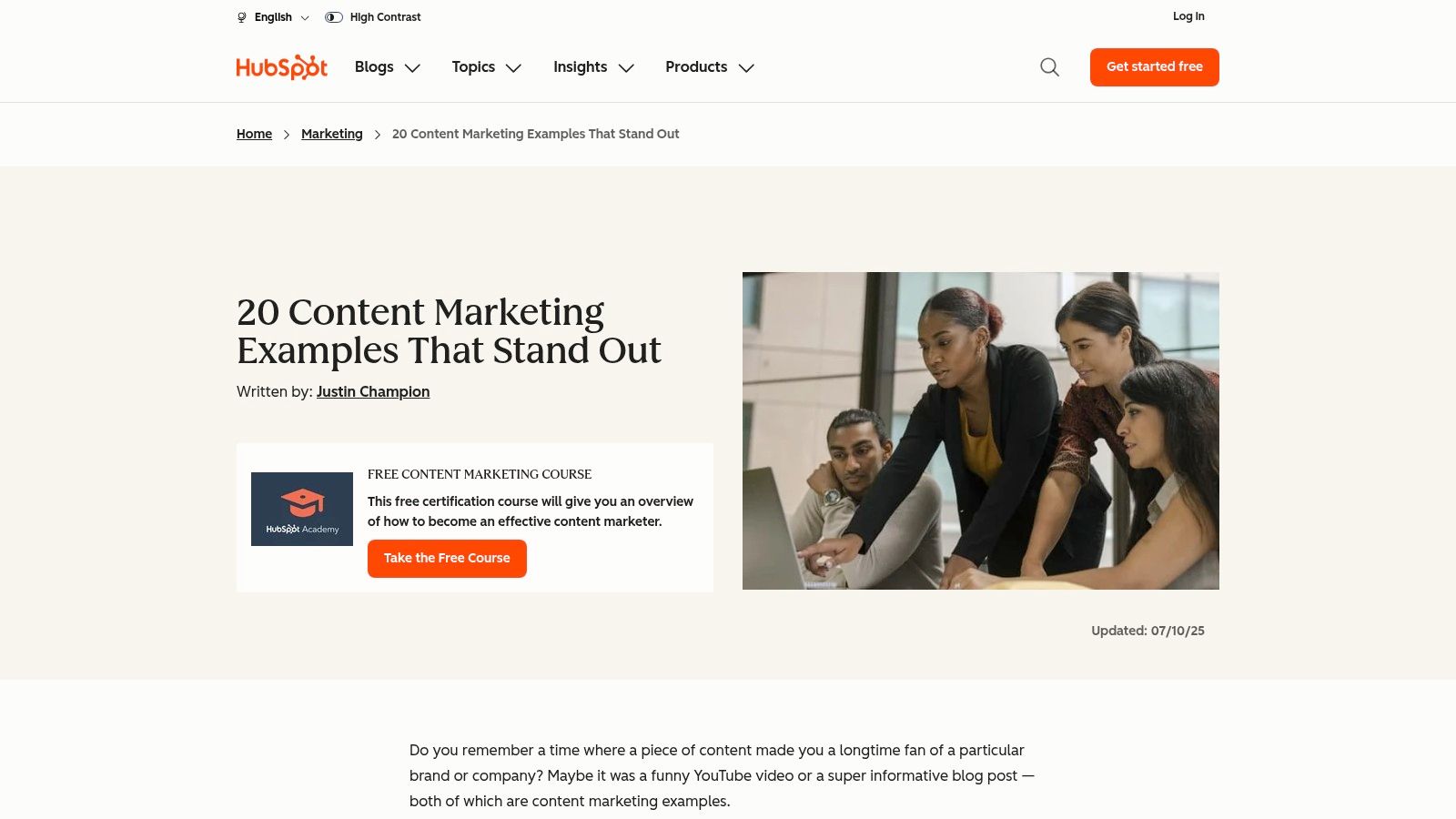
Not every team needs a deep case study library. Sometimes you need a resource that helps marketing, sales, and leadership agree on content directions quickly. That’s where HubSpot’s roundup of marketing examples and online resources is useful.
Its strength is accessibility. The examples are easy to scan, easy to explain, and usually connected to practical how-to content.
Best use case
This is a strong option when your internal challenge is alignment.
If a marketing manager understands content strategy but the owner, operations lead, or sales team doesn’t, HubSpot gives you a common language. The examples are broad enough to spark ideas across formats such as blogs, newsletters, interactive content, and branded resources.
That makes it helpful for:
- Workshop prep: Pull a few examples to discuss what your brand should and shouldn’t emulate.
- Cross-functional buy-in: Show non-marketers what “helpful content” looks like in plain English.
- Early planning: Use examples as prompts for content themes, not as final strategy.
The trade-off you need to manage
The downside is that these roundups often favor recognizable brands and easy-to-like ideas. That makes them digestible, but it also means they can push teams toward surface-level inspiration.
In B2B, inspiration without implementation details creates drift. Teams start saying “we should do something like that” without answering the operational questions that matter. Who owns it? What search intent does it target? Where does the lead go? What does sales do next?
That’s why we treat HubSpot as a spark, not a blueprint.
If you need a framework for turning inspiration into publishable, conversion-aware execution, our guide to content marketing best practices will help tighten that gap.
Good inspiration broadens your options. Good strategy narrows them to what your team can actually execute well.
5. Ahrefs The SEO Driven Asset Playbook
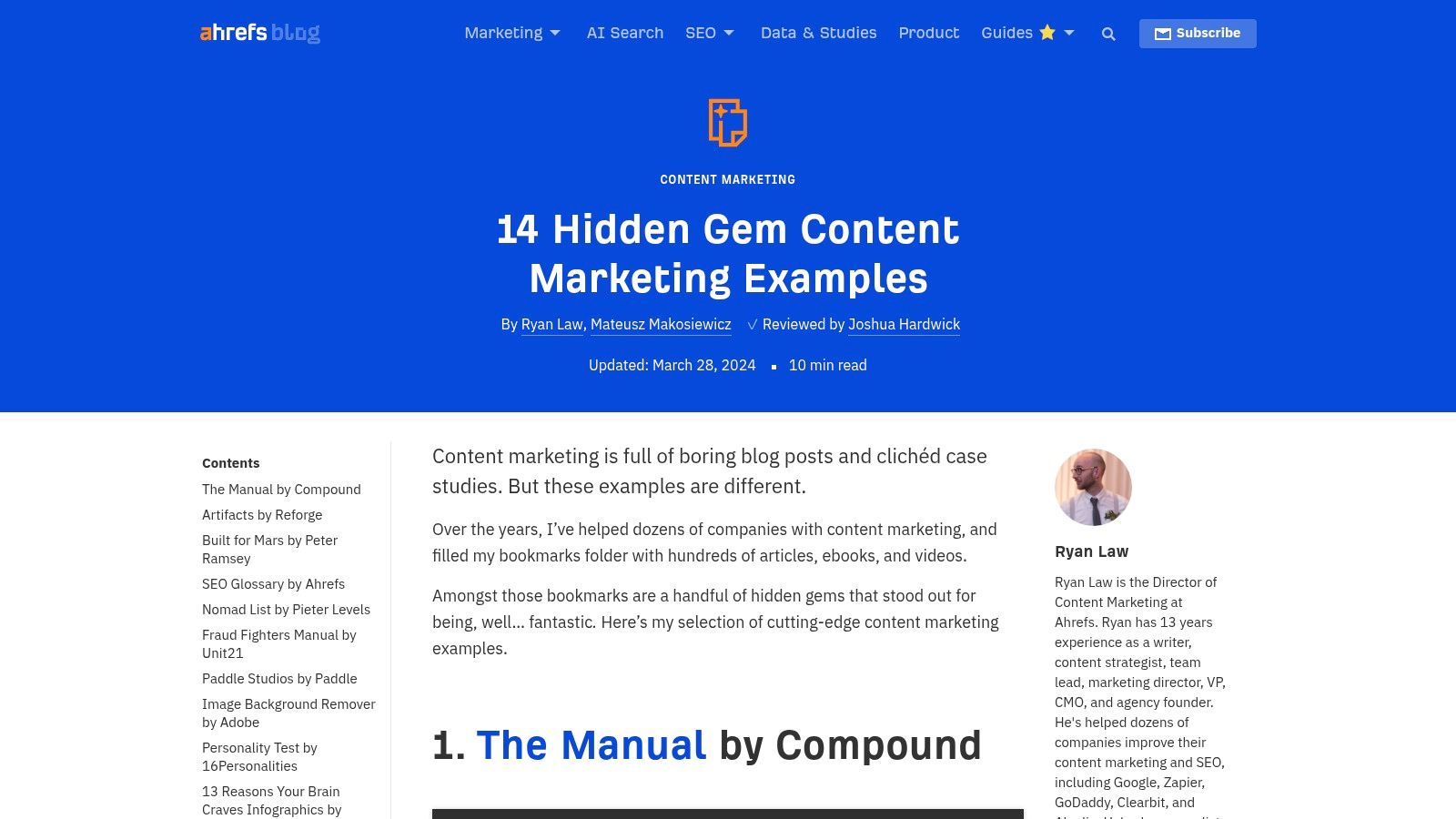
If your main goal is compounding organic value, Ahrefs’ content marketing examples are more useful than many trend-heavy roundups. The framing tends to stay closer to problem-solution fit, search potential, and asset durability.
That’s a better lens for B2B teams that need content to keep earning attention over time.
Why this approach works
A lot of content gets produced for launch-day excitement. Ahrefs tends to highlight assets that can continue attracting links, rankings, and qualified traffic after the initial push.
That includes formats B2B teams can use:
- Comparison pages
- Data-backed resources
- Stat pages
- Evergreen educational guides
- Tools and calculators when the use case is strong enough
This is especially relevant because there’s a documented gap in B2B-specific content marketing case studies. Existing examples skew heavily toward consumer brands, while manufacturers and technical service providers are underrepresented, as noted in this review from Podium.
So when a practitioner-oriented source emphasizes durable SEO assets instead of flashy brand moments, that has real value.
Where teams misuse this model
The mistake is reducing the lesson to “write SEO content.” That’s too shallow.
SEO-driven assets only work when the topic maps to an actual buyer problem and the page satisfies the intent better than what’s already ranking. Publishing keyword-led filler won’t create authority. It just increases your content inventory.
Engineering discipline helps. Before building the asset, pressure-test the query.
Ask:
- Does the keyword reflect a real buying-stage question
- Can your team add expertise the current results don’t
- Will the page naturally lead to a commercial next step
- Can sales use the asset in conversations after it ranks
Ahrefs is strongest when you use it that way. Not as a license to produce more content, but as a reminder to build fewer, stronger assets with staying power.
6. Contently The Enterprise ROI Case Study
When leadership asks whether content is worth the investment, creative examples won’t close the gap. Operational examples will. That’s where Contently’s client case studies are useful.
The platform tends to frame content as a business system involving governance, workflows, editorial operations, and measurable outcomes. That’s closer to how executives evaluate investment.
What this shows better than most libraries
Contently is useful when your bottleneck is internal credibility. Maybe the marketing team believes in content, but finance or leadership sees it as soft, hard to measure, or too long-term to prioritize.
Enterprise-style case studies help because they connect content to:
- Clear goals
- Process and operating structure
- Distribution choices
- Business outcomes
That operations layer matters. Strong content programs don’t just need ideas. They need ownership, review standards, publishing discipline, and measurement definitions that hold up under scrutiny.
Where the caution belongs
The main caution is fit. Enterprise case studies often assume larger teams, formal editorial processes, and more specialized staffing than a small or midsize business has available.
That doesn’t make them irrelevant. It means you should borrow the logic, not the org chart.
If leadership doesn’t trust content, don’t lead with creativity. Lead with process, attribution, and decision-stage usefulness.
For smaller B2B firms, the practical move is to simplify the same principles. Define your content roles, your approval path, your CRM handoff, and your reporting cadence. That will do more for ROI than publishing at a higher volume.
If you need help structuring the reporting side, our guide on how to measure marketing ROI gives a more grounded starting point.
7. MarketingSherpa The B2B Tactical Archive
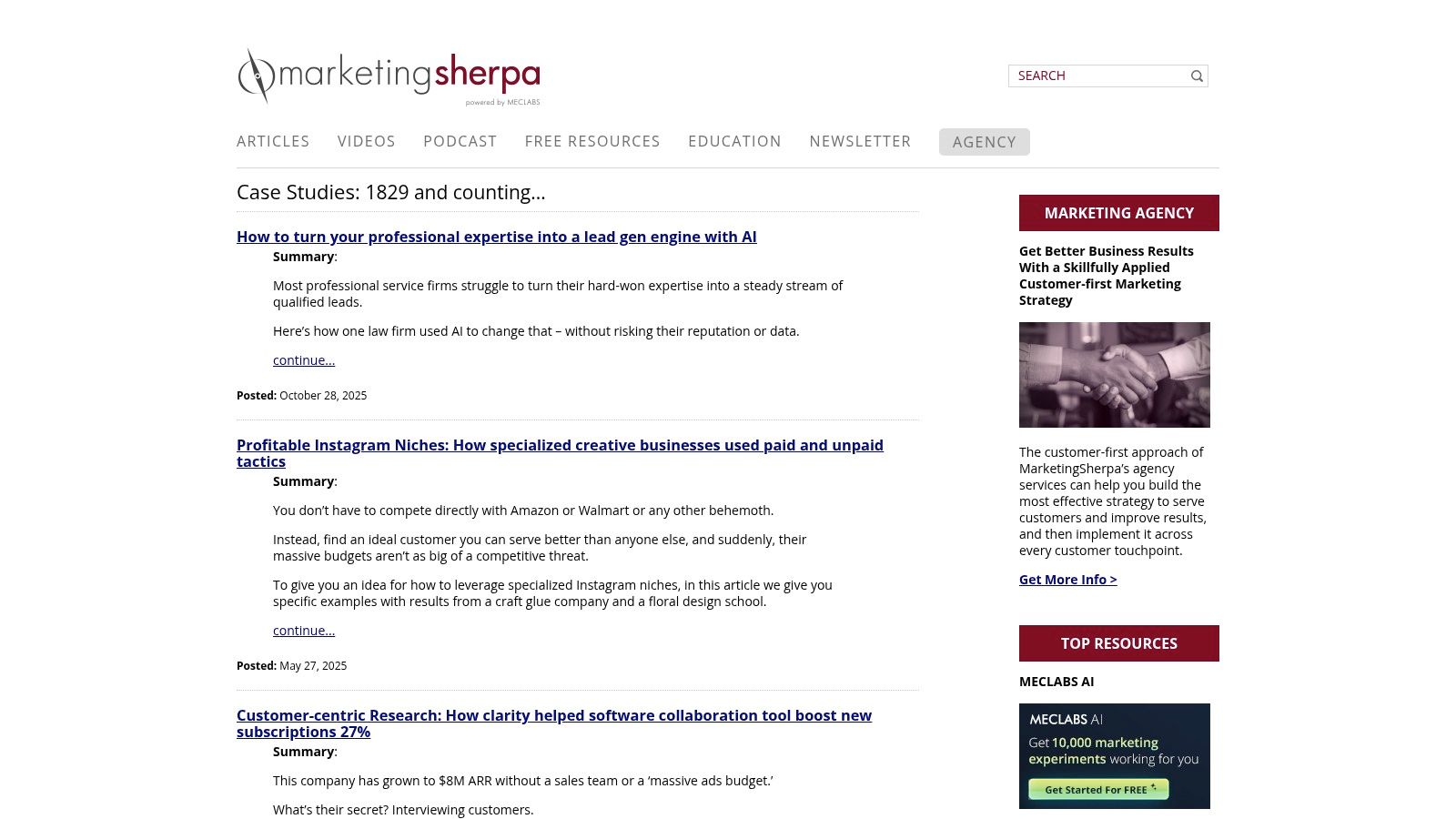
A marketing team at a B2B manufacturer usually does not need another polished brand film to study. It needs to know why a landing page converted, how an email sequence was structured, what changed in the offer, and where sales follow-up helped or hurt the result. That is why MarketingSherpa’s case studies archive earns a place on this list.
Its value is not visual flair. Its value is usable detail.
MarketingSherpa has been publishing case studies for years across lead generation, email, landing pages, PR, and content. For technical businesses, that breadth matters because content performance is rarely driven by the article or asset alone. Results usually come from the system around it: the CTA, the form, the handoff, the nurture logic, and the sales response time.
Why it works for B2B teams that need a blueprint
This archive is useful if your goal is reverse-engineering. Instead of admiring a campaign from a distance, you can study the operating choices behind it and adapt them to a sales-assisted funnel.
The recurring lessons tend to show up in a few places:
- Offer design
- Landing page structure
- Email sequence logic
- Testing choices
- Channel combinations tied to lead generation
That makes the archive more practical for B2B and manufacturing firms than inspiration-heavy content roundups. The useful question is not whether a campaign looked impressive. The useful question is whether you can trace the path from message to conversion.
The trade-off to accept
Some entries are dated. Some are plain. Neither issue reduces their value if you are evaluating mechanism instead of aesthetics.
I usually treat older B2B case studies the way engineers treat proven process documentation. The interface may look old, but the underlying logic can still be sound. A headline test, a shorter form, a stronger offer, or a better timed nurture sequence can remain relevant long after the design style changes.
That matters for companies using platforms like GHL. A MarketingSherpa example can often be translated directly into execution steps: build the landing page variant, map the follow-up sequence, tag the lead source, route high-intent submissions to sales, and measure contact-to-opportunity rate by campaign. That is the shift from inspiration to implementation.
MarketingSherpa belongs on this list because it stays close to the mechanics of B2B performance. For industrial and technical marketers, that usually makes it more useful than flashier examples.
7 Content Marketing Examples Compared
| Example | 🔄 Implementation Complexity | ⚡ Resource Requirements | 📊 Expected Outcomes | 💡 Ideal Use Cases | ⭐ Key Advantages |
|---|---|---|---|---|---|
| Machine Marketing: The Integrated Content & SEO System | Moderate–High, structured onboarding, 90‑day roadmap and integrations | Requires content production, SEO work, CRM/site access and ongoing collaboration | Improved organic visibility, qualified leads, CRM‑linked funnels | B2B manufacturers and industrial operators needing end‑to‑end SEO → revenue alignment | Strategy‑first, end‑to‑end execution, measurable POC and iterative optimization |
| Content Marketing Institute: The Award‑Winner's Gallery | Low to consume; replicating winners can be complex | Minimal to browse; replicating award‑level work often needs mid/enterprise budgets | Inspiration and benchmarking; directional best‑practice signals rather than direct ROI | Teams benchmarking creative scope and team structures, trend spotting | Curated, juried high‑quality examples across categories |
| Think with Google: The Measurement‑First Case Study | Low to read; medium to implement measurement‑centric approaches | Requires Google ad/measurement tools and media budget for replication | Measurable lifts (ad recall, reach, ROAS) and clear distribution playbooks | Media planners and teams focused on paid distribution and sequencing | Measurement‑first case studies with actionable sequencing and media pairing |
| HubSpot: The Practical Inspiration Roundup | Low, digestible examples with deconstructions | Minimal to use; links to playbooks reduce build time | Practical, tactical ideas and direct next steps (not always hard metrics) | Cross‑functional briefings, small teams needing quick briefs and playbooks | Clear deconstructions tied to tactical HubSpot resources |
| Ahrefs: The SEO‑Driven Asset Playbook | Medium, tactical replication requires SEO expertise | Requires SEO tools, content creation resources and link‑building effort | Long‑term organic traffic and compound returns from assets | Operators building SEO‑first assets (reports, tools, stat pages) to earn links | Practitioner‑led, SEO‑centric examples that emphasize replicable, high‑ROI assets |
| Contently: The Enterprise ROI Case Study | Medium–High, enterprise program complexity and governance details | Enterprise budgets, editorial operations, and governance/staffing | Demonstrable ROI and executive‑level metrics for content programs | Large brands proving content ROI and designing editorial systems | Enterprise‑grade case studies focused on operations and measurable outcomes |
| MarketingSherpa: The B2B Tactical Archive | Low to moderate, tactics‑first, step‑by‑step case studies | Varies; many free case studies but some paywalled reports | Concrete numbers and channel breakdowns with practical steps | B2B/manufacturing teams seeking tactics with before/after data | Tactics‑first storytelling with concrete metrics and actionable steps |
Turn Inspiration Into Your Next Profitable Campaign
A manufacturing team spends six months publishing articles, sees traffic inch up, and still gets the same complaint from sales: none of it turns into qualified pipeline. The problem usually is not effort. It is system design.
The examples in this list point to a better way to build content. Use them as patterns you can reverse-engineer. For B2B and manufacturing companies, that means choosing one proven content motion, tying it to a buyer stage, and connecting it to capture, routing, follow-up, and reporting inside GHL or your existing CRM.
Strong content programs do three things well. They answer a real buying question. They package that answer in a format the buyer will use. They create a measurable next step, whether that is a form fill, a booked call, a spec request, or a sales conversation.
That is why inspiration alone has low value. Diagnosis has high value.
Some teams need sharper positioning because their content is technically correct and commercially weak. Others need better content architecture because they have good topics scattered across disconnected blog posts, PDFs, and landing pages. In many B2B programs, the primary bottleneck sits after the click: no clear CTA, weak forms, no lead scoring, no routing logic, and no follow-up sequence. Publishing more into that setup usually creates more waste, not more revenue.
Well-known campaigns still matter, but only if you extract the operating lesson. Dollar Shave Club's launch video is a good example. It worked because the message, audience, offer, and distribution fit together tightly. B2B firms rarely need a viral moment. They need a repeatable system with occasional standout assets that support pipeline targets.
Start with five questions:
- Which buyer question can we answer better than competitors?
- Which format matches that question best?
- Where does this asset sit in the buying process?
- How will we capture, route, and follow up with responses?
- Which metric proves the asset is producing business value?
Those questions turn a list of examples into an execution plan.
For a manufacturer using GHL, the integration steps are straightforward. Build one campaign around a high-intent topic such as pricing, lead times, certification requirements, or process comparisons. Create the asset, publish it on a page built to convert, attach a form with source tracking, route submissions by product line or territory, and trigger a short follow-up sequence that gives sales context instead of sending a cold notification. Measure first-response time, meeting rate, and opportunity creation, not just pageviews.
Consistency still matters, but only after the model works. A weak content system published every week stays weak every week. A focused system compounds because each asset feeds search visibility, retargeting audiences, sales enablement, and CRM data quality.
If you want a different angle for inspiration, this roundup of 10 Ecommerce Content Marketing Examples is worth browsing. Then return to your own numbers, your own funnel, and your own constraints.
Choose one takeaway from this list and ship it in the next 90 days. If you want help diagnosing the gaps before you build, book a discovery call with Karl. We use a 40-Question Marketing Review to identify the constraint, prioritize the right content motion, and map a plan that supports sustainable growth.
If you want content that attracts qualified leads instead of just filling a blog feed, talk to Machine Marketing. We help manufacturers, B2B operators, and growing service businesses build practical marketing systems that connect SEO, content, CRM workflows, and follow-up into one revenue-focused process.