If you're selling into multinational customers, you've probably already felt the friction. One regional buyer asks for a pricing concession that another region never approved. Service commitments vary by country. Marketing speaks to one division, while sales is negotiating with another. The customer sees one brand. Internally, you still operate like separate islands.
That's where global account management becomes more than a sales concept. It becomes an operating system for keeping your most important accounts coordinated across countries, plants, distributors, business units, and service teams. For B2B manufacturers, especially small and midsize firms trying to scale without adding chaos, that matters.
The catch is simple. Global account management can create stronger retention, cleaner expansion opportunities, and more consistent customer experience. It can also become an expensive layer of meetings, politics, and CRM clutter if you implement it badly. The difference usually isn't intent. It's design.
The Global Account Management Double-Edged Sword
A common failure pattern looks like this. Your team wins business with a customer in one region. Another region opens up, and everyone assumes the relationship will transfer cleanly. It doesn't. Local teams negotiate their own terms, account ownership gets fuzzy, and the customer starts hearing different answers depending on which office they contact.
That isn't a small operational annoyance. It directly affects trust.
Global account management exists to solve that exact problem. This approach treats a multinational customer as one strategic account with coordinated planning, aligned pricing logic, shared visibility, and a clear owner for the relationship. The promise is compelling. The execution is where most companies struggle.
A landmark Harvard Business Review study found that only about one-third of companies with Global Account Management programs were satisfied with the results (Harvard Business Review on managing global accounts). That's the number every manufacturer should keep in mind before launching a program with big ambitions and fuzzy rules.
Most GAM failures don't come from lack of effort. They come from unresolved conflict between local autonomy and global consistency.
The lesson isn't that GAM doesn't work. The lesson is that it doesn't tolerate loose design. If you add a global account title without changing governance, incentives, systems, and decision rights, you create one more layer of confusion.
For SMB manufacturers, many guides are unhelpful. They assume enterprise headcount, enterprise budgets, and enterprise patience. Most smaller firms don't have any of those. You need a version of global account management that is selective, practical, and testable.
That means starting with a narrow scope, one accountable leader, visible workflows, and a short proof-of-concept instead of a company-wide reorganization. Done that way, GAM becomes manageable. Done the other way, it turns into a diplomatic exercise that your customer never asked for.
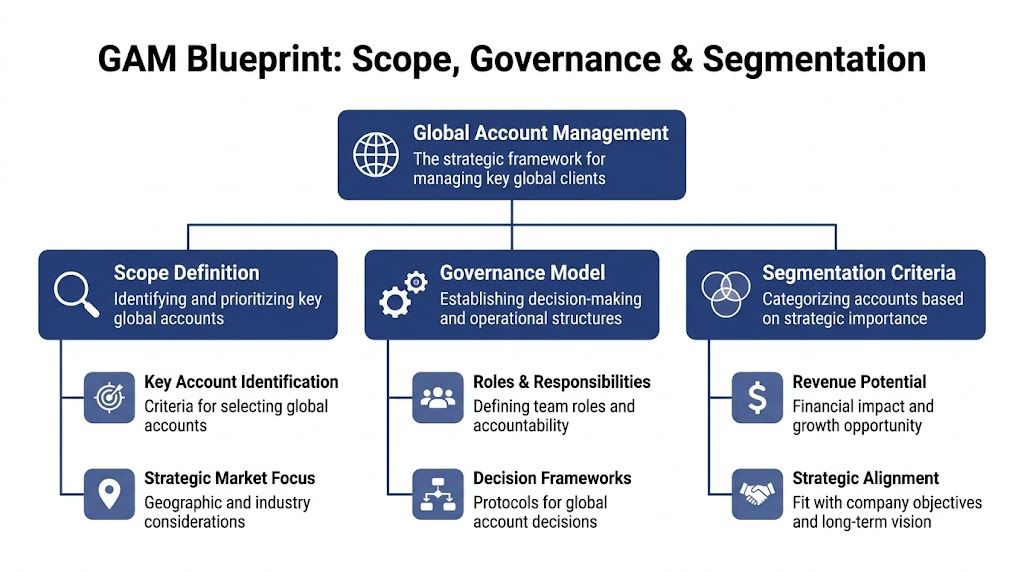
Designing Your GAM Blueprint Scope Governance and Segmentation
Before you assign a global account manager, you need to decide what a global account means inside your business. Many firms skip this step and treat any large customer with multiple locations as automatically "global." That's too loose.
A better approach is to define the account by operating complexity and strategic importance. If a customer buys in several regions, has overlapping stakeholders, expects some level of consistency across sites, and could justify coordinated planning, that account belongs on the shortlist.
Start with a practical definition
Your definition should be specific enough that your team can sort accounts quickly. For most manufacturers, a candidate global account usually has some mix of these conditions:
- Multi-region buying behavior: The customer purchases, sources, or services equipment across more than one country or region.
- Shared decision-makers: Procurement, engineering, operations, or executive stakeholders influence buying across sites.
- Cross-border risk: One region's decisions can affect pricing, service terms, forecasting, or brand perception elsewhere.
- Strategic upside: A more coordinated relationship could improve retention, expansion, or margin quality.
Companies often make their first bad call by choosing accounts only by top-line revenue. That's understandable, but incomplete. While 77% of companies select strategic accounts based on revenue, the top 10% of performers are more likely to use profit-focused criteria (Global Partners Training on SAM plan statistics).
That distinction matters. A customer can be large and still be a poor fit for a global program if they drain support resources, demand local exceptions, or create margin erosion.
Ask these questions before you segment
Use these questions in a working session with sales, operations, finance, and service. Keep it blunt.
- Where is the complexity? Are multiple regions already touching this account in ways that create handoff problems?
- Where is the strategic advantage? Would a coordinated plan create cleaner expansion into sister plants, divisions, or geographies?
- Where is the profit? Does the account justify investment after support load, customization, payment friction, and service burden?
- Where is the executive relevance? Does the relationship connect to markets, products, or verticals you want to grow?
- Where is the operational strain? Does this account expose recurring internal conflicts that need governance, not heroics?
If your team wants a useful mental model for account selection and coordinated growth, this overview of Account Based Marketing (ABM) is worth reading because it reinforces the same principle. Focus beats volume when the target account is strategically important.
Build a shortlist instead of a giant program
Most SMB manufacturers should start with a very small list. Not because ambition is bad, but because governance is fragile until it's tested.
A simple segmentation model works well:
| Segment | What it means | Action |
|---|---|---|
| Global now | Already active across regions with visible coordination problems or expansion opportunities | Put into pilot consideration |
| Regional with global potential | Strong account in one region with realistic path to broader footprint | Monitor and develop |
| Large but local | Big revenue, limited cross-border complexity | Keep in key account program, not GAM |
| Strategic watchlist | Smaller today but aligned with long-term market direction | Review quarterly |
This also helps marketing stay focused. If you want a practical view of how account selection ties into campaign execution, this guide to account based marketing for B2B is a useful companion to the segmentation work.
Set governance before the first customer meeting
Scope without governance creates arguments later. You need written rules for who decides what.
At minimum, define:
- Account ownership: Who is the single global lead?
- Regional authority: What can local teams decide without escalation?
- Pricing boundaries: Which terms must stay aligned and which can vary locally?
- Service promises: Who approves non-standard commitments?
- Escalation path: What happens when regional goals conflict?
Practical rule: If two teams can both say yes to the customer, neither team really owns the account.
A lightweight governance charter is enough at the start. One page often does the job better than a slide deck. The point is clarity, not ceremony.
What good scope looks like
Good scope is selective. It protects team attention. It keeps your first version of GAM from turning into a broad initiative with no discipline.
If you can't explain in one sentence why an account belongs in the program, leave it out for now. Global account management works best when the first few accounts teach you how to run the system. They shouldn't become a dumping ground for every large customer that happens to buy in more than one place.
Structuring Your Global Account Team for Success
Most GAM programs don't break because nobody cares. They break because the org chart says "global" while compensation, authority, and reporting lines still reward local behavior.

The hard truth is this. If your global account lead has responsibility without authority, you've created a coordinator, not a manager. The customer will notice the difference quickly.
A strong GAM structure usually fits one of two patterns for manufacturers:
One leader with a matrix team
This is often the best fit for SMBs. One Global Account Manager owns the relationship strategy, account plan, internal coordination, and executive communication. Regional sales, service, operations, and marketing support that lead through a matrix model.
This works when the global lead can convene people, resolve conflicts, and escalate decisions. It fails when local managers treat the role as advisory only.
Distributed regional leads with one control point
This is more common when a manufacturer already has strong regional business units. Local account owners stay close to day-to-day activity, but one central leader controls the master account plan, common messaging, and customer-facing alignment.
Use this model only if your account planning discipline is already solid. Otherwise, it becomes a polite way to preserve fragmentation.
Why commission structure often sabotages GAM
Traditional sales incentives push the wrong behavior for global accounts. Local teams protect "their" revenue. They resist handoffs. They avoid collaboration that could reduce their short-term credit, even when it's better for the customer.
That isn't just anecdotal. Misalignments in compensation and organizational structure are a primary driver of failure in GAM programs, contributing to failure rates as high as 70% (Columbia Business School publication on GAM misalignment).
If your global account manager reports into a hierarchy built around quarterly wins, don't expect patient relationship building, disciplined stakeholder mapping, or coordinated expansion planning. The incentives point the other way.
The account manager can't think long term if every surrounding metric is screaming for local short-term extraction.
A more workable compensation approach
You don't need an elaborate enterprise comp scheme. You do need one that stops punishing collaboration.
A practical hybrid model usually includes:
- Core revenue accountability: Keep a direct connection to commercial outcomes so the role doesn't drift into pure coordination.
- Shared account goals: Tie part of variable pay to account-wide progress, not just local bookings.
- Relationship and execution measures: Reward plan completion, cross-region opportunity development, stakeholder coverage, and issue resolution.
- Team-based triggers: Give key supporting functions a reason to participate when the account requires cross-functional effort.
You don't have to over-engineer it. The point is to reward behavior that builds an integrated account, not behavior that strips value from one region at a time.
A short perspective on team dynamics and account leadership is useful here:
What to look for in the person leading GAM
The best GAM lead is rarely just your top closer. This role needs range.
Look for someone who can:
- Address internal friction: They need enough credibility to challenge regional assumptions.
- Translate commercial and operational concerns: Customers don't care about your internal divide between sales and service.
- Run disciplined planning: A messy planner will create a messy account.
- Handle executive conversations: Global accounts often require C-level trust on both sides.
- Stay calm under ambiguity: Global relationships generate edge cases. Someone has to make them manageable.
If your current structure doesn't allow that person to lead across functions, fix the structure first. A title won't compensate for weak authority.
The Engine Room CRM Automation and Sales Marketing Alignment
A global account program without a shared system becomes a memory contest. People rely on inboxes, local spreadsheets, and personal relationships to hold the account together. That may work for a while. It won't scale.
Your CRM has to become the single operating record for the account. For many SMB manufacturers, a platform like GoHighLevel can support that role if you configure it around account visibility instead of basic lead tracking.

Build the account around one parent record
Don't treat each site or country as a completely separate customer if the buying relationship is connected. Create a parent account structure, then map child entities underneath it.
Your CRM setup should include custom fields such as:
- Global parent account
- Region or country
- Business unit or plant
- Primary stakeholder role
- Service level or support tier
- Product family
- Strategic priority
- Current expansion opportunity
- Escalation owner
This sounds basic, but it's what allows one person to open the account and understand what's happening in Germany, the US, and Asia without chasing five departments for updates.
Automate handoffs before they become excuses
Most GAM friction shows up in transitions. Marketing generates interest in one region. Sales picks it up late. Service learns about a commitment after it's sold. Finance finds out about a pricing exception after the quote is accepted.
A better setup uses automation to make those handoffs explicit.
For example:
- Marketing captures account-level engagement from a target division or region.
- CRM workflow routes the activity to the global account lead and the relevant regional owner.
- Task creation triggers follow-up with due dates based on region and account tier.
- Internal notification alerts service or technical staff if the inquiry touches installed equipment, support history, or compliance concerns.
- The account dashboard updates so everyone sees movement without needing a meeting.
That kind of workflow is more valuable than a large pile of dashboards nobody checks.
Give sales and marketing the same view of the account
Marketing shouldn't run campaigns in a vacuum. In a strong global account management system, marketing works from account intelligence collected by sales, service, and account leadership.
That means building shared views around questions like:
- Which plants or divisions are engaged but not yet in pipeline?
- Which stakeholders have gone quiet?
- Which product lines generate recurring support friction?
- Which regions are asking similar technical questions?
- Which installed-base signals suggest expansion potential?
If you're evaluating data inputs that improve contact quality and account visibility, this overview of lead qualification and CRM enrichment is a useful reference point. It aligns with the broader goal of making the CRM more actionable, not just more populated.
For teams still sorting out platform selection, this guide on how to choose a CRM system helps frame the practical trade-offs between flexibility, adoption, and workflow fit.
Use AI selectively, not theatrically
There's a lot of noise around AI in B2B systems. In GAM, the useful application is straightforward. Use it where it helps you anticipate account risk, signal expansion opportunities, and surface patterns humans miss across regions.
That matters because only 15% of suppliers have adopted AI-driven predictive analytics, yet it has been shown to reduce customer churn by up to 25% in the manufacturing sector (The KAM Coach on global account management challenges).
That doesn't mean you need a giant AI project. Start with small use cases:
- Engagement scoring: Flag declines in account activity across key stakeholders.
- Risk alerts: Surface repeated service issues or stalled opportunity stages.
- Cross-sell prompts: Identify product families present in one region but absent in another.
- Summary support: Help account leaders prepare for reviews with cleaner account snapshots.
Operational advice: If AI can't help your team decide what to do next, it's a demo, not a system.
The dashboard that matters
Teams often build too many reports. Global accounts need a compact dashboard that answers a few critical questions fast.
A useful GAM dashboard should show:
| Dashboard view | Why it matters |
|---|---|
| Open opportunities by region | Reveals where the account is active or stalled |
| Stakeholder coverage | Shows whether the relationship is broad or fragile |
| Recent service issues | Prevents commercial activity from ignoring operational pain |
| Pipeline stage consistency | Helps compare progress across regions |
| Escalations and exceptions | Exposes where governance is failing |
| Marketing engagement by division | Connects campaigns to account development |
Keep it simple enough that your team uses it. The best CRM design in global account management is the one your sales lead, service manager, and marketer all trust enough to work from daily.
Building and Executing Your Global Account Playbook
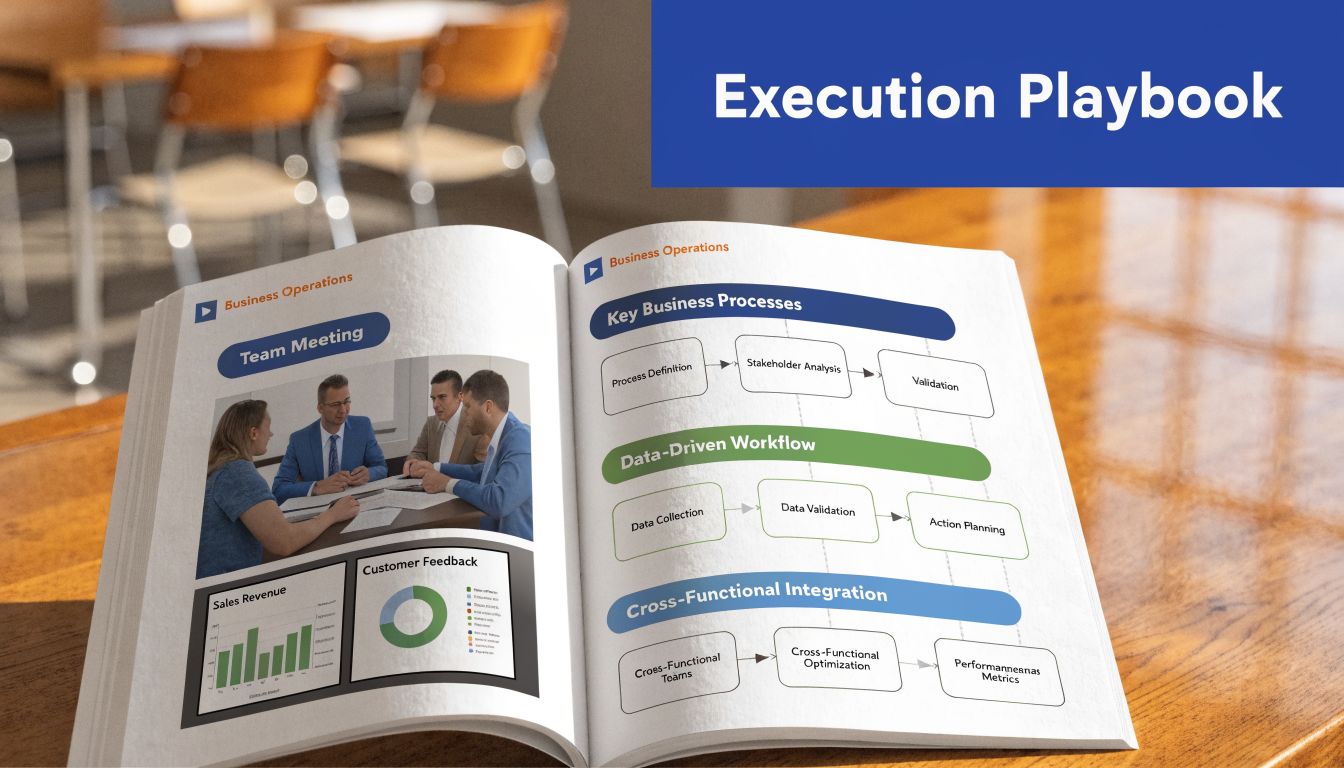
A GAM program needs a playbook because global accounts generate repeat situations. Pricing conflicts. Duplicate outreach. Escalations across time zones. New plant openings. Executive review requests. If each issue gets handled from scratch, consistency disappears.
Your playbook should operate like an SOP for the account team. Not a glossy document. A working guide that tells people how to communicate, review progress, escalate issues, and maintain one shared account plan.
Communication cadence that doesn't create noise
For a manufacturer selling machine parts to a customer with plants in multiple countries, a practical cadence might look like this:
- Weekly internal account huddle: Global lead, regional sales owners, service, and operations review open issues, opportunities, and handoffs.
- Monthly account sync: Customer-facing check-in with core stakeholders to review active priorities and unresolved problems.
- Quarterly business review: Broader strategic meeting with decision-makers, including commercial, service, supply, and growth topics.
- Executive touchpoints as needed: Triggered by major expansion, escalation, or strategic planning windows.
The point isn't meeting frequency. It's role clarity. Everyone should know which forum solves which type of issue.
A QBR agenda that earns the customer's time
Quarterly business reviews often fail because suppliers use them as retrospective sales presentations. A strong GAM QBR is different. It helps the customer make decisions.
Use a simple agenda:
Account snapshot
What changed across regions, plants, or business units since the last review?Operational review
Where did delivery, support, quality, or communication create friction?Commercial review
Which active opportunities, renewals, or expansion conversations need cross-region alignment?Strategic priorities
What is the customer trying to standardize, improve, reduce, or launch?Actions and owners
What gets done next, by whom, and by when?
A good QBR leaves the customer clearer on next actions. A bad one leaves them with your slide deck.
The core sections of a usable account plan
Each global account should have one current account plan. Not separate regional plans pretending to align.
A strong plan includes:
- Account structure: Parent company, divisions, regions, plants, and reporting relationships.
- Stakeholder map: Commercial, technical, operational, and executive contacts.
- Strategic objectives: What the customer appears to be optimizing globally.
- Current footprint: Products, services, installed base, contracts, and support dependencies.
- Growth map: Cross-sell, upsell, standardization, and new-site opportunities.
- Risk log: Service issues, pricing inconsistencies, competitor presence, or political blockers.
- Action plan: Named owners, deadlines, and escalation triggers.
For a machine parts manufacturer, this could mean one account plan that tracks where the customer already uses your components, which plants have recurring maintenance issues, and where standardization could simplify procurement.
Escalation paths save relationships
Global accounts don't need fewer disagreements. They need faster resolution.
Write down three escalation categories:
| Escalation type | Example | Owner |
|---|---|---|
| Commercial conflict | One region undercuts another on pricing | Global account lead with finance support |
| Service conflict | Local team can't meet a commitment sold elsewhere | Service leader and account lead |
| Strategic conflict | Regions disagree on account priority or investment | Senior leadership sponsor |
Disciplined GAM starts paying off. A customer shouldn't have to mediate your internal disputes.
Microsoft's example is useful here because it shows what coordinated execution can look like in practice. Microsoft's Global Account Management service has delivered over a 20% increase in customer satisfaction rates by using dedicated managers and cohesive strategies across regions (US Cloud on Microsoft's global account management).
You may not run Microsoft's model, but the principle transfers directly. Dedicated ownership plus consistent cross-region coordination improves the customer experience. That's what your playbook is there to operationalize.
Launch and Measure Your 90-Day Proof of Concept
Don't launch global account management across your whole customer base. Pilot it. A focused 90-day proof of concept gives you enough time to test governance, workflows, and team behavior without committing to a full redesign.
Choose one or two accounts only. They should be important enough to matter and contained enough to manage.
Pick the right pilot accounts
Good pilot accounts usually have three traits:
- Visible complexity: There are already cross-region touchpoints or coordination issues.
- Reachable stakeholders: You can engage the right internal and customer contacts during the pilot.
- Reasonable stability: Avoid an account in the middle of a major contract dispute or severe operational crisis.
Your goal isn't to pick the hardest account in the company. It's to pick one that can teach you how the system performs under real conditions.
Month one foundation and alignment
The first month is about diagnosis and setup. Slow down here. Most pilot failures begin with rushing past definitions.
Focus on these activities:
- Confirm account scope: Finalize which regions, products, sites, and teams are inside the pilot.
- Assign the global lead: One person owns the pilot and controls the master account plan.
- Map stakeholders: List customer contacts and internal contributors by region and function.
- Write governance rules: Clarify account ownership, approval boundaries, and escalation routes.
- Set up CRM structure: Build the parent account, child entities, tasks, dashboard, and handoff workflows.
- Create the first account plan: Document current footprint, active issues, and near-term opportunities.
A useful deliverable at the end of this phase is a one-page account brief that any executive can read in a few minutes.
Month two engagement and execution
The second month tests whether the system works under live conditions. Your process then meets customer reality.
Use this period to run the operating rhythm:
- Hold the weekly internal huddle and keep it disciplined.
- Launch coordinated outreach to the selected customer stakeholders.
- Track all regional activity in the CRM instead of side channels.
- Resolve at least one real cross-functional issue using the defined escalation path.
- Review opportunity and service signals for patterns that were previously hidden.
This month will expose the truth quickly. You'll see where your process is too heavy, where data entry breaks down, and where local managers still bypass the agreed structure.
Start measuring behavior before you measure revenue. Early proof comes from consistency, visibility, and response quality.
Month three review and refinement
The last month is where you decide whether GAM deserves expansion. Not because the concept sounds right, but because the pilot produced operational evidence.
At the end of the pilot, review:
- Which workflows held up under pressure
- Which approval steps slowed progress
- Where stakeholder coverage was still weak
- How well the team used the CRM as the source of truth
- Which conflicts required senior intervention
- Whether the customer experience became more coordinated
Then tighten the system. Remove friction, rewrite vague rules, and document the minimum viable playbook for the next account.
KPIs that make sense in a 90-day pilot
A short pilot shouldn't be judged only on booked revenue. Some commercial impact may appear, but the better test is whether the account became easier to manage and easier to grow.
Track leading indicators such as:
| Pilot KPI | What to look for |
|---|---|
| Pipeline visibility across regions | Whether the team can see current commercial activity in one place |
| Unified response handling | Whether inquiries and issues reach the right owner consistently |
| Stakeholder mapping completion | Whether key contacts are identified across functions and geographies |
| Escalation resolution quality | Whether internal conflicts get resolved through the agreed process |
| Account plan adoption | Whether the team is working from one shared plan |
| Sales and service alignment | Whether customer-facing commitments match operational reality |
If you need a cleaner framework for reporting impact during the pilot, this article on how to measure marketing ROI is useful because it helps you separate signal from noise and tie activity back to business outcomes.
What success really looks like after 90 days
A successful pilot doesn't mean you've built a mature global account management function. It means you've proven four things:
- The account can be managed through one shared structure.
- The team will use the system.
- The customer experience becomes more coordinated.
- Leadership can see enough value to justify the next phase.
If those four conditions are true, expand carefully. Add another account. Improve the SOP. Refine comp alignment. Strengthen dashboards. Train regional contributors. Keep the design tight.
If those conditions aren't true, that's still useful. A pilot is supposed to expose where the model breaks. Fix the design before you scale the failure.
From Global Chaos to Coordinated Growth
Global account management isn't a badge for large companies. It's a discipline for any manufacturer whose biggest customers operate across borders and expect your business to act like one company.
The practical version is rarely glamorous. It starts with scope decisions, not slogans. It depends on governance, not optimism. It works when the team has aligned incentives, one source of truth in the CRM, and a playbook that people follow.
For SMBs, that's good news. You don't need a sprawling enterprise transformation to begin. You need a controlled system that can prove itself on one or two accounts, then earn the right to expand.
Start with one question. Which customer would benefit most if your regions stopped acting independently and started managing the relationship as a coordinated whole? That's usually your first GAM candidate.
Pick that account. Define the scope. Name the owner. Build the pilot.
If you want help turning this into a working 90-day system, talk with Machine Marketing. We help manufacturers and B2B firms diagnose the gaps, set up the right CRM and automation structure, and build a practical proof of concept that your team can run.