If you're trying to grow a manufacturing business, you're probably not starting from zero. You're already shipping work, solving customer problems, and keeping the shop moving. The frustration is different. You're busy, maybe profitable, but growth still feels inconsistent. One month is packed. The next depends on a few quotes, a few referrals, or one salesperson pushing harder.
That usually isn't a demand problem alone. It's a systems problem. Marketing, sales, quoting, scheduling, production, and cash planning are often running as separate functions when they need to operate as one growth engine.
That matters because growth is available, but it doesn't go to the companies with the best intentions. It goes to the companies with the clearest plan. Recent Experian data cited by The Century Foundation's manufacturing succession report shows that U.S. manufacturing businesses grew 13% over the past five years. The opportunity is real. Capturing it takes design, not hope.
We see the same pattern in industrial firms that invest in branding or websites without connecting them to sales process and operational capacity. That's why long-term positioning still matters, especially for technical companies competing on trust and clarity, as discussed in this guide to engineering brand strategy for long-term success.
Table of Contents
- From Busy to Growing an Engineering Approach
- The Diagnostic Framework Where Are You Right Now
- Building Your Predictable Lead Generation Engine
- Systematizing Sales From First Click to Paid Invoice
- Optimizing Your Shop for Profitable Growth
- Your 90-Day Implementation Roadmap
- Measuring What Matters Your Growth Dashboard
From Busy to Growing an Engineering Approach
Most manufacturers don't fail because they can't make good parts, build solid products, or deliver technical value. They stall because growth is being handled with fragmented decisions. Sales wants more leads. Operations wants better forecasting. Finance wants cleaner margins. Leadership wants all of it without adding chaos.
That's why "try harder" doesn't work for long. More activity without a system usually creates more quoting, more interruptions, more production pressure, and more cash strain. You get busier without becoming more scalable.
An engineering approach starts with a different assumption. Growth is not a campaign. It's a designed system with inputs, constraints, controls, and feedback loops. If you want predictable output, you need a repeatable process that connects:
- Market focus: who you want more of
- Lead generation: how qualified buyers find you
- Sales execution: how opportunities move without getting lost
- Operational readiness: how the shop absorbs demand profitably
- Cash discipline: how growth gets financed without creating stress
Practical rule: If marketing generates work that operations can't fulfill profitably, you don't have growth. You have a scheduling problem.
Many industrial companies get stuck by buying tactics one at a time. Examples include a website redesign, some SEO work, a CRM subscription, or a new salesperson. These individual actions are not flawed; however, they won't maximize their potential impact unless connected.
When we help companies grow a manufacturing business, we don't start with channels. We start with diagnosis, then build the system in sequence. First, find the constraint. Then define the target customer. Then install the lead and sales process. Then tighten the shop's ability to convert demand into profitable throughput.
The Diagnostic Framework Where Are You Right Now
Before you add more demand, get honest about your current condition. Most owners can feel where the friction is, but they haven't mapped it cleanly enough to act with confidence. We use a simple diagnostic that forces the issue: Customers, Capacity, Cash, and Competition.
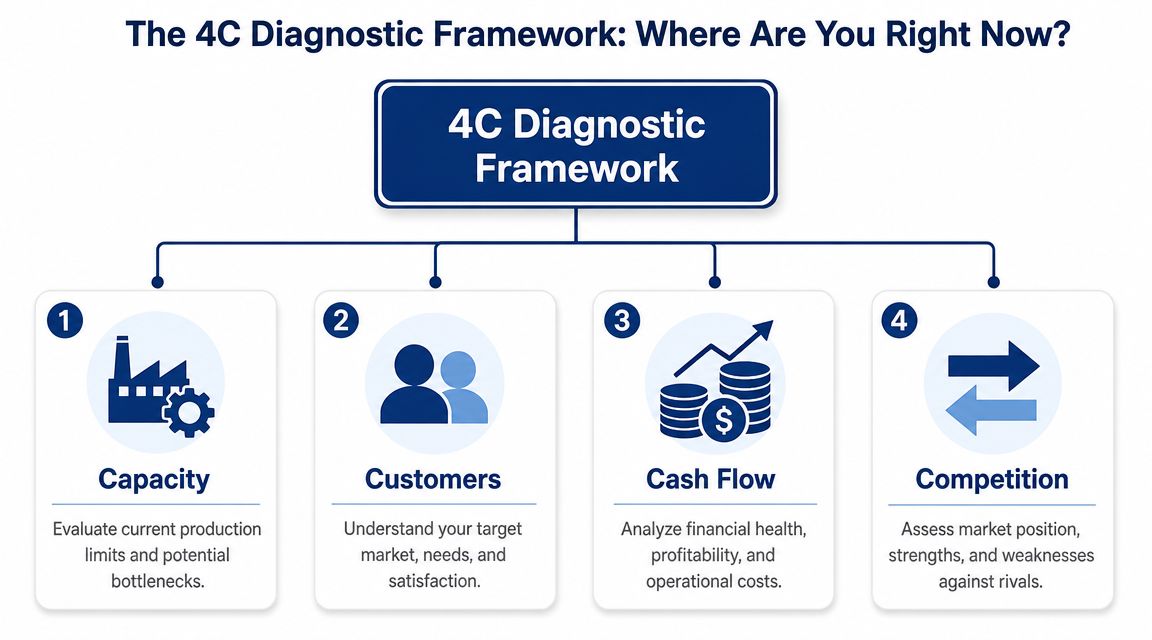
The point isn't to create a thick report. It's to identify where your growth system is weak enough to break under more volume.
Customers tell you where growth is possible
A common mistake is assuming every account deserves the same attention. That's one of the fastest ways to waste sales time and dilute operations. Enterprise Minnesota reports that manufacturers often identify new customers as the key growth driver, but only 40% of surveyed firms indicated a related growth response, which points to a gap between intent and process discipline, as noted in Enterprise Minnesota's revenue growth guidance.
Ask yourself:
- Which customers are attractive? Look beyond top-line revenue. Which accounts produce reasonable margins, smoother scheduling, fewer surprises, and repeatable work?
- Where is expansion easiest? Some customers already trust you but only buy one category, one line, or one service level.
- Who drains resources? Late approvals, constant engineering changes, small rush jobs, or buyers who grind every quote can create false growth.
- What does your ideal work look like? Define it in plain language. Lot size, lead time profile, material type, compliance burden, order frequency, and decision-maker type.
A simple segmentation model is enough to start. Group accounts into strategic fits, maintenance accounts, and problem accounts. Then decide who gets proactive attention.
Capacity tells you where growth breaks
Most shops don't have a company-wide capacity problem. They have a bottleneck problem. One machine, one process, one inspection step, one programmer, one estimator, or one approval flow limits everything else.
Look at capacity from three angles:
| Area | What to check | Warning sign |
|---|---|---|
| Production | Work center load, queue time, setup variation | One area is always expediting |
| Commercial | Quote turnaround, follow-up consistency | Good opportunities cool off before response |
| Management | Decision approvals, scheduling authority | Everything waits on one person |
Questions worth asking this week:
- Where does work pile up first?
- Which process depends on tribal knowledge?
- What happens if demand shifts toward your most attractive product line?
- Can your team absorb more orders without hurting lead times for your best customers?
If your quoting process is slow, your sales ceiling might be in the front office, not on the shop floor.
Cash and competition reveal the real position
Growth can hide bad economics for a while. More orders feel good until overtime rises, purchasing gets compressed, and collections lag behind production. You need visibility by job type, customer type, and payment behavior.
Review cash with blunt questions:
- Which jobs produce healthy contribution and which only fill the schedule?
- How long are you carrying material and labor before payment arrives?
- What assumptions are built into your pricing that no longer hold?
- Which customer terms create stress during busy periods?
Competition deserves the same discipline. Don't reduce it to "our competitors are cheaper" or "they're bigger." Those statements don't help. Instead, map where you win.
Consider these comparisons:
- Lead time advantage
- Technical complexity handled well
- Documentation quality
- Responsiveness during quoting
- Willingness to solve ugly jobs others avoid
That gives you a usable baseline. Not a motivational one. A real one.
Building Your Predictable Lead Generation Engine
Lead generation for manufacturers works best when you stop treating channels like isolated tactics. Your website, search visibility, content, email follow-up, and local presence should behave like a machine with clear handoffs. One piece attracts. Another qualifies. Another nurtures. Another prompts action.
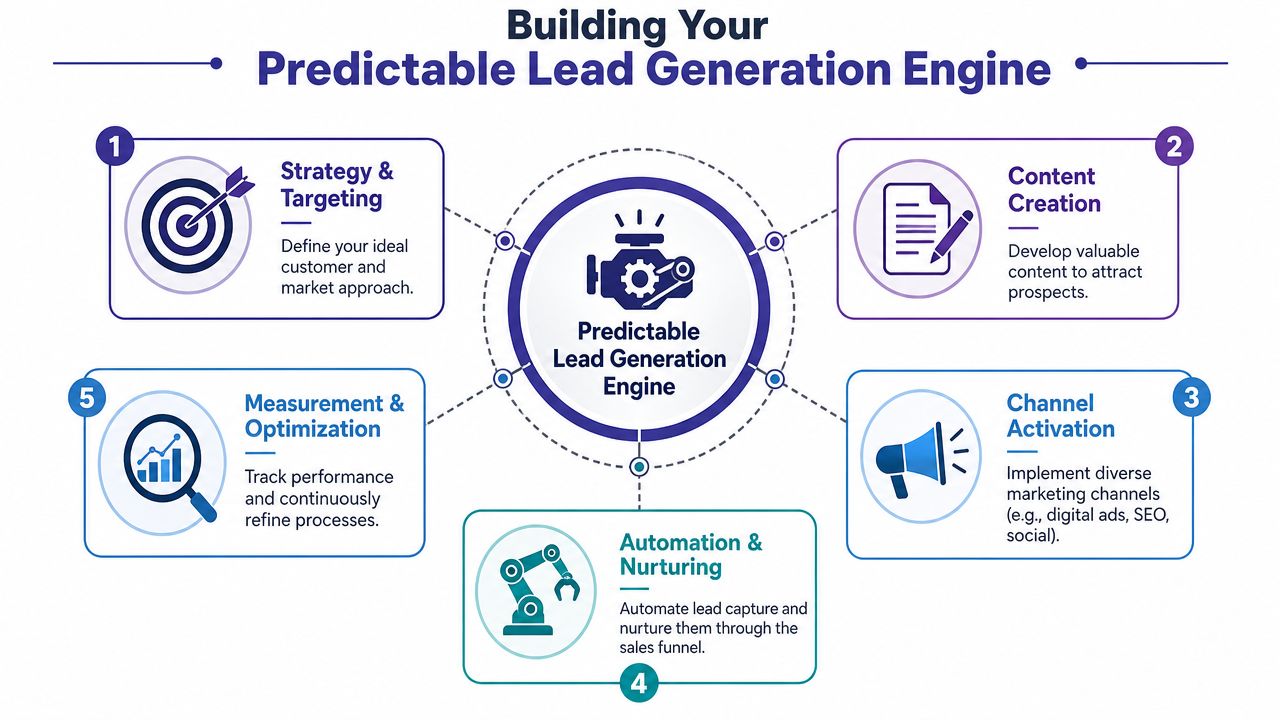
Start with search intent not channel obsession
Most buyers don't start by asking for your company name. They start with a problem, a process, a certification need, a material question, or a part category. That means your digital presence needs to answer buyer intent in the language they use.
For most industrial firms, the foundation looks like this:
- Core service pages: Build pages around the services and processes you want to sell, not just generic "capabilities."
- Industry or application pages: Show where your work fits. Aerospace is different from food equipment. OEM supply is different from repair work.
- Google Business Profile: If you serve a defined region, this helps you show up where buyers and procurement teams are validating local providers.
- Technical content: Publish useful material that answers pre-quote questions and reduces uncertainty.
A lot of manufacturers still rely on referrals and trade relationships. That's fine. But buyers still research you before reaching out. If your digital footprint is thin, outdated, or vague, you lose credibility before the conversation starts.
If you want a deeper look at how industrial firms can Boost manufacturer online visibility, that resource is useful because it frames SEO as a practical visibility system rather than a checklist of tricks.
Connect content SEO and nurture into one system
A good article shouldn't live alone on your blog. It should feed your whole pipeline.
Here's a simple example. Say you write a technical post answering a recurring buyer question about tolerances, material selection, or production lead times. That one asset can do several jobs:
- Rank for relevant searches if the topic matches real buyer language.
- Support sales conversations by giving estimators or account managers something clear to send.
- Feed email nurture for prospects who aren't ready to request a quote today.
- Expose objections early because the topics people click tell you what they're trying to solve.
This is why content marketing works better in manufacturing than many owners expect. It doesn't need to be clever. It needs to be useful, specific, and aligned with sales conversations your team already has every week.
For companies that need a practical starting point, this guide to lead generation for manufacturers lays out the mechanics of turning digital traffic into actual opportunities.
A basic content stack for manufacturers
- Decision-stage pages: Service pages, quote pages, capability summaries
- Mid-funnel education: Process explainers, FAQ articles, comparison posts
- Trust assets: Certifications, equipment lists, case examples without invented performance claims, team expertise
- Nurture emails: Short follow-ups tied to buying questions, not newsletters for the sake of sending
The best manufacturing content doesn't entertain. It reduces buying friction.
What to ignore early
You do not need to be everywhere. In the early phase, skip anything that doesn't clearly support qualified inquiry generation or sales follow-up.
That usually means being cautious with:
- Broad social posting without a purpose
- Paid campaigns before landing pages are solid
- High-volume traffic goals that don't match your buyer
- Content calendars full of generic company updates
A predictable engine starts narrow. Focus on the services you want more of, the regions you serve, and the buyer questions that show commercial intent. Once those pieces are producing consistent signals, then expand.
Systematizing Sales From First Click to Paid Invoice
Most manufacturers don't need more leads first. They need better control over what happens after a lead arrives. If inbound inquiries land in individual inboxes, quote follow-up depends on memory, and nobody can see pipeline status without asking around, sales is running on personal effort instead of system design.
A CRM fixes that, but only if you use it as operating infrastructure rather than a contact database.
Why a CRM changes behavior
The main benefit of a CRM isn't storage. It's visibility. A good pipeline makes work visible, ownership visible, delays visible, and lost opportunities visible. Once that happens, follow-up stops being optional.
For many industrial companies, GoHighLevel is one workable example because it combines forms, pipelines, email, text follow-up, landing pages, and automation in one environment. Other CRM tools can do the job too. What matters is that the system is simple enough your team will readily use it.
A practical sales pipeline might include:
| Stage | What happens there | Owner |
|---|---|---|
| New inquiry | Form fill, call, or email is logged | Sales coordinator or estimator |
| Qualified | Fit is reviewed against service, geography, volume, and timing | Sales or leadership |
| Quoted | Estimate delivered with clear next step | Estimator |
| Follow-up | Reminder cadence and objection handling | Sales |
| Won or lost | Outcome logged with reason | Sales or admin |
| In production | Handoff to operations with job details | Project or production team |
| Invoiced and paid | Final commercial closeout | Finance |
That pipeline gives you a single line of sight from marketing response to paid work.
A simple pipeline for industrial sales
Keep the first version basic. Overbuilt CRM setups fail because they ask too much of the team too early.
Use a few required fields:
- Lead source
- Customer type
- Requested service or product
- Estimated value band
- Next action date
- Current stage
- Loss reason if closed lost
Then build follow-up rules around common delays. If a quote is sent and no reply comes back, the CRM should trigger reminders for the responsible person and send helpful follow-up automatically where appropriate.
For example:
- Immediate response: Acknowledge inquiry and set expectation for next step.
- After quote delivery: Send a concise summary and invite a call.
- If no response: Follow up with a clarification prompt or timeline check.
- If stalled longer: Ask whether specs, timing, or budget changed.
This is the operational backbone behind any serious attempt to grow a manufacturing business. If you want examples of how to structure those handoffs and reminders, this article on how to automate the sales process is a practical reference.
Automation should support judgment not replace it
Automation is useful for acknowledgment, reminders, and consistency. It should not pretend to be relationship selling.
Use automation for:
- Lead capture
- Task creation
- Follow-up timing
- Status alerts
- Re-engagement of quiet opportunities
Do not use it to hide from real commercial conversations. Engineers, buyers, and plant managers still want thoughtful answers, fast quotes, and confidence that you understand the application.
A CRM doesn't make your team better at sales by itself. It makes missed follow-up impossible to ignore.
When sales is systematized, marketing becomes measurable. You can finally see which pages, forms, campaigns, and referrals produce real pipeline instead of vague activity.
Optimizing Your Shop for Profitable Growth
You can market your way into a bad quarter if the shop isn't ready. More quote requests sound positive, but if you accept the wrong work, price it poorly, or overload your true bottleneck, growth creates rework, missed dates, and margin erosion.
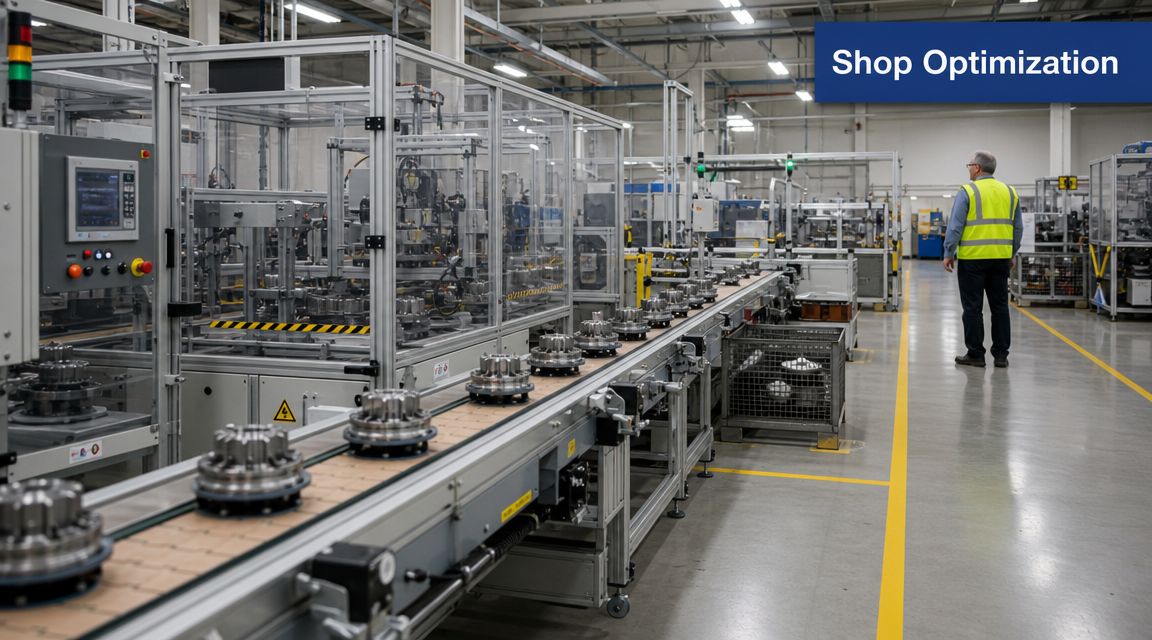
Manufacturing growth often stalls because of constraints in People, Strategy, Execution, and Cash. A more resilient path is to document processes, segment customers by opportunity, and run small measurable tests before scaling, as described in this analysis of why manufacturing growth stalls and how to break through.
Find the bottleneck before marketing makes it worse
Start with throughput, not hope. If one department or skill set gates delivery, every new order amplifies that weakness.
Check these areas first:
- Estimating capacity: Can you quote target work fast enough to win it?
- Engineering release: Are drawings, revisions, and approvals slowing starts?
- Critical machine centers: Which resource is booked first when demand rises?
- Inspection and quality: Does final release create hidden queue time?
- Supervision bandwidth: How many exceptions can your leaders handle before control drops?
A short weekly review often tells the truth faster than complex reporting. Look at late jobs, expedite requests, overtime causes, and work-center congestion. Patterns emerge quickly.
Pricing needs to reflect fit and complexity
Cost-plus pricing is comfortable because it's familiar. It also hides commercial decisions you should be making on purpose. Not every job deserves the same margin target, and not every customer should receive the same responsiveness.
Review pricing by category:
| Job type | Typical issue | Better approach |
|---|---|---|
| Repeat work | Price drifts down over time | Review margin and service burden regularly |
| Prototype or rush work | Complexity is underpriced | Charge for risk, speed, and interruption |
| Strategic accounts | Team over-serves without noticing | Price based on total account value and operational impact |
| Poor-fit jobs | Schedule filler becomes distraction | Raise price or decline selectively |
You don't need a complicated pricing model to improve. You need discipline. Separate strategic work from nuisance work. Review actual job profitability after completion. Then feed that learning back into quoting.
The wrong work doesn't just lower margin. It crowds out the right work.
Here's a useful operational mindset reset:
Run small tests before committing capacity
Many owners try to scale all at once. New market, new campaign, new salesperson, new equipment. That creates too many moving parts to diagnose.
A better approach is controlled testing:
- Choose one target segment you want more of.
- Define the offer clearly so sales and operations interpret it the same way.
- Limit the test window long enough to gather signal, short enough to contain risk.
- Review commercial and operational outcomes together.
- Document what changed before expanding volume.
That protects your cash, your team, and your customer experience. Growth should strengthen the operation, not expose every undocumented process you were able to ignore when volume was lower.
Your 90-Day Implementation Roadmap
A good 90-day plan should reduce chaos by week two.
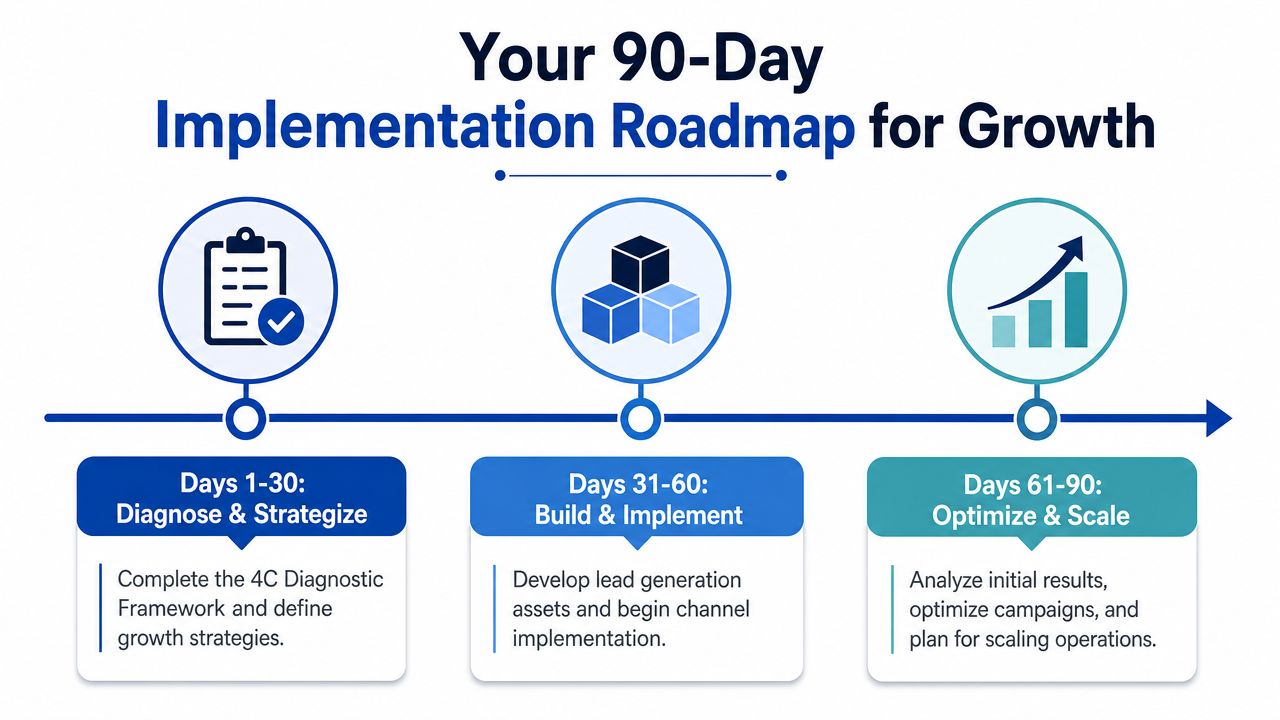
If inbound leads still sit in email, quotes still depend on one estimator's memory, and production still learns about promised dates after the sale, growth will stay fragile. The first quarter of implementation is for building one connected system across marketing, sales, and operations. That system needs clear ownership, visible flow, and rules the team can follow under pressure.
Start with financial guardrails. The U.S. Small Business Administration recommends building a 12-month capacity-and-cash model with monthly detail and stress-testing 10%, 20%, and 50% growth to identify when labor, materials, and working capital become constraints, according to the SBA business plan guidance.
Days 1 to 30 diagnose and stabilize
Month one is for baseline control. The goal is to stop guessing.
Set five things in place first:
- Finish the 4C diagnostic: define your target customer, current constraint, highest-margin work, and competitive position.
- Fix the digital front door: confirm that service pages, forms, phone numbers, and core messaging match what you want to sell.
- Set lead handling rules: assign an owner for inbound inquiries, define response-time expectations, and list the information required before quoting.
- Choose one system of record: set up the CRM, define pipeline stages, and stop managing live opportunities across spreadsheets, inboxes, and handwritten notes.
- Model capacity and cash: build the monthly view and test what happens if demand rises faster than labor, material supply, or receivables can support.
A one-page growth brief is enough for this phase. It should answer these questions:
| Item | Decision |
|---|---|
| Target customer | Which account types you want more of |
| Primary offer | Which service or capability leads the push |
| Bottleneck | What currently limits profitable throughput |
| Sales process owner | Who advances opportunities |
| Financial trigger points | What would force hiring, equipment, or financing decisions |
This document matters because every department defaults to its local problem. Sales wants faster quotes. Production wants schedule stability. Ownership wants revenue. A short written brief forces alignment before volume increases.
Days 31 to 60 activate the engine
Month two is where the integrated system starts working in the field. Keep the scope tight enough that the shop can absorb what marketing and sales produce.
Focus on one practical build:
- Publish or tighten core service pages around the offers you want to grow.
- Set up lead capture paths with forms, calls to action, call tracking, and immediate confirmation responses.
- Turn on the CRM pipeline and require every active opportunity to live there.
- Build a short follow-up sequence for new inquiries and sent quotes.
- Create one content asset that answers a buyer question tied to active demand.
- Hold a weekly sales and operations review so quoting, lead times, and actual capacity stay connected.
This is also the right time to lock definitions. Decide what counts as a qualified lead. Decide when an RFQ becomes a real opportunity. Decide when an opportunity is stalled. If those definitions stay fuzzy, the CRM becomes a contact database instead of a management tool.
For many manufacturers, GoHighLevel is sufficient for this stage if it is configured with a simple pipeline, automated acknowledgment, quote follow-up tasks, and reporting that the team reviews every week. The software is not the growth system. The process is. GoHighLevel just gives you one place to run it.
Use a fixed weekly meeting agenda:
- New inquiries received
- Qualified opportunities added
- Quotes sent and pending
- Stalled deals needing intervention
- Capacity concerns tied to likely wins
- Customer objections or recurring questions worth turning into content
If your sales meeting does not change next actions, it is a status meeting, not a growth mechanism.
Some firms bring in outside support for CRM setup, SEO, websites, and campaign execution, including providers such as Machine Marketing. Vendor choice is secondary. Pick tools and partners your team can maintain after the first push.
Days 61 to 90 optimize and document
Month three determines whether the system holds or slides back into informal habits.
Now review the full chain from first inquiry to released work order:
- Audit lead quality by source: identify which channels produce target-fit opportunities and which produce distraction.
- Review quote follow-up consistency: find where deals sit without a next step, owner, or deadline.
- Check operational impact: compare promised work against actual shop load and look for recurring handoff failures.
- Write basic SOPs: document inbound handling, qualification, quoting, follow-up, and sales-to-operations handoff.
- Refine targeting: cut segments that create activity without margin or repeatability.
This phase is where trade-offs become visible. A campaign can produce more RFQs and still be a bad decision if they choke estimating capacity. Faster quoting can raise close rates and still hurt margin if the team starts bidding poor-fit work just to keep volume up. Good systems expose those conflicts early.
At the end of 90 days, ask five blunt questions:
- Are we attracting the work we said we wanted?
- Can we respond fast enough to compete for it?
- Can the shop deliver it without schedule damage?
- Do the margins justify the sales and production effort?
- What must be standardized before we add volume?
A manufacturer does not need a perfect setup in 90 days. It needs control. If you finish the quarter with a clear target segment, working lead capture, a live CRM pipeline, basic automation, documented handoffs, and a usable capacity-and-cash model, you have built a growth engine instead of a pile of tactics.
Measuring What Matters Your Growth Dashboard
Most dashboards fail because they measure what is easy to count, not what helps you decide. Website visits, impressions, and social engagement can be interesting, but they won't tell you whether your growth system is healthy.
A useful dashboard fits on one page and links marketing, sales, and operations. If one part improves while another breaks, the dashboard should make that visible fast.
Three dashboard sections that actually help
Use three buckets.
Marketing
- Qualified leads: Not all inquiries. Only the ones that fit your target profile.
- Lead source quality: Which channels produce serious opportunities.
- Content engagement by buying topic: Which questions or pages are pulling in commercially relevant attention.
Sales
- Open opportunities by stage: So you can see where deals stall.
- Quote turnaround consistency: Slow quoting kills momentum.
- Quote-to-close pattern: Not as a vanity score, but as a signal of fit, pricing, and follow-up quality.
Operations
- On-time delivery trend: If wins rise but delivery slips, growth is outpacing control.
- Average job margin by type: This tells you which work should be pursued more aggressively.
- Bottleneck utilization: Watch the constraint, not just total plant busyness.
You can run this with a spreadsheet at first. The key is consistency. Same definitions. Same review rhythm. Same owners.
Questions to review every month
Use the dashboard to force decisions:
- Are we getting more of the right inquiries or just more inquiries?
- Where are opportunities slowing down?
- Which customer or job types are easiest to serve profitably?
- What changed operationally after new work came in?
- Which process needs to be documented next?
Measurement is only useful when it changes what your team does next week.
A company that wants to grow a manufacturing business predictably needs more than promotion. It needs a working system. Diagnose the current state. Build a focused lead engine. Install CRM control. Protect profitable capacity. Then review the numbers that connect all four.
If you want a second set of eyes on your growth system, Machine Marketing can help you diagnose the gaps between your marketing, sales process, CRM, and operational reality. The useful next step is simple. Get clear on where your current system breaks, then fix that constraint before adding more demand.