If your marketing plan is collecting dust in a forgotten folder, you’re not alone. Most business owners create a plan once, hope for the best, and then get back to the “real work.” The problem? This approach almost always fails to deliver results, leaving you guessing where your marketing dollars are going.
There’s a fundamental disconnect between creating a static document and building a system for growth. In this article, we’ll show you how to diagnose the gaps in your current approach and build a marketing plan that functions as a predictable engine for your business.
Why Your Marketing Plan Is Broken (and How to Fix It)
Most marketing plans are treated like a once-a-year checklist. You fill out a template, set some vague goals, and move on. This completely ignores the reality of your business—markets shift, competitors adapt, and customer behavior changes. A static plan is broken the moment it meets the real world.
The result is wasted time and money on tactics that aren’t moving the needle. It's the classic gap between high-level ambition and day-to-day execution.
Shift From a Document to a System
Here’s the fix: Stop thinking of your plan as a document. Start treating it as an operational system—a predictable engine you build specifically for growth. This isn’t about having more creative ideas; it's about having a structured process to turn the right ideas into measurable outcomes.
We see the most successful modern marketers think like engineers, building systems that produce reliable results. Need more insights on this data-first approach? The team at Improvado.io shares some great perspectives.
A great marketing plan doesn't just list what you'll do; it explains why you're doing it. It’s a tool for making smart, strategic decisions—not just a to-do list for staying busy.
The 7 Core Stages of a Plan That Actually Works
To build a marketing system that delivers, you need to follow a logical sequence. Each stage builds on the last, creating a solid foundation for growth. Forget the vague mission statements—we’re building an actionable blueprint.
Here's a quick look at the seven core stages we'll walk through in this guide. This table breaks down what each stage is for and what you'll have in hand when you're done.
| Stage | Objective | Key Output |
|---|---|---|
| 1. Diagnosis & Goal Setting | To establish a clear baseline and define specific, measurable outcomes that directly impact revenue. | A documented analysis of your current position and a list of S.M.A.R.T. goals and KPIs. |
| 2. Audience Research | To get inside your ideal customer's head, understanding their pain points, motivations, and journey. | Detailed Ideal Customer Profiles (ICPs) and Buyer Personas. |
| 3. Core Messaging & Positioning | To craft a compelling narrative that resonates with your audience and differentiates you from competitors. | A clear Value Proposition, brand messaging guide, and elevator pitch. |
| 4. Channels & Tactics | To strategically select the right platforms and methods to reach your target audience effectively. | A prioritized list of marketing channels and the specific tactics for each. |
| 5. Content & Offer Strategy | To plan the value you'll provide at each stage of the buyer's journey to attract, engage, and convert. | A content calendar, lead magnet concepts, and core service/product offers. |
| 6. The 90-Day Roadmap | To translate your strategy into concrete, actionable steps with clear timelines and ownership. | A detailed execution plan outlining tasks for the next 3 months. |
| 7. Measurement & Iteration | To set up the tools and processes needed to track progress, analyze results, and optimize your system over time. | A marketing dashboard, reporting schedule, and a process for regular review. |
By working through these stages, you'll have more than just a plan. You'll have a living, breathing system designed to turn your marketing efforts into predictable business growth.
Stage 1: Diagnosis and S.M.A.R.T. Goal Setting
Before you can build anything that lasts, an engineer needs a precise diagnosis of the problem. Your marketing is no different. Too many businesses jump straight into tactics—firing off social media posts or blasting email campaigns—without ever understanding their starting point.
That’s like a doctor prescribing medicine without knowing the illness. It's a guess, and it's almost always wrong. A marketing plan that actually works starts with an honest, clear-eyed look at where your business stands right now. This isn't about judging past mistakes; it's about setting a baseline so you can measure progress.
Equally important is defining what success really looks like. We hear it all the time: "I want more leads" or "I want better brand awareness." Those aren't goals; they're wishes. They’re too vague to guide your actions or prove your marketing is actually delivering a return.
Start with an Unbiased Diagnosis
To build a plan that gets results, you have to understand the terrain. That means looking inward at your own operations and outward at the market you’re competing in. Asking the right questions is the first step toward a strategy built on data, not gut feelings.
Questions to Ask Yourself (Internal Diagnosis):
- What are our biggest marketing strengths? Do you have a great reputation, a loyal customer base, or a truly unique product?
- Where are our most glaring weaknesses? Is your website outdated? Is your social media presence a ghost town? Are sales and marketing speaking different languages?
- What’s our current customer acquisition cost (CAC)? You must know what it costs, on average, to land a new customer.
- What’s the lifetime value (LTV) of that customer? Knowing this number is the key to justifying your marketing spend.
Questions to Ask About the Market (External Diagnosis):
- Who are our top 3-5 competitors? What are they doing well? More importantly, where are the obvious gaps you can exploit?
- What market trends or opportunities could we jump on? Think new technologies, underserved customer niches, or shifting demands.
- What potential threats could derail us? This could be anything from a new competitor and economic shifts to changing regulations.
Your diagnosis is the foundation for everything that follows. Be brutally honest with yourself here. A plan built on a shaky or inaccurate foundation is guaranteed to collapse.
Ditch the Vague Wishes for S.M.A.R.T. Goals
Once you have a clear picture of where you are, you can set meaningful goals for where you want to go. The best way to do this is with the S.M.A.R.T. framework: Specific, Measurable, Achievable, Relevant, and Time-bound. This system is what turns foggy ambitions into concrete objectives your team can actually execute.
Let’s see how this works for a B2B manufacturer:
- The Vague Wish: "We need our website to generate more leads."
- The S.M.A.R.T. Goal: "Increase qualified leads from our website's 'Request a Quote' form by 25%—from 40 per month to 50 per month—by the end of Q3."
See the difference? The S.M.A.R.T. goal gives your team a clear target. You know exactly what you're aiming for, how you'll track it, and the deadline you're working against. It creates focus and accountability.
Stage 2: Deep Audience Research
Knowing your goals is only half the battle. Do you know who you're trying to reach? Generic marketing messages are a waste of money because they speak to everyone and no one. This is where building out detailed customer personas becomes an absolute game-changer.
A persona is a detailed profile of your ideal customer. It’s not just demographics; it’s a semi-fictional character based on real data from your market research and existing customers.
What to Look For in a Powerful Persona
- Demographics: Nail down their job title, industry, company size, and years of experience. For a manufacturer, this is your "Plant Manager" or "Procurement Specialist."
- Goals & Motivations: What are they trying to accomplish in their job? Are they tasked with increasing efficiency, reducing costly downtime, or improving plant safety?
- Pain Points & Challenges: What keeps them up at night? Are they wrestling with supply chain nightmares, unreliable equipment, or a shortage of skilled labor? Your product is the solution to these pains.
- Information Sources: Where do they get their professional information? Are they reading industry trade magazines, attending specific trade shows, or following key influencers on LinkedIn?
- Watering Holes: This is all about where they hang out online. Are they active in LinkedIn groups for manufacturing professionals? Do they listen to industry-specific podcasts during their commute?
When you answer these questions, you can create a persona like "Plant Manager Pete." Suddenly, you’re not just shouting into the void. You’re crafting a message for Pete, having a conversation with a real person whose problems you understand inside and out. This is the secret to creating marketing that connects and converts.
Stage 3 & 4: Choose Your Channels & Craft Your Core Message
Once you've diagnosed your market position and set clear goals, it's time to decide where you'll engage potential customers and exactly what you'll say. This is a common stumbling block. Too many businesses either try to be everywhere at once, stretching themselves too thin, or they use a generic, one-size-fits-all message that falls flat.
The goal isn't to shout into every corner of the internet. It's about starting meaningful conversations in the right places. This is where your earlier audience research pays off. Where does "Plant Manager Pete" actually spend his time online? Answering this is the key to picking channels that give you the most leverage, ensuring your marketing budget is an investment, not an expense.
Where to Show Up: Picking Your Marketing Channels
Choosing your channels is a balancing act between your audience's habits and your own resources. Let's be realistic—the digital marketing space is massive. With the global digital ad market projected to hit $740.3 billion and 93% of all website traffic starting with a search engine, a digital-first mindset is critical. If you want to dive deeper into these trends, you can explore detailed digital marketing statistics on SEO.com.
Instead of spreading yourself thin across ten different platforms, focus on mastering one or two channels first. Here’s a practical way to think through your options:
- Search Engine Optimization (SEO): Think of this as your long game. It's non-negotiable if your customers are actively searching for solutions online. When "Plant Manager Pete" types "how to reduce manufacturing downtime" into Google, you absolutely have to be there.
- Content Marketing: This is the fuel for your SEO fire and the fastest way to build authority. It's all about creating genuinely useful resources—blog posts, in-depth guides, case studies—that solve your audience's problems before they're even thinking about buying.
- Email Marketing: Don't sleep on email. It's still one of the most powerful tools for nurturing relationships with leads and for re-engaging past customers. It's your direct line of communication, and you own it.
- Paid Advertising (PPC): Need to get traffic and leads in the door now? Pay-per-click ads on platforms like Google or LinkedIn deliver immediate results. It’s also a fantastic way to quickly test different messages and offers to see what sticks.
- Social Media: This isn't just for consumer brands anymore. For a B2B manufacturer, LinkedIn can be a goldmine for connecting directly with decision-makers and sharing valuable industry insights. The trick is to pick the platform where your audience is professionally active, not just scrolling.
What to Say: Crafting Your Core Message
Once you know where you're going to show up, you have to nail down what you're going to say. Your core message is the foundation for everything—every ad, every email, every webpage. It’s the simple, compelling answer to your customer’s fundamental question: "Why should I choose you over everyone else?"
This isn’t just a catchy slogan. It’s a clear, concise statement that hits on your unique value and speaks directly to the primary pain point of your ideal customer. It needs to be consistent everywhere.
Your core message should be so clear that anyone on your team, from the CEO to a new intern, can repeat it perfectly. If your own team can't articulate it, how can you expect your customers to understand it?
To get started, break your message down into three core components:
- The Problem: Clearly state the main pain point your customer is struggling with, using the words they would use.
- Your Solution: Briefly explain how your product or service directly solves that problem.
- The Transformation: Describe the positive outcome or success they'll experience after working with you.
For instance, a custom machine shop that targets engineers could land on this message: "We build custom-fabricated parts that meet exact tolerances, so you can eliminate production delays and launch your projects on schedule."
This process forces you to build your messaging around the customer, not your company. For a more structured approach, we’ve put together a detailed guide on developing a powerful marketing messaging framework that will walk you through this critical step.
Stage 5 & 6: Build Your 90-Day Execution Roadmap
A great marketing strategy is useless if it sits in a folder. This is the moment where theory becomes action—where your goals, audience insights, and messaging get translated into a tangible plan you can actually follow. We call this the 90-day execution roadmap.
Why 90 days? A full year is just too long. The market shifts, and what feels like a genius idea today might be irrelevant in six months. A 90-day "sprint" forces you to focus on what matters right now and build real, measurable momentum.
From Strategy to a Weekly To-Do List
The roadmap breaks down your big, ambitious goals into monthly milestones, weekly tasks, and daily actions. It’s the bridge between your "why" and your "how," creating clarity and accountability. When the plan is clear, your team knows exactly what they need to get done this week to stay on track.
This whole process is sequential for a reason. Everything builds on the step before it.
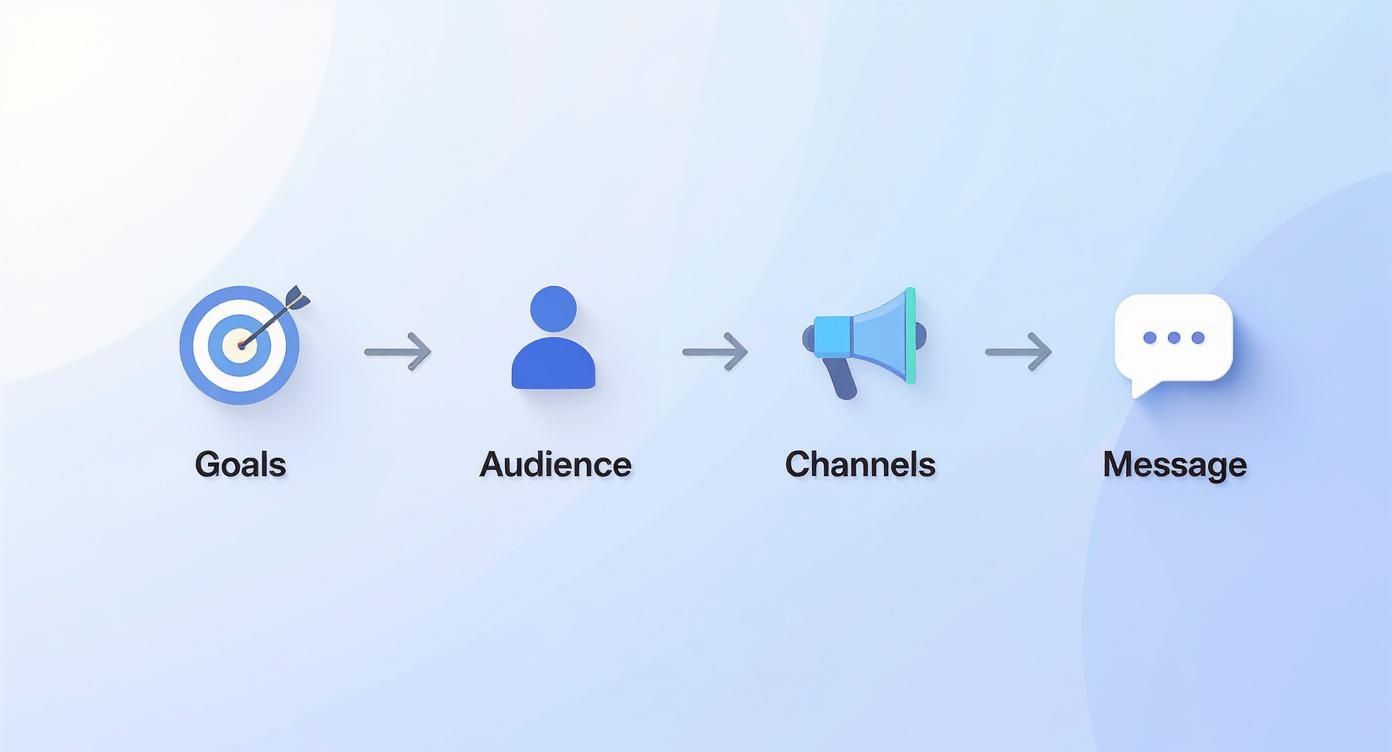
Skip a critical step like defining your audience, and you’ll end up picking the wrong channels and crafting a message that just doesn't connect. It's a domino effect.
Designing Your First 90-Day Sprint
Let's get practical. Open a simple spreadsheet. Your mission is to map out the next three months, making sure every major initiative ties directly back to your primary S.M.A.R.T. goal. Let’s imagine your goal is to "Increase qualified website leads by 25% in Q3."
You could structure your thinking like this:
- Month 1 Focus: Foundational Content & SEO. The first month is all about building the core assets that will attract your ideal customer through search engines.
- Month 2 Focus: Lead Capture & Nurturing. With traffic starting to build, you’ll shift focus to converting visitors into leads and setting up a system to follow up with them.
- Month 3 Focus: Promotion & Amplification. Now that your content and systems are in place, it's time to pour fuel on the fire and actively promote everything you've built.
See the logic? You’re not just randomly throwing things at the wall. You're building a lead-generation engine, piece by piece.
A roadmap isn't about perfectly predicting the future. Think of it as a GPS—you know the destination, but you’re ready to adjust the route if you hit unexpected traffic. It’s a plan of action that's flexible enough to adapt as new data comes in.
What to Look For: Pitfalls That Derail Execution
Even the best-laid plans can go sideways. From our experience, here are the most common traps that kill momentum and how to sidestep them.
- Lack of Ownership: If a task has no clear owner, it's not getting done. Period. Every single item on your roadmap needs one person's name next to it. They are ultimately responsible for seeing it through.
- Unrealistic Deadlines: Ambition is great, but consistently missing deadlines crushes morale. Be honest about what your team can realistically accomplish. It's far better to schedule three high-impact tasks and nail them than to plan for ten and finish none.
- Ignoring the Budget: Your roadmap and your budget must be best friends. Before you pencil in a big paid ad campaign for Month 2, make sure the money is actually there. Your budget isn't just a number; it's the tool that enables your plan.
Putting It All Together in a Simple Template
Your roadmap doesn't need to be some complex spreadsheet. Simpler is almost always better. It should give you a clear, at-a-glance view of your entire quarter. Here's a straightforward table you can adapt to lay out your first 90-day plan.
Sample 90-Day Marketing Roadmap
| Month | Focus/Theme | Key Actions & Channels | Success Metric |
|---|---|---|---|
| Month 1 | Foundational Content | Publish 4 SEO-optimized blog posts around "manufacturing efficiency." Create a downloadable guide on reducing downtime. | Increase organic traffic by 10%. |
| Month 2 | Lead Capture | Implement pop-up forms on the blog. Build a 5-part email nurture sequence for new leads. | Generate 20 new guide downloads. |
| Month 3 | Promotion & Amplification | Run a LinkedIn ad campaign promoting the guide. Share blog content in 3 industry forums. | Achieve a Cost Per Lead (CPL) under $75. |
This simple framework turns your strategy into a week-by-week game plan. Building out automated sequences for lead nurturing is a project in itself. If you're looking to make that process more efficient, you can explore some effective marketing automation strategies to handle follow-up at scale.
Stage 7: Measure What Matters and Iterate for Growth

Here’s a hard truth: your marketing plan is a living system that needs data to work. The "set it and forget it" mindset is a surefire way to waste money. Real growth comes from a disciplined cycle: measure what’s happening, learn from the results, and then tweak your approach.
This is where many business owners get stuck. They either track a dozen vanity metrics that look impressive but mean nothing, or they track nothing at all. The secret is to focus only on the numbers that tell you if you're getting closer to your actual business goals.
Identify Your Key Performance Indicators (KPIs)
Before you can measure anything, you need to define what success looks like in plain, numerical terms. Your Key Performance Indicators (KPIs) should tie directly back to the S.M.A.R.T. goals you set earlier. Think of them as the vital signs of your marketing health.
Don't get lost in a sea of data. Just start with a few high-impact metrics that tell the story of your customer journey.
- Customer Acquisition Cost (CAC): How much does it cost us to win a new customer? (Total Sales & Marketing Spend / New Customers)
- Customer Lifetime Value (LTV): What is the total revenue we can expect from a single customer?
- Return on Investment (ROI): For every dollar we put into a marketing campaign, how many dollars do we get back?
- Conversion Rate: What percentage of people take a specific action, like filling out a form or making a purchase?
A healthy marketing system almost always has an LTV that's significantly higher than its CAC—often a 3:1 ratio or better. If you're spending more to get a customer than they're worth to your business, the model is broken.
Build a Simple Marketing Dashboard
You don't need expensive software for this. A simple dashboard, even in a spreadsheet or a free tool like Google Data Studio, gives you an at-a-glance view of your most important KPIs. The goal is to get all your key data in one place so you can spot trends quickly.
Make your dashboard visual. Use simple charts to track your main KPIs week-over-week and month-over-month. Seeing the data visually makes it easier to understand what's working and what isn't.
Establish a Rhythm for Review and Iteration
Data is useless if you don't act on it. This is why a consistent review process is so important. We've found a simple two-tiered system works best:
- Weekly Check-in (The "Pulse Check"): A quick, 15-minute review of your dashboard. Are campaigns on track? Any red flags?
- Monthly Review (The "Deep Dive"): A more formal meeting to analyze the last month's performance against your goals. What worked? What failed? What did we learn? This is where you make strategic calls about where to double down and where to pull back.
This rhythm turns data into action. If your monthly review shows that LinkedIn ads are generating leads at half the cost of your Google ads, that's a crystal-clear signal to reallocate your budget. This iterative process is what makes a marketing plan a living, adaptable roadmap instead of a static document. For a closer look at how this applies to a specific channel, check out our guide on email campaign best practices.
Common Questions We Hear All the Time
Even with a perfect blueprint, you're going to have questions once you start building. After guiding dozens of businesses through this exact process, we've noticed the same hurdles tend to pop up. Here are the straight, practical answers we've seen work time and time again.
How often should I update my marketing plan?
Your plan needs to be a living roadmap, not a stone tablet. We tell all our clients to do a major strategic review every 90 days. This is your quarterly check-in to see what worked, what didn't, and where you need to pivot.
But the day-to-day tactics need a much closer eye.
- Weekly Pulse Checks: Block out 15-30 minutes every week to look at your main dashboard. This isn't for big changes; it's for spotting a leaky faucet before it floods the house.
- Monthly Deep Dives: At the end of the month, zoom in on specific campaigns. This is when you might tweak ad copy, shift your budget around, or cut a tactic that isn't pulling its weight.
The key is to stay agile and react to the data you're seeing in real-time without getting distracted from your bigger quarterly goals.
What’s a realistic marketing budget for a small business?
There is no magic number, but a solid rule of thumb is to set aside 5-10% of your total revenue for marketing. If you're a newer company or you're aggressively trying to grab market share, pushing that up to 12-20% is often what it takes to get real traction.
The most important thing you can do is stop thinking about marketing as an expense. It's an investment in acquiring new customers. The question shouldn't be "What's the budget?" It should be, "What's the return I can expect?"
Don't just pull a number from thin air. Work backward from your goals. First, figure out your Customer Acquisition Cost (CAC) and your Customer Lifetime Value (LTV). Once you know it costs you, say, $500 to land a new customer who is ultimately worth $5,000 to your business, budgeting becomes a simple math problem based on how fast you want to grow.
Which marketing channels should I focus on first?
The temptation to be everywhere at once is real. It’s also a trap. Spreading yourself too thin is the fastest way to get mediocre results. The right channel for you comes down to one critical factor: your audience.
Before you spend a dime, you have to be brutally honest in answering this question: “Where do my ideal customers actually hang out when they're looking for solutions?”
- If you're a B2B manufacturer trying to reach plant managers, you're probably not going to find them on TikTok. Your time is much better spent on targeted SEO for highly technical searches and building a serious presence on LinkedIn.
- If you sell a beautiful, custom-made product, then a visual platform like Instagram or Pinterest is likely where your future customers are getting their inspiration.
Pick one or two channels where you're absolutely confident your audience lives. Go all-in on mastering them. Once you have a system that predictably brings in results from those core channels, then you can start thinking about expanding.
Building a marketing plan that actually drives growth is a heavy lift, but you don't have to figure it out on your own. At Machine Marketing, our entire focus is on diagnosing the roadblocks holding businesses back and building the systems that create predictable, repeatable results.
If you’re ready to stop guessing and start growing, let's talk.
Book a discovery call with Karl today and we'll start mapping out your path forward.