If you're a B2B owner or local service operator, you've probably heard that you need an email list. Then you look up advice on how to build an email list from scratch and get the same recycled playbook: offer a discount, add a generic pop-up, send a newsletter, hope for the best.
That advice breaks down fast when you're selling a technical service, a longer-term contract, or a complex solution that involves multiple stakeholders. An engineer doesn't hand over a work email because you asked nicely. A plant manager won't join a list just to “stay updated.” They subscribe when the offer helps them solve a real problem.
Email is still worth building. It remains one of the highest-ROI marketing channels, with an average return of $36 for every $1 spent, according to benchmarks referenced by Unbounce’s guide on list building, which also discusses the setup basics and compliance considerations for getting started: https://unbounce.com/campaign-strategy/how-to-build-an-email-list/
What matters is the system behind it. You don't need a huge list. You need a relevant one, a clean capture path, and a follow-up process that fits a real B2B sales cycle.
An Email List Is a Business Asset Not a Vanity Metric
A list isn't valuable because it looks impressive in a dashboard. It's valuable because it gives you direct access to buyers, influencers, past prospects, referral partners, and dormant opportunities you can re-engage without paying for each click.
Most mainstream advice misses the B2B reality. It leans heavily on e-commerce tactics and consumer offers, while ignoring longer sales cycles, multiple decision-makers, account-based targeting, and channels such as LinkedIn and trade events. That gap is called out directly in this review of the B2B-specific list-building gap: https://www.youtube.com/watch?v=8M7B0-lM_CE
For B2B, the better question isn't “How do we get more subscribers?” It's “Who do we want permission to stay in front of for the next six to twelve months?” That changes everything.
What an actual asset looks like
A useful list has a few traits:
- It is permission-based: people asked to hear from you.
- It is segmented: sales contacts, customers, trade show contacts, and content leads should not all receive the same message.
- It supports revenue: the list helps your team stay visible between first touch and buying decision.
- It can be scored and prioritized: if you need a practical primer on how teams define and qualify leads in marketing, that framework helps clarify who belongs on your list and why.
Some companies also need a clearer underlying database structure before they worry about campaigns. If that's your situation, this overview of database and email marketing systems is a useful reference point: https://machine-marketing.com/database-email-marketing/
An email list becomes an asset when sales and marketing can both use it. If only marketing touches it, it usually turns into a broadcast tool instead of a pipeline tool.
The Foundation Diagnosis Before You Build
Most list-building problems start before the first form goes live. The issue isn't software. It's lack of specificity.
If you don't know who should subscribe, you'll create the wrong offer, place it in the wrong channels, and attract people who will never buy. That produces a list that looks active for a few weeks and then goes quiet.

Define your Ideal Subscriber Profile
Forget broad audience labels like “small businesses” or “manufacturers.” Those aren't usable.
Build an Ideal Subscriber Profile, or ISP, around the people most likely to engage and eventually buy. In B2B, that usually means documenting:
- Role: owner, operations manager, sales leader, marketing manager, engineer, estimator
- Company type: manufacturer, local service business, distributor, contractor
- Buying context: urgent need, active research, vendor dissatisfaction, growth initiative
- Pain point: inconsistent lead flow, poor CRM adoption, weak website conversion, no follow-up system
- Information habits: LinkedIn, trade associations, industry publications, webinars, trade shows, referrals
This profile should be narrow enough that your team can say, “Yes, this piece is for that person.”
Questions to ask your team
You don't need a research department for this. Start with the evidence already inside the business.
Ask sales, customer service, and account managers:
- Who asks the best questions before becoming a customer
- Who stalls deals and why
- What problem makes people finally take action
- Which job titles tend to champion your solution internally
- What objections repeat in calls, demos, and proposals
Then compare that with your current customer base and your LinkedIn engagement. Look at who comments, who views profile content, and which topics trigger conversations.
Build around pain, not demographics
In B2B, demographics matter less than operational friction. Two companies of similar size can need completely different email content if one is replacing a CRM and the other is trying to increase inbound quote requests.
A practical profile usually sounds like this:
| Attribute | Weak definition | Strong definition |
|---|---|---|
| Audience | Manufacturers | Small to midsize manufacturers with no consistent inbound lead system |
| Contact | Decision-maker | Sales manager or owner responsible for pipeline |
| Need | Marketing help | Needs a website, CRM, and follow-up process that sales will use |
| Trigger | General growth | Lost confidence in referrals and wants measurable lead flow |
What to document before moving on
Write this down in one page. Keep it simple.
- Primary subscriber: the person most likely to opt in
- Secondary subscriber: the influencer or internal recommender
- Core problem: the issue that drives action
- Desired quick win: the small result they want first
- Likely next step after signup: book a call, read more, reply to an email, request a review
Practical rule: if your lead magnet could be sent to five different industries unchanged, it's probably too generic for strong B2B list growth.
Crafting Your High-Value Lead Magnet
A lead magnet is not filler content. It's a value exchange.
Your prospect is giving you access to their inbox, and in many B2B markets that's a work inbox tied to their reputation, workload, and priorities. If the offer is weak, they'll ignore it. If it's vague, they'll delay. If it feels too promotional, they won't trust it.
The strongest lead magnets do one thing well. They help the reader make a decision, diagnose a problem, or avoid a mistake.
Why generic newsletters fail
“Join our newsletter” is rarely enough when you're learning how to build an email list from scratch in a B2B context. Buyers don't want more email. They want less noise and more usefulness.
A much better offer is a practical asset tied to a pressing issue. According to Emma’s email list guide, lead magnets drive 80-90% of effective email list growth from scratch, and targeted resources such as checklists or guides can convert visitors at 5-15% on high-traffic pages. The same source notes that a resource like a manufacturer-focused lead generation checklist can demonstrate immediate value: https://myemma.com/blog/email-101-how-to-build-an-email-list-from-scratch/
That matters because your first conversion has to earn trust, not just capture contact data.
Formats that work better for B2B
Consumer brands often use discounts. B2B firms usually need a different exchange.
These formats tend to be stronger:
- Diagnostic checklist: useful when buyers need to identify gaps quickly
- ROI calculator: useful when internal buy-in depends on business case logic
- Template pack: useful for teams that need to act, not just learn
- Short workshop or replay: useful when the topic needs explanation but buyers won't read a long guide
- Implementation roadmap: useful when the pain point is complexity, not awareness
A white paper can work too, but only if the topic is tightly scoped and decision-relevant. Broad thought leadership usually underperforms practical utility. If your audience expects more technical depth, this guide on writing white papers is a helpful benchmark for shaping a stronger resource: https://machine-marketing.com/writing-white-papers/
Mine the right source material
Many teams guess at lead magnet topics. That slows growth because they create assets no one asked for.
Better inputs come from operational reality:
- Sales call notes: what people keep asking before they buy
- Proposal objections: what causes hesitation
- Support emails: what existing customers struggled to set up or understand
- LinkedIn conversations: what earns replies instead of likes
- Site search data: what visitors are actively trying to find
If a prospect repeatedly asks, “What should our CRM track?” that can become a checklist. If they ask, “Why isn't our website generating qualified leads?” that can become a self-audit.
Build for action, not length
Shorter often wins. Not because buyers dislike depth, but because they want progress.
A useful B2B lead magnet should help someone do at least one of these:
- Spot a hidden problem
- Benchmark their current setup
- Prepare for a vendor conversation
- Get internal alignment
- Make a better decision this week
The best lead magnet doesn't try to prove you're smart. It proves you understand the buyer's job.
Pre-qualify without overcomplicating
A strong lead magnet should also act as a filter.
For example, “Manufacturer's Lead Gen Checklist” attracts a more relevant audience than “Marketing Tips for Any Business.” One signals fit. The other invites everyone, including people your sales team can't help.
That trade-off matters. Broad offers usually build bigger lists. Specific offers usually build better lists.
Building Your Lead Capture System
Even a strong offer fails if the capture system is clumsy. Many businesses lose momentum here. They create something useful, then bury it in a sidebar, gate it behind a long form, or send leads into a CRM with no structure.
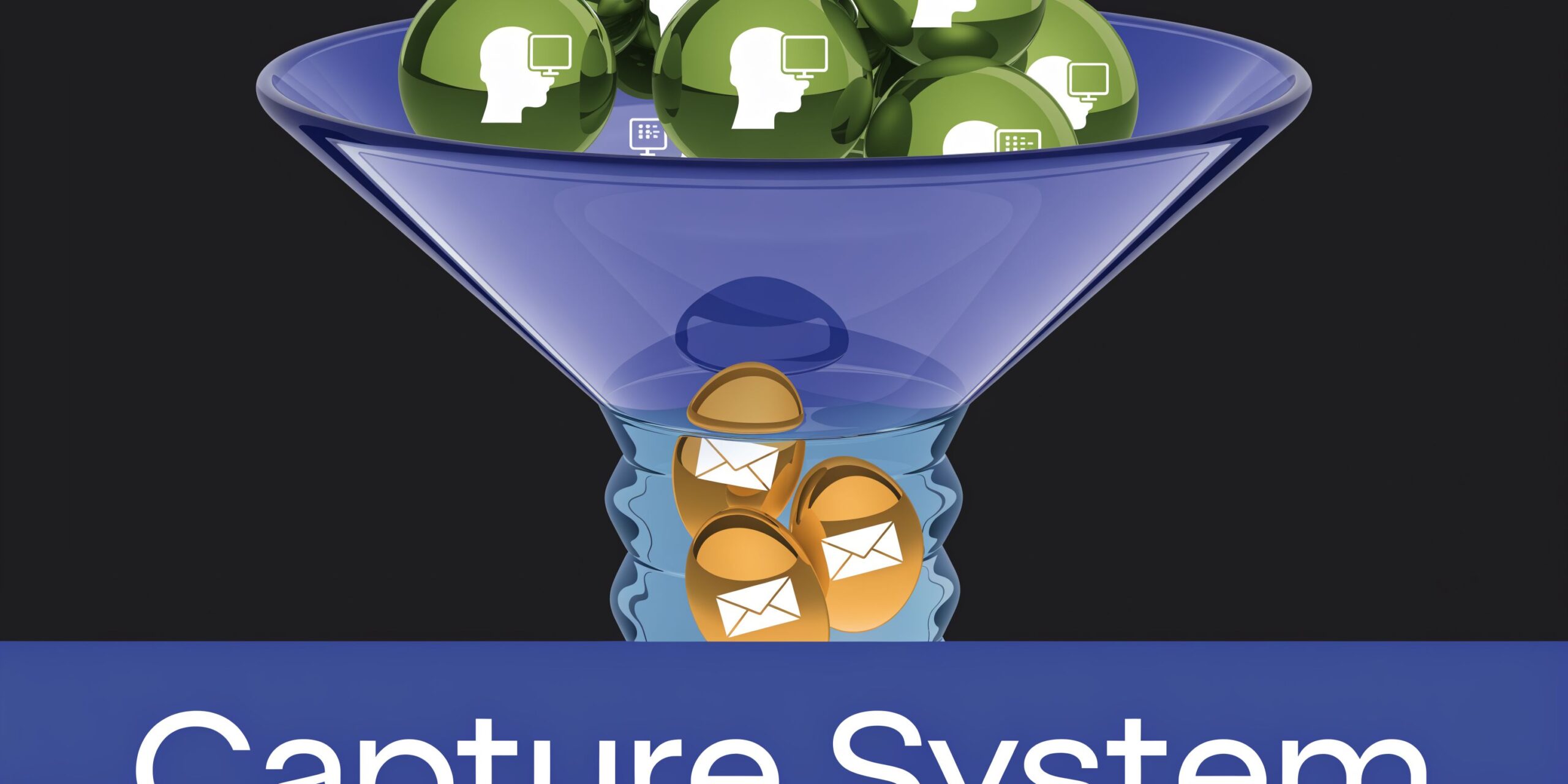
Your capture system needs three parts that work together. A focused page, a low-friction form, and a clean handoff into your email platform.
Start with a dedicated landing page
A proper landing page has one job. Get the signup.
That means removing extra navigation where possible, keeping the headline tightly tied to the problem, and making the CTA obvious. For B2B, the page should answer four questions fast:
| Question in the visitor's mind | What your page should show |
|---|---|
| Is this for someone like me | Industry or role relevance |
| Is it useful | Clear outcome, not vague education |
| Is it fast to consume | Format and expected effort |
| What happens next | Delivery method and follow-up expectation |
Use direct language. “Download the checklist.” “Get the audit template.” “Watch the replay.” Avoid clever headlines that force the reader to interpret your meaning.
Keep the form short first
Many teams get greedy at this point.
They want name, company, title, phone, employee count, website, project timeline, and budget before they've delivered anything. That kills response, especially early in the relationship.
Unbounce reports that pop-up forms convert at 3-5% for exit-intent or scroll-based triggers, compared with 0.5-1% for static forms, and that in B2B, minimizing forms to name and email can increase completion rates by up to 20% because each added field adds friction: https://unbounce.com/campaign-strategy/how-to-build-an-email-list-from-scratch/
That doesn't mean extra fields are always wrong. It means timing matters.
Use this trade-off framework:
- If traffic is limited: ask for less and maximize submissions.
- If sales qualification is urgent: add one or two fields only if they clearly support routing or follow-up.
- If you need both: use progressive profiling later through follow-up emails, preference updates, or sales conversations.
Set up lists, tags, and source tracking
Your platform matters less than your structure. Mailchimp, ActiveCampaign, and GoHighLevel can all do the job if you organize them properly.
At minimum, create:
- A master list: all opted-in contacts
- A customer segment: existing clients or past buyers
- A prospect segment: non-customers who opted in
- Source tags: homepage form, LinkedIn offer, trade show, service page, webinar, referral partner
- Offer tags: checklist, calculator, audit, replay, consultation request
This structure gives your team context. It also keeps you from sending the wrong message to the wrong person.
Add capture points across the site
Don't rely on one page alone. Place opt-in opportunities where intent already exists.
Good locations include:
- Homepage hero or mid-page CTA
- Relevant service pages
- Blog post endings
- Footer form
- About page for trust-driven visitors
- Exit-intent or scroll-triggered pop-ups on high-interest pages
The video below walks through practical setup ideas you can adapt to your own stack.
Compliance is part of the system
Consent is not optional. If you're collecting emails, your forms, storage, and follow-up need to respect privacy law and clear opt-in practices.
That matters even more for B2B firms that collect contacts through events, outbound conversations, and multiple touchpoints. Get explicit permission. Store source data. Make unsubscribing easy. Clean systems protect both deliverability and trust.
Fueling Growth B2B Channels to Attract Subscribers
A lead capture system without traffic is just a well-built container. You still need the right people to see the offer.
For B2B and local service businesses, the winning channels are usually boring in the best way. Website pages, LinkedIn, trade events, partner relationships, and targeted outreach. These aren't flashy. They are controllable.
Use your website like a salesperson
Your core pages already get attention. Most companies just waste it.
Add focused calls to action to pages that attract commercial intent:
- Homepage: offer the broadest relevant asset for your primary audience
- Service pages: match the lead magnet to the service problem
- About page: use authority and trust to invite the next step
- Blog posts: place contextual offers at the point where the reader has enough interest to act
This works better than one generic “subscribe” box in the footer because the offer matches the reason the visitor came to that page.
Treat LinkedIn as a distribution channel
LinkedIn is one of the clearest differences between B2B list building and B2C list building.
Instead of chasing viral reach, use it to move interested contacts into a permission-based relationship. Practical ways to do that:
- Post useful excerpts from your lead magnet, then link to the landing page.
- Add the offer to your profile so profile visits have a next step.
- Use direct outreach carefully when the resource is relevant to the person and their role.
- Turn comments into conversations by answering specific questions and then sharing the resource privately when appropriate.
The mistake is sending cold links to strangers. The better move is earning enough interest that the link feels timely, not intrusive.
Turn trade show attention into opt-ins
Trade events still matter for many industrial and service businesses because face-to-face conversations compress trust. What often goes wrong is the handoff afterward.
Don't collect cards and dump them into a newsletter. Ask for permission and connect the opt-in to a useful next step, such as a checklist, event follow-up resource, or replay of a demo topic.
The quality of the follow-up matters more than volume. If the message reminds them what you discussed and gives them something worth keeping, you stay relevant after the event.
Build small partner channels
Complementary firms can help you reach the right audience faster. Think agencies, software implementers, consultants, associations, or service providers who work with the same buyer but solve a different problem.
Simple partnership plays include:
- Co-branded checklist or guide
- Guest webinar
- Newsletter mention
- Resource swap on relevant thank-you pages
- Joint event follow-up asset
If you want additional ideas, this roundup of 10 actionable B2B email list building strategies gives useful prompts for channel testing.
Good channels are not the channels with the most traffic. They are the channels where the audience already trusts the context.
Paid traffic can work, but only with tight targeting
Paid search and LinkedIn ads can accelerate growth, but they are unforgiving if your offer is weak.
Use them when:
- the audience is well defined
- the lead magnet is highly specific
- the landing page is clean
- the follow-up sequence is already ready
Don't use paid traffic to test a vague idea. Fix the message organically first. Then pay to scale what has already shown signs of fit.
The Nurture System Automation and Segmentation
The signup is the beginning, not the win.
If a new subscriber gets the asset and hears nothing useful afterward, the list starts decaying immediately. Automation earns its place here. Not to blast people more often, but to deliver what they asked for and continue the conversation in a structured way.
Build a welcome sequence that matches intent
A simple welcome sequence usually does more for early list quality than a dozen future campaigns.
For B2B, the sequence should feel like guided onboarding. The contact opted in because they had a problem. Your emails should help them think through that problem, understand your approach, and see the next logical action.
A practical welcome sequence often includes:
- Email 1: deliver the promised resource immediately
- Email 2: help them interpret or apply it
- Email 3: share a related insight, common mistake, or decision framework
- Email 4: introduce a next step such as a reply, consultation, or useful page
- Email 5: segment further based on interest or behavior
Keep the tone useful. Early emails that read like sales brochures usually underperform because they skip trust-building.
Segment from day one
Segmentation is not an advanced tactic. It's basic list hygiene.
If someone joined through a trade show conversation, they should not get the same follow-up as someone who downloaded a website checklist after reading three blog posts. One is relationship-driven. The other is research-driven.
Tag contacts based on:
| Segment basis | Example tags |
|---|---|
| Source | LinkedIn, trade show, homepage, referral partner |
| Offer | checklist, replay, calculator, audit |
| Role | owner, sales manager, engineer, marketer |
| Stage | customer, prospect, reactivation, partner |
This keeps your future messaging relevant and gives sales useful context before they reach out.
Use automation to support long sales cycles
B2B deals often stretch across months, involve internal approvals, and stall for reasons that have nothing to do with your last email. That doesn't mean email failed. It means the system needs to support a slower decision path.
Good automation performs a few tasks:
- Delivers promised assets without delay
- Routes leads based on source or interest
- Notifies the right internal person when high-intent actions occur
- Keeps light contact with people who aren't ready yet
- Reactivates older contacts when a new relevant asset is published
GoHighLevel is often useful here because it combines CRM logic, pipeline visibility, forms, and automation in one place. If you're evaluating how that kind of setup supports B2B follow-up, this overview of marketing automation for B2B is a solid reference: https://machine-marketing.com/marketing-automation-for-b-2-b/
Automation should remove delay, not remove judgment. Sales still needs to know when to step in personally.
Don't over-automate the human moments
Some subscribers need a sequence. Others need a reply.
If a prospect clicks multiple times, answers a question, or requests something specific, that is not the moment for another generic nurture email. That is the moment for a human follow-up.
The best systems know the difference.
Your 90-Day Email List Launch Plan
Most businesses delay list building because the project feels bigger than it is. It becomes one of those “we need to fix this someday” initiatives that sits behind sales, operations, and client work.
A ninety-day plan keeps it practical. Build the foundation first, launch the system second, then improve based on actual behavior.
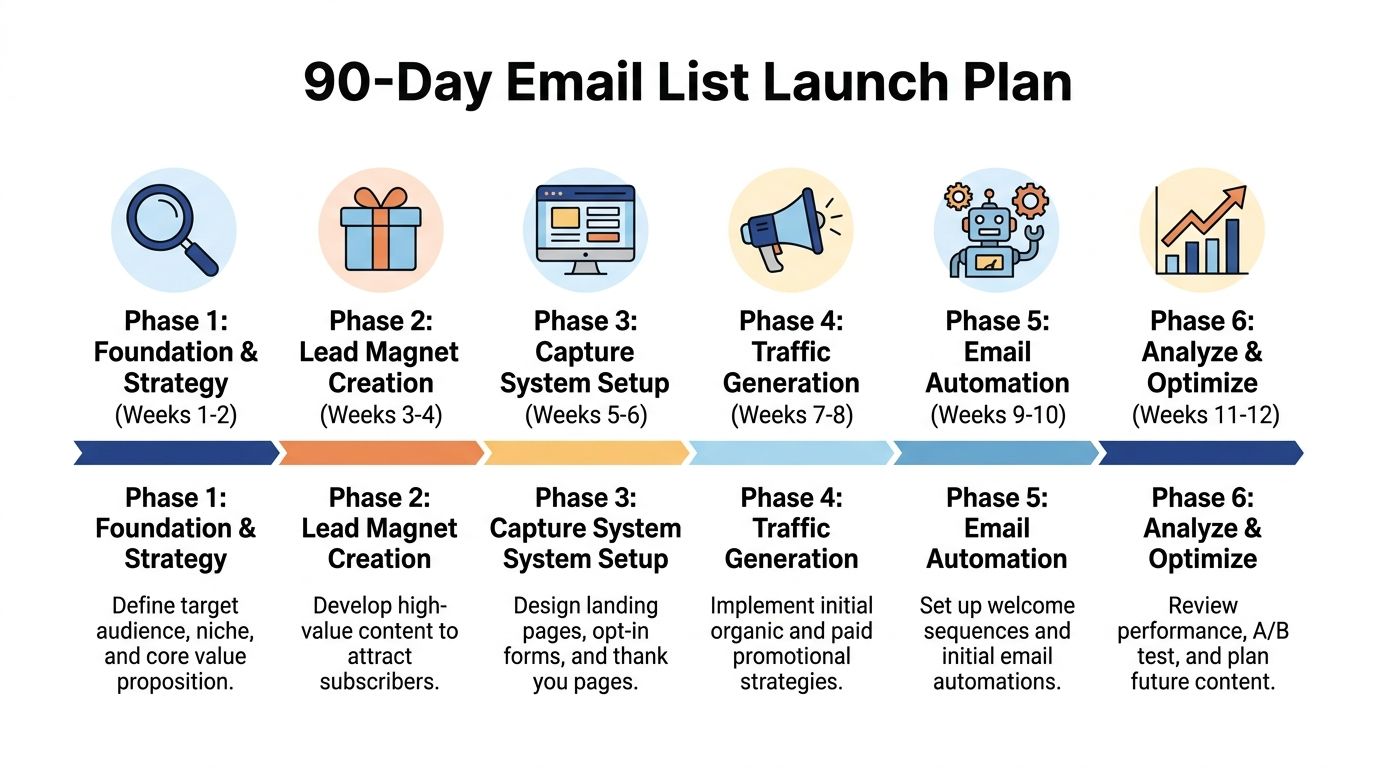
Days 1 to 30
The first month is for diagnosis and setup. Don't rush into promotion before the basics are in place.
Focus on these tasks:
- Define the audience: write your Ideal Subscriber Profile and agree on primary and secondary subscriber types.
- Choose one offer: pick the lead magnet most closely tied to a real buyer problem.
- Build the path: create the landing page, thank-you page, and delivery email.
- Set up the platform: configure your email service provider, core list structure, and source tags.
- Check consent language: make sure forms and follow-up respect privacy rules and set expectations clearly.
At the end of this phase, someone should be able to land on the page, opt in, receive the asset, and enter the right segment without manual cleanup.
Days 31 to 60
The second month is for traffic and controlled activation.
Use a mix of owned and outreach channels:
- Add CTAs across key site pages
- Publish LinkedIn posts tied to the asset
- Share the offer in direct conversations where relevant
- Prepare event or trade show follow-up workflows
- Test one partner or referral channel
Watch for friction. If people click but don't subscribe, the landing page or form may be weak. If they subscribe but don't engage, the offer or first email may be off.
Days 61 to 90
The final month is for improvement and consistent follow-up.
Use this period to:
- Review conversion points: identify pages and channels producing the best subscribers
- Refine the welcome sequence: improve clarity, relevance, and next steps
- Segment more intelligently: use source and behavior to tailor future sends
- Plan one broadcast email: send a useful non-automated campaign to the growing list
- Clean the system: fix broken tags, vague naming, and manual workarounds
Metrics that matter early
You don't need a huge reporting stack. You do need a few core indicators.
Track:
- Form conversion rate
- Subscriber growth by source
- Welcome sequence engagement
- Replies or direct hand-raisers
- Qualified conversations generated from the list
One useful benchmark for thinking about form math comes from the list-building guidance summarized by Unbounce. If 500 views produce 50 subscribers, that's a 10% signup rate. That kind of simple calculation helps you forecast and improve without overcomplicating reporting: https://unbounce.com/campaign-strategy/how-to-build-an-email-list/
What matters in the first ninety days is not perfection. It's proving that the system captures the right people and gives you enough signal to improve.
Frequently Asked Questions
How many subscribers do we need before email starts mattering
Fewer than most businesses think.
A small, relevant list can outperform a large, loose one if the subscribers match your market and your emails connect to real buying problems. In B2B, a list of the right owners, managers, engineers, or partners is far more valuable than a broad audience with weak intent.
Should we ask for only an email address
Usually at the start, yes.
Early friction kills signups. If qualification matters, collect only the minimum needed first, then gather more context later through segmentation, replies, sales conversations, or a follow-up form. That keeps the door open without sacrificing future relevance.
What metrics matter more than list size
Subscriber count is the easiest metric to stare at and one of the least useful on its own.
Look harder at:
- Where subscribers came from
- Which offer they signed up for
- Whether they engage with the welcome sequence
- Whether they reply, click, or request a next step
- Whether sales sees opportunities, not just contacts
Is email better than social media for B2B
They do different jobs.
Social platforms help you get discovered. Email helps you keep access to people who already showed interest. Social reach can fluctuate. An email list is an owned audience you can segment, nurture, and revisit without relying on a platform to distribute your message.
Can we build a list without heavy website traffic
Yes, especially in B2B.
LinkedIn, trade shows, referral partners, sales conversations, and existing customer relationships can all feed a list if you give people a relevant reason to opt in. Traffic helps, but a focused offer in the right context often matters more than raw volume.
What's the biggest mistake when learning how to build an email list from scratch
Trying to grow the list before defining the audience and offer.
When the message is too broad, the capture system gets cluttered, the follow-up becomes generic, and the list turns into a mixed bag that no one trusts. Start narrower than feels comfortable. You can expand later.
If your business needs more than tips and you want a working system, Machine Marketing helps B2B and service companies diagnose audience fit, build lead capture infrastructure, and connect email, CRM, and follow-up into a process your team can use.