If you're a business owner struggling with inconsistent revenue, the problem often isn't your product or your sales team—it's a broken system. Building a sales pipeline is about creating a repeatable, predictable process that turns strangers into qualified leads, and qualified leads into paying customers. It’s how you shift from random sales activities to a well-oiled machine that delivers consistent growth.
In this guide, we'll diagnose the common failure points we see in most B2B sales processes and give you a step-by-step framework to build a pipeline that works.
Diagnosing Your Leaky Sales Pipeline
Does it feel like your team is putting in a ton of effort for just a trickle of qualified leads? You’re not alone. For most B2B businesses, the core problem isn't a lack of hard work—it’s a broken system. The answer isn't to just "sell harder"; it's to ditch the random acts of selling and install a measurable process.
Symptoms of a Broken System
Ask yourself if any of this sounds familiar:
- Inconsistent Lead Flow: Some months are a flood of leads, but the next is a bone-dry desert. How can you forecast revenue when you have no idea what the next quarter holds?
- Deals Stalling Mysteriously: A prospect seems enthusiastic, then suddenly goes completely dark. Your team ends up wasting weeks chasing ghosts that were never going to close.
- Wasted Sales Time: Are your highly skilled, expensive salespeople stuck chasing down unqualified prospects—people who aren't a good fit, don't have the budget, or aren't even the decision-maker?
These aren't just isolated headaches; they are clear symptoms of a leaky pipeline. Data shows that the journey from a website visitor to a paying customer is tough, with the average B2B sales funnel converting only 2.3% of visitors into leads. For small-to-midsize manufacturers, that number drops to a painful 1.4%.
The Transformation: A sales pipeline isn't just a list of contacts. It's a strategic system engineered to create predictable outcomes. Without a clear process, you're just guessing. With one, you gain control over your growth.
The Four Pillars of a High-Converting Sales Pipeline
To stop the leaks for good, you need a solid foundation. We approach this with an engineering mindset, focusing on four key pillars that support a system designed for predictable results. This table gives you a quick overview of the foundational elements we’ll build together.
| Pillar | Diagnosis (The Problem It Solves) |
|---|---|
| A Crystal-Clear ICP | Stops your team from wasting time and money on prospects who will never buy. |
| Logical, Action-Based Stages | Provides a clear view of where every deal actually stands in the buyer's journey. |
| Consistent, High-Quality Lead Flow | Eliminates the "feast or famine" cycle by creating reliable sources of qualified leads. |
| Smart Automation & Nurturing | Frees up salespeople to focus on closing by automating follow-ups and lead education. |
Getting these four pillars right is the difference between a pipeline that constantly springs leaks and one that reliably generates revenue. Throughout this guide, we’ll break down exactly how to build and implement each one.
If you want to dive deeper into the day-to-day management side of things, our guide on sales pipeline management best practices is a helpful next step.
Building Your Pipeline Blueprint
Before you build anything meant to last, you need a blueprint. A sales pipeline is no different. This process starts with a rock-solid, crystal-clear understanding of your Ideal Customer Profile (ICP). From there, you can map out the distinct stages of their buying journey. Forget vague demographics; this is about precision.
Most businesses we work with either have a fuzzy ICP or none at all. The result is always the same: wasted marketing spend and a sales team chasing prospects who were never going to buy. Let's fix that first.
Defining Your Ideal Customer Profile
Your ICP isn't just a target market; it’s a detailed portrait of the perfect-fit company you should be selling to. This clarity allows you to focus your energy on high-potential accounts instead of spraying and praying.
Questions to Ask Yourself:
- Firmographics: What's their annual revenue? How many employees do they have? What specific industry are they in? Get granular—think "aerospace component manufacturing," not just "manufacturing."
- Technographics: What software or tools are they already using? Do they have a CRM? What about accounting or project management software? This tells you a lot about their operational maturity.
- Pain Points: What specific, real-world challenges are they facing that your product or service solves? Go beyond features and focus on the business pain, like "inefficient production scheduling" or "high scrap rates."
When you define these elements, you're creating a filter. Every new lead can be measured against this profile to instantly determine if they're worth pursuing.
Helpful Tip: Don't just guess. Pull a list of your top 10 best customers—the ones who are profitable, easy to work with, and see massive value in what you do. Your true ICP is almost always a composite of their shared characteristics.
Once your ICP is locked in, the next step is mapping out how these ideal customers actually make a purchase.
Mapping Your Pipeline Stages to the Buyer's Journey
Many sales pipelines are built around the seller's actions ("Followed up," "Sent email"). This is a huge mistake. A powerful pipeline reflects the buyer's progress, ensuring each stage represents a real step they’ve taken toward a decision. Your goal is to create logical, actionable stages that tell you exactly where a deal stands.
Here’s a simple side-by-side that shows the shift from a seller-focused to a buyer-focused model for a typical B2B service provider.
| Weak, Seller-Focused Stage | Strong, Buyer-Focused Stage | What It Represents |
|---|---|---|
| Contacted | Discovery Call Booked | The prospect acknowledged a potential need and agreed to a meeting. |
| Meeting Held | Solution Presented | The prospect confirmed their challenges, and you've shown how you solve them. |
| Followed Up | Proposal Requested | The prospect showed significant buying intent by asking for a formal quote. |
| Quote Sent | Contract Sent | The prospect verbally agreed to the proposal, and the final purchasing step is underway. |
See the difference? This structure provides immediate clarity. A deal in "Discovery Call Booked" is obviously less advanced than one in "Proposal Requested." This simple shift turns your pipeline from a vague to-do list into an accurate forecasting tool.
To really nail this, it's worth exploring proven strategies from the ground up. You can learn more about these sales pipeline management best practices to get deeper insights into optimizing your process from start to finish. A well-defined blueprint—a sharp ICP and logical, buyer-centric stages—is the foundation for everything that follows.
Fueling Your Pipeline with Qualified Leads
You've got a perfectly designed pipeline blueprint. That's great, but right now it's just a set of empty pipes. The real work begins now—turning on the fuel supply with a steady flow of high-quality leads.
Let's be clear: not all fuel is created equal. Your goal isn't just to generate more leads. It's to systematically attract the right leads—prospects who actually fit your Ideal Customer Profile. This means ditching random acts of marketing and focusing on the channels proven to deliver results.
Choosing Your Lead Generation Channels
For most B2B companies, especially in manufacturing and specialized services, a few channels consistently outperform the rest. We always advise our clients to master one or two of these before trying to be everywhere at once. Your time is precious; concentrate your effort where it counts.
Data shows that the channel you use to acquire a lead has a massive impact on whether they become a customer. Research shows that referrals are the undisputed champion, converting at an astonishing 25.56%. Close behind are email marketing (22.83%) and search engine optimization (21.22%). Meanwhile, old-school cold calling limps in with a measly 9.38% conversion rate.
Our Pro Tip: Stop chasing trends. Double down on the channels where your ideal customers are actively searching for solutions or where trust is already baked in. For most of our clients, that's a potent combination of SEO and a formalized referral program.
Let’s break down how to get these high-impact channels working for you.
- Search Engine Optimization (SEO): This is the ultimate long-term strategy for attracting high-intent leads. When a prospect Googles a problem you solve and finds your website, they're already halfway sold. You aren't interrupting their day; you're providing the solution they were actively looking for. To get a better handle on this, check out our guide on how to generate B2B leads.
- Referral Programs: Your happiest customers are your most effective salespeople. A simple, structured referral program gives them a nudge to send qualified, warm leads directly to you. These prospects arrive with built-in trust, which radically shortens the sales cycle.
- Targeted Content (Lead Magnets): Create genuinely useful resources your ICP would be thrilled to get. This could be a technical white paper, a deep-dive case study, or an ROI calculator. The idea is to trade your expertise for their contact information.
By focusing your energy here, you're building a system that attracts leads who are already well on their way to making a buying decision.
Building Your Lead Capture Machine
Stirring up interest is only half the job. You absolutely must have a reliable, automated way to capture every single lead and get them into your pipeline. A missed lead is lost revenue. This is where a simple but powerful tool like GoHighLevel becomes the central nervous system for your entire sales operation.
Every lead magnet, "Contact Us" page, or "Request a Quote" button on your website should funnel into a dedicated web form that triggers an automated workflow.
Real-World Example: A Custom Machine Shop
Let's imagine a machine shop creates a downloadable PDF guide: "5 Design Considerations for Slashing CNC Machining Costs."
- Landing Page: They use a tool like GoHighLevel to quickly build a simple landing page with a form asking for a name, company, and email.
- Web Form: The moment a prospect hits "submit," the system instantly kicks off three critical actions.
- Automation Trigger: The contact is created in the CRM, the PDF is immediately emailed to them, and they're automatically tagged "Interested in CNC" and dropped into the "New Lead" stage of the pipeline.
This entire sequence happens in seconds, with zero human effort. The sales team can walk in the next morning to a fresh list of tagged, qualified leads ready for follow-up. This isn't just about efficiency; it's about eliminating the human errors that let priceless opportunities slip through the cracks.
Automating Your Sales Process
Let's be direct: manual follow-up is a pipeline killer. It's where deals go to die. It’s inconsistent, eats up valuable time, and is the single biggest reason promising leads go cold. This is where we engineer that problem out of your business.
We're going to build a well-oiled automation machine using a CRM like GoHighLevel as our central command. This isn't about replacing your salespeople. It's about empowering them to do what they do best—build relationships and close deals—by taking repetitive tasks off their plates.
Setting Up Your Automation Foundation
Before building workflows, we have to lay the groundwork inside your CRM. Getting this part right is non-negotiable because every automation relies on this data to make smart decisions.
There are three core components you need to set up first:
- Pipeline Stages: Take the buyer-focused stages you mapped out earlier and turn them into a real, visual pipeline in GoHighLevel. Create columns for "New Inquiry," "Discovery Call Booked," "Solution Presented," and so on. This gives you an instant, at-a-glance view of where every single deal stands.
- Custom Fields: What critical information do you need to qualify a lead? For a manufacturer, this could be "Project Timeline," "Material Requirements," or "Annual Volume." Add these as custom fields to your contact records so you can capture and segment leads based on what truly matters.
- Lead Scoring: This is your automated prioritization system. You assign points to leads based on their actions. For example, someone who downloads a technical white paper gets +10 points. Someone who visits your pricing page gets +15 points. When a lead's score hits a certain threshold—say, 50 points—the system automatically flags them as a "Sales Qualified Lead" (SQL), ready for a conversation.
Doing this turns your CRM from a passive address book into an active, intelligent system that works for you.
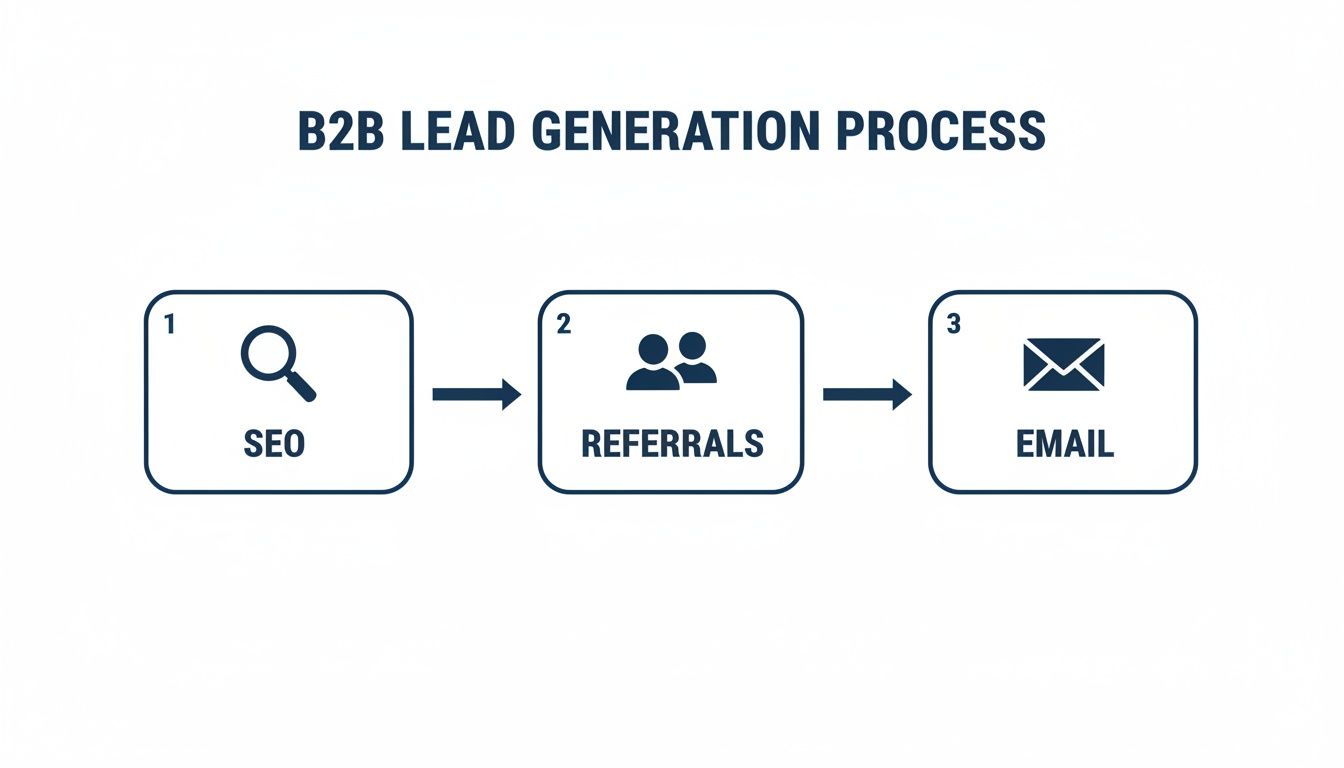
This visual below breaks down how different lead generation channels feed into the top of your sales pipeline. It’s a good reminder that whether a lead comes from SEO, a referral, or an email campaign, they all need to be managed through a central, automated system.
Designing Your Core Automation Workflows
With a solid foundation in place, we can start building the automated sequences that engage your leads 24/7. These workflows are set off by specific triggers—like a form submission or a jump in lead score—and they run pre-planned steps without anyone lifting a finger.
Let’s focus on three automations that will deliver the biggest impact right away.
- The New Lead Nurture Sequence: This is for fresh inquiries. The second someone fills out a form, this workflow kicks in to educate them, build trust, and demonstrate your expertise. It’s not about the hard sell; it’s about delivering value from the very first touchpoint.
- The Re-Engagement Campaign: We all have them—a database full of old, cold contacts. This workflow is designed to wake them up. You send a valuable offer or insightful content to pull them back into an active sales conversation.
- The SQL Handoff Trigger: This is pure efficiency. When a lead's score hits your "sales-qualified" number, this automation instantly creates a task in the CRM, assigns the lead to the right person, and sends a notification so they can follow up while that lead is still red-hot.
These simple workflows ensure no lead gets forgotten and every important action gets an immediate, intelligent response.
Helpful Tip: Your first few nurture messages should be 100% focused on education, not selling. A new lead isn't ready for a demo request. Send them your best case study, an article that solves one of their common headaches, or a quick video explaining a complex concept in their industry.
When marketing's automated touches warm up a lead before sales even gets involved, the whole process clicks. Research shows companies with tight sales and marketing alignment see 65% higher conversion rates when turning target accounts into pipeline opportunities.
Building a Simple Nurture Sequence
To make this tangible, here's a sample 5-step nurture sequence you can build in GoHighLevel. It's a simple, effective mix of email and SMS designed to build rapport without being pushy.
| Step | Action | Purpose |
|---|---|---|
| 1 (Immediate) | Send Email #1 | Deliver the requested asset (e.g., guide) and introduce your company. |
| 2 (Day 2) | Send SMS | A quick, personal check-in to see if they have any questions. |
| 3 (Day 4) | Send Email #2 | Share a relevant case study showing how you solved a similar problem. |
| 4 (Day 7) | Send Email #3 | Offer a different piece of high-value content, like a webinar recording. |
| 5 (Day 10) | Internal Notification | If they've engaged, create a task for a salesperson to make a personal call. |
This sequence is a starting point. The goal is to stay top-of-mind by being consistently helpful, so when they are ready to buy, you're the first person they think of.
Real-World Nurture Messages That Work
Generic, robotic messages are a one-way ticket to the spam folder. Your automated communication has to feel personal and sound like it came from a real human.
Here are a couple of examples you can adapt.
Example Email 1 (Sent Immediately After a Guide Download)
Subject: Here's the guide you requested, [First Name]
Hi [First Name],
Here’s your copy of the "[Guide Name]." Hope you find it useful.
We put it together because we kept seeing manufacturers struggle with [Specific Problem]. Most people find the tip on page 7 about [Specific Tip] saves them a ton of headaches.
No need to reply—just wanted to make sure you got it.
Best,
Karl
Example SMS 2 (Sent 2 Days After Initial Contact)
Hey [First Name], Karl from Machine Marketing here. Just checking in to see if you had any questions about the guide I sent over. Happy to chat if anything comes to mind.
These messages are short, direct, and helpful. They position you as a resource, not just another vendor. If you want to dive deeper into how to set this all up, check out our guide on using a CRM for lead generation.
Measuring Your Pipeline Performance
You can’t fix what you can’t see. A sales pipeline without metrics isn’t a strategic asset; it’s a glorified to-do list that leaves your revenue to chance. This is where we stop guessing what works and start using hard data to make smart, profitable decisions.
Building a simple but powerful reporting dashboard is how you find leaks in your pipeline long before they sink your quarterly numbers. It’s all about turning raw data into a clear, actionable story about your sales process.
Defining Your Essential Pipeline KPIs
Don't drown yourself in vanity metrics. We recommend focusing on a handful of key performance indicators (KPIs) that tell you almost everything you need to know. Think of these as the vital signs for your sales engine.
When one of these numbers looks off, it’s a flashing red light telling you exactly where to look.
- Lead Velocity Rate (LVR): This is your ultimate growth metric. It tracks the month-over-month growth in qualified leads, showing you if your pipeline is expanding or shrinking. A healthy LVR is one of the best predictors of future revenue.
- Stage Conversion Rates: This is your main diagnostic tool. It shows the percentage of deals moving from one stage to the next, pinpointing exactly where opportunities are stalling or falling through the cracks.
- Average Sales Cycle Length: This is the stopwatch for your sales process. It measures the average time it takes for a new lead to become a paying customer. A shorter cycle means a more efficient process and faster cash flow.
Tracking just these three metrics gives you a surprisingly clear picture of your pipeline’s health.
Building and Interpreting Your Reports
Getting these reports set up in a CRM like GoHighLevel is straightforward. You can create dashboard widgets that pull this data in real-time, giving you an always-current snapshot. The real skill is learning how to read the story the data tells.
Let's walk through a real-world scenario. You run a report and notice a huge drop-off between your "Discovery Call Booked" and "Solution Presented" stages. What does that tell you?
This isn't just a random data point—it's a symptom. A low conversion rate this early often means there's a problem with lead quality or initial qualification. Your team might be booking calls with prospects who aren't a good fit, don't have a real problem you can solve, or lack decision-making power.
That single insight gives you an immediate action item. Instead of just telling your team to "book more calls," you can now work with them to tighten up the qualification criteria so they're only spending time on opportunities that can actually close.
Using Data to Ask the Right Questions
Your KPI dashboard should be a conversation starter. It should make you ask better, more specific questions about your sales process.
Here’s how to translate those numbers into actionable conversations:
| If You See This Metric… | Ask Your Team This Question… | This Could Signal a Problem With… |
|---|---|---|
| Low MQL-to-SQL Conversion Rate | "Are the leads marketing is sending us a good fit for our ICP?" | Lead quality or a disconnect between sales and marketing. |
| Long Sales Cycle Length | "Is our follow-up content effectively handling key objections early on?" | Your nurture process or a weak value proposition. |
| High Drop-Off at Proposal Stage | "Are we failing to build enough value before we start talking about price?" | Pricing objections or a weak business case. |
This process shifts you from being a reactive manager putting out fires to a proactive problem-solver. It’s no surprise that companies that define and optimize their sales process around clear data grow revenue 18% faster than their peers. That's a powerful edge that comes from treating your pipeline like the engineered system it ought to be.
Laying It All Out: Your 90-Day Pipeline Build
All the strategy in the world is just talk without a plan. A high-performance sales pipeline isn't built in an afternoon, but it also shouldn't take a year. We've found the sweet spot is a focused 90-day sprint.
We're going to break this down into three manageable, 30-day phases: Foundation, Fuel & Automation, and Measurement & Refinement. You have to pour the concrete before you can put up the walls.
Phase 1: The Foundation (Days 1-30)
Your first month is all about getting the blueprint right. If you rush this part, the whole structure will be wobbly. The singular focus here is on clarity and setup. By day 30, you need to know exactly who you're selling to and have a system ready to handle leads.
Your Actionable Checklist:
- Finalize Your Ideal Customer Profile (ICP): This is non-negotiable. Use data on your best customers to define the common threads—firmographics, tech they use, and problems you solve. This document becomes your North Star.
- Define and Build Your Pipeline Stages: Map out the 5-7 core stages that reflect how your customers actually buy. Then, build those exact stages inside your CRM, like GoHighLevel.
- Complete Basic CRM Housekeeping: Import your existing contacts, set up custom fields that match your ICP criteria, and get your team logged in and comfortable with the basics.
What to Look For: You will be tempted to start generating leads. Don't. Your only job right now is to build a rock-solid container. A little patience here saves you from massive headaches later.
Phase 2: Fuel and Automation (Days 31-60)
The foundation is set. Now it’s time to flip the switch and start pumping fuel into the system. This month is about activating your first lead channel and building the automated workflows that do the heavy lifting. Don't try to launch five campaigns at once. Pick one and get it right.
Your Actionable Checklist:
- Launch One Lead Generation Campaign: Pick the channel with the highest potential right now. For most manufacturers, that’s SEO-driven content or a simple referral program. Get it live. This could be publishing your first cornerstone blog post or emailing top clients with a referral offer.
- Build Your First Nurture Sequence: Create the 5-step email and SMS workflow we designed earlier. This ensures every new lead gets an immediate, helpful, and consistent follow-up.
Phase 3: Measurement and Refinement (Days 61-90)
Leads are starting to trickle in and move through your pipeline. This final 30-day stretch is where you shift from building the system to actively managing it. It’s all about measurement, learning, and making your first data-driven tweaks.
Your goal here is to establish the feedback loop that drives continuous improvement. You'll set up your main dashboard, look at the early numbers, and start asking, "What's working? What's not? And where are the bottlenecks?" This is the beginning of true pipeline optimization.
Frequently Asked Questions
How Many Stages Should My Sales Pipeline Have?
There’s no single right answer, but most B2B businesses do just fine with 5-7 stages. The key isn’t the number, but what each stage represents.
Don't overcomplicate it. A stage needs to mark a genuine milestone in the buyer's journey—not just a task your team checked off. Think in terms of progress: New Lead, Contacted, Qualified, Proposal Sent, Negotiation, and Closed-Won/Lost. You can always add more detail later as you get a better feel for your sales cycle.
What Is the Difference Between a Sales Pipeline and a Sales Funnel?
They’re related, but they look at the world from two different perspectives.
A sales funnel is a marketing concept. It's the big-picture view of your customer's journey, starting wide at the top with many prospects and narrowing to a few paying customers at the bottom.
A sales pipeline, on the other hand, is your team's operational view. It's the series of concrete steps your salespeople take to move a deal forward, from a new lead to a signed contract. The pipeline is the playbook for managing the deals currently in your funnel.
How Often Should I Review My Sales Pipeline?
It depends on your goal. Your sales team should be living in the pipeline daily or weekly to prioritize tasks and ensure active deals don't fall through the cracks.
From a strategic level, you should analyze the whole system monthly or quarterly. This is when you review the bigger metrics—conversion rates between stages, sales cycle length, and where bottlenecks are forming. That's how you spot trends and find opportunities to improve the entire process.
Building a predictable, automated sales system is the single most powerful lever you can pull for growth. At Machine Marketing, we specialize in designing and implementing the exact systems we've walked through in this guide.
If you're ready for a clear, actionable roadmap to scale your business, let's talk. Book a discovery call with us, and we'll help you diagnose the gaps in your current system.