If your marketing feels like a shot in the dark, you’re not alone. We see this all the time—the root cause is often that businesses are marketing to a faceless crowd instead of a real person. The solution is to stop guessing and start building buyer personas: detailed, research-backed profiles of who your ideal customer really is.
This shift takes your marketing from a game of chance to a calculated, engineering-minded strategy. In this guide, we'll show you how to diagnose who your best customers are and build the personas that will transform your marketing results.
Why Your Marketing Feels Like Guesswork
Does it feel like you’re shouting into the void? Many B2B companies, especially in manufacturing, launch campaigns for excellent products only to see weak, unpredictable results.
The problem is almost always the same: they’re marketing to a vague idea of a "customer" instead of a well-defined person with specific problems, goals, and a distinct way of communicating. This generic approach is a recipe for wasted ad spend and stagnant growth. When you don't know exactly who you're talking to, your message gets diluted, missing the specific pain points that resonate with the plant managers, engineers, or procurement officers you need to reach.
Shifting from Guesswork to Precision
The fix is to build a marketing system based on evidence, not assumptions. Creating buyer personas is the foundation of this process. Think of it less as a branding exercise and more as a diagnostic tool for understanding who your best customers are and what they need from you.
Once you have these profiles defined, everything else clicks into place. You can:
- Sharpen Your Messaging: Craft copy that speaks directly to a plant manager’s obsession with efficiency or an engineer’s demand for technical accuracy.
- Optimize Your Channels: Stop wasting money on platforms your audience ignores and focus your budget where they actually look for solutions.
- Generate Qualified Leads: Attract prospects who are a genuine fit, which shortens your sales cycle and makes your sales team more effective.
This transition from a fuzzy strategy to a focused, data-backed system is what produces clear, actionable customer profiles.
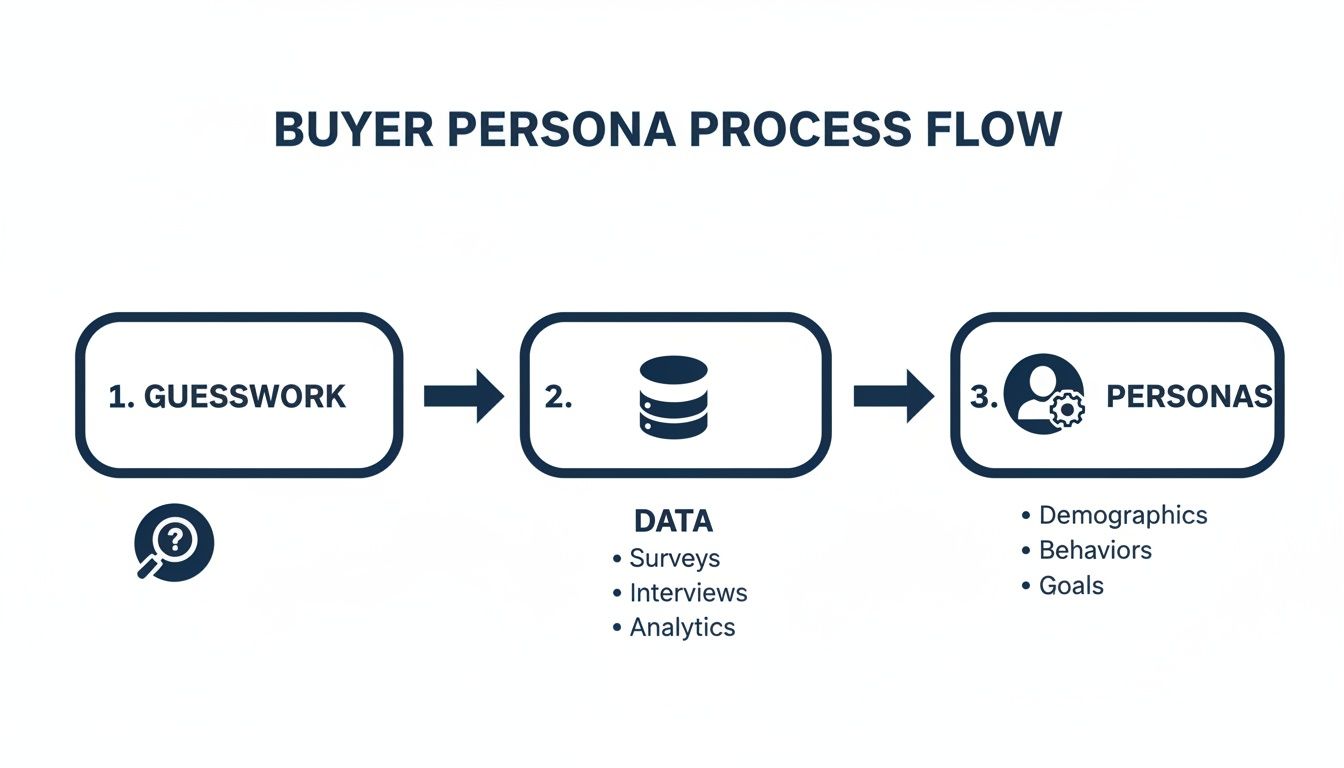
This shift isn't a new fad. While buyer personas were a niche concept in the early 2000s, interest has exploded. By the mid-2010s, research showed that 44% of marketers had adopted them, marking a major turning point from intuition-based to research-driven marketing. You can dig deeper into these buyer persona statistics and their impact to see how powerful this approach is.
The difference in how you operate is night and day. A persona-driven approach changes your entire team's perspective from "what do we want to sell?" to "what problem does our customer need to solve?"
Traditional Marketing vs Persona-Driven Marketing
| Attribute | Traditional Marketing Approach | Persona-Driven Marketing Approach |
|---|---|---|
| Focus | Product features and company achievements | Customer problems, goals, and challenges |
| Messaging | Broad, one-size-fits-all language | Specific, tailored language for each persona |
| Content | Company-centric (brochures, spec sheets) | Customer-centric (how-to guides, case studies) |
| Channels | Based on assumptions or past habits | Based on data about where personas spend time |
| Success Metric | Vague metrics like impressions or traffic | Qualified leads and conversion rates |
Ultimately, building personas is about trading assumptions for empathy and hard data. It’s the single most effective way to ensure your marketing budget is an investment, not an expense.
Finding the Truth in Your Existing Data
Great buyer personas are built on evidence, not assumptions. Before you interview a single customer, you’re likely sitting on a goldmine of objective truth within your business systems. This is the diagnostic phase—where you stop guessing and start gathering the hard facts.
Think of it like an engineer inspecting a blueprint. You need to understand the existing structure before making any improvements. The data you already have tells a powerful story about who your best customers are and how they behave.

Uncovering Quantitative Clues
Your first stop should be your quantitative data—the numbers that reveal patterns and trends. This information gives you the skeleton of your persona, a solid, fact-based starting point. The goal here is pure collection.
Here are the questions to ask yourself as you dig into these key areas:
-
Your CRM System (like GoHighLevel): Who are your top 20% of customers—the ones driving the bulk of your revenue? What common threads do you see in their job titles, company size, or industry? Which lead sources, like organic search or a specific trade show, consistently deliver these high-value clients?
-
Website Analytics (e.g., Google Analytics): Which pages and blog posts do your best prospects visit most? This behavior is a direct signal of the problems they're actively trying to solve. Understanding the basics of marketing analytics is non-negotiable here; it turns raw traffic data into real insights about user intent.
-
Sales Team Notes: What are the most frequent questions prospects ask on a demo? What are the common deal-breakers or winning arguments? These notes often contain direct quotes that are pure gold for building out a persona.
This quantitative work gives you a data-driven picture of who is buying and what they care about on a measurable level.
Mining for Qualitative Gold
Once you have the numbers, it's time to add context and emotion. Qualitative data helps you understand the why behind the what. This is where you uncover the real-world frustrations, motivations, and challenges that drive a purchase.
Diagnosis Tip: Your quantitative data tells you what is happening. Your qualitative data tells you why it matters to your customers. Both are essential for creating a persona that feels real and is truly useful.
Look for these narrative clues hiding in your systems:
- Customer Support Tickets: What are the most common problems your customers bring up? A recurring issue might highlight a major pain point for a certain type of user.
- Online Reviews and Social Media: How do people talk about your product in their own words? Pay close attention to the specific language they use to describe their wins and struggles.
- Win/Loss Reports: Why did you win your best deals? Just as important, why did you lose the ones you were sure you'd close? The reasons cited by prospects who went with a competitor are incredibly valuable.
For businesses looking to pull all this information together, a Customer Data Platform (CDP) can be a game-changer. It centralizes customer interactions from all these sources, making it easier to see the complete picture.
By combining the hard numbers with these human stories, you graduate from a simple customer profile to a rich, three-dimensional buyer persona.
Uncovering the Why Behind the Data
Your analytics tell you what people are doing, but they can't tell you why. To get the full story, you need to have candid conversations with two key groups: your internal customer-facing teams and your actual customers. This is how you move from spreadsheets to stories and find the context that makes a persona truly useful.
Without talking to real people, you’re just looking at charts and numbers—not a true picture of your customer.

Start With Your Internal Experts
Your sales and customer service teams are on the front lines every day. They hold a goldmine of raw, unfiltered feedback—the real objections, the urgent problems that trigger a purchase, and the exact language customers use. Tapping into this knowledge is a fast, low-cost way to get deep insights right out of the gate.
Schedule a few quick, informal chats. Make it clear this isn’t a performance review; you’re on a mission to understand the customer better so you can bring them higher-quality leads.
Questions to Ask Your Sales Team:
- What’s the one question that immediately tells you if a lead is a perfect fit or a waste of time?
- What’s the most common “aha!” moment prospects have during a demo?
- Walk me through the last deal you lost. What was the real reason we didn't win?
- Which competitors keep coming up, and what are prospects saying about them?
Questions to Ask Your Customer Service Team:
- When customers call for help, what problem are they really trying to solve?
- Describe your happiest, most successful customers. What makes them so good at using our solution?
- What’s a common frustration you hear that the rest of the company probably doesn’t know about?
- What are the top three things we could do to make our customers' lives easier?
These conversations will give you a solid baseline and help you see patterns in your audience’s mindset. Our guide on how to identify your target audience digs deeper into this initial discovery phase.
Talk to Your Customers to Get the Full Story
Now, go straight to the source. Customer interviews are where you discover the nuances that data will never reveal. You’ll hear their goals in their own words, learn what keeps them up at night, and find out where they actually look for information.
Aim to interview a handful of your best customers and, if you can, a few who recently chose a competitor. You often learn far more from those who challenge you or decided to go another way.
Actionable Tip: Keep interviews to a tight 20-30 minutes and offer a small thank-you, like a gift card. Be clear that this is for research, not a sales call. You’ll be amazed at how willing people are to share when they feel you’re genuinely listening.
The secret is to ask open-ended questions that encourage storytelling, not simple "yes" or "no" answers. You aren't trying to validate your assumptions; you're looking to be surprised.
A Simple Customer Interview Script to Start With
- Role & Responsibilities: "Could you tell me about your role? What does a typical day look like?"
- Goals & KPIs: "When you think about success in your job, what does that look like? How is your performance measured?"
- Challenges & Pains: "What are the biggest roadblocks you face in trying to hit those goals?"
- Information Sources: "When you’re stuck on a professional problem, where do you turn for answers? Any specific blogs, publications, or experts you follow?"
- The Buying Journey: "Take me back to the moment you realized you needed a solution like ours. What was happening that made you start looking?"
Listen closely for the exact words and phrases they use. Those terms are pure gold for your website copy, ads, and email campaigns.
Building Your Actionable Persona Document
The research is done. You've dug through your data, and most importantly, you've listened to your team and customers. Now, how do you shape that mountain of raw notes and transcripts into a tool that actually guides your marketing and sales teams?
This is where synthesis comes in. The goal isn't just to list facts; it's to weave those data points into a coherent story for each of your key customer segments. A great persona document is the compass that keeps your entire company from drifting back into guesswork.
From Raw Data to a Coherent Story
First, start looking for patterns. Spread out your interview notes and data summaries and begin grouping the common themes that jump out.
Are you noticing that multiple plant managers bring up downtime as their single biggest fear? Do several engineers use the exact same technical slang? These are the threads you'll use to build your persona. Your job is to pinpoint the dominant trends that define a specific type of customer.
The most powerful persona documents are sharp and focused. They cut through the noise to highlight the critical insights that directly impact a buying decision. If a detail doesn't help your team write better content or have a more relevant sales call, leave it out.
Give each persona a real-sounding name, like "Plant Manager Pete" or "Lead Engineer Emily." It’s a simple trick, but it instantly makes them feel like real people instead of abstract segments. The final document should be a clean, one-page snapshot that a new hire can absorb and use in five minutes.
The Essential Components of an Actionable Persona
For manufacturers and B2B businesses, a buyer persona must be practical. Forget generic fields like "hobbies" unless they tie directly to their professional life. You need to zero in on the information that drives business decisions.
We've laid out the essential components below and filled it out using a 'Plant Manager' persona as an example. This structure captures information that translates directly into sharper messaging, better content, and more effective campaigns.
Essential Components of a B2B Buyer Persona
| Component | What to Include | Example for 'Plant Manager Pete' |
|---|---|---|
| Role & Responsibilities | A brief summary of their day-to-day job and what they are accountable for. | "Oversees daily production, manages a team of 50+, responsible for plant safety, output quotas, and operational budget." |
| Key Performance Indicators (KPIs) | The specific metrics used to measure their job performance. | "Uptime/Downtime percentages, production output goals (units per hour), and adherence to the quarterly maintenance budget." |
| Core Challenges & Pains | The primary frustrations and obstacles that get in the way of hitting their KPIs. | "Unexpected equipment failure causing costly downtime; struggling to get budget approval for preventative maintenance." |
| Buying Triggers | The specific events or problems that would cause them to actively seek a solution. | "A major machine breakdown that halts production; a failed safety audit; a new mandate from corporate to improve efficiency by 10%." |
| Common Objections | The typical pushback or reasons they would hesitate to buy from you. | "'The upfront cost is too high.' 'Implementation will disrupt our production schedule.' 'How do I know this will actually deliver the ROI you're promising?'" |
| Watering Holes | Where they go for information and professional development. | "Industry trade publications like Reliable Plant Magazine, LinkedIn groups for manufacturing professionals, and attending major trade shows." |
| A Defining Quote | A direct quote from your interviews that captures their primary mindset. | "I can't afford any surprises. My job is to keep this line running smoothly, safely, and on budget. Everything else is just noise." |
Following a structured approach like this transforms your research from a pile of data into a genuine strategic asset. It gives your team the clarity they need to stop talking at your audience and start communicating with them.
Putting Your Personas to Work in Your Marketing
So you’ve built your detailed buyer personas. That’s a huge step, but it’s not the finish line. A persona document that collects dust in a shared drive is useless. The real transformation happens when you stop having personas and start actively using them to guide every marketing and sales decision.
This is where you weave these insights into your day-to-day operations to deliver communication that connects with your ideal customers. This is how you stop guessing and start engineering predictable results.
Integrating Personas Into Your CRM
Your CRM—whether it's GoHighLevel or another platform—is the central hub for your customer interactions. To make your personas actionable, embed them right into that system. The cleanest way to do this is by creating a simple custom field for "Persona."
This single step lets you tag every contact with their corresponding persona, like "Plant Manager Pete" or "Lead Engineer Emily."
Once you have this tagging system in place, the possibilities open up:
- Segment Your Lists: Need to send an email just to Plant Managers? Now you can filter your list and do it in seconds.
- Trigger Targeted Automations: Build workflows that only run for a specific persona, delivering content that speaks to their world.
- Personalize Sales Outreach: Your sales team gets immediate context, allowing them to tailor their conversation from the very first call.
This simple change turns your persona from a static PDF into a dynamic tool that shapes every customer touchpoint.

By operationalizing your personas within your CRM, you’re creating a direct line between your research and the activities that generate revenue.
Tailoring Your Messaging and Content
Now that your contacts are tagged by persona, you can ditch one-size-fits-all messaging. Your personas should be the first filter you run every piece of content through.
Before you publish a blog post or launch an email campaign, ask one simple question: "Who is this for, and does it solve their specific problems in their language?"
This question grounds your content in your customer's reality. For example:
- For Plant Manager Pete: He cares about ROI, uptime, and staying on budget. Your content should reflect that with headlines like, "3 Ways to Cut Unplanned Downtime by 20%."
- For Lead Engineer Emily: She needs technical details and performance data. A whitepaper comparing material durability would get her attention.
This targeted approach should extend everywhere. You can run ad campaigns on LinkedIn aimed squarely at users with "Engineer" in their job title, serving them content designed just for them. This is the foundation of a powerful marketing messaging framework that connects with each segment of your audience.
Using Personas to Qualify and Score Leads
Your personas are also the perfect blueprint for a smart lead scoring system. Because you know the key attributes of your ideal customers—job title, company size, industry—you can assign points to incoming leads to help your sales team focus on the best opportunities.
A lead who fits your "Plant Manager Pete" persona is worlds more valuable than an undefined inquiry. Your system should automatically flag them as a high-priority contact.
This is all about making sure your sales team spends their time on deals most likely to close. Once your personas are locked in, you can build systems to qualify leads automatically. For instance, knowing the ideal characteristics of your personas is essential when building a HubSpot Fit Score.
The data backs this up: 56% of companies generated higher-quality leads using personas, 36% achieved shorter sales cycles, and 24% generated more leads overall. When you systematically apply your persona insights, you build a more efficient, effective, and profitable marketing engine.
Common Questions About B2B Buyer Personas
Even with a solid plan, building buyer personas for the first time can bring up practical questions. You want to ensure the work pays off. Let's get direct, no-fluff answers to the most common questions we hear from B2B businesses.
Our goal is to help you sidestep common roadblocks and put these personas to work.
How Many Personas Do I Really Need?
The answer is almost always: fewer than you think. It’s easy to create a persona for every slight customer variation, but that just leaves you with weak, overlapping profiles that are impossible to act on.
For most B2B companies, starting with two to four core personas is the sweet spot. That's enough to cover your most valuable and distinct customer segments without getting overwhelmed.
Focus on the roles most critical to the buying decision. For a manufacturer, this might look like:
- The End User: The engineer or technician who uses your product.
- The Decision-Maker: The plant manager or department head who holds the budget.
- The Influencer: The purchasing agent who handles logistics.
Start with the roles that drive the most revenue. You can always build more later if you find a truly distinct segment that needs its own messaging.
How Often Should I Update My Personas?
Your buyer personas shouldn't be carved in stone. Think of them as living documents that need a regular check-in to stay sharp and accurate. Markets change, customer needs evolve, and new challenges are always popping up.
Our recommendation: A full review of your buyer personas at least once a year. But you should also plan to revisit them anytime there’s a major shift in your business or the market.
Give them a quick look if you:
- Launch a major new product or service.
- Move into a new industry or geographic area.
- Notice a big change in customer behavior in your analytics.
- Hear from your sales team that their conversations no longer match the persona documents.
Keeping your personas current ensures your marketing stays connected to the real-world needs of your audience.
What if I Sell to a Buying Committee?
Welcome to the B2B world. It's rare for one person to make a big purchase alone. You're almost always selling to a committee, which can include everyone from a C-level executive to a frontline engineer.
This is exactly why having multiple, distinct personas is so critical. Your job is to understand the unique goals and pain points of each person involved and create content that speaks directly to them.
The engineer wants specs and data sheets. The plant manager needs to see the ROI and efficiency gains. The CFO is looking at the total cost of ownership. Your marketing must address all of these different needs.
This is where persona-based segmentation shines. It's no surprise that more than 90% of companies that exceed their revenue goals segment their database by persona. You can dig into more of these compelling buyer persona statistics to see the full impact. When you create targeted content for each member of the buying committee, you build consensus and guide the entire group toward saying "yes."
Ready to stop guessing and build a marketing system that delivers predictable results? At Machine Marketing, we specialize in diagnosing marketing gaps and building foundational systems for manufacturers and B2B operators.