If your sales pipeline is full but your conversion rates are flat, the problem isn't a lack of leads—it's a lack of focus. We see this all the time. The root cause is often a broken or nonexistent lead qualification process, forcing your sales team to waste time on prospects who will never buy.
In this article, we’ll show you how to diagnose the hidden costs of unqualified leads and give you a step-by-step system for building a qualification process that works. The goal is to shift your focus from lead quantity to lead quality, ensuring your sales team only spends time on opportunities with a real chance of closing.
Diagnosing the Hidden Costs of Unqualified Leads
Is your sales team busy but not productive? Chasing every lead that comes through the door feels like progress, but it's often a massive drain on your most valuable assets: time, money, and morale. A broken qualification process is one of the most common—and most overlooked—roadblocks to growth.
When your reps are stuck on calls with people who were never going to buy, it kicks off a domino effect of inefficiency that you can feel across the entire business. The real costs start to pile up fast.
The True Financial and Operational Drain
The most obvious cost is wasted time. Research shows sales reps spend a huge chunk of their day on non-revenue-generating activities, and chasing dead-end leads is a prime offender. Every hour spent on a poorly qualified prospect is an hour that could have been invested in a high-potential deal.
But the damage goes deeper than just lost hours. It hits your bottom line in ways you might not be tracking:
- Sky-High Cost Per Acquisition (CPA): You spend good marketing dollars to bring in those leads. When they don't convert because they were a bad fit from the start, your CPA goes through the roof.
- Tanking Sales Team Morale: Hearing "no" all day from unqualified prospects is demoralizing. It leads to burnout and high turnover, forcing you to spend even more on recruiting and training new reps.
- Wildly Inaccurate Sales Forecasting: A pipeline stuffed with unqualified leads gives you a false sense of security. Your revenue forecasts become unreliable, making strategic planning a guessing game.
- Strained Marketing-Sales Alignment: When marketing sends over a high volume of junk leads, it creates serious friction with sales. Sales feels their time is being wasted, and that misalignment kills any chance of effective collaboration.
The Diagnosis: An unqualified lead isn't just a missed opportunity—it's an active cost center. It eats up resources that should be funding conversations with prospects who can actually become customers.
Shifting Your Mindset from More to Better
The first step to fixing this is a mental one. You have to ditch the "more leads is always better" mindset and adopt a "better leads are everything" strategy. A shorter, healthier pipeline of genuinely qualified opportunities is infinitely more valuable than a bloated list of contacts who will never write you a check.
This shift means committing to building a system. You need a repeatable process for figuring out a lead's potential before it eats up your sales team's time. The goal is to get your marketing efforts perfectly aligned with real sales outcomes, ensuring every lead passed over has been properly vetted and is worth the follow-up.
In the sections ahead, we’ll walk you through exactly how to build that system from the ground up.
Choosing The Right Lead Qualification Framework
Flying blind in sales is a recipe for disaster. Without a solid framework to qualify leads, your team is left relying on gut feelings—a reactive approach that stalls deals and burns through resources. So, what's the solution?
A good framework isn't about adding red tape; it's about creating clarity. It provides a shared language and a repeatable system for diagnosing a prospect's real potential. The goal is simple: have purposeful conversations that move qualified buyers forward and respectfully disqualify those who aren't a good fit.
In the tough world of B2B sales, this structured approach is no longer optional. The average conversion rate from lead to Marketing Qualified Lead (MQL) is just 31%. But companies that master their qualification process see that number jump to 40%. That’s a huge difference, especially when you consider that a staggering 79% of marketing leads never convert, mostly because they were a poor fit to begin with.
This decision tree shows exactly what happens when unqualified leads clog up the pipeline. A full funnel quickly turns into a graveyard of stalled deals and wasted effort.
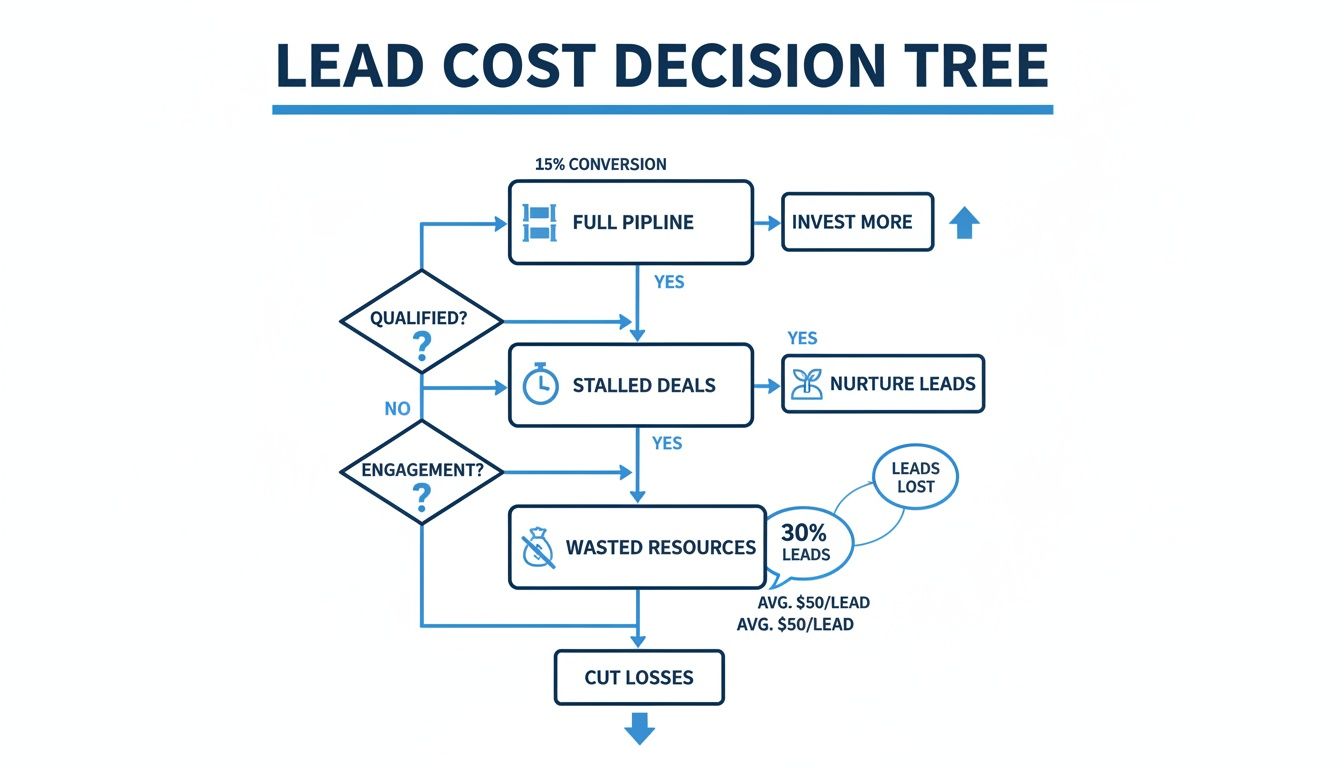
Without a clear system, your team's time and money are spent chasing prospects who were never going to sign on the dotted line. Let's dig into three proven frameworks that will stop that from happening.
Qualification Frameworks at a Glance
Picking a framework can feel overwhelming, so here's a quick rundown of the big three. Think of this as a cheat sheet to help you match the right tool to your specific sales environment. Each one has its strengths, whether you're dealing with quick transactional sales or navigating a complex, multi-stakeholder deal.
| Framework | What It Stands For | Best For | Key Question to Ask |
|---|---|---|---|
| BANT | Budget, Authority, Need, Timeline | Transactional sales, shorter sales cycles, and teams new to structured qualification. | "Do you have a budget allocated for this project in the current quarter?" |
| MEDDIC | Metrics, Economic Buyer, Decision Criteria, Decision Process, Identify Pain, Champion | Complex enterprise sales, high-value deals, and long buying cycles with multiple stakeholders. | "What specific metrics will you use to measure the success of this implementation?" |
| CHAMP | Challenges, Authority, Money, Prioritization | Consultative, customer-centric sales processes where understanding the prospect's pain is the top priority. | "What are the biggest challenges you're facing that led you to look for a solution now?" |
Ultimately, the best framework is the one your team will actually use. Consistency is key. Now, let's explore what makes each one tick.
BANT: The Classic Starting Point
BANT has been around forever, but its simplicity is its biggest asset. It’s perfect for teams just starting to build a structured qualification process.
It’s an acronym that helps you check the four most essential boxes:
- Budget: Can they actually afford your solution?
- Authority: Are you talking to the person who can sign the check?
- Need: Is there a real business pain you can solve?
- Timeline: Do they have a clear deadline for making a decision?
BANT is a fantastic first-pass filter. It helps reps quickly weed out prospects who clearly lack the means or immediate intent to buy, especially in sales cycles that are relatively straightforward.
Real-World Example: Your rep is talking to a plant manager about a new CNC machine. Using BANT, they quickly learn the manager has a need and a timeline for Q4. However, the budget is controlled by a corporate procurement officer they've never met. This instantly clarifies the next step: get a meeting with the real economic buyer.
MEDDIC: For The Big, Complex Deals
When you’re selling high-ticket equipment or a complex technical solution, BANT just won't cut it. You need to go deeper. That's where MEDDIC comes in. This is an enterprise-grade framework designed for navigating labyrinthine buying committees and six-to-twelve-month sales cycles.
MEDDIC gets your team asking the tough questions:
- Metrics: What are the quantifiable business outcomes they expect? (e.g., ROI, 15% reduction in scrap, 20% increase in uptime).
- Economic Buyer: Who has the ultimate profit-and-loss responsibility for this purchase?
- Decision Criteria: What are the specific technical and business requirements they'll use to judge all vendors?
- Decision Process: What are the exact steps, from technical validation to legal review, needed to get a signature?
- Identify Pain: What’s the core business problem, and what are the painful consequences of doing nothing?
- Champion: Who on the inside is selling on your behalf when you’re not in the room?
MEDDIC forces your reps to think like a consultant, not just a salesperson. It's essential when selling to engineers and operations leaders who live by the numbers and need a rock-solid business case.
CHAMP: A More Customer-Centric Approach
CHAMP is a modern spin on BANT that flips the script to be more customer-focused. Instead of leading with "Do you have the money?", it starts with the prospect's problems.
Here’s the breakdown:
- Challenges: What pain points are they trying to solve right now?
- Authority: Who is involved in the decision? (This acknowledges that it's often a committee, not a single person).
- Money: What are the financial consequences of their current challenges, and what have they budgeted to fix them?
- Prioritization: How important is solving this problem compared to everything else on their plate?
This framework naturally encourages a more consultative sales motion. By leading with challenges, your reps position themselves as problem-solvers first, building trust and uncovering the true motivation behind a potential purchase. We dive deeper into these customer-first strategies in our guide to inbound marketing lead generation.
There's no single "best" framework—it all depends on your business. Look at your average deal size, the complexity of your solution, and your typical sales cycle. The most important step is to choose one, train your team on it, and apply it consistently on every single call.
Building Your Practical Lead Scoring System
A qualification framework like BANT or MEDDIC gives your team a shared language, but it's still a manual process. How do you automatically bubble the best leads to the top so your sales team isn't digging for gold?
This is where lead scoring completely changes the game. It’s how you turn subjective guesswork into a data-driven science.
At its core, lead scoring is a simple concept: you assign points to leads based on who they are (fit) and what they do (interest). By creating a scoring model, you're building an engine that tells your sales team exactly who to call next, based on who is most likely to close.
The goal is to set a threshold. When a lead’s score crosses that line, they get automatically flagged as a Marketing Qualified Lead (MQL) or Sales Qualified Lead (SQL), signaling they're ready for immediate follow-up.
Defining Your Scoring Criteria
A solid lead scoring model is built on two types of data. When you combine them, you get a full picture of a prospect's real potential.
- Explicit Data (Fit): This is information a lead gives you directly, usually through a form. It tells you how well they match your Ideal Customer Profile (ICP).
- Implicit Data (Interest): This is all about their behavior—the digital breadcrumbs they leave behind. It reveals their level of engagement and buying intent.
An Engineering Mindset for Scoring: Don't overcomplicate this at the start. Your first lead scoring model won't be perfect, and that's okay. The goal is to build a solid V1.0, get it running, and then refine it based on real-world sales data.
Assigning Point Values That Actually Matter
For this system to work, you need to assign point values that accurately reflect a lead's value and intent. The best way to start? Go talk to your sales team. They're on the front lines and know what a good lead looks like.
Questions to Ask Your Sales Team:
- "Which job titles are the real decision-makers we talk to?"
- "What company size usually has the budget for our solutions?"
- "What's the difference between someone who requests a demo versus someone who just downloads a whitepaper?"
Use their answers to build out a scoring matrix. Here’s a practical example you can adapt for your own business.
Sample Lead Scoring Matrix
| Criteria Category | Detail | Assigned Points |
|---|---|---|
| Explicit Data (Fit) | Job Title (e.g., VP of Operations, Plant Manager) | +20 |
| Job Title (e.g., Engineer, Technician) | +10 | |
| Company Size (100-500 employees – your sweet spot) | +15 | |
| Industry (e.g., Manufacturing, Industrial) | +15 | |
| Unqualified Industry (e.g., Retail) | -50 (Disqualify) | |
| Implicit Data (Interest) | Requested a Demo or Quote | +30 |
| Visited High-Value Page (e.g., Pricing, Case Studies) | +15 | |
| Downloaded Technical Spec Sheet | +10 | |
| Attended a Webinar | +10 | |
| Opened a Marketing Email | +2 |
Setting the MQL Threshold
Once your matrix is built, you need to define the score that triggers the handoff from marketing to sales. This is your MQL threshold.
A great way to find your starting point is to analyze your last 10-15 closed-won deals. Run those customers through your new scoring model and see what their scores would have been. What was the average? Use that as your initial benchmark.
For example, if your best customers consistently scored around 85 points, you might set your MQL threshold at 80. Now you have a rule: any lead who hits that score gets automatically flagged in your CRM for sales to jump on. This simple automation prevents hot leads from going cold and ensures your reps are always working the most engaged prospects first.
Automating Lead Handoff with Your CRM
If you're still managing leads by hand, you're setting your team up to fail. It's a system designed for bottlenecks, relying on reps to remember every follow-up and letting high-value prospects go cold. The answer isn't to work harder—it's to build a smarter system that automates the handoff between marketing and sales.
This is where your Customer Relationship Management (CRM) system becomes your most valuable player. A well-configured CRM is more than a digital rolodex; it's the central nervous system for your entire sales operation. It’s the engine that guarantees the right lead lands with the right person at exactly the right time.

Speed is everything. We know from experience that businesses responding to a lead within five minutes are 9x more likely to convert them. And yet, a staggering 79% of leads are lost simply because they aren't nurtured properly. For businesses where a single lead can cost hundreds, that’s a massive, expensive leak in your pipeline.
Building Your Automated Handoff Workflows
Let's make this practical. We often set up these systems for clients using platforms like GoHighLevel, but the logic holds true for most modern CRMs, whether it's HubSpot or Salesforce. The idea is to create simple "if this, then that" automations that eliminate all the guesswork.
First, you need to define the trigger. What specific action tells your system a lead is officially "sales-ready"? This is where the lead scoring threshold we covered earlier comes into play.
- Trigger: Lead Score is greater than or equal to 80.
As soon as a lead hits that number, a series of automated actions should fire off instantly. This creates a seamless, immediate handoff, every single time.
Key Automation Recipes to Implement
Here are a few essential workflows you can build to ensure no qualified lead ever goes cold again. These steps move a contact from a marketing-nurtured lead to a sales-engaged opportunity without anyone lifting a finger.
-
Change Lead Status and Ownership
- Action: Automatically flip the lead’s status from "MQL" to "SQL."
- Action: Reassign the lead owner from a general marketing inbox to a specific sales rep. You can set this up based on territory, product specialty, or a simple round-robin to distribute leads evenly.
-
Create an Internal Notification and Task
- Action: Send an instant alert to the assigned sales rep via email or Slack. Keep it direct: "New SQL Assigned: [Lead Name], Score: [Score]. View contact record now."
- Action: Create a task in the rep’s CRM dashboard that’s due today. The task should be crystal clear: "Call [Lead Name] regarding their interest in [Product/Service]."
-
Trigger a "First Touch" Email Sequence
- Action: Immediately send a personalized email that looks like it came directly from the assigned sales rep. This isn't a glossy marketing blast; it’s a plain-text email that feels human. Something as simple as: "Hi [First Name], I saw you were looking at our [Product Page]. I'm the specialist for your area and wanted to see if you had any questions. When is a good time for a quick call?"
Pro Tip: Use your CRM's personalization tokens to pull in data like the specific page a lead visited or the whitepaper they downloaded. This makes your automated outreach feel incredibly relevant and timely. We dig deeper into how to make your CRM a lead generation powerhouse in our detailed guide.
This automated system vaporizes the delay between qualification and sales action. It creates clear accountability by assigning a task directly to a rep. And it guarantees a consistent, professional first touch with every single qualified prospect, setting the stage for a great sales conversation.
Measuring and Optimizing Your Qualification System
You can't improve a system you don't measure. Building frameworks and automating handoffs are fantastic first steps, but the real transformation comes from creating a feedback loop. A truly effective lead qualification process isn't a "set it and forget it" project; it’s a dynamic system you constantly monitor, diagnose, and refine.
Think of your qualification process like an engineering system. You need hard data to spot inefficiencies and find opportunities for improvement. Without tracking the right numbers, you're flying blind—completely unable to see if your lead scoring is accurate or if your sales team is actually closing the leads marketing sends their way.

Identifying Your Essential KPIs
Don't get overwhelmed trying to track a hundred different metrics. You just need a handful of Key Performance Indicators (KPIs) that give you a clear, honest picture of your system's health. These are the numbers that tell you if you're actually getting better at turning interest into revenue.
Here are the critical KPIs you should be tracking:
- MQL-to-SQL Conversion Rate: This is the big one. It measures the percentage of Marketing Qualified Leads your sales team accepts as Sales Qualified Leads. A low rate here is a major red flag, signaling a serious disconnect between what marketing thinks is a good lead and what sales knows is a good lead.
- Lead Velocity Rate (LVR): This metric tracks the month-over-month growth in your number of qualified leads. If your LVR is consistently growing, it's a strong predictor of future revenue growth. It tells you if the top of your qualified funnel is expanding.
- Sales Cycle Length: How long does it actually take to turn a qualified lead into a paying customer? When the sales cycle for qualified leads gets shorter, it’s a clear sign your process is working. It means reps are spending less time on dead ends.
- Lead-to-Close Conversion Rate: Of all the leads that become SQLs, how many actually close? This is your bottom-line metric for both sales effectiveness and lead quality.
We often advise clients to create a simple dashboard right inside their CRM to keep these numbers front and center. When the data is easy to see, it’s much easier to act on. For a deeper look into the data side, check out our guide on what is marketing analytics.
Building a Continuous Improvement Loop
Data is only useful if you use it to make better decisions. The final, critical piece is establishing a regular rhythm for review and optimization. This is how you create a feedback loop that keeps your sales and marketing teams aligned and constantly improving.
This isn't about pointing fingers; it's about solving problems together. We recommend a monthly or quarterly meeting with key stakeholders from both marketing and sales. The agenda should be simple, data-driven, and focused on action.
Your Review Meeting Checklist
- Review the KPI Dashboard: Start with the numbers. Is the MQL-to-SQL rate trending up or down? Is the sales cycle getting shorter? Get a baseline of what’s happening.
- Analyze Closed-Won Deals: Look at the deals you did win. What were their lead scores? What marketing channels did they come from? This tells you what's working so you can double down on it.
- Analyze Closed-Lost Deals: Just as importantly, why did you lose deals that were initially qualified? Did they fail on budget? Authority? Was the need not strong enough? Use this feedback to refine your qualification framework and scoring criteria.
- Agree on One or Two Adjustments: Based on the data and discussion, decide on a few small tweaks to test over the next month. Maybe you need to adjust the point value for a specific job title or refine an automation rule in your CRM.
This simple, repeatable process turns your lead qualification system from a static checklist into a living, breathing engine for growth. It ensures your team is always focused on the leads that matter and adapts to changes in the market to drive sustainable, predictable revenue.
Common Questions About Qualifying Sales Leads
Even with the best systems in place, figuring out an effective process for qualifying sales leads can feel complicated. Let’s cut through the noise. Here are some direct answers to the questions we hear most often from business owners and decision-makers.
What Is the Difference Between an MQL and an SQL?
Think of this as a two-stage filter. It’s a simple but critical distinction.
An MQL (Marketing Qualified Lead) is a prospect marketing has flagged as promising. They’ve shown interest by downloading a technical spec sheet, attending a webinar, or repeatedly visiting a key product page. They're curious, but they haven't been vetted for a real sales conversation yet.
An SQL (Sales Qualified Lead) is an MQL that your sales team has actually spoken with and verified. They’ve confirmed the prospect meets core criteria—like budget, authority, and a realistic timeline. This is the official handoff. This is someone ready for a serious sales conversation because they have a real, solvable problem.
How Often Should We Update Our Lead Scoring Model?
Your lead scoring model isn’t a set-it-and-forget-it tool. It's a living part of your sales system that needs regular maintenance. We tell our clients to review its performance at least quarterly.
The process is straightforward. Pull a list of your closed-won deals from the last 90 days and run them back through your scoring model.
- Did their final scores accurately predict they were high-value opportunities?
- Are there common traits among your best new customers that your model is undervaluing?
- Now, look at the deals that went nowhere. Were their scores inflated? Why?
This real-world data is gold. Use it to tweak point values and refine your criteria. It’s the only way to ensure your model focuses your sales team on prospects that match what actually drives revenue.
What to look for: Your data will tell you the truth. If your top customers are coming in with low lead scores, your model is broken and needs to be re-engineered based on what’s actually converting.
Can a Small Business Use These Qualification Methods?
Absolutely. In fact, for a smaller business or a lean team, a structured qualification process is even more critical. Every minute and every dollar counts. You simply can't afford to waste time on prospects who will never buy.
You don't need a complex, enterprise-level system to see a massive impact.
- Start Simple: A basic framework like BANT can immediately bring focus and structure to your sales calls.
- Use What You Have: Most modern CRMs have basic automation features. Set up a simple scoring system to help you prioritize who to call first each day.
- Focus on Efficiency: Qualification isn't about adding bureaucracy. It's about building a system that acts as a force multiplier, making sure your limited resources are spent only on opportunities with genuine potential.
The goal is the same for any size business: work smarter, not harder. A simple, consistent process for qualifying sales leads is one of the fastest ways to get there.
If your business is struggling to build a predictable pipeline of qualified leads, the problem isn’t your product or your team—it’s the system. At Machine Marketing, we specialize in engineering marketing and sales systems that deliver consistent results. Book a discovery call to get a clear diagnosis and a practical roadmap for growth.