If your customer acquisition costs feel like a runaway train, you're not alone. We see this all the time—spending more to get less. The problem isn't a lack of effort. It's often a disconnected system where marketing expenses aren't clearly tied to the revenue they generate.
Let's fix that. Forget guessing; it's time to measure.
In this guide, we’ll show you how to diagnose the leaks in your marketing system and share practical steps you can take today to build a more predictable, cost-effective growth engine.
Your Blueprint for Lower Customer Acquisition Costs
So, what's the most direct path to reducing customer acquisition cost? It's a systematic process: identify your most profitable customers and channels, then double down on what works while cutting the waste. It all starts with understanding the relationship between what you spend and what you earn.
An effective system begins with a simple diagnosis, focusing on two foundational metrics that dictate your growth potential.
The Two Metrics That Matter Most
Before you jump into complex strategies, you need absolute clarity on two numbers. Everything else you do will build upon this foundation.
- Customer Acquisition Cost (CAC): What is it? This is the total cost of your sales and marketing efforts divided by the number of new customers you brought in over a specific period. It’s the price you pay to win a new client.
- Lifetime Value (LTV): What is it? This is the total revenue you can reasonably expect from a single customer account throughout your business relationship. It represents the long-term value of each customer you acquire.
The magic isn't in the numbers themselves but in their relationship. A high CAC isn't automatically bad if your LTV is significantly higher. For a deeper look at the essential tactics on how to reduce customer acquisition cost, check out this excellent guide from LinkJolt.
This core ratio tells you if your business model is sustainable.
This process flow shows the fundamental relationship between increasing customer lifetime value, managing acquisition costs, and hitting a healthy, balanced ratio.
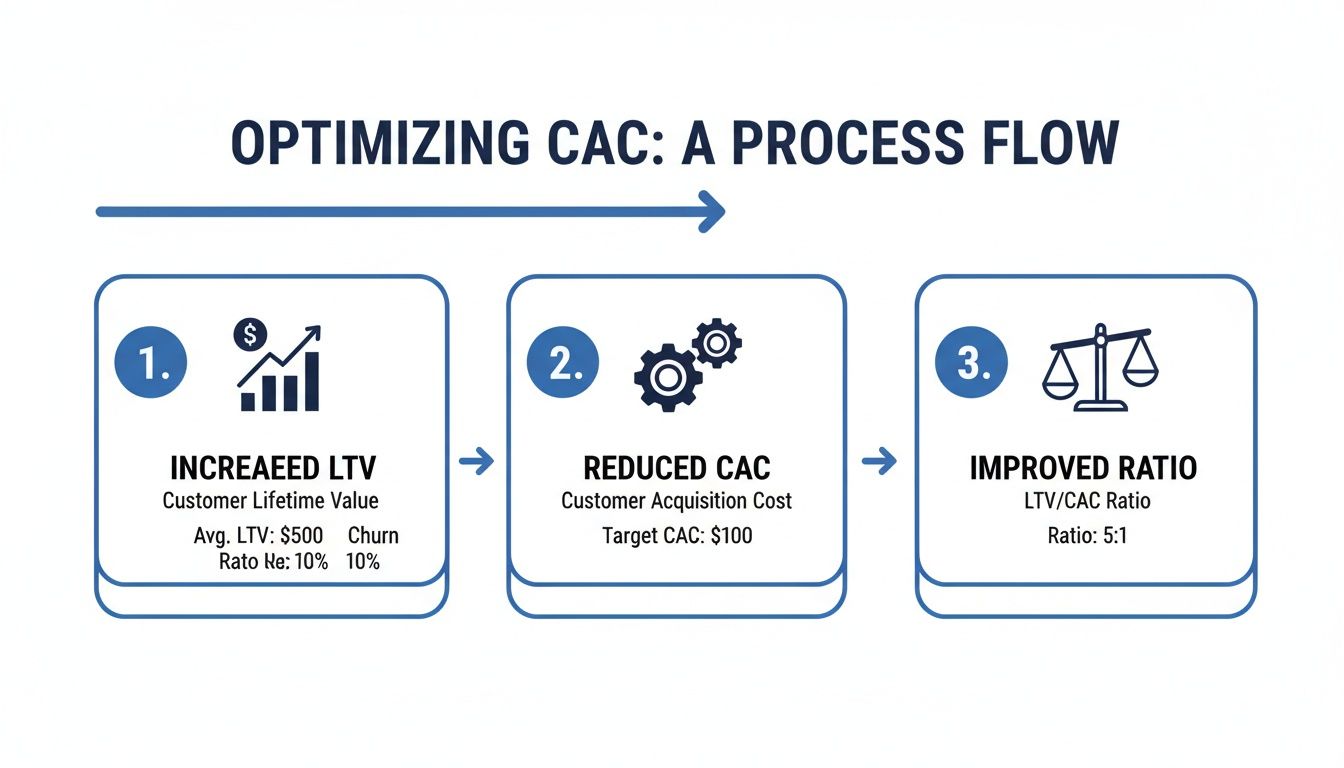
The key insight is that you have two levers to pull—you can either increase what a customer is worth (LTV) or decrease what it costs to get them (CAC).
A Quick Diagnosis: A healthy business typically maintains an LTV to CAC ratio of at least 3:1. This means for every dollar you spend acquiring a customer, you generate at least three dollars in lifetime revenue. If your ratio is 1:1, you're losing money on every sale once you factor in your operational costs.
Understanding this ratio is the first step toward real transformation. It moves you from spending blindly to investing strategically. For more details on calculating the return on your marketing spend, you can learn more about how to measure marketing ROI in our comprehensive article.
Core Metrics for CAC Reduction
Before diving deeper, it's crucial to have a firm grasp on the key performance indicators (KPIs) that will guide your decisions. This table gives you a quick overview of the essential metrics you need to track to begin diagnosing and reducing your Customer Acquisition Cost effectively.
| Metric | What It Tells You | Why It Matters for Your Business |
|---|---|---|
| Customer Acquisition Cost (CAC) | The average cost to acquire one new customer. | This is your baseline. If this number is too high relative to what a customer is worth, your business model isn't sustainable. |
| Customer Lifetime Value (LTV) | The total revenue a customer will generate over their entire relationship with your business. | LTV provides the context for your CAC. A high LTV allows for a higher CAC, giving you more room to invest in growth. |
| LTV:CAC Ratio | The relationship between what a customer is worth and what it costs to acquire them. | This is the ultimate health indicator. A ratio of 3:1 or higher is the goal for most B2B and manufacturing businesses. |
| Payback Period | How many months it takes to earn back the cost of acquiring a customer. | A shorter payback period means faster cash flow recovery, allowing you to reinvest in growth more quickly. |
These four metrics provide the financial framework you need. By tracking them closely, you'll know exactly which levers to pull to make your customer acquisition more efficient and profitable.
Diagnosing Leaks in Your Marketing and Sales Funnel
Trying to slash your Customer Acquisition Cost without knowing where the money is going is like patching a random spot on your roof to fix a leak. You might get lucky, but you’ll probably waste time and money. Before changing a single thing, you must diagnose the real source of the problem.
This means doing an honest audit of every channel you use to get customers—from paid ads and trade shows to organic search and referrals. It's time to ask the tough questions that get to the heart of your spending.

This whole process is about replacing guesswork with clarity. It gives you the hard data you need to make confident, strategic decisions about where to invest your next dollar.
Key Diagnostic Questions to Ask Yourself
Your first move is to pull together data from Google Analytics, your CRM, and your ad platforms. The goal is simple: see which channels are working and which are just siphoning off your budget.
Here are the questions we always start with when helping clients pinpoint inefficiencies:
- Which channels bring in your most valuable customers? Not all customers are created equal. You need to know which channels deliver clients with the highest LTV, not just the ones that generate the most leads.
- Where are we overspending for minimal returns? Hunt down the channels with a high CAC but a low LTV. These are the prime candidates to pause or reallocate budget from.
- What is our CAC for each specific channel? A blended CAC is a nice vanity metric, but channel-specific CAC is what’s actionable. It tells you exactly what it costs to land a customer from Google Ads versus SEO versus a referral.
- Where are prospects dropping off in the journey? Map out the typical path from the first touchpoint to a closed deal. A high drop-off rate on a specific landing page or right after an initial demo is a flashing red light signaling a leak.
Answering these questions forces you to connect your spending to actual, bottom-line results. It’s not always a quick process, but it’s the only way to truly get a handle on your acquisition costs.
A Real-World Scenario: The 80/20 Budget Trap
We recently worked with a B2B manufacturer that was pouring significant cash into digital ads across several platforms. They had a gut feeling their budget was out of control but couldn't figure out what to cut. Their blended CAC looked okay, but their profit margins were shrinking.
Once we dug into their channel-specific data, the problem became painfully obvious.
It turned out that 80% of their ad budget was being spent on two social media platforms that were generating only 20% of their best-fit customers—the ones with high LTV and low support needs. Meanwhile, their most profitable customers were quietly coming from organic search and a small, neglected LinkedIn campaign.
This is a classic 80/20 trap. The channels that felt busiest were actually the least effective. By reallocating that wasted budget from the underperforming platforms to SEO content and a more focused LinkedIn strategy, they cut their overall CAC by over 40% in a single quarter.
Mapping Your Customer Journey to Spot the Leaks
To really understand where things are breaking down, you need a clear picture of your customer journey. This doesn't need to be a complex flowchart. Start simply by identifying the key stages a prospect moves through.
For many B2B businesses, it looks something like this:
- Awareness: The prospect first learns about your solution (e.g., through an ad, a blog post, or a referral).
- Consideration: They engage more deeply by downloading a resource, watching a webinar, or requesting a demo.
- Decision: They talk to your sales team, get a quote, and make a purchase decision.
Use your analytics and CRM data to put numbers to each stage. How many people visit your site versus how many request a demo? How many of those demos turn into a qualified proposal? The gaps between these stages are your leaks. A massive drop-off between awareness and consideration, for example, might point to weak messaging or a confusing call-to-action on your website.
By conducting this kind of diagnostic review, you arm yourself with the insights needed to stop throwing money away and start investing in the channels that will actually grow your business.
Optimizing Your Channels to Improve Conversion Rates
You’ve done the diagnostic work and have a clear map of where your funnel is leaking. Now it’s time to plug those holes. This is where we focus on two powerful levers you can pull to bring down your customer acquisition cost: intelligently moving your budget and systematically improving your conversion rates.
This isn’t about throwing more money at the problem. It’s about working smarter—getting more results from the traffic and resources you already have. Efficiency is the name of the game, and it's the fastest way to slash your CAC.
Reallocate Your Budget to High-ROI Channels
Your audit should have made it painfully obvious which channels are your heavy hitters and which are just eating up your budget. The first, most logical move is to stop feeding the losers and double down on the winners. It sounds simple, but many businesses get sentimental about a channel that isn’t pulling its weight.
If you found that a specific paid ad platform is a money pit, pause it. Immediately. Take that budget and pour it back into an area that’s already bringing you high-value customers.
This could look like:
- Boosting your SEO game: Pushing out more targeted blog content or in-depth technical guides that organically attract your perfect customer.
- Expanding a winning LinkedIn campaign: Pumping more budget into the ad sets that are already performing well.
- Investing in email nurturing: Building out automated sequences to warm up leads who aren't quite ready to buy, boosting their potential LTV.
Question to Ask Yourself: "If I had to slash my marketing budget by 50% tomorrow, which channels would I absolutely keep? And which would I drop without a second thought?" Your gut answer tells you exactly where your real ROI is hiding.
This strategic shift is a direct and immediate way to lower your blended CAC. You're just moving your investment from low-return activities to high-return ones. It's the lowest-hanging fruit there is.
Master the Art of Conversion Rate Optimization
Once you've cleaned up your channel mix, the next move is to make those channels work harder for you. This means getting better at turning visitors into leads, and leads into paying customers. This is the world of Conversion Rate Optimization (CRO), and it's where tiny improvements can lead to massive gains.
Getting good at CRO is a game-changer for reducing CAC. Small tweaks to landing pages, onboarding flows, and your sales process can create huge gains in efficiency. We acknowledge this isn't right for every business—if you have very low website traffic, you won't get statistically significant results from A/B testing. But for most, it's a powerful tool.
You don't need to burn your website to the ground and start over. The key is to test one variable at a time so you know exactly what's moving the needle.
Practical CRO Tactics to Implement Today
Here are a few high-impact areas to get you started. These elements usually have the biggest influence on whether a user takes the next step.
- Refine Your Landing Page Headline: Does your headline speak directly to your audience's biggest pain point? Is it clear? Test a headline that screams benefits against one that just lists features.
- Strengthen Your Call-to-Action (CTA): Stop using boring CTAs like "Submit." Get specific and value-driven with something like "Get Your Custom Quote" or "Download the Free Guide."
- Simplify Your Lead Capture Forms: Are you asking for their life story upfront? Every extra field is another reason for someone to bail. Test a form that only asks for an email against one that also wants a phone number.
For a much deeper dive into this process, check out our guide on how to improve website conversion rates.
A Client Example: Tailoring the Message
We worked with a machine parts manufacturer whose website was pulling in two different types of visitors: engineers who cared about technical specs and procurement managers who cared about price. Their landing page was trying to talk to both at once and wasn't connecting with either.
We ran a simple A/B test to fix it.
- Version A (The Control): The original, generic landing page.
- Version B (The Test): A new version with a headline and bullet points written specifically for the engineer, focusing on precision and compatibility.
The results were almost instant. The engineer-focused landing page saw a 70% increase in conversions from that segment. We then built a second page tailored to the procurement managers and saw similar results. This dramatically lowered their cost per qualified lead without spending an extra dollar on ads. That's the power of CRO.
Using Automation and Technology to Cut Costs
Manual effort is expensive, prone to error, and doesn't scale. If you're serious about slashing your customer acquisition cost, you have to stop relying on sticky notes and spreadsheets to manage your pipeline. It’s time to build a marketing and sales machine that works for you 24/7.
This is all about creating a system that catches every opportunity. When you integrate your Customer Relationship Management (CRM), email, and SMS into one unified platform, you eliminate wasted time and ensure no lead falls through the cracks. It shifts your team's focus from chasing cold leads to engaging with warm, educated prospects who are ready to talk.
A unified system brings all your sales and marketing data together, giving you a clear view of your entire funnel. That visibility is the first step toward building a true automated growth engine.
Building Your Automated Nurturing System
Think about the last time a potential customer downloaded a resource from your website. What happened next? In too many businesses, that valuable lead either gets a single follow-up call or, worse, sits untouched in someone’s inbox. This is a massive, expensive leak.
Automation plugs that leak by instantly engaging new leads with valuable, relevant content. Using a platform like GoHighLevel, you can build automated sequences that educate prospects, answer their common questions, and qualify them before they ever speak to a salesperson.
The Goal of Automation: Your goal is simple: automate the repetitive, time-consuming parts of the sales process. This frees up your highly skilled (and expensive) sales team to do what they do best—build relationships and close deals with prospects who are already warmed up and interested.
This system works tirelessly in the background, building trust and moving leads down the funnel without requiring manual effort. You can take a much deeper dive by reading our complete guide on building a marketing automation strategy.
An Automated Workflow for a B2B Manufacturer
Let's make this practical. Imagine an engineer visits your website and downloads a technical spec sheet.
Here’s what an automated workflow could look like, all kicking off the second they hit "download":
- Immediate Follow-Up: The system instantly sends a personalized email with a direct link to the spec sheet. No waiting.
- Value-Add Nurturing (2 Days Later): An automated email shares a case study showing how a similar company used that exact component to solve a common engineering challenge.
- Educational Content (4 Days Later): A short text message links to a blog post explaining the installation process or best practices for that component.
- Qualification & Offer (7 Days Later): The final automated email asks a simple qualifying question and offers a direct link to book a 15-minute technical consultation with an expert.
This entire sequence happens automatically. The engineer receives helpful, non-pushy information that builds trust. By the time they book that call, they are a highly qualified lead, which significantly reduces the sales effort required and, as a result, your customer acquisition cost.
Finding Hidden Value in Referrals and Reactivation
While optimizing funnels and automating workflows are critical, your most affordable source of new business is often hiding in plain sight. We’re talking about your existing and past customer base—a goldmine of untapped potential that most businesses overlook.
Two of the most powerful, low-cost strategies for reducing your customer acquisition cost involve looking inward, not outward. By building a simple referral system and reactivating dormant accounts, you can generate high-quality leads for a fraction of what you spend on traditional advertising.
Turn Happy Customers into a Marketing Channel
Why are referrals so powerful? A recommendation from a trusted peer cuts through the marketing noise in a way no ad ever could. When one of your clients recommends you, they’re lending their credibility to your business, which instantly builds trust with the new prospect.
Referral programs are a powerhouse for slashing acquisition costs. According to research from Usermaven, customers acquired through referrals often have a higher lifetime value. You can get more stats on the power of referral marketing over at Usermaven.com.
Creating a formal referral program doesn’t need to be complex. The key is to make it ridiculously easy for customers to participate and to offer an incentive that feels genuinely valuable.
Here are a few simple referral program ideas to get started:
- Offer a Service Credit: Give both the referrer and the new customer a credit toward their next invoice. It’s a win-win that encourages loyalty.
- Provide a Cash Bonus or Gift Card: A direct financial reward is a strong motivator, especially for high-value B2B services.
- Create a Tiered System: Reward your best advocates more. For instance, offer a larger bonus after their third successful referral.
Pro Tip: Don't just hope referrals happen. Systematize the "ask." Use your CRM to trigger an automated email or SMS request after a customer has a positive experience, like giving a high satisfaction score or signing off on a successful project.
The goal is to build a system that consistently generates word-of-mouth leads, effectively turning your happy clients into a proactive, low-cost marketing force.
The Art of Customer Reactivation
What about customers who haven't done business with you in a while? They haven't necessarily gone to a competitor; more often, they've just gone quiet. These are people who already know and trust your work, making them far easier and cheaper to win back than a brand-new prospect.
This is where customer reactivation campaigns come in. Using an automated system like GoHighLevel, you can create simple email and SMS sequences designed to re-engage these past clients. The aim is to remind them of the value you provide and see if new opportunities are on the horizon.
A good reactivation campaign isn't about blasting a generic "we miss you" message. It’s a strategic sequence that provides value first.
A sample reactivation sequence might look like this:
- The Value-First Email: Start by sending something helpful, like a new industry report or a case study relevant to their business. There's no sales pitch—just pure value.
- The Gentle Nudge: A few days later, a follow-up email can reference the resource and ask if they're facing any new challenges you might be able to help with.
- The Special Offer: For those who still haven’t engaged, you can send a final message with an exclusive "welcome back" offer, like a discount on a new service or a free consultation.
This automated approach lets you systematically reach out to hundreds of past customers without manual effort. Re-engaging just a tiny percentage of this list can drive significant new business at an incredibly low cost, turning your old customer database into a dynamic revenue stream.
High-Impact, Low-Cost Growth Strategies
When you compare these internal strategies to traditional outbound marketing, the difference in efficiency becomes clear. While channels like paid ads have their place, they can't match the cost-effectiveness of leveraging existing relationships.
| Strategy | Average Cost | Conversion Speed | Ideal For |
|---|---|---|---|
| Paid Ads (PPC/Social) | High, ongoing spend | Fast, but can be inconsistent | Reaching new, cold audiences quickly |
| Content Marketing/SEO | Moderate, long-term investment | Slow, builds over months/years | Building long-term authority & trust |
| Customer Reactivation | Very Low (CRM/email costs) | Fast to Moderate | Generating quick wins from warm leads |
| Referral Programs | Very Low (incentive-based) | Very Fast | Acquiring high-trust, high-LTV customers |
The takeaway is simple: your biggest growth opportunities are likely already in your database. By focusing on reactivation and referrals, you can generate more revenue without simply throwing more money at advertising.
Your Top Questions About Cutting Customer Acquisition Costs
Running a business, getting a handle on customer acquisition costs can feel like solving a puzzle with half the pieces missing. You know it’s a critical number, but figuring out where to start is the hard part.
Let's cut through the noise. Here are direct answers to the questions we hear all the time from business owners like you.
What Is a Good Customer Acquisition Cost for a B2B Business?
There’s no magic number. A "good" CAC is completely tied to your Customer Lifetime Value (LTV). You can't look at one without the other.
The gold standard for a healthy business is an LTV to CAC ratio of at least 3:1. In plain English, for every dollar you spend bringing a new customer in the door, you should get at least three dollars back over the life of that relationship.
A CAC in the thousands might be perfectly fine for a business with long sales cycles and large contracts, as long as the LTV is massive. But if you're hovering around a 1:1 or 2:1 ratio, that's a red flag. It’s a clear sign your acquisition engine needs a tune-up.
How Long Does It Take to See a Reduction in CAC?
It depends on the moves you make, but you'll see progress come in waves.
- Quick Wins (30–60 Days): You can get fast wins within a month or two by tightening up your paid ad campaigns. This includes refining audience targeting, cutting underperforming ad groups, and optimizing landing pages.
- Mid-Term Results (90–180 Days): This is where email nurturing sequences and customer reactivation campaigns start to pay off. These strategies take a little longer to get rolling, but they build a more reliable, cost-effective pipeline over three to six months.
- Long-Term Transformation (6–12+ Months): The biggest, most sustainable drops in CAC come from organic strategies like SEO. It takes time—often six months or more to see real traction—but SEO eventually delivers one of the lowest acquisition costs because you're building an asset that brings in leads for free.
Which Marketing Channel Typically Has the Lowest CAC?
It almost always comes down to channels that build relationships and deliver value over time. Paid ads get you speed, but organic channels give you efficiency.
The heavy hitters for low-cost customer acquisition are consistently these three:
- Referrals: Getting happy customers to bring in new business is often the cheapest and most powerful channel you have. Those leads arrive with built-in trust and convert quickly.
- Email Marketing: It’s incredibly cost-effective to nurture the leads you already have and bring past customers back into the fold.
- SEO: Once you start ranking for valuable keywords, the cost to acquire a customer from organic search drops dramatically. It’s an upfront investment that pays you back for years.
Paid channels like Google Ads or LinkedIn Ads will get you results faster, but they'll almost always have a higher CAC. The smart play is to use paid channels for immediate momentum while you build your low-cost organic channels for long-term growth.
How Can a CRM like GoHighLevel Directly Help Lower CAC?
A unified platform like GoHighLevel is designed to attack high CAC from several angles by making your whole system more efficient.
First, it automates lead follow-up, ensuring no opportunity falls through the cracks. This simple act maximizes the return on every marketing dollar you spend because you engage with every lead you generate.
It also lets you nurture leads with automated email and SMS sequences. You educate prospects and build trust on autopilot, which shortens the sales cycle. This means your sales team spends their time talking to qualified people who are ready to have a conversation.
By tracking every touchpoint, a CRM gives you clear data on which marketing channels are actually making you money. You can finally stop guessing, stop pouring cash into campaigns that don't work, and double down on what does. It turns your marketing from a cost center into a predictable growth machine.
Ready to stop guessing and start building a predictable marketing system? We specialize in helping businesses implement the strategies and tools needed to cut acquisition costs and drive sustainable growth.
The next step is to diagnose your funnel and build a 90-day plan to get results.