If you're trying to figure out how to scale your service business, the answer isn't about finding more hours in the day. It’s about building an operational machine that runs without you. This is where you stop being the main "doer" and start being the architect of your own growth.
Diagnosing Why Your Service Business Is Stuck
That feeling of being on a hamster wheel—juggling clients, chasing sales, and putting out fires—is a classic sign you've hit a growth ceiling. You’ve maxed out what one person or a small, disorganized team can possibly handle. We see this all the time. The problem isn’t your work ethic; it’s the lack of repeatable systems.
True scaling isn't about grinding harder. It's a fundamental shift in your business model, moving away from a structure that breaks the moment you step away.

From Founder-Led to System-Driven
Most founders get trapped because they’re the company's best salesperson, top technician, and lead project manager all rolled into one. But you can't scale a hero. Real growth starts when you identify the bottlenecks that are holding you hostage.
Ask yourself these diagnostic questions:
- Is every new project a blank slate? If you're creating a custom proposal, a unique workflow, and providing constant oversight for every client, you have a consistency problem that makes delegation impossible.
- Is your pipeline based on "hope"? If your revenue is fueled by random referrals and word-of-mouth, you have no control, no predictability, and no idea where next month's clients are coming from.
- What happens if you unplug? If you took a two-week vacation, would the business grind to a halt? If the answer is yes, you don't own a business—you own a high-stress job. This is the ultimate founder dependency test.
Before you can break through these ceilings, you have to get honest about the state of your business. The table below outlines the transformation you need to make—moving from the all-too-common "stuck" phase to a scalable, system-driven operation.
From Manual Labor to a Scalable System
| The 'Stuck' Phase (Diagnosis) | The 'Scaling' System (Solution) |
|---|---|
| Custom, one-off projects | Productized service packages |
| Founder-led "everything" | Documented processes (SOPs) |
| Random referral pipeline | Repeatable marketing funnels |
| Inconsistent client experience | Standardized onboarding & delivery |
| Hero-based problem solving | Defined roles and responsibilities |
| Reactive, day-to-day focus | Proactive, data-driven strategy |
Moving from the left column to the right is the core of scaling. It's not just about growth; it’s about survival. High client turnover can quietly kill a business, so understanding the true cost of churn is non-negotiable as you make this transition.
The opportunity here is massive. The global business services market is on track to explode from $223.55 billion in 2026 to an incredible $1,419.38 billion by 2034. That growth is being powered by the 90% of businesses worldwide that are small to medium-sized—all looking to outsource specialized services to stay competitive. The demand for what you do is there, but only if you can deliver it systemically.
Productize Your Services to Eliminate Custom Work
For most service businesses, the real growth-killer isn’t finding clients. It's the constant drain of custom, one-off projects. If every new client means a brand-new proposal, a unique workflow, and your personal attention at every step, you're not running a scalable business—you just own a very demanding job.
To break out of this cycle, you have to productize your expertise. This simply means turning your best services into standardized packages with clear deliverables, a defined scope, and fixed pricing. You're no longer just selling hours; you're selling a predictable outcome. This is the first critical step to moving from "doer" to owner.
Find Your Most Repeatable Offers
So, where do you start? The answer is already in your accounting software and project management tool. You need to perform an honest audit of your work from the last 12–24 months to find the services that are both profitable and repeatable.
Look at every project through these lenses:
- Profitability: Which jobs brought in the highest margins with the least amount of headache?
- Repeatability: Which services followed a nearly identical process from kickoff to completion?
- Client Success: Which projects delivered the most impressive, measurable results for your clients?
- Enjoyment: What kind of work did your team actually like doing? (This matters more than you think for morale and retention).
Your goal is to pinpoint the intersection of what’s profitable, what you can build a system around, and what delivers undeniable value. Don’t be shocked if you discover that 80% of your profit comes from just 20% of your service types. That’s your gold mine.
Define Your Core Offer and Tiers
Once you’ve identified a winning service, it’s time to package it. This is where you clearly define exactly what a client gets, how long it takes, and what it costs. This clarity is a game-changer for simplifying your sales process and making fulfillment incredibly efficient.
For example, a digital marketing agency we worked with realized that "Google Business Profile (GBP) Optimization" was constantly requested and delivered fantastic local SEO results. Instead of creating a custom quote every time, they productized it.
Turning your most effective service into a defined package shifts the sales conversation. It moves from "How much does it cost?" to "Which option is the right fit for me?" This empowers the client and shortens your sales cycle dramatically.
Here’s how that GBP service could be broken down into tiered packages:
| Package Tier | Key Deliverables | Ideal For |
|---|---|---|
| Starter (Foundation) | Full profile setup, keyword optimization, 20 optimized photos, 5 initial posts. | New businesses or those with a neglected GBP. |
| Growth (Momentum) | Everything in Starter, plus monthly post creation, Q&A management, and review response templates. | Businesses looking to actively compete for local search traffic. |
| Scale (Dominator) | Everything in Growth, plus advanced service/product listings, weekly reporting, and a local citation-building campaign. | Companies aiming to dominate their local market and multiple service areas. |
This tiered structure accomplishes three powerful things. First, it speaks to clients with different needs and budgets. Second, it creates a built-in upgrade path. Most importantly, it makes your service teachable and delegable. You can now create a Standard Operating Procedure (SOP) for each package, allowing you to train team members to execute the work with consistency and quality.
Build Your Automated Sales and Marketing Machine
If you’ve successfully productized your services, you've already won half the battle. But relying on word-of-mouth to sell those packages just won't cut it for real growth. To truly scale, you need to stop chasing leads and build a predictable system that sells for you.
It's time to build your own automated sales and marketing engine. The goal is simple: create a machine that generates qualified appointments and sales 24/7, freeing you up from the constant grind of finding the next client.

Start With Your Ideal Customer Profile
Before you write a single line of copy or build a landing page, you have to know exactly who you're talking to. An automated funnel that tries to speak to everyone will fail because it resonates with no one. This is why defining your Ideal Customer Profile (ICP) is the absolute first step.
To dial in your ICP, ask yourself these specific questions:
- What’s their industry? Don't just say "manufacturing." Get granular. Think "sales managers for custom machine tool manufacturers in the Midwest."
- What's their role? Are you selling to a CEO, an operations director, or a founder who’s still wearing all the hats?
- What’s the specific problem you solve? For instance, our best clients often come to us because they have zero predictability in their sales pipeline and need a reliable B2B marketing system.
- Where do they get their information? Are they constantly on LinkedIn, lurking in niche industry forums, or reading trade publication websites?
Getting this clarity is the difference between shouting into the void and having a direct, personal conversation with your next best customer.
Map Out Your Automated Funnel
With your ICP firmly in mind, you can start architecting the journey that will guide them from a complete stranger to a paying client. This isn't some complex, theoretical flowchart. It’s a practical, step-by-step path you can build inside an integrated platform like GoHighLevel. Think of it as moving a prospect through four distinct stages: Attract, Capture, Nurture, and Convert.
1. Attract With a Compelling Lead Magnet
You have to earn your ideal customer's attention by offering something genuinely valuable. This is your lead magnet—a free, high-value resource that solves a small but painful piece of their biggest problem.
- A Good Example: A downloadable PDF, "The 10-Point Pre-Show Checklist for Maximizing Trade Show ROI," aimed directly at those manufacturing sales reps.
- A Bad Example: A generic "Free Consultation" offer. It provides no immediate value and screams "sales pitch."
2. Capture Leads on a High-Converting Landing Page
This is a simple, focused webpage with one job: to convince visitors to trade their contact info for your lead magnet. It needs a killer headline, a few bullet points that drive home the benefit, and a dead-simple form. No distractions.
3. Nurture With an Automated Follow-Up Sequence
Once someone requests your lead magnet, the machine kicks in. This is where an automated sequence of emails—and even SMS messages—takes over to build trust and guide them to the next step. If you want to go deeper, check out our complete guide to building a marketing automation strategy.
The magic of automation is that it works while you sleep. A prospect can discover you at 2 AM, download your checklist, and get your first two follow-up emails before you’ve even had your morning coffee. This is how you build a pipeline that never closes.
4. Convert With a Clear Call to Action
The final emails in your sequence must drive the prospect toward one specific action, like booking a 15-minute discovery call directly on your calendar. This is the conversion point where a warm lead becomes a qualified sales appointment, all without you lifting a finger.
Building this engine is what separates businesses that rely on chance from those that engineer predictable revenue. This shift is part of a massive USD 2.1 trillion digital transformation trend, where companies are investing heavily in systems that cut costs and create better customer experiences. You can see more on how scalable tech trends are driving growth on Kenresearch.com.
Systematize Delivery with SOPs and Technology
You’ve got a productized service and the beginnings of an automated sales funnel. Great. But if you’re not careful, you’re about to trade a sales bottleneck for an absolute delivery nightmare. A scalable business runs on systems, not on your personal heroics.
The next, and arguably most important, step is to systematize how you get the work done. This is about building a machine for delivery, not just for sales, so the business can run consistently whether you’re in the office or on vacation.
From Your Brain to a Playbook
Right now, the genius behind your client results is probably trapped in your head. The goal is to get it out and turn it into a clear, actionable playbook that anyone on your team can follow. This is where Standard Operating Procedures (SOPs) come in.
Forget about dusty, three-ring binders. Modern SOPs are living, breathing tools for different jobs:
- Checklists: Your best friend for any repeatable, multi-step task like client onboarding or prepping a final report. No more "oops, I forgot that" moments.
- Video Tutorials: Fire up a screen-recorder like Loom. A five-minute video showing your team exactly how to navigate a complex piece of software is worth ten pages of dense text.
- Process Maps: For more complex workflows with decision points, a simple flowchart makes it crystal clear who does what, when, and what happens next.
Don't try to boil the ocean. Pick just one of your productized services and start there. Document the delivery process from the moment a client pays to the final handoff.
Centralize Your Operations with Technology
SOPs are the "how," but technology is the "where." You need a central hub to manage the entire client journey, and this is where a platform like GoHighLevel evolves from a sales tool into your operational command center. By building your delivery process right into your CRM, you finally connect the sales engine to the fulfillment engine. Our detailed guide to CRM implementation steps is the perfect place to start if you want a deeper dive.
When a new client signs a proposal, it shouldn't just trigger an invoice. It should set off a cascade of automated actions that kick off the entire delivery process without any manual intervention. This is the difference between a business that runs on systems and one that runs on frantic emails.
Imagine this: a client pays their first invoice. Your system automatically gets to work.
- Triggers a Welcome Sequence: A series of onboarding emails are sent out, instantly setting expectations, outlining the next steps, and providing key resources.
- Creates a Project: A new project board is generated in your project management tool (many integrate with GoHighLevel), automatically populated with a task template for the specific service they bought.
- Assigns Initial Tasks: The right team members are notified and assigned their first tasks, getting the ball rolling immediately.
This isn't just about saving time—it’s about eliminating the human error that leads to shoddy work and unhappy clients. That consistency is the bedrock of a scalable business.
Structure Your Team for Profitable Growth
You can't scale a service business by yourself. That's the hard truth. But hiring without a plan is a fast track to chaos, not growth. If you’ve done the hard work of productizing your services and documenting your delivery playbooks (your SOPs), you’ve already sidestepped the biggest hiring trap.
You’re no longer trying to clone yourself. Instead, you're hiring for specific roles within a system you've already built and proven. This is the difference between adding payroll and building a team that actually drives profit.
From Fixed Costs to Variable Growth
Your first move shouldn't be a hiring spree. The smartest play is to convert your fixed costs into variable ones by strategically outsourcing non-core functions. Before you hire a full-time marketing manager, bring in specialists for specific jobs like SEO, content creation, or your initial GoHighLevel setup.
This isn't just a small-business hack; it's how major companies scale rapidly without letting overhead kill their momentum. Delegating specialized work to experts can slash operating costs by 30-40%. For you, this means handing off critical tasks to people who are better at them, freeing up your core team to absolutely nail client delivery.
Your First Critical Hires
Once you’ve outsourced everything that isn't core to your genius, it's time to look internally. So, who do you hire first? The answer is always found by looking at your biggest personal bottleneck.
- Drowning in admin? Your first hire is a Virtual Assistant (VA). A great VA takes over your calendar, handles initial customer inquiries, and runs the administrative parts of your SOPs. They don't just do tasks; they buy back your time.
- Struggling to keep client work on track? It’s time for a Project Manager (PM). Armed with your SOPs, a PM makes sure every project follows the playbook, hits its deadlines, and keeps quality high. This frees you from the daily grind of project oversight.
- Ready for a bigger sales pipeline? If your automated funnel is working but you can't handle all the sales calls, hire a dedicated Salesperson. Their only job is to close deals for the productized services you’ve already built.
For sustainable, long-term growth, you need to think ahead. Implementing solid strategic workforce planning ensures you have the right people ready for the right roles as you scale.
The goal of your first hires is simple: buy back your time to focus on strategy and improving the system. You hire to replace yourself in the tasks that are no longer the highest and best use of your time as the founder.
Define Success with Role Scorecards
The fastest way to make a bad hire is to be vague about what you need. Ditch the generic job description and create a Role Scorecard instead. It's a simple, powerful document that defines what winning looks like in a specific role.
A Role Scorecard is built on three pillars:
- Mission: A single, sharp sentence explaining the role's core purpose. For a Project Manager, this might be: "Ensure every client project is delivered on time, on budget, and to our quality standard, creating ecstatic clients who renew."
- Key Outcomes: List 3-5 measurable results this person is responsible for. That same PM might have outcomes like "Maintain a client satisfaction score of 9/10" or "Ensure 95% of project milestones are hit on schedule."
- Competencies: The non-negotiable skills and behaviors needed to excel in the role and fit into your company culture.
This simple framework removes all ambiguity. It forces you to define what an "A-Player" looks like for your company before you ever post a job ad, dramatically increasing your odds of getting the right person in the right seat.
Launch Your 90-Day Scaling Proof of Concept
All the strategy we've talked about is just theory until you put it into practice. It’s time to launch a 90-Day Scaling Proof of Concept.
This isn't about blowing up your business and starting from scratch. Think of this as a focused, 90-day sprint to prove that your new, scalable model actually works in the real world with real clients. The mission is simple: pick one of your new productized services. For the next 90 days, you're going to build and test its entire ecosystem—the marketing funnel that sells it, the delivery SOPs that get it done, and the metrics that prove it's profitable.
Your 90-Day Game Plan
Your only goal during this sprint is to sell and deliver that one service using your new, documented system. By focusing on a single offer, you can spot problems and fix them fast without blowing up your entire operation.
This is your controlled experiment. If an email in your sequence isn't converting or a step in your delivery process is causing confusion, you'll know exactly where the breakdown is happening.
Your targets for this 90-day period are crystal clear:
- Build the Machine: Lock in the marketing funnel, delivery SOPs, and reporting dashboard for your chosen service.
- Run the Play: Start driving traffic and actively selling this one offer. Stick to the process. No exceptions.
- Measure Everything: Track every moving part to get hard data on performance, profitability, and what your clients really think.
Setting Up Your Scaling Dashboard
You can’t improve what you don’t measure. A simple dashboard is the only way you'll know if this proof of concept is a success or a failure. You don't need complicated software—a Google Sheet will work just fine to get started.
Make sure you're tracking these core numbers to get a clear picture:
- Leads Generated: How many prospects actually entered your funnel?
- Sales Conversion Rate: What percentage of those leads became paying customers?
- Average Time to Close: From first contact to a signed deal, how many days did it take?
- Client Satisfaction Score: After the work is done, how happy are they? A simple 1-10 scale is perfect.
As this system starts working, you’ll naturally need to grow your team. This 90-day sprint is the first step toward building a business that can support a bigger structure.
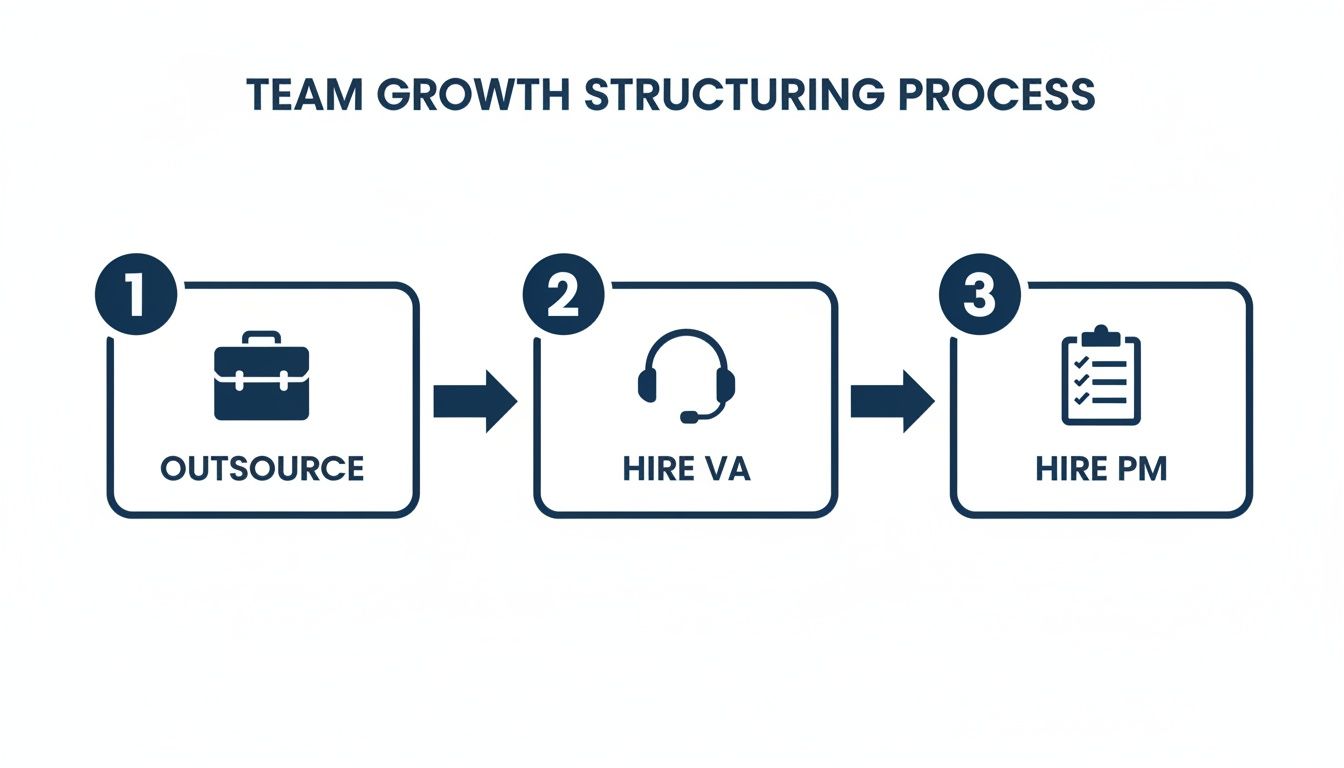
As you can see, the typical path is to start by outsourcing specific tasks, then bring on a virtual assistant for administrative work, and finally hire a project manager to own the delivery systems you're building now.
By the end of the 90 days, you will have a battle-tested system, real data, and a "franchise prototype" that's ready to be copied across your other services. This is how you start to remove yourself from the day-to-day and build a business that can truly scale. To get your goals on paper for this sprint, you can download our strategic objective template and map out your targets.
Common Questions About Scaling a Service Business
When you start talking about scaling, the same questions always pop up. You're moving from a business that relies on you to one that relies on systems, and that transition brings up some real-world hurdles. Let's tackle the most common ones we see from owners who are exactly where you are now.
How Do I Know Which Service to Productize First?
Start with what's already proven. Don't invent something new; look at your past work.
Which service is your rockstar? The one that consistently gets fantastic results for clients and is highly profitable for you. That's your starting point. Ignore the one-off, high-ticket projects that required a ton of custom work—they're a trap.
The key is repeatability. You’re looking for the offer that follows a predictable path every time. This is the perfect candidate for building out your first set of Standard Operating Procedures (SOPs) and creating a true system.
When Is the Right Time to Hire My First Team Member?
The time to hire is when you've pinpointed a specific, expensive bottleneck. If you can’t name the exact problem that's costing you time and money, you’re not ready.
A classic mistake is hiring someone to "just help out" without a defined role. This never works. You need to hire to fill a specific seat in your system. If you’re buried in admin work, you need a VA. If projects are constantly falling behind, you need a project manager.
This isn’t about just adding to your payroll; it's a strategic investment. Your first hire should immediately buy back your time so you can focus on the big-picture activities that actually grow the business. A temporary dip in profit is a normal and expected part of this scaling investment.
Ready to build a scalable system for your own business? At Machine Marketing, we specialize in diagnosing growth ceilings and implementing the marketing and operational systems that create predictable revenue. Book a discovery call with us today and let's build your machine. https://machine-marketing.com