Most advice on how to write a mission statement for business starts in the wrong place. It starts with wording.
That’s why so many mission statements end up sounding polished and doing nothing.
A useful mission statement isn’t a slogan for your About page. It’s a decision filter. It should shape what you say in sales calls, how you configure your CRM, what leads you pursue, what content you publish, and what work your team says no to. If it can’t do that, it isn’t finished.
This matters even more in B2B and manufacturing. You don’t need airy language. You need operational clarity.
Why Most Mission Statements Are Useless (And How to Make Yours Different)
Let’s challenge the usual assumption first. Having a mission statement does not appear to improve financial performance on its own. An extensive meta-analysis of nearly 2,000 companies found that the correlation between having a mission statement and corporate financial performance is statistically zero, according to Rice Business research on mission statements and financial performance.
That doesn’t mean mission statements are pointless. It means most companies use them badly.
What usually goes wrong
Most mission statements fail for three reasons:
- They’re too generic: “Deliver excellence through innovation” doesn’t tell anyone what the business does.
- They describe aspiration, not operation: Teams can’t use vague language to make real choices.
- They ignore the customer’s reality: Leaders emphasize what they care about, while buyers care about something else.
That last point matters. If your mission highlights internal pride points but skips what customers value, you’ve created a branding artifact, not a working tool.
A mission statement should help your team answer a practical question: “Does this choice fit how we create value?”
What makes one useful
A good mission statement acts like a control panel for your business. It should help you decide:
- what kind of leads belong in your pipeline
- what messaging goes on your homepage
- which services deserve more investment
- what your CRM stages and sales scripts should reinforce
If your current language can’t do that, rebuild it from the ground up. Start with customer value, current capabilities, and strategic focus. Then pressure-test it against your messaging system. If you need a way to align language with market positioning, this marketing messaging framework is the right kind of checkpoint.
The 4 Core Components of a High-Performance Mission
Most strong mission statements are short. One to three sentences or around 100 words is the practical range identified in Business.com’s guide to writing a mission statement. Short matters because your team has to remember it, use it, and repeat it consistently.
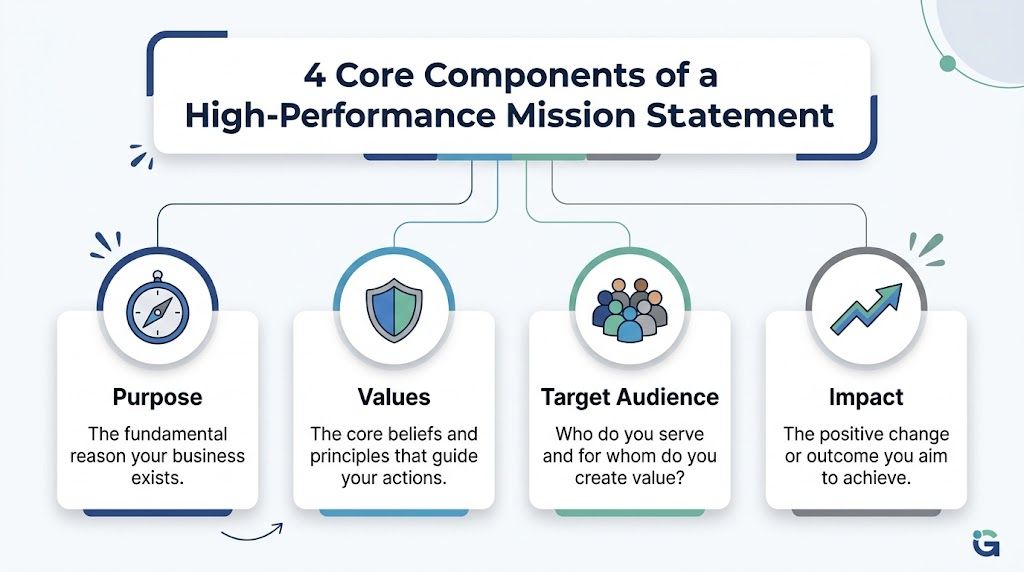
A high-performance mission usually includes four parts.
Purpose
This is the reason your business exists beyond collecting revenue.
For a manufacturer, that might be reducing production risk for customers. For a B2B service firm, it might be helping operators make better decisions with clearer systems. Purpose gives the business a stable center.
Ask:
- Why would customers miss us if we disappeared?
- What problem do we believe should be solved better?
- What business pain are we built to remove?
Value delivery
Here, many statements become weak. They say why they care, but not how they create value.
Your mission should name the actual work. Not every tactical detail, but the actual mechanism. Do you design, install, automate, source, repair, fabricate, consult, or optimize? Buyers need to recognize your business in the statement.
A useful test is whether a salesperson could point to the mission and say, “Yes, that’s what we deliver every day.”
Target audience
If your mission works for every possible customer, it probably connects with none of them.
Name who you serve. That can be broad, but not blurry. “Businesses” is weak. “Manufacturers with complex buying cycles” is stronger. “Commercial property operators” is stronger. A good mission narrows focus without boxing you in.
Differentiation and impact
This is the value outcome and the reason a buyer should care.
You don’t need hype here. You need a clear result. Better throughput. Faster visibility. More qualified demand. Less downtime. Cleaner execution. Better coordination across teams. The wording can stay simple, but it should point to a meaningful result.
Practical rule: If your mission says what you believe but not what changes for the customer, it’s incomplete.
A simple way to assemble the parts
Use this formula as a draft, not a final answer:
| Component | What to define |
|---|---|
| Purpose | Why you exist |
| Value delivery | What you do and how you do it |
| Target audience | Who you serve |
| Impact | What improves for the customer |
Then compress it until it reads clearly on first pass.
A strategic objective template can help if your business tends to blur mission, goals, and priorities. This strategic objective template is useful for sorting those layers before you write.
The Workshop Process for Drafting Your Mission Statement
Don’t write your mission statement alone in a quiet room and hope you nail it in one draft. That usually produces language that sounds polished to leadership and disconnected to everyone else.
A better approach is a workshop.
Using a structured framework to draft and refine a mission statement can lead to 2-3 times higher stakeholder alignment, and one effective method is to share 3-5 draft variants with team members and clients, score them on a 1-10 scale for clarity and actionability, and keep iterating until the statement scores over 8/10, based on Pipedrive’s mission statement framework.

Who should be in the room
Keep the group small enough to think clearly, but broad enough to reflect reality.
Include:
- Leadership: They know the strategic direction.
- Sales or account management: They hear objections, urgency, and buyer language.
- Operations or delivery: They know what the business can execute.
- Customer-facing support or service: They hear friction after the deal closes.
If you leave out frontline voices, you usually get a mission statement that sounds ambitious but misses practical customer truths.
Start with diagnosis, not writing
Before anyone starts crafting sentences, collect raw material. A whiteboard, shared doc, or workshop board works fine.
Ask the team:
- What problem do we solve best?
- Which customers get the most value from our work?
- What do buyers consistently thank us for?
- Where do we outperform competitors?
- What work do we avoid because it’s outside our lane?
- What result do we want customers to experience?
This stage should feel messy. That’s normal. You’re extracting signal.
Sort the answers into four buckets
Now organize what you heard into these categories:
- Purpose
- Methods and services
- Audience
- Customer result
At this point, you’ll usually see patterns.
For example, a manufacturer might hear recurring phrases like:
- dependable supply
- tolerance accuracy
- engineering support
- repeatable quality
- responsive communication
A B2B service firm might hear:
- cleaner pipeline
- better targeting
- less guesswork
- stronger follow-up
- more consistent lead flow
Those repeated ideas belong in the draft. Executive buzzwords usually don’t.
Build draft variants, not one precious sentence
Write several options. Not one.
That’s important because the first draft often overweights the opinion of whoever speaks earliest. Multiple drafts create comparison. Comparison leads to better judgment.
Try a few patterns:
- We help [audience] achieve [result] through [method].
- We serve [audience] by delivering [value] with [differentiator].
- Our mission is to [action] for [audience] through [approach].
Here’s what that can look like in rough form:
- We help industrial manufacturers generate better-fit demand through precise messaging and disciplined execution.
- We serve commercial operators by reducing service friction with responsive systems and reliable field delivery.
- Our mission is to help B2B teams create clearer growth paths through better data, cleaner process, and sharper positioning.
None of these has to be final. They just have to be specific enough to test.
Test for operational usefulness
Many teams stop too early at this point. They pick the statement that sounds best.
That’s the wrong criterion.
Test each draft against real decisions:
| Test question | What you’re checking |
|---|---|
| Could sales use this in a call? | Clarity and market relevance |
| Could marketing build messaging from it? | Positioning value |
| Could operations use it to say no to bad-fit work? | Strategic discipline |
| Could a new hire understand what matters here? | Internal alignment |
If the answer is no, the draft needs more work.
If your mission can’t guide a trade-off, it’s still a slogan.
Score the drafts
Have the group score each version for:
- Clarity
- Actionability
- Fit with real customer needs
- Memorability
Use the rating approach noted earlier. Don’t ask, “Which one do you like?” Ask, “Which one helps us run the business better?”
That shift changes the conversation.
Refine the language
Once one draft rises to the top, tighten it.
Cut:
- filler words
- abstract nouns
- internal jargon
- claims you can’t support operationally
Keep:
- plain verbs
- visible customer outcomes
- recognizable audience language
A strong mission usually reads cleanly in one breath. If it sounds like legal copy or investor copy, rewrite it.
Use the video below as a practical prompt
If your team needs a quick reset before finalizing language, this walkthrough can help frame the exercise.
Final check before adoption
Read the final draft and ask:
- Would a customer understand this immediately?
- Would the team use this naturally?
- Does this reflect the business we run today?
- Does it leave room for growth without becoming vague?
If yes, adopt it. Then put it where decisions happen, not just where branding lives.
Real-World Examples for B2B and Manufacturing
Generic examples don’t help much when you run a plant, a field service business, or a technical consultancy. The mission has to match the operating model.
That’s especially true in manufacturing. A 2025 analysis reported that manufacturing firms with mission statements emphasizing “scalable automation and audience precision” saw 24% higher lead conversion rates than firms with generic statements, according to Common Ninja’s review of mission statement trends.

Precision machine parts manufacturer
This business has a common problem. Leadership talks about craftsmanship. Buyers care about reliable supply, tolerance accuracy, and whether the vendor can support production schedules.
A usable mission statement could be:
We help industrial buyers reduce production risk by delivering precision components with dependable quality, responsive support, and repeatable execution.
Why this works:
- It identifies the buyer.
- It names the actual business value.
- It gives operations a standard to uphold.
- It gives sales a useful promise without hype.
This kind of mission also informs investment decisions. If a new inspection process improves repeatability, it fits. If a side offering distracts from production reliability, it probably doesn’t.
B2B software or systems consultancy
This kind of firm often writes a mission loaded with “innovation,” “transformation,” and enabling clients.” None of that tells a prospect what changes after engagement.
A stronger version might be:
We help B2B teams build clearer, more usable systems that improve follow-up, sharpen decision-making, and support consistent growth.
This statement works because it links service work to business outcomes. It can shape onboarding, proposal language, CRM architecture, and reporting.
A consultant reading that mission should know the standard isn’t creative presentation. It’s system clarity.
Commercial HVAC service company
Local service companies often swing too broad. They try to speak to everyone and end up with language nobody remembers.
A better mission could be:
We keep commercial properties running with dependable HVAC service, fast communication, and maintenance plans that reduce disruption.
That mission is grounded. It doesn’t overreach. It speaks to uptime, responsiveness, and prevention, which are usually what commercial buyers care about most.
What these examples share
Each one does three jobs at once:
- It clarifies who the company serves
- It defines how value is delivered
- It creates a filter for operational decisions
That’s the true standard. A mission statement should help a business choose better, not just sound better.
Common Mission Statement Mistakes to Avoid
Most weak mission statements don’t fail because the team didn’t care. They fail because the process introduced distortion.
One of the biggest mistakes is writing the statement without enough cross-functional input. That often misses up to 25% of valuable customer insights held by frontline employees, and if the final version feels uninspiring or inauthentic, employee engagement can drop by up to 40%, based on Penn State Extension guidance on developing mission statements.
Mistake one: writing for optics
This happens when leadership tries to sound impressive instead of useful.
You see phrases like:
- world-class excellence
- effective solutions
- customer-centric synergy
- industry-leading transformation
The problem isn’t that these words are positive. The problem is that they don’t help anyone act.
Better move: Replace abstract praise words with concrete verbs and business outcomes.
Mistake two: describing the company you wish you were
Some teams write a mission for a future business, not the current one. That creates a gap between what customers experience and what the company claims.
When that gap gets large, the mission starts to damage trust internally. Employees know it isn’t true. Customers feel the mismatch in sales conversations and delivery.
Write the mission for the business you can consistently operate now. Then revise it when the business changes.
Mistake three: letting committee edits flatten the statement
Group input matters. Endless compromise does not.
A mission statement can die by consensus when every strong phrase gets softened so no one objects. The result is safe, broad, and forgettable.
Better move: Gather broad input early, then assign one owner to synthesize and tighten the final wording.
Mistake four: confusing mission with slogan or vision
A slogan is for recall. A vision is about the future. A mission is about present-tense purpose and value delivery.
If the line sounds catchy but doesn’t explain what the business does, it’s probably a slogan. If it describes a future state of the world, it’s probably a vision.
Your mission needs to anchor daily choices.
Quick diagnostic checklist
If your current mission does any of the following, rewrite it:
- Could fit any competitor: It isn’t differentiated.
- Needs explanation: It isn’t clear enough.
- Avoids naming the customer: It lacks market focus.
- Says nothing about value delivery: It can’t guide operations.
- Feels fake to the team: It won’t stick.
The best alternative is plain language tied to actual work. Clear beats clever every time.
How to Integrate Your Mission Into Your Business Systems
Once the wording is done, most companies stop. That’s where the waste happens.
The mission only becomes valuable when you connect it to systems your team already uses. Marketing, CRM, sales process, hiring, onboarding, content production, and service delivery should all reflect it. Otherwise, the statement stays decorative.
Use it as a messaging filter
Your homepage, sales deck, email nurture, LinkedIn copy, and proposal language should all echo the same core promise.
If your mission says you help manufacturers reduce production risk through dependable execution, your marketing shouldn’t drift into generic “growth partner” language. It should emphasize reliability, responsiveness, process control, and results buyers care about.
A simple editorial filter helps:
- Does this content speak to the audience named in the mission?
- Does it reinforce the method we say we use?
- Does it point to the customer outcome we promise?
If not, it’s off-message.
Use it inside your CRM
Here, the mission becomes operational.
In GoHighLevel or any CRM, your mission can shape:
- Lead qualification fields: Define what a good-fit customer looks like.
- Pipeline stages: Reflect the buying journey your audience follows.
- Automation logic: Trigger follow-up based on the value promise you’re making.
- Sales notes and call scripts: Reinforce the same customer problem and outcome language.
For example, if your mission centers on helping commercial property operators reduce disruption, your CRM shouldn’t just track “interested” versus “not interested.” It should capture urgency, facility impact, service history, and maintenance fit.
That turns the mission into a usable operating standard. If you’re building that kind of connection between systems and messaging, this guide on CRM and digital marketing is a practical next resource.
Turn it into lead generation criteria
A mission should help you reject bad-fit leads faster.
That sounds harsh, but it improves the whole system. Better-fit leads move through the pipeline more cleanly. Sales conversations become more focused. Delivery teams inherit work they’re built to execute well.
Try translating your mission into three lists:
| Use | What to define |
|---|---|
| Best-fit leads | The buyers your mission clearly serves |
| Poor-fit leads | Prospects outside your value model |
| High-priority pain points | The outcomes your messaging should keep reinforcing |
That table becomes useful in campaign planning, sales handoff, and even ad targeting.
Build it into hiring and onboarding
New hires need to know more than the org chart and software stack. They need to know what kind of value the company is built to deliver.
Use the mission in:
- job descriptions
- interview scorecards
- onboarding docs
- role-specific SOPs
- performance conversations
A service coordinator, estimator, marketer, and account manager won’t use the mission in exactly the same way. But they should all be able to connect their role to it.
A mission starts paying off when people can explain how their daily work supports it.
Keep it active during growth
As the business changes, pressure-test the mission against new initiatives.
Ask:
- Does this new service fit our stated purpose?
- Does this market expansion still serve the audience we say we serve?
- Does this campaign reflect our actual differentiator?
- Does this automation improve the customer experience we promise?
If you’re a newer company and still trying to build that alignment from the ground up, Build Emotion’s article on how to market a startup is a useful companion read because it connects positioning decisions to early-stage execution.
A mission doesn’t replace strategy. It sharpens it.
Your Mission Is Your Compass Not Your Destination
A mission statement won’t fix a weak business model. It won’t rescue poor delivery. It won’t create profit by existing.
What it can do is make the business easier to run.
A strong mission gives your team a common reference point. It tightens marketing. It sharpens sales conversations. It helps operations decide what fits and what doesn’t. It keeps growth from turning into drift.
What to do next
Don’t let the statement sit in a slide deck.
Take these steps:
- Read it aloud with your leadership team: If it sounds unnatural, rewrite it.
- Test it against one current decision: A campaign, hire, service line, or CRM change.
- Push it into your systems: Website copy, pipeline stages, qualification rules, and onboarding.
- Review it regularly: Keep it stable, but not frozen.
The true test is simple. When a decision gets messy, does the mission help your team choose faster and better?
If yes, you wrote a working mission.
If you want help turning your mission into a practical growth system, not just a sentence on a page, talk with Machine Marketing. We help businesses diagnose positioning, tighten messaging, and connect strategy to CRM, content, and lead generation systems that your team can use.