If you're a business owner struggling to generate predictable leads, you’re not alone. We see this all the time—and the root cause is often hidden in plain sight: a collection of marketing tactics that aren't connected into a single, cohesive system.
The inbound marketing funnel is the engineering solution to this problem. It’s a blueprint for turning strangers into customers by attracting them with helpful content, not interrupting them with sales pitches. In this guide, we'll show you how to diagnose the gaps in your marketing and build a high-performance growth engine, step-by-step.
Why Your Marketing Feels Busy But Not Productive
Ever feel like you’re spinning your wheels? You're active on LinkedIn, sending emails, maybe even running ads, but you're just not getting predictable leads. If that sounds familiar, you're likely dealing with a "leaky" funnel.
We see this constantly with B2B owners and manufacturers. They invest in a nice website and some social media but lack a clear system for turning that attention into business. The result is a lot of motion—posting, emailing, advertising—with very little to show for it.
The problem we diagnose most often is simple: a bunch of disconnected marketing tactics without a defined path for a potential customer to follow.
Diagnosis: Questions to Ask Yourself
To diagnose the problem, you need to know what to look for. The signs of a broken or nonexistent funnel are obvious once you start asking the right questions.
- Are your leads low-quality? If your sales team complains about unqualified leads, it’s a red flag. It means you’re either attracting the wrong people or failing to educate them before the handoff.
- Is your sales cycle unpredictable? Without a structured journey, prospects get stuck or fall through the cracks. This makes forecasting revenue a complete guessing game.
- Can you prove marketing is working? When your activities aren't connected, you can't draw a line from a blog post to a closed deal. There’s no way to prove the ROI.
This isn't an effort problem; it’s a systems engineering problem. You have valuable parts—a website, deep expertise, a great product—but they haven't been assembled into a machine that actually works.
The Solution: An Engineered Inbound Funnel
This is where the inbound marketing funnel comes in. Instead of annoying cold leads with tactics that interrupt their day, you build a system that attracts, engages, and converts the exact customers already searching for solutions you provide.
It’s how you transform your marketing from a frustrating cost center into a reliable revenue engine.
The big shift here is moving from a "hunter" mentality (outbound) to a "farmer" mentality (inbound). You stop chasing customers for today and start cultivating relationships that bring in business for years to come.
This system works because it aligns with how people naturally make buying decisions. By giving them the right information at the right time, you establish yourself as the go-to authority. When they’re ready to buy, you're the obvious choice.
This guide provides the blueprint for building that exact system for your business.
Blueprint Your Funnel From First Touch To Final Sale
Many businesses build their marketing funnel backward. They start with what they want to sell and try to force customers into their process. The result? A funnel that feels pushy and disconnected.
Let’s flip that script. An effective inbound funnel starts with your customer's journey, not your sales pitch. We're going to build a blueprint that maps directly to how your best customers think and the problems they face. This isn't theory—it's about turning scattered marketing efforts into a predictable, revenue-generating system.
This diagram shows how a structured inbound funnel organizes the chaos into a clear path to profitability.
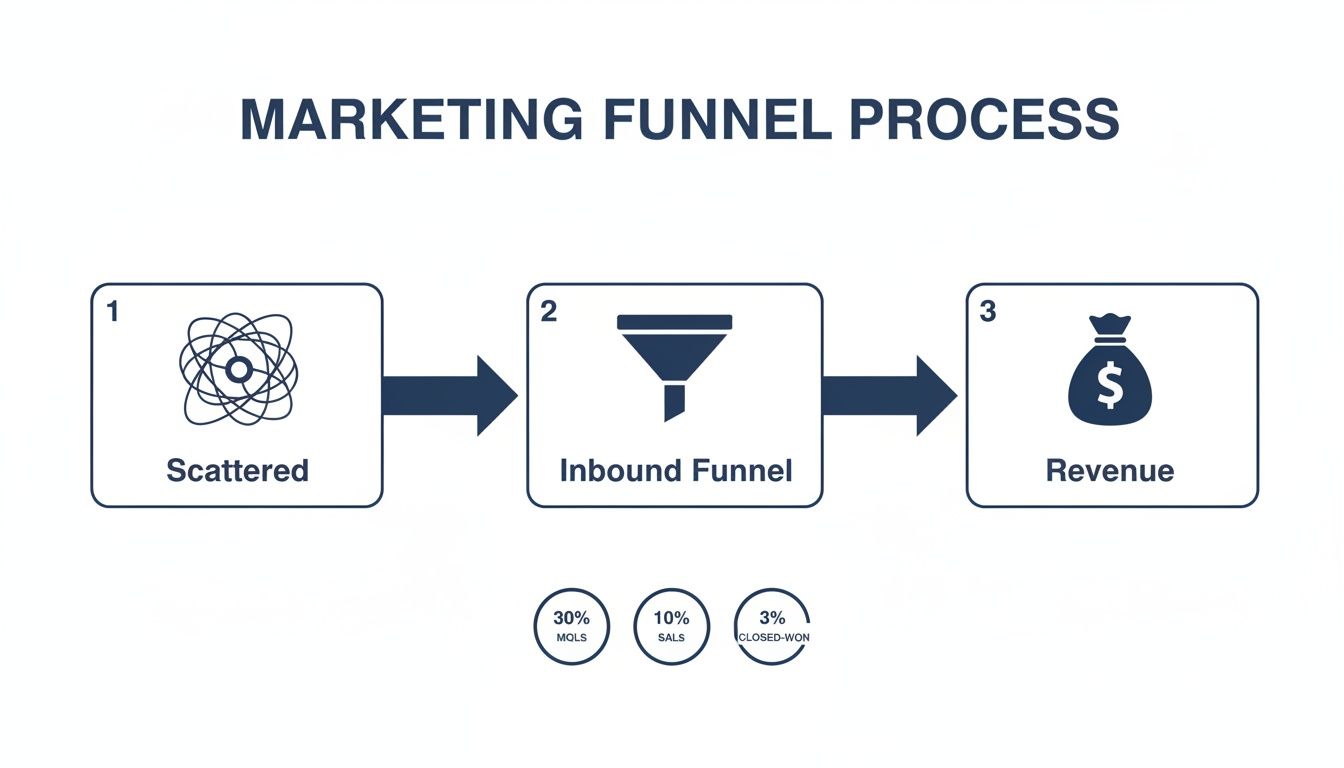
The real transformation is moving from random acts of marketing to an intentional process that guides leads from curiosity to a closed deal.
The Awareness Stage: What Problem Are They Solving?
At the top of your funnel (TOFU), your future customer is just realizing they have a problem. They might not have the right words for it yet, but they feel the pain. At this stage, they are looking for answers, not a sales pitch. Your job is to become their most trusted resource.
To diagnose their needs, ask yourself these questions:
- What are the nagging pain points that eventually lead someone to us?
- What "symptoms" of that pain are they actually searching for online?
- What questions are they asking that don't mention our brand or product?
Real-World Example: A plant manager is frustrated with production slowdowns. He isn't searching for "new CNC machine vendor" yet. He's searching for "how to improve manufacturing efficiency" or "reduce production line bottlenecks." Your content must meet him there with a helpful blog post or guide that addresses that specific problem.
As you blueprint this first touchpoint, it's also smart to think ahead and optimize your inbound lead generation with LLM SEO to build a foundation for long-term growth.
The Consideration Stage: How Are They Comparing Options?
Once your prospect moves into the middle of the funnel (MOFU), they’ve named their problem and are actively researching solutions. They're comparing approaches, methodologies, and providers. This is where you pivot from general education to solution-specific guidance.
Your content strategy should be guided by these questions:
- What are all the different ways someone could solve this problem (including your competitors')?
- How does our specific solution stack up against those alternatives?
- What proof—case studies, data, testimonials—can we offer to show our approach is the best one?
Real-World Example: The plant manager now knows his outdated equipment is the culprit. He's researching "5-axis CNC machines vs. 3-axis" and the "ROI of new machinery investment." Your content for him is now a detailed comparison guide, a webinar demonstrating your machine's capabilities, or a case study showing how a similar plant achieved a 30% efficiency gain with your solution.
The Decision Stage: Why Should They Choose You?
At the bottom of the funnel (BOFU), the prospect is ready to buy and has a shortlist—and you're on it. Your job now is to eliminate any final friction and make it an easy "yes."
Focus on nailing the answers to these final questions:
- What specific information does a buyer need to justify this purchase to their boss?
- What are the lingering doubts or perceived risks holding them back?
- How can we make taking the next step (getting a quote, booking a demo) completely painless?
Real-World Example: The plant manager is weighing your machine against two competitors. He needs pricing, financing options, and a clear implementation timeline. Your Decision stage content is a no-obligation consultation, an interactive ROI calculator, or a detailed quote that removes all guesswork.
Content Mapping for Each Funnel Stage
This table breaks down what content works best at each stage, what your customer is thinking, and what you're trying to achieve.
| Funnel Stage | Customer Mindset | Content Examples | Primary Goal |
|---|---|---|---|
| Awareness (TOFU) | "I have a problem, but I don't know what to call it." | Blog Posts, Checklists, How-To Guides, Infographics | Educate & build trust. |
| Consideration (MOFU) | "I understand my problem and am researching solutions." | Case Studies, Webinars, Comparison Guides, E-books | Show expertise & demonstrate your solution's value. |
| Decision (BOFU) | "I'm ready to buy and am comparing my final options." | Free Consultations, Demos, ROI Calculators, Quotes | Convert the lead into a customer. |
Mapping content this way ensures you deliver the right message at the right time. It's how you build trust and become the obvious choice when your prospect is ready to buy.
Build Your Lead Nurturing Machine In GoHighLevel
You've blueprinted the strategy. Now it's time to build the engine. A plan is just a document until you turn it into a system that captures and nurtures leads 24/7. This is where a platform like GoHighLevel becomes the central nervous system for your inbound funnel.
We're shifting from high-level strategy to hands-on execution. Think of it like assembling a machine: when all the parts are connected correctly, the output is consistent, predictable, and automated. The goal is to build a system that guarantees no lead ever falls through the cracks.

The workflows you create become a real-world system that engages prospects, no matter what device they're using.
Constructing High-Converting Landing Pages
The first piece of your machine is the landing page. This is not just another page on your website; it's a purpose-built tool designed for one job: converting a visitor into a lead by exchanging valuable content for their contact info.
In GoHighLevel, you can build these pages quickly. The secret is ruthless simplicity.
- A Killer Headline: Your headline must call out their specific pain point and promise a clear solution. For instance, "Download the 5-Point Checklist to Reduce Manufacturing Downtime by 20%."
- Minimalist Form: Only ask for what you absolutely need. Name and email are almost always enough. Every extra field hurts your conversion rate.
- Clear Call-to-Action (CTA): Your button must be impossible to miss. Use action-focused words like "Get My Checklist Now" instead of a passive "Submit."
- Zero Distractions: A high-converting landing page has no navigation menu, footer, or other links. There are only two choices: fill out the form or leave.
This laser-focused approach is critical. We've seen clients double their lead magnet downloads just by stripping the main navigation off their landing pages.
Engineering Your Automated Nurture Sequences
The moment someone downloads your content, the machine roars to life. This is where you set up automated email sequences—or workflows—that guide a prospect from mild curiosity to being sales-ready.
To do this right, you must understand automation. For a solid overview, check out this guide on Mastering Marketing Automation Workflows. These sequences are about building trust and delivering value over time.
The single biggest mistake we see is sending a "thank you" email and then immediately hitting the person with a hard sales pitch. It's the digital equivalent of proposing on a first date—it shatters trust and instantly kills the lead.
Your goal here is to be a helpful guide, not a pushy salesperson. A well-designed sequence delivers value first and only asks for the sale much later.
Here’s a real-world 5-Email Nurture Workflow you can use:
- Email 1 (Immediate): Delivers the content. Subject: "Here's the [Checklist] you requested."
- Email 2 (2 Days Later): Asks a simple question. Subject: "Quick question about the checklist." Body: "Did you find the section on [Specific Topic] helpful?" This starts a real conversation.
- Email 3 (4 Days Later): Offers more value. Subject: "Another resource for you." Body: "Since you're interested in [Topic], you might find this case study useful."
- Email 4 (7 Days Later): Introduces a soft CTA. Subject: "A few ideas for you." Body: "If you're looking to apply these ideas, we offer a no-obligation diagnostic call to map out a quick plan."
- Email 5 (10 Days Later): Makes the direct ask. Subject: "Ready to solve [The Problem]?" Body: "Let's book a 15-minute call to see if we can help."
This sequence methodically builds your authority and warms up the lead long before you ever ask for a sales call.
Implementing Lead Scoring To Signal Intent
The final component of your machine is its signaling system: lead scoring. This is how you automatically identify which leads are just browsing and which are showing serious buying intent.
Inside GoHighLevel, you can set rules that assign points to leads based on their actions.
- Opening an email: +1 point
- Clicking a link in an email: +3 points
- Visiting your pricing page: +10 points
- Watching a product demo video: +15 points
Once a lead hits a certain score—say, 50 points—the system can automatically tag them as a "Marketing Qualified Lead" (MQL) and notify your sales team. This ensures your reps waste zero time on lukewarm prospects and focus only on those who are engaged and interested.
This automated qualification process is the secret to building a truly scalable inbound marketing funnel.
How To Measure The Metrics That Actually Matter
You’ve built the machine. Now, how do you know if it’s working?
A funnel without data is just a collection of assets; a funnel with the right data is a predictable growth engine. The trick is to cut through vanity metrics like "likes" or "impressions" and zero in on the key performance indicators (KPIs) that directly impact your bottom line.
This isn't about creating a complex report no one reads. It's about building a simple diagnostic dashboard that tells you where your system is strong and where it needs a tune-up. Tracking just a few core numbers in a tool like GoHighLevel will give you the clarity to make smart, data-driven decisions.
The Critical Handoff: MQL to SQL Conversion Rate
One of the first places we look to diagnose funnel health is the handoff between marketing and sales. A Marketing Qualified Lead (MQL) has engaged with your content, and a Sales Qualified Lead (SQL) has been vetted by sales. The MQL-to-SQL conversion rate tells you how well marketing is setting up sales for success.
A low rate here signals a major disconnect. It could mean your lead magnets attract the wrong audience or your lead scoring is miscalibrated. A high rate, however, confirms your top-of-funnel content is hitting the mark with your ideal customer. This one metric is a powerful indicator of team alignment.
From Qualified Lead To Real Opportunity
The next step is turning that initial conversation into a tangible sales opportunity. The SQL-to-Opportunity Rate measures how many qualified leads progress to a formal proposal or quote. This KPI puts your initial sales conversations under the microscope.
If this number is low, it often points to a problem in the early sales process. Perhaps the follow-up isn't quick enough, or the sales team isn't effectively communicating your value. A low rate is a red flag that qualified interest is fizzling out.
To set realistic goals, you can explore the sales funnel conversion data from Gradient Works. Industry benchmarks can provide a helpful starting point for your own targets.
Your funnel data tells a story. A high landing page conversion rate but a low MQL-to-SQL rate means your offer is compelling, but the audience it attracts isn't the right fit. This isn't a failure; it’s a specific diagnosis that tells you exactly where to focus your optimization efforts.
The Final Hurdle: Opportunity to Close Rate
This is the moment of truth. The Opportunity-to-Close Rate (or close rate) is the ultimate measure of your sales effectiveness. It tracks how many legitimate opportunities become paying customers. While heavily influenced by your sales team, it's also directly impacted by the quality of the leads your inbound funnel produced.
A high close rate is the ultimate validation of your entire system. It proves you're attracting the right people, nurturing them correctly, and handing them off at the perfect moment. For a deeper look at what these numbers can tell you, read our guide on what marketing analytics can reveal about your business.
By consistently tracking these core metrics, you move from guessing to knowing. You can pinpoint leaks in your inbound marketing funnel and confidently show how your marketing machine is fueling real growth.
Your First 90 Days: A Practical Action Plan
Knowing the theory is one thing. Building the machine is another. Trying to build everything at once is a recipe for disaster.
That’s why we’re breaking this down into a clear, 90-day execution plan. The goal is to build one complete funnel—from a single lead magnet to a simple nurture sequence—to prove the system works. This focused approach creates momentum, generates initial data, and scores a win you can scale later.

Let's get tactical and break this down into three manageable months.
Month 1: Diagnosis and Planning
The first 30 days are for laying a solid foundation. Rushing this stage is the number one reason funnels fail. You end up building something perfect for an audience you don't truly understand.
Your mission is to get crystal clear on who you're targeting and what their journey looks like. This groundwork ensures that what you build next will actually work.
Your Month 1 Action Checklist:
- Define Your Ideal Buyer Persona: Go beyond demographics. What are their biggest professional frustrations? What goals are they trying to hit? What exact questions do they type into Google?
- Map Their Buying Journey: Outline the Awareness, Consideration, and Decision stages for this specific person. What pain point kicks off their search? What solutions do they consider? What information do they need to make a final call?
- Audit Your Existing Content: Do you already have assets that could be repurposed? Map what you have to the buyer's journey and find the most critical gap. That's your target.
Our marketing roadmap template provides a great framework for organizing your plan. Do not skip this part.
Month 2: Building the Core Components
With your blueprint in hand, Month 2 is all about building the essential pieces for one complete funnel. We're keeping it simple and focused. You don't need five lead magnets; you need one functional system.
This phase is about heads-down execution. The goal is to create the high-quality assets that will become the engine of your inbound funnel.
Don't aim for perfection; aim for "done." The goal is to launch a functional version 1.0 of your funnel. You can—and should—optimize it later based on real performance data.
Your Month 2 Action Checklist:
- Create One High-Value Lead Magnet: Based on your research, create one piece of content that solves a burning problem for your persona. Think practical: a checklist, a simple calculator, or a buyer's guide.
- Build a High-Converting Landing Page: Use a tool like GoHighLevel to create a clean, distraction-free landing page with a compelling headline, minimal form fields, and a clear call-to-action.
- Write a 3-Email Nurture Sequence: Draft three simple, helpful emails. The first delivers the content. The second offers another useful tip. The third introduces a soft call-to-action, like booking a no-pressure diagnostic call.
Month 3: Launching and Measuring
The final 30 days are about flipping the switch and creating a feedback loop. It's time to drive traffic to your new landing page and track the core KPIs we discussed.
This is where the system comes to life. You'll see how real people interact with what you've built, giving you the data needed to make smart improvements.
Your Month 3 Action Checklist:
- Drive Initial Traffic: Promote your lead magnet to your existing email list. Share it on your most active social channels. Consider a small, targeted ad budget to get your first visitors.
- Set Up Your KPI Dashboard: Create a simple spreadsheet or a CRM dashboard to track Landing Page Conversion Rate, MQL-to-SQL Rate, and other key metrics.
- Analyze and Iterate: Check the data weekly. Are people downloading the offer? Are they opening the follow-up emails? This initial data is your guide for everything that comes next.
Common Questions We Hear About Building an Inbound Funnel
Even with a plan, building an inbound marketing funnel can feel like a big step. We talk to business owners all the time who have the same practical questions about what it really takes to get a system like this running.
Here are the straight-up, no-fluff answers to the most common questions we hear.
How Much Should I Budget for an Inbound Funnel?
There’s no magic number, but the biggest investment isn't always cash—it’s time and expertise. Whether you're creating content yourself or hiring help, consistency is non-negotiable.
Here’s a simple way to think about your budget:
- The DIY Route: Your hard costs will be software like GoHighLevel and any ad spend. But the real cost is your time—the hours spent writing, designing, and automating.
- Working with an Agency: Here, you’re paying for expertise, systems, and speed. A good partner already has the framework to build and optimize your funnel far faster than you could alone, delivering ROI sooner.
A classic mistake is budgeting for the machine but forgetting the fuel. You must set aside resources for ongoing content creation and promotion. A perfectly built funnel is useless without a steady stream of traffic.
How Long Until I See a Return on Investment?
An inbound funnel is a long-term asset, not a quick campaign. While you can see initial leads within the first 90 days of launching a focused funnel, the real financial payoff compounds over time.
Think of it this way: the moment you stop making cold calls, they stop working. But a great blog post you write today can keep pulling in qualified leads for years. Your marketing becomes more efficient over time, and the content you create becomes a permanent asset.
The data backs this up. On average, inbound leads cost 39% less than outbound ones. Businesses that commit to the process see their average cost per lead drop by 80% after just five months. Automating lead management can also boost revenue by 10% within six to nine months. You can see more stats on the impact of inbound marketing to get the full picture.
Is This Too Complicated for My Small Team?
This is the most common concern we hear, especially from businesses without a large marketing department. The key is to start small and get one thing right first.
Don’t try to build five funnels at once. Follow the 90-day plan we laid out: one buyer persona, one lead magnet, and one nurture sequence. It’s manageable, lets your team learn the ropes, and scores a tangible win. Once that first funnel is working, you have a template to replicate for your next product or service.
At Machine Marketing, our job is to take the complexity out of this process. We partner with you to diagnose what you need, build that crucial first inbound funnel, and create a scalable system for predictable growth.
If you’re ready to stop chasing leads and start building a marketing machine that works for you, let's talk.
Try this step next: Book a complimentary diagnosis call with our team. We'll help you identify the biggest opportunity in your current marketing system. https://machine-marketing.com