If your sales pipeline feels unpredictable, you're not alone. We see this all the time—the root cause is often a broken, outdated sales process hidden in plain sight. An inbound sales funnel isn't an abstract concept; it's an engineered system designed to attract customers already looking for your solutions.
In this guide, we’ll diagnose the common gaps in traditional sales systems. Then, we’ll give you a practical, step-by-step blueprint to build an inbound sales funnel that turns strangers into qualified leads, predictably and efficiently.
Why Your Current Sales Process Is Leaking Money
Do you ever wonder why leads seem to ghost you after the first conversation? Or why your sales pipeline feels empty one month and overflowing the next? These aren't signs of bad luck; they are symptoms of a leaky system. Many B2B companies are still stuck in a traditional, outbound sales process that simply doesn't work anymore.
Think of your current approach as a leaky bucket. You pour time and money into filling it with leads, but gaps in the process—slow follow-ups, generic pitches, no clear next steps—let those valuable opportunities drip right out. It's a frustrating and expensive problem to have.
Today, buyers are in control. Research shows that 82% of B2B buyers review five or more pieces of content before they even consider talking to a salesperson. If you’re not providing that content, you're invisible.
The Shift from Chasing to Attracting
An inbound sales funnel flips that entire model on its head. It’s a systematic way to meet buyers exactly where they are: online, actively researching answers to their problems. The entire mindset shifts from interrupting people to earning their attention.
Instead of pushing a hard sell on someone who isn't ready, an inbound system is built to:
- Attract the Right People: Use helpful content and smart SEO to draw in visitors who have a real, pressing need for what you offer.
- Guide Their Journey: Lay out a clear path with valuable resources like whitepapers and case studies that help them make an informed decision.
- Automate Nurturing: Use a CRM to deliver the right message at the right time, ensuring no lead falls through the cracks.
The core principle is simple: be the most helpful and trustworthy resource your prospects can find. When you solve their problems before they ever pay you, you become the only logical choice when they're ready to buy.
This approach stops the leaks and turns your sales process from a constant grind into a predictable, scalable machine. To fix what’s broken, you need to implement proven B2B sales funnel optimization strategies that drive results. This is how you build a foundation for growth, fueled by qualified buyers who already see you as the expert.
Diagnosing Your Funnel Gaps
So, where exactly is your process breaking down? Let’s diagnose the problem. This quick assessment helps pinpoint the symptoms you're seeing, the hidden system failure behind them, and how a proper inbound funnel provides the cure.
| Symptom You Are Experiencing | The Hidden System Failure | The Inbound Funnel Solution |
|---|---|---|
| "Our sales pipeline feels empty one month and overflowing the next." | Inconsistent Lead Generation: Relying on manual prospecting. | Consistent Lead Flow: SEO and content attract qualified leads 24/7. |
| "We get leads, but they aren't ready to buy." | No Lead Nurturing: A "one-size-fits-all" sales pitch. | Automated Nurturing: Delivers targeted content to educate leads until they're sales-ready. |
| "Our sales team wastes time on unqualified prospects." | Lack of Filtering: Treating every inquiry as a hot lead. | Lead Scoring & Qualification: Identifies and prioritizes prospects based on their behavior. |
| "Leads go cold after our first conversation." | Poor Follow-Up Process: No system for staying top-of-mind. | Automated Follow-Up: Timely emails and tasks ensure no lead is ever forgotten. |
| "We can't tell which marketing efforts are actually working." | No Data or Analytics: Making decisions based on guesswork. | Closed-Loop Reporting: A CRM tracks every touchpoint from first click to final sale. |
| "Our sales cycle is way too long." | Buyer Indecision: Prospects don't have the info they need. | Educational Content: Case studies and guides empower buyers to make confident decisions. |
Looking at this table, it becomes clear that most sales "problems" are actually system problems. By shifting to an inbound model, you’re not just trying harder—you’re working smarter by building a reliable engine for growth.
Mapping Your Inbound Funnel Stage by Stage
A high-performing inbound sales funnel isn't a stroke of luck; it's an engineered pathway. It's designed to guide a complete stranger from their first moment of curiosity to becoming a loyal customer. To build sales funnels that convert, you have to understand your buyer's mindset at each step and give them exactly what they need, when they need it.
Let's walk through the four core stages: Awareness, Consideration, Decision, and Retention. This is your blueprint for a system that delivers the right message at the right time.
This diagram shows how an inbound approach plugs the holes found in most traditional sales processes.
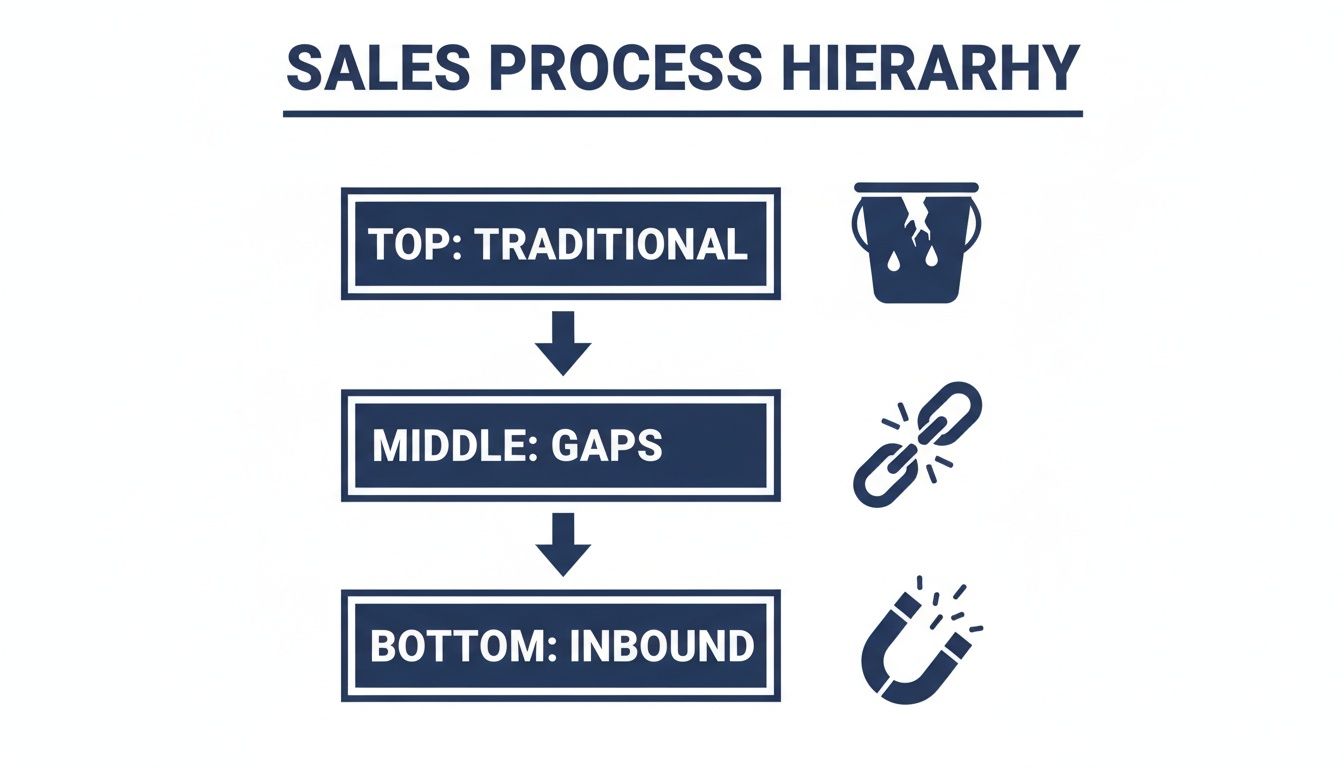
Unlike the "leaky bucket" model where leads fall through the cracks, a true inbound funnel acts like a powerful magnet, systematically pulling in and guiding qualified prospects forward.
Stage 1: Awareness
At the top of the funnel, your potential customer has a problem, but they might not have a name for it yet. They aren't searching for your product. They're looking for answers and clarity. Your job is to be the most helpful resource they find.
- Buyer’s Mindset: "I have this issue, but I don't know what the solution is called. I just need to understand what's happening."
- Your Goal: Attract relevant traffic by answering their earliest questions. Become their trusted source of information before you ever mention a product.
For a B2B manufacturer, this means creating content that dives deep into the technical challenges your audience faces. Forget about your products for a moment and focus entirely on their problems. This is where effective inbound marketing lead generation begins.
Actionable Content Tactics:
- Technical Blog Posts: Publish articles optimized for search that directly answer specific engineering questions, like "How to Reduce Cycle Time in CNC Machining."
- Educational Guides & Checklists: Offer downloadable resources that empower prospects to diagnose their own problems.
- Industry Research Reports: Share original data and insights that establish your company as an authority.
Stage 2: Consideration
Once a prospect can name their problem, they enter the Consideration stage. Now they’re actively researching and comparing potential solutions. Their mindset has shifted from "what is my problem?" to "what are my options for solving it?"
- Buyer’s Mindset: "Okay, I understand the problem and know solutions exist. Now I need to compare them and find the best fit for my situation."
- Your Goal: Nurture the leads you’ve attracted by showcasing your expertise and demonstrating why your approach is the smartest one.
Here, you gently introduce your solutions within a helpful, educational context. You're not selling; you're providing detailed information that helps them see you as a credible partner.
Actionable Content Tactics:
- Detailed Case Studies: Don't just tell them you can solve their problem—show them. Present real-world examples of how you delivered results for a company just like theirs.
- Product Spec Sheets & Data Sheets: For technical buyers, hard data isn't just nice to have—it's non-negotiable.
- Webinars & Explainer Videos: Host a deep-dive session on a particular technology. The live Q&A is often where the real magic happens.
Stage 3: Decision
At the bottom of the funnel, your prospect is ready to make a choice. They’ve narrowed their options to a few, and now they’re looking for validation that your company is the right one to trust.
- Buyer’s Mindset: "I've decided on the type of solution I need. Now, who should I buy it from?"
- Your Goal: Make it an easy and logical choice to pick you. Convert that highly qualified lead into a customer by removing any final doubt.
This is where your sales team typically steps in, but your content still does the heavy lifting to smooth the path.
Actionable Content Tactics:
- Product Demos & Consultations: Offer a free, no-obligation consultation or a live demo to show them exactly how your solution works in their world.
- Free Trials or Samples: When possible, let them get their hands on your product. Firsthand experience builds incredible confidence.
- Customer Testimonials & Reviews: Let your happy clients do the selling for you. Social proof is one of the most powerful tools for validating a final decision.
Stage 4: Retention
The sale is closed, but your work isn’t done. The final—and most profitable—stage of the inbound funnel is Retention. We all know it costs five times more to acquire a new customer than to keep an existing one, making this stage critical for long-term growth.
- Customer’s Mindset: "I made a good choice. How can I get the most value out of this purchase?"
- Your Goal: Transform one-time buyers into repeat customers and enthusiastic brand advocates.
Actionable Content Tactics:
- Onboarding Emails & User Guides: Set new customers up for success from day one with clear, helpful guidance.
- Exclusive Customer-Only Content: Reward their loyalty with advanced tips, private webinars, or special access to new features.
- Email & SMS Updates: Keep them informed about product updates or complementary services that add more value.
Using a CRM to Automate Your Funnel
A perfectly mapped funnel is a great blueprint, but a blueprint alone doesn't build the machine. To bring your strategy to life, you need an engine—a system that can execute, track, and automate every step. This is where a Customer Relationship Management (CRM) platform becomes your most valuable asset.
Without a solid CRM, you’re stuck managing leads with spreadsheets and sticky notes—a guaranteed recipe for dropped leads and missed opportunities. A CRM like GoHighLevel transforms your funnel from a static diagram into a dynamic, automated system that works for you 24/7.
Moving From Theory to Implementation
Let's get practical. The real power of an inbound sales funnel is unlocked when your marketing and sales activities are seamlessly connected. A CRM is the bridge that makes this happen.
Think about it: when a lead downloads a whitepaper, what happens next? In a manual system, that lead might sit in an inbox for days. By then, the trail is cold.
With a CRM, that same action can instantly trigger automated events:
- The lead’s contact info is captured and a new profile is created.
- They’re automatically tagged based on the content they downloaded (e.g., "Interest: CNC Machining").
- An automated email sequence kicks off, delivering more relevant content.
This is how you build a machine that nurtures leads at scale. Using a CRM for lead generation isn't just about storing contacts; it's about driving intelligent, automated action.
Building Automated Workflows That Nurture Leads
The heart of CRM automation is building workflows—a series of "if this, then that" rules that guide prospects through your funnel. Think of workflows as your digital sales assistants, making sure every lead gets the right attention at the right time.
A workflow isn’t just a fancy email sequence. It's an automated decision-making process that responds to your leads' behavior in real-time, delivering a personalized journey that builds trust.
For example, a workflow for a "Consideration Stage" lead might look like this:
- Trigger: Prospect downloads a case study.
- Immediate Action: Send a "thank you" email with the resource.
- Wait 3 Days: Check if they opened the email.
- If Yes: Send a follow-up with a related blog post.
- If No: Send a reminder email with a different subject line.
- Next Trigger: If they click a link to visit your pricing page, the workflow automatically notifies a sales rep to make a personal follow-up call.
This level of automation ensures your sales team only spends time on the most engaged, sales-ready leads, which dramatically increases their efficiency.
Your GoHighLevel Funnel Implementation Checklist
Setting up your CRM is the most critical step in activating your inbound sales funnel. Use this checklist to ensure you have the foundational pieces in place to capture, track, and convert leads.
| Setup Step | Key Action Required | Why This Step Matters |
|---|---|---|
| Integrate Your Website | Connect your website forms, pop-ups, and live chat directly to the CRM. | This ensures that every lead generated on your site is captured instantly, eliminating manual data entry and preventing leads from getting lost. |
| Create Custom Fields | Add fields to capture specific data points relevant to your business (e.g., "Industry," "Company Size," "Specific Interest"). | This allows for deeper segmentation, enabling you to send highly targeted messages that resonate with different types of buyers. |
| Build Your Nurture Sequences | Design email and SMS workflows for each stage of the funnel (Awareness, Consideration, Decision). | Automated nurturing keeps your brand top-of-mind and educates leads over time, moving them closer to a sale without manual follow-up. |
| Set Up Lead Scoring | Assign points to leads based on their actions (e.g., +5 for opening an email, +10 for downloading a case study, +25 for visiting the pricing page). | Lead scoring automatically identifies your most engaged prospects, so your sales team knows exactly who to prioritize and can focus their efforts where it counts. |
| Configure Sales Pipelines | Create visual pipeline stages in your CRM that mirror your sales process (e.g., "New Lead," "Contacted," "Demo Scheduled," "Proposal Sent"). | This provides a clear, at-a-glance view of your entire sales pipeline, helping you forecast revenue and identify bottlenecks in your process. |
| Establish Sales Notifications | Create automated alerts to notify sales reps when a lead reaches a certain score threshold or takes a high-intent action. | Instant notifications ensure that hot leads receive a timely follow-up, dramatically increasing the likelihood of converting them into a sales opportunity. |
By systematically working through this checklist, you transform your CRM from a contact database into the command center for your entire inbound sales operation.
A Real-World B2B Manufacturer Funnel Example
Theory is helpful, but seeing a system in action makes it real. Let’s walk through a common scenario for a B2B manufacturer to show how a practical, automated inbound sales funnel solves their biggest challenges. You can adapt this flow for your own business.
Imagine a custom CNC machining company. Their ideal customers are busy mechanical engineers and procurement managers who need highly specific, tight-tolerance parts. Here's the challenge: these buyers are technical experts. They ignore generic sales pitches and do their research long before they pick up the phone.
Our goal is to build a system that meets them during that research phase, guiding them from a Google search to a quote request.
Stage 1: Awareness — The Engineer's Problem
Every sale starts with a problem. An engineer—let's call her Sarah—is designing a new medical device and needs a complex component machined from titanium. She doesn't have a go-to supplier, so she heads to Google.
She searches for something specific, like "tight tolerance titanium CNC machining services." Our example company has done the work on technical SEO, so their blog post, "5 Common Pitfalls in Machining Medical-Grade Titanium," appears on the first page.
That title speaks directly to her problem. She clicks, reads the article, and immediately sees this company as a credible expert. Just like that, she has entered the top of our funnel.
Stage 2: Consideration — The Valuable Download
At the end of the insightful blog post is a clear call to action. It’s not "Contact Us." It’s something far more valuable for someone in Sarah's position.
Call to Action: "Download our free Design for Manufacturability (DFM) Checklist for Titanium Components. Make sure your parts are optimized for cost and performance before you request a single quote."
This offer is perfectly tuned to her immediate needs; it’s a tool, not a sales pitch. She happily provides her name, company, and email to get the checklist.
The second she hits "submit," the automation engine fires up. Her contact info is instantly added to the CRM and tagged as a "Hot Lead – Titanium DFM." This triggers the entire next phase of our automated funnel.
Stage 3: Decision — The Automated Nurture Sequence
Sarah doesn't just get a PDF. She enters a carefully designed email nurture sequence where we build trust and prove our expertise without being pushy.
Here’s what that automated workflow looks like:
- Immediate Email: Delivers the DFM checklist. The email is short, helpful, and reinforces our role as a partner.
- Email 2 (3 days later): A quick case study lands in her inbox titled, "How We Achieved a 0.005mm Tolerance for [Similar Company]'s Medical Device." This is pure social proof that showcases our technical skills.
- Email 3 (5 days later): This email is more direct. We offer a free, 15-minute project consultation with a senior engineer. The call to action is simple: "Upload your CAD file on our secure portal for a complimentary DFM review and a quote within 24 hours."
Because we've provided value upfront, this final ask feels like the logical next step. Feeling confident, Sarah uploads her design file and requests a quote.
The system automatically pings the sales team, giving them Sarah's complete history. Now, the salesperson can have an intelligent, helpful conversation, turning a digital inquiry into a warm, qualified opportunity. That is what a high-functioning inbound sales funnel looks like.
Measuring Funnel KPIs to Optimize Performance
You can't improve what you don't measure. An engineering mindset demands data, and your inbound sales funnel is no different. A funnel without key performance indicators (KPIs) is like driving without a dashboard—you're moving, but you don't know if you're about to run out of fuel.
This is where we move past vanity metrics and focus on the hard numbers that drive business decisions. Tracking the right KPIs lets you diagnose your system's health, pinpoint bottlenecks, and make intelligent optimizations.
Core Funnel Metrics That Actually Matter
Your CRM should be the central hub for this data. Instead of getting lost in dozens of data points, start by focusing on these three foundational KPIs.
1. Lead-to-Customer Conversion Rate
This is the ultimate measure of your funnel's health. It answers a simple question: "Of all the leads we generate, what percentage actually become paying customers?" A low rate here signals a major leak in your system.
2. Cost Per Acquisition (CPA)
CPA tells you exactly how much you spend, on average, to acquire one new customer. To calculate it, divide your total marketing and sales spend over a period by the number of new customers acquired. This number is critical for budgeting and scaling.
3. Sales Cycle Length
This metric measures the average time it takes for a lead to move from first contact to a closed sale. A long sales cycle can indicate friction in your process, like slow follow-ups or content that isn't answering buyer questions.
By focusing on these three core metrics, you gain a high-level view of your inbound funnel's efficiency. They tell you if your system is working, what it costs, and how quickly it produces results.
Diagnosing Bottlenecks with Stage-Specific KPIs
Once you have the big picture, it’s time to zoom in. Each stage of your funnel has its own KPIs that act as diagnostic tools, helping you see exactly where prospects are getting stuck.
Here’s a simple framework for what to track at each stage:
-
Awareness Stage Metric: Website Traffic-to-Lead Conversion Rate. This measures the percentage of website visitors who become a known lead (e.g., fill out a form). If you have high traffic but a low conversion rate—below 2% is a common red flag—it’s time to diagnose your offers and landing page designs.
-
Consideration Stage Metric: Lead-to-Marketing Qualified Lead (MQL) Rate. This tracks how many initial leads show enough engagement to be considered serious prospects. If this number is low, your lead nurturing content may not be compelling enough.
-
Decision Stage Metric: MQL-to-Sales Qualified Lead (SQL) Rate. This is where the marketing-to-sales handoff happens. A low rate here often points to a misalignment between your marketing and sales teams on what defines a "qualified" lead.
Building a simple dashboard in your CRM to monitor these KPIs is the first step toward continuous optimization. The data will tell you what’s working and what isn’t, letting you make targeted adjustments instead of just guessing. Understanding these numbers is fundamental to measure marketing ROI and justify your investment in an inbound system.
Your First 90 Days: A Practical Execution Plan
An idea without a plan is just a wish. Here is a straightforward, 90-day roadmap to build and launch your first inbound sales funnel. This isn’t about perfection; it's about building a proof of concept, getting wins on the board, and gaining momentum.
We'll break it down into three focused, 30-day sprints.
Having an actionable plan takes the guesswork out of the equation and gives you a structured path to follow.
Month 1: The Foundation
The first 30 days are about laying the groundwork. Your goal is to build the essential engine your funnel will run on.
- Define Your Ideal Customer: Go deeper than basic demographics. Pinpoint their specific problems, understand the questions they're asking, and know where they look for answers online.
- Configure Your CRM: Get core tracking and automation features running. At a minimum, connect your website forms and set up a basic sales pipeline to track new leads.
- Create One High-Value Content Piece: Don't try to build an entire content library. Instead, create one exceptional piece of content—a detailed checklist, technical guide, or comparison sheet that solves a major problem for your ideal customer. This will be your primary lead magnet.
Month 2: Launch and Promotion
With the foundation in place, it’s time to flip the switch. Month two is about activating the system and driving targeted traffic to your new content offer.
- Launch Your Landing Page: Build a simple, clean landing page for your content piece. Focus on the value, not the fluff.
- Drive Initial Traffic: Don't spread yourself thin. Pick one or two channels where you know your ideal customer spends their time—like a specific LinkedIn group or a niche industry forum—and promote your offer there.
- Activate Your First Automation: Build a simple three-email nurture sequence that automatically starts the moment someone downloads your content.
Month 3: Measure and Iterate
The final 30 days are for analysis and optimization. Your goal is to figure out what worked, what didn't, and how to improve it. This is where the real learning happens.
- Analyze Initial Data: Jump into your KPIs. How many visitors converted into leads? How many opened your follow-up emails? The numbers will tell you a story.
- Make One Targeted Improvement: Based on that data, find the single biggest bottleneck in your funnel and focus on fixing just that one thing. For example, if your landing page conversion rate is low, test a new headline. Small, focused changes lead to big results.
Got Questions? We've Got Answers.
Building a new system from the ground up always comes with questions. Here are some of the most common ones we hear from business owners as they get ready to build their first inbound sales funnel.
How Long Does It Take to See Results?
You can expect to see early wins, like new leads trickling in, within the first 90 days. But let's be transparent: a mature inbound sales funnel is a long-term asset, not a quick fix. Think of it like planting a tree—you see sprouts quickly, but real growth and fruit come with consistent care.
The compounding power of SEO and content marketing typically takes 6-12 months to build into a predictable stream of qualified leads. The key is consistent execution and using data to make smart adjustments.
Will This Really Work for a Niche Manufacturing Business?
Absolutely. In fact, inbound funnels are often more effective for niche B2B businesses. Your specificity is your superpower.
Instead of casting a wide net with traditional advertising, you can create highly specific, technical content that speaks directly to the small, targeted group of your perfect customers. The goal isn't to attract everyone; it's to attract the right people. This strategy prioritizes quality over quantity, which is always more efficient.
The more specialized your audience, the more powerful your targeted content becomes. You stop being just another vendor and start being the go-to resource for their specific challenges.
Do I Need a Huge Budget to Build an Inbound Funnel?
Not necessarily, but you must invest one of two things: time or money. The main investment is in creating high-quality, valuable content and setting up your CRM correctly.
If you have the in-house expertise and hours to write technical content and manage the technology, your direct cash outlay will be lower. If you're short on time, investing in an expert partner gives you the systems and experience to get it done faster and see a more reliable return on your investment.
At Machine Marketing, we specialize in diagnosing your current system and building the marketing machine you need for scalable growth. We handle the CRM setup, content creation, and automation so you can focus on running your business.
Ready to stop leaking leads and start building a predictable sales pipeline? Book a discovery call with us today.