If you're a manufacturing CEO, the situation probably looks familiar. Your team builds solid products, deliveries are on track, customers stay happy, and sales still feel uneven. Some quarters look strong, then the pipeline thins out, follow-up gets inconsistent, and nobody can say with confidence which marketing activity moved revenue.
That's usually the point where companies start asking the wrong question. They ask whether they need ads, a website refresh, SEO, email automation, or a new CRM. The better question is simpler: do you need someone to engineer the full revenue system so marketing, sales, and service stop operating like separate departments?
That's where a good industrial marketing consultant earns their keep. Not as a campaign vendor. As a systems builder.
Table of Contents
- Your Sales Are Stagnant Is a Consultant the Answer
- What an Industrial Marketing Consultant Actually Does
- Core Services and Channels for Manufacturers
- How to Measure ROI Beyond Just Leads
- How to Evaluate and Hire the Right Consultant
- A Sample Engagement Roadmap The First 90 Days
- Your Next Step Toward a Predictable Growth Engine
Your Sales Are Stagnant Is a Consultant the Answer
Stagnant sales rarely mean you have no market. More often, they mean your commercial system has gaps. Good opportunities come in, but the wrong ones get too much attention. The right ones sit in inboxes, spreadsheets, and tribal knowledge spread across sales reps, estimators, and service managers.
Manufacturers feel this problem differently than software firms or retailers. Your buyer may need engineering approval, operational sign-off, procurement review, and budget clearance before anything moves. If your marketing only attracts names instead of supporting that full decision path, activity goes up while results stay flat.
An industrial marketing consultant can be useful here, but only if you hire the right kind. You don't need someone who treats your business like a generic lead generation account. You need someone who understands that quoting activity, sales conversations, technical content, account follow-up, and post-sale support all affect growth.
The market has already matured around that need. The U.S. Marketing Consultants industry reached $88.4 billion in revenue in 2025, with 323,000 businesses in the industry, according to IBISWorld's Marketing Consultants industry report. IBISWorld also reports the industry grew at a 3.2% compound annual growth rate from 2020 to 2025, while business counts rose at a 5.0% CAGR over the same period. That matters because it tells you this isn't a fringe decision. Companies across sectors already use consultants for strategy, lead generation, and revenue support.
What stagnation usually looks like in practice
- Sales blames lead quality: Marketing delivers inquiries, but reps say none of them are serious.
- Marketing blames follow-up: Sales gets opportunities, but nobody responds quickly or consistently.
- Leadership lacks visibility: Revenue reports live in one place, CRM data in another, and website data somewhere else.
- Service sits on usable insight: The people who know the installed base best aren't connected to growth planning.
A stalled pipeline often isn't a traffic problem. It's a coordination problem.
When a consultant is worth the investment
A consultant is usually the right move when you already have pieces in place but they don't work together. That might mean a website with decent traffic but weak conversion paths. It might mean a CRM that sales barely trusts. It might mean content exists, but it doesn't answer the questions engineers, buyers, and plant leaders ask before they shortlist a vendor.
If that sounds familiar, the answer probably isn't “more marketing.” It's better system design.
What an Industrial Marketing Consultant Actually Does
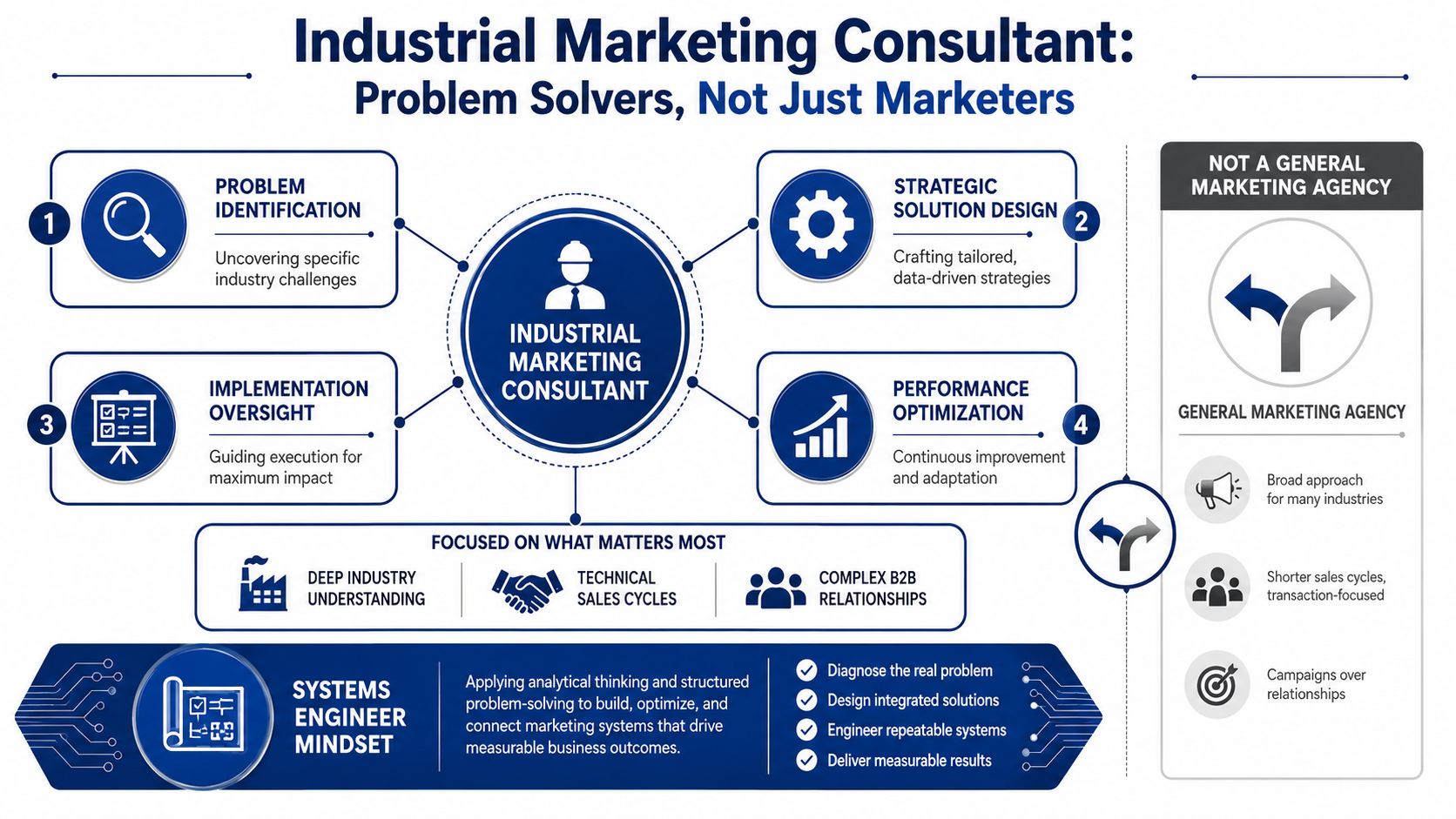
A general agency usually starts with channels. They ask whether you want SEO, paid search, LinkedIn ads, email campaigns, or a website redesign. An industrial marketing consultant should start somewhere else. They should ask how revenue is created now, where deals stall, who influences the sale, and which data points the leadership team can't currently see.
A consultant should diagnose system failure not just channel performance
The best way to think about an industrial marketing consultant is as a systems engineer for your revenue process. They aren't there just to publish content or launch campaigns. They're there to find the breakpoints between your website, CRM, sales process, quoting workflow, and service follow-up.
That diagnosis usually includes questions like these:
- Where do qualified opportunities first appear: Organic search, referrals, distributors, trade shows, outbound, or existing accounts?
- What happens after first contact: Is there a defined handoff, or does every rep improvise?
- Which content supports technical evaluation: Capability pages, application notes, comparison guides, case-style proof, FAQ pages, or post-demo follow-up?
- What does management see: Pipeline by source, by product line, by rep, by region, or not at all?
If a consultant can't map those relationships, they'll default to campaign activity. That creates motion, but not control.
A strong industrial consultant should also be comfortable recommending that some channels wait. If your CRM is unreliable, paid traffic can make the chaos worse. If your sales team doesn't have a standard response process, more inbound won't fix anything.
For companies that need this kind of top-down diagnosis, a structured strategic marketing consultation is often more useful than jumping straight into monthly execution.
The real deliverable is visibility across the buying group
In industrial sales, one contact almost never tells the whole story. Konstruct Digital notes in its industrial marketing strategy guidance that the buyer journey should be treated as an account-level system, with CRM and marketing automation structured to track signals from the full buying committee and support multi-touch attribution across channels in its industrial marketing strategy article.
That changes what a consultant should build.
Instead of a simple funnel tied to one lead form, they should help you create a model that can capture:
- website visits from multiple people in the same account
- repeat content consumption across product categories
- demo or quote interest tied to company-level activity
- sales follow-up based on account behavior, not just one person's click
- lifecycle segmentation by industry, region, product fit, or installed base
Practical rule: If your reporting can only tell you who filled out the form, but not which account is warming up, your system is underbuilt for industrial sales.
The output isn't just better reporting. It's better timing. Sales sees more context. Marketing stops over-crediting the last click. Leadership gets a cleaner view of pipeline influence.
Core Services and Channels for Manufacturers
Most manufacturers don't need every marketing tactic. They need the right mix of channels tied to clear commercial jobs. A consultant should be able to explain each service in business terms, not marketing jargon.
Industrial marketing is now primarily digital. WebFX reports that 98% of manufacturers are generating sales-qualified leads through digital marketing, while 78% plan to increase spending on AI tools and 46% are already using generative AI in operations in its industrial marketing facts and statistics roundup. That means digital execution isn't optional anymore. But digital activity without system design still underperforms.
The channel only matters if it serves the sales process
Here's what core services should do inside a manufacturing business.
- Technical SEO: Help engineers, sourcing teams, and operations buyers find specific capabilities, tolerances, certifications, materials, or application pages when they search.
- Website strategy: Turn the site into a qualification tool. Not just a digital brochure. Strong industrial sites answer technical questions, route buyers to the right product or service path, and create clean next steps.
- Content for complex decisions: Build pages and assets that support specification, vendor comparison, process understanding, and internal justification. That often includes capability pages, process breakdowns, use-case content, and sales enablement materials.
- CRM and automation: Standardize what happens after inquiry, quote request, demo, or download. Many manufacturers lose momentum at this stage.
- Account-based outreach: Focus on target accounts where the deal size, fit, or strategic value justifies coordinated sales and marketing effort.
- Email nurturing: Keep long sales cycles moving with follow-up that matches buyer stage. A first inquiry shouldn't get the same sequence as a post-quote prospect.
What doesn't work well is channel shopping. Hiring one vendor for SEO, another for paid media, and letting the CRM sit unmanaged usually creates reporting noise and disconnected messaging.
AI and automation matter when they remove friction
AI has become part of the conversation in manufacturing, but most companies apply it too broadly at first. A consultant should narrow the use case.
Useful applications often include:
- Content support: Drafting outlines, organizing technical source material, and speeding internal review cycles.
- Lead routing and enrichment: Helping teams classify inbound requests and assign them faster.
- Workflow triggers: Prompting sales or service actions based on account behavior inside the CRM.
- Knowledge capture: Turning scattered sales and service input into reusable campaign and enablement material.
What usually fails is using AI to mass-produce generic content that doesn't reflect your technical reality. Engineers and buyers spot thin content fast. If the consultant talks about scale but not about validation, review, and ownership, they're skipping the hard part.
A good channel plan is disciplined. It matches buyer behavior, supports the sales team, and creates cleaner data over time.
How to Measure ROI Beyond Just Leads
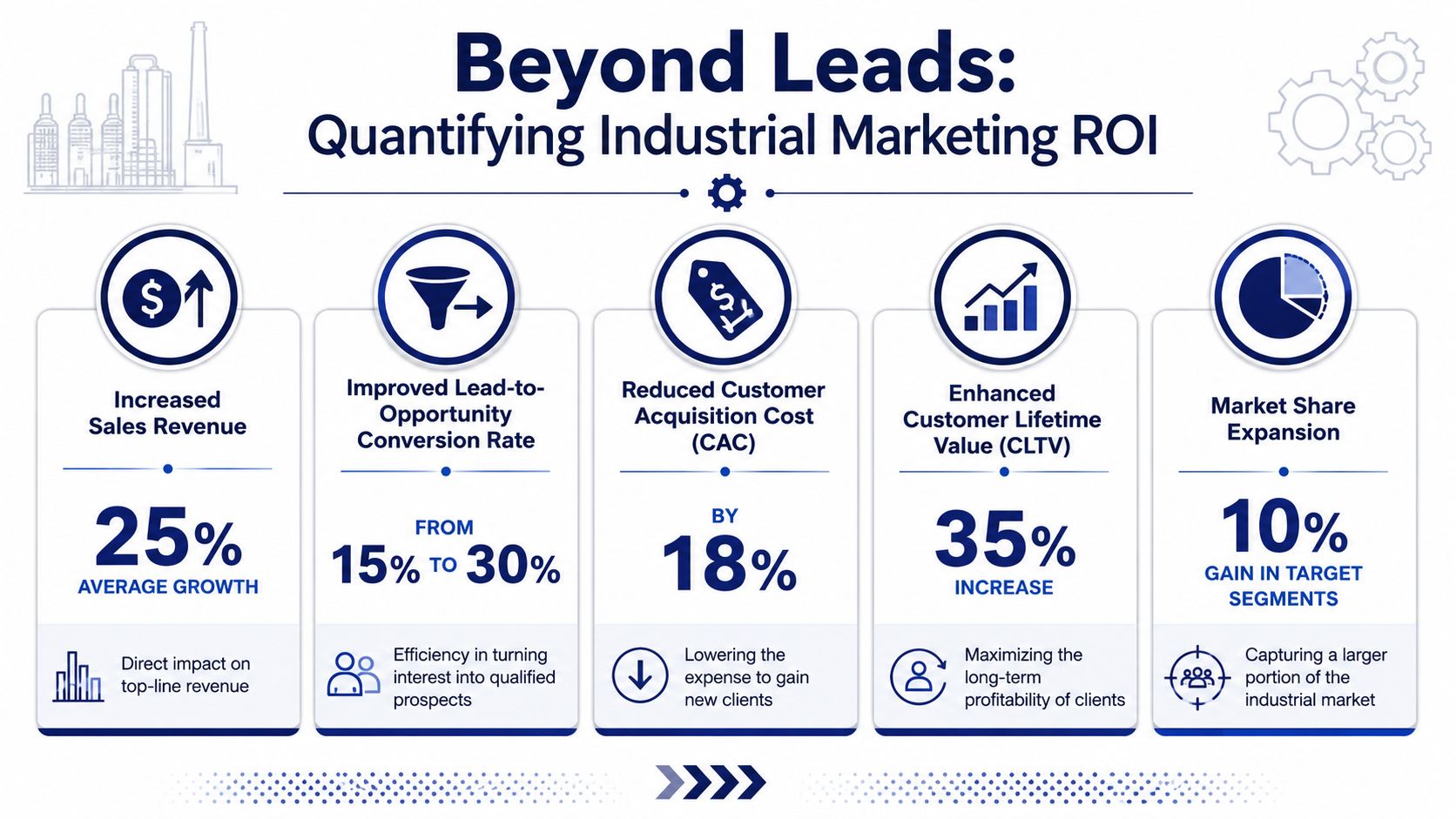
Leads are easy to count. That's why so many companies stop there. But lead volume is a poor way to judge an industrial marketing consultant if your actual sales process depends on fit, timing, buying committee activity, quote quality, and account expansion.
The wrong scoreboard creates bad decisions
If you measure marketing on raw inquiries, you'll often reward the noisiest channels instead of the most profitable ones. An industrial business needs a tighter ROI model.
A better scorecard usually includes:
- Qualified pipeline created: Which opportunities meet your fit and readiness standards.
- Marketing-influenced pipeline: Which deals were supported by content, search, nurturing, or account engagement before they moved forward.
- Lead-to-opportunity conversion: Whether inbound interest turns into real sales conversations.
- Sales cycle movement: Whether marketing shortens delays between inquiry, qualification, quote, and next meeting.
- Customer quality: Whether the accounts you win match your margin, serviceability, and long-term fit.
If your team needs a practical framework for the conversion side of this, LinkedFuse put together a useful comprehensive B2B conversion guide that's worth reviewing alongside your own funnel stages.
You also need reporting discipline. That means one shared definition of a qualified lead, one shared definition of an opportunity, and one owner for dashboard accuracy. Without those basics, ROI arguments turn into opinion fights.
For a deeper look at building a reporting model that leadership can trust, this guide on how to measure marketing ROI is a practical next read.
When a consultant reports activity without tying it to pipeline movement, they're describing effort, not return.
Post sale growth belongs in the ROI model
Many manufacturers undercount value. They measure marketing only on net-new acquisition, then ignore what happens after the first sale.
Bain's perspective on industrial services argues that leading companies win by systematically identifying customer opportunities, defining route-to-market and commercial responsibilities, and managing execution and performance across the service sales team in its analysis of how industrial companies sharpen go-to-market strategy for services. That should shape how you judge a consultant.
A strong ROI model should ask:
- Are existing customers buying additional services
- Can sales and service see the same account history
- Does installed-base information trigger campaigns or follow-up
- Is there a process for renewals, replacements, upgrades, or support offers
That's where the best consultants separate themselves. They don't stop at lead generation. They connect service data, CRM structure, and account planning so you can grow the full customer lifecycle.
How to Evaluate and Hire the Right Consultant
Hiring the wrong consultant usually doesn't fail all at once. It fails subtly. You get a polished kickoff, some attractive reports, regular meetings, and very little change in how your revenue system works.
Questions that reveal how they think
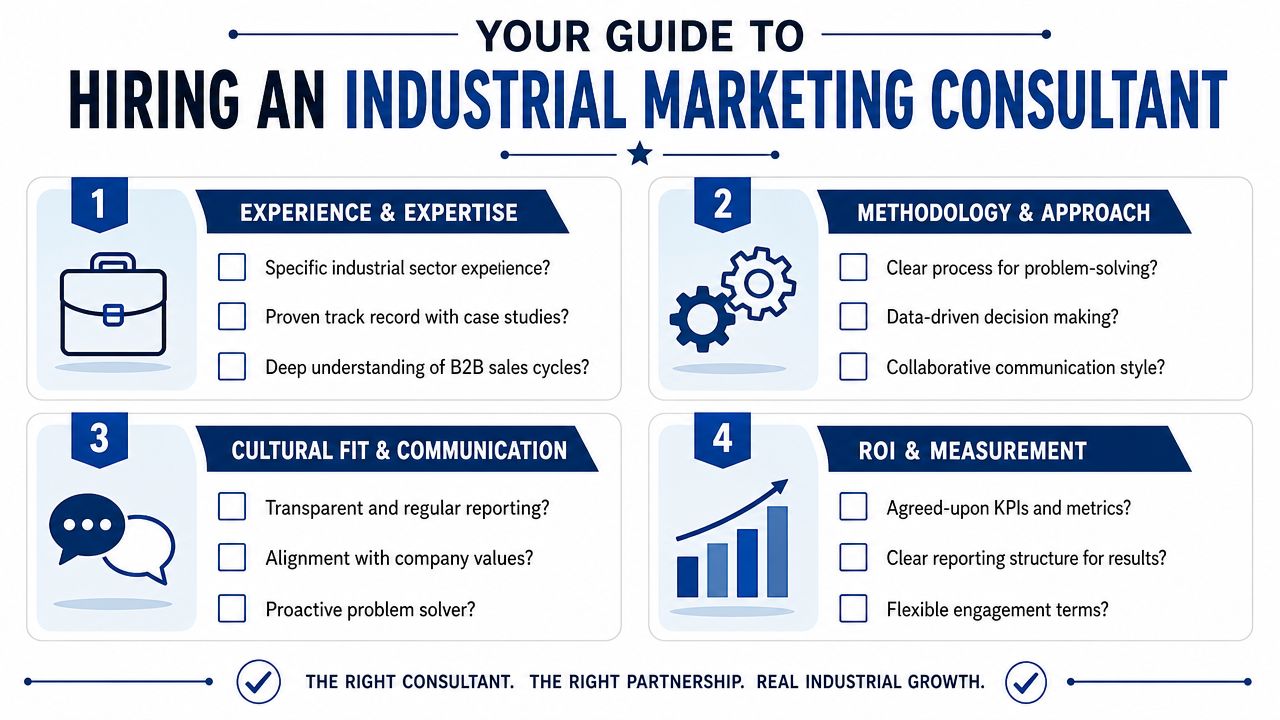
The interview should test diagnosis, not charisma. Ask questions that force the consultant to show process.
- How do you define success in an industrial engagement: Listen for pipeline, opportunity quality, lifecycle value, and reporting integrity. Be cautious if the answer centers on impressions, clicks, or traffic alone.
- How do you handle long sales cycles with multiple stakeholders: They should talk about buying groups, account-level tracking, and coordinated sales follow-up.
- Show us a dashboard or reporting structure you'd want leadership to review monthly: The specifics matter more than polish.
- What would you audit first in our business: Strong consultants usually mention CRM data quality, website conversion paths, lead handling, sales process consistency, and account segmentation.
- What should we not do yet: Good consultants know sequencing. Weak ones sell everything immediately.
This short video gives a useful outside perspective on what to consider before you hire.
Red flags you should take seriously
Some warning signs are obvious. Others are easy to miss in a good sales presentation.
- Guaranteed outcomes: Nobody serious can guarantee results in a complex B2B market.
- No questions about sales or service: If they only ask about marketing channels, they're too narrow.
- Platform-first recommendations: If the first answer is a tool, not a diagnosis, expect shallow strategy.
- Vanity metric reporting: Lots of traffic talk. No conversation about opportunity stages, account fit, or follow-up quality.
- Little interest in internal adoption: Great plans fail when sales and service teams never use the process.
The consultant you want should make your internal process clearer, not more dependent on them.
Comparing consultant pricing models
Pricing should match the problem you need solved. Here's the trade-off.
| Model | Best For | Pros | Cons |
|---|---|---|---|
| Retainer | Ongoing strategy, execution oversight, and optimization | Consistent support, easier coordination across channels, better for continuous improvement | Can drift if scope and success measures aren't tightly defined |
| Project-based | Website rebuilds, CRM cleanup, messaging work, audits | Clear deliverables, easier to budget, useful for focused needs | Often stops before adoption and optimization happen |
| Performance | Narrow lead generation engagements with clear attribution | Aligns incentives when tracking is strong | Hard to structure fairly in long industrial sales cycles and multi-touch buying journeys |
Choose the model that fits your bottleneck, not the one with the most attractive packaging.
A Sample Engagement Roadmap The First 90 Days
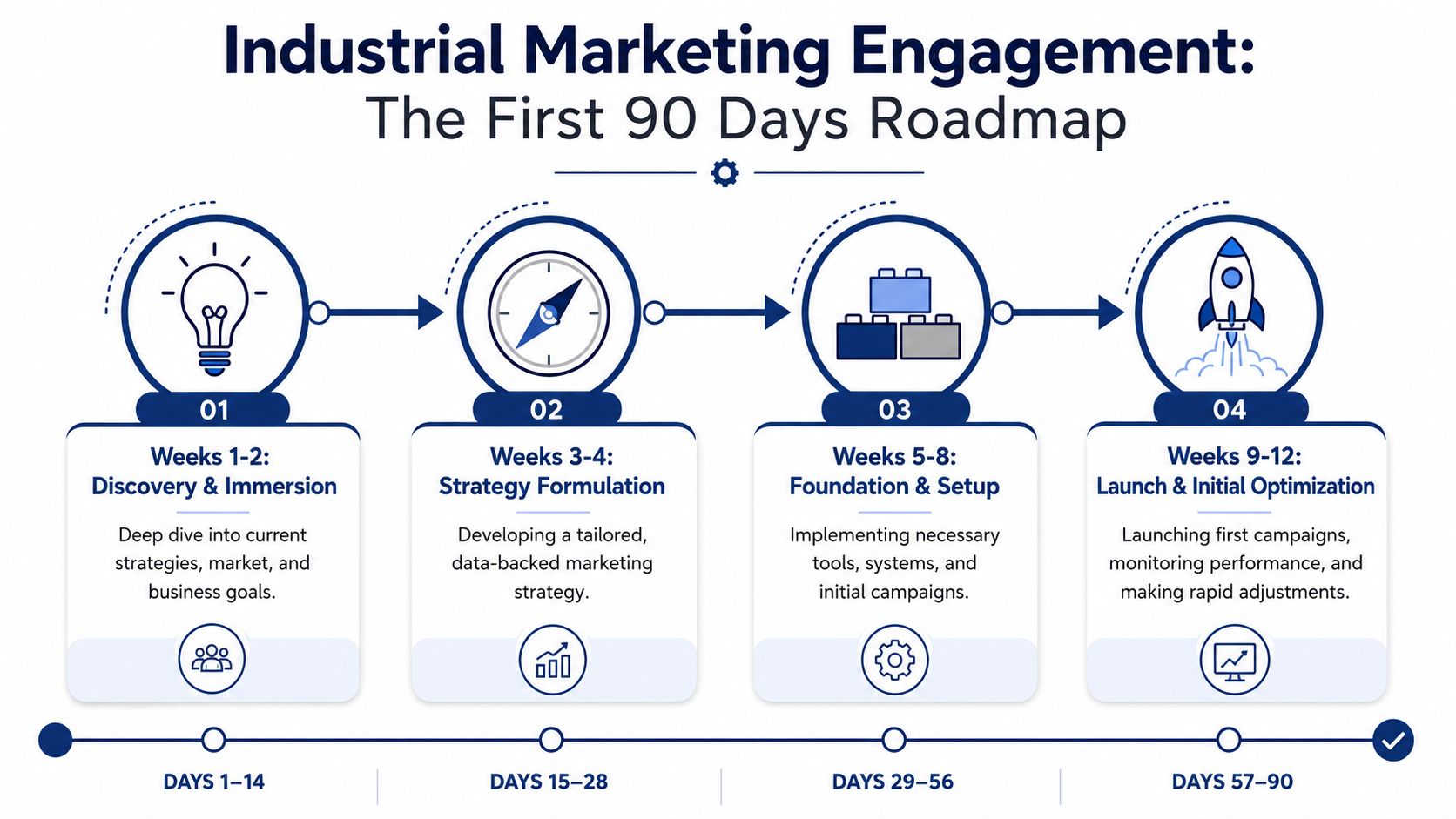
Most manufacturing leaders don't hesitate because they hate marketing. They hesitate because they've seen vague engagements before. Nobody wants to sign up for another open-ended initiative that starts with enthusiasm and turns into recurring invoices plus unclear ownership.
Days 1 through 30 diagnosis before action
The first month should feel investigative. The consultant learns how your business wins.
That often includes stakeholder interviews with leadership, sales, and service. It also includes a review of the website, CRM, lead sources, forms, routing logic, follow-up workflows, current reporting, and key content assets. In a healthy engagement, this stage surfaces friction that internal teams have already felt but haven't documented.
Typical outputs in this phase include a current-state map, a list of bottlenecks, and a prioritized set of fixes. If the consultant starts publishing campaigns before completing this work, they're guessing.
Days 31 through 60 system design and setup
Once diagnosis is complete, the engagement should shift into design. Here, strategy turns into infrastructure.
The consultant usually defines target segments, messaging priorities, conversion paths, lifecycle stages, dashboard requirements, and handoff rules between marketing, sales, and service. They may also clean up fields in the CRM, standardize forms, create automations, or restructure key website pages so incoming demand is easier to qualify and route.
For teams that need a structured planning tool, a marketing roadmap template can help align internal stakeholders before execution starts.
Operator's view: The first real win in many engagements isn't more traffic. It's getting the team to trust one process and one set of numbers.
Days 61 through 90 launch early wins and reporting
Only after the foundation is in place should the first campaigns or programs launch. That might mean updated conversion pages, a search campaign targeting high-intent terms, an email nurture sequence for quote follow-up, or account-based outreach to a short list of target manufacturers or buyers.
The goal in this phase isn't scale. It's proof. You want to confirm that data is flowing correctly, sales can use the signals, and management can read the dashboard without debate.
By the end of this period, you should have three things: a working system, baseline metrics, and a clear plan for the next quarter. If you don't, the engagement is still too abstract.
Your Next Step Toward a Predictable Growth Engine
A good industrial marketing consultant doesn't just help you market better. They help you run growth like a system. That means connecting your website, CRM, content, sales process, and service opportunities so the business stops depending on scattered effort and inconsistent follow-up.
That's the standard to use when you evaluate help. Not whether someone can post content or run ads. Whether they can diagnose bottlenecks, build process, improve visibility, and make revenue performance easier to manage.
If your sales have stalled, the answer may not be more activity. It may be better architecture.
Start with a simple self-diagnosis:
- Can you see where qualified opportunities come from
- Does sales trust the CRM
- Do marketing and service share useful account insight
- Can leadership tie activity to pipeline and expansion
- Is there a clear operating model for follow-up
If the answer to most of those is no, you don't have a marketing problem by itself. You have a system design problem. That's fixable, but only if you treat it that way.
If you want a practical second opinion, Machine Marketing helps manufacturers and industrial businesses diagnose gaps in their growth systems, connect the tools they already have, and build a clearer path to predictable pipeline. If you're ready, book a diagnostic conversation and pressure-test your current setup before you spend more on disconnected tactics.