If your manufacturing or engineering firm is struggling to generate a steady flow of qualified leads, you're not alone. We see this all the time—and the root cause is often hidden in plain sight. It’s not a sales problem; it’s a marketing system problem.
In this guide, we’ll show you how to diagnose the gaps in your current approach. More importantly, we'll provide proven, step-by-step industrial marketing strategies you can use to build a predictable engine for growth.
Diagnosing Your Current Industrial Marketing System

Is your lead flow inconsistent? The diagnosis is almost always an outdated marketing approach disconnected from how modern B2B buyers find solutions. The old playbook of relying on trade show budgets and cold calls is broken.
Today’s industrial buyers are digital-first. They research solutions, compare spec sheets, and vet suppliers on their own terms, long before they pick up the phone. This isn’t a trend; it's a fundamental shift.
The Shift to Digital Dominance
The data is clear. Digital is the undisputed heavyweight in industrial marketing, with up to 98% of manufacturers now generating their best leads through online channels. You can explore the data on industrial marketing trends to see how deep this change runs.
What does this mean for you? Your website can't be a static, "set it and forget it" digital brochure. It must be your hardest-working salesperson—a 24/7 machine that attracts, educates, and qualifies prospects. Your entire marketing engine needs to meet buyers where they already are: on Google, in industry forums, and on professional networks like LinkedIn.
An effective industrial marketing system doesn't just generate a list of names. It builds a predictable pipeline of high-value opportunities by systematically solving problems for your ideal customer at every stage of their journey.
Key Questions for Your Diagnostic Audit
Let's run a quick diagnostic. This isn't about assigning blame; it's about putting on our engineering hats to identify gaps so we can build a better machine.
Ask yourself these questions honestly:
- Ideal Customer Clarity: Do we really know who our Ideal Customer Profile (ICP) is? Can we describe the specific pain points of the engineers or plant managers we serve?
- Website Performance: When someone searches on Google for a technical problem we solve, do we show up? Does our site offer genuinely valuable resources—like CAD files or case studies?
- Messaging Resonance: Does our marketing talk about our features, or does it talk about the tangible business outcomes and ROI our customers get?
- System Integration: Are our sales and marketing teams operating in silos, or is everything tracked in a central system (like a CRM) so we can measure performance from first click to final handshake?
A modern industrial marketing system isn't a collection of random tactics; it's an integrated engine where each part has a specific job.
Key Components of a Modern Industrial Marketing System
This table breaks down the core pillars of a high-performing system.
| Component | Primary Goal | Key Metric |
|---|---|---|
| ICP & Messaging | Attract high-value customers | Lead-to-Opportunity Rate |
| Website & SEO | Generate inbound organic leads | Keyword Rankings, MQLs |
| Inbound/Outbound | Create conversations & book meetings | Sales Appointments Set |
| CRM & Automation | Nurture leads & track pipeline | Lead Velocity, Pipeline Value |
| Reactivation | Re-engage old leads & past clients | Deals from Reactivated Leads |
| Content & Social | Build authority & educate prospects | Engagement Rate, Website Traffic |
| Sales Enablement | Equip sales team to close deals | Sales Cycle Length, Win Rate |
When these components work together, you stop chasing leads and start building a predictable growth engine.
Defining Your Ideal Customer and Core Message

Before you spend a dollar on ads, a new website, or a trade show, you need to answer two questions: Who, exactly, are we talking to? And what do they actually care about?
Get this wrong, and you're just making noise. Get it right, and every marketing activity that follows hits the mark with precision.
Most industrial companies have a fuzzy idea of their customer, saying things like, "we sell to manufacturers with 50-500 employees." That’s not nearly specific enough. You need to build a rock-solid Ideal Customer Profile (ICP).
Moving Beyond Basic Demographics
An ICP isn't just a list of industries and company sizes. It's a detailed blueprint of the businesses that get the most value from your solutions and are the most profitable for you to serve. You must reverse-engineer your best client relationships to find more just like them.
To do this, you have to understand their operational reality. Are they struggling with production downtime, wrestling with compliance standards, or trying to increase throughput? These are the real triggers for a purchase.
Your Ideal Customer Profile is a portrait of the company where your solution is not just a 'nice to have,' but an essential component for their success. It's the difference between being a vendor and being a partner.
Questions to Ask When Defining Your ICP
Get your sales, leadership, and service teams in a room. Pull up your customer list and ask these diagnostic questions:
- Who are our most profitable customers? Factor in revenue, sales cycle length, support demands, and lifetime value.
- What specific, urgent problems do we solve for them? Don't say "we sell CNC machines." Say "we eliminate the production bottleneck caused by manual part changes, saving them $150,000 a year in labor costs."
- What do our best clients have in common? Consider their technical know-how, decision-making process, and company culture.
- Who are our worst-fit customers? Knowing who not to sell to is just as critical for protecting your resources and reputation.
Once you have these answers, document your ICP. This becomes the north star for all future marketing and sales decisions and is the foundation for all effective industrial marketing strategies.
Crafting a Core Message That Resonates
With your ICP in focus, your next job is to craft a core message that speaks directly to their pains and goals. This is where most industrial marketing fails. Companies talk about themselves: their features, their founding date, their technology.
Your customers don’t care about your features. They care about outcomes. They want a solution that makes their job easier, their department more efficient, and their company more profitable.
Use this simple messaging framework:
- The Problem: State the specific, high-stakes problem your ICP faces.
- The Solution: Position your company as the expert guide to solving that problem.
- The Transformation: Paint a vivid picture of the successful outcome—the increased efficiency, reduced waste, or improved safety they can expect.
This framework ensures every piece of marketing reinforces the tangible value you deliver.
Turning Your Website Into a Lead Generation Engine
For too long, manufacturing websites have been treated like digital brochures: static, outdated, and underperforming. That has to change. Your website should be your best salesperson—working 24/7 to find, educate, and qualify the exact engineers you want as customers.
This isn’t about chasing vanity metrics like raw traffic. It's about turning your site into a powerful lead magnet by focusing on a rock-solid SEO foundation and content that solves real-world problems.
How Industrial Buyers Actually Use Search
Engineers and technical buyers don't browse Google like average consumers. They search with extreme precision.
They use specific model numbers, material compositions, performance tolerances, and complex, application-based questions. Your job is to show up at that exact moment of need. This requires a technical approach to keyword research that digs deep into the language your Ideal Customer Profile (ICP) uses daily.
Your website's only job is to answer your ideal customer's most urgent technical and logistical questions. When you do that better than anyone else, you don't just get traffic—you get qualified leads ready for a business conversation.
Foundational SEO for Manufacturers
Before you can win with content, you have to get the technical fundamentals right. This is the behind-the-scenes work that allows search engines to find and understand your site.
Here are the non-negotiables for your technical SEO checklist:
- Mobile Optimization: More engineers than you think pull up spec sheets on their phones from the shop floor. Your site must be fast and easy to use on any screen.
- Site Speed: No one waits for a slow-loading page. Speed is a make-or-break ranking factor, especially for complex technical sites.
- Logical URL Structure: URLs should be clean and descriptive (
yourcompany.com/products/model-xyz-stainless-steel-valve), not a jumble of numbers. - Technical Content Optimization: Every product and service page needs a unique, detailed description with technical specs and relevant keywords woven in naturally.
This foundational work prepares your site for success. For a deeper dive, check out our complete guide on SEO for manufacturing companies.
Creating Content That Closes Deals
With a solid technical base, you can shift your focus to content. This is where many industrial companies stumble. While 88% of industrial marketers use content marketing, 51% admit they struggle to create content that provides genuine value because they are pushing a sale instead of solving a problem.
The key is to build your content strategy around one word: utility. Create assets that your ICP can't do their job without.
Stop thinking "blog posts" and start thinking "resource library." Here’s what works:
- CAD Files & 3D Models: Providing downloadable files allows an engineer to drop your component directly into their design, making you part of their project from the start.
- Detailed Case Studies: Go beyond a simple quote. Break down the problem, your solution, and the measurable results (e.g., 15% reduction in cycle time, 22% decrease in material waste).
- Comprehensive Spec Sheets: Make it easy for buyers to find and download PDFs with every technical detail they need to make a confident decision.
When you transform your website from a sales pitch into an indispensable resource, you become a partner, not just another vendor.
Targeting High-Value Accounts with Precision
While inbound marketing casts a wide net, sometimes you need a spear. Account-Based Marketing (ABM) is that spear. It’s a laser-focused strategy that treats an entire target company as its own market, designed to land specific, high-value contracts.
This approach flips the traditional marketing funnel. Instead of blasting a message to a huge audience, you start by identifying your dream clients. Then, you build a coordinated, hyper-personalized campaign to engage the entire buying committee within that company.
You stop chasing individual leads and start building strategic relationships with the accounts that can truly transform your business.
Identifying and Prioritizing Your Target Accounts
The first step in any ABM campaign is a data-driven diagnosis to create a shared "most wanted" list for your sales and marketing teams.
Start by analyzing your best current customers based on these factors:
- Financial Value: Which clients have the highest revenue and lifetime value (LTV)?
- Operational Fit: Who gets the most from your solutions with the least hand-holding?
- Growth Potential: Which accounts offer the biggest opportunity for expansion and repeat business?
Use this analysis to create a tiered list of target accounts. Your Tier 1 might be the top 10 "must-win" accounts. This focus ensures you put your heaviest efforts where they’ll deliver the biggest return.
Mapping the Buying Committee
Once your target list is locked, the real work begins. Industrial purchases are rarely made by one person. Trends show that personalization and ABM are becoming critical industrial marketing strategies because they are designed for a complex buying process that now involves 6-10 decision-makers. You can explore more on how ABM is shaping industrial marketing to see where the industry is heading.
For each target company, your mission is to map out the key players:
- The Champion: Your inside contact who already sees your value.
- The Influencer: The lead engineer whose technical opinion is highly respected.
- The Decision-Maker: The executive with final budget authority.
- The Blocker: The procurement manager or CFO focused primarily on price.
Your job is to craft personalized messages that speak to each person’s unique role and motivations. The goal is to position your company as a strategic partner, not just another vendor.
Account-Based Marketing is an exercise in precision engineering. It requires you to diagnose the entire decision-making machine within a target company and then systematically engage each component with a message tailored to its specific function.
Executing a Multi-Channel ABM Campaign
With your accounts identified and contacts mapped, you can launch a coordinated outreach plan to surround the buying committee with a consistent, value-driven message across multiple channels.
A practical ABM playbook should include:
- Personalized Email: Craft emails that reference their company’s specific challenges and offer a relevant case study or technical guide.
- LinkedIn Engagement: Connect with key contacts, comment on their posts, and use targeted ads to put your best white papers and webinars in their feed.
- Direct Mail: In a world of digital noise, a well-designed physical package with a handwritten note can cut through the clutter and leave a lasting impression.
This multi-channel approach ensures your message is seen and heard, transforming your sales and marketing teams into a single, efficient revenue-generating force.
Integrating Your Marketing Technology Stack
A great strategy is useless without the engine to run it. Your technology stack—the tools that automate work, gather data, and arm your sales team—is that engine. But choosing the right software can be overwhelming.
The goal isn't to collect tools; it's to build a lean, integrated system that creates a single source of truth for every customer interaction, from their first click to the final purchase order.
The Core Components of Your Tech Stack
For most industrial firms, a powerful tech stack boils down to three essential pillars:
- Customer Relationship Management (CRM): This is your command center. It stores all prospect and customer data, giving both sales and marketing a single view of the truth.
- Marketing Automation Platform: This is the workhorse. Connected to your CRM, it handles repetitive tasks like sending follow-up emails, nurturing leads with relevant content, and scoring engagement to identify hot prospects.
- Analytics and Reporting Tools: These are your diagnostic scanners. Tools like Google Analytics show you where website traffic comes from, while your CRM dashboard tracks pipeline velocity, conversion rates, and marketing ROI.
The real transformation happens when these systems are integrated. A new lead can be automatically added to the CRM, placed in a nurture sequence, and assigned to a salesperson once they show enough interest—a seamless, hands-off process. You can learn more about how to triple your engineering firm's ROI with automation in our detailed guide.
Building a Scalable and Efficient System
Adopting this kind of marketing technology is no longer optional. Data shows that 85% of industrial firms now use social media and analytics, and 75% rely on email marketing software. You can explore more details about technology adoption in the industrial sector to see how fast things are changing.
The true power lies in automation. Imagine an engineer downloads a CAD file from your website. Instead of that lead sitting in an inbox, an automated workflow kicks in instantly.
Your marketing tech stack should work like a well-oiled assembly line. Raw leads go in one end, and through an automated process of nurturing and qualification, sales-ready opportunities come out the other.
Here’s a practical example of a lead nurturing workflow:
- Trigger: A prospect fills out a form to download a case study.
- Action 1: The system immediately emails them the PDF.
- Action 2: The contact is added to your CRM and tagged as "Interested in [Your Solution]."
- Nurture: The system automatically sends two more emails over the next few weeks with related technical articles and a video testimonial.
- Qualify: If the prospect engages with the content, their lead score increases.
- Alert: Once their score crosses a set threshold, the system creates a task for a sales rep to follow up.
This is a practical, achievable system that saves your team hundreds of hours and ensures they spend their time talking to genuinely interested, educated buyers.
Your 90-Day Industrial Marketing Roadmap
A great strategy is worthless if it just sits on a shelf. This 90-day action plan will put these industrial marketing strategies into motion and start generating tangible results.
We’ve broken this down into three manageable phases. This isn't about boiling the ocean; it's about building momentum through focused sprints to prove the ROI of your efforts.
Phase 1: Foundation (Days 1-30)
The first 30 days are about pouring a solid foundation. Rushing this step is the most common mistake we see. Before you launch a single campaign, you must get your core systems and messaging dialed in.
Your focus is on clarity and setup. You will align your teams, clean your data, and lay the technical groundwork for everything that follows.
Key Actions for Days 1-30:
- Finalize Your ICP and Messaging: Lock down your Ideal Customer Profile and core messaging. Ensure everyone from the shop floor to the C-suite agrees on who you're targeting and what you're saying.
- CRM Data Cleanup: Dedicate time to cleaning your contact database, merging duplicates, and standardizing data fields. A clean database is non-negotiable for automation.
- Technical SEO Audit: Run a full audit of your website. Fix foundational issues like slow page speed, broken links, and a poor mobile experience.
- Install Tracking Scripts: Implement measurement tools. Ensure analytics and tracking pixels, like the Google Tag Manager and LinkedIn Insight Tag, are correctly installed.
This timeline shows how each phase—Foundation, Activation, and Optimization—builds on the last, creating a structured path to a well-oiled marketing machine.
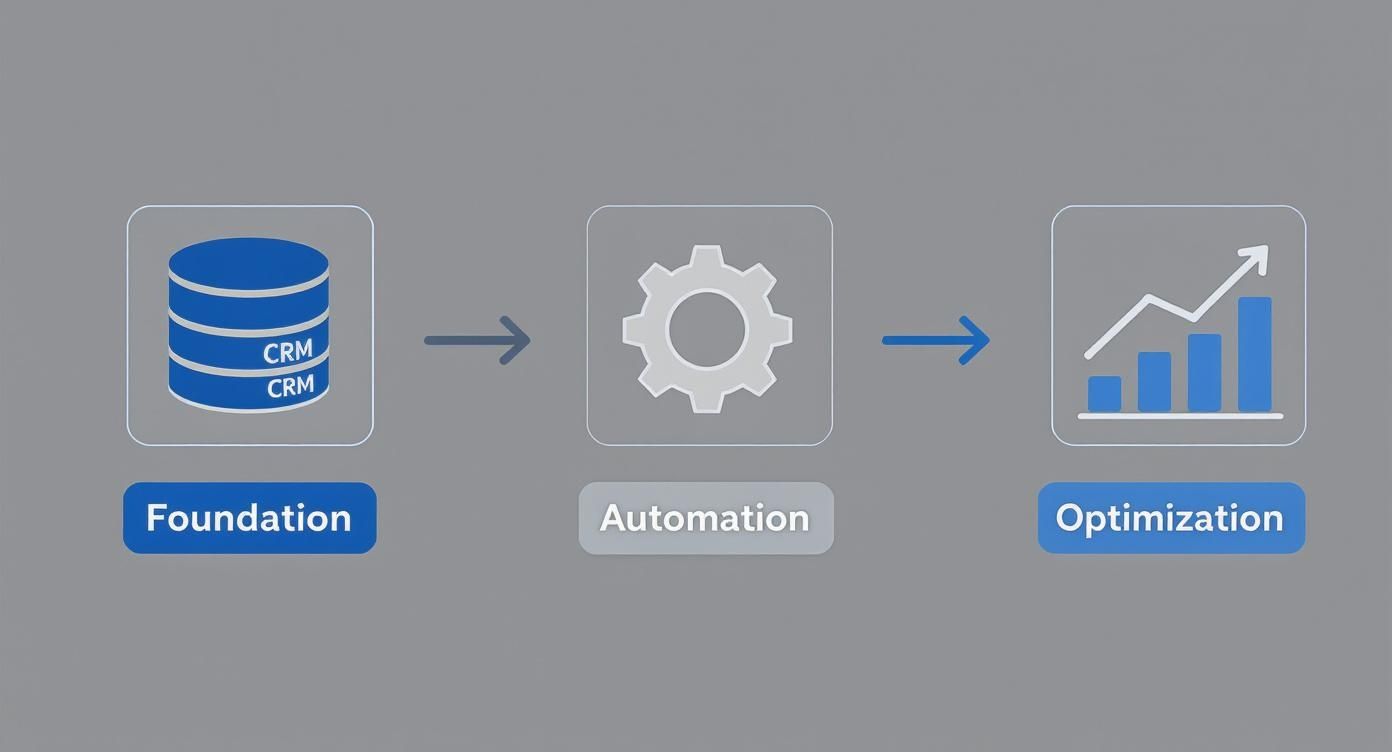
This systematic approach ensures you build a robust engine for growth, not just a series of disconnected, one-off campaigns.
Phase 2: Activation (Days 31-60)
With a solid foundation in place, it’s time to flip the switch. This month is about activating your strategy by launching targeted campaigns and building your first automated workflows.
You will start gathering real-world data, testing your messaging, and seeing how your target audience responds.
Key Actions for Days 31-60:
- Launch a Lead Magnet: Create and publish your first high-value content piece, like a technical guide or a buyer's checklist, gated behind a simple form.
- Build Your First Nurture Sequence: Create a 3-5 step automated email sequence for new leads who download your content. Need help? Check out our guide to dramatically grow your industrial email list.
- Start a Small-Scale Ad Campaign: Launch a focused ad campaign on LinkedIn or Google, driving traffic directly to your new lead magnet. The goal is to gather data and learn.
Phase 3: Optimization (Days 61-90)
The final 30 days are about analysis and improvement. You now have a full month of performance data. It's time to dig into the numbers, determine what worked and what didn't, and double down on the winners.
This is the "engineering mindset" applied to marketing. You've built the machine and run the test. Now, you diagnose the performance data and make intelligent adjustments to improve the output.
Your mission is to use data to make smarter decisions and tune your system for better results.
Key Actions for Days 61-90:
- Analyze Campaign KPIs: Dive into the numbers. What was your cost per lead? Which ad copy had the highest click-through rate? Which email subject line got the most opens?
- A/B Test Key Elements: Create a variation of your landing page or ad creative. Test it against the original to see if you can improve the conversion rate.
- Interview New Leads: Talk to a few of the leads you generated. Ask them why they downloaded your content and what problems they're trying to solve. This qualitative feedback is gold.
- Create Your Next 90-Day Plan: Based on your learnings, outline priorities for the next quarter. This iterative cycle of building, measuring, and learning is the secret to sustainable growth.
We've laid out the entire 90-day plan in a simple table to help you track your progress. This roadmap provides a clear, phase-by-phase guide with specific actions and metrics to keep you focused on generating results.
90-Day Industrial Marketing Implementation Plan
| Phase (Days) | Key Actions | Success KPIs |
|---|---|---|
| Foundation (1-30) | Finalize ICP & messaging, clean CRM data, run technical SEO audit, install tracking scripts. | ICP document signed off, **<5%** duplicate contacts in CRM, technical SEO score >85, tracking tags firing correctly. |
| Activation (31-60) | Launch lead magnet, build first email nurture sequence, start small-scale ad campaign. | 50+ new leads from lead magnet, email open rate >25%, ad click-through rate (CTR) >1%. |
| Optimization (61-90) | Analyze campaign data, A/B test landing page/ads, interview new leads, plan next 90 days. | Cost Per Lead (CPL) reduced by 10%, landing page conversion rate improved by 15%, qualitative insights documented. |
By following this plan, you move beyond just "doing marketing" and start building a predictable system for growth. Each phase builds on the last, ensuring your efforts are strategic, measurable, and designed for long-term success.
Your Industrial Marketing Questions, Answered
We understand that committing to a new marketing system is a significant decision. Here are direct answers to the most common questions we hear from industrial business owners.
How Long Does It Take to Actually See Results from Industrial SEO?
Let’s be transparent: SEO is a long game, not a light switch. While some technical fixes can provide a quick boost, meaningful results—a predictable flow of qualified leads from competitive technical keywords—realistically take 6 to 12 months to achieve.
Think of it like investing in new capital equipment. It takes time to install and ramp up, but once it's running, it becomes a valuable asset that generates revenue for years.
In the first 3-6 months, look for these early indicators of traction:
- Increased organic traffic to your key product pages.
- Ranking for specific, long-tail keywords.
- More of your site's pages being indexed by Google.
We're a Small Industrial Company. What's the Absolute First Thing We Should Do?
Before you spend a single dollar on marketing, lock down your Ideal Customer Profile (ICP). This is the most critical first step.
You must get crystal clear on exactly who your best-fit customers are. What specific operational challenges are they facing? Why do they choose you over a competitor?
Nailing this down first prevents wasted resources and ensures every subsequent marketing move is laser-focused. Without a solid ICP, even the most advanced industrial marketing strategies will miss the mark.
Should an Industrial Business Even Bother with Social Media?
Yes, but with a sniper rifle, not a shotgun. For most B2B industrial companies, LinkedIn is the only platform that will move the needle. It's not for posting company picnic photos.
It’s a powerful tool for Account-Based Marketing (ABM), positioning your top engineers as subject matter experts, and sharing valuable content that solves real problems.
Use LinkedIn as a precision sales tool, not a megaphone. The goal isn't to broadcast to 5,000 random followers; it's to connect with the five specific engineers at the one company you need to land.
On a related note, AI is changing how companies can personalize outreach. More than half of industrial manufacturers are now using generative AI to create custom-tailored sales decks and marketing campaigns. You can find more insights on AI's role in industrial marketing here.
How Do We Actually Measure the ROI of Our Marketing?
You can't manage what you don't measure. Metrics like "website traffic" or "likes" are vanity metrics—they don't pay the bills. To measure real ROI, you need a CRM and analytics setup that tracks the entire customer journey, from first click to signed purchase order.
You must connect marketing actions directly to revenue.
The core KPIs that truly matter are:
- Customer Acquisition Cost (CAC): How much did it cost in marketing and sales to acquire a new customer?
- Customer Lifetime Value (LTV): What is the total profit you expect from a customer over the entire relationship?
- Lead-to-Customer Conversion Rate: What percentage of qualified leads become paying customers?
When you can trace revenue back to the specific campaigns that generated it, you can finally prove the financial impact of your marketing.
Ready to stop guessing and start building a predictable lead generation system? At Machine Marketing, we build the engine that drives your growth.
Book a no-obligation discovery call with us today to get a clear diagnosis of your current system and a practical roadmap for success.