
Ranking for broad terms like “custom machining” won't build a reliable industrial pipeline by itself. Your buyers usually aren't searching for a category in the abstract. They're checking whether you can hold a tolerance, work with a material, meet a certification requirement, or solve a specific application problem.
That changes the job of industrial SEO services. The objective isn't maximum traffic. It's to make your capabilities, specifications, proof, and buying information discoverable before an engineer or procurement manager contacts Sales. Organic search drives 64.2% of web traffic and 69% of leads for industrial manufacturing sites, while the average industrial organic lead conversion rate is 4.4%, according to 2026 manufacturing marketing benchmark data. Your website should function as a technical qualification system, not a static brochure.
Table of Contents
- Why Generic SEO Fails in Manufacturing
- Core Deliverables of Industrial SEO Services
- Structuring Pages for Spec-Level Buyer Intent
- Pricing Models and ROI Expectations
- How to Evaluate and Vet an SEO Vendor
- Local Visibility and the Shift to AI Search
- Next Steps for Auditing Your Search Strategy
Why Generic SEO Fails in Manufacturing
The common SEO advice is simple: find high-volume keywords, publish content around them, and build links. That model fits consumer markets better than industrial markets. A manufacturer can rank for a broad category term and still attract visitors who have no authority, no project, and no reason to request a quote.
Industrial buyers search differently. They use phrases connected to materials, tolerances, certifications, process types, part numbers, and application constraints. An engineer may need a machining partner that can work with a specific alloy and maintain a defined tolerance. A procurement manager may search for an approved supplier, a compatible replacement, or a vendor that meets a compliance requirement. A page that only says “we provide quality machining services” does nothing to validate that fit.
This is capability-first search behavior. The page must reflect the language used during engineering and supplier evaluation, not the language a generalist marketer thinks sounds attractive. Research on SEO for manufacturing companies makes the same practical distinction, emphasizing technical attributes such as tolerances, compliance standards, and production capabilities.
Broad traffic creates weak signals
A generic service page often hides the information that matters most:
- Material compatibility: Which metals, plastics, coatings, or composites can you process?
- Dimensional capability: What size range, tolerance range, or part complexity can you support?
- Process detail: Do you offer CNC milling, turning, grinding, forming, welding, finishing, or assembly?
- Compliance evidence: Which certifications, inspection processes, or quality systems apply?
- Application fit: Which industries, environments, loads, temperatures, or operating conditions do you understand?
Without those details, visitors have to call or email to determine whether you're relevant. Many won't. They'll return to search results and shortlist a competitor whose site answers the validation question directly.
Industrial buying also takes time and involves multiple stakeholders. One 2026 source reports that 57% of industrial buyers make purchase decisions before contacting a supplier (manufacturing digital marketing statistics). That makes technical content part of the sales process, not just a marketing asset.
Practical rule: If a buyer needs to speak with Sales to discover whether you meet a basic requirement, your SEO and website architecture are both underperforming.
A specialized industrial SEO approach therefore starts with sales conversations, quote-request forms, product data, and engineering documentation. Use those sources to identify the questions your market asks, then create pages that answer them in crawlable, indexable HTML. A resource such as Bidwell's industrial machinery page can also help you examine how industrial offerings are organized and described for a technical audience.
Core Deliverables of Industrial SEO Services
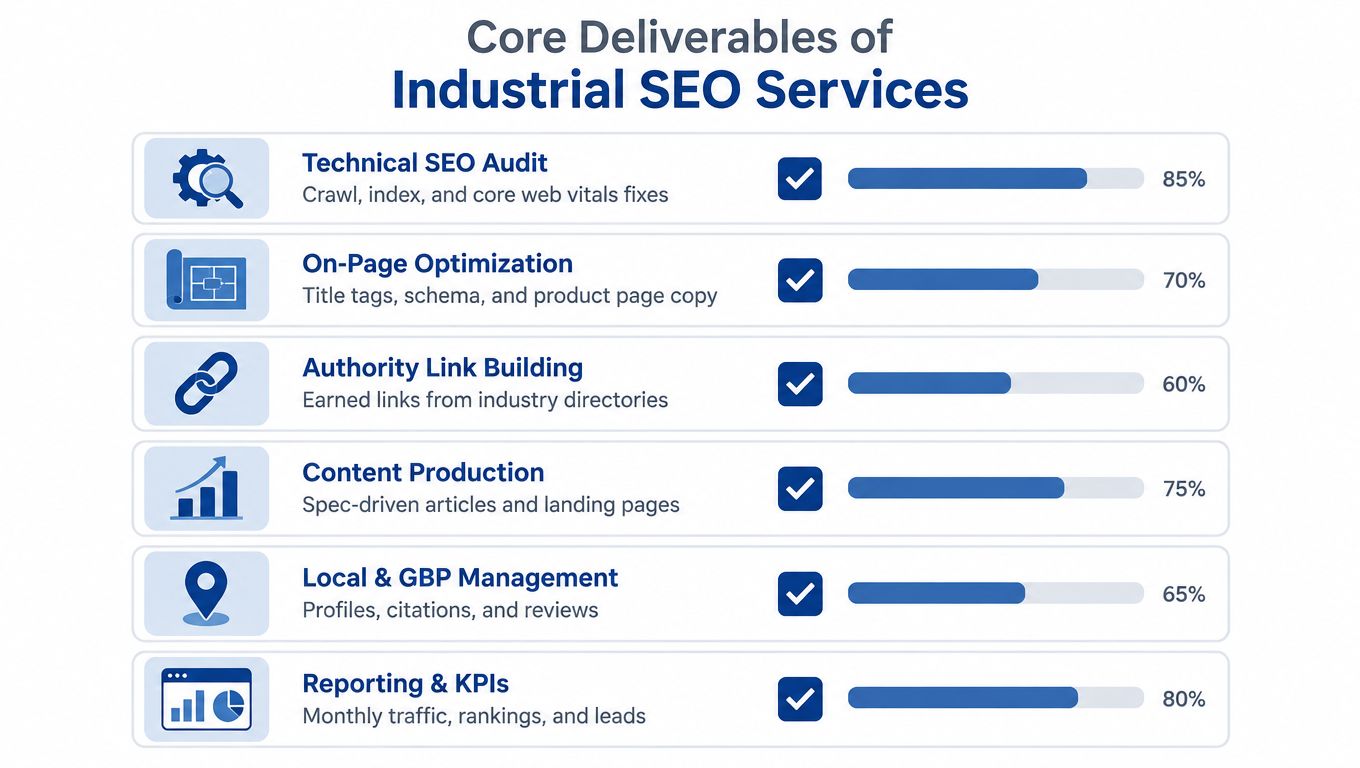
A credible industrial SEO engagement produces identifiable work, not a monthly ranking report with vague commentary. You should know which technical problems were found, which pages were improved, which content gaps were filled, and how organic interactions connect to qualified inquiries.
Technical diagnosis comes first
A technical audit should examine crawl paths, indexation, duplicate pages, redirects, broken links, page templates, mobile usability, and performance. Industrial sites often have layered catalogs, filters, legacy PDFs, distributor pages, and product variations. A generic audit may flag issues without explaining which ones block commercial pages from being discovered.
The audit should produce a prioritized action list. Fixes might include consolidating duplicate product URLs, improving navigation to capability pages, repairing internal links, or making specification content accessible in HTML rather than leaving it only inside a document file.
Google explains that snippets are automatically created from page content and can be influenced with nosnippet or max-snippet controls in its documentation on search snippets. That means your page copy needs to state the capability clearly and concisely. Metadata alone won't compensate for thin or confusing on-page information.
Page optimization should expose technical proof
On-page work for a manufacturer includes more than title tags. A strong product or capability page normally includes:
- A precise page title: Name the process, product, material, or application the buyer is evaluating.
- A clear opening summary: State what you make, for whom, and under which technical conditions.
- Specification tables: Present dimensions, materials, tolerances, finishes, ratings, and constraints in readable HTML.
- Structured internal links: Connect the capability to relevant industries, materials, FAQs, certifications, and resources.
- Conversion paths: Offer a quote request, drawing upload, consultation, or technical review without forcing every visitor into the same form.
PDFs still matter. Engineers may want to download a datasheet, drawing, inspection report, or CAD file. But the page should summarize the important information in HTML first, so search engines and buyers can understand the asset before downloading it.
Content and authority must support the buying process
Content production should focus on useful technical questions, not a calendar of generic posts. Good topics include material selection, tolerance interpretation, process comparisons, design-for-manufacturing guidance, compliance questions, and application constraints. Each page should have a defined buyer and a defined next action.
Authority building also needs industrial judgment. Relevant trade publications, engineering directories, supplier associations, technical partners, and customer resources are more useful than a large volume of unrelated links. For practical background on promoting a smaller manufacturing operation, see this resource on marketing a small machine shop.
A legitimate scope should also include reporting that separates visibility from commercial activity. Track qualified organic inquiries, quote requests, drawing uploads, calls, assisted conversions, and the pages involved. Ranking improvements matter only when they help the right buyers evaluate and contact you.
Structuring Pages for Spec-Level Buyer Intent
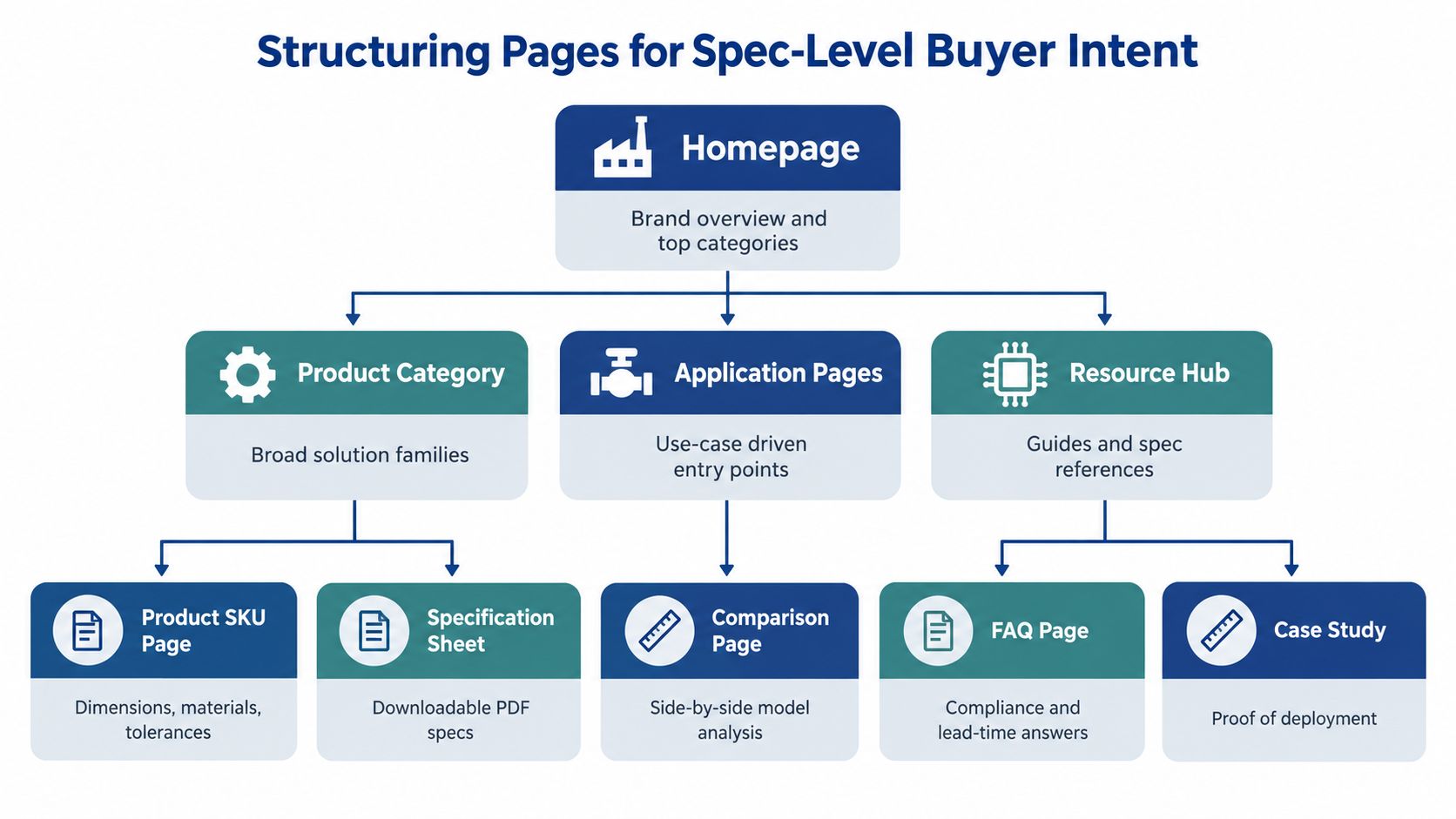
Your website should mirror the way buyers investigate capability. Start with a broad service or process page, then give visitors a direct route to the technical evidence that determines fit. This is a topic-cluster structure, with one central capability page supported by narrowly focused technical pages.
Build from the capability outward
Choose a core capability such as CNC milling, injection molding, precision grinding, or industrial valve manufacturing. The pillar page should explain the process, the work you accept, the production environment, the relevant industries, and the information a buyer needs before requesting a quote.
Support that page with subordinate content:
- Material pages: Explain compatibility, limitations, finishing options, and common applications.
- Technical FAQ pages: Answer recurring questions about tolerances, lead times, inspection, tooling, and design requirements.
- Certification pages: Describe applicable quality or compliance standards without making unsupported claims.
- Application pages: Connect the capability to sectors, operating environments, and use cases.
- Specification resources: Provide dimensional data, downloadable sheets, drawings, and comparison information.
The architecture should make every important asset reachable through normal links. Google's SEO Starter Guide notes that search snippets draw from the content on the linked page. A page that relies on an isolated PDF, image, or script for its central technical explanation gives both the crawler and the buyer less usable context.
Turn technical documents into searchable evidence
Start with your existing documentation. Gather datasheets, inspection templates, capability statements, CAD instructions, quality manuals, and sales enablement documents. Then classify each asset by the question it answers.
For example, a single PDF might contain material compatibility, dimensional limits, and inspection information. Those subjects may deserve separate HTML sections or pages because buyers search for them independently. The document can remain available as a download, but the page should carry the substance.
Use a consistent template for technical pages:
- State the buyer's question in the page title and introduction.
- Answer it directly with plain language and accurate specifications.
- Add supporting tables or diagrams where comparison matters.
- Link to adjacent evidence, such as material pages, certifications, or FAQs.
- Provide a commercial next step, such as submitting a drawing or requesting technical review.
Recommended industrial SEO architecture follows this capability-and-supporting-page model because it improves internal linking and helps engineering assets become discoverable rather than buried in a resource folder.
The trade-off is governance. More pages create more opportunities for outdated specifications, conflicting terminology, and duplicated content. Assign an owner to technical accuracy, record revision dates, and remove or redirect obsolete pages. A large content library without document control creates risk instead of authority.
Pricing Models and ROI Expectations
Industrial SEO pricing should reflect the work required to understand your products, systems, catalog, and sales process. A small site with a few well-defined capabilities needs a different engagement from a manufacturer with thousands of product variations, multiple facilities, distributor relationships, and a large archive of technical files.
You'll usually encounter three commercial models.
| Engagement Model | Typical Focus | Best For |
|---|---|---|
| Project-based audit | Technical diagnosis, indexation review, architecture recommendations, and prioritized fixes | Companies that need a clear starting point or an independent assessment |
| Fixed-scope implementation | Rebuilding templates, optimizing priority pages, converting documentation, and improving conversion paths | Teams with internal resources that can maintain the system after launch |
| Monthly retainer | Ongoing technical improvements, content production, internal linking, authority development, and reporting | Manufacturers that need continuous execution across a long buying cycle |
What drives the investment
The cost rises when the engagement requires specialized engineering writing, catalog cleanup, product-data coordination, international structures, or collaboration with Sales and Engineering. It also rises when the website platform makes routine changes difficult.
Ask what is included in the proposal. A low monthly fee may cover generic articles and automated reports while excluding the work that creates pipeline, such as page redevelopment, technical review, conversion tracking, and CRM alignment. A higher fee can still be poor value if the agency can't explain which buyer problem each deliverable solves.
You should also treat SEO as a compounding asset, not a short-term lead purchase. Industrial buyers research anonymously, compare suppliers, revisit documentation, and involve other stakeholders. A useful page may influence a quote request later, even when the first visit doesn't create a form submission.
Track value through a connected measurement model. Monitor organic sessions by landing page, engaged visits from target markets, technical resource downloads, quote requests, calls, drawing submissions, sales-qualified opportunities, and revenue where your CRM supports that connection. Use this guide to measuring marketing ROI to pressure-test whether your reporting reflects commercial outcomes.
The right question isn't “How many keywords did we rank for?” Ask, “Which technical buyer journeys did we make easier, and which qualified opportunities can we trace back to them?”
How to Evaluate and Vet an SEO Vendor
Interview an industrial SEO vendor like you'd interview a technical contractor. Ask for the method, the dependencies, the acceptance criteria, and the person responsible for each part of the work. A polished proposal means little if the team can't discuss your products and constraints with precision.
Questions that reveal real expertise
Ask these before signing:
- How will you map our capabilities to buyer intent? The answer should include materials, processes, applications, specifications, certifications, and procurement language, not only broad keywords.
- How will you handle confidential or restricted information? Ask how the team approaches public content when your work involves ITAR-related restrictions, export controls, proprietary drawings, or customer confidentiality. They should distinguish publishable capability information from controlled technical data.
- How will you make CAD files and technical documents discoverable? The vendor should explain how HTML summaries, descriptive links, file naming, access controls, and page relationships work together.
- How will you validate technical content? Look for a defined review process involving your engineers, quality team, or product specialists.
- Which conversions will you measure? The answer should include quote requests, calls, drawing submissions, technical downloads, and qualified pipeline, not just impressions and rankings.
- What will you change first? A competent partner will prioritize based on business impact and technical dependencies rather than promise to publish everywhere at once.
Red flags in a proposal
Be cautious when an agency guarantees rankings, avoids technical questions, or presents the same content calendar for a machine shop, a software company, and a consumer retailer. Other warning signs include bulk links from irrelevant directories, articles written without engineering review, no access to analytics or CRM data, and reports that never identify landing pages or lead quality.
A vendor should also explain what won't work. Some pages shouldn't be indexed. Internal search results, duplicate filtered URLs, obsolete products, and sensitive resources may require restrictions or noindex. Google's guidance states that robots.txt controls crawler access but doesn't reliably prevent a linked URL from appearing in search. The industrial SEO guidance on crawl and index controls reinforces the distinction between blocking a crawler and keeping a page out of search results.
Choose the partner that can diagnose trade-offs clearly. You're not buying content volume. You're buying a system that helps the right people verify your fit.
Local Visibility and the Shift to AI Search
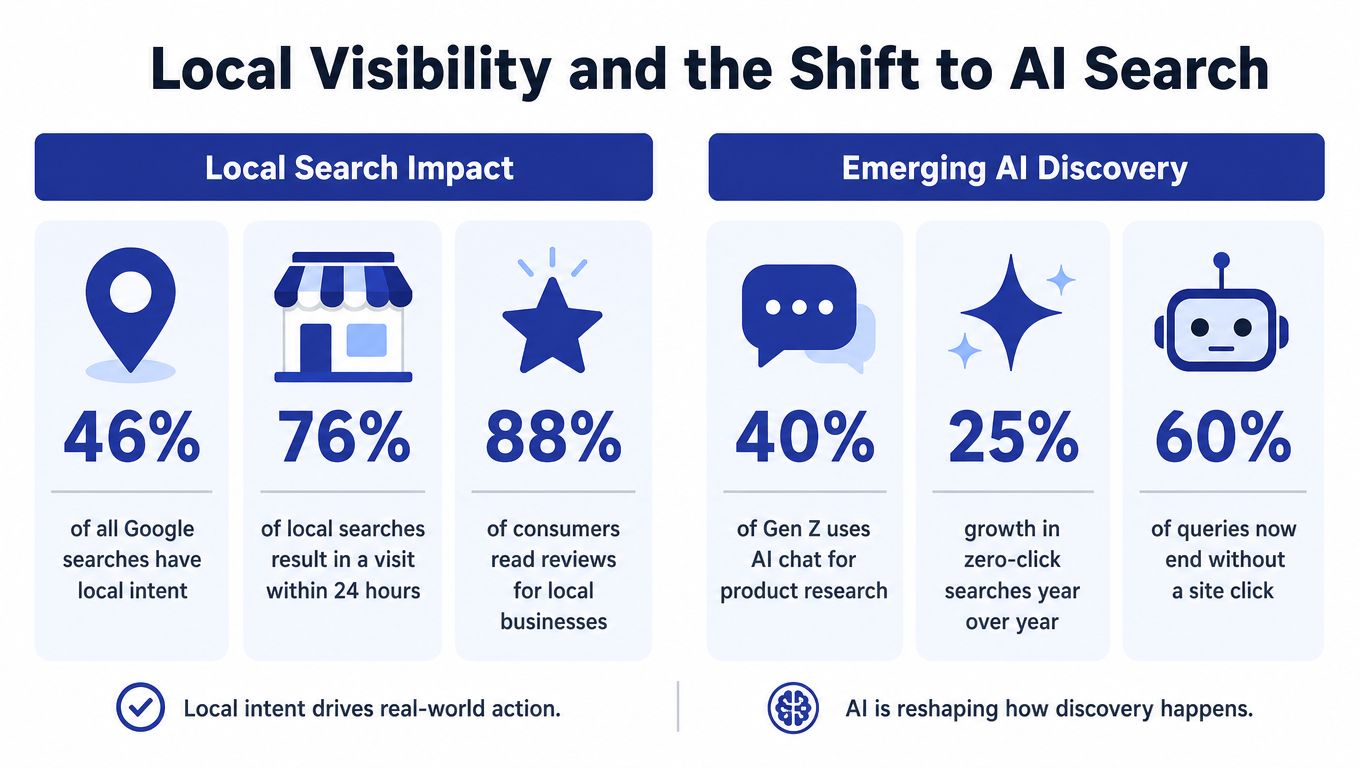
Local visibility supports industrial SEO because facilities, sales offices, plants, and service territories affect supplier selection. A buyer may search for a regional machine shop, an approved supplier near a production site, or a manufacturer that can handle a local installation. Set up your Google Business Profile to reflect the company's actual operating footprint, then connect it to capability pages that prove what each location can deliver.
Keep these details consistent:
- Business identity: Use the same company name, address, phone information, and operating details across important profiles.
- Facility description: Explain whether the location is a plant, office, showroom, or service site, and state its function.
- Category selection: Choose categories that describe the actual operation instead of relying on a broad label.
- Evidence: Add relevant images, services, updates, and reviews that help buyers assess the facility.
- Landing pages: Link each local profile to pages covering regional capabilities, applications, and contact options.
AI discovery now affects how manufacturers get evaluated. Google AI Overviews appeared on 57% of tracked manufacturing-related search volume, up from 38% in January 2026, across 458 manufacturing and industrial keywords, according to 2026 manufacturing search behavior research. The same source reports that AI search tools and assistants generated 0.48% of sessions to manufacturing sites, while direct and organic search accounted for nearly 80% of sessions. Prepare for AI-mediated discovery while protecting the organic foundation that currently drives most visits.
Make your evidence easy to extract
AI systems can summarize facts they can access and interpret. Put specifications in visible HTML, use descriptive headings, keep tables consistent, and define the relationships among products, materials, applications, certifications, and facilities. Engineering buyers need evidence they can verify quickly, whether they arrive through a local listing, a standard search result, or an AI-generated answer.
State the applicable process, material range, inspection approach, and application conditions where you can support them. If a capability depends on project details, describe the qualification step and identify the information required from the buyer. This structure maps search visibility to real engineering validation.
For a practical framework connecting structured content with emerging discovery channels, use this guide to optimizing for AI search. Clear technical proof gives search systems useful material and gives buyers enough detail to judge fit, request a quote, or contact the right facility.
Next Steps for Auditing Your Search Strategy
Don't start by commissioning a large content program. Start with a diagnosis that identifies where qualified buyers lose the trail.
Use a focused 30-day review
Days one through ten, inspect the foundation. Crawl the site and check indexation, redirects, duplicate URLs, broken links, page templates, mobile rendering, speed, internal links, and access to important documents. Identify which capability and product pages receive organic visits, and which commercially important pages receive none.
Days eleven through twenty, compare the site with real buyer questions. Interview Sales and Engineering. Collect recurring questions from quote requests, lost opportunities, technical calls, and customer onboarding. Map each question to an existing page. Mark gaps involving materials, tolerances, certifications, applications, lead times, and comparison needs.
Days twenty-one through thirty, repair the measurement system. Confirm that forms, calls, document downloads, drawing submissions, and CRM stages are tracked. Create a baseline for qualified organic inquiries, then connect landing pages to those inquiries so future reporting shows which content supports pipeline.
Use this technical SEO audit checklist to organize the first review and assign each issue to a specific owner. Don't let an audit become a document nobody implements. Give every recommendation a priority, a responsible person, a dependency, and a definition of done.
The strongest industrial SEO programs make technical validation easier before the first sales conversation. They don't chase broad traffic at the expense of relevance, and they don't treat content as separate from CRM, conversion tracking, or sales enablement. If your website can explain what you make, the constraints you handle, and the evidence behind your claims, it can become a dependable part of your demand system.
Machine Marketing helps manufacturers connect industrial SEO, technical content, CRM, and lead tracking into a measurable growth system. Visit Machine Marketing to discuss a diagnosis of your search strategy and the next practical improvements for your pipeline.
