If you're a business owner, "innovation in marketing" probably sounds like a distraction—a list of buzzwords that have little to do with the day-to-day reality of running your company. We see this all the time. Your focus is on operations, quality, and your bottom line, not chasing the latest digital trends.
But what if marketing innovation wasn't about trends? What if it was about applying a problem-solving mindset to your growth strategy?
For you, true innovation means building a smarter, more efficient system to attract high-value clients and create a predictable pipeline of qualified leads. It's about shifting from reactive hope to proactive control. In this guide, we'll show you how to diagnose the gaps in your current marketing and build a machine that delivers measurable results.

What Innovation in Marketing Really Means for Your Business
Let’s cut through the noise. For a results-driven business, innovation isn't about being on every new social media platform. It’s about strategically integrating the right tools and processes to solve one core problem: generating a consistent stream of profitable work.
This marks the shift from a reactive, "wait-for-the-phone-to-ring" model to a proactive, systematic one that you own and control.
The goal is to build a marketing machine that operates with precision and reliability. It should diagnose problems, automate solutions, and produce measurable results that you can take to the bank.
This approach treats marketing not as a creative expense, but as a core business system designed for growth. For example, an AI-driven marketing strategy isn’t just a futuristic concept; it’s a practical way to automate lead qualification and personalize outreach at scale, saving your team valuable time.
To see how this works in practice, let's compare outdated tactics with a modern, innovative approach.
Old vs. New Marketing Approaches
| Outdated Tactic | Modern Innovation | Business Impact |
|---|---|---|
| Relying on trade shows & referrals | Building a digital lead generation engine | Consistent, predictable lead flow independent of events |
| Generic email blasts | CRM-driven personalized nurturing | Higher engagement and conversion rates from existing contacts |
| No clear ROI measurement | Data-driven dashboards showing CPL & ROAS | Clear visibility into what works, allowing for smarter budget allocation |
| Cold calling and manual follow-up | Automated SMS & email reactivation sequences | Efficiently re-engages old leads and past customers without manual effort |
This shift doesn't happen overnight. It starts with an honest diagnosis of your current system.
Questions to Ask About Your Current Marketing System
Before you can build something new, you need to identify the problems. Ask yourself these tough questions:
- Is our lead generation predictable? Do you know exactly where your next 10, 20, or 50 qualified leads will come from next month? Or is your pipeline built on hope?
- Are we maximizing our existing assets? What happens to contacts from old trade shows or the list of past customers? Are they collecting dust in a spreadsheet, or are they part of an active communication system?
- Can we actually measure marketing ROI? Can you confidently say which marketing activities are driving valuable inquiries and which are just draining your budget?
If you answered "no" or "I don't know" to any of these, you’re not alone. This is precisely the gap that marketing innovation is designed to fill. It’s not about adding complexity; it’s about creating clarity, control, and predictable outcomes.
For any business, especially in the B2B space, the first step is always foundational. A well-defined marketing strategy for manufacturers serves as the blueprint for any successful innovation, ensuring every tool you adopt serves a specific, strategic purpose.
Using AI and Hyper-Personalization to Fill Your Sales Pipeline
What if you could send a perfectly timed, highly specific message to hundreds of ideal prospects without manually drafting a single one? That’s not a hypothetical—it’s what AI-driven hyper-personalization does. This is how you transform your CRM from a digital address book into a powerful engine for your sales pipeline.
By analyzing your customer data, AI spots patterns in past behavior—like which spec sheets a prospect downloaded or what services they viewed on your site. This allows you to anticipate their needs and move beyond generic email blasts to create automated campaigns that speak directly to a prospect’s specific challenges.

How to Turn Data Into Conversations
Effective hyper-personalization makes automated communication feel human. We’re not just talking about dropping a {first_name} into a template. We’re talking about referencing their industry, past inquiries, or even a question they asked your team months ago.
Here’s a real-world example of this system in action:
- The Problem: A sales rep had a great call about a new piece of equipment, but the deal went cold. The rep has dozens of similar stalled leads and no time to manually track and re-engage all of them.
- The AI-Powered Solution: Three months later, the CRM detects that the prospect’s company just announced a major expansion. The system automatically tees up an email for the rep: "Hi [Prospect Name], saw the great news about your expansion. When we last spoke, you mentioned needing to scale up production. Does it make sense to revisit how our [Equipment Model] could support that growth?"
This timely, relevant outreach is nearly impossible to manage manually at scale. It transforms your follow-up process from a tedious chore into a strategic, automated system. While this level of automation is powerful, it’s not for everyone. A business with very few leads may find manual follow-up is still more effective. For most, however, it’s a game-changer.
Questions to Diagnose Your Personalization Gaps
Is your current communication built for this level of detail? Ask your team these questions to find the gaps:
- Does our outreach reference specific customer history? Can you easily email every client who bought a specific part two years ago and remind them about a maintenance cycle?
- Are our follow-ups timely and relevant? Does your team have an automated way to re-engage a prospect based on their company’s news or a recent visit to your website?
- Is our content actually tailored? Are you sending the same message to a procurement manager (who cares about cost) and an engineer (who cares about technical specs)?
If you aren't using data to drive these interactions, you're leaving money on the table. A great starting point is to explore AI-powered customer segmentation strategies that group your audience by their behaviors and needs, not just their job titles.
The goal is to make every prospect feel like you’re speaking directly to them—because your data allows you to. It tells you what they care about, and AI gives you the tools to act on that knowledge instantly and at scale.
This is a fundamental change in how you build relationships. You shorten the sales cycle by giving prospects the right information at the right moment, giving your team a massive advantage.
Capturing High-Intent Leads Through Mobile and Voice Search
Let's be direct: your B2B buyers aren't chained to their desks. They are on job sites, warehouse floors, and on the road. And they are all using their phones to solve problems, vet suppliers, and make purchase decisions.
Ignoring this reality is a massive blind spot. The good news is, this is exactly the kind of opportunity modern marketing can capitalize on. We're not talking about chasing shiny objects; we're talking about showing up where your customers are already looking for you.
How to Optimize for "Near Me" Searches
One of the most powerful, yet underutilized, tools for any business with a physical location is its Google Business Profile (GBP). When a potential customer searches for "industrial suppliers near me" or "local machine shop," your GBP determines if you even appear in their search results. A weak profile is an invisible one.
Think of your Google Business Profile as your digital storefront for local search. It's often the very first impression a mobile user has of your business. It needs to be sharp, accurate, and convincing enough to turn a quick search into a phone call.
To start capturing these high-intent local leads, you must treat your GBP with focus. Here’s a quick diagnosis and solution:
- Diagnosis: Is your profile incomplete? A missing phone number, an old address, or incorrect hours are all points of friction that send a prospect straight to your competitor.
- Solution: Go through every single section of your profile. Add high-quality photos of your facility and products. Select every service category that applies to you. Most importantly, start actively asking your happy clients for reviews. A complete, active profile signals trust to both Google and your future customers.
How to Prepare for the Rise of Voice Commerce
Beyond tapping on a screen, your buyers are starting to talk to their devices to get business done. Voice commerce is no longer a "future" trend—it's here. Valued at $108.33 billion in 2024, this market is growing at a staggering pace, a trend detailed in recent global marketing analyses. You can discover more insights about 2025 global marketing trends on Mojoactive.com.
For your business, this means a prospect can say, "Hey Google, find manufacturers near me," and your company needs to be the answer. To make that happen, structure your website's content so voice assistants can find and understand it. Use clear, conversational language and organize information in a Q&A format that mimics how people speak.
Here are three practical steps you can take:
- Create a dedicated FAQ page: Answer the most common questions you get from customers directly (e.g., "What types of materials do you work with?").
- Use natural-sounding headings: Frame your blog posts and service pages with headings that sound like a spoken question ("How do I choose the right supplier?").
- Implement structured data: This is a technical, backend task where you use schema markup to explicitly label information for search engines, making it incredibly easy for them to pull answers for voice searches.
When you connect these mobile and voice strategies to your CRM, you build a system. The moment a new lead comes in, an automated follow-up can be sent via email or SMS. This ensures no valuable opportunity falls through the cracks.
Building Your Marketing Machine With CRM Automation
All the marketing innovation in the world means nothing without a system to manage it. You can generate a flood of new leads, but if they just fall into a black hole, you've wasted every dollar. This is where your Customer Relationship Management (CRM) platform becomes the central nervous system of your entire marketing and sales operation.
A properly configured CRM does more than just store contacts. It acts as an intelligent, automated machine that runs your entire customer lifecycle. It’s the engine that ensures every lead gets nurtured, every sales opportunity is tracked, and no potential revenue slips away.
Building this system is a methodical process. It moves in phases, from building the foundation to nurturing leads and analyzing performance for continuous improvement.
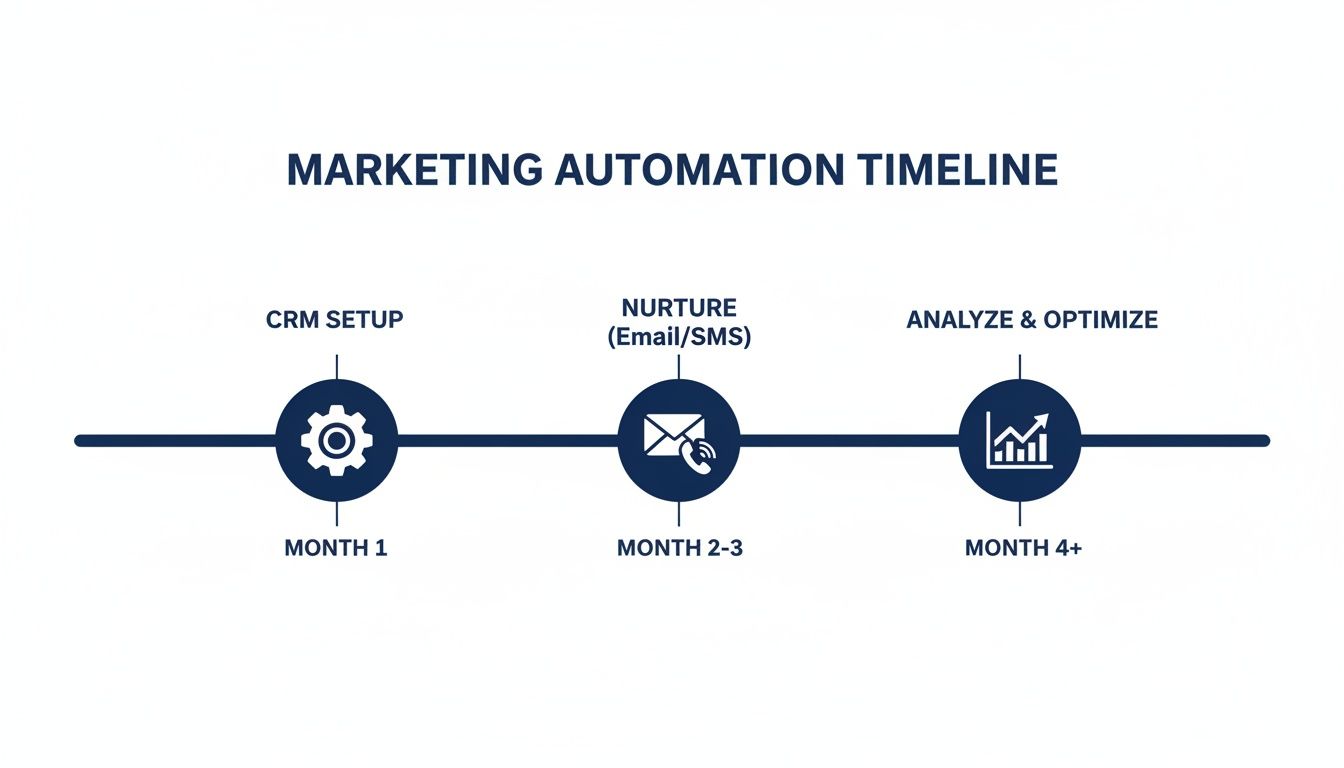
This phased approach is what creates sustainable, long-term results.
How to Turn Your CRM into an Automated Engine
Imagine a well-built CRM system, like GoHighLevel, as your most reliable employee—one who works 24/7 and never asks for a day off. Its only job is to follow the rules you set, ensuring the right message reaches the right person at the right time.
This automation is what makes your innovation in marketing truly scalable. Here’s what this machine does in practice:
- Nurtures New Leads: A prospect downloads a guide from your website. Instead of that lead sitting in an inbox, the CRM automatically triggers a sequence of helpful emails, sending them related case studies and offering a consultation over the next few weeks.
- Gives Sales Real-Time Intelligence: The system logs every interaction. When a lead from six months ago suddenly reappears on your pricing page, your CRM can instantly notify the assigned sales rep, turning a cold contact into a hot, actionable opportunity.
How to Reactivate Your Hidden Goldmine of Old Leads
One of the fastest wins from CRM automation is waking up your existing contact list. Most businesses are sitting on a goldmine of dormant contacts from old trade shows, past quotes, and former customers. Re-engaging them manually is nearly impossible. With automation, it's simple and incredibly effective.
Your past customer list is not a graveyard; it’s an untapped asset waiting for a reason to buy from you again. A simple, automated campaign can generate significant revenue with a near-zero acquisition cost.
Inside your CRM, you can build a workflow that sends a targeted reactivation campaign using both email and SMS. It could be an exclusive offer, an update on new capabilities, or a simple "we haven't heard from you in a while" message. The system does the work, tracks who engages, and delivers a clean list of warm prospects right back to your sales team.
For business owners wondering where to begin, getting the foundation right is everything. Our guide on how to properly use a CRM for lead generation can help you nail the fundamentals.
This is the engineering mindset applied to marketing. You’re no longer just doing tasks—you are building a robust system with defined inputs, processes, and outputs. Your marketing stops being a list of random activities and becomes a predictable, efficient, and profitable machine.
Your 90-Day Roadmap to Marketing Innovation
Theory is one thing, but execution is everything. For busy business owners, the biggest hurdle with marketing innovation isn't the what; it's the how and where to start. We use a practical, 90-day roadmap designed to deliver tangible wins and prove the power of a modern marketing system.
This isn't about doing everything at once. It's a focused sprint to install a foundational system, reactivate your most valuable asset—your existing contacts—and set up clear measurement. The goal is to generate ROI that justifies and funds future growth.
Here's a breakdown of our proven 90-day plan. This table outlines the core actions, tools, and success metrics for each phase, giving you a clear path from diagnosis to results.
90-Day Innovation Implementation Plan
| Phase (Timeline) | Key Actions | Tools | Success Metrics (KPIs) |
|---|---|---|---|
| Phase 1 (Weeks 1-4) | Marketing diagnosis, CRM configuration, contact import, segmentation. | GoHighLevel | CRM setup complete, 100% of contacts segmented. |
| Phase 2 (Weeks 5-8) | Campaign copywriting, automation workflow build, launch of email/SMS reactivation. | GoHighLevel, Email, SMS | 10-15% Email Open Rate, 5-10% Re-engagement Rate. |
| Phase 3 (Weeks 9-12) | Performance analysis, sales team feedback loop, campaign optimization. | GoHighLevel Analytics | 25% Increase in Qualified Leads, Positive Campaign ROI. |
This structured approach ensures that every action builds on the last, creating a powerful system that drives measurable growth.
Phase 1: Weeks 1-4 – System Foundation and CRM Setup
The first month is all about building the engine. Without a central hub to manage activity, even brilliant marketing efforts will fall flat. We install and configure a powerful CRM like GoHighLevel to act as the central nervous system for all sales and marketing.
This is a diagnostic process where we analyze your specific sales cycle and customer journey to build a system that fits your business.
Key Actions in Phase 1:
- Marketing Diagnosis: We conduct a deep dive into your current processes to find the biggest bottlenecks and the best opportunities for automation.
- CRM Configuration: We set up your account, create custom fields to track the data that actually matters, and build out your sales pipeline stages.
- Contact Import and Segmentation: We consolidate all your contacts—from past customers, old quotes, and trade show lists—into one clean database and segment them into logical groups (e.g., "Past Clients," "Cold Leads") for targeted outreach.
By the end of this phase, you will have an active tool ready to execute and track automated campaigns.
Phase 2: Weeks 5-8 – Launching a Reactivation Campaign
With the system in place, it’s time for a quick, high-impact win. The fastest path to new revenue isn’t chasing new leads; it's re-engaging people who already know you. In this phase, we launch a strategic email and SMS reactivation campaign to your list of past customers and old leads.
The goal is simple: wake up your dormant contacts. A well-timed message can turn a cold list into a hotbed of new opportunities.
Key Actions in Phase 2:
- Craft the Message: We develop compelling email and SMS copy that provides real value, such as a new capability announcement or a special offer for returning customers.
- Build the Automation: We build a multi-step workflow in GoHighLevel that automatically sends these messages over a set period. It's a sequence designed to nurture interest, not a one-time blast.
- Monitor Engagement: The system tracks every open, click, and reply, instantly flagging re-engaged leads for your sales team to follow up with personally.
This campaign is the first real test of your new marketing machine, built to generate immediate conversations and prove the ROI of automation.
Phase 3: Weeks 9-12 – Measuring Results and Iterating
How do you know it's working? The final month is dedicated to measurement and optimization. This is where a problem-solving mindset really pays off. We move past vanity metrics and focus on the KPIs that directly impact your bottom line.
Using data from the reactivation campaign, we refine the process. This creates a powerful feedback loop where results from one cycle inform the strategy for the next, guaranteeing continuous improvement.
Key Success Metrics (KPIs) to Track:
- Lead Response Time: How quickly are reps following up with re-engaged leads? Automation should make this nearly instantaneous.
- Re-engagement Rate: What percentage of your dormant list opened an email, clicked a link, or replied?
- Lead-to-Opportunity Conversion Rate: Of the leads who re-engaged, how many turned into active sales conversations or quote requests?
- Campaign ROI: How much new revenue was generated compared to the cost of the campaign and software?
This 90-day roadmap replaces guesswork with a clear plan, builds a foundational asset in your CRM, and delivers measurable results that create momentum for long-term growth. It's the first step to truly implementing innovation in marketing.
Measuring Success and Optimizing for Long-Term Growth
Putting new strategies in motion is one thing. But the real test of innovation in marketing is whether it actually moves the needle on revenue and growth. To know that, you have to stop chasing vanity metrics and start focusing on the numbers that matter.
How do you know if a campaign is truly working? The answer is in your CRM. A properly configured system lets you build dashboards that track the entire customer journey, from the first ad click to the final invoice. That visibility is what separates a real strategy from wishful thinking.
What to Look For: Your Core Health Metrics
To get a true diagnosis of your sales pipeline's health, you need to track the right Key Performance Indicators (KPIs). Think of these as your system's vital signs.
Inside your CRM, you should be obsessively tracking these numbers:
- Lead-to-Opportunity Conversion Rate: What percentage of your new leads are qualified enough to become active sales opportunities? This tells you about the quality of your lead sources.
- Sales Cycle Length: How long does it take, on average, to turn a new lead into a paying customer? If this number is shrinking, your system is getting more efficient.
- Customer Acquisition Cost (CAC): What is the total marketing and sales cost to acquire one new customer? This is the ultimate check for your marketing ROI.
These aren't just numbers on a screen; they’re the hard data you need to make smart decisions. They show you where to invest more and what to cut. You can dive deeper into setting up these systems in our guide on what is marketing analytics.
How to Adopt Review and Improvement Cycles
True marketing innovation isn’t a 'set it and forget it' project. It demands a problem-solving mindset, where you constantly review performance data to refine and improve your campaigns. We call these review and improvement cycles.
This is all about creating a feedback loop. Data from your CRM dashboards shapes your strategy, and every change you make is measured right back in the data. It's an iterative process that makes your marketing machine smarter and more efficient over time.
For instance, mobile has become a non-negotiable part of the marketing equation, with smartphones now accounting for over 60% of global web traffic. This means using tools like GoHighLevel to optimize your Google Business Profile to capture local leads. When done right, this can deliver 30-45% better conversion rates from location-aware ads.
The landscape is always shifting. As HubSpot's latest research shows, the impact of AI now affects 92% of marketer roles, and short-form video has become essential. You can read the full research about these marketing statistics on HubSpot to see just how fast things are changing.
By regularly analyzing which tactics drive the most qualified leads, you can double down on what works and trim what doesn't. This constant cycle of analysis, adjustment, and optimization is the only real path to long-term, sustainable growth.
Common Questions About Marketing Innovation
When you’re running a business, every new idea has to pass a reality check. Exploring marketing innovation naturally brings up tough questions about cost, time, and whether it will work for your customers.
Let's address the concerns we hear most often from business leaders. Our goal is to give you straight answers so you can decide what’s right for your company.
"Isn't this kind of marketing too expensive for my business?"
This is the first question on everyone's mind, and it’s based on a myth. Genuine marketing innovation should drive down your overall costs through efficiency, not add to them.
Modern platforms like GoHighLevel roll the functions of a CRM, email marketing tool, and SMS service into a single system. You often pay less for one integrated platform than for three separate, disconnected tools.
The key is to start smart. Our 90-day roadmap targets high-impact, low-cost strategies first—like reactivating your existing contact list. That initial win generates an immediate return, which you can then reinvest. It’s about being strategic, not just spending more.
"How much time will this take from my team?"
There is an initial time investment during the setup phase to build your system and lock in the strategy. But the entire point of this process is to buy your time back.
Once your marketing machine is running, it works 24/7 in the background. It nurtures new leads, follows up with prospects, and keeps your brand top-of-mind without anyone on your team having to lift a finger.
The upfront investment in time pays dividends in long-term efficiency. Your team can then shift from manual, repetitive tasks to high-value activities like closing sales and strengthening customer relationships.
"Will my 'old-school' customers even respond to this?"
Absolutely. Even the most traditional B2B buyer uses email, turns to search engines to solve problems, and has a smartphone in their pocket. This is not a limitation, but an opportunity.
The innovation here isn’t about using flashy tech for its own sake. It’s about using simple, powerful tools to deliver the right information at the right time. A personalized follow-up email that references a past order or a helpful article that answers a technical question is valuable to any customer. It’s not about new technology; it’s about better, more helpful communication.
Ready to diagnose your marketing system and build a predictable pipeline for growth? Machine Marketing specializes in creating tailored, scalable marketing systems for B2B operators.
Next Step: Book a discovery call with our team to get a free diagnosis of your current marketing system. Visit us at https://machine-marketing.com to get started.