If your SEO efforts feel like a constant game of catch-up, you're not alone. The root cause is often an outdated focus on keywords instead of topics. The reality is, Google moved beyond simple keyword matching years ago—and that shift created a massive opportunity for businesses ready to build true authority and attract the right customers.
In this guide, we’ll diagnose the common mistakes holding your content back and show you the system to build topic authority that search engines and customers reward.
What Is Latent Semantic Indexing and Why Does It Matter for Your Business?

If you're a business owner struggling with SEO, is it because you’re still focused on exact-match keywords? Before we diagnose the problem, it helps to have a firm grasp of What is Search Engine Optimization (SEO) as a whole. This context makes it clear why a new way of thinking is critical for modern marketing.
The most common mistake we see is an outdated approach. You choose a keyword like "custom metal fabrication," repeat it all over your page, and hope for the best. That system is broken because it ignores how real people—and today’s search engines—actually use language. This is where understanding Latent Semantic Indexing becomes a powerful diagnostic tool for your content strategy.
The Shift Beyond Keywords
Let's use an analogy. You walk up to a librarian and ask for books about "space travel." A basic, outdated system would only show you books with that exact phrase in the title.
A great librarian, on the other hand, understands the concept behind your words. They’d also bring you books on "astronauts," "rocketry," and "Mars missions" because they are all semantically related. That’s the core idea of latent semantic indexing seo: understanding the contextual relationships between words to figure out what a piece of content is really about.
This isn't new. The technology behind LSI was patented in 1988, and it began influencing search with Google's Brandy update in 2004. This update allowed algorithms to recognize synonyms and related concepts, moving far beyond exact matches. After 2004, websites that produced natural, topic-rich content saw huge boosts. Some industry audits showed an average traffic increase of 25-40% for sites that adapted.
For your business, this shift is a golden opportunity. It means you can:
- Stop guessing keywords: Instead, you can focus on covering a topic thoroughly for your ideal customer.
- Attract better-qualified leads: By answering related questions, you connect with buyers at every stage of their journey.
- Build true authority: Google rewards websites that show deep expertise, which leads to more sustainable, long-term traffic.
By understanding this concept, you can build content that aligns with how search engines actually work today. It's the first step toward a reliable system to increase your organic traffic.
Debunking the Myth of "LSI Keywords"
Let's get straight to the point on one of the most persistent myths in SEO. You’ve almost certainly heard of "LSI keywords," and you may have even used tools that spit out long lists of them.
Here’s the honest truth: that's not how modern SEO works.
The idea of finding a "secret" list of synonyms to sprinkle into your content is an outdated and flawed tactic. Chasing these so-called LSI keywords is a symptom of a much bigger problem—focusing on SEO tricks instead of building a content system that drives results. The myth hangs around because when people write more thorough content, they see positive results and mistakenly give credit to this phantom concept.
The Real Story: Where Did This Myth Come From?
It's a classic case of the SEO community taking a complex, academic concept and twisting it into a simple—but wrong—tactic. Latent Semantic Indexing was a real mathematical method developed in the 1980s, but it was never a keyword strategy for web pages.
The confusion snowballed from there. By 2005, some SEOs started talking about the importance of related words. But almost immediately, real experts began debunking the idea, because the technology's true legacy wasn't a keyword list; it was the foundational thinking that led to the much smarter systems search engines use today. You can read the full history of the LSI keyword myth and what actually replaced it if you want to go deeper.
The biggest problem with the "LSI keyword" myth is that it makes you think like a 1990s machine. Modern search engines are far more sophisticated. They want you to prove your expertise, not just check off terms from a list.
Questions to Ask Your Team: Are You Still Chasing a Myth?
It’s time for a quick diagnosis. If your team is still spending time finding "LSI keywords," you’re likely working from an outdated playbook. Seeing it is the first step toward building a content engine that performs.
Ask yourself and your team these questions:
- Do we use tools specifically to generate "LSI keywords" to add to our articles?
- Is our primary on-page tactic to sprinkle in synonyms and related terms?
- Are we more worried about hitting a keyword density score than we are about completely answering our reader's questions?
If you answered "yes" to any of those, it's a clear sign your strategy needs an upgrade. Focusing on these old-school tactics pulls your team away from what really moves the needle: covering a topic so comprehensively that you become the undeniable authority.
The Modern Solution: From Keywords to Concepts
If "LSI keywords" are a myth, what should you focus on instead? The answer lies in understanding how modern search engines actually think. While the original LSI tech is old news, its core idea—finding relationships between concepts—is the direct ancestor of today’s powerful search algorithms.
Google’s current systems, like RankBrain and BERT, are built to understand language with the nuance of a human expert. They analyze context, user intent, and the subtle connections between topics. This is the heart of semantic SEO.
Think Like Your Customer, Not a Machine
Put yourself in your customer's shoes. An engineer looking for a new supplier doesn't just search "CNC machining services." They’re also searching for related needs like "tight tolerance manufacturing," "5-axis capabilities," and "precision milling."
A modern search engine understands that these terms all belong to the same conceptual universe. It connects these related ideas, or entities, to build a complete picture of what your content is truly about.
This shift from keywords to concepts is fundamental. Google's goal is to reward expertise and comprehensive coverage, not just clever keyword placement. Your job is to prove you're an authority on a topic, not just a single term.
We’ve seen this evolution play out for years. The introduction of this kind of thinking in Google's 2004 Brandy update was a huge step, improving search precision by an estimated 20-30% in early tests. You can explore a full timeline of the history of these algorithm updates to see how algorithms have become more sophisticated.
This table breaks down the fundamental change in how to approach SEO.
Evolution from Keywords to Concepts
| SEO Element | Old Approach (Keyword Stuffing) | Modern Approach (Semantic SEO) |
|---|---|---|
| Primary Goal | Rank for a specific, high-volume keyword. | Establish authority on a broad topic. |
| Content Focus | Repeating the target keyword as often as possible. | Covering a topic comprehensively with related sub-topics. |
| Success Metric | Top ranking for one or two primary keywords. | Visibility across a wide range of related queries. |
| Audience | Broad, often untargeted traffic. | Attracting highly qualified, intent-driven users. |
The game has changed entirely. Forcing a keyword into your text is a strategy that died years ago. Today's winners are those who build true topical authority.
What This Transformation Means for Your Business
This evolution is a massive advantage for B2B companies with specialized services. Instead of battling for one hyper-competitive keyword, you can create a web of content that attracts customers through dozens of related queries. To get a better handle on how modern AI in SEO works behind the scenes, that guide is a great starting point.
By focusing on semantic relationships, you create content that:
- Answers multiple questions at once. Your page on "CNC machining" can also satisfy users searching for "types of CNC milling."
- Demonstrates deep expertise. Covering related sub-topics and technical specifics proves to Google that you know your field.
- Captures highly qualified leads. You attract customers who are further along in their buying journey and searching for specific capabilities you offer.
Understanding this system is the key to a content strategy that doesn't just chase rankings but builds lasting authority and drives real business growth.
A Step-by-Step Framework for Semantic Content Planning
So, you know why search engines have changed. Now, let's talk about the solution. How do you ditch the broken, keyword-obsessed approach and build a predictable system for creating content that works? The answer is to stop thinking about one-off articles and start building topic clusters.
This framework turns a blog from a random collection of posts into a structured, lead-generating machine. Think of it as building an expert library on your website, where every book and chapter is strategically planned to prove your authority.
How to Build Topic Clusters
A topic cluster is a simple but powerful system. It starts with a broad, central "pillar page" that serves as the definitive guide to a core topic. This pillar is then supported by multiple "cluster content" pages that go deep into specific, related sub-topics. Crucially, all of these deep-dive articles link back to the main pillar.
This is how you put the principles of semantic search into practice.
For a B2B example, let's say a manufacturer wants to own the topic of "Custom Metal Fabrication." That's their pillar page. From there, they would build out detailed cluster articles on topics like:
- "Choosing the Right Welding Type for Your Project"
- "An Engineer's Guide to Sheet Metal Bending"
- "Understanding Laser Cutting Tolerances"
- "Comparing Stainless Steel vs. Aluminum Fabrication"
Each of these articles links back to that main pillar page. This interconnected structure sends a powerful signal to Google: you're not just mentioning a topic; you are a comprehensive authority on it.
The entire evolution of search has led to this moment, rewarding websites that demonstrate deep topical expertise.
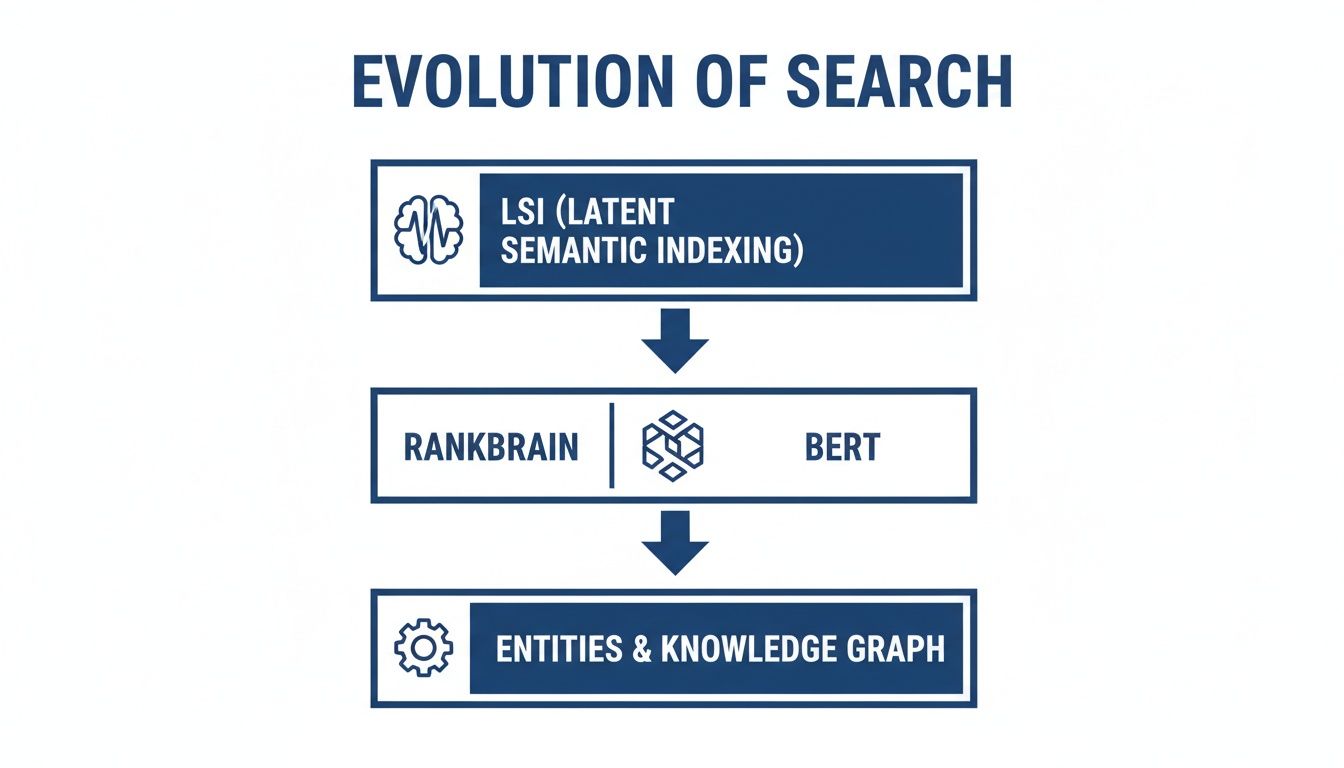
The progression is obvious. We've moved from basic keyword matching to models that understand concepts, context, and real-world connections. Your content strategy has to operate in this reality.
Your Action Plan for Content Planning
Where do you start? Don't open a keyword tool yet. Start with your customers and their problems. Your deep, real-world industry knowledge is your most valuable asset.
Diagnose Your Core Topic Pillar: What's the single most important service or solution you offer? This becomes the foundation for your first topic cluster. It must be a broad topic with plenty of smaller, more specific questions tied to it.
Map Out Customer Questions: Forget about keywords. Brainstorm every question a prospect might have about that core topic. What are their biggest pain points, their technical hurdles, and the comparisons they're making?
Group Questions into Sub-Topics: Look at your list of questions and organize them into logical themes. Each theme is a potential cluster article. For example, questions about "TIG vs. MIG" and "weld strength" can be grouped into an article about choosing welding types.
Prioritize and Execute: You don't have to do everything at once. Pick the 3-5 most critical sub-topics that address the most urgent customer problems. Create high-quality, genuinely helpful content for each one. Once published, make sure every article links back to your main pillar page.
This systematic approach is the engine of modern B2B content marketing. It establishes your authority, answers your customers' questions, and builds an interconnected web of content that search engines are built to reward.
To make sure every piece you create hits the mark, review these content marketing best practices we use for our clients. By following this framework, you’ll create a content system that works for you.
On-Page SEO Techniques for Semantic Relevance

Once your topic clusters are mapped out, it's time to bring them to life on the page. This is where your strategic plan becomes tangible—where you send clear signals to both your audience and search engines about your expertise.
The goal isn't to sound like a robot; it's to prove your authority naturally. Here's a practical checklist for getting it right.
Weave Concepts into Your Content
The real work of on-page semantic SEO happens in the writing. This is about covering a topic so comprehensively that all the related terms and ideas naturally fall into place.
- Headings and Subheadings: Use your H2s and H3s to explore important sub-topics. If your page is on "CNC Machining," a subheading like "Comparing 3-Axis vs. 5-Axis Capabilities" adds far more value than just repeating the main keyword.
- Body Copy: When you introduce a concept, explain it. If you mention "tight tolerances," take a sentence to clarify what that means to an engineer. This builds credibility and adds rich, contextual signals for Google.
- Meta Descriptions: Your meta description is an ad for your content. Hint at the depth inside by mentioning a key sub-topic or a problem you solve. For example: "Explore CNC machining and discover which materials deliver the best durability for industrial applications."
Build a Web of Internal Links
Internal linking is one of the most powerful—and overlooked—tools for communicating semantic relationships to Google. Every link you add shows search engines how your content connects and which pages are the most authoritative.
An effective internal linking strategy does more than just help SEO—it guides your visitors to the next logical answer, keeping them on your site longer and proving that you are a comprehensive resource.
When building a topic cluster, make sure every supporting article links back to your main pillar page. Always use descriptive anchor text. For instance, link the phrase "comprehensive guide to technical content SEO" to your in-depth https://machine-marketing.com/unlocking-digital-success-a-conversion-centric-guide-to-technical-content-seo/, not just "click here."
Give Search Engines Explicit Context with Schema
While writing naturally is key, you can also give search engines a cheat sheet using schema markup. Think of schema as tags you add to your site's code to explicitly tell Google what your content is—a product, a service, a business, or an FAQ.
This is a massive advantage for any B2B company. You can use schema to clearly define:
- Your Services: Specify the exact type of service and the areas you serve.
- Your Products: Mark up product names, model numbers, and key specifications.
- Your Business Information: Reinforce your name, address, and phone number (NAP) to strengthen local search signals.
Implementing schema removes the guesswork for search engines, giving them a clear, machine-readable map of your content. This is a critical piece of mastering on-page optimization for latent semantic indexing seo principles.
Tools to Support Your Semantic SEO Strategy
The core of any great semantic SEO plan is your deep understanding of your customers. No tool can replace that. But the right tools can make executing your strategy faster, smarter, and more data-driven.
This isn't about finding a magic bullet. It’s about working more efficiently. Let's be transparent about what these tools are good for—and where they fall short. Here are a few tools we’ve found genuinely helpful for putting a semantic SEO strategy into action.
Helpful Tools for Research and Optimization
- For Audience Questions: To find out what questions your audience is actually asking, a tool like AnswerThePublic is invaluable. It takes search data and turns it into visual maps of user queries, helping you pinpoint the exact cluster topics that address real-world intent.
- For Content Analysis: Platforms like SurferSEO or Frase are fantastic for analyzing what’s already working. They let you dissect top-ranking content to find common themes, important sub-topics, and structural patterns you might have missed. Be careful, though—these are guides, not paint-by-number instructions. The goal is to cover a topic better, not just hit a score.
- For Deployment and Tracking: Once your helpful content is live, you need to see what’s happening. A system like GoHighLevel lets you deploy and track campaigns, measure performance, manage leads, and re-engage visitors.
Here's a look inside SurferSEO, showing how it breaks down a topic and suggests relevant terms and entities to cover.
The key takeaway here is that the tool isn't just spitting out synonyms. It’s identifying the concepts that signal expertise on a given topic to search engines. When you use them correctly, these tools amplify your strategy. They don't create it for you.
Frequently Asked Questions About Latent Semantic Indexing
When it comes to technical SEO, you need straightforward answers, not more jargon. Here are the most common questions we get about semantic indexing and how it actually impacts your business.
Is Latent Semantic Indexing Still Relevant?
Yes, but not in the way you’ve probably heard. The original 1980s technology itself is ancient history, but its core idea—understanding relationships between words and concepts—is the absolute bedrock of modern search.
Think of it as the foundation for Google’s much smarter algorithms, like RankBrain and BERT. So, while you should ignore anyone selling you "LSI keywords," the modern takeaway is to build comprehensive, topically-focused content. That's how you apply the principle today.
How Do I Know If My Content Is Semantically Optimized?
It comes down to one question: "Does this page completely answer the user's primary question and their most likely follow-up questions?" A semantically strong page doesn't just stuff in a keyword; it proves genuine expertise.
A semantically optimized page covers a topic from every important angle, uses related terms naturally, and links to other relevant resources on your own site. It's about proving you're an authority—the very thing search engines want to find.
For example, a page targeting "industrial pumps" needs to go deeper. It should naturally discuss "centrifugal pumps," "pump maintenance," "flow rates," and "common industrial applications."
What Is the First Step to Implement a Semantic SEO Strategy?
Start with a simple content diagnosis. It’s the fastest way to find your footing.
- Identify your single most important service or product page. This is your starting point, your pillar.
- Map out the top 3-5 questions a real customer asks about it. Get your sales team involved here. What are the common points of confusion or objections they hear?
- Write specific, dedicated articles that answer each of those questions. These articles become your first topic cluster.
- Link these new articles back to your main service page. This action starts building your topical authority and signals to Google that you are the definitive expert in that specific area.
This is your first actionable step. Try it this week and see what you discover.
Ready to build a marketing system that delivers predictable growth? If you've diagnosed your strategy and are ready for a clear roadmap, we can help. Book a discovery call to get started.