If your marketing feels like a black box—swallowing your budget and spitting out very few qualified sales opportunities—you are not alone. We see this all the time, and the root cause is often hidden in plain sight. The problem isn't a lack of trying; it's the lack of a system. True lead generation for manufacturers isn’t about random tactics; it's about building a repeatable process that turns scattered efforts into a predictable pipeline.
In this guide, we’ll show you how to diagnose the gaps in your marketing system and share the practical steps you can take today to start seeing results.
Diagnosing Your Manufacturing Lead Generation Problem

Does this sound familiar? You invest heavily in a new website, run a few ads, or hit the trade show circuit, but the sales pipeline stays stubbornly inconsistent. This happens because you're chasing individual symptoms—like low website traffic or a quiet phone—instead of diagnosing the core issue.
Here’s the hard truth: traditional, old-school sales and marketing tactics are losing their punch. Why? Because the B2B buying journey has flipped on its head. Today, well over 70% of B2B buyers conduct their own research and define their needs online long before they ever talk to a salesperson. If you’re not showing up with valuable information during that critical research phase, you’re not even in the game.
The Real Cost of a Broken System
A disjointed approach doesn't just lead to frustration; it's a direct hit to your bottom line. Generating leads in manufacturing is expensive, carrying a much higher cost than in most other industries. This reflects the reality of long, complex B2B sales cycles.
The blended average cost per lead in manufacturing is a staggering $553. That number is driven by sales cycles that average 158 days and the need to convince multiple decision-makers. You can discover more insights about lead generation statistics and see how your numbers stack up.
Without a systematic approach, you're just burning cash. You're likely overspending to attract leads that are unqualified, not ready to buy, or simply a bad fit for your capabilities. It's like running a high-performance machine with misaligned parts—it’s inefficient, expensive, and eventually, it’s going to break down.
To help you get started, use this quick diagnostic checklist to pinpoint where the cracks in your current system might be.
Manufacturing Lead Generation Diagnosis Checklist
| Symptom | Potential Cause | System to Fix |
|---|---|---|
| Inconsistent Lead Flow | Over-reliance on a single channel (e.g., referrals, trade shows). No consistent "always-on" marketing. | Diversified Lead Channels (Content/SEO, Paid Ads) |
| "Bad" or Unqualified Leads | Vague messaging that attracts the wrong audience. Website isn't pre-qualifying visitors. | Ideal Customer Profile (ICP) & Value Messaging |
| Prospects Go Dark | No follow-up process. Lack of valuable content to stay top-of-mind. | Lead Nurturing & Automation (Email/SMS) |
| Low Website Conversion | No clear calls-to-action (CTAs). Website doesn't answer key customer questions. | Website & Conversion Rate Optimization (CRO) |
| Sales Team Complains About Leads | No shared definition of a "qualified lead." Marketing and sales are disconnected. | CRM & Lead Management |
Once you've identified the symptoms, you can start focusing on the right system to fix.
Questions to Ask Yourself
- Feast or Famine Lead Flow? Do some months feel great while others are alarmingly quiet? This makes it impossible to forecast revenue with confidence.
- Too Many Tire-Kickers? Does your sales team waste hours vetting calls from hobbyists, students, or companies that are a terrible fit for what you do?
- Deals Stalling Out? Do prospects show strong initial interest, request a quote, and then go dark for months, leaving your team chasing ghosts?
- Website Visitors Don't Convert? Do people land on your website, click around, and leave without ever requesting a quote or contacting your team?
These aren't random problems. They are clear signs of a disconnected lead generation process. To fix it, we have to stop patching holes and start building an integrated system—a machine designed from the ground up to attract, engage, and convert your ideal customers.
Defining Your Ideal Customer Profile
Let's get one thing straight: the fastest way to burn your marketing budget is to try and sell to everyone. A high-performance lead generation system isn't a megaphone—it's a laser. Without a specific target, you're just making noise.
The solution is to build a razor-sharp Ideal Customer Profile (ICP). This isn't about basic stats like company size or location. It’s a deep dive into the companies that get the most value from what you do and, just as importantly, are the most profitable for you.
Think about your best customers. What makes them the best? They have specific operational headaches that you are uniquely equipped to solve. Their technical needs perfectly match your capabilities. You understand how they think, how they buy, and who needs to sign off on the PO. That's the DNA of your ICP.
This Isn’t About Vague Personas
Many businesses create buyer personas that are frankly useless. "Bob the Buyer" who is "budget-conscious" doesn't help your team close a deal. A manufacturing ICP isn't about an individual—it's a diagnostic tool that defines the perfect-fit company.
To build your ICP, ask yourself these questions:
- What is their specific industry or sub-niche? Are you selling to medical device manufacturers or Tier 1 automotive suppliers specializing in injection molding? Get specific.
- What is their typical annual revenue or employee count? This tells you if they can afford your solution and operate at the right scale.
- What equipment or technology do they already use? This can signal a need for an upgrade you provide or reveal perfect compatibility with your systems.
- What are their biggest operational pains? Are they fighting production bottlenecks? Are supply chain delays killing their margins? Is regulatory compliance a nightmare?
- What does their buying process actually look like? Who is involved? How long does it take? Who holds the purse strings?
Answering these questions changes the entire game. Your marketing goes from a shotgun blast to a sniper shot. You stop wasting time on tire-kickers and focus your energy on prospects that are practically pre-qualified.
Mapping the Buying Committee
Once you've defined the ideal company, you have to understand the people inside it. In a complex manufacturing sale, you're almost never selling to just one person. You're selling to a buying committee, and each member has a different agenda.
Your messaging has to hit multiple targets at once, each with different—and sometimes conflicting—priorities. The engineer obsesses over specs. The procurement manager cares about the bottom line. The plant manager just wants to eliminate downtime. A generic message speaks to none of them.
Here’s a practical way to map this out and tailor your approach:
| Role on Buying Committee | Primary Concern | Your Message to Them |
|---|---|---|
| Design Engineer | Technical specs, material compatibility, ease of integration. | "Our component meets ISO 9001 standards and integrates seamlessly with existing systems. You can download the CAD files right now." |
| Procurement Manager | Total cost of ownership, payment terms, lead times, vendor reliability. | "We offer competitive volume pricing and have a 99.7% on-time delivery rate, which will significantly reduce your total operational costs." |
| Operations/Plant Manager | Durability, maintenance needs, production uptime, operator safety. | "Our solution is proven to reduce equipment downtime by 15% and requires minimal operator training, keeping your lines running." |
This isn't just a chart; it's a strategic weapon. It forces you to translate features into tangible business outcomes that resonate with each decision-maker. You stop selling a product and start selling a solution to their specific problem.
Turning Your Website Into a Sales Engine

Your website should be your hardest-working salesperson. It works 24/7, never takes a vacation, and can talk to thousands of prospects at once. Yet for too many manufacturers, their site is just a digital brochure. This is a massive, costly mistake.
The buyers you want—engineers, procurement managers, and operations directors—are already online, digging for solutions. If your website doesn't show up when they search and immediately answer their questions, you don’t just lose a visitor. You lose a potential high-value contract.
Transforming your site from a passive brochure into an active sales engine is the bedrock of lead generation for manufacturers. It’s not about flashy design; it's about creating a simple journey that guides your ideal customer from a Google search to a qualified lead in your pipeline.
Building Your Digital Showroom
Treat your service and product pages like your digital showroom. Each page has one job: answer the questions of a skeptical, time-crunched buyer. They need specifics, and they need them now.
-
Focus on High-Intent Keywords
Your buyers don't search for "manufacturing solutions." They search for "precision CNC machining for aerospace components" or "ISO 13485 certified medical device molding." Your on-page SEO must target these long-tail keywords that signal an active need. We cover this in our guide to SEO for manufacturing companies. -
Structure for the Skeptic
Every service page should follow a logical path that builds trust. Start with the problem you solve, present your solution with hard technical specs, show real-world proof with case studies, and end with a direct call to action. -
Provide Technical Resources
Engineers and technical buyers live on data. Make it easy for them to find and download what they need. Gating valuable resources like CAD files or spec sheets behind a simple form is one of the most effective lead-gen tactics there is.
Making It Easy for Buyers to Act
A visitor who is impressed by your capabilities but can't figure out how to take the next step is a wasted opportunity. Your website needs clear, compelling calls-to-action (CTAs) that guide users.
The goal is to remove every ounce of friction. A procurement manager on a deadline shouldn't have to hunt for your "Request a Quote" button. It should be obvious and simple.
Offer multiple paths for different types of buyers:
- For the "Ready-to-Buy" Buyer: Prominent "Request a Quote" or "Contact Sales" buttons on every page.
- For the "Researching" Engineer: "Download CAD File" or "View Spec Sheet" CTAs that capture their contact info in exchange for valuable data.
- For the "Exploring" Manager: "View Our Case Studies" or "See Our Process" links that build confidence and prove your expertise.
Showcasing Proof and Building Credibility
In manufacturing, trust is everything. Your website is the perfect platform to build it. Don't just tell prospects you're good at what you do—prove it.
Case studies are non-negotiable. They must tell a clear story: here was the client's challenge, here's how our process solved it, and here are the measurable results. Use real numbers, like "reduced part defects by 18%" or "cut production lead time by three weeks."
This focus on tangible outcomes turns your site from a list of claims into a portfolio of proof. When a potential buyer sees you've already solved a problem just like theirs, the sales process is already halfway done.
With your foundation set—a clear ICP and a website built to convert—it's time to open the floodgates and bring in a steady flow of qualified prospects.
The most durable lead generation machines never rely on a single source. They run on a powerful blend of inbound and outbound strategies.
Inbound pulls in prospects who are already looking for a solution like yours. You create useful content that solves their problems, making you the obvious expert. Outbound is more direct—proactively reaching out to a hand-picked list of your dream customers. When both work in harmony, they create a self-feeding growth engine.
Mastering Inbound: Become the Go-To Technical Resource
For manufacturers, content marketing isn't about fluffy blog posts. It's about proving your technical expertise and ability to solve complex operational problems. Your buyers are technical, skeptical, and demand proof. Your content must speak their language.
The goal is to create assets that not only attract traffic but also serve as powerful tools for your sales team.
- Technical Whitepapers & Guides: Go deep on a specific challenge your ICP faces. A whitepaper titled "Material Selection for High-Temperature Aerospace Applications" will attract the exact engineers you want to talk to.
- Demo & Process Videos: Show, don't just tell. A two-minute video demonstrating your 5-axis CNC machining capabilities or quality control process is infinitely more powerful than a wall of text.
- Detailed Case Studies: We mentioned these for your website, but they are pure inbound gold. Promote them everywhere to provide undeniable proof of your results.
Your inbound content has one job: build trust by generously sharing your expertise. When an engineer downloads your guide and it actually helps them solve a problem, you've instantly gone from being just another vendor to a credible, trusted resource.
Precision Outbound That Actually Gets a Response
Let's be honest: outbound gets a bad rap because most of it is spam. But when done with precision and a human touch, it's one of the fastest ways to start conversations with high-value accounts. The secret is to stop selling and start helping.
This is where a tool like LinkedIn Sales Navigator becomes your secret weapon. It lets you build hyper-targeted lists based on the exact criteria that define your ICP.
Building Your Target List with Sales Navigator
- Lay Down Your Filters: Start with your ICP criteria. Filter by industry (e.g., Medical Device Manufacturing), company size (e.g., 50-200 employees), and geography.
- Zero In on Decision-Makers: Layer on job titles like "Director of Engineering," "Procurement Manager," or "Operations Director."
- Watch for Buying Signals: Use Sales Navigator's alerts to spot companies that are hiring or were just mentioned in the news. These are often triggers for new projects.
Once your list is built, your outreach must be sharp and personal. A lazy "I saw your profile and wanted to connect" message is a waste of time. Your first message should offer value, not ask for a meeting.
Try referencing a recent company announcement or sharing a relevant technical article you wrote that speaks directly to a challenge in their industry. The goal is to start a genuine conversation. This approach respects their time and positions you as a thoughtful expert.
Combining these inbound and outbound approaches is a cornerstone of how we build effective industrial marketing strategies. By attracting prospects who are actively looking and proactively engaging your perfect-fit companies, you build a robust system that delivers consistent, high-quality leads.
Automating Your Lead Nurturing System
Getting a lead is just the start. The real race is getting to a closed deal, and in manufacturing, it's a marathon. We see it all the time—sales cycles stretch for months, and even promising prospects go radio silent without consistent follow-up. This is where a leaky system costs you money.
The numbers don't lie. Data suggests a staggering 80% of leads in manufacturing never convert into sales. With average sales cycles hitting 158 days, it's not hard to see why. Buyers are cautious, multiple decision-makers are involved, and one missed touchpoint can derail the conversation. You can find more details in this breakdown of lead generation statistics.
You can't solve this by asking your sales team to "try harder." Their time is too valuable to be spent chasing every form submission. You need an automated nurturing system that works around the clock, keeping your brand top-of-mind and warming up prospects until they're ready to talk business.
Building Your Automated Follow-Up Machine
An automated lead nurturing system isn’t about blasting out emails. It's about delivering the right information to the right person at the right time. Using a platform like GoHighLevel, you can build smart sequences that engage new leads, educate them, and hand them off to sales when the iron is hot.
Here’s a practical example of a nurturing sequence after someone downloads a technical whitepaper:
- Immediate Value Delivery: The moment they submit the form, an automated email delivers the whitepaper. This provides instant gratification.
- Educational Follow-Up (Day 3): A few days later, a second email arrives with a related case study. The message is simple: "Since you were interested in [whitepaper topic], we thought you might find it useful to see how we tackled a similar challenge for [Client Name]."
- Problem-Focused Content (Day 7): A week in, they get an email with a link to a short video or blog post that digs into a common pain point. This reinforces your position as a problem-solver.
- Soft Call-to-Action (Day 14): After two weeks of providing pure value, you can introduce a gentle call-to-action, like an invitation to a webinar or a link to a recorded demo.
This entire process runs on its own, ensuring no lead slips through the cracks. It frees your sales team from manual follow-ups, letting them focus on conversations with engaged prospects.
If you need more ideas, check out our guide on tactics to dramatically grow your industrial email list.
Your CRM shouldn't just be a digital rolodex; it should be an intelligent sales engine. Automation turns it from a passive database into an active system that builds relationships and flags real opportunities.
Using Lead Scoring to Prioritize Your Hottest Prospects
Let's be honest: not all leads are created equal. A college student downloading a case study is worlds away from a procurement manager who has visited your pricing page three times. Lead scoring is the automated system that helps you tell the difference.
By assigning points to specific actions and demographic details, you build a data-driven picture of a lead's intent and fit.
-
Explicit Scoring (The "Who"): Points based on who they are.
- Job Title: Director of Engineering gets +20 points vs. an Intern who gets +1 point.
- Industry: Aerospace might be +15 points vs. an Unspecified industry at +0 points.
- Company Size: A perfect-fit company of 100-500 employees could be +10 points.
-
Implicit Scoring (The "What"): Points based on what they do.
- Visited 'Request a Quote' page: A huge signal. +25 points.
- Downloaded a CAD file: Shows serious interest. +15 points.
- Opened 3+ emails in a week: They're paying attention. +10 points.
Once a lead’s score crosses a certain threshold—say, 75 points—the system can automatically ping a salesperson to follow up personally. This ensures your team spends their time on prospects who are raising their hands, dramatically improving efficiency and conversion rates.
Your 90-Day Plan for a Predictable Pipeline
A great system is nothing without a plan. This 90-day roadmap is designed to build momentum and get you measurable results, fast. We'll break down the entire process into focused, monthly sprints.
Forget random acts of marketing. This is your structured plan to build a genuine lead-generation machine.
The graphic below shows the journey a lead takes—from discovery to customer. This is the exact path our 90-day plan will build for you.
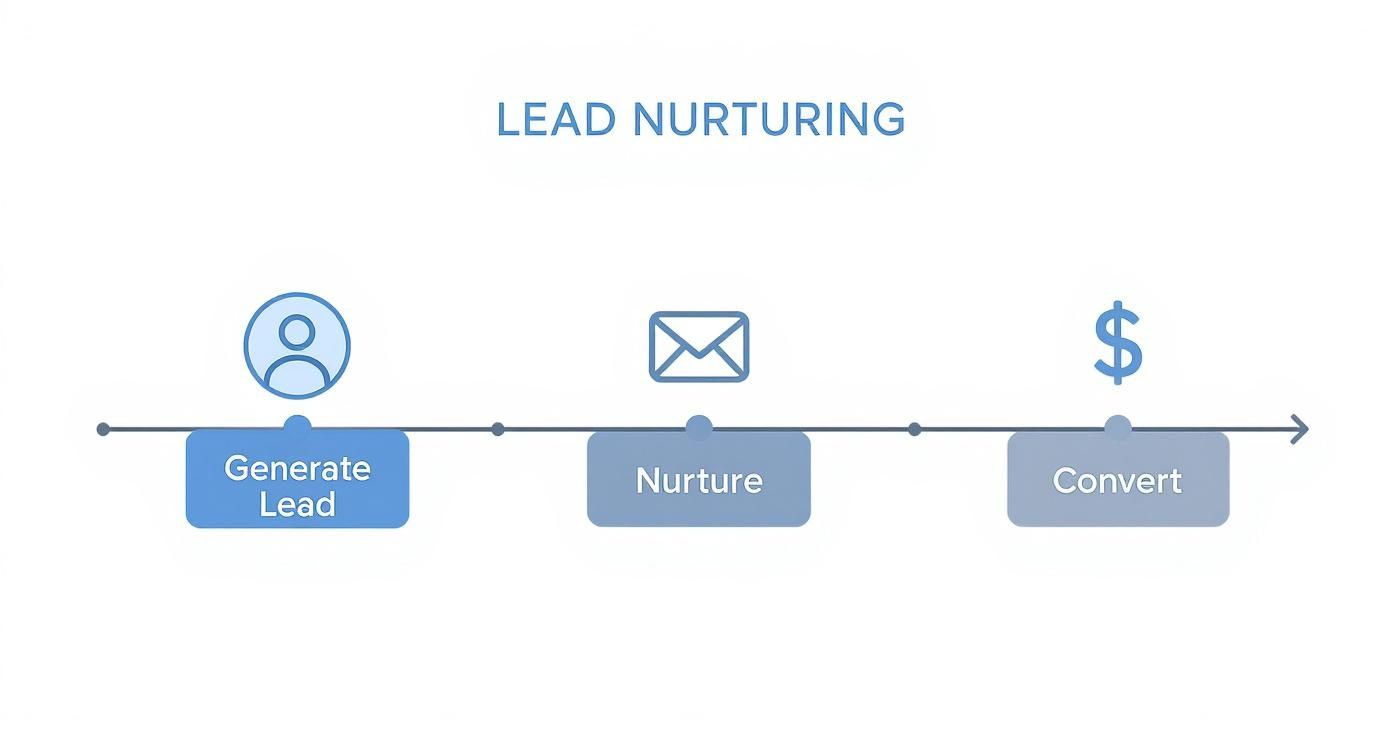
This flow highlights why a systematic approach is so critical. Every lead gets the attention it needs to become a valuable, long-term customer.
Month 1: Foundation and Definition (Weeks 1-4)
The first 30 days are about getting the foundation right. Nailing this part makes everything that follows ten times more effective. Precision now prevents wasted effort and budget later.
Your job this month is to get crystal clear on who you're selling to and what you need to say.
- Define Your ICP: Use the framework we discussed to build out a detailed Ideal Customer Profile. Talk to your best current customers and your sales team to get specific.
- Map the Buying Committee: Identify every key role involved in a purchase, from the engineer to the procurement manager.
- Refine Your Core Messaging: Translate your technical features into tangible business outcomes for each person on that committee. This becomes your messaging playbook.
- Quick Website Audit: Take an honest look at your website. Can a prospect find your contact info in 10 seconds? Are your services explained clearly? Note any obvious roadblocks.
Month 2: Asset Creation and Optimization (Weeks 5-8)
With your strategy locked in, it's time to build the tools that will attract and convert customers.
- Optimize Key Service Pages: Rewrite your most important service pages using your new messaging. Focus on high-intent keywords and make sure every page has a clear call-to-action.
- Create One High-Value Content Piece: Develop a single piece of "hero" content, like a technical whitepaper, a comprehensive guide, or a case study that solves a major headache for your ICP.
- Set Up Your CRM & Automation: Implement your CRM. Build out the initial lead nurturing email sequence we outlined earlier. Keep it simple and focused on providing value.
Month 3: Launch and Measurement (Weeks 9-12)
Foundation laid. Assets built. Now it's time to flip the switch.
- Launch a Targeted Outreach Campaign: Use LinkedIn Sales Navigator to build a hyper-targeted list of 50-100 ideal prospects. Begin your personalized outreach.
- Promote Your Content Piece: Share the high-value guide or whitepaper on LinkedIn and send it to your existing email list. If you have a budget, consider putting a little ad spend behind it.
- Track Your KPIs: Start tracking what matters. At this stage, you should be obsessed with two numbers: your Lead-to-Opportunity Conversion Rate and your Cost Per Qualified Lead. This data is your compass.
Common Questions We Get Asked
We've had countless conversations with manufacturers who are tired of inconsistent leads. Here are straight answers to the questions that pop up again and again.
What's a Realistic Marketing Budget for a Manufacturer?
There's no single magic number. The best approach is to work backward from your revenue goals.
First, lock in your growth target. From there, use your average deal size and sales conversion rates to figure out how many qualified leads you need. With the average cost per lead in this space often exceeding $500, a realistic starting point for a dedicated program often lands in the $5,000 to $15,000 per month range. This typically covers essential tech, content creation, and any ad spend needed to get started.
How Long Does Manufacturing SEO Actually Take to Work?
SEO is an asset you build over time, not a faucet for instant leads. Think of it as building a new production line—it’s a long-term investment.
You can often see initial movement in 3-4 months from fixing technical issues and optimizing existing pages. But for significant, consistent lead flow from organic search, you should plan for the 6 to 12-month mark. Earning authority for competitive keywords takes time, but it builds a sustainable asset that pays you back for years.
Don't mistake a lack of immediate leads for a lack of progress. Early indicators like climbing keyword rankings and a steady increase in organic traffic are the leading signs of a successful SEO system taking root.
Should We Focus on Inbound Marketing or Outbound Sales?
Honestly, the best systems do both. It’s a classic push-and-pull strategy.
Inbound (SEO, content marketing) builds a long-term magnet that attracts qualified buyers who are already searching for solutions. It’s incredibly efficient but takes time to gain momentum.
Outbound (targeted email, LinkedIn outreach) lets you go directly to your ideal customers right now. It’s perfect for generating immediate opportunities while your inbound engine warms up. A balanced approach gives you both the quick wins you need today and the stability you want for tomorrow.
Ready to stop patching holes and start building a real lead-generation machine? The team at Machine Marketing specializes in creating predictable marketing systems for manufacturers. Book a discovery call with us to get a clear diagnosis and a roadmap for growth.