A machine shop can have a capable sales team, a professional website, and a steady trickle of inquiries, yet still struggle to explain where next month's qualified opportunities will come from. The problem usually isn't a lack of effort. It's that traffic, forms, follow-up, qualification, and sales activity aren't connected into one operating system.
We see this often in manufacturing. An engineer researches a tolerance requirement, a purchasing manager compares suppliers, and an operations leader joins the conversation later. The company may recognize only the person who finally submits a form, while the earlier research remains invisible. A reliable lead generation process has to account for that non-linear journey, then turn scattered signals into an actionable pipeline.
Table of Contents
- Why Your Lead Generation Results Keep Disappointing You
- The Five Stages Every Lead Generation Process Needs
- Choosing Channels That Fit Industrial Buyers
- Building Your CRM and Automation Workflows
- Qualifying Leads and Handing Off to Sales Cleanly
- KPIs, Testing, and the Pitfalls That Sink Industrial Lead Gen
- Your Next Steps to a Predictable Pipeline
Why Your Lead Generation Results Keep Disappointing You
A machine shop can publish strong technical pages, attend trade events, send email, and run paid campaigns while next month's opportunities remain unclear. Each activity may perform acceptably on its own. The breakdown usually occurs between stages, where research does not become an account record, an account does not become a qualified opportunity, or a qualified opportunity does not reach sales with usable context.
Treat lead generation as a diagnosis problem. Start by locating the failure point: visibility, capture, qualification, follow-up, or handoff. The right question is not which channel to add. It is which buyer signal the current system fails to record or act on.
A campaign has a budget and an endpoint. A process has definitions, inputs, outputs, owners, and feedback loops. For industrial companies, that process must connect anonymous research, several people on the buying committee, and a long evaluation cycle. A single form submission may represent only the latest step in research that began with an engineer, continued with quality, and reached purchasing later.
Industrial buyers often need drawings, certifications, material information, quality documentation, production capacity, and commercial approval before contacting sales. A generic contact form captures a name, but rarely explains which condition is satisfied or what objection remains. Qualification should therefore combine firmographic fit, technical requirements, timing, buying role, and the requested next action. Teams that manage field sales can also apply the practical how to qualify leads in route sales principles to improve fit and follow-up decisions.
Use these checks to expose the gaps:
- Can we connect important anonymous activity to an account?
- Do we record the buyer's role and technical context?
- Does each submission trigger a defined next action?
- Do marketing and sales apply the same qualification rules?
- Can we trace activity to pipeline, rather than count inquiries alone?
The goal is a measurable operating system. Stage definitions, ownership, and automation should make the next decision clear, even while the buyer is still researching.
The Five Stages Every Lead Generation Process Needs
A machine shop can publish useful content, collect form fills, and still produce little pipeline. The problem is usually a broken handoff between stages, not a missing campaign. Treat the process as a system with defined inputs, outputs, owners, and feedback. The practical sequence is to attract the right accounts, capture context, nurture the buying committee, qualify conditions, and hand sales a usable opportunity.
Attract buyers with useful evidence
Attraction starts before a buyer is ready to contact you. For a machine shop, useful evidence may include material selection guidance, tolerance considerations, inspection methods, finishing options, equipment capabilities, and common manufacturability problems.
Input: a defined ideal customer profile and its technical questions.
Output: relevant visits, account engagement, and recognizable intent signals.
Company-centered copy creates weak demand. “We offer precision machining” gives an engineer little help while comparing processes. A page explaining when to choose one process over another answers a decision question and gives the account a reason to return.
Capture context, not just contact details
Capture turns anonymous interest into an identifiable record. Forms, quote requests, consultation pages, drawing uploads, and technical downloads each serve different points in the buying process.
Input: a visitor with a problem worth solving.
Output: contact data plus enough context to route the inquiry.
Set the follow-up action before adding fields. Where appropriate, capture application, material, timing, project type, and the requested next step. Otherwise sales receives a name without the information needed to judge urgency or fit. Targeted landing pages can support specialized campaigns, including the approach described in this guide to web development leads with LPagery.
Nurture the buying committee
Nurture keeps the company useful while stakeholders gather evidence and align internally. Engineering may need technical proof, quality may need certifications and process detail, procurement may need commercial clarity, and an executive may need confidence in delivery.
Input: known contacts, account context, and observed interests.
Output: stronger understanding, engagement, and evidence of active evaluation.
A single newsletter treats every contact as if the buying process were at the same point. Create paths around questions such as design review, supplier qualification, capacity planning, and sourcing risk. The system should record which people engage with which evidence, then alert the owner when activity suggests coordinated account research. Nurture makes the eventual sales conversation more productive without forcing contact before the project is ready.
Qualify fit and buying conditions
Qualification checks whether the account fits the business and has a credible path to purchase. Review industry, application, technical requirements, commercial viability, timing, buying role, and access to a decision-maker.
Input: contact and account data, engagement history, and stated requirements.
Output: a documented status with a next action.
Activity is evidence, not a verdict. A technical download may show interest in a topic, while the opportunity still lacks timing, authority, or a defined application. Record those gaps explicitly and return the account to a relevant nurture path when sales cannot advance it.
Hand off a complete sales opportunity
Handoff makes marketing activity usable for sales. The record should include source, pages or assets viewed, stated need, account fit, known stakeholders, timing, qualification gaps, and the agreed follow-up action. A sales rep should be able to understand the account before the first call.
Input: a qualified record with evidence.
Output: sales acceptance, a conversation, an opportunity, or a defined nurture return.
Set an owner and response expectation, then require disposition reasons when an opportunity is rejected or delayed. Feed those reasons back into targeting, content, forms, and routing. Stage benchmarks should show where accounts stall, while automation should create the next task without pretending that a long industrial cycle will move at campaign speed.
Choosing Channels That Fit Industrial Buyers
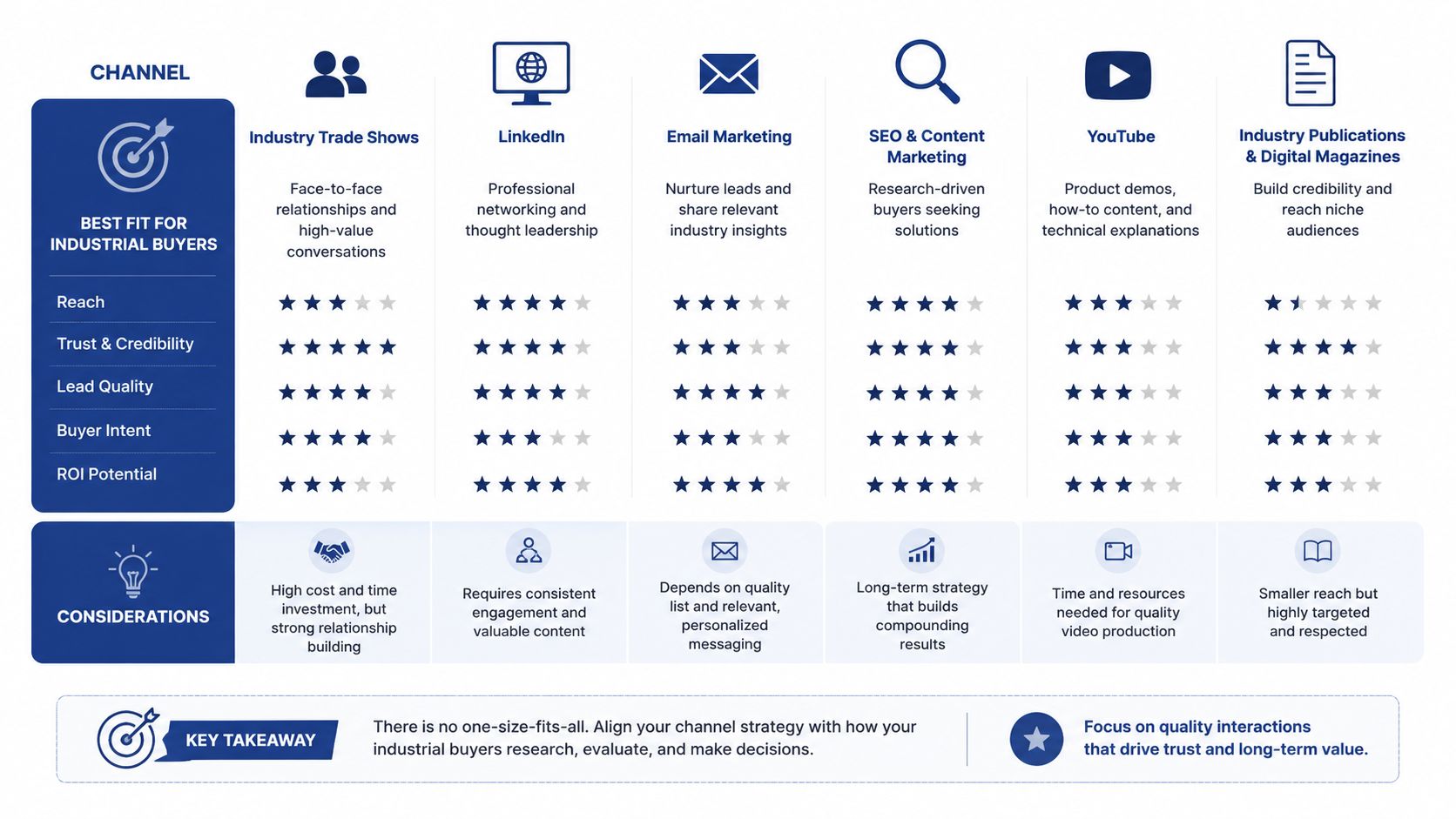
A machine shop can publish consistently, buy ads, and send outbound sequences yet still produce few qualified opportunities. The failure may sit in channel fit, response capacity, or measurement. Choose channels against buyer behavior, buying-group complexity, economics, and the time your team can support.
Industrial buyers often research anonymously before identifying a supplier. Search visibility and technical content should answer questions about materials, tolerances, processes, documentation, and applications before a contact submits a form. A 2026 industry compilation cited that 92% of B2B buyers start research before contacting a vendor, supporting investment in educational content and upstream visibility through the cited lead generation statistics summary.
Channel choice also affects operating cost. The same summary reported an average B2B cost per lead of $198, with a range from $91 to $653 by industry. It reported average costs of $31 for SEO-generated leads and $53 for cold email. Use these as directional comparisons, not promises. A low-cost lead is still expensive if it lacks account fit, technical need, or a credible buying path.
Email remains widely used by 87% of B2B businesses, social media by 78%, and LinkedIn leads social lead generation at 97%, according to that summary. Adoption alone does not create differentiation. Each channel needs a specific offer, a defined audience, and a follow-up rule that accounts for slow buying cycles and multiple stakeholders.
Match the channel to the operating constraint
| Channel | Average Cost per Lead | Best Fit | Time to Impact |
|---|---|---|---|
| SEO | $31 | Buyers researching technical problems | Builds over time |
| Cold email | $53 | Defined accounts and specific roles | Can create conversations sooner |
| Broad B2B acquisition | $198 average | Programs with varied channel mixes | Depends on channel and process |
| Paid and specialized campaigns | $91 to $653 range | Segments where targeting is precise | Depends on market and execution |
These values come from the cited B2B cost-per-lead benchmark source. Compare channels using qualified opportunities, sales-accepted accounts, and pipeline value rather than lead volume alone.
For many manufacturers, a focused mix is easier to operate:
- SEO and technical content: Answer questions buyers ask before they name a supplier, then connect each topic to a capability page or technical conversation.
- Email: Segment by account, role, application, and buying stage. Keep contacts from the same buying group visible at the account level.
- LinkedIn: Build account visibility, demonstrate technical authority, and target relevant roles. Review these decisions in B2B advertising on LinkedIn.
- Direct outreach: Contact accounts with a credible fit and a reason to engage now, while recording the trigger and intended next step.
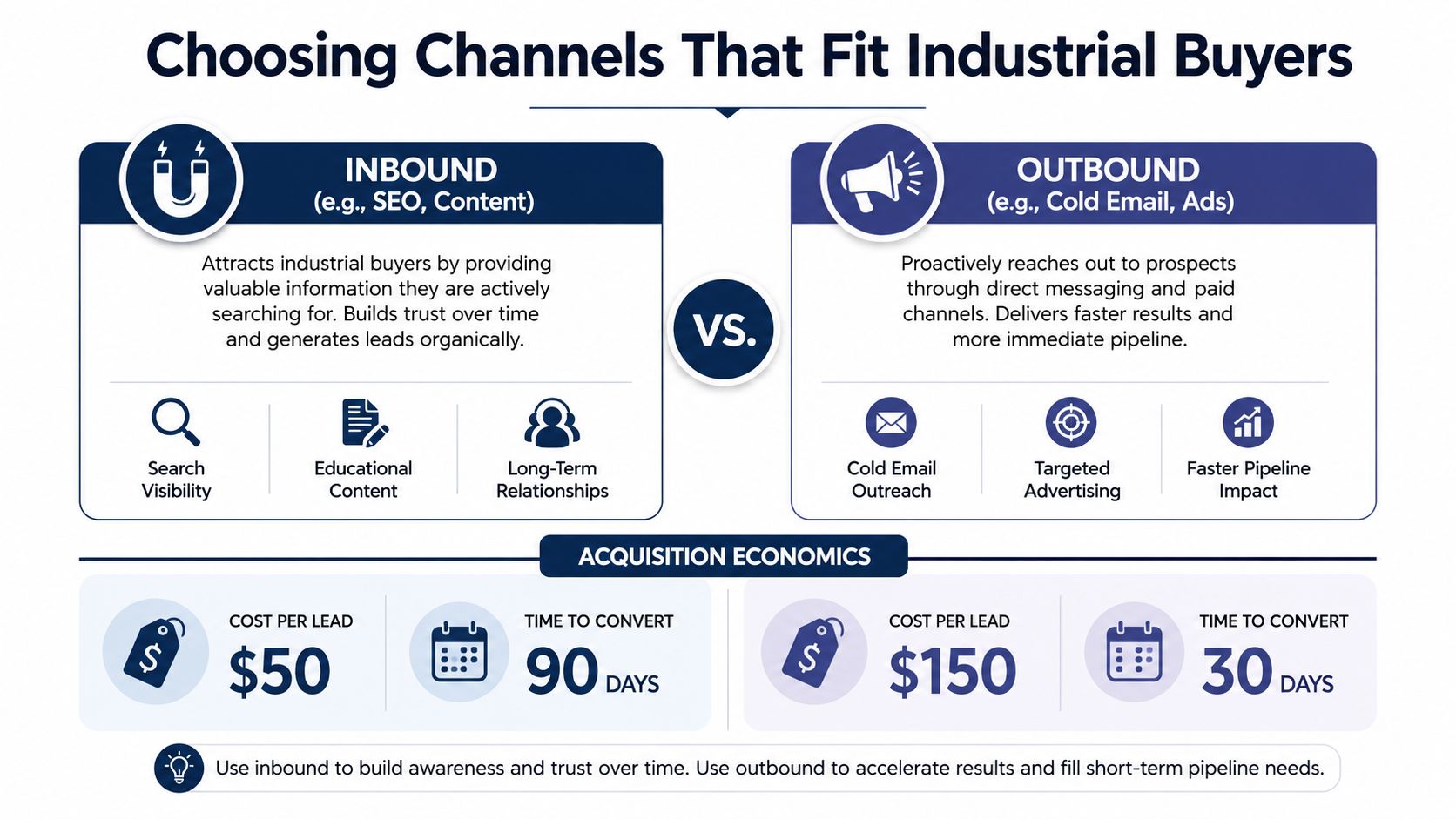
Outbound can create conversations sooner, but targeting and deliverability require active management. Inbound builds visibility over a longer period and depends on technical depth. Select the combination your team can run consistently, then connect anonymous research, known contacts, and buying-committee activity to one account record. Stage benchmarks should show which channels create progression, not merely inquiries.
Building Your CRM and Automation Workflows
A CRM should expose where an industrial opportunity slows down, which evidence is missing, and who owns the next action. A CRM limited to storing names and deal stages cannot help a sales manager diagnose stalled buying.
Build fields around the decisions sales and marketing must make:
- Account fit: industry, application, location, company type, and service alignment.
- Technical need: process, material, tolerance, volume, documentation, or equipment requirement.
- Commercial context: project status, sourcing reason, and known budget condition.
- Timing: active project, future project, recurring requirement, or unknown.
- Buying group: technical contact, procurement, operations, executive sponsor, and purchasing authority.
- Source and intent: first known source, latest interaction, requested asset, and account-level activity.
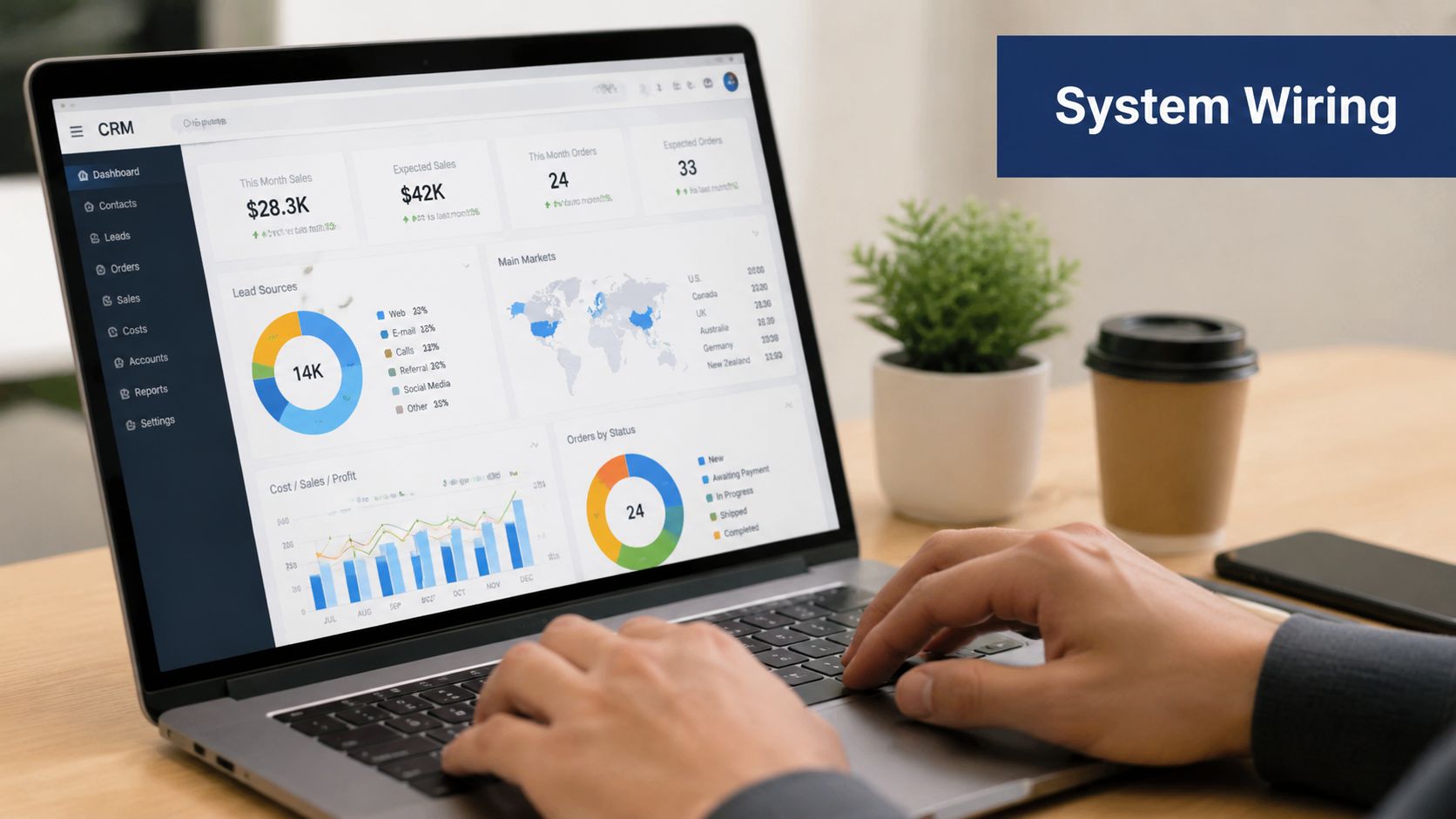
Treat scoring as a prioritization aid rather than an automatic verdict. Give fit and buying evidence more weight, then use activity as supporting context. A contact from the right account requesting a capability discussion should outrank an unrelated contact who viewed several general pages.
Response speed also needs an explicit workflow. The average B2B lead response time is reported as 42 hours, while responding within five minutes is repeatedly described as a strong benchmark, as reported in this lead response time study. One source says follow-up within five minutes makes a lead nine times more likely to convert.
Practical rule: Automate the alert and reminder. Keep the first meaningful technical conversation human.
Use automation for repetitive coordination:
- Send form confirmations and route records by service, territory, or account owner.
- Create a task when a high-fit inquiry arrives.
- Start nurture when sales marks a lead as not ready.
- Notify an owner when a known account returns to a high-intent page.
- Re-engage dormant contacts with a useful technical resource.
- Record disposition reasons when sales closes or disqualifies a lead.
Keep human judgment for unusual technical requirements, shop capability, account-specific outreach, objections about quality, capacity, or risk, and coordination across stakeholders.
Before adding another tool, test whether the current CRM can store these fields, trigger tasks, report stage movement, and preserve source data. Document each gap first. A CRM implementation for lead generation works better when anonymous research, known contacts, buying-group activity, and stage benchmarks share one account record.
Use the video below as a practical reference while reviewing your workflow design.
Qualifying Leads and Handing Off to Sales Cleanly
A machine shop can receive a technically detailed inquiry that still has no active project behind it. A known contact may also return repeatedly while the buying committee remains incomplete. Qualification separates those situations and gives marketing and sales a shared operating language.
Store five questions in the CRM, then record evidence rather than relying on a score alone.
Fit
Does the account match your ideal customer profile? Check industry, application, geography, process requirements, quality expectations, and order profile. Anonymous research can become useful account-level context once the contact identifies themselves.
Finances
Is there a commercial path that makes sense? The first conversation rarely produces a precise budget. It should establish whether the project is exploratory, approved, sourced, or blocked.
Need
What problem is the buyer solving? Capture the technical requirement in the buyer's own language, including specifications, tolerances, materials, or production constraints. A service category alone gives sales too little context.
Timing
When does the requirement need action? Separate an active sourcing event from a future engineering project. Both belong in the pipeline, but their stages, reminders, and nurture paths should differ.
Purchasing authority
Can this contact approve a purchase, influence the specification, or introduce the person who can? Teams can use what is an SQL in sales to distinguish sales readiness from general interest.
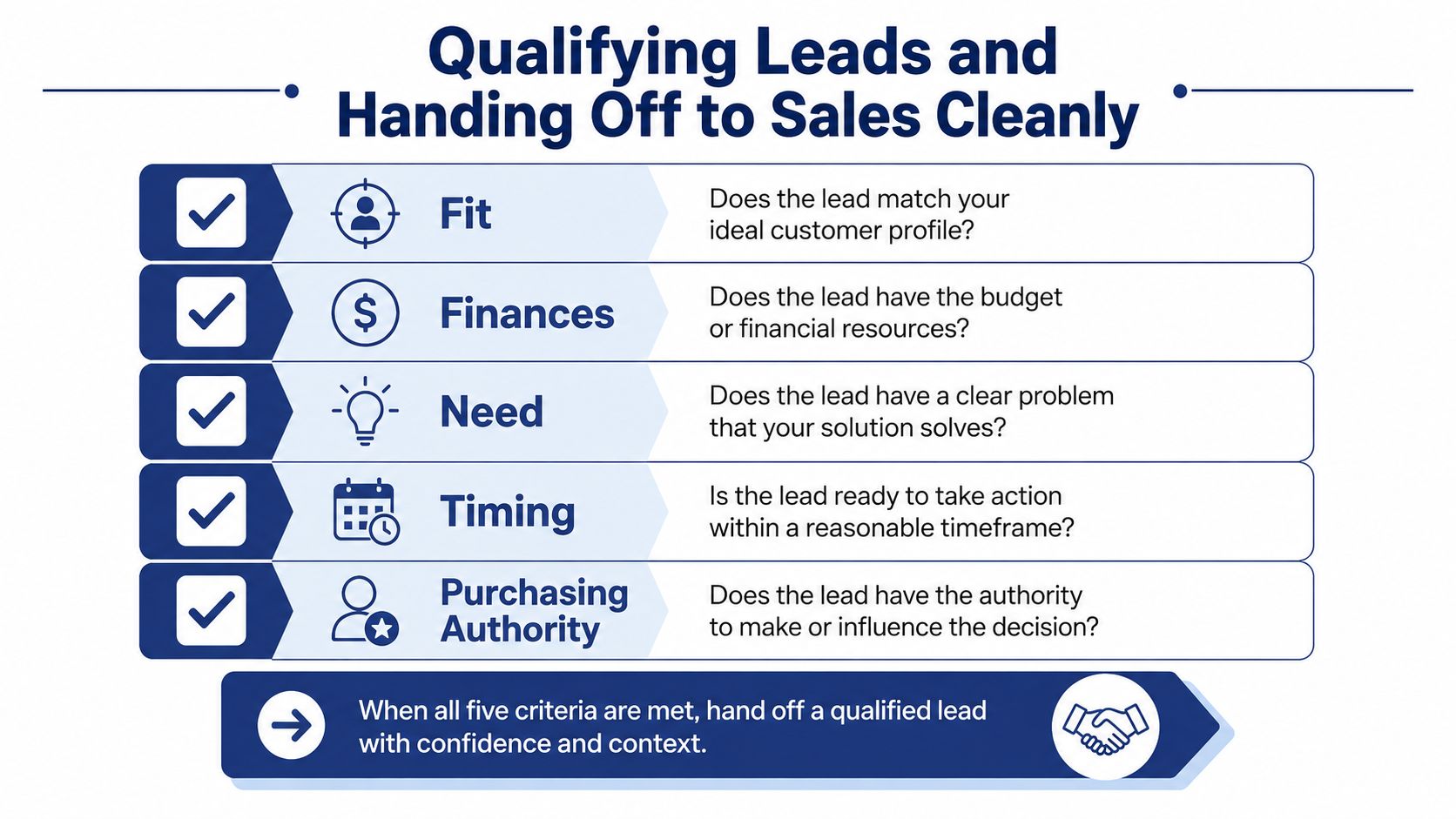
A sales-ready handoff should contain the five qualification answers, source, interaction history, requested service, known stakeholders, and recommended next step. Sales then accepts, rejects, or returns the record with a reason. Those reasons show marketing whether targeting, messaging, or nurture needs adjustment.
Published funnel benchmarks report roughly 20% to 25% from Lead to MQL, 12% to 18% from MQL to SQL, 10% to 12% from SQL to Opportunity, and 6% to 9% to Closed-Won. The same source reports a 2.9% median B2B website conversion rate, as shown in B2B funnel conversion benchmarks. Use these figures as diagnostic reference points, not quotas.
Set a simple service-level agreement:
- Marketing provides: qualification fields, source context, engagement history, and a clear handoff reason.
- Sales commits to: accepting or rejecting the lead, recording the reason, and completing the defined first action.
- Both teams review: rejected leads, stalled opportunities, and accounts showing renewed intent.
- Management monitors: stage conversion, response time, pipeline value, and aging.
For an operating checklist, compare your process with this guide on how to qualify sales leads. The aim is to protect sales time while preserving future demand.
KPIs, Testing, and the Pitfalls That Sink Industrial Lead Gen
A disappointing result does not prove the channel is wrong. In industrial markets, the failure may sit in the capture form, qualification rules, response routing, or nurture logic. Diagnose the handoffs before replacing SEO, email, or LinkedIn.
The evidence supports that approach. 79% of marketing leads never convert to sales, with lack of nurture cited as the main cause, while 61% of B2B marketers report that insufficient staff, funding, or time blocks effective execution, according to ZoomInfo's B2B lead generation statistics. Treat those figures as a prompt to inspect the operating system behind each channel.
Measure the system at its handoffs
Track the numbers that explain how an account progresses:
- Visitor-to-lead rate: Do relevant visitors take the intended action?
- Lead-to-MQL rate: Does capture produce contacts that fit your market?
- MQL-to-SQL rate: Does qualification create conversations sales considers useful?
- Response time: How long does an inquiry wait for an owner?
- SQL-to-opportunity rate: Do sales conversations reveal a real project?
- Pipeline value: Which sources create commercial opportunities?
- Stage aging: Where do records wait without a next action?
A website conversion rate can appear healthy while producing poor-fit contacts. A modest rate may support a stronger pipeline when traffic matches the buying committee and sales follows up consistently. Review performance by account, source, role, and stage, rather than treating every form fill as equal.
Test one failure point at a time
Choose one stage, record its current result, define one change, and assign an owner. Possible tests include a more specific form offer, a technical landing page, a faster routing rule, or a nurture sequence for inactive projects.
Change one meaningful variable at a time. If you alter the offer, audience, landing page, and follow-up together, the result cannot identify the cause. Compare the test with the relevant stage benchmark, then keep, revise, or remove the change.
Buyers often do not engage sellers until roughly two-thirds of the way through the journey, multiple stakeholders are involved in 84% of purchases, and the average buying cycle is about 10.1 months, according to the same buyer journey data source. Anonymous research, committee activity, and long pauses therefore belong in the measurement model. Track account-level intent and return visits, not only named leads.
Inspect these recurring failures:
- No buyer definition: Content attracts broad attention without identifying valuable accounts.
- Weak capture offer: The form requests contact details without giving a clear reason to submit them.
- Single-track nurture: Every contact receives the same message despite different roles or needs.
- Unclear qualification: Marketing and sales apply different standards for readiness.
- Slow ownership: Leads remain unassigned while the buyer continues researching elsewhere.
- Incomplete handoff: Sales receives a name without project or account context.
- No rejection feedback: Disqualified records disappear instead of improving targeting and routing.
- Tool-first thinking: The company adds software before documenting the workflow it must support.
Your Next Steps to a Predictable Pipeline
A predictable pipeline is a connected system. Attraction, capture, nurture, qualification, and handoff need clear owners, measurable outputs, and rules for stalled or anonymous accounts.
Start with a stage audit. Select the weakest constraint and repair it before changing the rest. Slow response points to routing or ownership. Low conversion points to the offer or capture step. Frequent sales rejection points to qualification. Strong accounts that go quiet need role-specific nurture and account-level follow-up.
Use this checklist:
- Where do qualified accounts disappear?
- What project evidence does sales need?
- Which stage has an owner and a benchmark?
- What automation starts, pauses, or escalates each stage?
- What rejection reason will improve targeting?
Record the answers in the CRM. Assign one next action, then review outcomes with sales after the next process change. This makes anonymous research, committee activity, and long buying cycles visible without forcing them into a false linear funnel.
Machine Marketing helps manufacturers diagnose disconnected lead generation systems and implement CRM and automation workflows for qualification and follow-up. Visit Machine Marketing to request a practical pipeline diagnosis.