If you're a manufacturer, this probably sounds familiar. Your team posts a machine photo, a trade show booth shot, maybe a hiring update. A few people react. Nothing moves in the pipeline. Sales says LinkedIn isn't producing anything useful, so the channel becomes a checkbox instead of a system.
That's usually not a content problem. It's a design problem. Most LinkedIn marketing for manufacturers fails because the page, the people, the content, the outreach, and the lead routing were never built to work together. When we diagnose underperforming LinkedIn programs, we usually find scattered activity where there should be an operating system.
Table of Contents
- Why Your Current LinkedIn Efforts Are Falling Flat
- Build Your Digital Headquarters on LinkedIn
- Create Content That Speaks to Engineers and Buyers
- Proactive Growth with Ads and Sales Navigator
- Systematize Lead Capture and Follow-Up
- Measure What Matters and Implement Your 90-Day Plan
Why Your Current LinkedIn Efforts Are Falling Flat
Most weak LinkedIn programs in manufacturing look busy from the outside. Posts go up. The page exists. Someone on the sales team occasionally sends connection requests. But if you inspect the system, you find random acts of marketing instead of a repeatable process.
A common pattern looks like this. The marketing coordinator posts whenever there's news. The company page speaks in broad brand language. Leadership profiles read like resumes. Sales reaches out cold without context. When an inquiry comes in, nobody's sure whether it belongs to direct sales, a rep, or a distributor.
That setup creates three predictable problems:
- The wrong message reaches the wrong audience. Engineers want technical clarity. Procurement wants supplier confidence. Operations leaders want implementation confidence. Most manufacturing pages talk to none of them well.
- Organic posting has no compounding effect. If each post is standalone, the audience never gets a clear picture of what you solve, for whom, and why your approach is different.
- Interest dies in handoff. Even good engagement doesn't matter if the next step is vague or routed slowly.
Practical rule: If LinkedIn activity isn't tied to a named audience, a defined offer, and a follow-up path, it's not a marketing channel. It's just publishing.
The fix isn't more volume by itself. It's structure. LinkedIn marketing for manufacturers works when you build it like an engineered process. First, make your presence credible. Then publish content that answers buyer questions. Then choose proactive growth tools based on your sales model. Then route every response into a workflow the sales team can use.
That's what turns LinkedIn from an obligation into a working demand system.
Build Your Digital Headquarters on LinkedIn
Your LinkedIn presence needs to work like a clean front office and a capable plant tour. Buyers should understand what you make, who you help, and why they should trust your team within a few seconds of landing on the page.
LinkedIn matters because it concentrates professional attention. It's a 1.3 billion-member network, and industry roundups report that 93% to 96% of B2B marketers use it for content distribution while 80% of B2B social media leads come from the platform, according to Brenton Way's LinkedIn marketing statistics roundup. For manufacturers, that makes the page less of a social profile and more of a digital headquarters.

Start with buyer clarity
Most company pages lead with generic statements about quality, innovation, and service. That language is harmless, but it doesn't help a technical buyer sort you quickly.
Use this checklist instead:
- Banner image: Show the product, environment, or process buyers care about. A plant-wide hero shot is fine if it signals capability. A random stock image isn't.
- Headline and tagline: State what you make and who it's for. “Precision-machined components for OEMs in harsh-duty applications” is better than “Delivering excellence since 1989.”
- About section: Write for the buying committee. Include applications, industries served, production strengths, certifications if relevant, and how projects typically start.
- Featured section: Pin assets that answer buying questions. Think application guides, process walkthroughs, engineering explainers, or a short capability overview.
- Contact path: Make the next step obvious. Should buyers request a quote, talk with engineering, or find a distributor?
A good page reduces uncertainty. It doesn't try to say everything. It helps the right visitor self-identify and move forward.
Align the company page and leadership profiles
Company pages rarely close the trust gap alone. Buyers click into people. They want to know who leads the business, who understands the application, and who they'd likely speak with after first contact.
That's why leadership profiles need alignment. The owner, president, sales leader, and technical expert profiles should reinforce the same story, not four different ones.
A practical setup looks like this:
| Profile element | What to say | Why it matters |
|---|---|---|
| Headline | Role plus market focus | Helps buyers place the person quickly |
| About summary | Problems solved, industries served, process strengths | Moves beyond a job-title-only profile |
| Featured content | Capability deck, technical post, customer-facing resource | Gives visitors a useful next click |
| Experience section | Clear explanation of the company's value | Supports credibility during research |
Buyers don't separate your company page from your people. They treat both as evidence.
If your team needs help maintaining a posting calendar and keeping profile messaging consistent, one option is Machine Marketing's social media and audience strategy support. The main point isn't who manages it. The point is that somebody owns the system and keeps it coherent.
Create Content That Speaks to Engineers and Buyers
The fastest way to waste LinkedIn is to treat it like a press release feed. New machine. New hire. Trade show booth. Company anniversary. None of that is useless, but it rarely earns attention from technical buyers unless it connects to a problem they're trying to solve.
A better content engine starts with the questions buyers ask before they contact sales.
Build around technical buying questions
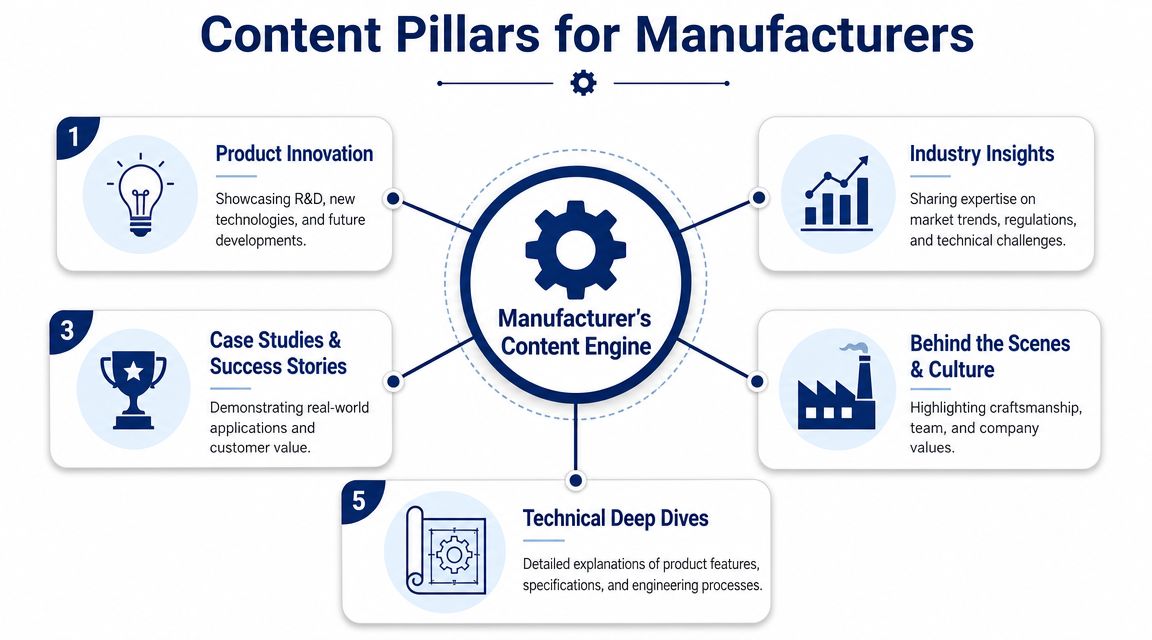
For manufacturers, five content pillars usually create enough range without making production unmanageable.
Technical deep dives
Explain how something works, where it fails, what specs matter, or how to compare options. Here, your engineers and product specialists earn trust.Application stories
Show how a product or process fits a real operating environment. Keep it practical. Focus on the use case, the constraints, and the decision logic.Behind-the-process content
Buyers want proof that you can execute. Show inspection workflows, machining practices, quality checks, packaging discipline, or project kickoff steps.Industry insight
Comment on regulations, supply chain realities, material choices, maintenance implications, or shifts in buyer expectations. Don't chase trends. Address what affects purchase decisions.People and expertise
Feature engineers, plant leaders, service technicians, and project managers. Not as culture fluff, but as subject-matter voices.
A practical publishing benchmark is 1 update per day, or roughly 20 to 30 organic updates per month, and a manufacturing-focused LinkedIn guide recommends using page analytics to identify strong organic posts before sponsoring them, rather than boosting everything equally, as noted in Grant Marketing's LinkedIn guide for manufacturing companies.
Here's a useful format mix:
- Short text post: One technical misconception, one explanation, one takeaway.
- Carousel or document post: Selection criteria, inspection checklist, installation mistakes to avoid.
- Native video: Walkthrough from engineering or production.
- Comment-led post: A strong point of view that invites practical discussion.
If you need a broader editorial framework, this guide on content marketing for manufacturing companies pairs well with a LinkedIn-first publishing model.
A short video can carry a lot of weight when the topic is easier to show than explain.
Adapt the content engine for distributor and rep models
General advice often proves inadequate. If you sell through distributors, reps, or integrators, you can't run LinkedIn like a direct-to-buyer lead machine without creating friction.
The smarter approach is to publish content that builds end-user preference while making partners more effective.
That means:
- Create partner-enabling content. Publish explainers, application guidance, and comparison content that distributors can share with their accounts.
- Stay brand-forward, not channel-disruptive. Talk about buying factors and use cases. Don't undercut your own channel by pushing every conversation toward direct purchase.
- Make routing explicit. If a buyer reaches out, direct the inquiry to the right territory owner or partner path.
The strongest LinkedIn programs in channel-heavy manufacturing don't just generate attention. They make the whole selling ecosystem easier to trust and easier to use.
Proactive Growth with Ads and Sales Navigator
Organic content builds familiarity. It gives buyers a reason to trust your company once they discover you. But it doesn't guarantee coverage of target accounts, and it doesn't create a disciplined outreach motion on its own.
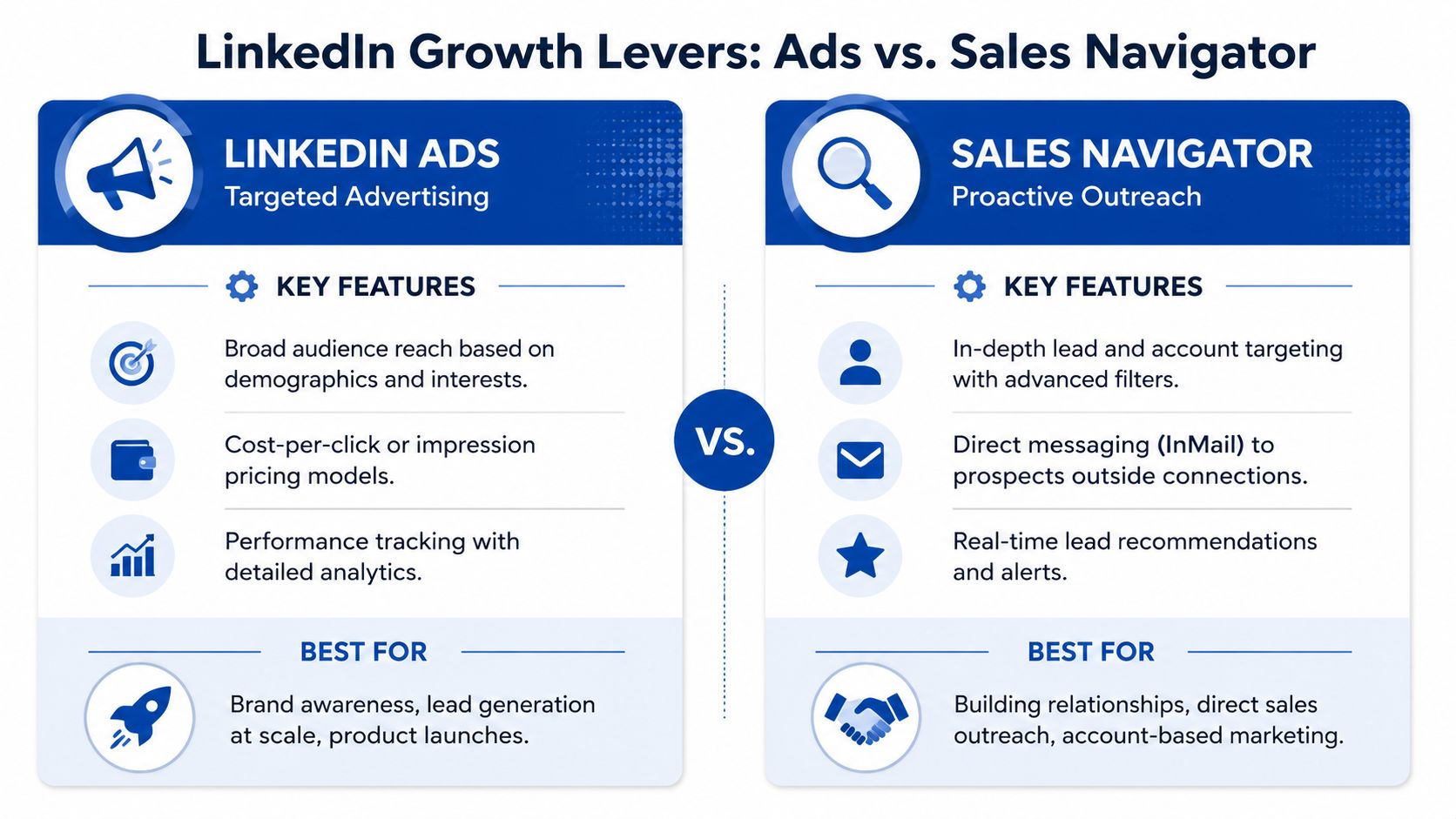
That's where LinkedIn Ads and Sales Navigator come in. They solve different problems. Teams get stuck when they treat them as substitutes instead of separate tools.
Use ads when you need market coverage
Ads work well when you need to reach a defined segment consistently. That could mean operations leaders at target OEMs, engineers in a specific vertical, or procurement roles inside named account tiers.
LinkedIn's economics are one reason manufacturers keep using it. A 2026 benchmark summarized by Digital Applied's LinkedIn B2B marketing data reports a 2.74% visitor-to-lead conversion rate on LinkedIn, compared with 0.77% for Facebook and 0.69% for X/Twitter. The same source notes that manufacturing campaigns can see around 0.49% CTR, with 0.40% to 0.60% considered a common global range on the platform.
That doesn't mean every manufacturer should pour budget into ads. It means the channel is built for professional targeting and tends to reward clear offers.
Ads are usually the right choice when you want to promote:
- A technical guide or application resource
- A webinar or product education session
- A product launch with a clearly defined audience
- A retargeting sequence for previous site visitors or engaged users
For campaign planning, this breakdown of the elements of advertising is useful because it forces the team to define audience, message, offer, and action before spending.
Use Sales Navigator when the account list matters more than reach
Sales Navigator is different. It's not a broadcast tool. It's an account research and relationship development tool.
Use it when your sales motion depends on a named list of OEMs, plants, distributors, EPC firms, integrators, or strategic prospects. In those cases, the work is about identifying the buying committee, understanding role differences, and starting targeted conversations with context.
A practical sequence looks like this:
- Build account lists: Segment by vertical, geography, installed base, or strategic fit.
- Map roles: Engineering, operations, maintenance, procurement, and leadership often need different messages.
- Warm the contact path: Reps should engage with relevant content before sending a direct message.
- Send brief outreach: Lead with relevance, not a brochure.
Example outreach structure:
| Step | Message focus | What to avoid |
|---|---|---|
| Connection request | Shared context or relevant topic | Pitching in the request |
| Follow-up note | One problem your team sees often | Generic “just checking in” language |
| Resource share | A useful guide, checklist, or explanation | Dropping a calendar link immediately |
| Conversation ask | Specific reason for a short discussion | “Would love to connect and learn more” |
A simple decision table
If you're choosing where to start, use this:
- Use ads first if you already have a strong asset, a clear audience, and weak top-of-funnel visibility.
- Use Sales Navigator first if your sales team works named accounts and needs more structured prospecting.
- Use both together if marketing can create air cover while sales runs account-based outreach into the same market.
What doesn't work is running ads with no credible page behind them, or asking sales to do LinkedIn outreach without content that supports the conversation.
Systematize Lead Capture and Follow-Up
A good LinkedIn program can still fail at the point of handoff. Someone fills out a form, sends a message, or asks for a spec sheet. Then the lead sits in an inbox, gets forwarded manually, or lands with the wrong person. That's where momentum dies.
The fix is simple in principle. Reduce friction at capture, then automate routing.
Reduce friction at the point of interest
For paid campaigns, LinkedIn Lead Gen Forms can shorten the path between interest and inquiry. For organic activity, the equivalent is a clear next action tied to a useful asset or a well-defined contact path.
What matters is what happens next.
Build the handoff like an SOP:
Define lead categories
Separate quote requests, distributor requests, spec inquiries, recruiting inquiries, and partnership inquiries.Push leads into a CRM immediately
Route them into your CRM or operating system so sales, channel managers, and marketing can see status in one place.Assign ownership by rule
Territory, product line, end market, and channel model should determine who receives the lead.Trigger follow-up automatically
Confirmation email, internal notification, and task creation should happen without manual copying.
If your team is sorting this out, a guide on CRM for lead generation can help you define the workflow before you pick tools.
Speed matters, but clarity matters just as much. Fast follow-up from the wrong team creates as much friction as slow follow-up.
Route leads without creating channel conflict
Indirect sales models require a different design. Mainstream LinkedIn advice often assumes every inquiry should go straight to your internal sales team. Many manufacturing businesses do not sell that way.
A major blind spot in most guidance is distributor and rep support. The better model is to influence buying committees while enabling partners, then route inquiries systemically to avoid channel conflict, as discussed in Market Veep's article on LinkedIn marketing for manufacturers.
Use a routing logic like this:
- Named distributor territory: Assign to the partner owner and notify the internal channel manager.
- Direct-sale product line: Send to internal sales with product context attached.
- Unclear fit inquiry: Route to a triage queue for qualification before assignment.
- Existing account contact: Notify the account owner first to avoid overlap.
That structure turns LinkedIn into more than a lead source. It becomes partner enablement with traceable handoffs.
Measure What Matters and Implement Your 90-Day Plan
If your scorecard is likes, impressions, and follower count, your team will optimize for activity instead of revenue. Manufacturers need a different dashboard. The right question isn't “Did people engage?” It's “Did LinkedIn contribute to qualified conversations and the pipeline we want?”
Track pipeline signals, not vanity metrics
Some engagement metrics still matter. You need them to diagnose message fit. But they are supporting indicators, not business outcomes.
Focus your review on these categories:
- Audience quality: Are the right job titles, companies, and partner profiles engaging?
- Content usefulness: Which posts generate meaningful comments, profile visits, direct inquiries, or sales conversations?
- Lead handling: How many inquiries were routed correctly, accepted by sales, or assigned to the proper partner?
- Pipeline contribution: Which campaigns, posts, or outreach sequences led to meetings, opportunities, or partner-assisted activity?
A practical internal scorecard can look like this:
| KPI category | What to review weekly | What to review monthly |
|---|---|---|
| Content | Top posts by quality engagement | Themes that led to inquiries |
| Outreach | Connection acceptance and reply quality | Meetings created from target accounts |
| Lead flow | Routing accuracy and response time | Qualified leads by source and type |
| Revenue influence | Opportunity creation notes | Pipeline tied to LinkedIn activity |
One useful operating habit is to review top-performing organic posts and decide which are worth sponsoring. That keeps paid spend tied to real audience response instead of internal opinion.
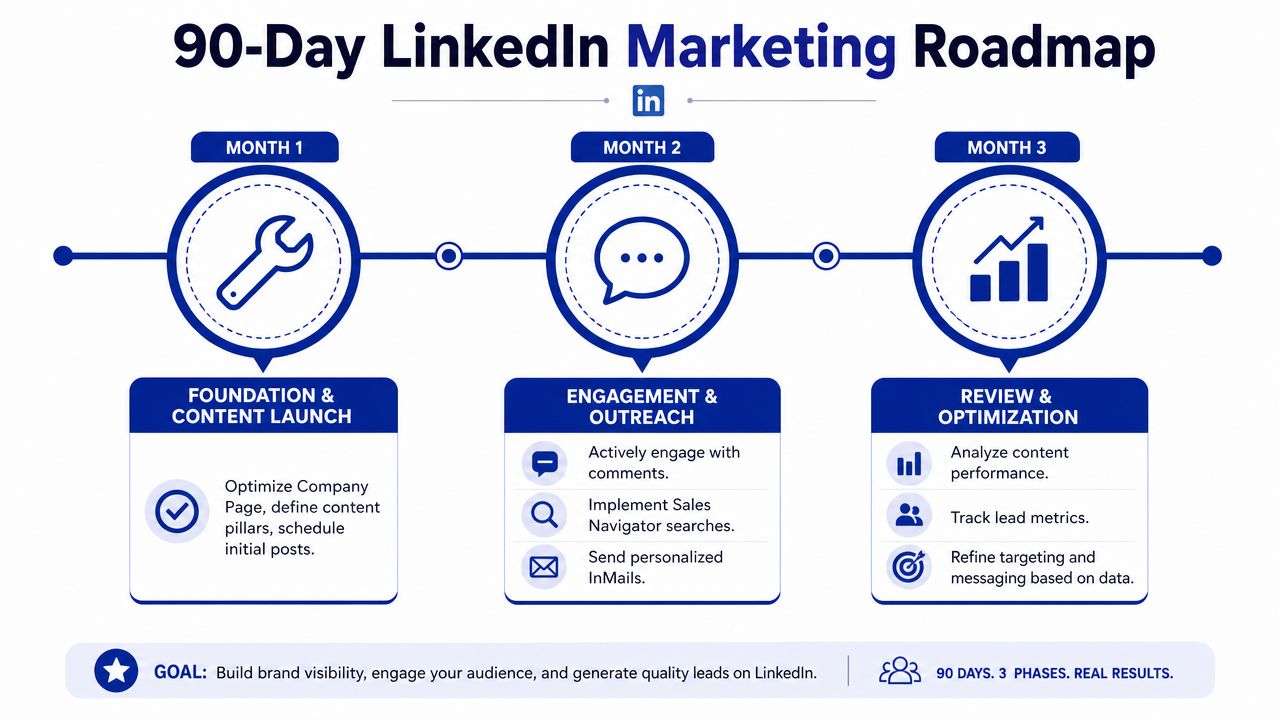
Your 90-day operating plan
The first ninety days should build discipline, not complexity. Don't try to launch everything at once.
Days 1 through 30
- Clean up the foundation. Rewrite the company page, align leadership profiles, clarify the call to action.
- Set content pillars. Choose a manageable set based on recurring buyer questions.
- Build the workflow. Define lead categories, CRM fields, assignment rules, and follow-up triggers.
- Prepare assets. Create a short list of guides, explainers, or product education pieces for posting and outreach.
Days 31 through 60
- Publish consistently. Commit to the content rhythm your team can sustain.
- Activate subject-matter experts. Pull short insights from engineering, sales, quality, or operations.
- Launch one proactive motion. Start either a targeted ad campaign or a Sales Navigator sequence, not both if the team is still immature.
- Review comments and messages weekly. Demand signals often show up first here.
Days 61 through 90
- Audit what worked. Look at inquiries, meetings, partner handoffs, and campaign response quality.
- Promote proven content. Sponsor posts that already showed strong fit.
- Refine audience targeting and messaging. Remove waste. Tighten role-based language.
- Document the SOP. Turn the process into a repeatable operating procedure so it survives staffing changes.
A strong LinkedIn system doesn't rely on one enthusiastic employee. It survives because the workflow, ownership, and reporting are documented.
The manufacturers that get results from LinkedIn usually aren't doing flashy things. They're doing ordinary things consistently, with good routing, clear messaging, and steady review.
If you want help diagnosing your LinkedIn marketing for manufacturers setup, Machine Marketing works with industrial companies that need a clearer system for content, outreach, CRM handoff, and measurable pipeline contribution. If your team already has tools in place but the pieces aren't connected, that's a good place to start.