Most LinkedIn advice starts with the wrong victory condition. It tells you to send more connection requests, improve your acceptance rate, and treat every new connection as a prospect. For an industrial business, that's a weak diagnosis. A connection is only an opportunity to begin a relevant conversation, and the commercial test is whether that conversation becomes a qualified sales interaction in your CRM.
LinkedIn has the reach to support serious B2B prospecting. The platform launched in May 2003, Microsoft acquired it in 2016 for $26.2 billion, and it had grown beyond 1 billion members worldwide by 2024, according to LinkedIn market and platform statistics. But scale creates noise. Manufacturers need a LinkedIn outreach strategy built around audience fit, technical relevance, disciplined follow-up, and pipeline visibility, not activity for its own sake.
Table of Contents
- Diagnosing the Real Bottleneck in B2B Outreach
- Engineering Your Profile and Target Audience
- Building High-Converting Message Sequences
- Integrating Automation and CRM Systems
- Measuring KPIs That Actually Impact Revenue
- Common Pitfalls and System Fixes
Diagnosing the Real Bottleneck in B2B Outreach
The popular assumption is simple: if more prospects accept your requests, more opportunities will enter the pipeline. The evidence points to a more complicated funnel. A 2026 benchmark study of more than 15 million LinkedIn outreach contacts recorded an average connection acceptance rate of 26% and an overall reply rate of 7.2%. It also found meaningful variation by audience and timing, with HR and Talent professionals replying at 10.9%, C-level executives at 7.0%, April at 7.9%, and September at 6.3%. Those figures are reported in the Belkins LinkedIn outreach benchmark study.
Acceptance, then, is a useful diagnostic metric, but it isn't proof of demand. A separate 2026 analysis of 180,155 matured connection requests found that 27.1% were accepted, 27.6% of accepted connections replied, and only 2.0% of accepted connections booked meetings, as detailed in Reachium's 2026 LinkedIn outreach research. The funnel narrows sharply after the handshake.
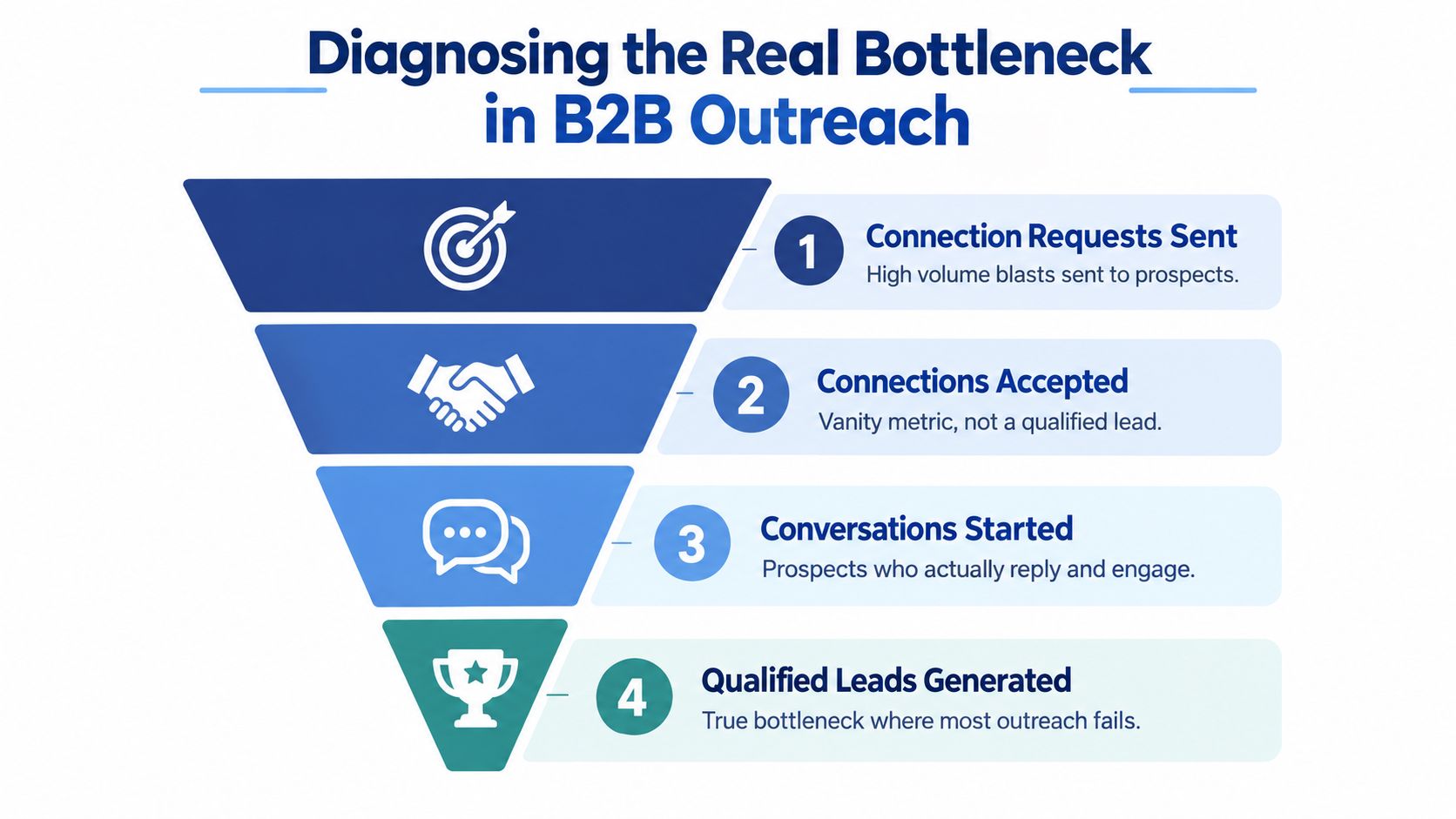
Find the stage where conversations stop
The most useful question isn't “How many people accepted?” It's “Where do qualified prospects stop moving?”
A manufacturer might have a respectable acceptance rate while losing nearly every opportunity in the next step. Common causes include:
- Generic follow-up: The message says “Thanks for connecting” and immediately introduces a service with no connection to the buyer's operating reality.
- Premature meeting requests: The seller asks for time before earning enough relevance to justify a discussion.
- Weak qualification: The team counts any reply, including polite acknowledgments and unrelated questions, as a sales response.
- No ownership after reply: A prospect answers, but no person or CRM task ensures a timely, informed response.
- Disconnected reporting: LinkedIn activity sits outside the sales system, so management can't connect conversations to opportunities.
Recent benchmark commentary identifies a similar shift. Acceptance rates remain around the high-20s, while post-acceptance reply rates reportedly fell from 32.2% in 2025 to 22.0% in 2026, suggesting that conversation quality deserves more attention than acceptance alone. The figures appear in Reachium's research overview.
Practical rule: Treat an accepted connection as a permission signal, not a lead. The lead begins when the prospect engages with a relevant business problem.
Apply an engineering mindset
Map the funnel like a production process. Record requests sent, accepted connections, replies, positive replies, qualified conversations, meetings, opportunities, and closed revenue. Then inspect the first failing handoff.
If acceptance is poor, review audience fit and profile credibility. If acceptance is healthy but replies are weak, inspect the message and the timing. If replies are strong but meetings are rare, examine the offer, qualification questions, response speed, and booking process. Teams that need additional prospecting capacity can also evaluate a specialized resource such as Hire SDR when internal ownership is the constraint.
The transformation is straightforward. Stop optimizing the widest part of the funnel because it looks impressive. Optimize the transition from connection to useful conversation, then connect that conversation to a controlled sales process.
Engineering Your Profile and Target Audience
Before a plant manager, procurement leader, or engineering director replies, they'll usually inspect the person behind the request. Your profile must answer three questions quickly: Who do you help? What industrial problem do you understand? Why should this buyer trust you enough to continue?
A profile built around a generic job title fails that test. “Sales executive at ABC Manufacturing” tells the buyer who you are, but not why the conversation matters.
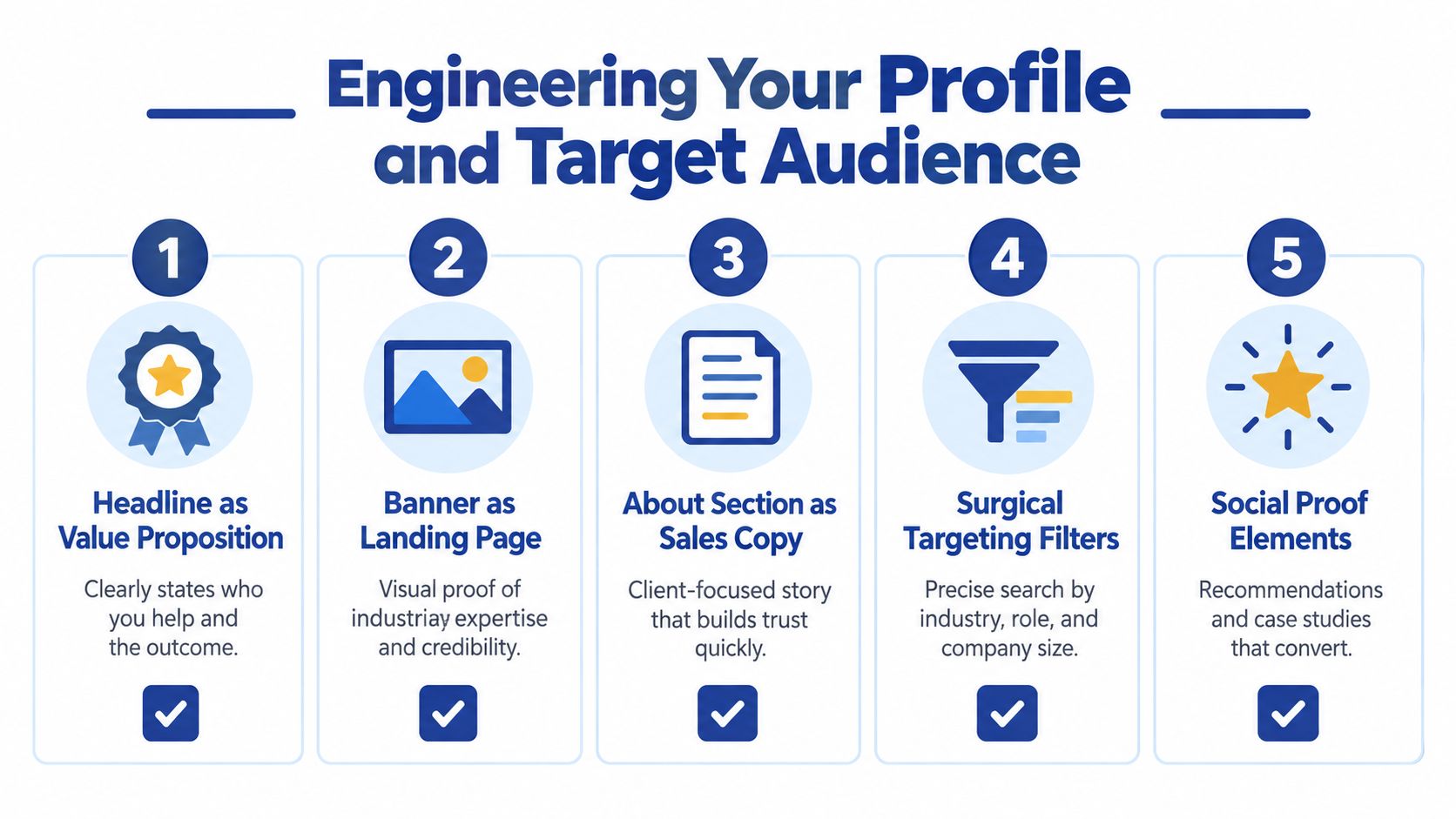
Build the profile as a buyer-facing asset
Use this checklist before sending an invitation:
- Rewrite the headline as a value proposition. State the type of manufacturer you support and the operating outcome you influence. A practical format is “Helping machine manufacturers improve qualified B2B demand through [specific capability].” If you need a starting point, use a tool to optimize your LinkedIn headline, then edit the result so it reflects your actual market.
- Turn the banner into visual proof. Use a production environment, engineered product, facility image, or clear brand graphic. Avoid decorative stock imagery that says nothing about your expertise.
- Write the About section for the buyer. Lead with familiar problems, such as inconsistent RFQ flow, poor visibility among engineering buyers, long approval cycles, or sales and marketing data living in separate systems. Explain how you diagnose those problems and what a sensible next step looks like.
- Use the Featured area deliberately. Include technical resources, project pages, facility content, product documentation, or useful explanations that help a buyer assess your competence.
- Strengthen social proof. Recommendations should describe the kind of work completed and the business context, not merely say you were pleasant to work with.
A profile can't compensate for poor targeting, but a weak profile can undermine otherwise relevant outreach. Your guide to using LinkedIn for sales can serve as a broader reference while you audit the profile and process together.
Define a narrow audience before searching
Start with an ideal customer profile that maps to actual LinkedIn filters. Define:
- Industry: Separate machine builders, component manufacturers, contract manufacturers, distributors, and industrial service firms when their buying triggers differ.
- Role: Include the operational and commercial stakeholders who influence the purchase, not only the final executive.
- Geography: Segment regions when language, sales coverage, regulation, or purchasing behavior differs.
- Company characteristics: Use relevant company-size and business-model filters instead of treating every industrial firm as equivalent.
- Trigger signals: Look for hiring activity, new facilities, product launches, leadership changes, expansion announcements, or posts about a known production challenge.
Boolean search can improve precision when titles vary. Combine related role terms, exclude irrelevant functions, and test the results manually before saving a list. A good search should produce names you'd want to contact, not a large directory that forces personalization to become superficial.
Use a message-market fit test
Pick a small segment and write one clear hypothesis. For example, “Engineering directors at custom equipment manufacturers may respond to a message about reducing friction between technical content and RFQ generation.” Then build the profile, message, qualification field, and CRM stage around that hypothesis.
That creates a system you can inspect. Without the hypothesis, a poor result tells you little. With it, you can ask whether the audience, trigger, message, or offer needs adjustment.
The video below provides another visual reference for profile preparation and audience engagement.
Building High-Converting Message Sequences
Industrial buyers don't need another pitch disguised as a greeting. They need a reason to believe you understand their environment, plus a low-friction way to decide whether continuing makes sense.
Connection requests have tight constraints. LinkedIn states that personalized connection notes are capped at 300 characters for Premium, Sales Navigator, and Recruiter accounts, while free accounts have a lower 200-character cap when notes are available, as summarized in LinkedIn connection note limits. That limitation is useful. It forces you to choose one relevant reason to connect instead of compressing an entire sales presentation into a small box.
Design the sequence around permission
A practical sequence has distinct jobs:
- Connection request: Establish relevance through a specific trigger, shared market, technical topic, or professional context.
- First follow-up: Ask an easy question or offer a useful observation. Don't introduce every capability.
- Conversation response: Answer the prospect's point directly and ask one diagnostic question.
- Qualification: Explore the problem, current approach, urgency, stakeholders, and next action.
- Meeting invitation: Suggest a call only when the conversation indicates a business reason to meet.
A connection note might reference a recent facility expansion or a post about quoting delays. The follow-up can ask whether that issue sits with engineering, sales, or operations. The point isn't to sound clever. It's to make the next response easy and relevant.
For more examples of concise business copy, use these marketing message examples. Teams that want to compare different approaches can also review resources on targeting and messaging sequences for B2B, then adapt the principles to their industrial segment.
Use timing and format as test variables
Timing should be tested rather than assumed. Independent 2026 benchmarks reported post-acceptance message reply rates around 10.4%, connection-note replies around 3.0%, morning sends outperforming evening sends by roughly 8 to 10 points, and regional differences including the United States at 6.0% versus the Netherlands at 10.5%. These findings are published in Expandi's 2026 LinkedIn outreach benchmarks.
| Variable | Metric / Reply Rate | Strategic Takeaway |
|---|---|---|
| Post-acceptance message | Around 10.4% | Invest in the follow-up, not only the invitation |
| Connection note | Around 3.0% | Keep the note focused on relevance and connection |
| Morning versus evening | Morning sends outperform by roughly 8 to 10 points | Test send windows against your buyers' working patterns |
| United States market | 6.0% | Don't assume one market's response pattern applies globally |
| Netherlands market | 10.5% | Segment by geography and review local performance |
These benchmarks aren't guarantees. Industrial roles have different schedules, and a maintenance leader may engage differently from a commercial executive. Use them as hypotheses, then review performance by segment, sender, message, geography, and send window.
Avoid the pitch slap
The first message after acceptance should not ask for a long sales call unless the prospect has already shown intent. A better structure is:
- Observation: Mention a specific company, role, or market signal.
- Problem: Connect the observation to a plausible operational challenge.
- Useful offer: Provide an insight, checklist, or brief explanation.
- Small question: Ask whether the issue is relevant before proposing a meeting.
For example:
Message framework: “Thanks for connecting. I noticed your team is expanding its custom equipment work. That often creates pressure around qualified RFQs and technical follow-up. Is improving that process a current priority, or is another growth constraint taking precedence?”
The question gives the buyer an easy way to correct your assumption. That matters in manufacturing, where a company may look like an ideal prospect but have no active need, no available capacity, or a purchasing process controlled by another team.
InMail has different field limits. The subject line allows up to 200 characters, while the body is limited to approximately 1,900 to 2,000 characters, depending on the documentation version cited by LinkedIn InMail character limit guidance. Treat those limits as maximums, not targets. A shorter message with a credible observation is usually easier to process than a complete company history.
Integrating Automation and CRM Systems
Manual outreach creates inconsistent execution. Reckless automation creates account risk and poor buyer experiences. The useful middle ground is a controlled system where automation handles repetitive administration while people own judgment, personalization, replies, and qualification.
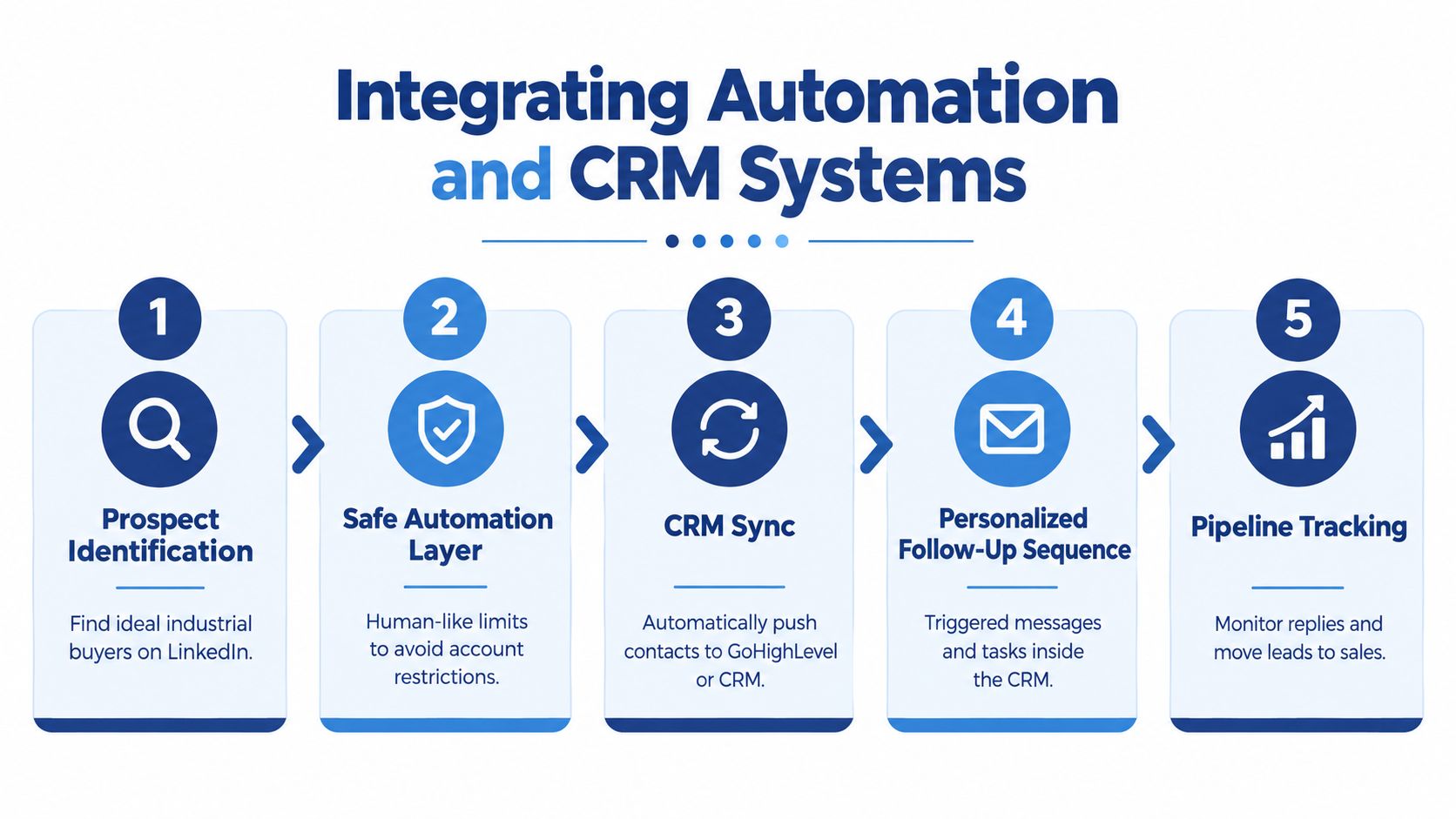
Separate automation from decision-making
Use tools such as Sales Navigator for list building and a CRM such as HubSpot or GoHighLevel for pipeline control. Automation can help assign tasks, synchronize approved prospect data, trigger reminders, and prevent duplicate follow-up. It shouldn't decide whether a technical buyer is qualified or send an unreviewed message after a prospect raises a sensitive commercial issue.
A workflow looks like this:
- Identify the prospect: Save the person, company, role, segment, geography, and trigger.
- Apply a controlled outreach layer: Use conservative activity rules and human review points.
- Create or update the CRM record: Store source, campaign, sender, message stage, and response status.
- Route the conversation: Assign an owner and create a task when a prospect replies.
- Track the commercial outcome: Move the record from conversation to qualified lead, opportunity, or disqualified status.
The CRM should preserve the context that makes a reply useful. “Replied on LinkedIn” isn't enough. Record the problem mentioned, current initiative, relevant facility or product line, decision participants, and agreed next action.
Protect the account and the data
LinkedIn's Recruiter InMail policy requires a response rate of at least 13% over a 14-day assessment period once 100 or more InMail messages are sent in that window. Only responses received within the first 30 days after sending count toward the rate, according to LinkedIn's InMail response-rate policy.
That policy makes message quality an operational requirement, not just a copywriting preference. Monitor response performance, pause weak sequences, and review whether your audience is too broad or your message asks for too much too soon.
Build safeguards into the process:
- Approval gates: Require human review for new segments and message variants.
- Duplicate controls: Check the CRM before adding a prospect to another campaign.
- Reply routing: Create an immediate owner and task for every substantive response.
- Suppression rules: Remove current customers, active opportunities, competitors, employees, and people who opt out.
- Audit trails: Keep campaign and message-stage history so managers can diagnose failures.
Machine Marketing helps industrial businesses connect marketing strategy, CRM processes, automation, and lead generation. Whether you use an agency, an internal operator, or another implementation partner, the standard should remain the same: every automated action must support a visible business process.
For teams reviewing their wider system, this CRM marketing automation guide provides useful context for connecting outreach activity with follow-up and reporting.
Measuring KPIs That Actually Impact Revenue
A connection count can rise while the sales pipeline stays empty. Profile views can increase without producing a single qualified opportunity. Industrial sales teams need KPIs that reveal whether LinkedIn is creating commercial movement, not merely platform activity.
Start with a funnel report that separates volume from quality:
- Targeting accuracy: How many contacted accounts match the agreed ideal customer profile?
- Acceptance rate: How often do relevant prospects accept?
- Reply rate: How often do accepted prospects respond?
- Positive reply rate: How many replies indicate a relevant problem, initiative, or willingness to continue?
- Qualification rate: How many conversations meet your agreed sales criteria?
- Meeting-booked rate: How many qualified conversations produce a scheduled meeting?
- Opportunity rate: How many meetings become genuine sales opportunities?
- Revenue attribution: Which opportunities and closed-won deals originated or were influenced by LinkedIn?
The benchmark evidence shows why these stages need to stay separate. The Reachium study of 180,155 matured connection requests recorded 27.6% replies among accepted connections but only 2.0% meeting bookings among accepted connections. The important lesson isn't that your company should copy those figures. It's that a reply is not a meeting, and a meeting is not revenue.
Diagnose by failure point
If acceptance is low, review profile credibility, targeting, and the relevance of the invitation. If acceptance is healthy but positive replies are scarce, inspect the message angle and the problem you're addressing. If positive replies fail to become meetings, review the call to action, booking friction, response speed, and the salesperson's qualification behavior.
For manufacturing, add fields that reflect a longer buying cycle:
- Application or product line
- Facility, region, or market served
- Operational problem
- Current process or incumbent solution
- Buying stage
- Technical and commercial stakeholders
- Estimated opportunity status
- Next action and owner
Report contribution, not convenient attribution
LinkedIn may begin the relationship, while email, a trade show, a referral, or a salesperson's call may complete it. Your reporting should show first touch, assisted touch, opportunity source, and closed revenue where your CRM supports those distinctions.
Calculate cost using actual labor, software, agency support, content production, and sales time. Don't force a precise acquisition figure when your tracking is incomplete. First make the fields reliable, then compare cost per qualified conversation, cost per meeting, and cost per opportunity across segments.
Don't ask whether LinkedIn is “working” in the abstract. Ask which audience, message, sender, and follow-up path is producing the next valuable sales action.
Common Pitfalls and System Fixes
LinkedIn prospecting usually deteriorates through operational drift, not one dramatic mistake. A message that once felt specific becomes familiar after repeated use. A target list gets exhausted. A salesperson stops updating the CRM. A sequence keeps running even after the market signal changes.
Watch for these failure patterns
- Audience saturation: Acceptance and reply quality decline because the same narrow list receives repeated angles. Rotate by role, application, geography, or trigger instead of expanding into irrelevant accounts.
- Message fatigue: Prospects see the same opening language from multiple sellers. Retire weak variants, write segment-specific observations, and test one meaningful change at a time.
- Accepted but silent contacts: Don't treat silence as a reason to increase volume. Review the first follow-up, timing, profile, and relevance of the original request.
- Unmanaged replies: A prospect answers a technical question, but no qualified person responds. Create ownership and response tasks inside the CRM.
- Account-risk behavior: Aggressive automation can damage continuity. Use controlled activity, monitor policy requirements, and stop campaigns when response quality or account signals deteriorate.
- Disconnected sales handoff: Marketing records a reply while sales records nothing. Use shared lifecycle stages and require the owner to document the next action.
When reply rates suddenly drop, run a short diagnosis:
- Compare the current audience with the last healthy segment.
- Review recent messages for generic language or a stronger-than-earned ask.
- Check performance by sender, geography, role, and send window.
- Inspect whether replies are being answered quickly and intelligently.
- Pause the weakest sequence before changing every variable at once.
- Record the learning in the SOP and update the next campaign.
The sustainable advantage isn't sending more requests. It's maintaining a system that detects decay, protects account health, preserves buyer context, and moves qualified conversations into a sales process your team can manage.
Machine Marketing helps manufacturers and industrial businesses diagnose gaps between LinkedIn outreach, CRM follow-up, content, and revenue reporting. Visit Machine Marketing to discuss a practical outreach and marketing system built around your sales cycle, target accounts, and measurable next actions.