If your shop does great work but new buyers rarely find you, the problem usually isn't capability. It's visibility. A machine shop online presence now does the job your front office, sales rep, line card, and referral network used to handle on their own.
Most shops still treat online marketing as a set of disconnected tasks. A website gets built once. A Google Business Profile gets claimed halfway. A form submission goes to someone's inbox and sits there. That isn't a system. It's a leak.
What works is tighter than that. Your website, Google Business Profile, content, CRM, and follow-up process need to operate like one lead generation machine. A buyer searches, finds proof, requests a quote, gets a fast response, and moves into a tracked sales process. If any link breaks, the whole thing underperforms.
Table of Contents
- Introduction Why Your Online Presence is Your New Front Office
- The Diagnostic Audit Where Do You Stand Today
- Building Your Digital Foundation Website and Google Business Profile
- Engineering Your Lead Generation Engine with Content
- Systematizing Follow-Up with a CRM and Automation
- Your 90-Day Online Presence Execution Roadmap
Introduction Why Your Online Presence is Your New Front Office
A lot of machine shops are still operating with an outdated assumption. If the work is good enough, the market will eventually notice. That used to be more true when buyers relied on trade relationships, local reputation, and direct sales to shortlist vendors.
Today, buyers start online. In the U.S. machine tools market, direct sales still accounted for 56.56% of revenue in 2025, but online and e-commerce was identified as the fastest-growing channel, projected to expand at a 6.41% CAGR through 2031 according to Mordor Intelligence's U.S. machine tools market analysis. That changes how a machine shop online presence should be built. Your site is no longer a brochure. It's part of the sales process.
That shift catches many owners off guard because the shop may be running fine operationally while the pipeline feels inconsistent. A buyer searches for CNC machining, prototype work, tight-tolerance parts, or local production support. Your competitor appears with a cleaner website, clearer capabilities, and a faster next step. They look easier to buy from, even if your team machines better parts.
Practical rule: If a buyer can't confirm your capabilities, quality approach, and next step in a few minutes, they'll keep looking.
The fix isn't chasing every new platform. It's building a connected system. Your website has to answer technical questions. Your local presence has to show up where buyers search. Your content has to prove capability. Your lead handling has to move quickly. If you need a broader view of how that system fits together, this guide on digital marketing for manufacturers is a useful companion.
The Diagnostic Audit Where Do You Stand Today
Before you change anything, get a baseline. Most shops skip this and go straight to redesigns, SEO packages, or social posting. That usually creates more activity, not better outcomes.
Start by looking at your current machine shop online presence the way a buyer would.

Start with what a buyer sees
Search your core services in Google using plain buyer language. Use terms like:
- Capability plus location: “CNC machining [city]”
- Process plus industry: “precision milling supplier for aerospace”
- Urgent buying intent: “machine shop quote near me”
- Specific need: “prototype machining aluminum parts”
Then ask a few blunt questions:
- Do you appear at all: If not, you've got a visibility problem before you even get to conversion.
- Does your listing look credible: Buyers notice missing photos, outdated hours, weak descriptions, and no reviews.
- Do your competitors look easier to contact: Fast quote access often beats clever copy.
- Does your homepage explain what you do: “Quality service since 1998” tells a buyer almost nothing.
A useful outside resource for this process is Feather's walkthrough on performing a website audit. It gives you a structured way to review content, performance, and technical issues without turning the exercise into guesswork.
Audit the path from visit to RFQ
Once a buyer lands on your site, the audit begins. Most industrial sites fail here. They talk in broad claims, hide important details, and make the next step harder than it should be.
Use this checklist:
| Area | What to inspect | What weak looks like | What strong looks like |
|---|---|---|---|
| Homepage | Immediate clarity | Generic branding language | Clear services, industries, and next action |
| Capabilities pages | Technical detail | Thin paragraphs with no specs | Processes, materials, tolerances, examples |
| Mobile experience | Ease of use on phones | Tiny text, broken layout, slow load | Fast, readable, simple forms |
| Quote path | Friction level | Hidden contact page, long form | Visible RFQ buttons and short forms |
| Trust signals | Proof | Stock photos and broad claims | Real shop photos, certifications, process detail |
Search your own shop like a stranger. Owners often evaluate the site by what they know already, not by what the buyer needs to confirm.
Look beyond traffic. Check whether you can track form submissions, calls, source of inquiry, and key page visits. If you don't know which pages attract interest and which ones lose people, you're managing by instinct.
The goal of this audit isn't to score your site. It's to identify the exact places where visibility, trust, and follow-up are breaking down.
Building Your Digital Foundation Website and Google Business Profile
Your website and Google Business Profile are the two assets that carry the most load early in the buying journey. One proves capability. The other gets you found in local and branded searches. If either is weak, the rest of your marketing has to work harder to compensate.
What your website must do
A machine shop website doesn't need to impress a design jury. It needs to remove buyer doubt.
That means every core service should have its own page. Turning, milling, prototyping, secondary operations, inspection, and production support shouldn't be buried in one paragraph. Buyers need a fast way to confirm whether you're relevant.
Your strongest website pages usually include these elements:
- Capabilities with specifics: Name the processes, common materials, part types, tolerances if appropriate, and industries served.
- Real media from the shop floor: Show machines, setups, finished parts, inspection steps, and team expertise.
- A visible RFQ action: “Request a Quote” should appear where a buyer naturally decides, not only in the top menu.
- Downloadable support assets: Spec sheets, quality documents, certifications, or a capability statement help move internal buying conversations forward.
- Fast mobile usability: Engineers, procurement teams, and plant managers all check vendors on phones more often than many shops assume.
Here's the trade-off. A site can be visually polished and still perform poorly if it hides information. It can also be plain and convert well if it's structured around buyer questions. Choose clarity over decoration.
What your Google Business Profile must do
Your Google Business Profile is not just a map listing. It's often the first trust check. Buyers search your company name, verify your location, scan photos, and decide whether you look active and legitimate.
Focus on completeness and accuracy:
- Set the right primary and secondary categories so Google understands what kind of business you are.
- List services clearly using buyer language, not internal shorthand.
- Upload real shop photos instead of logos only.
- Keep hours, phone numbers, and website links current so leads don't hit dead ends.
- Ask satisfied customers for reviews in a steady, professional way.
A weak profile sends the wrong signal. So does a strong profile that points to a poor site. The two have to reinforce each other.
Your website answers, “Can this shop handle my job?” Your Google Business Profile answers, “Is this company real, reachable, and active?”
If you want a deeper checklist for local visibility, this guide on how to optimize Google Business Profile gives a practical breakdown.
Engineering Your Lead Generation Engine with Content
A static site tells people you exist. Content shows why they should trust you. That distinction matters because most buyers don't submit an RFQ after reading one generic page. They move closer when they see evidence that you understand the work, control the process, and can communicate clearly.
The most effective approach is process transparency. Industry guidance from CloudNC notes that shops can strengthen their reputation by exposing measurable shop-floor capability online, such as first-pass yield, inspection consistency, and production-data-backed case studies, rather than relying on generic claims, as outlined in this manufacturing technology article from CloudNC.
Publish proof, not filler
Many content plans fall short in this regard. Shops publish broad posts about innovation, company news, or motivational brand language. Buyers rarely care unless that content helps them reduce risk.
Useful content for a machine shop online presence usually looks more like this:
- Job walkthroughs: Show the part challenge, material, process decisions, and inspection checkpoints.
- Short machine videos: A clean clip of a setup, toolpath, or finishing operation often says more than a paragraph of copy.
- Quality-focused case studies: Use production evidence when possible. Don't say “high quality” if you can show how quality is checked.
- Process explainers: Clarify what makes a part suitable for certain machining methods, finishes, or tolerances.
- FAQ pages built from real RFQs: If buyers repeatedly ask about lead times, materials, quantities, or inspection, answer those questions publicly.
What doesn't work well is filler built for algorithms alone. Search visibility matters, but low-value content weakens trust if it reads like it was written for a machine instead of a buyer.
Turn shop knowledge into sales assets
The easiest content to create is usually already inside your operation. Look at what your estimators explain, what your machinists troubleshoot, what your quality team documents, and what your sales team repeats on calls.
Turn those into assets:
| Shop knowledge source | Content asset | Why it helps |
|---|---|---|
| Repeated quoting questions | FAQ page or article | Reduces friction before contact |
| Inspection process | Quality page or short video | Builds confidence in consistency |
| Complex completed jobs | Case study | Demonstrates real capability |
| Material or process choices | Technical explainer | Helps engineers evaluate fit |
One overlooked move is using content to support follow-up after the initial inquiry. If a buyer downloads a capability sheet or asks for pricing, timely follow-up can include a relevant article, case study, or process page. For shops exploring faster contact methods beyond email, this guide on text marketing for small businesses is a useful reference for thinking through opt-in communication and lead response.
Generic claims create skepticism. Specific process evidence lowers it.
Good content doesn't just attract traffic. It gives your sales process better tools. It shortens explanation cycles, answers repeat questions, and helps buyers justify your shop internally.
Systematizing Follow-Up with a CRM and Automation
A machine shop online presence can generate interest and still fail commercially if follow-up is inconsistent. Many shops lose opportunities at this exact stage. The website works. The form gets filled out. Then the lead lands in a crowded inbox, gets forwarded twice, or sits until someone has time.
That delay is expensive, even when the inquiry looked promising.
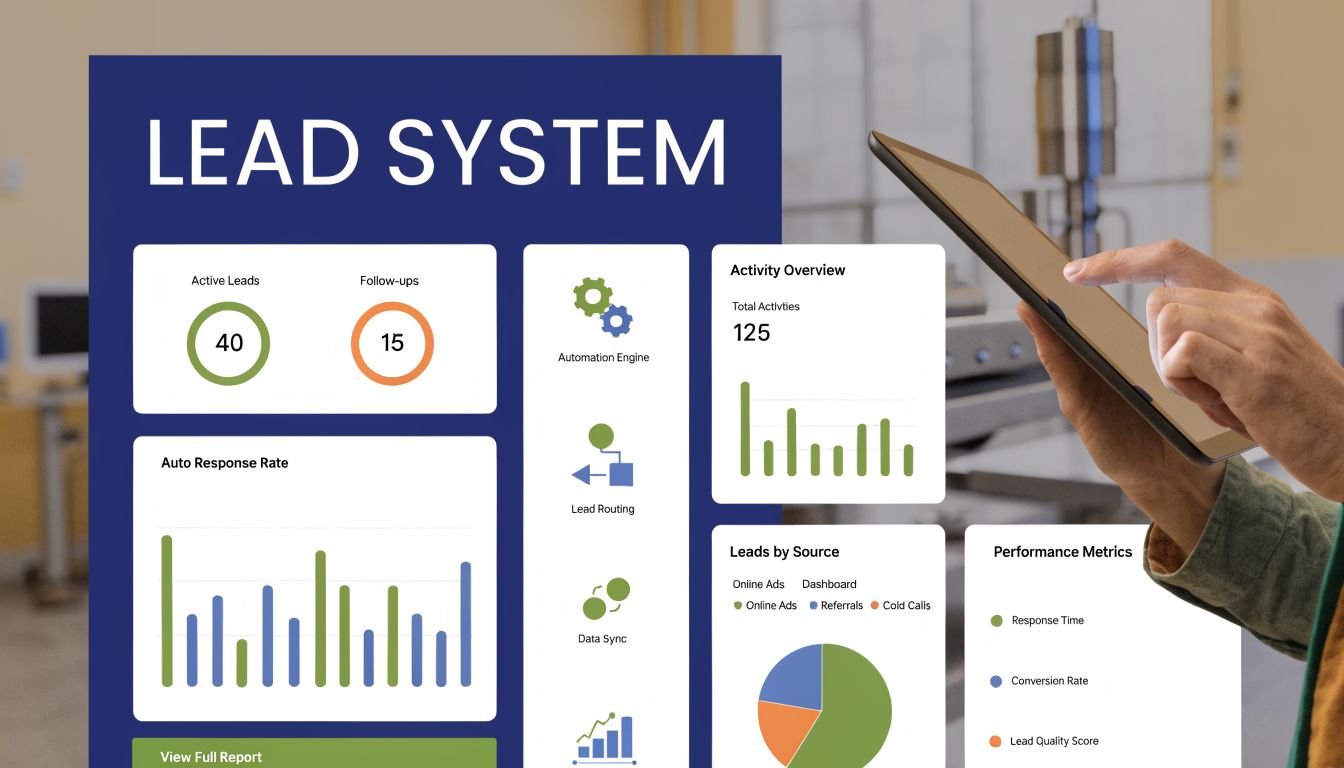
A better approach is to treat every channel as a measured funnel. Social Success Marketing recommends routine reporting on engagement, click-through rate, conversions, impressions, and referral traffic so teams can identify what's working and where the process needs improvement, as described in their article on machine shops and social media reporting.
Why lead handling breaks down
Lead management problems usually come from process, not effort. People are busy. Sales owns some inquiries, estimating owns others, and nobody has one source of truth.
Common failure points include:
- Forms that only send email notifications: Easy to miss, hard to report on.
- No central contact record: One inquiry can start three disconnected conversations.
- No response standard: Some leads get called fast. Others wait.
- No pipeline visibility: You can't improve what nobody tracks.
A CRM solves that only if it's wired into the actual workflow. Otherwise it becomes another half-used tool.
A practical workflow that closes the gap
A simple setup is enough for most shops:
- A buyer submits an RFQ or contact form on the site.
- The system creates a new contact and opportunity in the CRM.
- The buyer gets an immediate confirmation by email or text.
- The right internal person gets assigned a task.
- If no one responds in time, the system escalates.
- The opportunity moves through quoting, follow-up, and closed-lost or closed-won stages.
That kind of automation doesn't replace human follow-up. It protects it.
For email sequences that confirm receipt, send supporting documents, or nudge inactive leads, this email automation guide is a solid reference. Platforms like HubSpot, GoHighLevel, and other CRMs can handle these flows. Machine Marketing also provides support for shops that need help connecting forms, pipelines, and reporting through a practical CRM implementation process.
Fast acknowledgment matters. Even when a quote takes time, buyers want proof that their request entered a real system.
If you're getting leads but not seeing enough revenue impact, the issue may not be traffic. It may be handoff discipline. In industrial marketing, the shops that respond clearly and consistently often look more reliable before they've even cut the first chip.
Your 90-Day Online Presence Execution Roadmap
Most shops don't need a year-long digital transformation project. They need one quarter of focused execution. A good machine shop online presence can start improving quickly when the work is sequenced correctly.
The broader market supports that urgency. The global machine tools market was estimated at USD 97.1 billion in 2024 and is projected to reach USD 196 billion by 2034, according to GM Insights' machine tool market analysis. Buyers increasingly use digital platforms to compare vendors and make decisions, so a stronger online system helps your shop compete for a larger share of that demand.
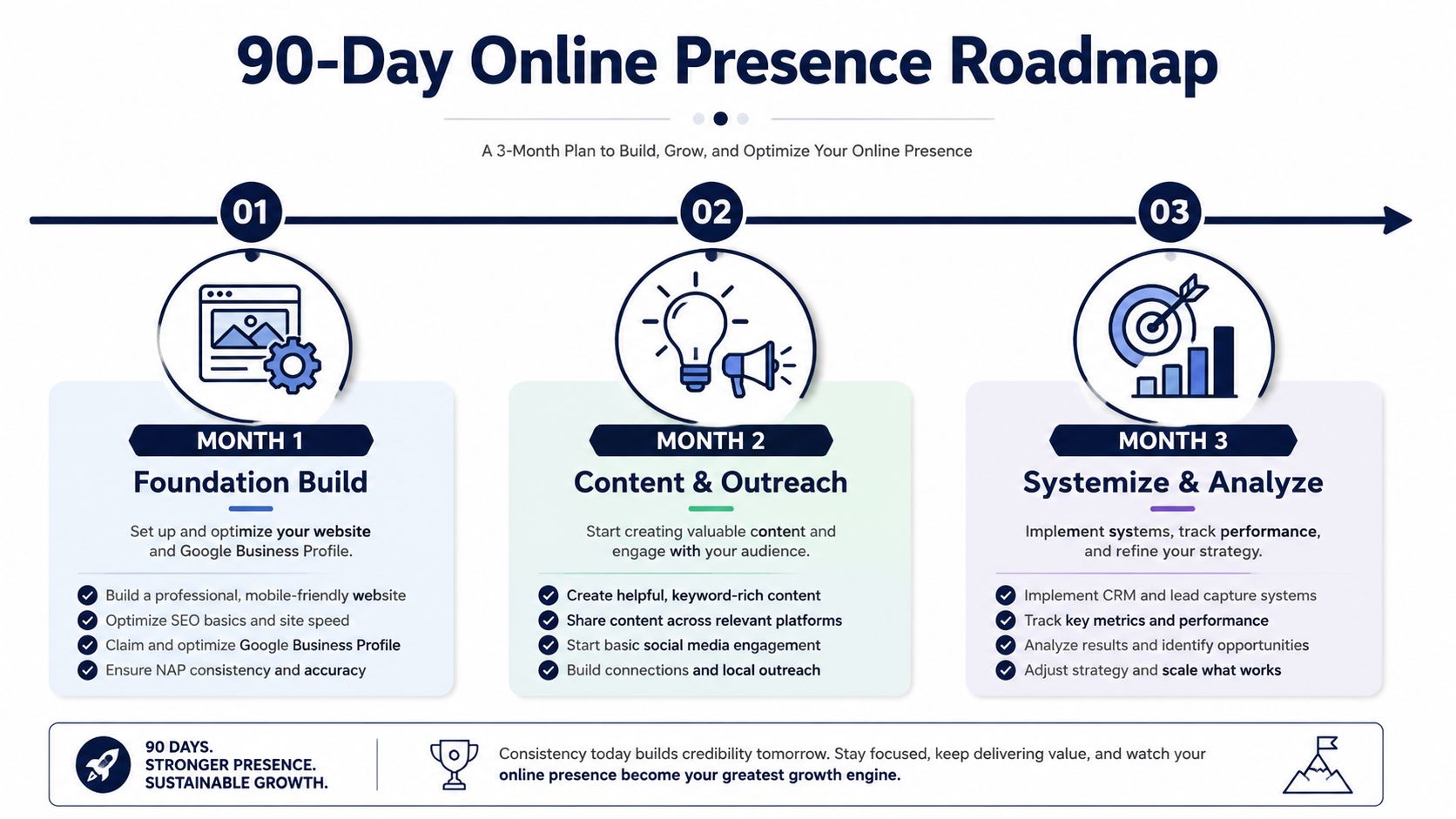
Days 1 through 30
Use the first month to diagnose and fix the foundation. Don't start with content calendars or ad campaigns if the core assets are weak.
Priority work:
- Run the audit: Search visibility, competitor comparison, website clarity, form function, and mobile usability.
- Fix critical website gaps: Broken pages, unclear service descriptions, buried quote actions, weak trust signals.
- Clean up your Google Business Profile: Categories, services, photos, business details, and contact accuracy.
- Define one owner for lead flow: Someone has to own what happens after form submission.
A good outcome for month one is simple. A buyer can find you, understand what you do, and contact you without friction.
Days 31 through 60
Month two is where you start building the engine. This is not the time to create lots of content. Create the right few pieces.
Focus on:
- Two capability-driven content assets: For example, one case study and one process page tied to a high-value service.
- A cleaner RFQ path: Shorten forms and route submissions properly.
- CRM setup: Create pipeline stages, contact records, and internal task ownership.
- Basic automation: Instant confirmation, internal alerts, and follow-up reminders.
If you're short on time, assign content collection to the people closest to the work. Your programmer, estimator, quality lead, or shop manager usually has better raw material than an outside writer starting from zero.
Days 61 through 90
The third month is for measurement and adjustment. You now have enough structure to see where the machine is working and where it's dragging.
Review these questions:
- Which pages are attracting actual inquiry intent
- Which forms or contact paths are producing usable leads
- How fast is the team responding
- What questions still slow down quoting or qualification
- Which content assets help sales conversations move forward
At this stage, establish a simple reporting rhythm. Weekly is useful for operational issues. Monthly is better for trend review.
A workable monthly review can include:
| Area | What to review |
|---|---|
| Visibility | Search appearance, GBP engagement, key landing pages |
| Conversion | Form submissions, calls, quote requests |
| Follow-up | Response consistency, stalled opportunities |
| Content | Which assets support inquiries or sales conversations |
Don't overcomplicate this. The point is to create a repeatable system, not a reporting burden.
By day 90, you should have four things in place: a more credible digital storefront, clearer proof of capability, a tracked lead process, and a management rhythm that supports improvement. That's enough to move from random online activity to a machine that supports sales.
If your shop has the tools and team but your digital system still feels disconnected, Machine Marketing helps manufacturers and machine shops diagnose the gaps, connect website, SEO, CRM, and follow-up, and build a lead generation process that's practical to run.