If you’re a manufacturer, you probably know what a stable system feels like. Inputs are controlled, tolerances are defined, and output is measurable.
Marketing often feels like the opposite. Leads come in waves, trade shows carry too much weight, your website looks respectable but doesn’t produce enough qualified conversations, and sales keeps saying the inquiries aren’t the right fit.
That usually isn’t a talent problem. It’s a systems problem.
Manufacturing digital marketing services work best when you treat marketing the way you treat production. You define the process, instrument the weak points, remove friction, and build feedback loops. The companies that do this well don’t rely on luck. They build a repeatable lead generation system around search visibility, useful content, CRM discipline, and follow-up that occurs.
Why Your Current Marketing Feels Stuck and Unpredictable
Most manufacturers don’t have a marketing activity problem. They have an integration problem.
A common pattern looks like this. The business has a decent reputation, a capable sales team, and strong technical knowledge. But marketing lives in disconnected pieces. The website is one thing. Trade shows are another. Email follow-up depends on who remembers to send it. Sales notes sit in inboxes or spreadsheets. Nobody can see the whole machine.
That’s when marketing starts to feel random. One quarter looks strong because a rep closes an old relationship. The next quarter looks weak because there’s no steady inbound engine underneath the revenue number.
The website often behaves like a brochure
Many manufacturing sites explain who the company is, show a few capabilities, and list contact details. That’s fine for credibility. It’s weak for lead generation.
Buyers don’t just need reassurance. They need help deciding whether you can solve their problem, whether you’ve done similar work, and whether it’s worth contacting you now. If your pages don’t answer those questions, traffic doesn’t turn into pipeline.
Buyers don’t experience your company in departments. They experience one journey. Search result, page visit, form, email reply, sales call.
Wrong traffic creates expensive noise
One of the clearest warning signs is activity without progress. You get traffic, but not useful inquiries. You get form fills, but not serious buyers. You get calls, but they’re for the wrong applications, wrong geographies, or wrong volume.
That problem usually starts upstream. One of the most toxic digital marketing pitfalls for manufacturers is acquiring wrong traffic through misaligned content, and 27% of manufacturing firms cite lack of marketing strategy as their top challenge according to Marketing Engineers on manufacturing marketing pitfalls.
Predictability comes from system design
The fix isn’t “do more marketing.” It’s to build a controlled system.
That system usually includes:
- Search-first discovery: Buyers need to find your capability pages and technical content when they’re researching.
- Clear qualification paths: Forms, calls-to-action, and routing rules should separate serious prospects from general inquiries.
- Consistent follow-up: Every lead should enter a workflow, not a memory test.
- Shared reporting: Sales and marketing need the same view of lead status and pipeline movement.
If your shop floor ran the way many manufacturers run marketing, you’d stop the line and investigate. That same mindset works here.
Diagnosing Your Current Marketing Performance
Before changing channels, agencies, or software, inspect the current system. A useful diagnosis is blunt. It doesn’t ask whether the site “looks good.” It asks whether the system produces qualified opportunities and whether your team can trace results from visit to revenue.
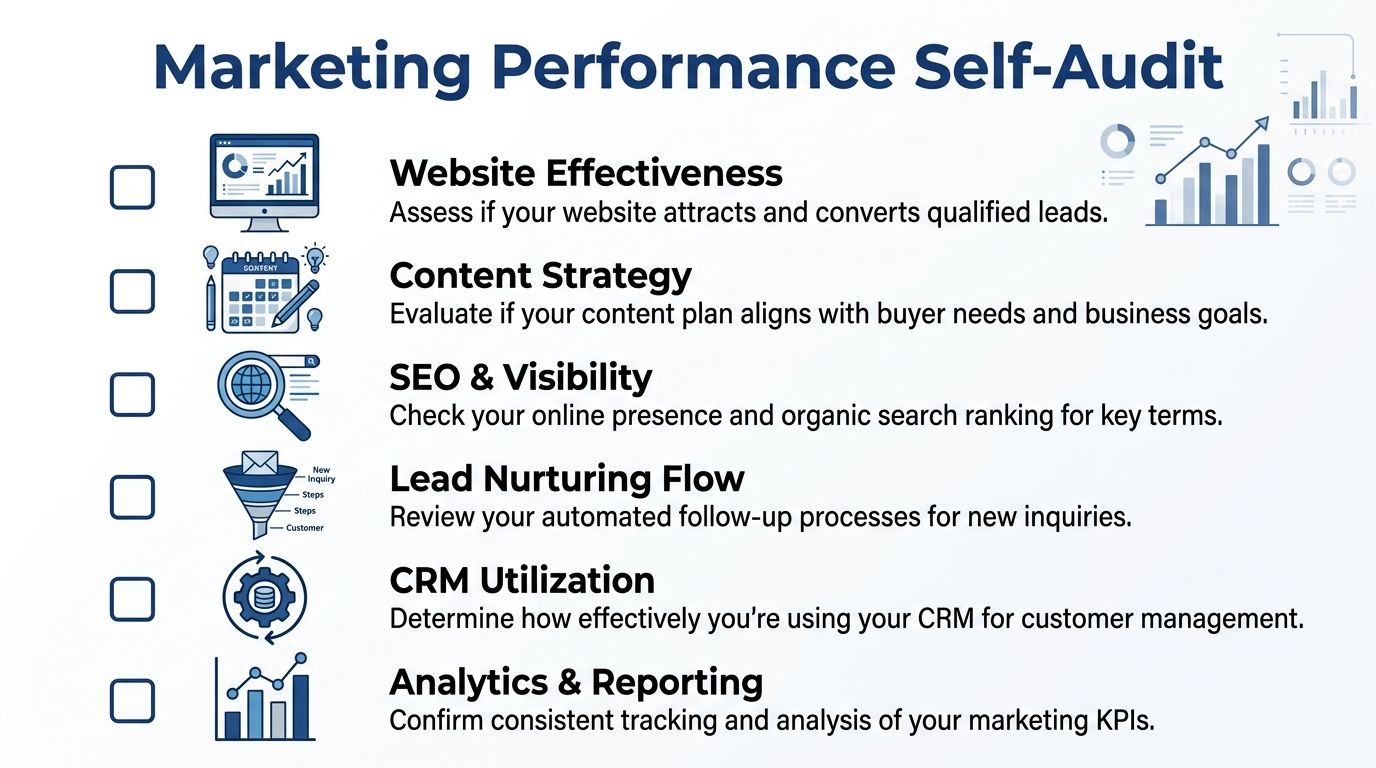
If you want a deeper framework for this process, this guide on what is a marketing audit is a useful starting point.
Audit the website like a sales tool
Start with your core pages. Don’t review them as brand assets. Review them as conversion surfaces.
Ask:
- Capability clarity: Can a buyer tell what you manufacture, for whom, and under what requirements?
- Technical usefulness: Do pages answer real pre-sales questions, or do they stay at the slogan level?
- Proof: Is there evidence of applications, certifications, industries served, tolerances, materials, or process strengths?
- Action path: Does every important page give the visitor a clear next step?
- Form friction: Are you asking for enough information to qualify without making the form painful?
A good manufacturing website lets an engineer, buyer, or procurement lead self-educate. A weak one forces them to contact sales just to understand basics. That creates drop-off.
Check whether search is carrying its weight
Search visibility matters because that’s where buyers begin problem-solving. The gap between average and high-performing manufacturers is large. Fast-growing manufacturers get 65 to 75% of traffic from search engines, while typical firms get 20 to 25%, according to WebFX manufacturing marketing statistics.
That doesn’t mean every company should chase volume. It means your digital presence should capture high-intent searches tied to your real capabilities.
Use this quick diagnostic:
| Area | Healthy signal | Warning sign |
|—|—|
| Core service pages | Pages target specific capabilities and industries | One generic services page tries to rank for everything |
| Search intent | Content matches real buying questions | Blog topics attract curiosity traffic with no commercial fit |
| Internal linking | Capability pages connect to relevant resources | Valuable content sits isolated and can’t support conversion |
| Conversion path | Visitors can request quote, consult, or spec review easily | Traffic lands, reads, and leaves |
Practical rule: If your top pages attract visitors who would never buy from you, the problem isn’t traffic volume. It’s targeting.
Inspect lead capture and follow-up
Many manufacturers lose leads after the click, not before it.
A form submission should trigger a sequence. Someone should get notified. The lead should be tagged by source, product interest, or inquiry type. Sales should know what happened before the call. If none of that is consistent, you don’t have lead management. You have inbox dependency.
Look for these issues:
- No routing logic: Every inquiry goes to one inbox and waits.
- No source tracking: Sales can’t tell if the lead came from search, email, social, or paid.
- No qualification data: The team must ask the same first questions repeatedly.
- No nurture path: Prospects who aren’t sales-ready disappear.
Email often fails without immediate notice. Messages are sent, but they don’t reliably land. If you suspect deliverability problems, a free email deliverability and spam checker can help you identify whether your domain reputation or message setup needs attention before you scale outreach.
Review your content library for buyer fit
A lot of manufacturing content is technically correct and commercially weak.
That happens when content explains features but doesn’t connect those features to buyer problems, evaluation criteria, or project risk. The result is information without movement.
Use these questions:
- Does content answer sales questions your team gets every week?
- Does it reflect different stakeholders, such as engineers, procurement, and decision-makers?
- Does each asset support a specific stage of the buying journey?
- Can sales use it in follow-up?
Questions to ask your team this week
- What pages generate the most inquiries?
- Which inquiries turn into real opportunities?
- Where does sales complain about lead quality?
- Which questions do prospects ask repeatedly before quoting?
- What happens in the first day after a form fill?
If those answers are vague, the diagnosis is already useful. It means your next move isn’t more activity. It’s instrumentation.
The Two Paths to Execution In-House versus Agency
Once the diagnosis is clear, the execution question gets simpler. Who’s going to run the system every week?
There are two valid paths. Build internally, or partner externally. The mistake is treating this as a branding preference instead of an operating model decision.
Why the decision matters more now
Manufacturers are already shifting budget toward digital. By 2022 to 2023, 55% of manufacturing marketing budgets were allocated to digital, with an average annual 11% increase in digital spending, according to Straight North’s manufacturer marketing survey.
That level of investment needs ownership. Software alone won’t create execution discipline. Someone has to manage campaigns, content, reporting, CRM workflows, and sales handoff.
When in-house makes sense
An internal team is usually the better fit when your company already has strong marketing leadership, enough budget to support multiple skill sets, and the patience to build process over time.
The upside is control. Your team gains direct access to product experts, sales feedback, and internal priorities. That’s useful when your products are complex and your differentiators are technical.
The trade-off is breadth. One hire rarely covers strategy, SEO, writing, CRM automation, reporting, paid media, design, and web operations at a high level.
Here’s where in-house works well:
- You already have a leader: Someone can set priorities and hold the system together.
- Your product team is available: Marketing can regularly extract useful technical insight.
- You’re committed to process: Documentation, review cycles, and accountability exist.
- You can absorb ramp time: Hiring, onboarding, and training won’t stall growth plans.
When an agency model is stronger
An outside partner is often better when speed matters, internal bandwidth is thin, or your business needs a wider range of skills than one team can realistically carry.
The main benefit is cross-functional execution. A good agency brings operators who already know how to structure campaigns, reporting, and automation without spending months figuring out basics.
That doesn’t mean outsourcing everything blindly. It means buying a system and the people who can run it.
A strong external team should reduce management load, not create another vendor to chase.
Side-by-side decision criteria
| Decision factor | In-house team | Agency partner |
|—|—|
| Speed to launch | Slower at first because hiring and setup take time | Faster if the partner has proven workflows |
| Product knowledge | Usually deeper | Needs onboarding and access to experts |
| Skill coverage | Often narrow unless you build a full team | Usually broader across channels and systems |
| Daily control | High | Shared through process and reporting |
| Accountability | Depends on internal management discipline | Depends on scope clarity and review cadence |
What usually fails in both models
The same issues show up whether the work sits inside or outside the company.
- No owner: Tasks happen, but nobody owns outcomes.
- No SLA between sales and marketing: Leads are generated, but follow-up quality varies.
- No weekly review: The team waits too long to spot friction.
- No documented workflow: Execution depends on individual memory.
A manufacturer should choose based on operational fit, not ego. If your team can build and manage the engine internally, do it. If not, use external support to gain speed and discipline. The wrong choice isn’t agency or in-house. The wrong choice is under-resourcing a system that already carries a growing share of your budget.
Building Your 90-Day Proof-of-Concept Plan
A full marketing rebuild sounds expensive because people imagine doing everything at once. That’s not how a useful proof of concept works.
The better approach is to run one disciplined quarter. Pick a narrow scope, instrument it properly, and prove that the system can generate cleaner data, better lead handling, and stronger sales conversations.

A lot of manufacturers don’t need more tactics. They need fewer moving parts and better execution. That matters because some digital efforts produce only 6.5 marketing qualified leads per month on average, while a structured 90-day plan built around an integrated CRM like GoHighLevel can improve performance by closing execution gaps, as discussed by MarketVeep in its manufacturing digital marketing services guide.
Days 1 to 30 on foundation and control
The first month is about setup. Not flashy work. Important work.
Start by selecting one growth target. That might be a single capability, one product line, one market segment, or one reactivation list. Keep scope tight so your team can see cause and effect clearly.
During this phase, focus on:
- Offer definition: Decide what action you want prospects to take. Request a quote, book a technical call, download a spec sheet, or reply to a reactivation email.
- Pipeline design: Build stages that reflect your real sales process, not generic CRM labels.
- Tracking plan: Define what counts as a lead, what counts as qualified, and who updates status.
- Messaging cleanup: Rewrite pages and emails around buyer problems, not just features.
A practical move here is to map every step from first visit to sales conversation on one page. If the process looks fuzzy on paper, its performance will suffer in practice.
Days 31 to 60 on activation
Month two is launch time. Pick one campaign type and run it properly.
For some manufacturers, that means optimizing a high-intent capability page and attaching a better form and follow-up flow. For others, it means reactivating dormant contacts with segmented email outreach. If email is part of the plan, this resource on B2B email marketing best practices is worth using before you write sequences that feel generic or pushy.
This is also where one-to-one relevance matters. A buyer asking about a machine rebuild should not receive the same follow-up as someone requesting support for a new line. This idea is easier to apply when your campaigns are shaped around one-to-one marketing rather than one-message-for-everyone broadcasting.
Good activation choices
- Revise one key service page: Add qualification copy, technical detail, proof, and a stronger CTA.
- Launch a lead reactivation sequence: Reach past contacts with a reason to respond now.
- Build one downloadable asset: Use it to support a focused page and an email follow-up flow.
- Run narrow paid search: Only if the landing page and CRM path are already in shape.
Bad activation choices
- Launching five channels at once
- Publishing content with no linked conversion path
- Starting ads before sales routing is fixed
- Using one generic contact form for every inquiry type
Early wins usually come from reducing friction, not increasing complexity.
A short walkthrough can also help teams understand what a staged implementation looks like in practice.
Days 61 to 90 on proof and iteration
The last month is where many teams get impatient. They want scale before they’ve built evidence.
Use this period to inspect the system. Which traffic sources are producing qualified conversations? Which emails get replies? Where do leads stall? Which pages attract interest but fail to convert?
Create a simple review structure:
| Review area | What to inspect |
|---|---|
| Lead quality | Are the inquiries aligned with your target buyer and actual capabilities? |
| Speed to response | How fast does sales follow up, and does that timing vary by source? |
| Pipeline movement | Which leads advance, stall, or disappear? |
| Message fit | What objections or questions appear repeatedly? |
Then make small, surgical changes. Adjust forms. Rewrite subject lines. Improve page copy. Tighten routing. Add tags. Remove unnecessary steps.
What a successful proof of concept proves
A good quarter doesn’t need to prove that every channel works. It needs to prove that your company can run a marketing system with discipline.
That means:
- Leads are captured consistently.
- Follow-up is documented.
- Sales and marketing use the same definitions.
- Reporting shows where opportunities come from.
- Next-quarter decisions rely on evidence instead of opinion.
That’s enough to earn internal trust and justify broader investment.
The GoHighLevel and CRM Integration Checklist
Your CRM should behave like an operations hub, not a storage closet. If it only holds contact records, it’s underbuilt.
For manufacturers, a platform like GoHighLevel becomes useful when it connects website activity, lead qualification, follow-up, and sales stages in one visible system. That visibility matters because 64% of manufacturers struggle to prove marketing ROI, and 53% can’t connect content efforts to business goals, according to NPWS on manufacturing marketing challenges.

If you’re comparing systems or planning implementation, this guide to CRM for manufacturing companies gives useful context around fit and workflow design.
The practical setup checklist
Use this as a working checklist, not a feature wishlist.
- Import and clean contacts: Remove duplicates, standardize fields, and separate customers, open opportunities, cold prospects, and inactive records.
- Tag by business relevance: Use tags for product interest, market, source, and lifecycle stage so future segmentation is easy.
- Build a visual pipeline: Match stages to your real sales motion, such as inquiry, qualified, quoting, technical review, and closed.
- Create smart forms: Capture useful qualification details upfront so sales doesn’t start every call from zero.
- Assign ownership rules: Every new lead should have a clear owner and response expectation.
- Set up immediate acknowledgments: Prospects should know their inquiry was received and what happens next.
- Automate basic nurture: Follow up when a lead downloads content, requests information, or goes quiet.
- Track source data: Preserve whether the lead came from search, email, social, direct outreach, or paid traffic.
- Standardize notes and outcomes: Reps should log disposition in a consistent way so reporting means something.
- Build dashboard views: Leadership needs a quick read on lead volume, stage movement, and stuck deals.
Outcome first, feature second
A CRM setup fails when teams obsess over menus and forget business outcomes.
Here’s the better lens:
| CRM task | Business outcome |
|---|---|
| Contact tagging | Better segmentation and cleaner follow-up |
| Pipeline stages | Shared visibility between sales and marketing |
| Smart forms | Faster qualification and fewer repetitive calls |
| Automation | Less lead leakage |
| Dashboards | Clearer ROI discussions |
Field note: If your sales team won’t update the CRM, the setup is too complicated or the value isn’t obvious enough.
What to avoid during implementation
Some mistakes show up repeatedly:
- Overbuilding early: Too many workflows create confusion and break trust.
- Using generic stages: Manufacturing deals often need stages that reflect technical review and quoting reality.
- Ignoring old contacts: Past lists are often one of the fastest places to test re-engagement.
- Separating marketing from sales usage: The CRM has to support both teams, not one side only.
A good GoHighLevel implementation isn’t about having more automation. It’s about making sure no inquiry disappears, no sales rep has to guess what happened before the call, and no reporting meeting turns into opinion versus opinion.
Measuring What Matters and Scaling Your System
Manufacturers don’t need more dashboards. They need fewer metrics with stronger operational meaning.
The simplest way to keep a marketing system honest is to ask one question repeatedly. Does this metric help us improve lead quality, sales efficiency, or revenue visibility? If the answer is no, it’s probably noise.
Stop chasing vanity metrics
Website sessions, impressions, and clicks can be useful diagnostic signals. They are not enough for decision-making on their own.
A manufacturer should care more about whether the right accounts are entering the pipeline, whether sales can work them effectively, and whether the system is shortening or slowing the path to real opportunity.
Useful measurement usually centers on:
- Lead quality: Are inquiries aligned with your target industries, applications, and buying profile?
- MQL to SQL movement: Are marketing leads becoming sales-accepted opportunities?
- Pipeline velocity: How quickly do qualified opportunities move through stages?
- Customer acquisition cost: What does it take to generate and convert a customer through the system?
Build one source of truth
CRM discipline pays dividends here. When forms, tags, pipeline stages, and lead sources are configured consistently, your dashboard becomes an operating panel.
It should help you answer practical questions fast:
- Which campaigns generate qualified opportunities?
- Which pages or offers create weak-fit leads?
- Where does follow-up stall?
- Which sales stages are clogged?
- Which channels deserve more budget next quarter?
If leadership reviews one report and sales uses another spreadsheet, scaling gets political. One shared system prevents that.
Use a review rhythm that forces decisions
A reporting process should produce actions, not observations.
A useful cadence often looks like this:
| Review timing | Main question |
|---|---|
| Weekly | Where is lead handling breaking down right now? |
| Monthly | Which channels and offers are producing qualified pipeline? |
| Quarterly | What should we scale, stop, or redesign? |
This structure keeps teams from waiting too long to fix avoidable issues. It also prevents overreacting to one good week or one bad campaign.
The best dashboard is the one your team uses to make changes this week.
Scale what’s working, not what’s fashionable
Once the first system is stable, scaling gets easier because you aren’t guessing where to invest.
Expansion usually happens in layers:
- Deepen existing winners: Improve the pages, emails, and workflows already producing good-fit leads.
- Add adjacent content: Build resources for related applications, industries, or technical questions.
- Introduce paid search carefully: Use it to support proven conversion paths rather than compensate for weak pages.
- Expand automation: Add nurture sequences and re-engagement logic where manual follow-up is slipping.
- Tighten the sales loop: Feed objections, close reasons, and quote outcomes back into content and qualification.
That last point matters more than many expect. Manufacturing marketing improves fastest when sales feedback shapes the next revision cycle. If sales says leads are unqualified, ask why in operational terms. Wrong industry. Wrong size. Wrong urgency. Wrong spec requirement. Those answers should change targeting, forms, and messaging.
What scaling should feel like
It shouldn’t feel chaotic. It should feel more controlled over time.
You know the system is maturing when:
- Sales trusts the lead flow more.
- Marketing can explain where opportunities come from.
- Leadership can make budget calls without arguing over basic data.
- The website acts like part of the sales process, not a static brochure.
- Follow-up happens because the system triggers it, not because someone remembered.
That’s the true value of manufacturing digital marketing services when they’re built properly. Not more content. Not more tools. A more reliable commercial system.
If your marketing feels disconnected, unpredictable, or hard to measure, Machine Marketing can help you diagnose the gaps and build a practical system around CRM, messaging, website performance, and lead follow-up. If you want a grounded second opinion and a clearer path forward, start with Machine Marketing.