Choose a plan that can survive the shop floor
You already have marketing activity. The website exists. Sales reps are quoting. Someone posts on LinkedIn when there's time. Trade shows get booked. Email campaigns go out in bursts. But there's still no shared system that answers the hard questions: who you're targeting, what you need to say to different buyers, where those buyers research, how much budget belongs in each channel, and which KPIs matter after the lead form comes in.
That's a gap a manufacturing marketing plan template should close. The best one usually isn't the prettiest download. It's the one your team can adapt, assign, review, and connect to quoting, CRM stages, and sales follow-up without it becoming shelfware. That matters even more in manufacturing, where buyers often decide early and consume multiple pieces of content before contacting sales. Thomas reports that 57% of industrial buyers make purchase decisions before interacting directly with a manufacturing company, and 40% of B2B buyers consume three to five pieces of content before reaching out.
This comparison ranks resources by the planning problem they solve, not by design polish alone. We'll also show how to adapt each one for machine shops, technical suppliers, distributors, and longer industrial sales cycles. If your next step is account selection and coordinated outreach, this ABM playbook for B2B manufacturing is a useful companion.
At Machine Marketing, we help manufacturers diagnose the disconnect between tools, teams, and pipeline goals, then turn that into a measurable strategy. The list starts there.
Table of Contents
- 1. Visme – B2B Manufacturing Company Marketing Strategy Plan Template
- 2. MarketVeep – Step-by-Step Marketing Plan Template for Manufacturers
- 3. OneIMS – Marketing Plan for Manufacturing Company
- 4. Lillian Group Marketing – How to Create a Manufacturing Marketing Plan
- 5. Gushwork – Manufacturing Marketing Plan Template
- 6. Thomas – Marketing Campaign Launch Planner
- 7. Template.net – Manufacturing Business Marketing Plan
- 8. Chemical Tech Review – Marketing Plan Template for Manufacturing Suppliers
- 9. B2B Marketing World – B2B Marketing Plan Template
- 10. LinkedIn – The Comprehensive Playbook for Creating a B2B Marketing Plan
- Top 10 Manufacturing Marketing Plan Templates Comparison
- Turn the Template Into a Working System
1. Visme – B2B Manufacturing Company Marketing Strategy Plan Template
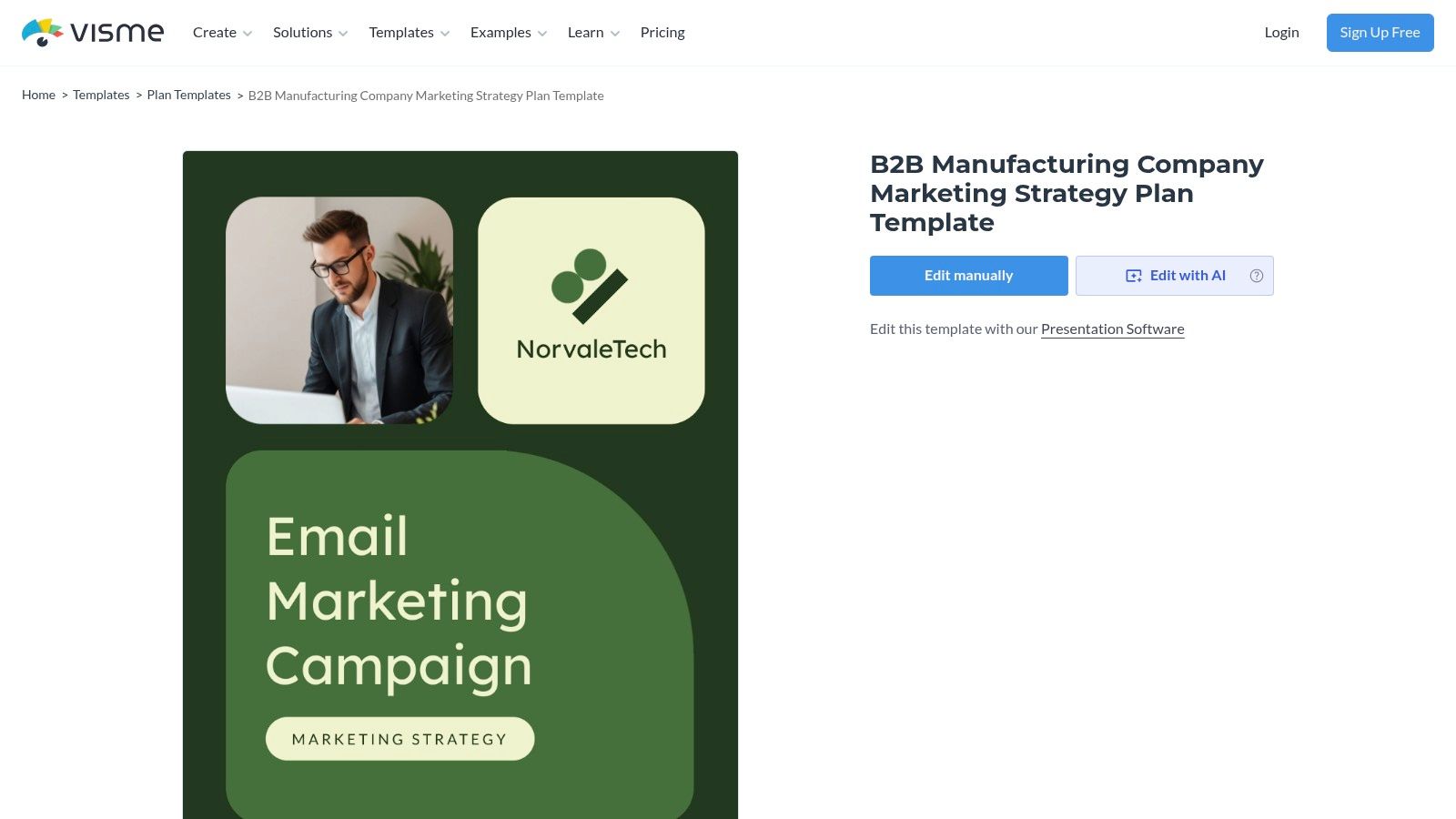
A common planning failure in manufacturing happens after the strategy is already written. Marketing has a channel plan, sales has account priorities, leadership wants budget confidence, and none of it lives in one document people will review. Visme solves that presentation and alignment problem better than it solves execution.
The template itself is built for strategy communication. It covers objectives, target audience, channels, KPIs, and timeline in a format that leadership can review without digging through a spreadsheet or project board. The editor, brand controls, collaboration features, and PDF or PowerPoint export also make it practical for annual planning decks and budget conversations. You can review it on Visme's manufacturing strategy plan page.
What problem this template actually solves
Use Visme when the main blocker is getting agreement on direction. It works well for manufacturers that already have partial planning inputs but need to organize them into one strategy document that sales leaders, owners, and marketing managers can discuss in the same meeting.
That strength creates a trade-off.
A polished template can hide weak planning. If the team has not defined buyer segments, sales stages, budget split, or what counts as a qualified opportunity, the final document may still look finished. That makes Visme a good front-end planning tool, but a weak stand-alone system for campaign management or reporting discipline.
- Best fit: Leadership review, annual strategy approval, budget planning, sales and marketing alignment meetings
- Less useful for: Campaign buildouts, CRM workflows, task ownership, handoff rules, and weekly KPI tracking
- Best way to use it: Keep Visme as the strategy layer and maintain a separate operating plan for owners, due dates, channel budgets, and reporting cadence
For machine shops, simplify the template around revenue-driving realities. Define the job types worth pursuing, target industries, quoting bottlenecks, geographic limits, and proof points such as tolerances, lead times, certifications, and material experience. A shop chasing prototype work needs a different message and channel mix than one focused on repeat production runs.
For technical suppliers, the adaptation should center on specification influence and long sales cycles. Add buyer roles such as engineering, procurement, and operations. Map content to each stage, from problem education to supplier validation. Distributors need another layer. Territory coverage, line card priorities, co-op marketing constraints, and channel conflict rules should be visible in the plan, or the strategy will drift once field sales starts using it.
If the team still needs to define the operating pieces behind the deck, this guide to the core components of a marketing plan is a better starting point before design work begins.
Use Visme to make strategy readable and reviewable. Do not use it as a substitute for the working system that connects campaigns, CRM stages, quoting activity, and sales follow-up.
2. MarketVeep – Step-by-Step Marketing Plan Template for Manufacturers
A common planning failure in manufacturing happens before any campaign launches. Sales wants better leads, leadership wants revenue forecasts, and marketing is stuck staring at a blank page with no order for building the plan. MarketVeep solves that specific problem well.
The MarketVeep step-by-step manufacturing marketing plan guide is less useful as a polished executive document and more useful as a planning sequence. It walks teams through goals, audience definition, positioning, channel choices, content, and measurement in an order that helps smaller teams make decisions without overbuilding the process too early.
That makes it a practical starting point for manufacturers that are still standardizing how marketing and sales plan together.
Best fit: teams that need planning order, not presentation polish
MarketVeep works best when the issue is process discipline. If the team has good product knowledge but weak planning habits, this format gives enough structure to move from scattered ideas to a usable plan. If the company already runs annual planning, campaign budgets, CRM reporting, and sales feedback loops with consistency, the guide will feel light.
That trade-off matters. A lighter template gets finished. A heavier one often sits half-complete.
The other advantage is sales alignment. Industrial buying rarely runs through a single contact, so a manufacturing plan built around one audience usually breaks down in execution. MarketVeep pushes teams to define customer profiles and messaging early, which is the right move for manufacturers selling into engineering, procurement, operations, and leadership at the same account.
How to adapt it by manufacturing model
Use the guide as a decision framework, then tune each section to the sales motion.
For machine shops, tighten the audience section around quoting realities. Start with part type, tolerance demands, material experience, order volume, and lead-time expectations. Then build messaging around the factors that win RFQs, such as repeatability, responsiveness, inspection capability, and whether the shop is better suited for prototype work or repeat production.
For technical suppliers, the main planning problem is usually message mismatch across stakeholders. Engineers care about performance and fit. Procurement cares about supply continuity, pricing, and risk. Operations cares about implementation and support. The MarketVeep structure gives enough room to separate those messages, but teams need to add that detail themselves.
For distributors, the template needs another layer tied to channel constraints. Territory rules, line card priorities, supplier co-marketing obligations, and brand compliance should sit inside the channel and campaign sections. If those limits stay informal, marketing ends up generating interest that field sales cannot pursue cleanly.
For long-cycle industrial sales, expand the content and measurement sections. Pre-RFQ education, evaluation-stage proof, quote follow-up, and post-quote nurturing should be planned as separate motions with different KPIs. A basic lead target is not enough when opportunities can stall for months between first inquiry and purchase decision.
MarketVeep is a good working draft tool for manufacturers building planning muscle. It is not the strongest option for teams that already need detailed budget controls, ownership tracking, or quarterly performance management. For that group, the value is in using this resource to clarify the plan logic first, then moving the approved strategy into a more operational system.
3. OneIMS – Marketing Plan for Manufacturing Company
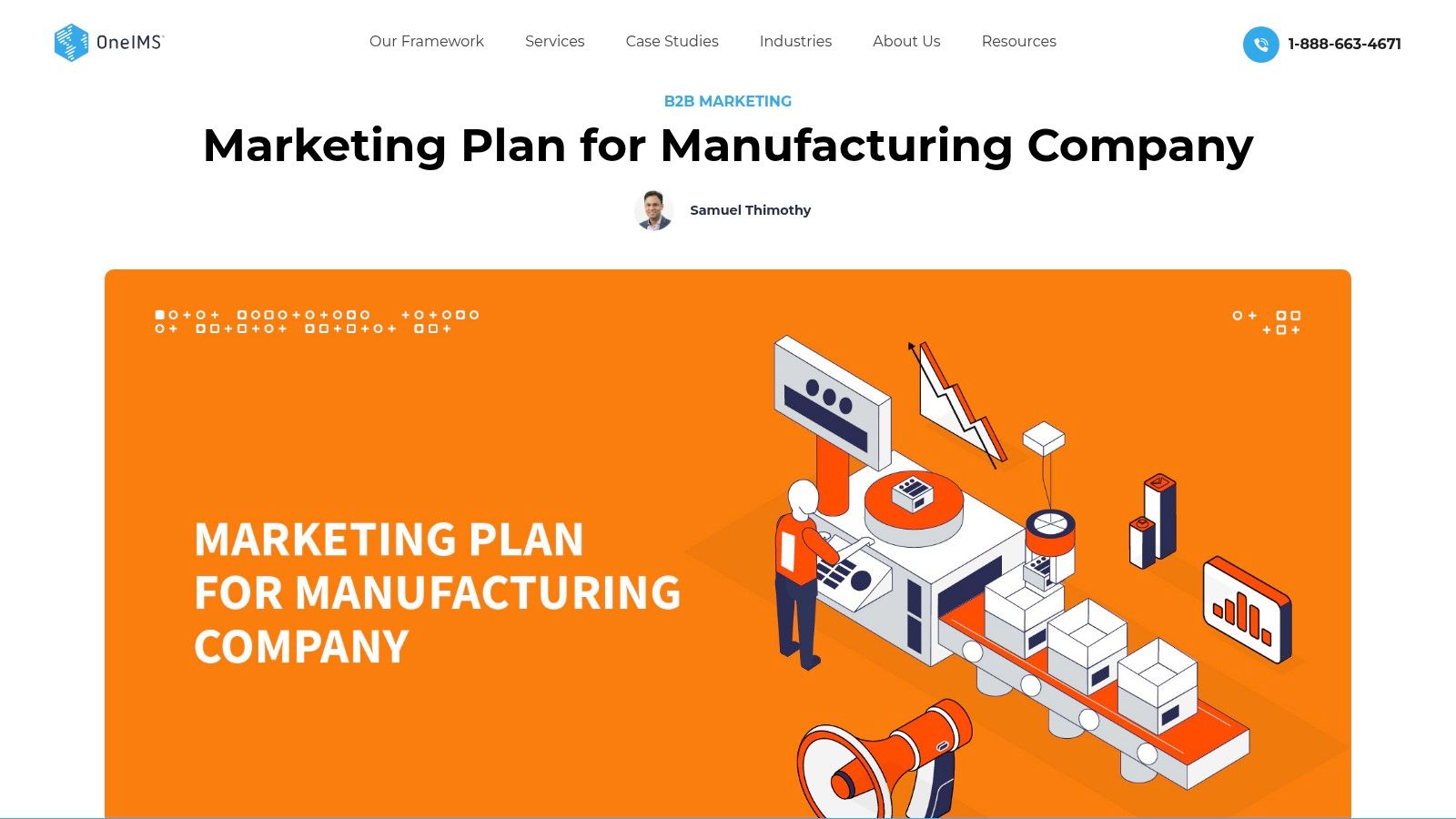
A common manufacturing planning problem shows up in Q2 or Q3. The team has campaigns in market, sales wants better leads, and leadership asks which channels are producing quote opportunities. If the plan cannot connect traffic, inquiries, sales follow-up, and pipeline stages, quarterly reviews turn into opinion fights.
OneIMS manufacturing marketing plan template and guide is useful for that specific gap. It gives more structure than a basic worksheet, but it does not force teams into a heavyweight planning process. The value is in turning scattered channel activity into a repeatable operating plan with goals, personas, tactics, and funnel checkpoints tied to sales activity.
The trade-off is clear. OneIMS is stronger on execution rhythm than on financial control. Teams that need detailed budget governance by business unit, territory, or product line will still need a separate reporting layer. Teams that mainly need better quarterly planning discipline can get a lot from it.
What stands out is the sales alignment angle. The template pushes planning closer to how industrial revenue moves. A website form fill rarely matters on its own. What matters is whether that inquiry fits an account list, gets routed fast, reaches the right rep, and progresses toward a quote or technical review.
That makes this resource a better fit for manufacturers with active digital programs than for firms still building basic market positioning.
A practical way to use OneIMS is to pressure-test four areas before the plan gets approved:
Lead stage definitions
Define what counts as an inquiry, marketing qualified lead, sales accepted lead, quoted opportunity, and active deal. If these labels stay loose, KPI reporting will overstate marketing performance and understate handoff problems.Channel purpose
Assign one job to each channel. SEO should capture high-intent searches around capabilities, tolerances, materials, or certifications. Email should support stalled opportunities, existing accounts, or distributor communication. Paid search should target terms that can produce quote activity, not just traffic.Ownership and response time
Name the owner for campaign setup, landing page updates, CRM routing, and follow-up. Many manufacturing teams do not have a traffic problem. They have a response-time problem.Quarterly change triggers
Set rules for what changes the plan. Quote volume drops. One vertical slows down. A product line starts attracting poor-fit inquiries. Without trigger points, quarterly planning becomes retrospective commentary instead of active management.
The adaptation work matters by business model.
Machine shops should simplify the template and build around quoting friction. Focus the plan on priority services, industries served, RFQ entry points, turnaround expectations, and post-quote follow-up. A broad channel mix usually matters less than a clear path from capability search to quote request.
Technical suppliers can use the OneIMS structure to separate messaging by buying role and product family. That is where the template earns its keep. Engineers need performance and application detail. Procurement needs continuity, lead times, and risk reduction. Sales needs content that helps move spec discussions into commercial conversations.
Distributors need another layer that OneIMS does not fully provide out of the box. Add supplier brand rules, co-op funding constraints, line card priorities, and territory boundaries to the channel plan. Otherwise marketing can generate demand that the field team cannot pursue cleanly.
For long industrial sales cycles, expand the funnel section beyond lead counts. Track pre-RFQ education, spec-stage engagement, quote follow-up, and reactivation of stalled opportunities. If the plan stops at form conversions, it will miss the parts of the cycle where industrial deals usually slow down.
OneIMS is a good choice for teams that already have baseline marketing activity and need a tighter planning cadence. It solves the problem of disconnected execution better than the problem of top-level strategy creation. If your issue is channel sprawl, unclear ownership, or weak sales handoffs, this template is worth using. If your issue is foundational positioning or annual budget architecture, it will need support from a broader planning process.
4. Lillian Group Marketing – How to Create a Manufacturing Marketing Plan
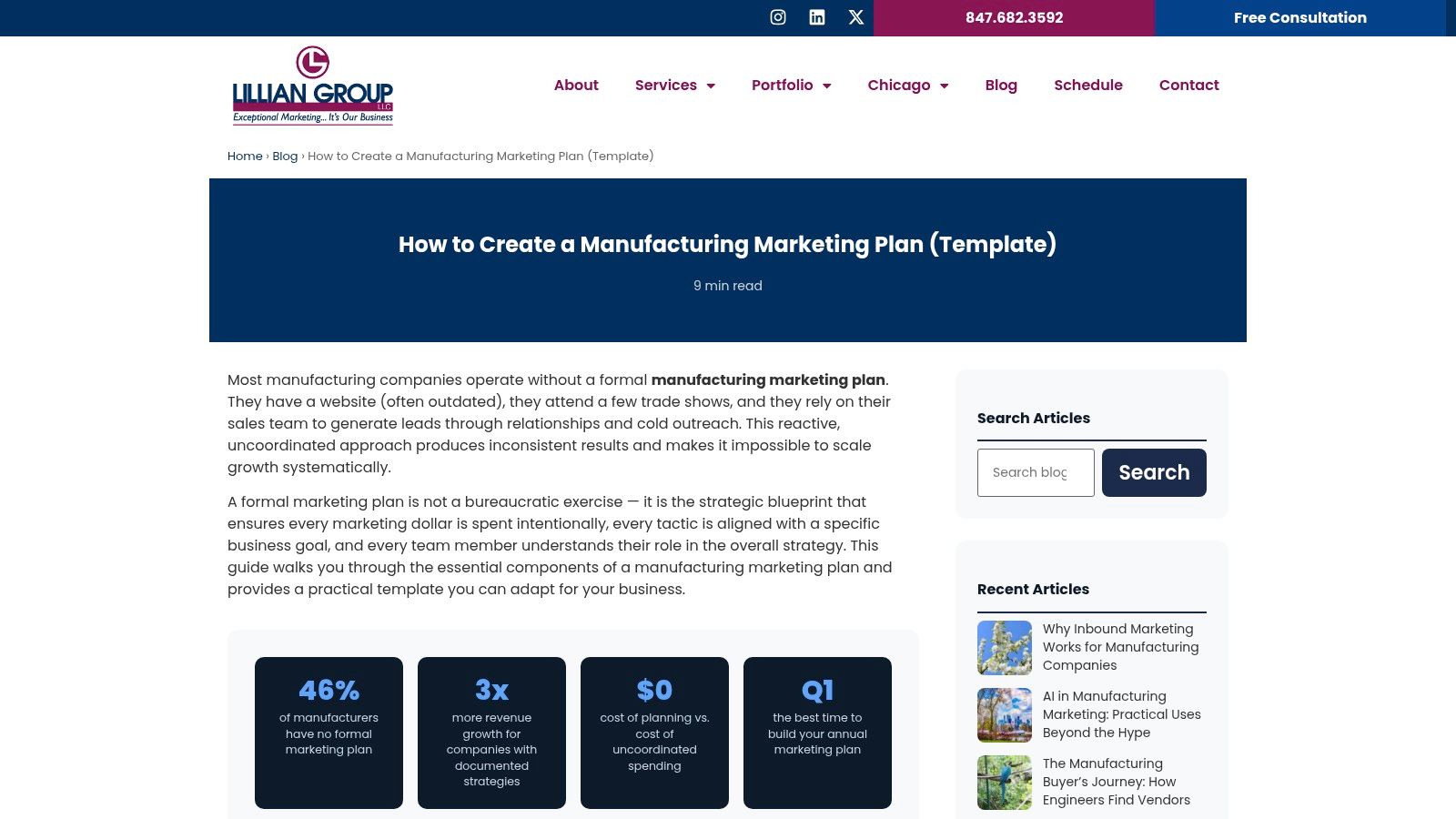
A common planning problem in manufacturing looks like this. Sales wants more qualified opportunities, leadership wants a budget they can defend, and marketing is stuck with a generic template that never accounted for rep relationships, technical content, or long quote cycles.
Lillian Group Marketing's manufacturing plan template article is useful because it solves that problem at the planning level. It gives smaller industrial teams a plain-language structure for objectives, ideal customer profiles, positioning, content, and budgeting without forcing them into a software workflow.
Best for straightforward planning teams
This resource fits manufacturers that need alignment before they need reporting sophistication. Job shops, custom fabricators, and smaller industrial suppliers can get a workable annual plan in place without translating startup language for engineering, operations, and sales.
Its main strength is usability. The format is simple enough for cross-functional review, which matters when the blocker is not channel knowledge but agreement on who the target accounts are, what problems the company solves, and which messages support quote-worthy opportunities.
The budget section is most useful when you adapt it by channel role. Split spending into relationship channels, credibility channels, and demand-capture channels. That gives manufacturing teams a cleaner way to decide whether the next dollar should support distributor relationships, technical proof, or high-intent lead flow.
That structure adapts well across industrial models:
Machine shops: Put local associations, rep support, and customer visits under relationship channels. Put capability pages, tolerancing examples, and process case studies under credibility. Put process-specific paid search under demand capture.
Technical suppliers: Assign relationship spend to distributors, OEM contacts, and trade events. Assign credibility spend to application notes, certifications, and engineering content. Assign demand capture spend to product-line search terms and quote-request paths.
Distributors: Add supplier priorities, co-op limits, and territory rules before finalizing channel budgets. Otherwise the plan can favor demand that the field team or vendor partner cannot support cleanly.
Good use case: Annual planning for a smaller industrial team that needs one document sales and leadership will both use.
Weak spot: It does not give much built-in help for KPI formatting, reporting cadence, or executive summary pages.
Smart adaptation: Add a final page that ties each channel to one owner, one budget line, one KPI, and one sales follow-up action.
For long industrial sales cycles, add stage-based KPIs before the plan goes live. Track target-account engagement, engineering-content consumption, quote requests, quote follow-up, and reactivation of stalled deals. Lillian Group provides a practical planning base. Teams with layered distribution, complex attribution, or monthly leadership reporting will still need to build the operating system around it.
5. Gushwork – Manufacturing Marketing Plan Template
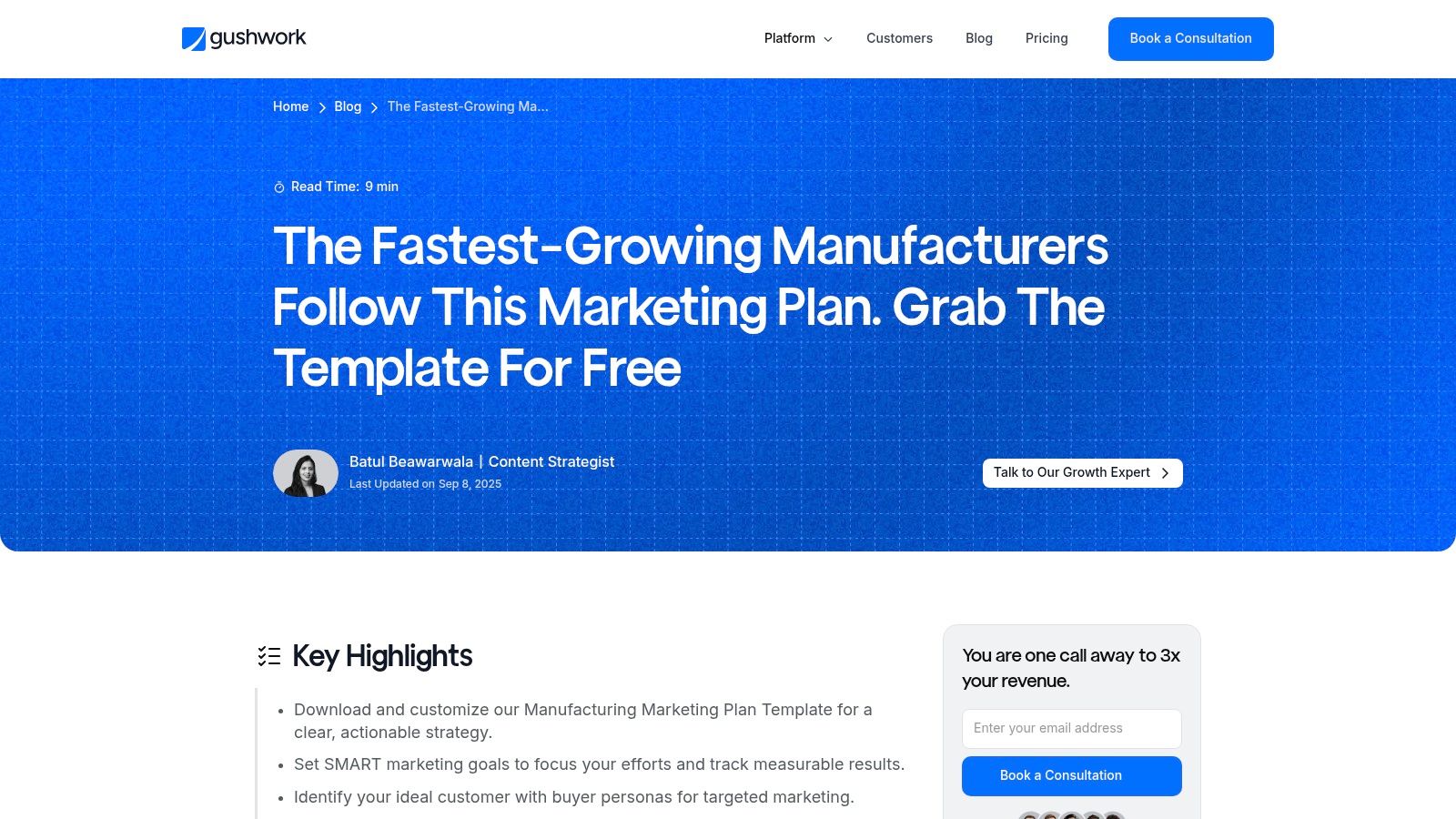
Monday starts with a familiar problem. Sales wants better leads, leadership wants a plan, and marketing has scattered notes, a few campaign ideas, and no shared structure. The Gushwork manufacturing marketing plan template fits that situation well because it gets a draft on paper fast.
Its value is speed, not depth.
The template covers goals, personas, channel tactics, content prompts, and basic KPIs. That makes it useful for a planning sprint where the job is forcing decisions about target audiences, messages, and first-priority channels. Teams that have been operating request by request usually need that discipline before they need a more detailed annual model.
The trade-off is clear. Gushwork will not solve messy route-to-market questions on its own. If the business sells through reps, distributors, direct sales, and existing house accounts at the same time, the template needs extra layers for ownership, budget control, and sales follow-up.
A practical test helps here. If the main planning problem is "we need one place to organize what we are trying to sell, to whom, and through which channels," Gushwork is a good fit. If the problem is "we need to reconcile channel budgets across territories, product lines, and partner influence," it is too light by itself.
Here is where it fits best by manufacturing model:
- Machine shops: Use it to narrow the plan around the work you want more of, such as repeat production, prototyping, or higher-margin specialty jobs. Add a column for process capability, minimum order fit, and quote turnaround expectations so messaging matches what the shop can deliver profitably.
- Technical suppliers: Split audiences by engineer, purchasing, and distributor contact. The base template gives you a place to organize messages, but it needs added fields for spec-driving content, certification proof, and distributor-assisted conversion paths.
- Distributors: Add vendor priorities, co-op constraints, and territory rules before assigning channel spend. Without that layer, the plan can produce leads the branch team cannot support or campaigns that conflict with supplier agreements.
- Industrial sales teams with long cycles: Expand KPI tracking beyond leads. Add content engagement by account, quote requests, follow-up timing, and stalled-opportunity reactivation so marketing activity connects to pipeline movement.
One way to implement it without overbuilding is to use it in three passes. First, define segments, priority offers, and the buying problem each offer solves. Second, assign channel owners, messaging themes, and monthly campaign focus. Third, add the operating details the template does not fully provide, including CRM fields, reporting cadence, budget lines, and sales handoff rules.
That last step matters most.
A lightweight template can start alignment, but it does not replace a working system. Gushwork is strongest when a manufacturer needs to stop planning drift, make channel choices, and give sales something concrete to react to. Teams with layered distribution, complex attribution, or leadership reporting requirements will need to build more structure around it before it can support a full-year manufacturing marketing plan.
6. Thomas – Marketing Campaign Launch Planner
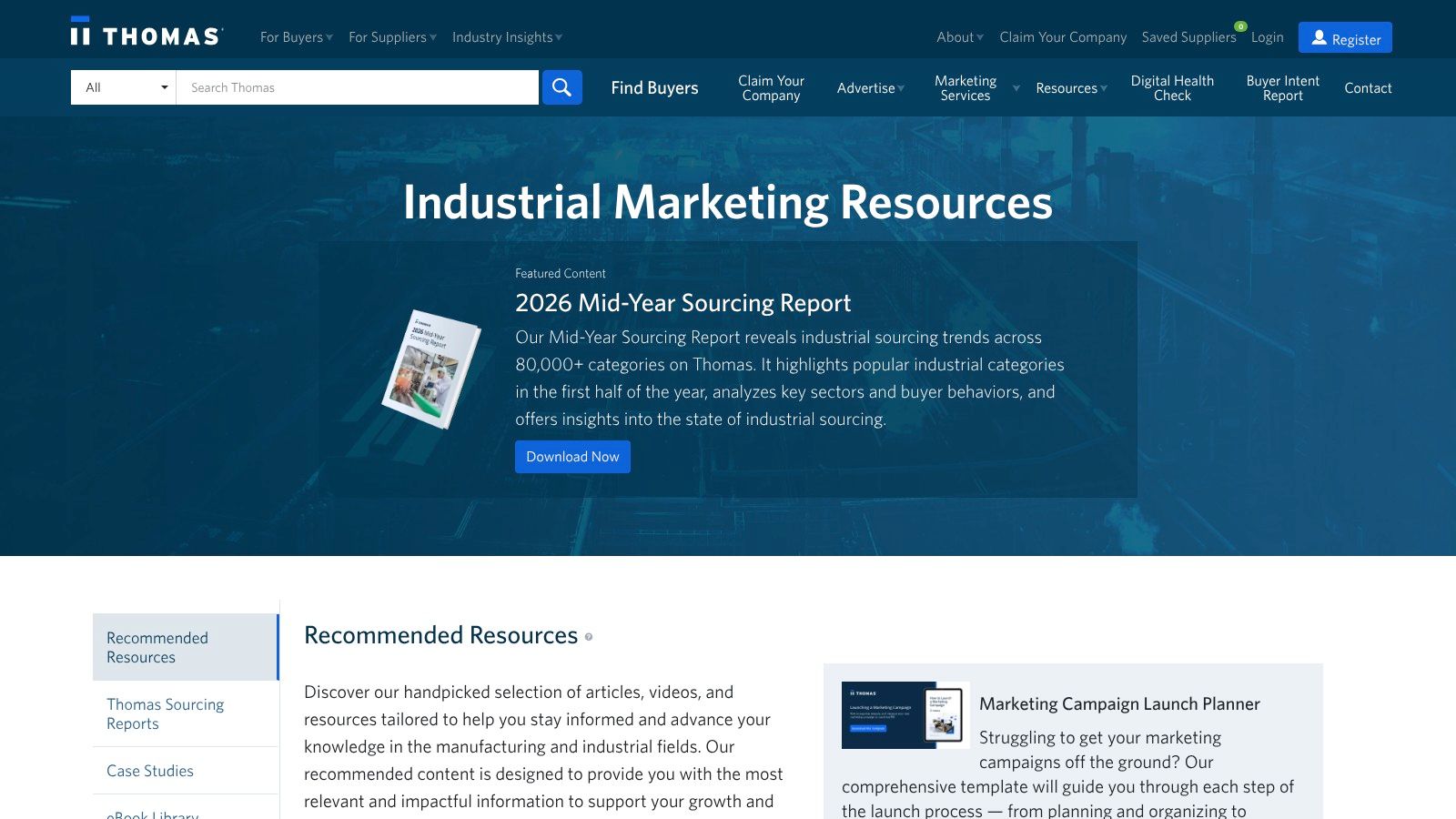
A common manufacturing planning failure shows up right before launch. The annual plan exists, the product team is ready, sales wants leads, and marketing is still chasing missing assets, unclear routing, and approval delays. That is the gap Thomas helps address.
You can find the resource inside Thomas industrial marketing resources. It works best as a campaign operations tool for one release, promotion, or market push. It does not carry the full job of annual planning. It helps teams get a specific launch out the door with the right materials, timing, owners, and follow-up steps.
The practical value is focus. Many manufacturing teams already have strategic goals on paper but still miss launches because nobody defined what must be ready before traffic starts. A launch planner forces that conversation early. Are the landing pages finished? Does the rep team know which accounts to call first? Are technical documents, quote forms, and CRM routing in place? Those details decide whether campaign spend produces qualified opportunities or a pile of unworked inquiries.
Thomas is a strong fit when the planning problem is execution discipline.
For machine shops, that usually means a capability launch. A new material, tighter tolerance range, or added process needs more than a short announcement. The planner should be adapted to include sample parts, application examples, target industries, RFQ routing rules, and response-time expectations so the campaign supports quoting capacity instead of overwhelming it.
For technical suppliers, the missing piece is often proof. Add checkpoints for test data, certifications, compliance language, distributor communication, and engineer-focused content. If those assets are late, the campaign may generate interest without giving buyers enough confidence to shortlist the product.
Distributors should adjust the planner around branch reality. Include supplier approvals, co-branded asset versions, inventory position, territory ownership, and lead-routing rules by location. That keeps a launch from creating demand in regions where the team cannot fulfill, stock, or support the offer.
Long-cycle industrial sales teams need one more layer. Track post-launch actions tied to pipeline movement, not just clicks or form fills. Measure target-account engagement, quote requests, meeting creation, and follow-up completion by rep. Without that sales alignment, campaign reporting stays busy but disconnected from revenue progress.
Thomas is useful here because it solves a narrower problem than a full marketing plan. It helps manufacturers turn strategy into a launch sequence that sales, marketing, and product teams can run.
7. Template.net – Manufacturing Business Marketing Plan
A lot of manufacturing plans still die in the approval chain. Marketing drafts a strategy. Sales asks for clearer target accounts. Finance wants budget logic. Leadership wants a document they can review without learning another tool.
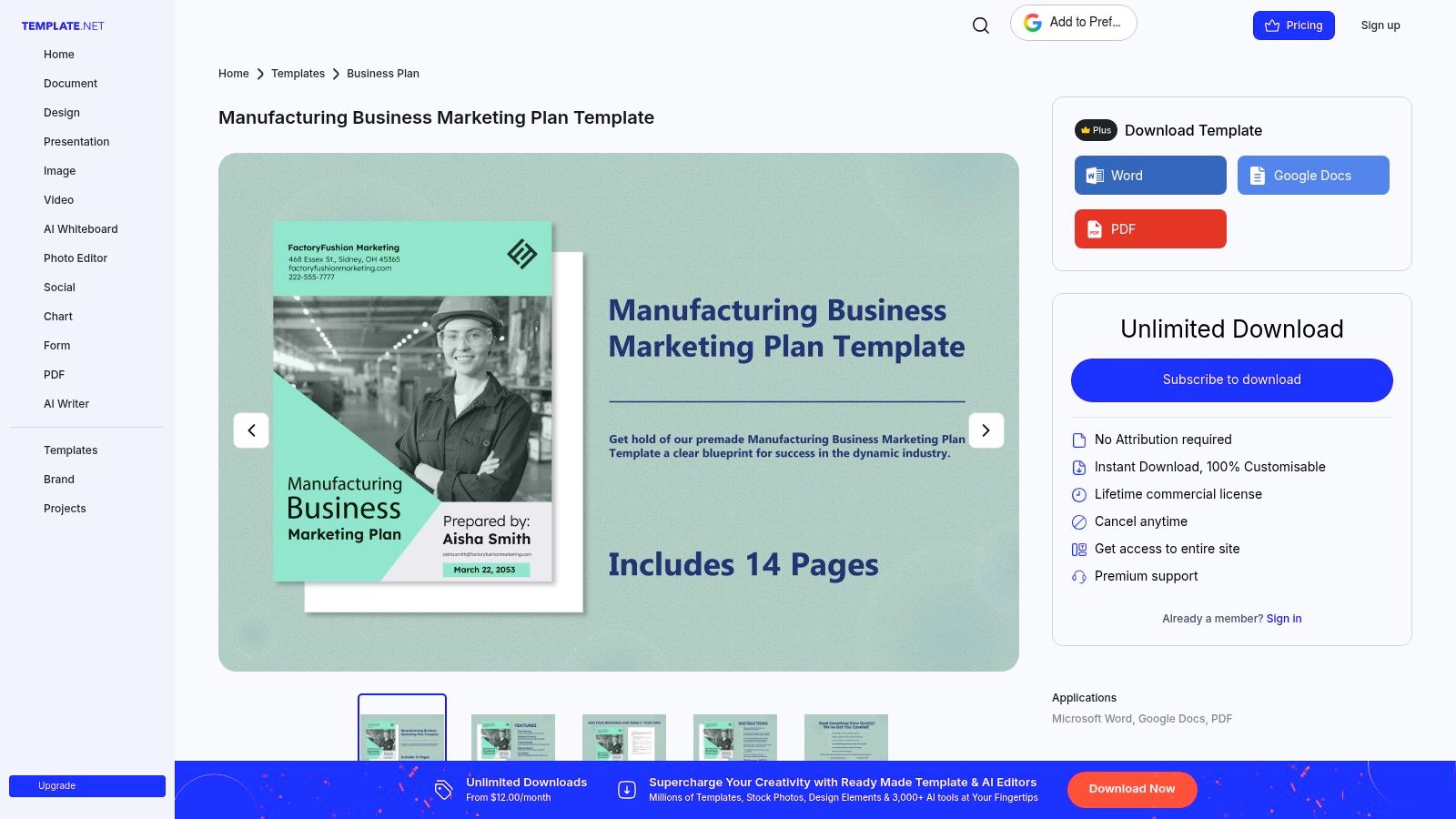
Template.net's manufacturing business marketing plan fits that environment well. It gives manufacturers a clean document in Word, Google Docs, or PDF, which matters for companies that still run planning through formal review, version control, and sign-off.
Its real value is administrative clarity, not planning depth.
The template covers the standard sections leadership expects: business overview, market analysis, objectives, strategy, and budget. That makes it a workable starting point for teams that need to get a draft in front of operations, sales, and ownership quickly. The weakness is just as clear. The default structure assumes a general business marketing plan, not a manufacturing sales process with technical buyers, long RFQ cycles, channel partners, and uneven sales capacity by product line.
That gap shows up fast in execution. A machine shop needs to define which work it wants more of, such as repeat production, prototype overflow, or higher-margin tight-tolerance jobs. A technical supplier needs space for certifications, test data, application claims, and the handoff between marketing content and sales engineering. A distributor has to map supplier priorities, regional inventory, and branch-level follow-up before a campaign ever goes live.
Template.net can handle those needs, but only after a rewrite of the middle sections. I would not treat the stock version as a finished plan. I would use it as an approval shell, then rebuild the working parts around six decisions:
- Define target segments by buying role and revenue potential.
- State the message each segment needs to hear to move to the next sales step.
- Assign channels based on how buyers research and request quotes.
- Tie budget lines to offers, campaigns, and owners.
- Set KPIs that reflect pipeline quality, not just traffic.
- Clarify how leads, RFQs, and follow-up move into sales.
That last point matters more than the document format. If the plan does not specify response times, qualification rules, and who owns the next action, the file will look finished while execution stays vague.
This template is strongest for manufacturers with slower planning cycles, multiple reviewers, or compliance-heavy documentation habits. It is weaker for teams that need campaign orchestration, fast iteration, or close coordination across product marketing, sales, and channel partners. In those cases, the document should sit underneath a separate execution layer. A simple way to add that layer is a marketing roadmap template, which turns approved strategy into timing, ownership, and delivery checkpoints.
Use Template.net if the planning problem is document control. Adapt it heavily if the planning problem is growth execution.
8. Chemical Tech Review – Marketing Plan Template for Manufacturing Suppliers
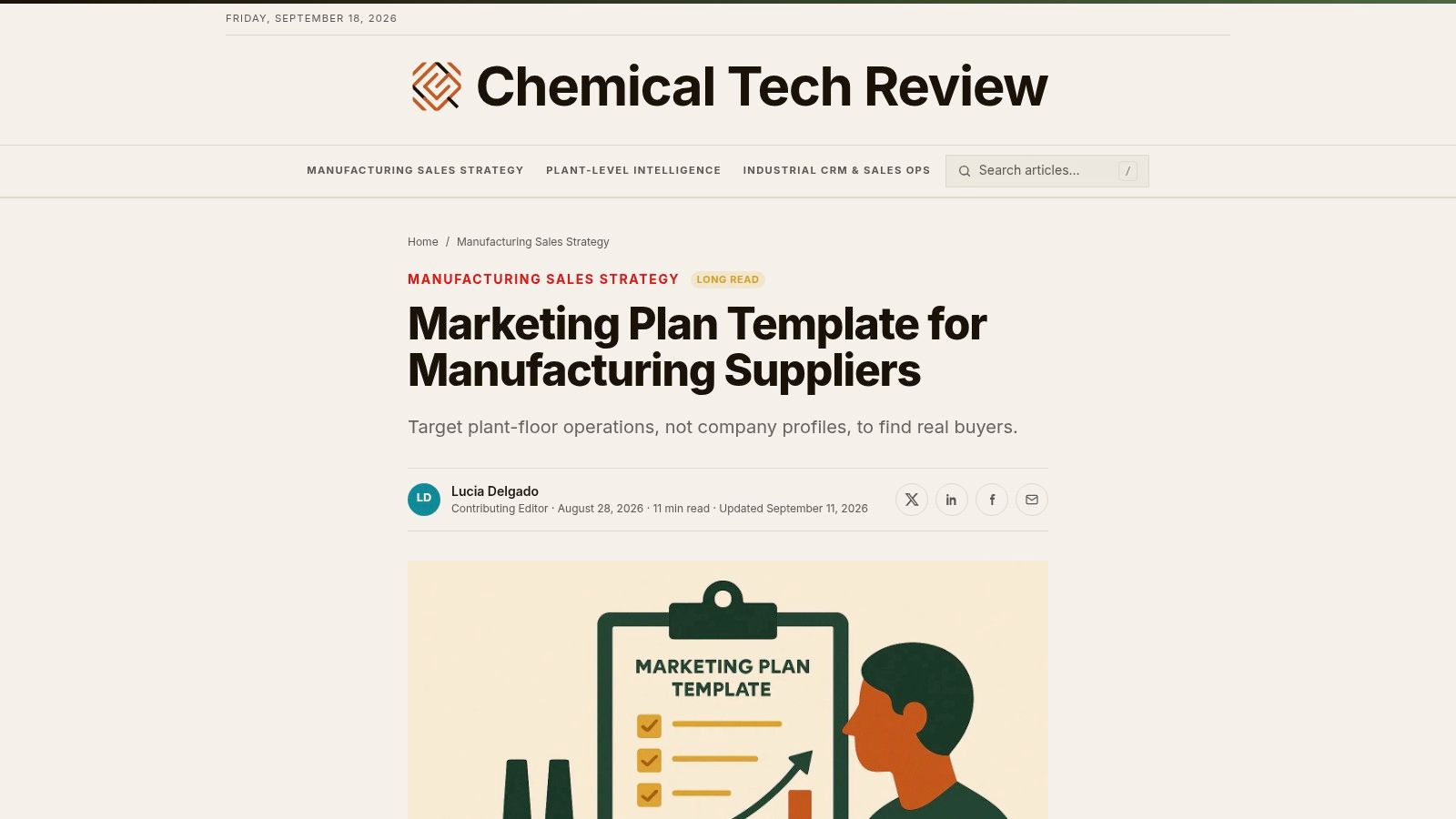
A supplier gets an RFQ from an OEM, a distributor asks for co-branded collateral, and a rep firm wants help opening a target account. One generic manufacturing plan usually handles only one of those paths well. Chemical Tech Review is useful because it starts from the planning problem supplier teams face: one product line, several routes to market, and different people influencing the sale at different stages.
The Chemical Tech Review supplier-focused planning guide is better read as a framework than a template. There is no polished workbook to fill out. You will need to turn the structure into your own planning document, spreadsheet, or operating sheet. For smaller industrial suppliers, that trade-off is fair if the bigger risk is missing channel conflict, weak technical messaging, or unclear ownership between direct sales and distribution.
What it solves well is planning for mixed-channel industrial selling.
A machine shop selling local precision work may find this resource too channel-heavy. A technical supplier, materials company, or component manufacturer with distributor coverage will get more value from it because the guide pushes you to separate audiences that often get blurred together. End users need application proof. Distributor reps need simple positioning and tools they can reuse. Engineers and specifiers need technical content that answers selection and performance questions before a quote request shows up.
That distinction changes the plan itself. Budgets need separate lines for demand creation and channel support. KPIs need two views: direct inquiries you can attribute clearly, and influenced opportunities where marketing supports distributor pull-through but never owns the final transaction. If those measures sit in one bucket, teams either overstate marketing impact or underinvest in programs that help partners sell.
A practical way to adapt this resource is to rebuild it around five operating decisions:
- Map direct buyers, specifiers, distributors, and reps as separate audiences
- Write a message by audience and sales stage, not one value proposition for everyone
- Assign channels by buying behavior, such as technical search, line card discovery, email nurture, rep outreach, or distributor promotion
- Define lead routing by geography, product family, and account ownership
- Match proof assets to the sale, including certifications, case studies, data sheets, test results, and application guidance
That last point matters in supplier environments. Sales cycles often stall because marketing produces brand material while buyers and channel partners need proof they can use in a technical review or account conversation.
I would use Chemical Tech Review if the planning gap is channel complexity. I would skip it if the team mainly needs board-ready formatting, budget controls, or a simple annual plan for one direct sales motion. For industrial chemical, component, and material suppliers, it is more relevant than a generic manufacturing template. For distributors, it works best after adding vendor-specific campaign rules and co-op marketing responsibilities.
9. B2B Marketing World – B2B Marketing Plan Template
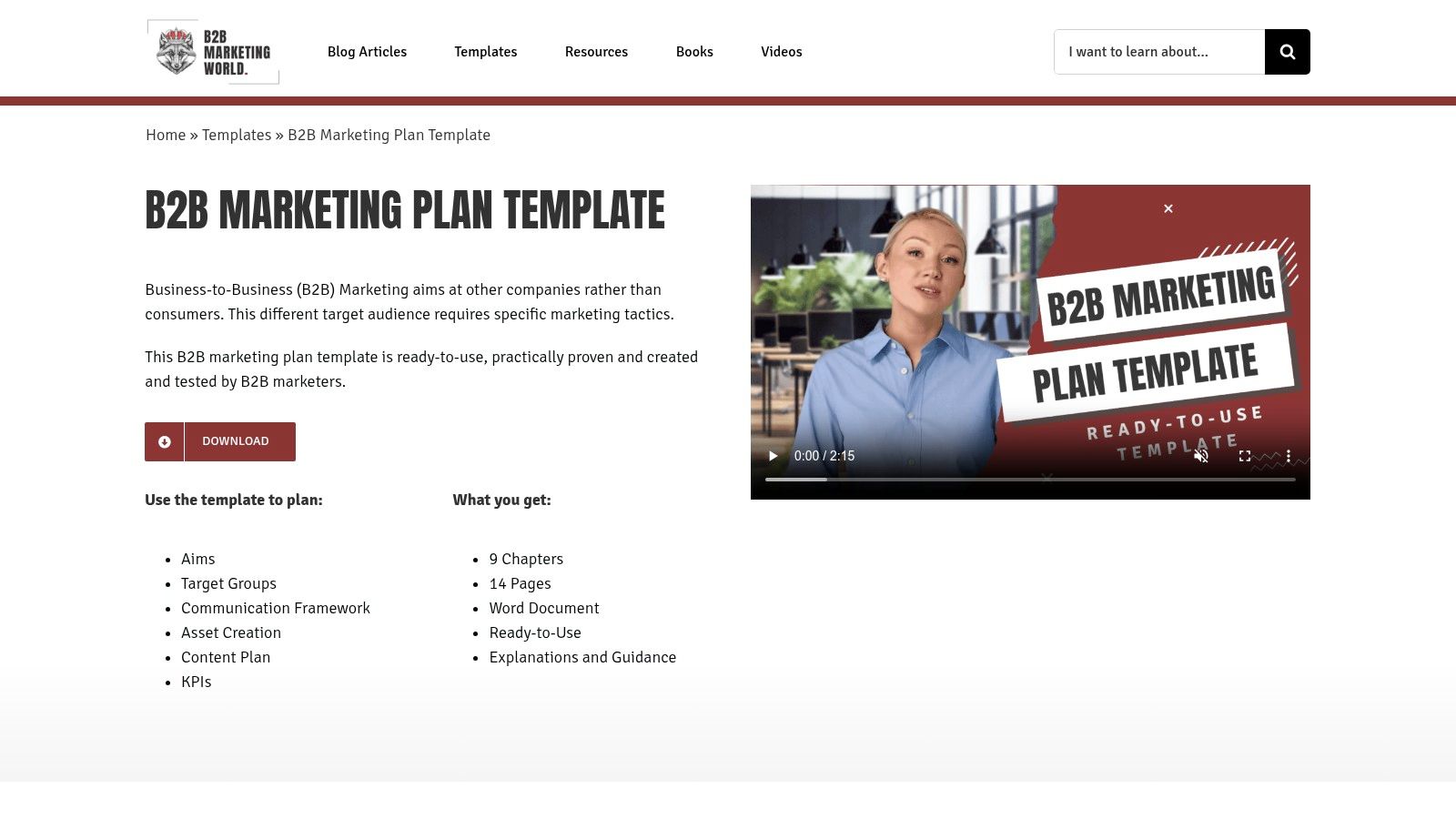
If you already have a marketing lead who can build personas, set campaign goals, and work with sales, but needs a clean planning shell, this template is a practical starting point. It gives that person enough structure to organize objectives, segments, tactics, KPIs, and budget lines without forcing a specific software stack or agency model.
You can review it at B2B Marketing World's free B2B marketing plan template. I would use it when the planning problem is basic plan assembly, not industrial strategy. The resource helps a team get out of scattered spreadsheets and disconnected channel ideas. It does not answer the harder manufacturing questions on its own.
Best for teams that know B2B planning but need manufacturing filters
The value here is speed. A capable marketer can take this framework and turn it into an annual plan faster than they could with a blank document. The trade-off is customization time. Machine shops, technical suppliers, and industrial distributors will have to rebuild several sections so the plan reflects long sales cycles, technical review steps, and shared ownership with sales or channel partners.
The sections I would change first are the ones that affect execution:
- Audience definition: Split economic buyers, engineers, plant leaders, procurement, reps, and distributors instead of using one generic B2B persona set.
- Messaging: Write claims around capability, tolerance, compliance, lead time, risk reduction, and application support, then match each one to a stage in the sales cycle.
- Channel plan: Separate spec-building channels from demand capture channels. SEO, technical content, email nurture, rep follow-up, distributor promotions, and trade media do different jobs.
- KPIs: Track quote requests, sales-accepted leads, opportunity creation, pipeline influence, and progression through long evaluation cycles.
- Budget ownership: Mark which programs marketing owns, which sales supports, and which require distributor participation or co-op funds.
That last point matters more than many teams expect.
A distributor-focused manufacturer may run campaigns that generate demand but never close the order directly. A custom fabricator may care less about MQL volume and more about whether inbound inquiries fit margin targets and production capacity. A component supplier selling through engineers and OEM accounts needs content that supports specification before procurement enters the conversation. This template can support all three cases, but only after those operating assumptions are written into the plan.
I would rate B2B Marketing World as a good base template for mid-market manufacturers with internal planning discipline. I would skip it if the team needs examples specific to industrial buying groups, technical content requirements, or channel conflict rules.
10. LinkedIn – The Comprehensive Playbook for Creating a B2B Marketing Plan
A machine shop often hits the same planning wall. The sales team wants better target-account outreach, engineering has useful application knowledge, and marketing has no clear system for turning that expertise into a monthly program that supports long quoting cycles. LinkedIn's playbook is useful when that coordination problem is bigger than the content problem itself.
The resource is available as LinkedIn's B2B marketing plan PDF playbook. It covers planning worksheets, campaign calendars, objective setting, KPI mapping, and reporting structure.
The fit is narrower than some of the manufacturing-specific templates in this list. LinkedIn helps teams build a working plan for thought leadership, paid promotion, and account-based targeting. It does not cover the full industrial channel mix, so manufacturers still need to add trade media, technical SEO, rep enablement, distributor programs, and quote-stage follow-up.
Here is where the playbook earns its place. It gives industrial teams a practical framework for assigning audiences, themes, campaign timing, and measurement across multiple contributors.
For a machine shop, that can look like this:
- Set one monthly engineer-led post around a tolerance, material, or process problem buyers ask about.
- Promote that post to procurement, operations, and engineering titles at named OEM accounts or target SIC groups.
- Retarget engaged visitors with a capability sheet, RFQ offer, or plant-tour request.
- Give sales reps the same post as follow-up material after outbound touches or trade show meetings.
For a distributor, the adaptation changes. The content should focus less on corporate brand visibility and more on line-card positioning, application guidance, replacement timing, and inventory availability by vertical. The paid audience should include maintenance, reliability, and sourcing roles, then route engagement into distributor sales coverage instead of a generic marketing conversion path.
That trade-off matters. LinkedIn is strong for visibility inside buying committees and for keeping technical expertise in front of dormant accounts. It is weaker as a standalone planning tool for manufacturers that depend heavily on channel partners, field reps, or specification content housed on their own site.
Use this playbook if the planning gap is cross-functional execution. Skip it if the team needs a manufacturing-first template with clearer guidance on industrial messaging, channel conflict, or offline and distributor-driven demand.
Top 10 Manufacturing Marketing Plan Templates Comparison
| Template | Core features ✨ | Usability / Quality ★ | Price / Value 💰 | Best fit 👥 | Standout 🏆 |
|---|---|---|---|---|---|
| Visme – B2B Manufacturing Company Marketing Strategy Plan Template | Executive visuals, drag‑and‑drop editor, brand kit, PPT/PDF export | ★★★★☆, polished presentation, lighter ops detail | 💰 Paid (best w/Pro) | 👥 Leadership, marketing managers | 🏆 Exec‑ready visuals & branding |
| MarketVeep – Step-by-Step Marketing Plan Template for Manufacturers (Free Sample) | Stepwise framework, sales/quote alignment, planning prompts | ★★★☆☆, clear but light workbook | 💰 Free sample (may require form) | 👥 SMB manufacturers new to planning | 🏆 Guided sequence with industrial examples |
| OneIMS – Marketing Plan for Manufacturing Company (Free Template) | In‑depth guide, KPIs, digital + sales enablement integration | ★★★★☆, detailed, operationally useful | 💰 Free (often gated) | 👥 SMB & mid‑market teams operationalizing strategy | 🏆 Integrates digital tactics with sales enablement |
| Lillian Group Marketing – How to Create a Manufacturing Marketing Plan (Template) | Adaptable plan outline, align to engineering & sales | ★★★☆☆, practical, no‑frills | 💰 Free guidance/template | 👥 Small manufacturers & job shops | 🏆 Industrial‑practitioner tone; easy to adapt |
| Gushwork – Manufacturing Marketing Plan Template (Free Download) | Fill‑in worksheets, campaign planning, prioritization prompts | ★★★☆☆, fast start, brief advanced sections | 💰 Free download | 👥 Small teams modernizing digital presence | 🏆 Quick, worksheet‑driven sprint starter |
| Thomas (Thomasnet) – Marketing Campaign Launch Planner (Industrial Resource) | Campaign launch checklists, buyer journey alignment, analytics | ★★★★☆, buyer‑insight backed | 💰 Free (registration) | 👥 Manufacturers targeting NA engineers/procurement | 🏆 Thomas buyer network insights for campaigns |
| Template.net – Manufacturing Business Marketing Plan (Word/Google Docs/PDF) | Traditional business plan structure, budgets, editable formats | ★★★☆☆, standard office doc, needs tailoring | 💰 Downloadable (Word/Google/PDF) | 👥 Teams needing formal internal docs/approvals | 🏆 Office‑ready formats for stakeholder sharing |
| Chemical Tech Review – Marketing Plan Template for Manufacturing Suppliers | Supplier‑focused messaging, technical SEO, distributor guidance | ★★★★☆, detailed editorial outline | 💰 Free editorial (requires copying into docs) | 👥 Manufacturing suppliers & niche vendors | 🏆 Supplier‑specific SEO & channel considerations |
| B2B Marketing World – B2B Marketing Plan Template (Free) | Comprehensive vendor‑agnostic framework, KPI↔budget linkage | ★★★★☆, thorough baseline model | 💰 Free | 👥 Teams wanting a complete planning architecture | 🏆 Full B2B model adaptable to manufacturing |
| LinkedIn – The Comprehensive Playbook for Creating a B2B Marketing Plan (Template + Guide, PDF) | End‑to‑end playbook, LinkedIn channel planning, measurement frameworks | ★★★★☆, robust, platform‑centric | 💰 Free PDF | 👥 Mid‑market manufacturers using LinkedIn/ABM | 🏆 Strong LinkedIn/ABM & channel alignment |
Turn the Template Into a Working System
The right manufacturing marketing plan template depends less on ranking position and more on the problem you need to solve first.
If you need leadership buy-in and a presentable strategy document, Visme is hard to beat. If you need planning prompts and a practical sequence, MarketVeep is a good entry point. If your team is ready for quarterly planning discipline, OneIMS gives you more operational structure. If you want plain language for a smaller industrial business, Lillian Group Marketing is a strong fit. If speed matters most, Gushwork is useful for a first sprint. If your challenge is campaign execution after strategy is set, Thomas is the specialist option. If formal documentation matters, Template.net is simple and familiar. If you sell through supplier and channel complexity, Chemical Tech Review is more relevant than many generic templates. If you want a broad B2B planning framework, B2B Marketing World is a strong base. If LinkedIn is central to your outreach and ABM motion, LinkedIn's playbook helps coordinate that part of the system.
The selection questions are practical:
- Company size: Smaller teams usually need simpler templates with fewer moving parts.
- Planning maturity: Newer teams need prompts. Mature teams need operating structure and review cadence.
- Audience complexity: Direct-sales machine shops need less channel logic than supplier-distributor models.
- Required format: Some teams need a board deck. Others need a doc, worksheet, or campaign planner.
- Planning scope: Decide whether you need an annual strategy document or a launch-specific planning tool.
A template only works when the diagnosis is honest. If the issue is weak positioning, no worksheet fixes that. If the issue is slow sales follow-up, adding another content calendar won't help. If the issue is channel confusion, a nicer PDF won't make the plan executable.
Start with one operating document and make it the source of truth. That document should answer who you're targeting, what proof you'll use, which channels matter, who owns each action, how budget is allocated, how leads move into sales, and when the team reviews results.
Use this quick-start checklist before you fill in any template:
- Audience and buyer definition: Name priority segments, job roles, buying triggers, and disqualifiers.
- Positioning and proof: List technical differentiators, application expertise, certifications, case evidence, and sales objections.
- Channel priorities: Decide which channels create relationships, build credibility, and capture demand.
- Owners and budget: Assign owners by channel and tie budget lines to real business priorities.
- KPI baselines: Define success measures that go beyond raw lead volume.
- Sales alignment: Set handoff rules, follow-up ownership, and CRM stage definitions.
- First review date: Put the next review on the calendar before launch begins.
We've seen the same pattern across manufacturers of different sizes. The companies that grow more consistently aren't always the ones with more tools. They're the ones with a plan the team can run. Diagnose the gap first, choose the template that fits that gap, and then turn it into a working system.
If your team has the tools, activity, and sales effort in place but still lacks a connected strategy, Machine Marketing can help you diagnose the gaps and build a manufacturing plan that ties messaging, channels, CRM, and sales follow-up together. We work with manufacturers, machine shops, and industrial teams that need a practical system, not another generic template. Visit Machine Marketing to get a clearer strategy diagnosis and next-step plan.