You already have marketing activity. You may have a website, a rep-driven sales process, some trade show follow-up, a few email campaigns, and a LinkedIn page that gets occasional attention. But the pipeline still feels inconsistent. Some months bring quote requests. Other months go quiet. Sales says the leads aren't qualified. Marketing says nobody follows up fast enough. Operations worries about promoting work the plant can't support.
That's the normal manufacturing marketing problem in 2026. It isn't a lack of effort. It's a system failure.
Buyers now research across many digital touchpoints before they ever talk to your team. Gartner is cited as predicting that by 2025, 80% of B2B sales interactions will occur in digital channels, while McKinsey is cited as finding that B2B buyers use more than 10 channels on average during the purchase journey, as summarized by Lform's manufacturing marketing analysis. If your channels, content, CRM, and follow-up aren't connected, the buyer experiences your company as fragmented.
Most articles respond to that shift with trend lists. That doesn't help much when you're trying to decide what to build, what to fix, and what to stop doing.
This article takes a different approach. We're going to treat your manufacturing marketing strategy 2026 like an engineered system. We'll diagnose where leads are getting lost, design a practical operating blueprint, connect channels to a CRM like GoHighLevel, and show you how to measure pipeline impact instead of admiring traffic charts.
Table of Contents
- Your 2026 Manufacturing Marketing Problem and Solution
- Diagnosing Your Current Marketing System
- The Blueprint for Your 2026 Marketing Strategy
- Building Your Omnichannel Execution Plan
- Integrating Your System with a CRM like GoHighLevel
- Measuring What Matters Most for Manufacturers
- Your First 90 Days of Execution
Your 2026 Manufacturing Marketing Problem and Solution
The core issue is simple. Most manufacturers have tactics, not a strategy system.
A plant manager might assume the website is underperforming. A sales manager might blame lead quality. An owner might think the company just needs more traffic. Sometimes those are real problems. More often, the failure happens between stages. Search traffic arrives, the page is too generic, the form asks the wrong questions, the CRM doesn't route the lead well, and follow-up comes too late or with no technical relevance.
That's why disconnected improvement efforts usually stall. Better SEO won't fix a weak landing page. More ad spend won't fix slow sales follow-up. More content won't help if no one can tie it to opportunities.
What the shift means for manufacturers
Manufacturing buyers don't move in a straight line. They compare vendors, share documents internally, revisit spec pages, and loop procurement into the process long before a formal RFQ appears. A technical buyer may care about tolerance, material compatibility, and certification. Procurement may care about supply reliability and response speed. Leadership may care about implementation risk.
Your marketing system has to support all of those decision layers.
Practical rule: If a prospect can find your product but can't quickly find the right use case, spec detail, or next step, your marketing is generating friction, not demand.
What works and what fails
What works in 2026 is coordinated execution:
- Technical pages tied to buyer intent: Product, process, industry, and application pages that answer specific questions.
- Nurture tied to sales reality: Follow-up sequences that reflect actual buying stages, not generic newsletter blasts.
- CRM visibility: A shared view of where each lead came from, what they engaged with, and what should happen next.
- Measurement tied to pipeline: Reporting that shows whether marketing is moving buyers toward qualified conversations.
What fails is familiar:
- Brochure-style websites: Pretty, high-level, and weak on specifics.
- One-size-fits-all forms: Every inquiry gets the same path regardless of urgency or fit.
- Channel silos: SEO, LinkedIn, and email run separately with no shared handoff logic.
- Vanity reporting: Lots of talk about impressions, very little about quotes or opportunities.
A strong manufacturing marketing strategy for 2026 doesn't start with more activity. It starts with a diagnosis, then a blueprint, then disciplined execution.
Diagnosing Your Current Marketing System
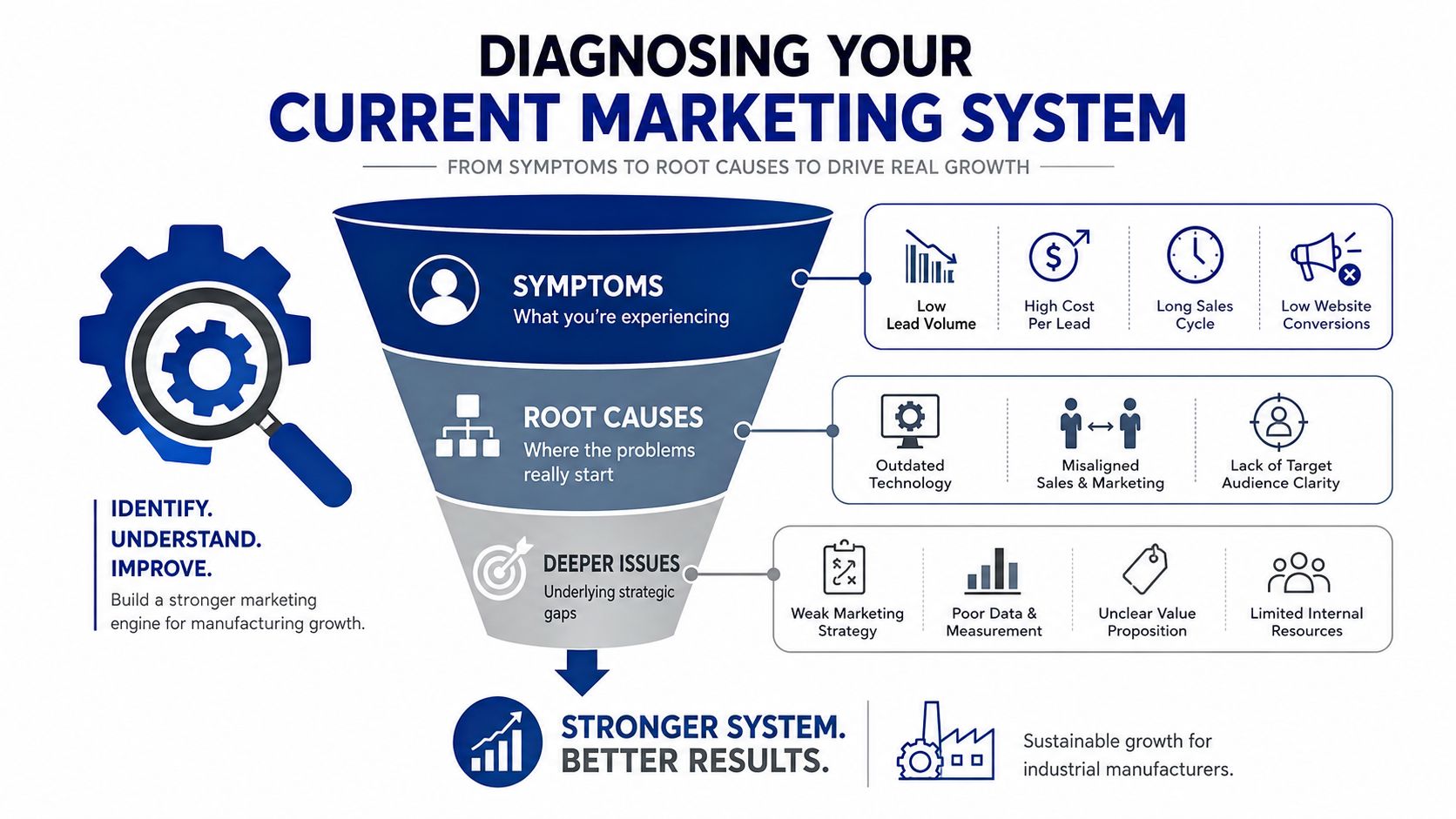
You can't fix what you haven't isolated. In manufacturing, we'd never troubleshoot a machine by guessing at the loudest symptom. Marketing deserves the same discipline.
Start with symptoms, then trace the failure point
Teams often describe their problem too broadly. “We need more leads” isn't a diagnosis. It's a complaint. The underlying issue usually fits into one of three buckets:
| Failure area | What it looks like | What it usually means |
|---|---|---|
| Traffic failure | Few qualified visits to high-intent pages | Buyers can't find you, or the wrong buyers are finding you |
| Conversion failure | Traffic exists, but forms, calls, and quote requests stay low | Your pages don't create confidence or a clear next step |
| Handoff failure | Leads come in, but sales says they go nowhere | Follow-up, qualification, or CRM routing is weak |
That framework matters because each problem needs a different fix. A traffic issue points toward search visibility and channel reach. A conversion issue points toward messaging, page design, offer fit, and form logic. A handoff issue points toward process, ownership, and automation.
If you haven't done this kind of root-cause review before, a formal marketing audit for manufacturers and industrial companies gives you a structured way to examine channel performance, buyer journey gaps, and system leaks.
Questions to ask your team this week
Use these in your next sales and marketing meeting. Don't answer them from memory. Pull the pages, forms, emails, and CRM stages and inspect them.
- Where do qualified inquiries start? Look for the first touch that leads to a meaningful sales conversation. Don't assume it's the homepage.
- Which pages attract technical buyers? Review product, service, and application pages. If visitors land there and leave, the page may be attracting interest without supporting evaluation.
- What happens in the first day after a form submission? Document each step. Who gets notified, what message goes out, and how fast does a human follow up?
- Does sales know what content the lead consumed? If the rep can't see whether someone downloaded a guide, viewed a spec page, or clicked an email, context is missing.
- Are you promoting work the business wants? Marketing should support profitable capacity, not create noise around low-priority jobs.
- Can you separate poor-fit leads from under-nurtured leads? Those aren't the same problem.
When marketing and sales use different definitions of a qualified lead, reporting becomes theater.
A solid diagnosis often reveals an uncomfortable truth. The funnel isn't empty. It's leaking. That's good news, because leaks can be engineered out of the system.
The Blueprint for Your 2026 Marketing Strategy
A working strategy needs structure. Not inspiration. Not trends. Structure.
The five pillars that hold the system together
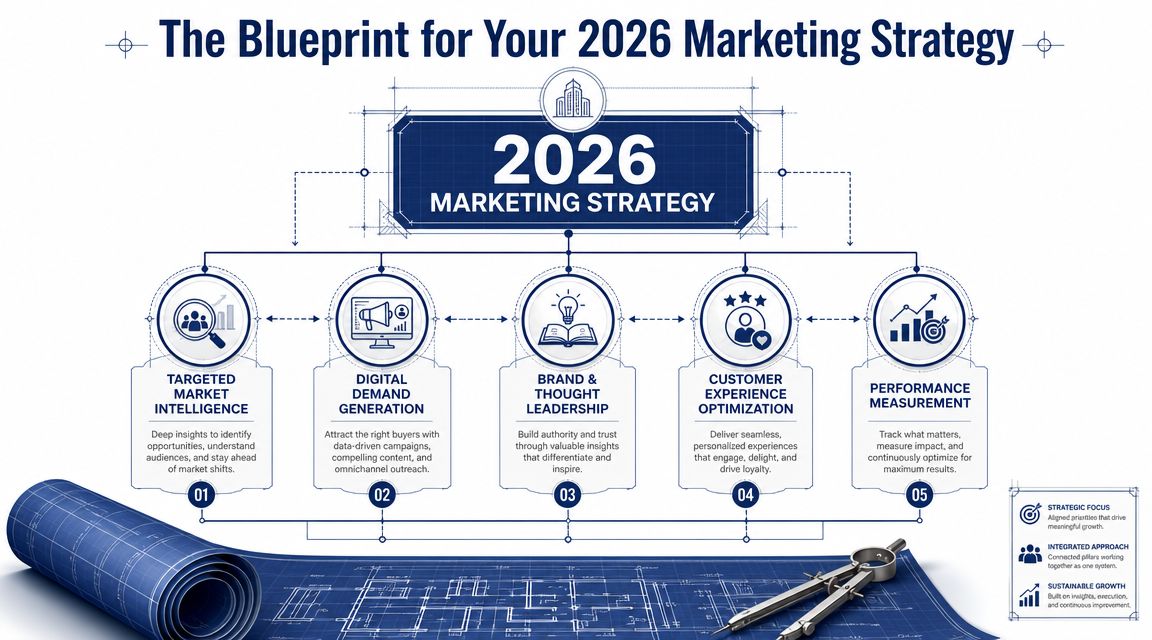
We use a five-pillar model because manufacturing buying is too complex for a single-channel plan.
1. Market and persona intelligence
Know exactly who you want to attract. Not just “engineers” or “procurement.” Define industries, production environments, buying triggers, common objections, and the documents each stakeholder needs to move forward.
2. Strategic positioning
Your message has to survive technical scrutiny. In 2026, manufacturers also need to account for AI-assisted buyer research. Engineers and procurement teams are using search and LLMs to evaluate vendors, which means your content needs to be technically rich, accurate, and distributed across multiple channels, as noted in 50 Marketing's discussion of manufacturing strategy in 2026.
3. Omnichannel execution
You don't need every channel. You need the right channel mix. For most manufacturers, that means technical SEO, application-focused content, LinkedIn, email nurture, and selective paid campaigns.
4. System integration and automation
This is the operational spine. Forms, CRM stages, alerts, nurture workflows, lead routing, quote requests, and reporting all need to connect. If they don't, the strategy won't scale.
5. Performance measurement
Measure movement through the pipeline, not just top-of-funnel activity. The purpose of content and channels is to create qualified opportunities.
How the pillars connect in practice
These pillars are interdependent. Persona intelligence informs positioning. Positioning shapes content. Content drives channel execution. Channel activity feeds the CRM. CRM data tells you what's working and what needs adjustment.
That sequence matters. Teams often skip straight to execution and wonder why results feel noisy. They launch ads before fixing the offer. They publish blogs before defining target segments. They buy software before deciding how leads should be routed.
Here's the more reliable order:
- Define buyer groups and priority markets
- Clarify your differentiators and trust signals
- Build pages and assets aligned to actual buyer questions
- Connect every entry point to a CRM workflow
- Review performance by opportunity movement, not by channel vanity
Field note: A strong strategy feels boring in the best possible way. Everyone knows what happens next when a lead comes in.
That's the test. If your team can't describe the path from anonymous visitor to sales-ready conversation, the blueprint still has gaps.
Building Your Omnichannel Execution Plan
Manufacturing teams often ask which channel matters most. That's usually the wrong question. The better question is which channel supports the buyer at a specific stage, with the right level of technical confidence.
According to Monday.com's manufacturing marketing guidance, effective strategy in 2026 is built on technical content assets such as white papers and application guides because technical buyers research extensively before contacting sales. That aligns with what we see in the field. Educational content outperforms promotional copy when the buyer is evaluating risk.
Technical SEO that matches how engineers search
Generic keyword targeting wastes time. Industrial buyers search with technical intent. They look for part categories, tolerances, certifications, materials, applications, machine capabilities, and process constraints.
Your SEO plan should include:
- Application pages: Build pages around use cases, not just product names.
- Specification-rich product pages: Include dimensions, standards, materials, compatibility, and process notes where relevant.
- Problem-based articles: Answer practical questions your buyers ask sales engineers.
- Supporting documents: Use downloadable spec sheets, capability statements, and technical summaries where they help evaluation.
A common mistake is hiding details behind a contact form too early. If the buyer can't validate fit, they won't convert.
Content that earns trust before sales gets involved
Not all content deserves equal effort. Start with assets that remove friction for technical evaluation.
Prioritize content like this:
- Application guides: Show where the product or process fits and where it doesn't.
- Comparison tools or pages: Help buyers understand differences across options.
- Case studies: Focus on the operational challenge, the solution path, and the implementation context.
- FAQ pages for engineers and buyers: Address recurring technical and procurement questions clearly.
- Short videos: Demonstrate process, equipment, inspection methods, or installation workflow.
What usually fails is “about us” content pretending to be buyer education. Buyers don't need more adjectives. They need evidence, clarity, and relevance.
Email and SMS for long buying cycles
Email still matters because manufacturing decisions often stretch over time. The goal isn't to send more messages. It's to send messages that match buying stage.
A simple nurture structure works well:
| Trigger | Follow-up direction |
|---|---|
| Application guide download | Send related use cases, FAQs, and a relevant contact path |
| Quote request started but not completed | Send a reminder, then offer help from sales or engineering |
| Repeated visits to technical pages | Route to a rep with page-level context |
| Trade show or event lead | Send the exact material promised, then sequence role-specific follow-up |
SMS can be useful for appointment reminders or prompt handoffs, but it's not right for every audience. Use it sparingly and only when it supports a clear next action.
Paid media that supports precision, not waste
Paid campaigns help when they're tightly aligned to a specific offer or audience. They fail when used as a shortcut around weak messaging.
LinkedIn is often useful in manufacturing because it lets you target by company, role, and industry with more precision than broad social channels. It works best when paired with a strong content asset, not a generic “contact us” ad.
Use paid media when:
- You have a clear target segment
- The landing page matches the ad promise
- Sales can handle and respond to inquiries quickly
- You can track the inquiry into the CRM
Use less paid media when:
- Your site still reads like a brochure
- Your forms are clunky
- You can't tell which campaigns generate real opportunities
Omnichannel execution isn't about being everywhere. It's about making each channel reinforce the others.
Integrating Your System with a CRM like GoHighLevel
A CRM should do more than store contacts. In a manufacturing marketing strategy for 2026, it should run the handoffs, preserve buyer context, and keep leads from disappearing between departments.
That matters because post-click conversion is where many manufacturers struggle. Independent coverage summarized by NPWS reports that 66% say content is not converting, 64% struggle to prove ROI, and 53% can't tie content to business goals in this breakdown of manufacturing marketing challenges. Those numbers point to the same issue. Lead generation and lead handling are often disconnected.
Why the CRM is the operating layer
When a visitor downloads a guide, requests a quote, books a call, or revisits a product page, that behavior should inform what happens next. Without a connected CRM, marketing can generate signals but sales can't act on them effectively.
A platform like GoHighLevel can serve as a central operating layer for:
- Lead capture: Forms, landing pages, and inbound inquiries
- Routing: Assigning leads by region, product line, or account owner
- Automation: Immediate email responses, task creation, reminders, and nurture paths
- Pipeline stages: Inquiry, qualified lead, quote, open opportunity, closed outcome
- Reporting: Source visibility and stage progression
If you're evaluating implementation details, this guide on GoHighLevel for manufacturers shows how the platform fits industrial sales cycles and automation needs.
What to automate first
Don't start with a huge workflow map. Start with the places where leads most often die.
A practical first sequence looks like this:
Instant acknowledgment
Every form submission should trigger an immediate confirmation with a relevant next step.Internal notification with context
The assigned rep should see source, page history, form content, and any downloaded asset.Task creation with deadline
Follow-up should have an owner and a due date. Otherwise, it's wishful thinking.Branching nurture by intent
A quote request should not enter the same sequence as a top-of-funnel content download.Stage update discipline
If reps don't update stages, reporting breaks and automation becomes unreliable.
A CRM doesn't fix bad process. It exposes it. That's why implementation needs sales agreement, not just software access.
One more practical point. Your CRM should reflect production reality. If lead times, capabilities, or target job types shift, marketing and automation need to shift with them. Otherwise the system keeps generating demand the business doesn't want.
Measuring What Matters Most for Manufacturers
Manufacturing marketers have tracked top-of-funnel metrics for a long time. Historical benchmark data summarized by Stream Creative from the Content Marketing Institute shows 75% of manufacturing marketers said their organization measured content performance, with website traffic at 73%, website engagement at 69%, and email engagement at 67% among the indicators used. The same benchmark summary notes that LinkedIn was rated effective by 79% for organic posts and 74% for paid posts, and that brand awareness, credibility, and audience education were major goals in the field's earlier maturation phase, as outlined in these manufacturing content marketing benchmarks.
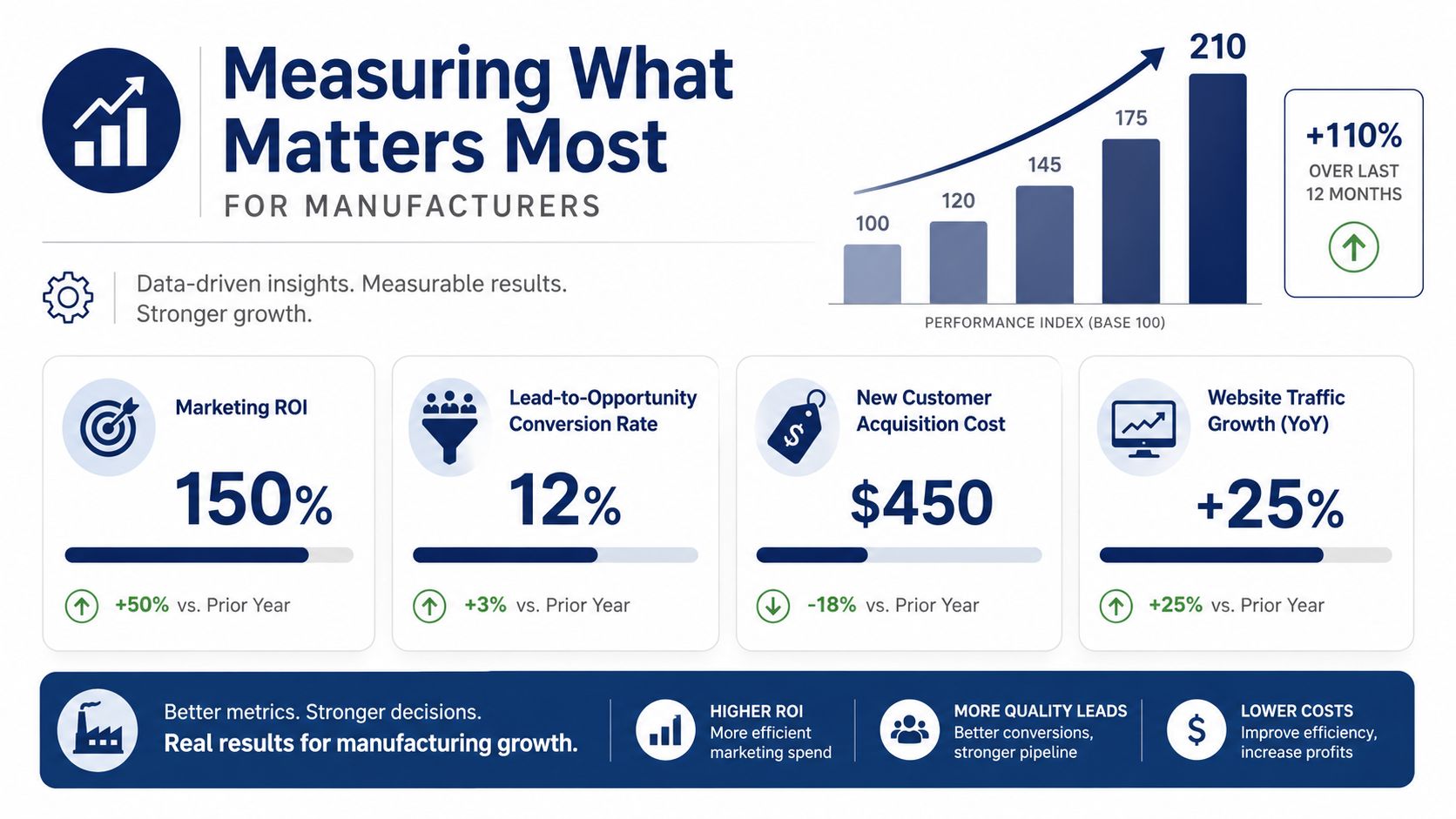
That history is useful. It shows the discipline matured. But in 2026, traffic alone won't answer the question leadership cares about. Is marketing moving buyers into the pipeline?
Stop reporting activity and start reporting movement
A visit is not a lead. A lead is not a quote. A quote is not a customer.
Your dashboard should show movement between stages. That means every metric needs to connect to a decision:
- Are the right channels creating qualified inquiries?
- Do those inquiries become quotes?
- Where do deals stall?
- Which content appears before sales conversations or quote requests?
If you're working through fixing your funnel problems, that's the right frame. Don't ask only how many people arrived. Ask where momentum slows and why.
A practical KPI stack for industrial teams
Use a layered KPI model instead of a flat report.
| KPI layer | What to monitor | Why it matters |
|---|---|---|
| Attraction | Organic visibility on technical pages, ad response by offer, traffic to product and application pages | Shows whether target buyers are finding the right entry points |
| Engagement | Content downloads, return visits, form starts, email clicks from nurture sequences | Indicates whether interest is progressing |
| Qualification | Marketing qualified leads, sales accepted leads, lead-to-quote ratio | Reveals lead quality and sales alignment |
| Pipeline | Open opportunities influenced by marketing, stalled deals by stage, time between stages | Shows where process friction exists |
| Outcome | Closed business tied to source categories and campaigns | Connects effort to commercial results |
A few cautions matter here:
- Don't overload the dashboard: If your team won't review it weekly, it's too complex.
- Don't separate reporting from operations: The CRM stage model and KPI model must match.
- Don't hide weak conversion behind traffic growth: More visits can mask a broken middle funnel.
For teams formalizing attribution and revenue reporting, this guide on how to measure marketing ROI for industrial businesses is a useful reference point.
Your First 90 Days of Execution
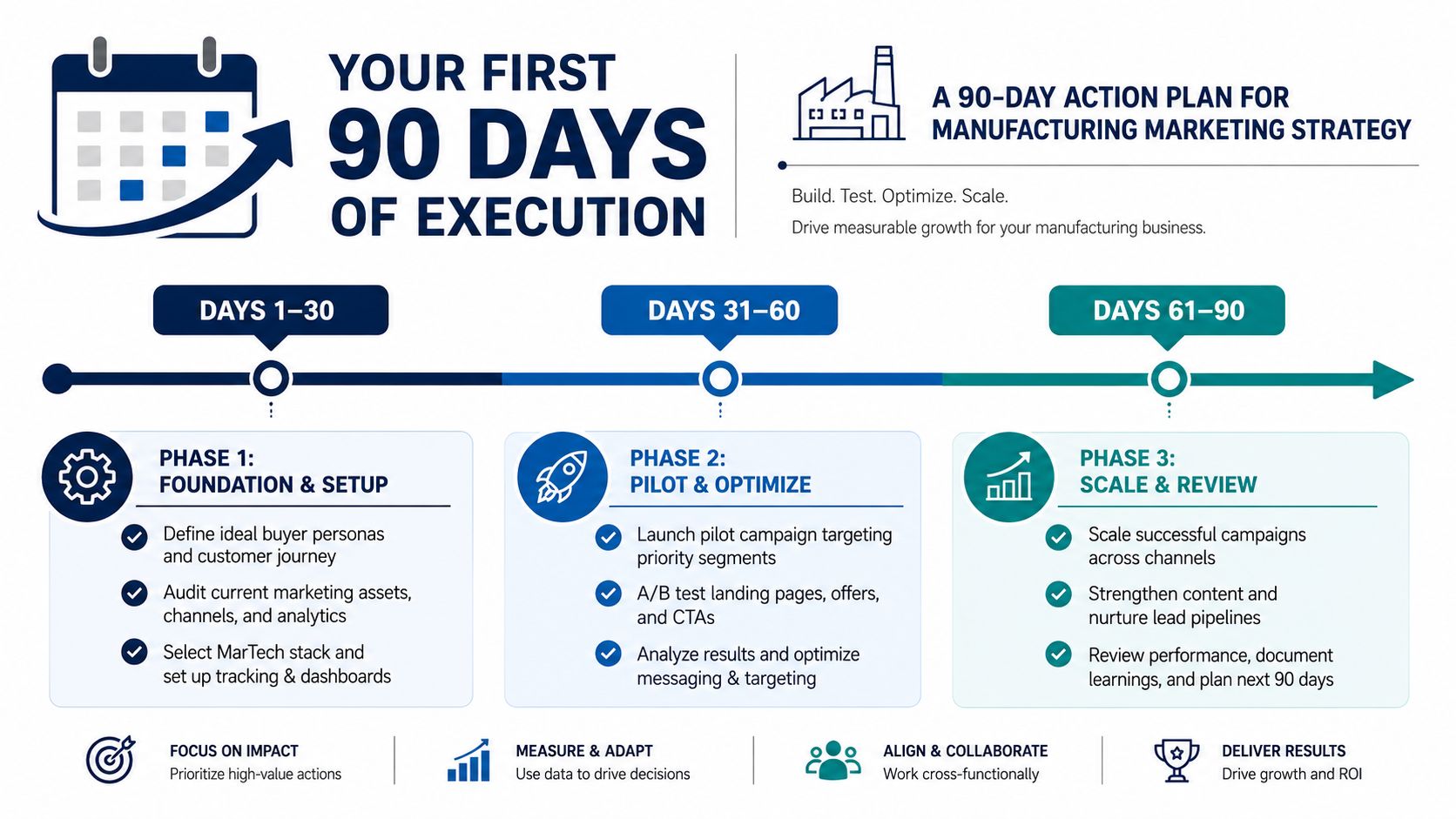
Strategy gets real when it enters the calendar. Most manufacturers don't need a giant rollout. They need an execution sequence that's manageable, visible, and tied to commercial outcomes.
Days 1 through 30 foundation and setup
Your first month is about clarity. Not volume.
Focus on three deliverables:
- System diagnosis completed: Review channels, entry pages, forms, CRM stages, and follow-up gaps.
- Buyer segments defined: Identify priority industries, job roles, common triggers, and objections.
- Offer and page priorities selected: Choose the products, services, or applications that deserve concentrated attention first.
Use this month to remove obvious friction. Fix broken forms. Simplify unclear calls to action. Clarify who owns inbound lead response. Tighten page messaging where it's vague.
Start smaller than you want to. One clear market, one strong page set, and one clean follow-up path usually outperform a broad launch.
This short video is a useful complement if you want to align the plan with execution discipline:
Days 31 through 60 activation and pilot campaigns
Your second month is where the system starts producing signals.
Launch a focused pilot:
Publish one high-value technical asset
An application guide, use-case page cluster, or comparison resource works well.Promote it through one primary channel
For many manufacturers, that's organic search support plus LinkedIn targeting or email to existing contacts.Build one dedicated landing path
Match message, offer, and form fields tightly.Document the sales handoff
Write the rule set. Who responds, in what timeframe, with what context.
This is also the right time to refine one nurture sequence. Keep it short and relevant. If someone downloads a technical guide, follow up with adjacent material and a clear human contact option. Don't drop them into a generic monthly newsletter and call that nurturing.
Days 61 through 90 automation and review
Month three is where you make the pilot repeatable.
Build out:
- Lead routing rules: By product line, geography, or account ownership
- Basic automation: Confirmation messages, task creation, follow-up reminders
- Dashboard visibility: Source, stage movement, inquiry quality, and quote progression
- Feedback loops: Weekly review between marketing and sales
At the end of the 90 days, ask hard questions:
- Which entry points produced qualified conversations?
- Where did leads stall?
- Which content drove actual sales engagement?
- What should be scaled, revised, or cut?
A good first quarter won't create a perfect system. It will create a visible one. That's the point. Once you can see the leaks, you can improve them deliberately instead of guessing.
If you want help diagnosing and building your manufacturing marketing system, Machine Marketing works with manufacturers, machine shops, and industrial businesses to connect strategy, CRM, SEO, content, and follow-up into a measurable growth process. A good next step is a system diagnosis. Map the leaks, define the handoffs, and then build the parts in the right order.