If you're a manufacturer staring at a website that looks respectable but doesn't produce steady quote requests, you're not dealing with a cosmetic problem. You're dealing with a system problem. The site may rank for the wrong terms, bury critical technical details, confuse search engines with overlapping pages, or fail to connect form fills to real sales outcomes.
That matters because organic search drives about 53% of website traffic, and the top organic position captures 39.8% of clicks, with the top three results taking 68.7% collectively, according to Exploding Topics' SEO statistics roundup. For manufacturing websites, that concentration changes the economics of lead generation. A single page that earns strong rankings for a high-intent query can alter your sales pipeline.
Most manufacturing SEO advice stops at "do keyword research" and "write blogs." That isn't enough. You need a working system that diagnoses defects, maps content to buyer intent, tracks conversions inside your CRM, and improves the pages that influence RFQs and sales conversations.
Table of Contents
- Diagnose Your Website Like an Engineer
- Target Keywords with Industrial Buyer Intent
- Create Content That Converts Technical Buyers
- Build Trust with Links and Local Signals
- Measure SEO Performance and Lead Quality
- Your 90-Day Implementation Roadmap
Diagnose Your Website Like an Engineer
A manufacturing website audit should work like a plant-floor diagnosis. You don't start by guessing. You inspect the system, isolate defects, and rank them by operational impact.
The first mistake we see is treating SEO as a content-only problem. Often, the issue sits lower in the stack. Search engines can't reliably crawl key pages. Product information appears in multiple versions. Slow pages make technical buyers bounce before they reach the spec table or RFQ form.

Start with defects, not opinions
Run a full crawl with Screaming Frog. Then review Google Search Console and PageSpeed data page by page, not only at the domain level. You want evidence, not assumptions.
Look for these failure modes first:
- Crawl barriers: Important product, category, or resource pages shouldn't be buried, orphaned, or blocked from discovery.
- Duplicate relevance: Near-identical product pages, filter pages, and PDF copies can split authority across multiple URLs.
- Weak metadata: Missing or repetitive title tags make it harder for search engines and buyers to distinguish one page from another.
- Slow templates: Heavy imagery, large PDFs, and bloated scripts often drag down catalog and product-detail pages.
- Broken internal paths: A visitor should be able to move from category page to spec page to RFQ without friction.
Practical rule: Treat technical SEO defects the same way you'd treat production defects. If a page can't be crawled, understood, or used efficiently, it isn't "good enough."
A clean taxonomy helps here. If your categories, subcategories, and page relationships are messy, search engines struggle to understand the site the same way buyers do. That's why it's worth reviewing how website taxonomy affects navigation and findability before you rewrite copy.
Build a punch list you can act on
Don't leave the audit as a spreadsheet dump. Convert it into a short defect list with owners and priorities.
A useful punch list usually includes:
| Issue type | What to check | Why it matters |
|---|---|---|
| Indexation | Which high-value pages are indexed and which aren't | Hidden pages can't rank |
| Duplication | Product variants, PDFs, parameter URLs | Relevance gets diluted |
| Performance | Slow templates and oversized media | Buyers abandon slow pages |
| Internal linking | Paths between related product and use-case pages | Search engines need context |
| Conversion points | Broken forms, weak CTAs, dead-end pages | Traffic without action is wasted |
The output of this stage isn't "SEO complete." It's clarity. You should know which pages deserve repair first, which templates need redevelopment, and which structural issues will keep suppressing results if you ignore them.
Target Keywords with Industrial Buyer Intent
Most manufacturers aim at terms that sound important internally but don't reflect how buyers search. Product managers use one vocabulary. Engineers, maintenance teams, and procurement staff often use another.
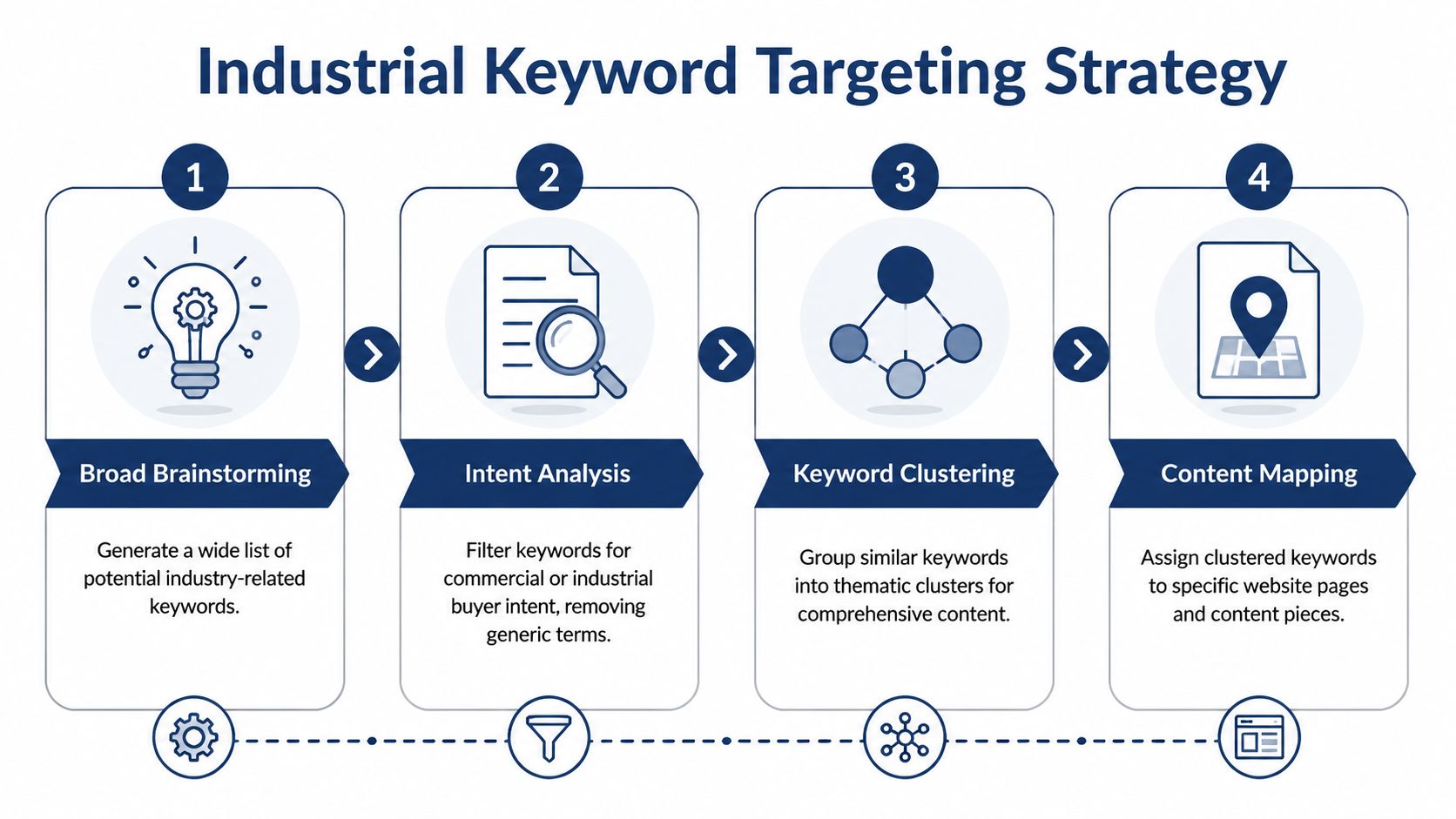
That gap produces a familiar pattern. The company ranks for broad informational terms, attracts mixed traffic, and gets few serious inquiries. The fix is to organize keyword strategy around buyer intent, not around your internal product list.
Stop chasing broad product terms
A practical workflow for manufacturers starts with clustering terms around buyer intent, then mapping separate page sets for products, industry use cases, and technical FAQs to canonical URLs. Guidance for manufacturers also recommends keeping title tags under 60 characters to reduce truncation in search results, as outlined in Sales Layer's manufacturing SEO guidance.
That means a better keyword list usually includes several intent layers:
- Product-specific terms: Exact product types, part categories, and specification-driven searches.
- Application searches: Phrases tied to industries, environments, or production use cases.
- Problem-driven searches: Failure symptoms, maintenance issues, compatibility questions, and performance constraints.
- Commercial terms: Request, supplier, manufacturer, OEM, custom, certification, and compliance language.
Here's a useful way to think about it. "Hydraulic motor" is usually too broad by itself. "Hydraulic motor for washdown environment" is closer to a real requirement. "NEMA stepper motor specifications" signals a buyer trying to verify fit, not just browse.
Later in the buying cycle, search behavior gets more specific. This walkthrough is a good visual primer before you build your own clusters:
Cluster pages by buying task
Instead of assigning one keyword to one page and calling it done, group related phrases by what the buyer is trying to accomplish.
A manufacturing site usually needs at least these page families:
- Product pages for exact solutions and specifications.
- Industry or application pages for use cases such as food processing, packaging, aerospace, or heavy equipment.
- Technical FAQ pages for compatibility, installation, maintenance, tolerances, certifications, or troubleshooting.
- Local pages when geography matters for service areas, plant locations, or regional sales coverage.
Buyers don't search in a straight line. They bounce between product fit, technical proof, risk reduction, and supplier validation.
Map one intent cluster to one page
Many industrial sites create their own ranking problems by publishing several pages that target nearly the same phrase with slight wording changes. Search engines then have to guess which page is most relevant.
Use one canonical URL per cluster. Then support that page with internal links from related resources, application notes, FAQs, and downloadable documents.
Ask these questions before you publish:
- Does this page serve a distinct buying task? If not, merge it.
- Is this term commercial, technical, or educational? Match the page type to the intent.
- Will this page answer a real objection? If not, it may be filler.
- Does another page already cover this topic? If yes, strengthen that URL instead of creating another weak one.
Good manufacturing website SEO isn't about stuffing more terms into more pages. It's about reducing ambiguity so buyers and search engines land on the right page the first time.
Create Content That Converts Technical Buyers
Thin pages are expensive. They don't always look broken, but they fail at the moment a serious buyer starts evaluating risk.
A late-stage industrial buyer doesn't want polished generalities. They want enough evidence to decide whether your product fits the application, meets the requirement, and deserves a conversation. That's why an underserved angle in manufacturing SEO is answering late-stage buyer questions with specs, certifications, and case studies instead of relying on brochure copy, as noted in Workshop Digital's manufacturing SEO article.
Brochure pages don't answer buying questions
A standard brochure page usually includes a headline, a stock image, a short paragraph, and a contact button. That may satisfy an internal stakeholder who wants every product "represented" online. It doesn't satisfy an engineer comparing options.
Technical buyers often want to verify details before they identify themselves. If your page forces them to call sales for basic information, many won't. They'll move to the supplier that publishes tolerances, materials, certifications, dimensions, and use-case guidance directly on the page.
The website should handle the first round of qualification before your sales team ever opens the CRM.
If you want a deeper framework for turning technical content into a conversion asset, this guide on conversion-centric technical content SEO is worth reviewing alongside your page rewrite process.
What strong technical pages include
A high-performing manufacturing page usually combines search visibility with sales enablement. It should answer discovery questions and reduce hesitation.
Strong pages often include:
- Technical specifications: Materials, dimensions, tolerances, pressure or temperature ranges, certifications, and compatibility details.
- Use-case guidance: Where the product fits, where it doesn't, and what environment or process it supports.
- Downloadable assets: Spec sheets, installation documents, CAD files, manuals, and compliance documents.
- Proof content: Case studies, test data, quality standards, and examples of real-world deployment.
- Structured formatting: Clear headings, concise answer blocks, and FAQ sections that search engines can parse more easily.
A simple comparison can help your team evaluate existing pages:
| Weak page | Strong page |
|---|---|
| Generic description | Specific performance and fit details |
| One audience | Engineer, buyer, and procurement concerns addressed |
| "Contact us for more info" | Key facts published before the form |
| No trust indicators | Certifications, documentation, and proof |
| Isolated page | Linked to FAQs, applications, and quote path |
Make the conversion step fit the buyer
Manufacturers often bury the request step inside a generic contact form. That's a mismatch. A buyer evaluating a technical solution may need a structured way to request pricing, share requirements, or upload drawings.
If your team needs a better starting point, examples of create quote request forms can help you build forms that collect the information sales needs without forcing back-and-forth emails. The key is to ask for details that improve qualification, not to make the form longer for its own sake.
Good content and good conversion design work together. The page earns trust. The form captures useful context. Sales gets a lead that's closer to a real opportunity.
Build Trust with Links and Local Signals
Authority in manufacturing SEO doesn't come from random backlinks. It comes from being referenced by sites that already matter in your market.
A link from a respected trade publication, supplier portal, association directory, or industry resource page usually carries more value than a pile of generic listings. Relevance matters because it matches how buyers evaluate suppliers in the first place. They trust familiar industry institutions.
Earn links from places buyers already trust
Start with assets you already have. Manufacturers often sit on linkable material without realizing it. Application notes, technical explainers, process insights, compliance resources, and original product documentation can all support outreach.
A practical outreach list includes:
- Trade publications: Offer technical commentary, contributed articles, or expert input on process issues.
- Supplier and partner sites: Ask for inclusion on partner, distributor, or integration pages where the relationship already exists.
- Industry associations: Complete member profiles fully and add useful details, not just a logo and phone number.
- Industrial directories: Prioritize the directories your buyers already use during vendor research.
A relevant link works best when it sits next to context that explains what your company actually does.
Clean up your local and citation signals
For manufacturers with plant locations, regional territories, or local service coverage, citation consistency still matters. Your Name, Address, and Phone details should match across your website, Google Business Profile, and industrial directories.
Inconsistent listings create avoidable confusion. They also make local visibility harder than it needs to be.
Use this quick audit:
- Homepage and contact page: Confirm the official company details are current.
- Google Business Profile: Match the site exactly, including suite formatting and phone number.
- Directory listings: Update old addresses, old phone lines, and duplicate profiles.
- Location pages: Give each location a real purpose, not recycled filler text.
If you're tightening regional visibility, these local SEO best practices for industrial businesses can help you standardize location signals before you invest more in outreach.
Measure SEO Performance and Lead Quality
Traffic doesn't pay for itself. Qualified opportunities do.
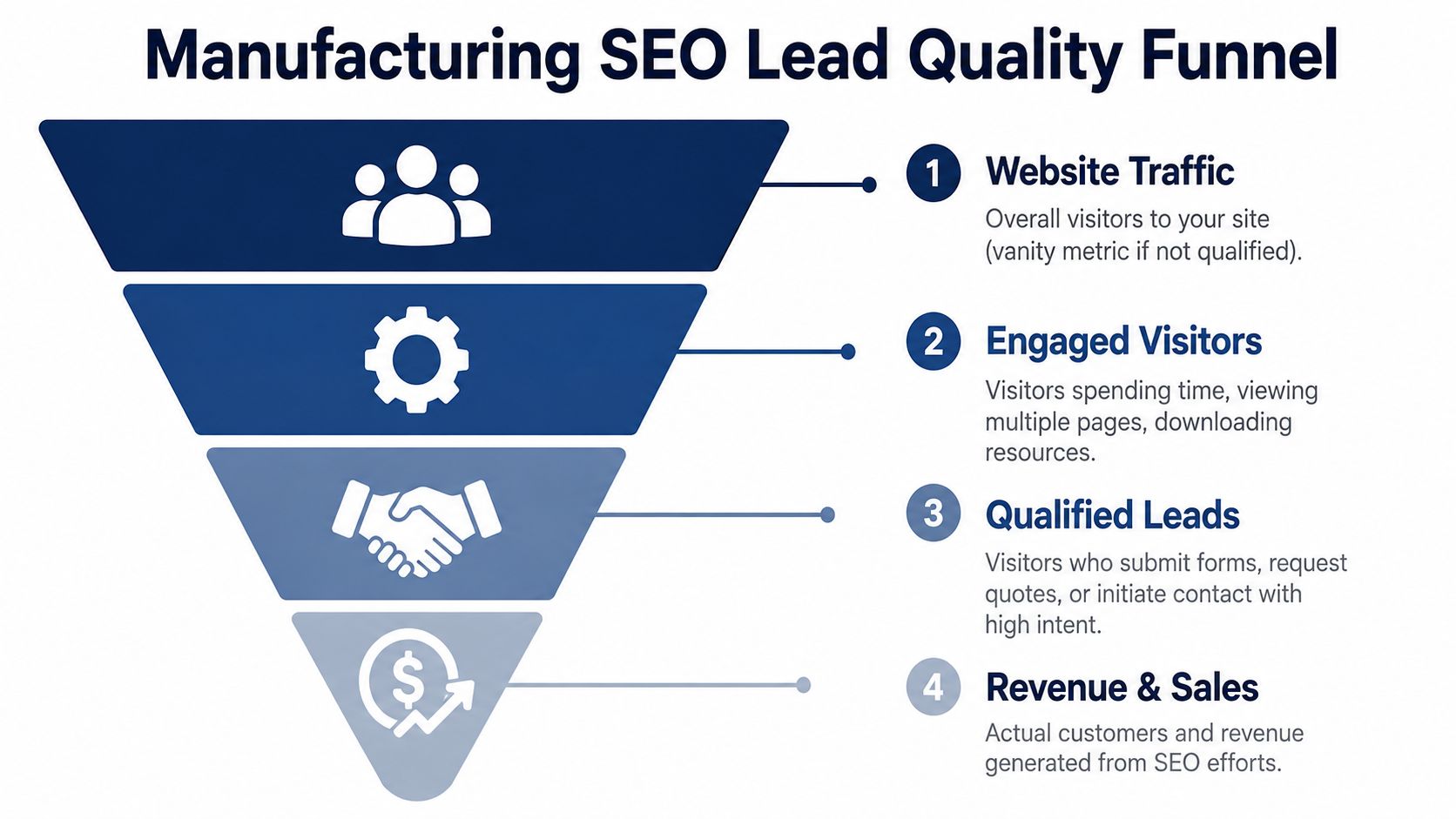
Manufacturers often review SEO reports full of rankings, impressions, and session charts while the sales team still says, "We're not getting the right leads." That disconnect usually means measurement stops too early. The site is being judged by visibility, not by pipeline contribution.
Track actions, not just sessions
Technical SEO is not optional for manufacturers. A cited benchmark notes that the top 10% of websites have an average health score of 92%, and strong programs monitor organic traffic and conversion rates to calculate ROI rather than rankings alone, according to Global Reach's technical SEO guidance.
That's the right standard. Measure actions that signal buying intent, such as:
- Quote requests: Especially from product and application pages.
- Contact submissions: When tied to meaningful page paths.
- Spec sheet or CAD downloads: Strong indicators when they happen on high-intent pages.
- Key page engagement: Repeat visits to product, certification, or resource pages.
A page with modest traffic but strong quote-request behavior is usually more valuable than a blog post with lots of visits and no downstream activity.
Use your CRM to qualify the lead source
The reporting becomes useful at this juncture. Push form submissions into your CRM with the landing page, first-touch source, and key content interactions attached to the contact record.
Once those records reach sales, add qualification fields your marketing team can learn from. Examples include product line, industry, opportunity status, expected fit, and deal outcome. If you're using GoHighLevel, HubSpot, or another CRM, the principle is the same. Don't stop at lead capture. Carry source data through the sales process.
A simple source-quality framework helps:
| Lead signal | What it suggests | What to do |
|---|---|---|
| Blog visit only | Early research | Nurture with related technical content |
| Product page plus spec download | Stronger fit evaluation | Route to sales follow-up faster |
| Quote request with detailed requirements | High intent | Prioritize direct contact |
| Repeat visits to proof pages | Risk reduction behavior | Send case studies or validation docs |
If SEO reporting ends before sales qualification, you're measuring attention, not business impact.
Build a reporting view your sales team will use
Avoid dashboards that only marketing understands. Build one view that combines search performance and lead quality.
Include:
- Organic conversions by landing page
- Qualified leads by page type
- Sales outcomes by original organic entry page
- Pages that drive inquiries but not opportunities
- Pages that influence opportunities but rarely get updated
This is also the one section of the system where a specialist partner can be useful if your team lacks implementation bandwidth. For example, Machine Marketing works on SEO, web development, CRM alignment, and automation for industrial firms, which makes it relevant when the issue isn't one tactic but the connection between all of them.
The point isn't to collect more data. It's to see which pages create qualified demand, which pages attract noise, and where the handoff between marketing and sales breaks down.
Your 90-Day Implementation Roadmap
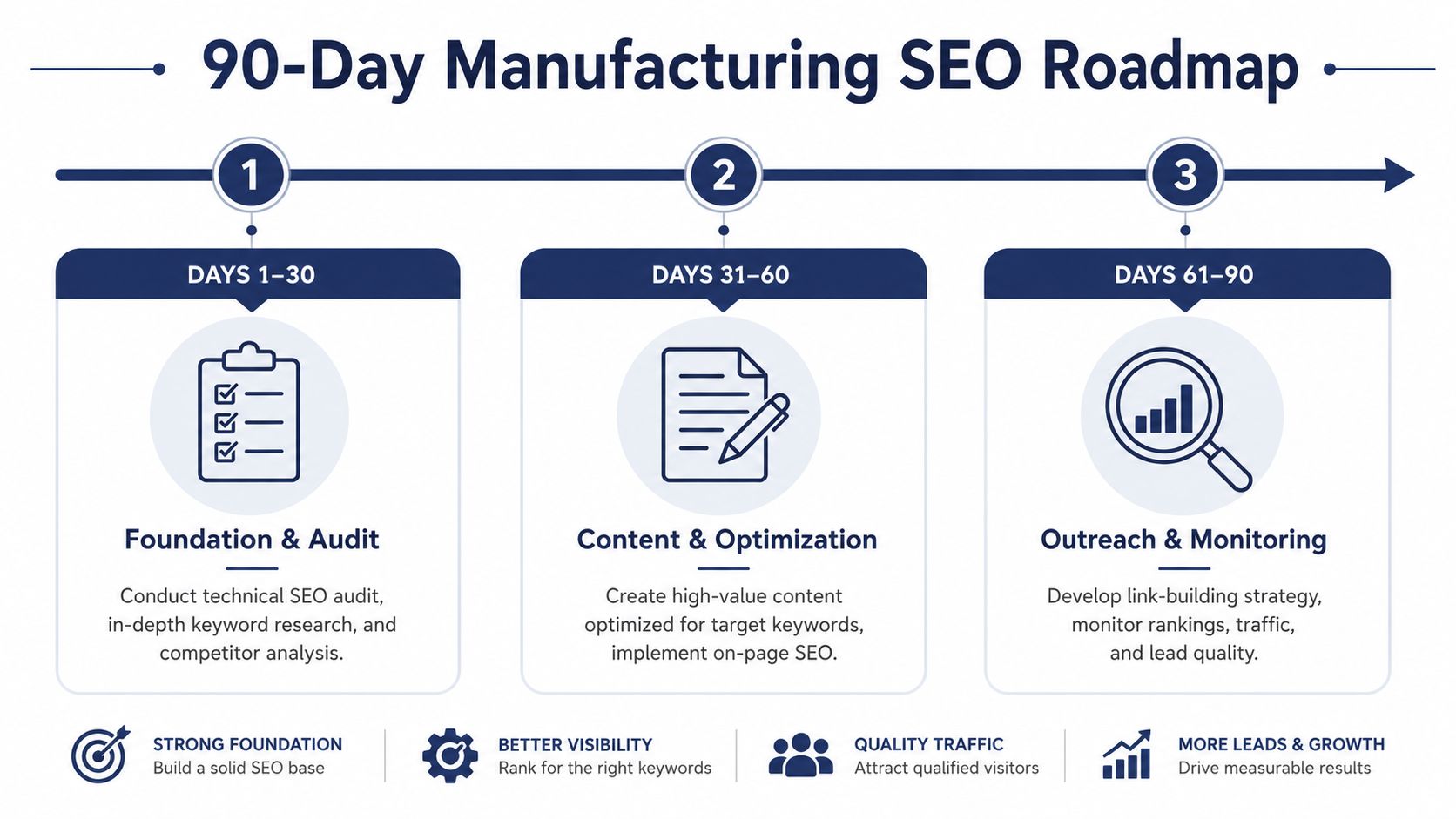
SEO plans fail when they stay theoretical. A manufacturer needs a short operating cycle with tasks, owners, and review points. Ninety days is enough time to fix obvious defects, publish high-intent assets, and start tracking whether the work produces qualified leads.
Days 1 through 30
The first month is for diagnosis and structural repair. Don't jump straight into publishing new content if the site architecture and measurement are weak.
Priorities for this phase:
- Run a crawl with Screaming Frog and review Search Console coverage.
- Identify high-value pages with crawl, duplication, metadata, speed, or internal-link issues.
- Audit forms and conversion paths on product, application, and contact pages.
- Build buyer-intent keyword clusters for product, use case, FAQ, and local page families.
- Set up analytics events and CRM field mapping for form submissions and key downloads.
The most common mistake in this phase is trying to "do SEO" everywhere at once. Pick a narrow set of commercially important pages first.
Days 31 through 60
The second month, dedicated to content and on-page improvement, involves rewriting thin pages and publishing the supporting assets that reduce buyer hesitation.
Focus on a manageable production sprint:
- Upgrade priority product pages: Add specs, documents, FAQs, and clearer CTAs.
- Launch application pages: Build pages around industries and use cases your sales team already knows convert well.
- Add technical FAQs: Answer recurring pre-sales questions in concise, structured language.
- Tighten page structure: Improve title tags, headings, internal links, and canonical targeting.
A useful internal checkpoint is simple. Ask sales whether the updated pages answer the questions prospects keep repeating. If they don't, the content still isn't doing enough.
Days 61 through 90
The third month shifts from internal fixes to authority and feedback loops. By now, the site should be easier to crawl, easier to understand, and more useful to buyers. Next, improve trust signals and review lead quality.
Complete these tasks:
- Start targeted outreach: Trade publications, partner sites, directories, and association profiles.
- Standardize citations: Align company details across the site and external profiles.
- Review CRM lead quality: Compare organic leads by landing page, qualification status, and sales outcome.
- Refine follow-up automation: Route quote requests differently from general inquiries. Trigger relevant email or task sequences based on page intent.
- Build the next sprint list: Keep only the actions tied to qualified pipeline growth.
A simple operating model for GoHighLevel or a similar CRM looks like this:
| Trigger | CRM action | Business reason |
|---|---|---|
| Product page quote form | Assign to sales and create immediate task | High-intent inquiry needs speed |
| Spec sheet download | Start technical nurture sequence | Buyer may still be validating fit |
| Application page inquiry | Tag by industry and route by segment | Improves sales context |
| Repeat visits to proof content | Flag for follow-up | Signals evaluation activity |
By the end of ninety days, you should have more than a cleaner website. You should have a repeatable manufacturing website SEO system. One that identifies defects, publishes buyer-intent content, captures useful lead data, and shows which pages contribute to revenue conversations.
If you want a second set of eyes on your manufacturing website SEO system, Machine Marketing can help diagnose where rankings, content, CRM tracking, and lead quality are disconnecting. The useful next step is a practical review of your current site, your conversion paths, and the pages that should be generating qualified opportunities but aren't.